


EN ISO 13503-5:2006
(Main)Petroleum and natural gas industries - Completion fluids and materials - Part 5: Procedures for measuring the long-term conductivity of proppants (ISO 13503-5:2006)
Petroleum and natural gas industries - Completion fluids and materials - Part 5: Procedures for measuring the long-term conductivity of proppants (ISO 13503-5:2006)
ISO 13503-5:2006 provides standard testing procedures for evaluating proppants used in hydraulic fracturing and gravel packing operations. ISO 13503-5:2006 provides a consistent methodology for testing performed on hydraulic fracturing and/or gravel packing proppants. The "proppants" mentioned henceforth in this part of ISO 13503-5:2006 refer to sand, ceramic media, resin-coated proppants, gravel packing media, and other materials used for hydraulic fracturing and gravel-packing operations.
ISO 13503-5:2006 is not applicable for use in obtaining absolute values of proppant pack conductivities under downhole reservoir conditions.
Erdöl- und Erdgasindustrie - Komplettierungsflüssigkeiten und Materialien - Teil 5: Verfahren zur Messung der Langzeitleitfähigkeit von Stützmaterialien (ISO 13503-5:2006)
Industries du pétrole et du gaz naturel - Fluides de complétion et matériaux - Partie 5: Modes opératoires pour mesurer la conductivité à long terme des agents de soutènement (ISO 13503-5:2006)
L'ISO 13503-5:2006 fournit des modes opératoires d'essais normalisés pour l'évaluation des agents de soutènement utilisés dans les opérations de fracturation hydraulique et de gravillonnage.
L'ISO 13503-5:2006 est de fournir une méthodologie cohérente d'essai des agents de soutènement utilisés pour les opérations de fracturation hydraulique et/ou de remplissage de gravier. Il n'est pas prévu qu'elle soit utilisée pour déduire des valeurs absolues de conductivités de matériaux de soutènement dans des conditions de fond.
Industrija za predelavo nafte in zemeljskega plina - Tekočine in materiali za zaključna dela - 5. del: Postopki za merjenje dolgoročne prevodnosti podpornih materialov (ISO 13503-5:2006)
General Information
- Status
- Published
- Publication Date
- 30-Jun-2006
- Withdrawal Date
- 30-Jan-2007
- Technical Committee
- CEN/TC 12 - Materials, equipment and offshore structures for petroleum and natural gas industries
- Drafting Committee
- ISO/TC 67 - ISO/TC 67
- Current Stage
- 6060 - Definitive text made available (DAV) - Publishing
- Start Date
- 01-Jul-2006
- Due Date
- 12-Jul-2007
- Completion Date
- 01-Jul-2006
Overview
EN ISO 13503-5:2006 (CEN adoption of ISO 13503-5:2006) defines standardized laboratory procedures for measuring the long-term conductivity of proppants used in hydraulic fracturing and gravel-packing operations. The standard establishes consistent test methods for proppant materials - including sand, ceramic media, resin-coated proppants and gravel-pack media - to enable repeatable comparisons of proppant pack permeability and conductivity under controlled laboratory conditions.
Note: the standard explicitly states these laboratory tests are not intended to provide absolute proppant pack conductivity values under downhole reservoir conditions.
Key topics and technical requirements
- Scope & objective: Provide a consistent methodology for long-term proppant conductivity evaluation rather than downhole-absolute values.
- Test apparatus and setup: Requirements for test units, hydraulic load frames, pack width measurement devices, fluid drive systems and differential pressure transducers.
- Test fluids & materials: Specification and handling of test fluids, and use of reference media (e.g., sandstone) where applicable.
- Environmental control: Temperature control, oxygen removal, and silica saturation monitoring to reproduce long-term chemical conditions.
- Calibration & leak testing: Procedures for calibrating pressure indicators, flow rates, pack width measurements and leak verification of systems.
- Cell loading and press procedures: Stepwise methods for preparing, loading and compressing proppant cells in the press.
- Data acquisition & calculations: Methods for collecting flow/pressure data and calculating permeability and conductivity (fracture width × permeability).
- Reporting & annexes: Required data reporting elements and informative/normative annexes (conversion factors; silica-saturation vessel setup; figures and bibliography).
Practical applications and users
EN ISO 13503-5:2006 is primarily used by:
- Petroleum and completion engineers comparing proppant performance for hydraulic fracturing and gravel packing
- Laboratory technicians and test facilities performing proppant qualification and QA/QC
- Proppant manufacturers validating product conductivity characteristics
- R&D groups assessing the long-term stability and degradation of proppant packs
Typical uses include comparative material selection, quality control testing, and research into factors affecting long-term pack conductivity (e.g., temperature, cyclic stress, embedment, fracturing-fluid residues, formation fines).
Related standards
EN ISO 13503 is a multi-part series on completion fluids and materials. Part 5 complements other parts (e.g., Parts 1–4) that cover viscous properties, proppant properties, heavy brines and leakoff testing. Users should consult the other ISO 13503 parts and referenced industry guidance (API/ASTM documents) for a complete test and evaluation framework.
Keywords: EN ISO 13503-5:2006, ISO 13503-5, proppant long-term conductivity, hydraulic fracturing testing, gravel packing, proppant pack conductivity, laboratory procedures.


Frequently Asked Questions
EN ISO 13503-5:2006 is a standard published by the European Committee for Standardization (CEN). Its full title is "Petroleum and natural gas industries - Completion fluids and materials - Part 5: Procedures for measuring the long-term conductivity of proppants (ISO 13503-5:2006)". This standard covers: ISO 13503-5:2006 provides standard testing procedures for evaluating proppants used in hydraulic fracturing and gravel packing operations. ISO 13503-5:2006 provides a consistent methodology for testing performed on hydraulic fracturing and/or gravel packing proppants. The "proppants" mentioned henceforth in this part of ISO 13503-5:2006 refer to sand, ceramic media, resin-coated proppants, gravel packing media, and other materials used for hydraulic fracturing and gravel-packing operations. ISO 13503-5:2006 is not applicable for use in obtaining absolute values of proppant pack conductivities under downhole reservoir conditions.
ISO 13503-5:2006 provides standard testing procedures for evaluating proppants used in hydraulic fracturing and gravel packing operations. ISO 13503-5:2006 provides a consistent methodology for testing performed on hydraulic fracturing and/or gravel packing proppants. The "proppants" mentioned henceforth in this part of ISO 13503-5:2006 refer to sand, ceramic media, resin-coated proppants, gravel packing media, and other materials used for hydraulic fracturing and gravel-packing operations. ISO 13503-5:2006 is not applicable for use in obtaining absolute values of proppant pack conductivities under downhole reservoir conditions.
EN ISO 13503-5:2006 is classified under the following ICS (International Classification for Standards) categories: 75.100 - Lubricants, industrial oils and related products. The ICS classification helps identify the subject area and facilitates finding related standards.
You can purchase EN ISO 13503-5:2006 directly from iTeh Standards. The document is available in PDF format and is delivered instantly after payment. Add the standard to your cart and complete the secure checkout process. iTeh Standards is an authorized distributor of CEN standards.
Standards Content (Sample)
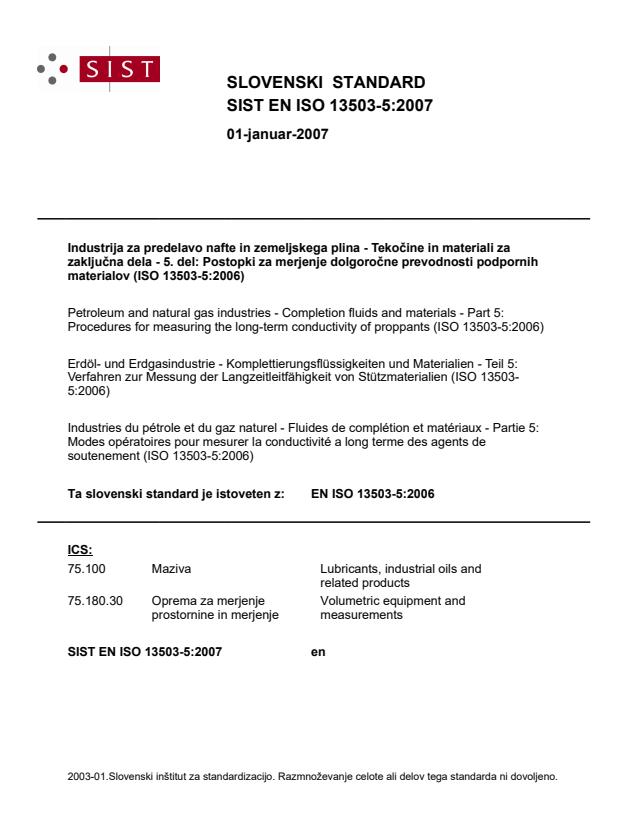
SLOVENSKI STANDARD
01-januar-2007
Industrija za predelavo nafte in zemeljskega plina - Tekočine in materiali za
zaključna dela - 5. del: Postopki za merjenje dolgoročne prevodnosti podpornih
materialov (ISO 13503-5:2006)
Petroleum and natural gas industries - Completion fluids and materials - Part 5:
Procedures for measuring the long-term conductivity of proppants (ISO 13503-5:2006)
Erdöl- und Erdgasindustrie - Komplettierungsflüssigkeiten und Materialien - Teil 5:
Verfahren zur Messung der Langzeitleitfähigkeit von Stützmaterialien (ISO 13503-
5:2006)
Industries du pétrole et du gaz naturel - Fluides de complétion et matériaux - Partie 5:
Modes opératoires pour mesurer la conductivité a long terme des agents de
soutenement (ISO 13503-5:2006)
Ta slovenski standard je istoveten z: EN ISO 13503-5:2006
ICS:
75.100 Maziva Lubricants, industrial oils and
related products
75.180.30 Oprema za merjenje Volumetric equipment and
prostornine in merjenje measurements
2003-01.Slovenski inštitut za standardizacijo. Razmnoževanje celote ali delov tega standarda ni dovoljeno.
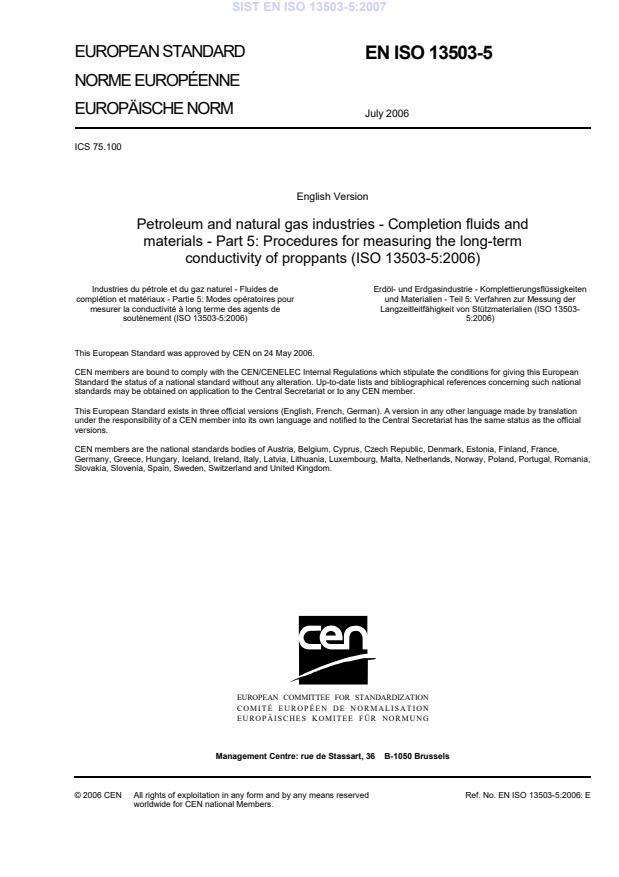
EUROPEAN STANDARD
EN ISO 13503-5
NORME EUROPÉENNE
EUROPÄISCHE NORM
July 2006
ICS 75.100
English Version
Petroleum and natural gas industries - Completion fluids and
materials - Part 5: Procedures for measuring the long-term
conductivity of proppants (ISO 13503-5:2006)
Industries du pétrole et du gaz naturel - Fluides de Erdöl- und Erdgasindustrie - Komplettierungsflüssigkeiten
complétion et matériaux - Partie 5: Modes opératoires pour und Materialien - Teil 5: Verfahren zur Messung der
mesurer la conductivité à long terme des agents de Langzeitleitfähigkeit von Stützmaterialien (ISO 13503-
soutènement (ISO 13503-5:2006) 5:2006)
This European Standard was approved by CEN on 24 May 2006.
CEN members are bound to comply with the CEN/CENELEC Internal Regulations which stipulate the conditions for giving this European
Standard the status of a national standard without any alteration. Up-to-date lists and bibliographical references concerning such national
standards may be obtained on application to the Central Secretariat or to any CEN member.
This European Standard exists in three official versions (English, French, German). A version in any other language made by translation
under the responsibility of a CEN member into its own language and notified to the Central Secretariat has the same status as the official
versions.
CEN members are the national standards bodies of Austria, Belgium, Cyprus, Czech Republic, Denmark, Estonia, Finland, France,
Germany, Greece, Hungary, Iceland, Ireland, Italy, Latvia, Lithuania, Luxembourg, Malta, Netherlands, Norway, Poland, Portugal, Romania,
Slovakia, Slovenia, Spain, Sweden, Switzerland and United Kingdom.
EUROPEAN COMMITTEE FOR STANDARDIZATION
COMITÉ EUROPÉEN DE NORMALISATION
EUROPÄISCHES KOMITEE FÜR NORMUNG
Management Centre: rue de Stassart, 36 B-1050 Brussels
© 2006 CEN All rights of exploitation in any form and by any means reserved Ref. No. EN ISO 13503-5:2006: E
worldwide for CEN national Members.
Foreword
This document (EN ISO 13503-5:2006) has been prepared by Technical Committee ISO/TC 67
"Materials, equipment and offshore structures for petroleum and natural gas industries" in
collaboration with Technical Committee CEN/TC 12 "Materials, equipment and offshore
structures for petroleum, petrochemical and natural gas industries", the secretariat of which is
held by AFNOR.
This European Standard shall be given the status of a national standard, either by publication of
an identical text or by endorsement, at the latest by January 2007, and conflicting national
standards shall be withdrawn at the latest by January 2007.
According to the CEN/CENELEC Internal Regulations, the national standards organizations of
the following countries are bound to implement this European Standard: Austria, Belgium,
Cyprus, Czech Republic, Denmark, Estonia, Finland, France, Germany, Greece, Hungary,
Iceland, Ireland, Italy, Latvia, Lithuania, Luxembourg, Malta, Netherlands, Norway, Poland,
Portugal, Romania, Slovakia, Slovenia, Spain, Sweden, Switzerland and United Kingdom.
Endorsement notice
The text of ISO 13503-5:2006 has been approved by CEN as EN ISO 13503-5:2006 without any
modifications.
INTERNATIONAL ISO
STANDARD 13503-5
First edition
2006-07-01
Petroleum and natural gas industries —
Completion fluids and materials —
Part 5:
Procedures for measuring the long-term
conductivity of proppants
Industries du pétrole et du gaz naturel — Fluides de complétion et
matériaux —
Partie 5: Modes opératoires pour mesurer la conductivité à long terme
des agents de soutènement
Reference number
ISO 13503-5:2006(E)
©
ISO 2006
ISO 13503-5:2006(E)
PDF disclaimer
This PDF file may contain embedded typefaces. In accordance with Adobe's licensing policy, this file may be printed or viewed but
shall not be edited unless the typefaces which are embedded are licensed to and installed on the computer performing the editing. In
downloading this file, parties accept therein the responsibility of not infringing Adobe's licensing policy. The ISO Central Secretariat
accepts no liability in this area.
Adobe is a trademark of Adobe Systems Incorporated.
Details of the software products used to create this PDF file can be found in the General Info relative to the file; the PDF-creation
parameters were optimized for printing. Every care has been taken to ensure that the file is suitable for use by ISO member bodies. In
the unlikely event that a problem relating to it is found, please inform the Central Secretariat at the address given below.
© ISO 2006
All rights reserved. Unless otherwise specified, no part of this publication may be reproduced or utilized in any form or by any means,
electronic or mechanical, including photocopying and microfilm, without permission in writing from either ISO at the address below or
ISO's member body in the country of the requester.
ISO copyright office
Case postale 56 • CH-1211 Geneva 20
Tel. + 41 22 749 01 11
Fax + 41 22 749 09 47
E-mail copyright@iso.org
Web www.iso.org
Published in Switzerland
ii © ISO 2006 – All rights reserved
ISO 13503-5:2006(E)
Contents Page
Foreword. iv
Introduction . v
1 Scope . 1
2 Normative reference . 1
3 Terms and definitions. 1
4 Abbreviations . 2
5 Procedures for evaluating long-term proppant pack conductivity . 2
5.1 Objective. 2
5.2 Discussion. 2
6 Reagents and materials . 3
6.1 Test fluid . 3
6.2 Sandstone. 3
7 Long-term conductivity test apparatus . 3
7.1 Test unit . 3
7.2 Hydraulic load frame . 3
7.3 Pack width measurement device(s). 3
7.4 Test fluid drive system. 3
7.5 Differential pressure transducers . 4
7.6 Back-pressure regulators . 4
7.7 Balance . 4
7.8 Oxygen removal. 4
7.9 Temperature control. 4
7.10 Silica saturation and monitoring. 5
8 Equipment calibration . 5
8.1 Pressure indicators and flow rates. 5
8.2 Zero pack width measurement . 5
8.3 Determination of cell width. 6
8.4 Hydraulic load frame . 6
9 Leak tests . 6
9.1 Hydraulic load frame . 6
9.2 Test fluid system. 6
10 Procedure for loading the cells . 6
10.1 Preparation of the test unit . 6
10.2 Cell setup. 7
11 Loading cell(s) in the press . 9
12 Acquiring data. 9
13 Calculation of permeability and conductivity . 10
14 Data reporting . 11
Annex A (informative) Conversion factors . 12
Annex B (normative) Silica-saturation vessel setup . 13
Annex C (informative) Figures .15
Bibliography . 24
ISO 13503-5:2006(E)
Foreword
ISO (the International Organization for Standardization) is a worldwide federation of national standards bodies
(ISO member bodies). The work of preparing International Standards is normally carried out through ISO
technical committees. Each member body interested in a subject for which a technical committee has been
established has the right to be represented on that committee. International organizations, governmental and
non-governmental, in liaison with ISO, also take part in the work. ISO collaborates closely with the
International Electrotechnical Commission (IEC) on all matters of electrotechnical standardization.
International Standards are drafted in accordance with the rules given in the ISO/IEC Directives, Part 2.
The main task of technical committees is to prepare International Standards. Draft International Standards
adopted by the technical committees are circulated to the member bodies for voting. Publication as an
International Standard requires approval by at least 75 % of the member bodies casting a vote.
Attention is drawn to the possibility that some of the elements of this document may be the subject of patent
rights. ISO shall not be held responsible for identifying any or all such patent rights.
ISO 13503-5 was prepared by Technical Committee ISO/TC 67, Materials. equipment and offshore structures
for petroleum, petrochemical and natural gas industries, Subcommittee SC 3, Drilling and completion fluids,
and well cements.
ISO 13503 consists of the following parts, under the general title Petroleum and natural gas industries —
Completion fluids and materials:
⎯ Part 1: Measurement of viscous properties of completion fluids
⎯ Part 2: Measurement of properties of proppants used in hydraulic fracturing and gravel-packing
operations
⎯ Part 3: Testing of heavy brines
⎯ Part 4: Procedure for measuring stimulation and gravelpack fluid leakoff under static conditions
⎯ Part 5: Procedures for measuring the long-term conductivity of proppants
iv © ISO 2006 – All rights reserved
ISO 13503-5:2006(E)
Introduction
[1]
This part of ISO 13503 is largely based on API RP 61 . Informative references are also included in the
Biblography, References [2] to [15].
The tests and test apparatus herein have been developed to establish standard procedures and conditions for
use in evaluating the long-term conductivity of various hydraulic fracture proppant materials under laboratory
conditions. This procedure enables users to compare the conductivity characteristics under the specifically
described test conditions. The test results can aid users in comparing proppant materials for use in hydraulic
fracturing operations.
The procedures presented in this publication are not intended to inhibit the development of new technology,
materials improvements, or improved operational procedures. Qualified engineering analysis and sound
judgment is required for their application to fit a specific situation.
This part of ISO 13503 may be used by anyone desiring to do so. Every effort has been made by ISO and API
to ensure the accuracy and reliability of the data contained in it. However, ISO and API make no
representation, warranty, or guarantee in connection with this part of ISO 13503, and hereby expressly
disclaim any liability or responsibility for loss or damage resulting from its use or for the violation of any federal,
state, or municipal regulation with which this part of ISO may conflict.
In this part of ISO 13503, where practical, U.S. customary units are included in parentheses for information.
INTERNATIONAL STANDARD ISO 13503-5:2006(E)
Petroleum and natural gas industries — Completion fluids and
materials —
Part 5:
Procedures for measuring the long-term conductivity of
proppants
CAUTION — The testing procedures in this part of ISO 13503 are not designed to provide absolute
values of proppant conductivity under downhole reservoir conditions. Long-term test data have
shown that time, elevated temperatures, fracturing fluid residues, cyclic stress loading, embedment,
formation fines and other factors further reduce fracture proppant pack conductivity. Also, this
reference test is designed to measure only the frictional energy losses corresponding to laminar flow
within a pack. It is recognized that fluid velocity within an actual fracture can be significantly higher
than in these laboratory tests, and can be dominated by inertial effects.
1 Scope
This part of ISO 13503 provides standard testing procedures for evaluating proppants used in hydraulic
fracturing and gravel-packing operations.
NOTE The “proppants” mentioned henceforth in this part of ISO 13503 refer to sand, ceramic media, resin-coated
proppants, gravel packing media, and other materials used for hydraulic fracturing and gravel-packing operations.
The objective of this part of ISO 13503 is to provide consistent methodology for testing performed on
hydraulic-fracturing and/or gravel-packing proppants. It is not intended for use in obtaining absolute values of
proppant pack conductivities under downhole reservoir conditions.
2 Normative reference
The following referenced document is indispensable for the application of this document. For dated references,
only the edition cited applies. For undated references, the latest edition of the referenced standard (including
any amendments) applies.
ISO 3506-1, Mechanical properties of corrosion-resistant stainless-steel fasteners — Part 1: Bolts, screws and
studs
3 Terms and definitions
3.1
conductivity
width of the fracture multiplied by the permeability of the proppant pack
3.2
laminar flow
type of streamlined flow for single-phase fluids in which the fluid moves in parallel layers, or laminae, such that
the layers flow smoothly over each other with instabilities being dampened by the viscosity
ISO 13503-5:2006(E)
3.3
Ohio sandstone
fine-grained sandstone found in the United States from the Scioto Formation in southern Ohio
3.4
permeability
a measure of the ability of media to transmit fluid through pore spaces
4 Abbreviations
API American Petroleum Institute
ASTM American Society for Testing and Materials
RTV Room temperature vulcanizing
ANSI American National Standards Institute
PID Proportional-integral device
5 Procedures for evaluating long-term proppant pack conductivity
5.1 Objective
The objective is to establish a standard test procedure, using a standard apparatus, under standard test
conditions to evaluate the long-term conductivity of proppants under laboratory conditions. This procedure is
used to evaluate the conductivity of proppants under laboratory conditions but is not intended for use in
obtaining absolute values of proppant pack conductivities under downhole reservoir conditions. The effects of
fines, formation hardness, resident fluids, time, and/or other factors are beyond the scope of this procedure.
5.2 Discussion
In this part of ISO 13503 procedure, a closure stress is applied across a test unit for 50 h ± 2 h to allow the
proppant sample bed to reach a semi-steady state condition. As the fluid is forced through the proppant bed,
the proppant pack width, differential pressure, temperature and flow rates are measured at each stress level.
Proppant pack permeability and conductivity are calculated.
Multiple flow rates are used to verify the performance of the transducers, and to determine darcy flow regime
at each stress; an average of the data at these flow rates is reported. A minimum pressure drop of 0,01 kPa
(0,002 0 psi) is recommended; otherwise, flow rates shall be increased. At stipulated flow rates and
temperature conditions, no appreciable non-darcy flow or inertial effects are encountered. After completing the
rates at a closure stress level in all cells, the closure stress is increased to a new level; 50 h ± 2 h is allowed
for the proppant bed to reach a semi-steady state condition, and multiple flow rates in all cells are introduced
to gather data required to determine proppant pack conductivity at this stress level. The procedure is repeated
until all desired closure stresses and flow rates have been evaluated. To achieve accurate conductivity
measurements, it is essential that single-phase flow occurs.
Test condition parameters, such as test fluid, temperature, loading, sandstone and time, at each stress shall
be reported along with long-term conductivity and permeability data. Other conditions can be used to evaluate
different characteristics of proppants and, therefore, can be expected to produce differing results.
2 © ISO 2006 – All rights reserved
ISO 13503-5:2006(E)
6 Reagents and materials
6.1 Test fluid
The test fluid is 2 % by mass potassium chloride (KCl) in a deionized or distilled-water solution filtered to at
least 7 µm. The potassium chloride shall be at least 99,0 % by mass pure.
6.2 Sandstone
Ohio sandstone cores should have dimensions of 17,70 cm to 17,78 cm (6,96 in to 7,00 in) in length, 3,71 cm
to 3,81 cm (1,46 in to 1,50 in) wide, and a minimum of 0,9 cm (0,35 in) thick. The ends of the sandstone cores
shall be rounded to fit into the test unit (see 7.1). Parallel thickness shall be maintained within ± 0,008 cm
(± 0,003 in).
7 Long-term conductivity test apparatus
7.1 Test unit
2 2
The test unit shall be a linear flow design with a 64,5 cm (10 in ) proppant and bed area. Figure C.1
illustrates the details of the test unit and an example of how cells can be stacked. The pistons and test
1)
chamber(s) shall be constructed of 316 stainless steel (e.g. ISO 3506-1, Grade A4), Monel or Hastalloy
material. Filters for the test unit may be constructed using Monel wire cloth with an opening of 150 µm or
equivalent (100 US mesh). Nominal particle retention sizes are greater than 114 µm.
7.2 Hydraulic load frame
The hydraulic load frame shall have sufficient capacity to develop 667 kN (150 000 lbf). To ensure uniform
stress distribution, the platens shall be parallel to each other. It is recommended that the hydraulic load frame
be of a four-post design that minimizes warping that can be transmitted to the test cell. Each post should have
a minimum diameter of 6,35 cm (2,5 in).
The hydraulic pressurization source shall be capable of holding any desired closure stress [± 1,0 % or
345 kPa (50 psi), whichever is greater] for 50 h. The hydraulic load frame shall be capable of loading rate
2 2
changes of 4 448 N/min (1 000 lbf/min) or 690 kPa/min (100 psi/min) on a 64,5 cm (10 in ) cell. A calibrated
electronic load cell shall be used to calibrate the stress between the hydraulic ram and the opposing platen of
the load frame.
7.3 Pack width measurement device(s)
Pack width measurements shall be made at each end of the test unit. A measuring device capable of
measuring to 0,002 5 cm (0,001 in) accuracy or better shall be used. Figure C.4 shows an example of width
slats allowing for the measurement of pack widths.
7.4 Test fluid drive system
Some constant-flow-rate pumps (e.g. chromatographic pumps) have been found satisfactory for this
application. Pulsation dampening can be necessary and can be accomplished by use of a piston, bladder
accumulator or other effective means. Pressure fluctuations during differential pressure and flow rate
measurements (for conductivity calculations) shall be maintained at less than 1,0 %. Each laboratory shall
determine the best technique for pulsation dampening. Large pressure spikes can be indicative of pump
problems or trapped gas in the flow system and shall be corrected before recording data.
1) Monel and Hastalloy are examples of suitable products available commercially. This information is given for the
convenience of users of this part of ISO 13503 and does not constitute an endorsement by ISO of this product.
ISO 13503-5:2006(E)
7.5 Differential pressure transducers
Differential pressure transducers with a range of 0 kPa to 7 kPa (0 psi to 1,0 psi) are satisfactory. The
transducer shall be capable of measuring the differential pressure to ± 0,1 % of full scale.
7.6 Back-pressure regulators
The back-pressure regulator shall be capable of maintaining a pressure of 2,07 MPa to 3,45 MPa (300 psi to
500 psi). The stress applied to the cells shall take into account the back-pressure. For example, if the back-
pressure is 3,45 MPa (500 psi), then the applied stress shall be 3,45 MPa (500 psi) greater to take into
account the pressure exerted outward from the pistons.
7.7 Balance
The balance shall be capable of accommodating a minimum capacity of 100 g with a precision greater than
0,01 g.
7.8 Oxygen removal
The conductivity test fluid shall have the oxygen content reduced to simulate reservoir fluids and to minimize
corrosion of test equipment. De-oxygenation can be accomplished with a two-reservoir system for the fluid.
The first reservoir holds fluid for oxygen removal. This is connected to nitrogen gas that is bubbled through the
fluid at low pressure below 103 kPa (15 psi) and at low rate. The nitrogen supply is first passed through an
2)
oxygen/moisture trap such as Agilent Model OT3-4 that has an efficiency to remove oxygen to less than
15 µg/l. An equivalent system can be made; this system allows nitrogen to pass through heated copper
shavings at 370 °C (698 °F), where the copper reacts with the trace amounts of oxygen in the system forming
3)
copper oxide. An indicating trap, such as the oxygen trap by Chrom Tech, Inc. part # 10T-4-HP , after the
oxygen-removal process allows for visual confirmation that oxygen has been removed. When the visual
indicating trap is oxygen-saturated, both traps shall be replaced to maintain the efficiency of oxygen removal.
The second reservoir holds the oxygen-free fluid; this is the supply reservoir for the pumping system.
All fluids in each reservoir are held in sealed, inert-gas pressurized containers to eliminate oxygen
contamination from the air.
7.9 Temperature control
The test cell and proppant pack shall be maintained at the desired temperature ± 1 °C (± 3 °F). The
temperature for the test conditions is measured in the temperature port of the conductivity cell (Figure C.1).
This temperature is used to determine the fluid viscosity from Table C.1. The thermocouple assembly is split
into a temperature-control device and a data-acquisition system or equivalent. The temperature control
devices shall be programmable PID controllers and capable of self-tuning for different temperature conditions
and flow rates.
A temperature of 121 °C (250 °F) is employed in the test for ceramics and resin-coated proppants and 66 °C
(150 °F) for naturally occurring sands. The temperature for the silica-saturation vessel (see Annex B) should
be 11 °C (20 °F) above testing temperature of 66 °C (150 °F) for naturally occurring sands. Sand 20 °C
(35 °F) above 121 °C (250 °F) is used for resin-coated and ceramic proppants to ensure that the fluid is
saturated with silica prior to reaching the cell. Care shall be taken to ensure that the fluid arriving to the cell is
at the appropriate temperature. Tests using other fluids or temperatures can be of value in evaluating
proppant pack conductivity.
2) Agilent Model OT3-4 is an example of a suitable product available commercially. This information is given for the
convenience of users of this part of ISO 13503 and does not constitute an endorsement by ISO of this product.
3) Chrom Tech, Inc. part # 10T-4-HP is an example of a suitable product available commercially. This information is
given for the convenience of users of this part of ISO 13503 and does not constitute an endorsement by ISO of this
product.
4 © ISO 2006 – All rights reserved
ISO 13503-5:2006(E)
7.10 Silica saturation and monitoring
It is critical to have a silica-saturated solution flowing through the proppant pack to prevent dissolution of the
Ohio sandstone and proppant. To achieve this, a high-pressure cylinder with a minimum volume of 300 ml per
4)
10 ml/min flow rate capacity, such as a Whitey sample cylinder 316L-HDF4 , or equivalent equipped with
0,635 cm (0,25 in) female pipe ends is needed. For equipment setup, see Annex B.
8 Equipment calibration
8.1 Pressure indicators and flow rates
Pressure indicators in the test fluid-flow stream with back-pressure applied shall be calibrated initially and
rechecked before each test. Constant-flow-rate pumps shall be tested at several flow rates with back-pressure
applied with suitable flow meters, or accurate balance, containers and timing device (stop watch). High- and
low-pressure transducers shall be zeroed before each run. Use only that portion of the transducer range that
is repeatable and linear.
8.2 Zero pack width measurement
8.2.1 Purpose
To accurately measure the width of the proppant pack, the variations in sandstone thickness, the
compressibility of sandstone and the compression and thermal expansion of the metal shall be taken into
account.
8.2.2 Procedure
8.2.2.1 Using callipers, measure and record the thickness of the cores and metal shims. Mark the width
of the core on the face of the core with a pencil. Two cores are placed in each cell. Match the cores so that the
combined thickness of the ends of the cores is the same. Cores that measure more than 0,008 cm (0,003 in)
from parallel shall not be used. If the bottom core is different from end to end, then the top core shall offset
this difference, so the total core thickness at each end is identical.
8.2.2.2 A width adjustment factor or zero pack width shall be calculated at each closure stress and at
temperature to be tested for each cell and for each lot of Ohio sandstone and square rings. Measure the
vertical dimension of the complete test unit [± 0,002 5 cm (± 0,001 in)] equipped with pistons, square rings,
shims and sandstone cores, but without proppant, at each test closure stress level and temperature where the
proppant will be tested. For each test, measure an initial zero width by measuring the vertical dimension of the
pistons, shims and sandstone cores. This value is subtracted from the measured equipment and proppant
values to obtain the actual width of the proppant pack.
8.2.2.2.3 Pistons for the baseline cell(s) shall be marked in the order in which they are stacked. Place the
two matched sandstone cores in the cell and, if applicable, continue stacking the cells as in Figure C.1.
8.2.2.2.4 Heat the cells to the temperature at which the test will be run. Ramp closure stress at a rate of
689 kPa/min
...
La norme EN ISO 13503-5:2006, intitulée "Industries pétrolières et gazières - Fluides et matériaux de mise en production - Partie 5 : Procédures pour mesurer la conductivité à long terme des proppants", fournit des procédures d'essai standardisées pour l'évaluation des proppants utilisés dans les opérations de fracturation hydraulique et de mise en graviers. Cette norme est essentielle pour garantir la fiabilité et la sécurité des processus d'exploitation dans le secteur énergétique. L'un des principaux atouts de la norme ISO 13503-5:2006 est sa capacité à fournir une méthodologie cohérente pour les tests effectués sur les proppants de fracturation hydraulique et de mise en graviers. En définissant des procédures claires, cette norme permet aux professionnels de s'assurer que les résultats des tests sont comparables et reproductibles, ce qui est crucial dans un environnement où l'efficacité opérationnelle et la prévention des défaillances sont primordiales. Par ailleurs, la norme souligne que les "proppants" concernent des matériaux variés tels que le sable, les médias céramiques, les proppants recouverts de résine et les médias de mise en graviers. Cela démontre la polyvalence de l'application de la norme dans différents contextes opérationnels au sein de l'industrie pétrolière et gazière. Il est important de noter que l'ISO 13503-5:2006 n'est pas applicable pour obtenir des valeurs absolues de conductivité des paquets de proppants dans les conditions de réservoir en profondeur. Cette spécificité limite son utilisation, mais elle garantit que l'application de la norme se concentre sur des tests qui sont fiables et pertinents pour les opérations où les résultats sont exploités dans un cadre de laboratoire ou de simulation. En somme, la norme EN ISO 13503-5:2006 présente des forces indéniables en fournissant un cadre structuré pour l'évaluation des proppants, garantissant ainsi leur performance dans des environnements critiques. Sa pertinence dans le secteur des industries pétrolières et gazières est essentielle pour optimiser l'utilisation de proppants, contribuant à une meilleure gestion des ressources et à l'amélioration des pratiques opérationnelles.
SIST EN ISO 13503-5:2007의 기준은 석유 및 천연 가스 산업에서 사용되는 프로판트의 장기 전도성을 측정하는 절차를 제시합니다. 이 표준은 유압 파쇄 및 자갈 포장 작업에 사용되는 프로판트를 평가하기 위한 일관된 테스트 방법론을 제공하며, 이는 효과적인 유정 개발과 생산 최초의 중요한 요소입니다. ISO 13503-5:2006의 강점 중 하나는 다양한 프로판트 유형(예: 모래, 세라믹 미디어, 수지 코팅 프로판트, 자갈 포장 미디어 등)에 적용 가능한 포괄적인 테스트 절차를 제공한다는 점입니다. 이러한 표준화된 접근법은 실험실 테스트와 현장 응용 프로그램 간의 일관성을 보장하여, 프로판트 성능 평가의 신뢰성을 높입니다. 또한, ISO 13503-5:2006는 프로판트 팩 전도도의 절대 값을 얻는 데 적합하지 않다는 점을 명확히 함으로써, 이 기준이 어떤 한계에서 유용하게 사용될 수 있는지를 명시합니다. 이는 연구자들이 또는 엔지니어들이 해당 테스트 결과를 해석할 때, 보다 정확한 기대치를 설정할 수 있도록 도와줍니다. 결론적으로, SIST EN ISO 13503-5:2007 기준은 프로판트의 장기 전도성을 측정하는 절차의 표준화를 통해 유압 파쇄 및 자갈 포장 기술의 발전에 기여하며, 석유 및 천연 가스 산업에서 중요한 참고 자료로 자리 잡고 있습니다.
EN ISO 13503-5:2006は、石油および天然ガス産業における完成流体と材料に関する重要な標準であり、特に水圧破砕およびグラベルパッキング作業に使用されるプロppantの長期導電性を測定する手順を提供します。この文書は、プロppantの評価に対する一貫した方法論を確立しており、業界内での信頼性の高いデータ取得を可能にします。 この標準の強みは、その明確な範囲と適用性にあります。ISO 13503-5:2006は、砂、セラミックメディア、樹脂コーティングされたプロppant、グラベルパッキングメディアなど、さまざまな材料の試験方法を詳細に規定しており、さまざまな状況におけるプロppant性能の評価に寄与します。また、業界全体での共通理解を促進し、研究開発や実践的な応用において信頼できる基準を提供しています。 ただし、注意点として、ISO 13503-5:2006は地層条件下でのプロppantパック導電性の絶対値取得には適用されないことが明記されています。このため、使用者はこの文書の目的と制限を理解した上で、補完的な手法やデータ源を組み合わせる必要があります。 総じて、EN ISO 13503-5:2006は、プロppantの評価とその性能に関する標準的手順を提供することで、石油および天然ガス産業における水圧破砕およびグラベルパッキングプロセスの最適化に寄与し、業界の技術的向上を支える重要な文書です。
Die Norm EN ISO 13503-5:2006 ist ein wichtiger Standard für die Erdöl- und Erdgasindustrie, der spezifische Prüfverfahren zur Bewertung von Proppants in hydraulischen Frakturierungs- und Schüttungsoperationen bereitstellt. Diese Norm legt eine konsistente Methodologie fest, die es ermöglicht, die langfristige Leitfähigkeit von Proppants zu messen, was für die Effizienz und Sicherheit bei der Anwendung von hydraulischen Frakturen entscheidend ist. Ein wesentlicher Vorteil dieser Norm liegt in der Standardisierung der Testverfahren, die unter verschiedenen Bedingungen und in unterschiedlichen Betrieben angewendet werden können. Dadurch wird sichergestellt, dass die erzielten Ergebnisse vergleichbar und reproduzierbar sind, was für die Entscheidungsfindung und die Optimierung von Prozessen unerlässlich ist. Die klare Definition von Proppants, einschließlich Sand, keramischer Medien, harzbeschichteter Proppants und Schüttmaterialien, erweitert den Anwendungsbereich und die Relevanz der Norm erheblich. Darüber hinaus hebt die Norm hervor, dass sie nicht für die Bestimmung absoluter Werte der Proppant-Pack-Leitfähigkeiten unter reservoirbedingten Bedingungen geeignet ist. Dies betont die Bedeutung, die die Norm für Laborprüfungen hat, und unterstreicht gleichzeitig die Notwendigkeit von ergänzenden Tests unter realen Betriebsbedingungen, um umfassende Daten zu erhalten. Die EN ISO 13503-5:2006 ist somit nicht nur ein unverzichtbares Werkzeug für die Industrie, um getestete Materialien für Frakturierungsanwendungen zu bewerten, sondern bietet auch eine solide Grundlage für die Weiterentwicklung und Forschung im Bereich der Proppants und deren Einsatzmöglichkeiten. Die Relevanz dieses Standards zeigt sich in seiner Anwendung und den daraus gewonnenen Erkenntnissen, die zur Verbesserung der Technologien in der Erdöl- und Erdgasproduktion beitragen können.
The EN ISO 13503-5:2006 standard provides a vital framework for the petroleum and natural gas industries, specifically addressing the procedures for measuring the long-term conductivity of proppants used in hydraulic fracturing and gravel packing operations. This standard serves as a cornerstone for the evaluation of proppants, which include sand, ceramic media, resin-coated proppants, and other materials integral to these processes. One of the primary strengths of ISO 13503-5:2006 is its emphasis on a consistent methodology for testing proppants, ensuring that results can be reliably compared across different studies and applications. This standard details specific testing procedures that allow for the accurate measurement of proppant conductivity, which is crucial for understanding the effectiveness of proppants in maintaining fracture permeability over time. The relevance of EN ISO 13503-5:2006 cannot be overstated in the context of hydraulic fracturing, where the durability and performance of proppants can significantly impact resource extraction efficiency. By establishing a standardized approach, ISO 13503-5:2006 facilitates improved quality assurance and performance benchmarking, which are imperative for operators seeking to optimize their completion strategies and enhance production outcomes. It's also noteworthy that while the standard provides essential guidelines for testing, it clarifies that the procedures outlined are not intended for determining absolute values of proppant pack conductivities under actual downhole reservoir conditions. This specificity helps to delineate the scope of the document, guiding practitioners to apply the standard appropriately and within its intended parameters. In summary, the EN ISO 13503-5:2006 standard is an essential resource for those involved in the evaluation of proppants in hydraulic fracturing and gravel packing, promoting consistency, reliability, and relevance in testing methodologies. Its established procedures contribute significantly to advancements in the efficiency and effectiveness of proppants used in the petroleum and natural gas industries.
Questions, Comments and Discussion
Ask us and Technical Secretary will try to provide an answer. You can facilitate discussion about the standard in here.
Loading comments...