

EN 13075-2:2026
(Main)Bitumens and bituminous binders - Determination of breaking behaviour - Part 2: Determination of fines mixing time of cationic bituminous emulsions
- Abstract
This document specifies a method for the determination of the fines mixing time of diluted cationic bituminous emulsions, under standardized conditions.
WARNING - Use of this document can involve hazardous materials, operations and equipment. This document does not purport to address all of the safety problems associated with its use. It is the responsibility of the user of this document to identify the hazards and assess the risks involved in performing this test method and to implement sufficient control measures to protect individual operators (and the environment). This includes appropriate safety and health practices and determination of the applicability of regulatory limitations prior to use.
- Status
- Published
- Publication Date
- 10-Nov-2026
- Technical Committee
- CEN/TC 336 - Bitumens and bituminous binders
- Drafting Committee
- CEN/TC 336/WG 2 - Fluxed bitumen and bituminous emulsions
- Current Stage
- 6060 - Definitive text made available (DAV) - Publishing
- Start Date
- 11-Nov-2026
- Due Date
- 05-Jul-2027
- Completion Date
- 05-Jul-2027
EN 13075-2 is a CEN document for testing diluted cationic bituminous emulsions. It specifies a laboratory method for determining fines mixing time under standardized conditions, so users can compare how a cationic bituminous emulsion behaves when mineral filler is added and stirring continues until breaking occurs. It is written for testing laboratories, producers, and technical staff who need a repeatable way to judge breaking behaviour.
What does EN 13075-2 specify?
EN 13075-2 specifies a single test method for the fines mixing time of diluted cationic bituminous emulsions. The document also sets out the test principle, the required reagents and apparatus, the sampling route, the procedure, the way to express results, and the test report content.
| Annex | What it covers |
|---|---|
| Annex A (normative) | Characteristics of the reference fillers: Forshammer SE, Q92, and Sikaisol |
The method is organized in Clauses 1 to 11, followed by Annex A and a bibliography. That structure matters in practice because the test depends on controlling the filler, the temperature, the mixing rate, and the end point.
What are the key requirements of EN 13075-2?
EN 13075-2 relies on a tightly controlled laboratory sequence, because the result is the time until the emulsion breaks under specified mixing conditions.
Clause 4, Principle - A specified quantity of filler is added at a uniform rate to a diluted emulsion while stirring. The end point is reached when the mixture becomes pasty, forms lumps that do not stick to the pan walls, and stirring power rises noticeably. In practice, the operator must watch the mixture behaviour, not just the clock.
Clause 5, Reagents and materials - The method uses analytical-grade reagents, grade 3 water, cleaning agents, and one of the reference fillers named in Annex A. In dispute work, the same filler shall be used by the testing laboratories, which keeps results comparable.
Clause 6, Apparatus - The test needs controlled equipment, including an oven at 110 °C, a constant-temperature bath or climatic chamber at 25 °C, a balance, a timer, suitable bottles, and metal spatulas. This matters because the test result depends on temperature control, weighing accuracy, and consistent mixing.
Clause 7, Sampling - The laboratory sample is taken in accordance with EN 58, and the test sample is prepared in accordance with EN 12594. That means the test starts with standardized sampling and sample preparation, not with an arbitrary container of material.
Clause 8, Procedure - The filler is dried to constant mass, the emulsion and water are conditioned for at least 1.5 h, and then 100.0 g of emulsion, 50.0 g of water, and 150 g of filler are combined. The filler is added in portions of 10 g every 5 s while stirring at 1 r/s, so the whole filler charge is introduced within 75 s. If the emulsion does not break within 300 s, the report uses the specified over-limit wording.
Clauses 9 to 11, Results and reporting - Each mixing time is rounded to the nearest integer second, and the final result is the arithmetic mean of two individual results. The report must identify the sample, state the filler used, give the individual values and final result, note deviations and unusual features, and record the test date.
What terms does EN 13075-2 define?
Fines mixing time is the time in seconds until a mixture of mineral filler and bituminous emulsion shows no noticeable breaking effect under the conditions of this method.
Breaking behaviour is the way the diluted cationic bituminous emulsion changes as filler is added and stirring continues until the emulsion breaks.
Reference filler is one of the specified fillers used to make the test repeatable: Forshammer SE, Q92, or Sikaisol.
Laboratory sample is the sample taken for testing in accordance with EN 58.
Test sample is the sample prepared from the laboratory sample in accordance with EN 12594.
Constant mass means the filler has been dried until further drying no longer changes its mass in the sense used by the method.
Who uses EN 13075-2?
EN 13075-2 is used by laboratories that test bitumens and bituminous binders, especially when working with cationic bituminous emulsions. It is also relevant to producers and quality control teams who need to compare products, check batch consistency, or investigate disputes using the same filler and the same procedure. Road binder specialists use it when they need a standardized measure of how quickly an emulsion accepts filler before breaking.
What changed in EN 13075-2 from the previous edition?
The edition that will supersede EN 13075-2:2016 makes four stated changes:
- Clause 5 removes the naming “Caolin” for the Q92 filler.
- Clause 6 revises the apparatus wording and uses the metrological concept of maximal permissible measurement error.
- Annex A revises the reference fillers list and places Sikaisol in third position.
- Paragraph A.2 tightens the particle size distribution envelope of the Q92 filler.
Which standards are used with EN 13075-2?
- EN 58 - sampling bituminous binders for the laboratory sample.
- EN 12594 - preparation of test samples.
- EN 12597 - terminology for bitumens and bituminous binders.
- EN ISO 3696:1995 - grade 3 water for the test.
- EN 933-1 - used for the constant-mass definition in Clause 8 and for particle size distribution in Annex A.
- EN 933-10 - used for the particle size distribution envelope of the Forshammer SE filler in Annex A.
- EN 13075-1 - a related part in the EN 13075 series on breaking behaviour, listed in the bibliography.
What does the EN 13075-2 document contain?
EN 13075-2 contains a complete laboratory method, from sampling and sample conditioning to the final report. It gives the principle of the test, the equipment list, the step-by-step mixing procedure, the rules for calculating and rounding the result, and the reporting items to record. Annex A supplies the filler characteristics and gradation figures needed to keep the method reproducible across laboratories.
Relations
- Effective Date
- 18-Jan-2023
- Effective Date
- 18-Nov-2026
- Effective Date
- 18-Nov-2026
- Effective Date
- 18-Nov-2026
- Effective Date
- 28-Jan-2026
- Effective Date
- 28-Jan-2026
- Effective Date
- 28-Jan-2026
- Effective Date
- 28-Jan-2026
- Effective Date
- 28-Jan-2026
Get Certified
Connect with accredited certification bodies for this standard

DIBt (Deutsches Institut für Bautechnik)
German Institute for Building Technology.

DIN CERTCO
DIN Group product certification.

Element Materials Technology
Materials testing and product certification.
Sponsored listings
Frequently Asked Questions
EN 13075-2:2026 is a draft published by the European Committee for Standardization (CEN). Its full title is "Bitumens and bituminous binders - Determination of breaking behaviour - Part 2: Determination of fines mixing time of cationic bituminous emulsions". This standard covers: This document specifies a method for the determination of the fines mixing time of diluted cationic bituminous emulsions, under standardized conditions. WARNING - Use of this document can involve hazardous materials, operations and equipment. This document does not purport to address all of the safety problems associated with its use. It is the responsibility of the user of this document to identify the hazards and assess the risks involved in performing this test method and to implement sufficient control measures to protect individual operators (and the environment). This includes appropriate safety and health practices and determination of the applicability of regulatory limitations prior to use.
This document specifies a method for the determination of the fines mixing time of diluted cationic bituminous emulsions, under standardized conditions. WARNING - Use of this document can involve hazardous materials, operations and equipment. This document does not purport to address all of the safety problems associated with its use. It is the responsibility of the user of this document to identify the hazards and assess the risks involved in performing this test method and to implement sufficient control measures to protect individual operators (and the environment). This includes appropriate safety and health practices and determination of the applicability of regulatory limitations prior to use.
EN 13075-2:2026 is classified under the following ICS (International Classification for Standards) categories: 75.140 - Waxes, bituminous materials and other petroleum products; 91.100.50 - Binders. Sealing materials. The ICS classification helps identify the subject area and facilitates finding related standards.
EN 13075-2:2026 has the following relationships with other standards: It is inter standard links to EN 13075-2:2016, EN 14733:2005+A1:2010, EN 13108-31:2019, EN 13808:2005, EN 2876:2023, EN 4269:2023, EN 3228:2022, EN 2882:2023, EN 3434:2022. Understanding these relationships helps ensure you are using the most current and applicable version of the standard.
EN 13075-2:2026 is associated with the following European legislation: Standardization Mandates: M/124. When a standard is cited in the Official Journal of the European Union, products manufactured in conformity with it benefit from a presumption of conformity with the essential requirements of the corresponding EU directive or regulation.
EN 13075-2:2026 is available in PDF format for immediate download after purchase. The document can be added to your cart and obtained through the secure checkout process. Digital delivery ensures instant access to the complete standard document.
Standards Content (Sample)
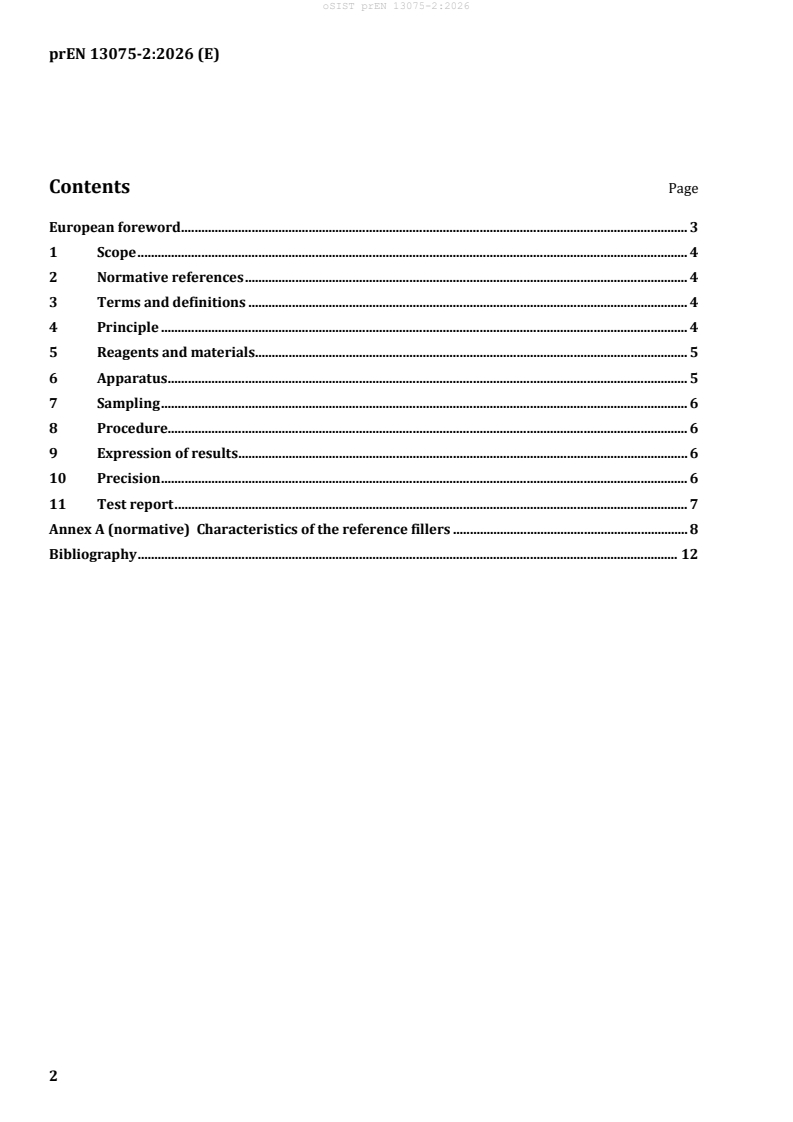
Contents
- 1 Scope
- 2 Normative references
- 3 Terms and definitions
- 3.1 fines mixing time
- 4 Principle
- 5 Reagents and materials
- 6 Apparatus
- 6.5 Timer or stop watch, with a maximal permissible measurement error of ± 0,2 s over a time
- 6.7 Constant temperature bath or climatic chamber, capable of maintaining the sample in the
- 6.8 Balance, capable of weighing up to 1 000 g with a maximal permissible measurement error
- 7 Sampling
- 8 Procedure
- 9 Expression of results
- 10 Precision
- 11 Test report
- Annex A
- 30 TÄBY, Sweden
- Bibliography
1 Scope
This document specifies a method for the determination of the fines mixing time of diluted cationic bituminous emulsions, under standardized conditions.
WARNING — Use of this document can involve hazardous materials, operations and equipment. This document does not purport to address all of the safety problems associated with its use. It is the responsibility of the user of this document to identify the hazards and assess the risks involved in performing this test method and to implement sufficient control measures to protect individual operators (and the environment). This includes appropriate safety and health practices and determination of the applicability of regulatory limitations prior to use.
2 Normative references
The following documents are referred to in the text in such a way that some or all of their content constitutes requirements of this document. For dated references, only the edition cited applies. For undated references, the latest edition of the referenced document (including any amendments) applies. EN 58, Bitumen and bituminous binders — Sampling bituminous binders EN 12594, Bitumens and bituminous binders — Preparation of test samples EN 12597, Bitumens and bituminous binders — Terminology EN ISO 3696:1995, Water for analytical laboratory use — Specification and test methods (ISO 3696:1987)
3 Terms and definitions
For the purposes of this document, the terms and definitions given in EN 12597 and the following apply. ISO and IEC maintain terminology databases for use in standardization at the following addresses:
- ISO Online browsing platform: available at https://www.iso.org/obp
- IEC Electropedia: available at https://www.electropedia.org/
3.1 fines mixing time
time in seconds for the mixability of a mixture of mineral filler and bitumen emulsion without noticeable breaking effect under the conditions specified in this document
4 Principle
A specified quantity of filler is added at a uniform rate, with stirring, to a specified quantity of bituminous emulsion diluted with water. Stirring is continued until the mixture becomes pasty and forms lumps that do not adhere to the walls of the pan. This, combined with a noticeable increase in stirring power indicates the end of mixability. The time to reach this point (breaking status) is the fines mixing time.
oSIST prEN 13075-2:2026 prEN 13075-2:2026 (E)
5 Reagents and materials
Reagents of recognized analytical grade, together with the following shall be used. 5.1 Reference fillers.
1 1 The Forshammer SE filler , the Q92 filler or the Sikaisol filler shall be used as reference fillers and shall comply with the respective characteristics given in Annex A.
In case of dispute, the same filler shall be used by the testing laboratories. 5.2 Water, conforming to grade 3 of EN ISO 3696:1995.
5.3 Cleaning agents, as used conventionally in laboratories.
6 Apparatus
The usual laboratory apparatus and glassware, together with the following shall be used. 6.1 Oven, capable of maintaining a temperature of 110 °C with a maximal permissible measurement error of ± 5 °C.
6.2 Containers, of appropriate capacity for storing and holding the quantities of filler required in Clause 8.
6.3 Spatula, made of nickel or stainless steel, having an approximate length of 20 cm. 6.4 Spatula, spoon shaped for adding filler.
6.5 Timer or stop watch, with a maximal permissible measurement error of ± 0,2 s over a time
interval of 500 s.
6.6 Bottles, for storing the emulsion samples and water, having a capacity of approximately 500 ml, made of a material that will not react with the emulsion and having tight fitting lids.
...