

EN 1793-6:2018
(Main)Road traffic noise reducing devices - Test method for determining the acoustic performance - Part 6: Intrinsic characteristics - In situ values of airborne sound insulation under direct sound field conditions
General Information
- Abstract
This document describes a test method for measuring a quantity representative of the intrinsic characteristics of airborne sound insulation for traffic noise reducing devices: the sound insulation index.
The test method is intended for the following applications:
- determination of the intrinsic characteristics of airborne sound insulation of noise reducing devices to be installed along roads, to be measured either in situ or in laboratory conditions;
- determination of the in situ intrinsic characteristics of airborne sound insulation of noise reducing devices in actual use;
- comparison of design specifications with actual performance data after the completion of the construction work;
- verification of the long term performance of noise reducing devices (with a repeated application of the method);
- interactive design process of new products, including the formulation of installation manuals.
The test method is not intended for the determination of the intrinsic characteristics of airborne sound insulation of noise reducing devices to be installed in reverberant conditions, e.g. inside tunnels or deep trenches or under covers.
Results are expressed as a function of frequency in one-third octave bands, where possible, between 100 Hz and 5 kHz. If it is not possible to get valid measurement results over the whole frequency range indicated, the results will be given in a restricted frequency range and the reasons for the restriction(s) will be clearly reported.
- Status
- Withdrawn
- Publication Date
- 26-Jun-2018
- Withdrawal Date
- 29-Sep-2026
- Technical Committee
- CEN/TC 226 - Road equipment
- Drafting Committee
- CEN/TC 226/WG 6 - Noise reducing devices
- Current Stage
- 9960 - Withdrawal effective - Withdrawal
- Start Date
- 10-Mar-2021
- Completion Date
- 30-Sep-2026



Relations
- Effective Date
- 08-Jun-2022
- Effective Date
- 18-Jan-2023
- Effective Date
- 09-Feb-2026
- Effective Date
- 09-Feb-2026
- Effective Date
- 28-Jan-2026
- Effective Date
- 22-May-2019
- Effective Date
- 04-Nov-2020
Get Certified
Connect with accredited certification bodies for this standard

BSMI (Bureau of Standards, Metrology and Inspection)
Taiwan's standards and inspection authority.
Zavod za gradbeništvo Slovenije (ZAG) - Inšpekcija
ZAG inspection body for construction products, structures, and materials.
Sponsored listings
Frequently Asked Questions
EN 1793-6:2018 is a standard published by the European Committee for Standardization (CEN). Its full title is "Road traffic noise reducing devices - Test method for determining the acoustic performance - Part 6: Intrinsic characteristics - In situ values of airborne sound insulation under direct sound field conditions". This standard covers: This document describes a test method for measuring a quantity representative of the intrinsic characteristics of airborne sound insulation for traffic noise reducing devices: the sound insulation index. The test method is intended for the following applications: - determination of the intrinsic characteristics of airborne sound insulation of noise reducing devices to be installed along roads, to be measured either in situ or in laboratory conditions; - determination of the in situ intrinsic characteristics of airborne sound insulation of noise reducing devices in actual use; - comparison of design specifications with actual performance data after the completion of the construction work; - verification of the long term performance of noise reducing devices (with a repeated application of the method); - interactive design process of new products, including the formulation of installation manuals. The test method is not intended for the determination of the intrinsic characteristics of airborne sound insulation of noise reducing devices to be installed in reverberant conditions, e.g. inside tunnels or deep trenches or under covers. Results are expressed as a function of frequency in one-third octave bands, where possible, between 100 Hz and 5 kHz. If it is not possible to get valid measurement results over the whole frequency range indicated, the results will be given in a restricted frequency range and the reasons for the restriction(s) will be clearly reported.
This document describes a test method for measuring a quantity representative of the intrinsic characteristics of airborne sound insulation for traffic noise reducing devices: the sound insulation index. The test method is intended for the following applications: - determination of the intrinsic characteristics of airborne sound insulation of noise reducing devices to be installed along roads, to be measured either in situ or in laboratory conditions; - determination of the in situ intrinsic characteristics of airborne sound insulation of noise reducing devices in actual use; - comparison of design specifications with actual performance data after the completion of the construction work; - verification of the long term performance of noise reducing devices (with a repeated application of the method); - interactive design process of new products, including the formulation of installation manuals. The test method is not intended for the determination of the intrinsic characteristics of airborne sound insulation of noise reducing devices to be installed in reverberant conditions, e.g. inside tunnels or deep trenches or under covers. Results are expressed as a function of frequency in one-third octave bands, where possible, between 100 Hz and 5 kHz. If it is not possible to get valid measurement results over the whole frequency range indicated, the results will be given in a restricted frequency range and the reasons for the restriction(s) will be clearly reported.
EN 1793-6:2018 is classified under the following ICS (International Classification for Standards) categories: 17.140.30 - Noise emitted by means of transport; 93.080.30 - Road equipment and installations. The ICS classification helps identify the subject area and facilitates finding related standards.
EN 1793-6:2018 has the following relationships with other standards: It is inter standard links to EN 1793-6:2012, EN 1793-6:2018+A1:2021, EN 61672-1:2013, ISO/IEC Guide 98-3:2008, EN 1793-3:2025, EN 1793-6:2018/prA1, EN 1793-6:2025. Understanding these relationships helps ensure you are using the most current and applicable version of the standard.
EN 1793-6:2018 is available in PDF format for immediate download after purchase. The document can be added to your cart and obtained through the secure checkout process. Digital delivery ensures instant access to the complete standard document.
Standards Content (Sample)
2003-01.Slovenski inštitut za standardizacijo. Razmnoževanje celote ali delov tega standarda ni dovoljeno.Lärmschutzvorrichtungen an Straßen - Prüfverfahren zur Bestimmung der akustischen Eigenschaften - Teil 6: Produktspezifische Merkmale - In-situ-Werte der Luftschalldämmung in gerichteten SchallfeldernDispositifs de réduction du bruit du trafic routier - Méthode d'essai pour la détermination de la performance acoustique - Partie 6: Caractéristiques intrinsèques - Valeurs in situ d'isolation aux bruits aériens dans des conditions de champ acoustique directRoad traffic noise reducing devices - Test method for determining the acoustic performance - Part 6: Intrinsic characteristics - In situ values of airborne sound insulation under direct sound field conditions93.080.30Cestna oprema in pomožne napraveRoad equipment and installations17.140.30Emisija hrupa transportnih sredstevNoise emitted by means of transportICS:Ta slovenski standard je istoveten z:EN 1793-6:2018SIST EN 1793-6:2018en,fr,de01-september-2018SIST EN 1793-6:2018SLOVENSKI
STANDARDSIST EN 1793-6:20131DGRPHãþD
EUROPEAN STANDARD NORME EUROPÉENNE EUROPÄISCHE NORM
EN 1793-6
June
t r s z ICS
s yä s v rä u râ
{ uä r z rä u r Supersedes EN
s y { uæ xã t r s tEnglish Version
Road traffic noise reducing devices æ Test method for determining the acoustic performance æ Part
xã Intrinsic characteristics æ In situ values of airborne sound insulation under direct sound field conditions Dispositifs de réduction du bruit du trafic routier æ Méthode d 5essai pour la détermination de la performance acoustique æ Partie
x ã Caractéristiques intrinsèques æ Valeurs in situ d 5isolation aux bruits aériens dans des conditions de champ acoustique direct
Lärmschutzvorrichtungen an Straßen æ Prüfverfahren zur Bestimmung der akustischen Eigenschaften æ Teil
xã Produktspezifische Merkmale æ InæsituæWerte der Luftschalldämmung in gerichteten Schallfeldern This European Standard was approved by CEN on
s { February
t r s zä
egulations which stipulate the conditions for giving this European Standard the status of a national standard without any alterationä Upætoædate lists and bibliographical references concerning such national standards may be obtained on application to the CENæCENELEC Management Centre or to any CEN memberä
translation under the responsibility of a CEN member into its own language and notified to the CENæCENELEC Management Centre has the same status as the official versionsä
CEN members are the national standards bodies of Austriaá Belgiumá Bulgariaá Croatiaá Cyprusá Czech Republicá Denmarká Estoniaá Finlandá Former Yugoslav Republic of Macedoniaá Franceá Germanyá Greeceá Hungaryá Icelandá Irelandá Italyá Latviaá Lithuaniaá Luxembourgá Maltaá Netherlandsá Norwayá Polandá Portugalá Romaniaá Serbiaá Slovakiaá Sloveniaá Spainá Swedená Switzerlandá Turkey and United Kingdomä
EUROPEAN COMMITTEE FOR STANDARDIZATION COMITÉ EUROPÉEN DE NORMALISATION EUROPÄISCHES KOMITEE FÜR NORMUNG
CEN-CENELEC Management Centre:
Rue de la Science 23,
B-1040 Brussels
t r s z CEN All rights of exploitation in any form and by any means reserved worldwide for CEN national Membersä Refä Noä EN
s y { uæ xã t r s z ESIST EN 1793-6:2018
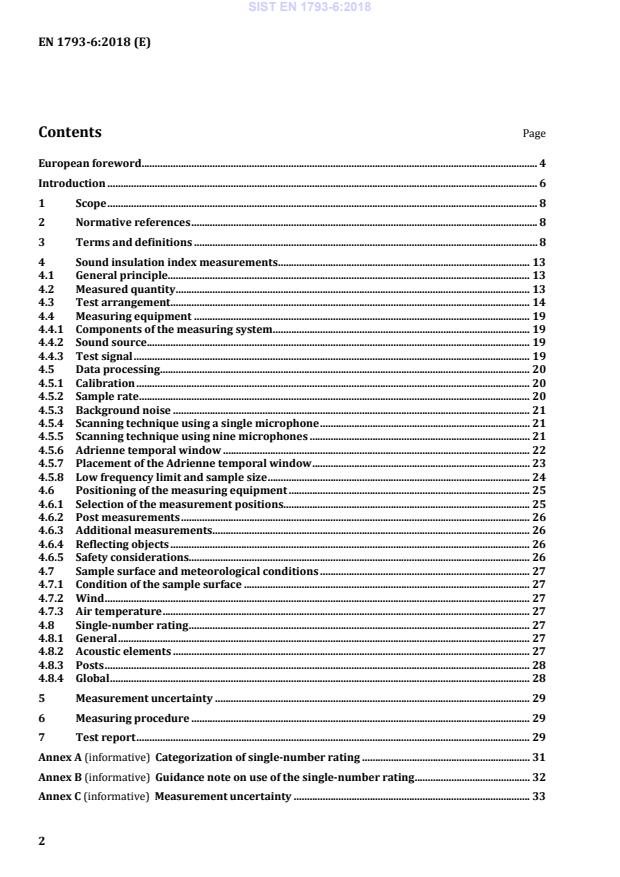
Page European foreword . 4 Introduction . 6 1 Scope . 8 2 Normative references . 8 3 Terms and definitions . 8 4 Sound insulation index measurements . 13 4.1 General principle . 13 4.2 Measured quantity . 13 4.3 Test arrangement . 14 4.4 Measuring equipment . 19 4.4.1 Components of the measuring system . 19 4.4.2 Sound source . 19 4.4.3 Test signal . 19 4.5 Data processing . 20 4.5.1 Calibration . 20 4.5.2 Sample rate . 20 4.5.3 Background noise . 21 4.5.4 Scanning technique using a single microphone . 21 4.5.5 Scanning technique using nine microphones . 21 4.5.6 Adrienne temporal window . 22 4.5.7 Placement of the Adrienne temporal window . 23 4.5.8 Low frequency limit and sample size . 24 4.6 Positioning of the measuring equipment . 25 4.6.1 Selection of the measurement positions. 25 4.6.2 Post measurements . 26 4.6.3 Additional measurements. 26 4.6.4 Reflecting objects . 26 4.6.5 Safety considerations. 26 4.7 Sample surface and meteorological conditions . 27 4.7.1 Condition of the sample surface . 27 4.7.2 Wind . 27 4.7.3 Air temperature . 27 4.8 Single-number rating . 27 4.8.1 General . 27 4.8.2 Acoustic elements . 27 4.8.3 Posts . 28 4.8.4 Global . 28 5 Measurement uncertainty . 29 6 Measuring procedure . 29 7 Test report . 29 Annex A (informative)
Categorization of single-number rating . 31 Annex B (informative)
Guidance note on use of the single-number rating . 32 Annex C (informative)
Measurement uncertainty . 33 SIST EN 1793-6:2018
Template of test report on airborne sound insulation of road traffic noise reducing devices . 36 D.1 General . 36 D.2 Test setup (example) . 38 D.3 Test object and test situation (example). 39 D.4 Results (example) . 42 D.4.1 Part 1 – Results for ‘element’ in tabular form . 42 D.4.2 Part 2 – Results for ‘element’ in graphic form . 43 D.4.3 Part 3 – Results for ‘post’ in tabular form . 44 D.4.4 Part 4 – Results for ‘post’ in graphic form. 45 D.4.5 Part 5 – Results for global condition (average of ‘element’ and ‘post’) in tabular form . 46 D.4.6 Part 6 – Results for global condition (average of ‘element’ and ‘post’) in graphic form . 47 D.5 Uncertainty (example) . 47 Bibliography . 50
¶ 0,25, where e = (w+h1+h2). This document introduces a specific quantity, called sound insulation index, to define the airborne sound insulation of a noise reducing device. This quantity should not be confused with the sound reduction index used in building acoustics, sometimes also called transmission loss. NOTE This method can be used to qualify noise reducing devices for other applications, e.g. to be installed nearby industrial sites. In this case, the single-number ratings can preferably be calculated using an appropriate spectrum. SIST EN 1793-6:2018
a) Partial cover on both sides of the road; b) Partial cover on one side of the road; envelope, e = w+h1+h2 envelope, e = w+h1
c) Deep trench; d) Tall barriers or buildings; envelope, e = w+h1+h2 envelope, e = w+h1+h2 Key r road surface w width of open space h1 Developed length of element, e.g. cover, trench side, barrier or building h2 Developed length of element, e.g. cover, trench side, barrier or building NOTE Figure 1 is not to scale. Figure 1 — Sketch of the reverberant condition check in four cases SIST EN 1793-6:2018
IEC Electropedia: available at http://www.electropedia.org/
ISO Online browsing platform: available at http://www.iso.org/obp SIST EN 1793-6:2018
function, is the mathematical idealization of a signal that is infinitely short in time which carries a unit amount of energy. SIST EN 1793-6:2018
Key 1 source reference plane 4 loudspeaker front panel 2 noise reducing device height, hB [m] 5 distance between the loudspeaker front panel and source reference plane, dS [m] 3 reference height, hs [m]
Figure 2 — Sketch of the loudspeaker-microphone assembly in front of the noise reducing device under test for sound insulation index measurements (not to scale)
a) Measurement grid for sound insulation index measurements as seen from the receiver (not to scale) b) Numbering of the measurement points as seen from the receiver (not to scale) Key 1 noise reducing device height, hB (m) 2 reference height, hS (m) 3 orthogonal spacing between two adjacent microphones, s (m) Figure 3 — Measurement points as seen from the receiver SIST EN 1793-6:2018
Key 1 sound source reference plane 4 noise reducing device height, hB [m] 2 microphone reference plane 5 reference height, hS [m] 3 noise reducing device thickness, tB, at height hS [m]
Figure 4— Sound source and microphone reference planes (side view, not to scale)
Key M measurement grid hB noise reducing device height (m) s distance between two vertical or horizontal microphones in the grid dS horizontal distance [loudspeaker - source reference plane] at height hs hS reference height dM horizontal distance [microphone 5 - microphone reference plane] at height hS Figure 5 — Placement of the sound source and measurement grid for sound insulation index measurement (side view, not to scale) SIST EN 1793-6:2018
Key S loudspeaker front panel tB noise reducing device thickness at height hS M measurement grid dM horizontal distance [microphone 5 - microphone reference plane] at height hS hS reference height dT horizontal distance [loudspeaker – microphone 5] at height hS dS horizontal distance [loudspeaker - source reference plane] at height hS
NOTE =++TSBMddtd; see Formula (3). Figure 6 — Sketch of the set-up for the reference “free-field” sound measurement for the determination of the sound insulation index (not to scale) 4 Sound insulation index measurements 4.1 General principle The sound source emits a transient sound wave that travels toward the device under test and is partly reflected, partly transmitted and partly diffracted by it. The microphone placed on the other side of the device under test receives both the transmitted sound pressure wave travelling from the sound source through the device under test, and the sound pressure wave diffracted by the top edge of the device under test (for the test to be meaningful the diffraction from the lateral edges should be sufficiently delayed). If the measurement is repeated without the device under test between the loudspeaker and the microphone, the direct free-field wave can be acquired. The power spectra of the direct wave and the transmitted wave give the basis for calculating the sound insulation index. The sound insulation index shall be the logarithmic average of the values measured at nine points placed on the measurement grid (scanning points). See Figure 3 and Formula (1). The measurement shall take place in a sound field free from reflections within the Adrienne temporal window. For this reason, the acquisition of an impulse response having peaks as sharp as possible is recommended: in this way, the reflections coming from other surfaces can be identified from their delay time and rejected. 4.2 Measured quantity The expression used to compute the sound insulation index SI as a function of frequency, in one-third octave bands, is: SIST EN 1793-6:2018
a) Sound insulation index measurements for elements and posts b) Sound insulation index measurements in front of a post only
c) Sound insulation index measurements in front of a sample having a post to post distance smaller than 4 m Key Thin circles: tested area for elements Dotted circles: tested area for posts L actual horizontal length of the acoustic elements having a post to post distance smaller than 4 m LTOT minimal horizontal length of the sample if the post to post distance is smaller than 4 m Figure 7 — Sketch of the minimum sample required for measurements in laboratory conditions SIST EN 1793-6:2018
Key S loudspeaker front panel dS horizontal distance [loudspeaker - source reference plane] at height hS M measurement grid tB barrier thickness at height hS hS reference height dM horizontal distance [microphone 5 - microphone reference plane] at height hS hB barrier height dT horizontal distance [loudspeaker - microphone 5] at height hS NOTE =++TSBMddtd; see Formula (3). Figure 8 — Sketch of the set-up for the sound insulation index measurement – Normal incidence of sound on the sample – Transmitted component measurement in front of a flat noise reducing device (not to scale) SIST EN 1793-6:2018
a) Transmitted component measurements in front of a concave noise reducing device
b) Transmitted component measurements in front of a convex noise reducing device
c) Transmitted component measurements in front of an inclined noise reducing device Key S loudspeaker front panel dS horizontal distance [loudspeaker - source reference plane] at height hS M measurement grid tB barrier thickness at height hS hS reference height dM horizontal distance [microphone 5 - microphone reference plane] at height hS hB barrier height dT horizontal distance [loudspeaker - microphone 5] at height hS NOTE =++TSBMddtd; see Formula (3). Figure 9 — Examples of the set-up for the sound insulation index measurement – Normal incidence of sound on the sample (not to scale - informative) SIST EN 1793-6:2018
Key 1 device under test 2 microphone 3 loudspeaker dM horizontal distance [microphone 5 - microphone reference plane] at height hS Figure 10 — Sketch representing the essential components of the measuring system SIST EN 1793-6:2018
Key 1 time [ms] 2 Adrienne window shape (arbitrary units) Figure 11 — The Adrienne temporal window If the window length W,ADRT has to be varied (this occurs only in exceptional cases), the lengths of the flat portion and the right-half Blackman-Harris portion shall have a ratio of 7/3. As an example, when testing very large samples the window length can be enlarged in order to achieve a better low frequency limit. The point where the flat portion of the Adrienne temporal window begins is called the marker point (MP). 4.5.7 Placement of the Adrienne temporal window For the “free-field” direct component, the Adrienne temporal window shall be placed as follows: — the first peak of the impulse response, corresponding to the direct component, is detected; — a time instant preceding the direct component peak of 0,2 ms is located; — the direct component Adrienne temporal window is placed so that its marker point corresponds to this time instant. In other words, the direct component Adrienne temporal window is placed so that its flat portion begins 0,2 ms before the direct component peak. For the transmitted component, the Adrienne temporal window shall be placed as follows: — the time instant when the transmission begins is located, possibly with the help of geometrical computation (conventional beginning of transmission); — a time instant preceding the conventional beginning of transmission of 0,2 ms is located; SIST EN 1793-6:2018
...