

EN 1996-1-1:2022/prA1
(Amendment)Eurocode 6 - Design of masonry structures - Part 1-1: General rules for reinforced and unreinforced masonry structures
- Abstract
(1) The basis for the design of building and civil engineering works in masonry is given in this Part 1-1 of EN 1996, which deals with unreinforced masonry, reinforced masonry and confined masonry. Principles for the design of prestressed masonry are also given. This Part 1-1 of EN 1996 is not valid for masonry elements with a plan area of less than 0,04 m2.
(2) For those types of structures not covered entirely, for new structural uses for established materials, for new materials, or where actions and other influences outside normal experience have to be resisted, the provisions given in this Part 1-1 of EN 1996 may be applicable, but may need to be supplemented.
(3) Part 1-1 of EN 1996 gives detailed rules which are mainly applicable to ordinary buildings. The applicability of these rules may be limited, for practical reasons or due to simplifications; any limits of applicability are given in the text where necessary.
(4) Part 1-1 of EN 1996 does not cover:
- resistance to fire (which is dealt with in EN 1996-1-2);
- particular aspects of special types of building (for example, dynamic effects on tall buildings);
- particular aspects of special types of civil engineering works (such as masonry bridges, dams, chimneys or liquid-retaining structures);
- particular aspects of special types of structures (such as arches or domes);
- masonry where gypsum, with or without cement, mortars are used;
- masonry where the units are not laid in a regular pattern of courses (rubble masonry);
- masonry reinforced with other materials than steel.
- Status
- Not Published
- Publication Date
- 19-Jan-2028
- Technical Committee
- CEN/TC 250 - Structural Eurocodes
- Current Stage
- 4060 - Closure of enquiry - Enquiry
- Start Date
- 16-Jul-2026
- Due Date
- 31-Dec-2026
- Completion Date
- 16-Jul-2026

Overview
EN 1996-1-1:2022/prA1 is a draft amendment to Eurocode 6 - Design of masonry structures - Part 1-1: General rules for reinforced and unreinforced masonry structures, published by the European Committee for Standardization (CEN). This document provides the fundamental basis and detailed rules for designing masonry structures, covering both reinforced and unreinforced masonry as well as confined masonry. It establishes core requirements for the safe and effective structural design of buildings and civil engineering works constructed from masonry.
The standard supports the structural engineering community in complying with European regulatory safety requirements, and is integral to harmonized building practices across Europe. It is specifically tailored for structures built from regular masonry units and covers buildings of ordinary types, with guidance for prestressed masonry and additional applications as appropriate.
Key Topics
- Design Principles for Masonry: Guidance for both reinforced and unreinforced masonry, with considerations for durability, basis of design, and structural analysis.
- Applicability: Covers structures made with masonry units laid in regular patterns, providing requirements predominantly for buildings, not specialized civil engineering works such as bridges or dams.
- Prestressed and Confined Masonry: Outlines general rules for the use of prestressed masonry elements and confined masonry systems.
- National Annexes: Recognizes the autonomy of national authorities to dictate regulatory values for safety through national annexes.
- Amendments and Editorial Corrections: The draft amendment introduces several editorial enhancements, reference updates, and term clarifications to align with the latest structural and geotechnical design codes.
Applications
EN 1996-1-1:2022/prA1 is designed for wide use within the building sector, particularly by:
- Structural engineers designing new buildings using masonry-whether reinforced, unreinforced, or confined.
- Architects and design consultants specifying masonry solutions in compliance with Eurocode standards.
- Construction firms seeking harmonized requirements for safety, durability, and reliable masonry design.
- Standards bodies and regulators implementing European or national construction codes.
- Educational institutions instructing future civil and structural engineers in best practices for masonry structure design.
Typical applications include:
- Residential and commercial buildings using brick, block, or stone masonry.
- Structural design calculations for reinforced masonry walls and partitions.
- Assessment and design of confined masonry elements in earthquake-prone areas.
- Guidance for the innovative use of established or new masonry materials within the standardized framework.
Not Covered: The standard does not address fire resistance (see EN 1996-1-2), dynamic effects on special structures, certain civil engineering works (e.g. masonry bridges, dams), non-steel reinforced masonry, irregular/rubble masonry, or units with plan areas under 0.04 m².
Related Standards
For comprehensive compliance and best practices, the following related standards should be consulted alongside EN 1996-1-1:2022/prA1:
- EN 1996-1-2: Eurocode 6 - Design of masonry structures - Part 1-2: General rules - Structural fire design
- EN 1990-1: Eurocode - Basis of structural and geotechnical design - Part 1: New structures
- EN 1992-1-1: Eurocode 2 - Design of concrete structures - Part 1-1: General rules for buildings and civil engineering structures
- EN 1997-1: Eurocode 7 - Geotechnical design - Part 1: General rules
- EN 1996-2: Design, materials, and execution requirements for masonry structures
EN 1996-1-1:2022/prA1 is an essential reference for the safe design and construction of masonry structures, central to Eurocode-compliant building design in Europe. For the latest updates and implementation guidance, always consult the most recent official publications and the national annexes applicable in your region.
Get Certified
Connect with accredited certification bodies for this standard

DIBt (Deutsches Institut für Bautechnik)
German Institute for Building Technology.
DIN CERTCO
DIN Group product certification.

Aboma Certification B.V.
Specialized in construction, metal, and transport sectors.
Sponsored listings
Frequently Asked Questions
EN 1996-1-1:2022/prA1 is a draft published by the European Committee for Standardization (CEN). Its full title is "Eurocode 6 - Design of masonry structures - Part 1-1: General rules for reinforced and unreinforced masonry structures". This standard covers: (1) The basis for the design of building and civil engineering works in masonry is given in this Part 1-1 of EN 1996, which deals with unreinforced masonry, reinforced masonry and confined masonry. Principles for the design of prestressed masonry are also given. This Part 1-1 of EN 1996 is not valid for masonry elements with a plan area of less than 0,04 m2. (2) For those types of structures not covered entirely, for new structural uses for established materials, for new materials, or where actions and other influences outside normal experience have to be resisted, the provisions given in this Part 1-1 of EN 1996 may be applicable, but may need to be supplemented. (3) Part 1-1 of EN 1996 gives detailed rules which are mainly applicable to ordinary buildings. The applicability of these rules may be limited, for practical reasons or due to simplifications; any limits of applicability are given in the text where necessary. (4) Part 1-1 of EN 1996 does not cover: - resistance to fire (which is dealt with in EN 1996-1-2); - particular aspects of special types of building (for example, dynamic effects on tall buildings); - particular aspects of special types of civil engineering works (such as masonry bridges, dams, chimneys or liquid-retaining structures); - particular aspects of special types of structures (such as arches or domes); - masonry where gypsum, with or without cement, mortars are used; - masonry where the units are not laid in a regular pattern of courses (rubble masonry); - masonry reinforced with other materials than steel.
(1) The basis for the design of building and civil engineering works in masonry is given in this Part 1-1 of EN 1996, which deals with unreinforced masonry, reinforced masonry and confined masonry. Principles for the design of prestressed masonry are also given. This Part 1-1 of EN 1996 is not valid for masonry elements with a plan area of less than 0,04 m2. (2) For those types of structures not covered entirely, for new structural uses for established materials, for new materials, or where actions and other influences outside normal experience have to be resisted, the provisions given in this Part 1-1 of EN 1996 may be applicable, but may need to be supplemented. (3) Part 1-1 of EN 1996 gives detailed rules which are mainly applicable to ordinary buildings. The applicability of these rules may be limited, for practical reasons or due to simplifications; any limits of applicability are given in the text where necessary. (4) Part 1-1 of EN 1996 does not cover: - resistance to fire (which is dealt with in EN 1996-1-2); - particular aspects of special types of building (for example, dynamic effects on tall buildings); - particular aspects of special types of civil engineering works (such as masonry bridges, dams, chimneys or liquid-retaining structures); - particular aspects of special types of structures (such as arches or domes); - masonry where gypsum, with or without cement, mortars are used; - masonry where the units are not laid in a regular pattern of courses (rubble masonry); - masonry reinforced with other materials than steel.
EN 1996-1-1:2022/prA1 is classified under the following ICS (International Classification for Standards) categories: 91.010.30 - Technical aspects; 91.080.30 - Masonry. The ICS classification helps identify the subject area and facilitates finding related standards.
EN 1996-1-1:2022/prA1 is available in PDF format for immediate download after purchase. The document can be added to your cart and obtained through the secure checkout process. Digital delivery ensures instant access to the complete standard document.
Standards Content (Sample)
SLOVENSKI STANDARD
01-junij-2026
Evrokod 6 - Projektiranje zidanih konstrukcij - 1-1. del: Splošna pravila za armirano
in nearmirano zidovje
Eurocode 6 - Design of masonry structures - Part 1-1: General rules for reinforced and
unreinforced masonry structures
Eurocode 6 - Bemessung und Konstruktion von Mauerwerksbauten - Teil 1-1:
Allgemeine Regeln für bewehrtes und unbewehrtes Mauerwerk
Eurocode 6 - Calcul des ouvrages en maçonnerie - Partie 1-1 : Règles générales pour
ouvrages en maçonnerie armée et non armée
Ta slovenski standard je istoveten z: EN 1996-1-1:2022/prA1
ICS:
91.010.30 Tehnični vidiki Technical aspects
91.080.30 Zidane konstrukcije Masonry
2003-01.Slovenski inštitut za standardizacijo. Razmnoževanje celote ali delov tega standarda ni dovoljeno.
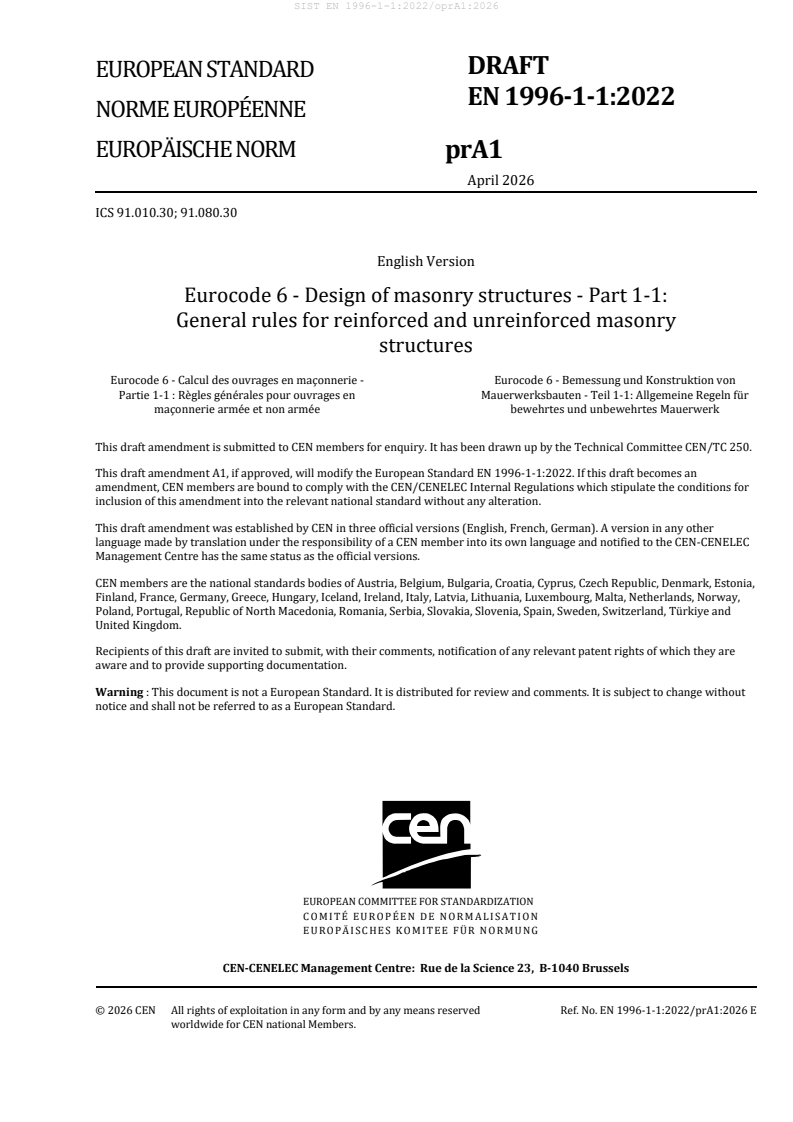
DRAFT
EUROPEAN STANDARD
EN 1996-1-1:2022
NORME EUROPÉENNE
EUROPÄISCHE NORM
prA1
April 2026
ICS 91.010.30; 91.080.30
English Version
Eurocode 6 - Design of masonry structures - Part 1-1:
General rules for reinforced and unreinforced masonry
structures
Eurocode 6 - Calcul des ouvrages en maçonnerie - Eurocode 6 - Bemessung und Konstruktion von
Partie 1-1 : Règles générales pour ouvrages en Mauerwerksbauten - Teil 1-1: Allgemeine Regeln für
maçonnerie armée et non armée bewehrtes und unbewehrtes Mauerwerk
This draft amendment is submitted to CEN members for enquiry. It has been drawn up by the Technical Committee CEN/TC 250.
This draft amendment A1, if approved, will modify the European Standard EN 1996-1-1:2022. If this draft becomes an
amendment, CEN members are bound to comply with the CEN/CENELEC Internal Regulations which stipulate the conditions for
inclusion of this amendment into the relevant national standard without any alteration.
This draft amendment was established by CEN in three official versions (English, French, German). A version in any other
language made by translation under the responsibility of a CEN member into its own language and notified to the CEN-CENELEC
Management Centre has the same status as the official versions.
CEN members are the national standards bodies of Austria, Belgium, Bulgaria, Croatia, Cyprus, Czech Republic, Denmark, Estonia,
Finland, France, Germany, Greece, Hungary, Iceland, Ireland, Italy, Latvia, Lithuania, Luxembourg, Malta, Netherlands, Norway,
Poland, Portugal, Republic of North Macedonia, Romania, Serbia, Slovakia, Slovenia, Spain, Sweden, Switzerland, Türkiye and
United Kingdom.
Recipients of this draft are invited to submit, with their comments, notification of any relevant patent rights of which they are
aware and to provide supporting documentation.
Warning : This document is not a European Standard. It is distributed for review and comments. It is subject to change without
notice and shall not be referred to as a European Standard.
EUROPEAN COMMITTEE FOR STANDARDIZATION
COMITÉ EUROPÉEN DE NORMALISATION
EUROPÄISCHES KOMITEE FÜR NORMUNG
CEN-CENELEC Management Centre: Rue de la Science 23, B-1040 Brussels
© 2026 CEN All rights of exploitation in any form and by any means reserved Ref. No. EN 1996-1-1:2022/prA1:2026 E
worldwide for CEN national Members.
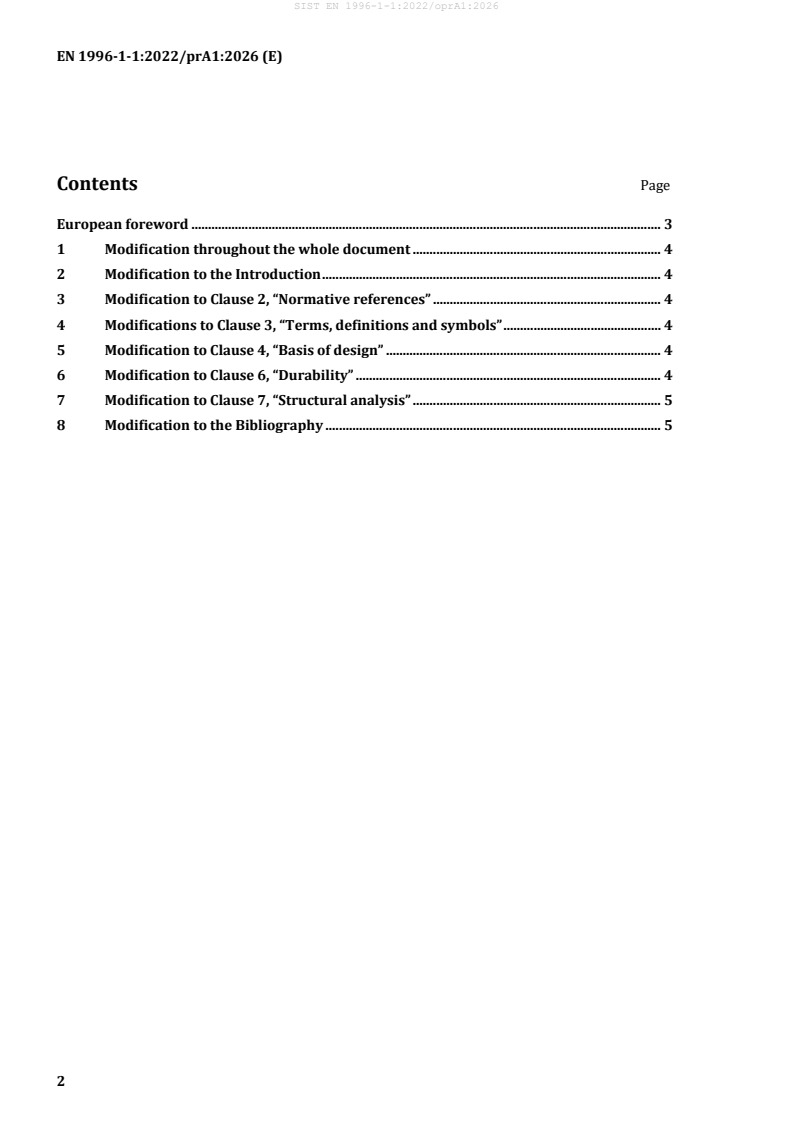
Contents Page
European foreword . 3
1 Modification throughout the whole document . 4
2 Modification to the Introduction . 4
3 Modification to Clause 2, “Normative references” . 4
4 Modifications to Clause 3, “Terms, definitions and symbols” . 4
5 Modification to Clause 4, “Basis of design” . 4
6 Modification to Clause 6, “Durability” .
...