

EN 12871:2013
(Main)Wood-based panels - Determination of performance characteristics for load bearing panels for use in floors, roofs and walls
- Abstract
This European Standard specifies:
- concentrated load test and assessment methods for floor and roof decking;
- soft body impact assessment methods and classification system for floors, roofs and walls.
This European Standard does not include racking testing or uniformly distributed loads as these are covered by testing according to EN 594 or calculation according to EN 1995-1-1 respectively.
This European Standard specifies the procedure for determining the performance characteristics through type testing, of load-bearing wood-based panels fitted on:
a) structural joists for decking:
1) in flooring applications in load categories A, B, C and D;
2) in roof applications in load categories H and I;
for which type testing involves:
i) punching shear under concentrated loading;
ii) vertical soft body impact;
b) studs for walling application for which type testing involves:
1) pendular soft body impact.
Annex A (normative) lists modifications to EN 1195, particularly the contact area of the loading head that may be used for concentrated loading.
Annex B (informative) provides proposals for national performance requirements.
Annex C (informative) provides examples for a decking application in a floor and a roof.
- Status
- Published
- Publication Date
- 25-Jun-2013
- Withdrawal Date
- 30-Dec-2013
- Technical Committee
- CEN/TC 112 - Woodbased panels
- Drafting Committee
- CEN/TC 112/WG 4 - Test methods
- Current Stage
- 9093 - Decision to confirm - Review Enquiry
- Start Date
- 23-May-2024
- Completion Date
- 07-Oct-2026

Overview
EN 12871:2013 - "Wood-based panels - Determination of performance characteristics for load bearing panels for use in floors, roofs and walls" (CEN) defines type‑testing methods and assessment criteria for load-bearing wood-based panels used as decking and wall sheathing. The standard specifies procedures to determine performance characteristics under concentrated load and soft body impact, and provides a classification system for impact performance. EN 12871:2013 is focused on type testing of specific constructions rather than general racking or uniformly distributed load testing (those are covered by EN 594 and EN 1995‑1‑1).
Key topics and technical requirements
- Scope of testing
- Decking on structural joists (flooring load categories A–D; roofing load categories H–I).
- Wall sheathing on studs (pendular soft body impact).
- Test methods
- Punching shear under concentrated loading (concentrated load test for floor/roof decking).
- Vertical soft body impact for decking; pendular soft body impact for wall sheathing.
- Performance characteristics evaluated
- Stiffness characteristics (serviceability limit state) for concentrated loads.
- Serviceability load corresponding to the elasticity limit.
- Fmax,k (characteristic maximum force) for ultimate limit state.
- Impact Class (three classes defined for soft body impact performance).
- Type testing approach
- Results apply to a specific panel design and installation configuration.
- Statistical evaluation references EN 1058 (characteristic 5‑percentile and mean values).
- Annexes
- Annex A (normative): modifications to EN 1195, including the contact area / loading head (load pad now 50 mm × 50 mm).
- Annex B (informative): proposals for national performance requirements (includes a reduction factor for ULS and span adjustments for roof slope).
- Annex C (informative): worked examples for floor and roof decking.
Applications and users
EN 12871:2013 is intended for manufacturers, test laboratories, structural engineers, specifiers and certification bodies involved with:
- Structural floor and roof decking design and product development.
- Type testing and CE marking of wood-based panels (OSB, particleboard, plywood, MDF, etc.).
- Assessing panel suitability for building use where concentrated loads and impact resistance are critical (residential floors, accessible roofs, wall sheathing in exposed locations).
Related standards
- EN 1195 (structural floor decking test methods) - modified by Annex A of EN 12871.
- EN 1058 (statistical evaluation of characteristic values).
- EN 594 (racking tests) and EN 1995‑1‑1 (Eurocode 5 calculations for uniformly distributed loads).
- EN 789, EN 1156 and product standards (EN 300, EN 312, EN 636, EN 622 series) for material definitions and complementary testing.
Relations
- Effective Date
- 08-Jun-2022
- Effective Date
- 22-Jul-2026
- Effective Date
- 28-Jan-2026
- Effective Date
- 28-Jan-2026
- Effective Date
- 28-Jan-2026
- Effective Date
- 28-Jan-2026
- Effective Date
- 28-Jan-2026
- Effective Date
- 28-Jan-2026
- Effective Date
- 28-Jan-2026
- Effective Date
- 28-Jan-2026
- Effective Date
- 28-Jan-2026
- Effective Date
- 28-Jan-2026
- Effective Date
- 28-Jan-2026
- Effective Date
- 28-Jan-2026
- Effective Date
- 28-Jan-2026
Get Certified
Connect with accredited certification bodies for this standard

Gozdarski inštitut Slovenije
Slovenian Forestry Institute. Forest management certification support, timber testing.
Sponsored listings
Frequently Asked Questions
EN 12871:2013 is a standard published by the European Committee for Standardization (CEN). Its full title is "Wood-based panels - Determination of performance characteristics for load bearing panels for use in floors, roofs and walls". This standard covers: This European Standard specifies: - concentrated load test and assessment methods for floor and roof decking; - soft body impact assessment methods and classification system for floors, roofs and walls. This European Standard does not include racking testing or uniformly distributed loads as these are covered by testing according to EN 594 or calculation according to EN 1995-1-1 respectively. This European Standard specifies the procedure for determining the performance characteristics through type testing, of load-bearing wood-based panels fitted on: a) structural joists for decking: 1) in flooring applications in load categories A, B, C and D; 2) in roof applications in load categories H and I; for which type testing involves: i) punching shear under concentrated loading; ii) vertical soft body impact; b) studs for walling application for which type testing involves: 1) pendular soft body impact. Annex A (normative) lists modifications to EN 1195, particularly the contact area of the loading head that may be used for concentrated loading. Annex B (informative) provides proposals for national performance requirements. Annex C (informative) provides examples for a decking application in a floor and a roof.
This European Standard specifies: - concentrated load test and assessment methods for floor and roof decking; - soft body impact assessment methods and classification system for floors, roofs and walls. This European Standard does not include racking testing or uniformly distributed loads as these are covered by testing according to EN 594 or calculation according to EN 1995-1-1 respectively. This European Standard specifies the procedure for determining the performance characteristics through type testing, of load-bearing wood-based panels fitted on: a) structural joists for decking: 1) in flooring applications in load categories A, B, C and D; 2) in roof applications in load categories H and I; for which type testing involves: i) punching shear under concentrated loading; ii) vertical soft body impact; b) studs for walling application for which type testing involves: 1) pendular soft body impact. Annex A (normative) lists modifications to EN 1195, particularly the contact area of the loading head that may be used for concentrated loading. Annex B (informative) provides proposals for national performance requirements. Annex C (informative) provides examples for a decking application in a floor and a roof.
EN 12871:2013 is classified under the following ICS (International Classification for Standards) categories: 79.060.01 - Wood-based panels in general. The ICS classification helps identify the subject area and facilitates finding related standards.
EN 12871:2013 has the following relationships with other standards: It is inter standard links to EN 12871:2010, EN 312:2010, EN 13353:2022, EN 1058:2024, EN 1990:2002, EN 14279:2004+A1:2009, EN 596:1995, EN 1995-1-1:2004, EN 634-2:2007, EN 636:2012+A1:2015, EN 1156:2013, EN 789:2004, EN 1991-1-1:2025, EN 1195:1997, EN 13986:2004+A1:2015. Understanding these relationships helps ensure you are using the most current and applicable version of the standard.
EN 12871:2013 is associated with the following European legislation: EU Directives/Regulations: 305/2011, 89/106/EEC; Standardization Mandates: M/113. When a standard is cited in the Official Journal of the European Union, products manufactured in conformity with it benefit from a presumption of conformity with the essential requirements of the corresponding EU directive or regulation.
EN 12871:2013 is available in PDF format for immediate download after purchase. The document can be added to your cart and obtained through the secure checkout process. Digital delivery ensures instant access to the complete standard document.
Standards Content (Sample)
2003-01.Slovenski inštitut za standardizacijo. Razmnoževanje celote ali delov tega standarda ni dovoljeno.Holzwerkstoffe - Bestimmung der Leistungseigenschaften für tragende Platten zur Verwendung in Fußböden, Wänden und DächernPanneaux à base de bois - Détermination des caractéristiques de performance des panneaux travaillants utilisés en planchers, toitures et mursWood-based panels - Determination of performance characteristics for load bearing panels for use in floors, roofs and walls79.060.01Wood-based panels in generalICS:Ta slovenski standard je istoveten z:EN 12871:2013SIST EN 12871:2013en,fr,de01-december-2013SIST EN 12871:2013SLOVENSKI
STANDARDSIST EN 12871:20101DGRPHãþD
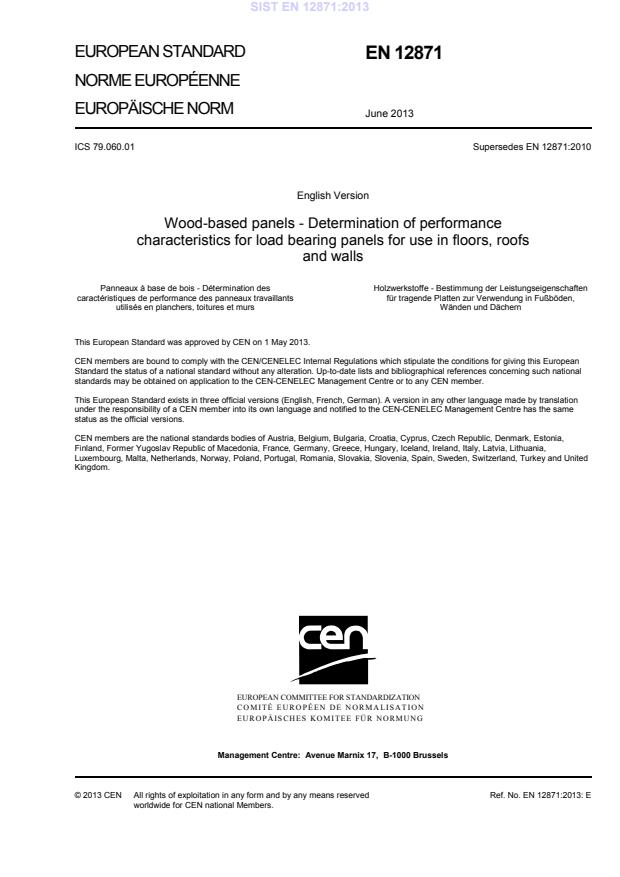
EUROPEAN STANDARD NORME EUROPÉENNE EUROPÄISCHE NORM
EN 12871
June 2013 ICS 79.060.01 Supersedes EN 12871:2010English Version
Wood-based panels - Determination of performance characteristics for load bearing panels for use in floors, roofs and walls
Panneaux à base de bois - Détermination des caractéristiques de performance des panneaux travaillants utilisés en planchers, toitures et murs
Holzwerkstoffe - Bestimmung der Leistungseigenschaften für tragende Platten zur Verwendung in Fußböden, Wänden und Dächern This European Standard was approved by CEN on 1 May 2013.
CEN members are bound to comply with the CEN/CENELEC Internal Regulations which stipulate the conditions for giving this European Standard the status of a national standard without any alteration. Up-to-date lists and bibliographical references concerning such national standards may be obtained on application to the CEN-CENELEC Management Centre or to any CEN member.
This European Standard exists in three official versions (English, French, German). A version in any other language made by translation under the responsibility of a CEN member into its own language and notified to the CEN-CENELEC Management Centre has the same status as the official versions.
CEN members are the national standards bodies of Austria, Belgium, Bulgaria, Croatia, Cyprus, Czech Republic, Denmark, Estonia, Finland, Former Yugoslav Republic of Macedonia, France, Germany, Greece, Hungary, Iceland, Ireland, Italy, Latvia, Lithuania, Luxembourg, Malta, Netherlands, Norway, Poland, Portugal, Romania, Slovakia, Slovenia, Spain, Sweden, Switzerland, Turkey and United Kingdom.
EUROPEAN COMMITTEE FOR STANDARDIZATION
COMITÉ EUROPÉEN DE NORMALISATION EUROPÄISCHES KOMITEE FÜR NORMUNG
Management Centre:
Avenue Marnix 17,
B-1000 Brussels © 2013 CEN All rights of exploitation in any form and by any means reserved worldwide for CEN national Members. Ref. No. EN 12871:2013: ESIST EN 12871:2013
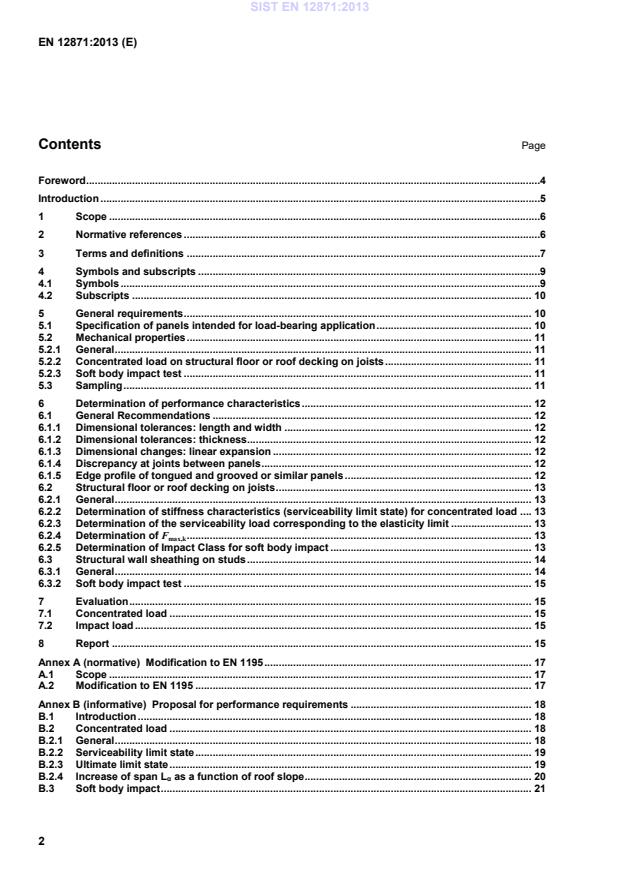
Modification to EN 1195 . 17 A.1 Scope . 17 A.2 Modification to EN 1195 . 17 Annex B (informative)
Proposal for performance requirements . 18 B.1 Introduction . 18 B.2 Concentrated load . 18 B.2.1 General . 18 B.2.2 Serviceability limit state . 19 B.2.3 Ultimate limit state . 19 B.2.4 Increase of span L. as a function of roof slope . 20 B.3 Soft body impact . 21 SIST EN 12871:2013
Example . 22 C.1 General . 22 C.2 Features of the end use . 22 C.2.1 Decking for flooring in housing applications . 22 C.2.2 Decking for an accessible cold roof (load category I) . 22 C.3 Type testing values of the component . 22 C.3.1 Main features of the testing (according to EN 1195) . 22 C.3.2 Results . 22 C.4 Values for the calculation parameters . 23 C.5 Determination of the Limit States of the component and compliance to recommended requirements . 23 C.5.1 Ultimate Limit State (according to B.2.3) . 23 C.5.2 Serviceability Limit State (according to B.2.2) . 24 C.5.3 Summarisation . 24 Bibliography . 25
This European Standard contains an informative annex with proposals for national requirements to the characteristics determined by this European Standard, based on Eurocodes and national annexes. SIST EN 12871:2013
EN 1991-1-1, Eurocode 1: Actions on structures — Part 1-1: General actions — Densities, self-weight, imposed loads for buildings EN 1995-1-1:2004, Eurocode 5: Design of timber structures — Part 1-1: General — Common rules and rules for buildings 2.2 Product standards EN 300, Oriented Strand Boards (OSB) — Definitions, classification and specifications EN 312, Particleboards — Specifications
EN 622-2, Fibreboards — Specifications — Part 2: Requirements for hardboards EN 622-3, Fibreboards — Specifications — Part 3: Requirements for medium boards EN 622-5, Fibreboards — Specifications — Part 5: Requirements for dry process boards (MDF) EN 634-2, Cement-bonded particleboards — Specifications — Part 2: Requirements for OPC bonded particleboards for use in dry, humid and external conditions EN 636, Plywood — Specifications EN 13353, Solid wood panels (SWP) — Requirements EN 14279, Laminated Veneer Lumber (LVL) — Definitions, classification and specifications 3 Terms and definitions For the purposes of this document, the following terms and definitions apply.
3.1 service class 1 service class 1 is characterised by a moisture content in the materials corresponding to a temperature of 20 °C and the relative humidity of the surrounding air only exceeding 65 % for a few weeks per year [SOURCE: EN 1995-1-1:2004, 2.3.1.3] 3.2 service class 2 service class 2 is characterised by a moisture content in the materials corresponding to a temperature of 20 °C and the relative humidity of the surrounding air only exceeding 85 % for a few weeks per year [SOURCE: EN 1995-1-1:2004, 2.3.1.3] 3.3 service class 3 service class 3 is characterised by climatic conditions leading to higher moisture contents than in service class 2 [SOURCE: EN 1995-1-1:2004, 2.3.1.3] SIST EN 12871:2013
Note 1 to entry: The load values are defined in the National Annexes to EN 1991-1-1 or, where not available, in EN 1991-1-1. 3.8 structural wall-sheathing vertical (or quasi-vertical) assembly of wood-based panels, supported by studs, capable of taking up loading in the 3 directions of space 3.9 structural floor-decking horizontal (or quasi-horizontal) assembly of wood-based panels fixed to supporting joists and spanning over them Note 1 to entry: When a load is applied on the decking, it is free to deflect between the joists. 3.10 sub-floor structural panel meant to be covered by overlays 3.11 structural roof-decking usually, sloping assembly of wood based panels, fixed to supporting joists and spanning over them Note 1 to entry: Roof assemblies are tested horizontally. Note 2 to entry: When a load is applied on the decking, it is free to deflect between the joists. SIST EN 12871:2013
3.13 cold roof roof design in which the panels and some of the supporting joists are placed above the insulation Note 1 to entry: Usually, the panels are considered to be under conditions corresponding to service class 2.
3.14 set irreversible deformation (unevenness between two adjoining panels) of the test floor, wall or roof after the removal of the applied load 3.15 punching shear strength stress in the section of a panel under a concentrated load applied perpendicularly to its face by means of a loading head with a specified cross section 4 Symbols and subscripts 4.1 Symbols A Contact area of a square load pad F Force applied to the component being tested L Span between joists or studs (axis to axis distance) with horizontal test assembly L. Increased span between joists or studs (axis to axis distance), as a function of roof slope Qk Characteristic concentrated load for the relevant load category, specified in National Annexes to EN 1991-1-1 R Stiffness of the structural decking or sheathing for concentrated loading (experimental value) and racking kdef Deformation factor defined by EN 1995-1-1 kdis Correction factor converting test loads, for consideration of influence of size and shape of the load pad kmod
Modification factor defined by EN 1995-1-1 kred
Reduction factor for local types of failure wfin Final deflection . Roof slope γM Material partial factor defined by National Annexes to EN 1995-1-1 or, where not available, by EN 1995-1-1 γQ Action partial factor defined by National Annexes to EN 1990 or, where not available, by EN 1990 SIST EN 12871:2013
ser related to Serviceability Limit State 5 General requirements 5.1 Specification of panels intended for load-bearing application Table 1 specifies the wood-based panel types for load bearing purposes in floor-decking, roof-decking and wall sheathing. Table 1 — Panel product specification standards for structural decking (floors and roofs) and sheathing (walls) Panel type Technical class Relevant EN Particleboard P4 P6 P5 P7 EN 312 OSB OSB/2 OSB/3 OSB/4 EN 300 Plywood EN 636-1 S
EN 636-2 S
EN 636-3 S EN 636 Solid wood panel SWP/1 S SWP/2 S SWP/3 S SWP/1 SD SWP/2 SD SWP/3 SD EN 13353 LVL LVL/1 LVL/2 LVL/3 EN 14279 Fibreboard HB.LA HB.HLA1 HB.HLA2 MBH.LA1 MBH.LA2 MBH.HLS1 MBH.HLS2 MDF.LA MDF.HLS EN 622-2
EN 622-3
EN 622-5 Cement bonded particle board a
— EN 634-2 a To be used only if the following properties are determined:
- the bending properties according to EN 789 and EN 1058,
- the mechanical durability according to EN 1156 for kmod and kdef
...