

EN 789:2004
(Main)Timber structures - Test methods - Determination of mechanical properties of wood based panels
- Abstract
This standard specifies test methods for determining some mechanical properties of commercial wood-based panel products for use in load-bearing timber structures. These properties are intended for the calculation of characteristic values for use in obtaining material design values. For each type and grade of panel product, as defined for example in an EN wood based panel standard, it is necessary to determine characteristic values of mechanical properties to enable it to be used for structural purposes.
- Status
- Published
- Publication Date
- 19-Oct-2004
- Technical Committee
- CEN/TC 124 - Timber structures
- Drafting Committee
- CEN/TC 124/WG 1 - Test methods
- Current Stage
- 9020 - Submission to 2 Year Review Enquiry - Review Enquiry
- Start Date
- 15-Jul-2026
- Completion Date
- 15-Jul-2026

Overview
EN 789:2004 - Timber structures: Test methods - Determination of mechanical properties of wood-based panels is a CEN standard that defines laboratory test methods for determining the mechanical properties of commercial wood‑based panel products intended for load‑bearing timber structures. Its purpose is to establish the data needed to calculate characteristic values used in structural material design. Tests are normally carried out once per product type/grade unless product properties have changed.
Key topics and requirements
The standard specifies procedures, measurements and result expressions for a range of mechanical tests and preparatory steps, including:
- Sampling and specimen preparation
- Sampling of panels and fabrication of test pieces.
- Conditioning, dimensional measurement and reporting requirements.
- Physical property measurements
- Moisture content and density determination (referenced normative methods).
- Mechanical test methods
- Bending - modulus of elasticity, bending stiffness, bending strength and moment capacity.
- Compression in the plane of the panel - compression modulus and strength.
- Tension - tension modulus and strength.
- Panel shear and planar shear - shear modulus of rigidity and shear strength.
- Compression perpendicular to the plane (bearing) - included as Informative Annex D due to limited experience.
- Test procedure controls
- Specified loading equipment, loading methods, rates of load application, and deformation measurement techniques for reproducible results.
- Result reporting
- Required content of the test report: general data, material data, individual test piece data, physical property data, sampling and additional notes.
Applications and users
EN 789:2004 is used to generate the mechanical property data needed to derive characteristic material values for structural design of timber constructions where wood‑based panels are used as load‑bearing elements. Typical users include:
- Structural engineers and designers requiring validated panel properties for calculations.
- Product manufacturers preparing data for CE marking and structural use.
- Independent testing laboratories performing type‑approval or product qualification testing.
- Certification bodies and standards committees establishing harmonized design values.
Note: EN 789 is intended for product qualification and deriving characteristic values, not routine production quality control (QC) testing - QC may use smaller test pieces and different procedures.
Related standards
Important referenced and related documents include:
- EN 13986 (wood‑based panels - structural use / Harmonised Standard)
- EN 12369 (panel characteristic values for some panel types)
- Normative references used for measurements: EN 322 (moisture), EN 323 (density), EN 325 (dimensions), EN 14358 (calculation of 5‑percentile characteristic values)
Keywords: EN 789:2004, timber structures, wood‑based panels, test methods, mechanical properties, characteristic values, bending strength, shear modulus, compression strength, sampling, conditioning.
Relations
- Effective Date
- 22-Dec-2008
- Effective Date
- 28-Jan-2026
- Effective Date
- 28-Jan-2026
- Effective Date
- 28-Jan-2026
- Effective Date
- 28-Jan-2026
- Effective Date
- 28-Jan-2026
- Effective Date
- 28-Jan-2026
- Effective Date
- 28-Jan-2026
- Effective Date
- 28-Jan-2026
- Effective Date
- 28-Jan-2026
- Effective Date
- 28-Jan-2026
- Effective Date
- 28-Jan-2026
- Effective Date
- 28-Jan-2026
- Effective Date
- 28-Jan-2026
- Effective Date
- 28-Jan-2026
Get Certified
Connect with accredited certification bodies for this standard

Gozdarski inštitut Slovenije
Slovenian Forestry Institute. Forest management certification support, timber testing.
Sponsored listings
Frequently Asked Questions
EN 789:2004 is a standard published by the European Committee for Standardization (CEN). Its full title is "Timber structures - Test methods - Determination of mechanical properties of wood based panels". This standard covers: This standard specifies test methods for determining some mechanical properties of commercial wood-based panel products for use in load-bearing timber structures. These properties are intended for the calculation of characteristic values for use in obtaining material design values. For each type and grade of panel product, as defined for example in an EN wood based panel standard, it is necessary to determine characteristic values of mechanical properties to enable it to be used for structural purposes.
This standard specifies test methods for determining some mechanical properties of commercial wood-based panel products for use in load-bearing timber structures. These properties are intended for the calculation of characteristic values for use in obtaining material design values. For each type and grade of panel product, as defined for example in an EN wood based panel standard, it is necessary to determine characteristic values of mechanical properties to enable it to be used for structural purposes.
EN 789:2004 is classified under the following ICS (International Classification for Standards) categories: 79.060.01 - Wood-based panels in general. The ICS classification helps identify the subject area and facilitates finding related standards.
EN 789:2004 has the following relationships with other standards: It is inter standard links to EN 789:1995, EN 14358:2016, EN 322:1993, EN 323:1993, EN 325:2025, EN 16351:2021, EN 12369-3:2008, EN 14374:2004, EN 13810-1:2002, EN 1058:2009, EN 636:2012+A1:2015, EN 13353:2008+A1:2011, EN 12811-3:2002, EN 1058:2024, EN 13986:2004+A1:2015. Understanding these relationships helps ensure you are using the most current and applicable version of the standard.
EN 789:2004 is associated with the following European legislation: EU Directives/Regulations: 305/2011, 89/106/EEC; Standardization Mandates: M/113. When a standard is cited in the Official Journal of the European Union, products manufactured in conformity with it benefit from a presumption of conformity with the essential requirements of the corresponding EU directive or regulation.
EN 789:2004 is available in PDF format for immediate download after purchase. The document can be added to your cart and obtained through the secure checkout process. Digital delivery ensures instant access to the complete standard document.
Standards Content (Sample)
2003-01.Slovenski inštitut za standardizacijo. Razmnoževanje celote ali delov tega standarda ni dovoljeno.Holzbauwerke - Prüfverfahren - Bestimmung der mechanischen Eigenschaften von HolzwerkstoffenStructures en bois - Méthodes d'essai - Détermination des propriétés mécaniques des panneaux a base de boisTimber structures - Test methods - Determination of mechanical properties of wood based panels91.080.20Lesene konstrukcijeTimber structures79.060.01Wood-based panels in generalICS:Ta slovenski standard je istoveten z:EN 789:2004SIST EN 789:2005en01-april-2005SIST EN 789:2005SLOVENSKI
STANDARDSIST EN 789:19961DGRPHãþD
EUROPEAN STANDARD NORME EUROPÉENNE EUROPÄISCHE NORM
EN 789
October 2004 ICS 79.040 Supersedes EN 789:1995 English version
Timber structures - Test methods -Determination of mechanical properties of wood based panels
Structures en bois - Méthodes d'essai - Détermination des propriétés mécaniques des panneaux à base de bois
Holzbauwerke - Prüfverfahren - Bestimmung der mechanischen Eigenschaften von Holzwerkstoffen This European Standard was approved by CEN on 1 April 2004.
CEN members are bound to comply with the CEN/CENELEC Internal Regulations which stipulate the conditions for giving this European Standard the status of a national standard without any alteration. Up-to-date lists and bibliographical references concerning such national standards may be obtained on application to the Central Secretariat or to any CEN member.
This European Standard exists in three official versions (English, French, German). A version in any other language made by translation under the responsibility of a CEN member into its own language and notified to the Central Secretariat has the same status as the official versions.
CEN members are the national standards bodies of Austria, Belgium, Cyprus, Czech Republic, Denmark, Estonia, Finland, France, Germany, Greece, Hungary, Iceland, Ireland, Italy, Latvia, Lithuania, Luxembourg, Malta, Netherlands, Norway, Poland, Portugal, Slovakia, Slovenia, Spain, Sweden, Switzerland and United Kingdom.
EUROPEAN COMMITTEE FOR STANDARDIZATION COMITÉ EUROPÉEN DE NORMALISATION EUROPÄISCHES KOMITEE FÜR NORMUNG
Management Centre: rue de Stassart, 36
B-1050 Brussels © 2004 CEN All rights of exploitation in any form and by any means reserved worldwide for CEN national Members. Ref. No. EN 789:2004: ESIST EN 789:2005
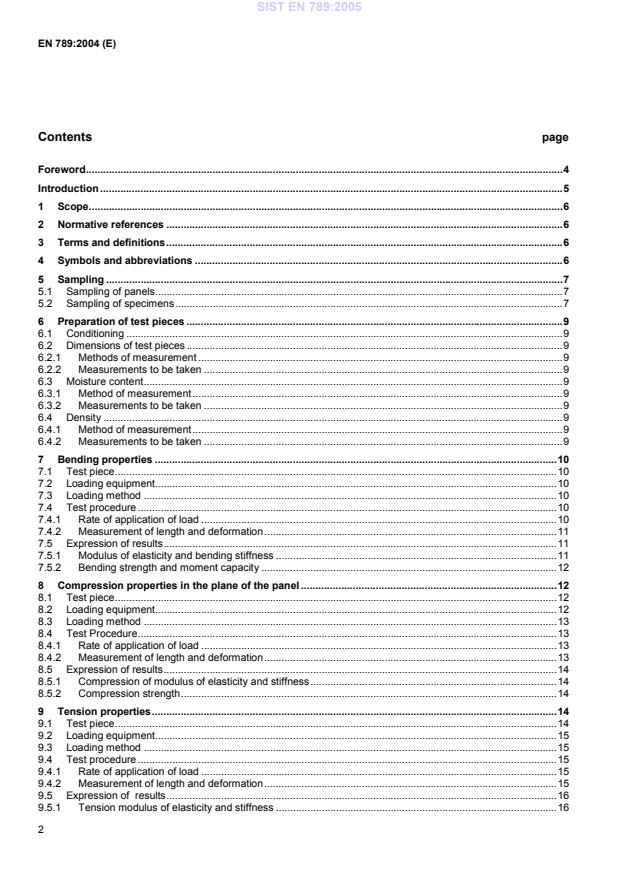
page Foreword.4 Introduction.5 1 Scope.6 2 Normative references.6 3 Terms and definitions.6 4 Symbols and abbreviations.6 5 Sampling.7 5.1 Sampling of panels.7 5.2 Sampling of specimens.7 6 Preparation of test pieces.9 6.1 Conditioning.9 6.2 Dimensions of test pieces.9 6.2.1 Methods of measurement.9 6.2.2 Measurements to be taken.9 6.3 Moisture content.9 6.3.1 Method of measurement.9 6.3.2 Measurements to be taken.9 6.4 Density.9 6.4.1 Method of measurement.9 6.4.2 Measurements to be taken.9 7 Bending properties.10 7.1 Test piece.10 7.2 Loading equipment.10 7.3 Loading method.10 7.4 Test procedure.10 7.4.1 Rate of application of load.10 7.4.2 Measurement of length and deformation.11 7.5 Expression of results.11 7.5.1 Modulus of elasticity and bending stiffness.11 7.5.2 Bending strength and moment capacity.12 8 Compression properties in the plane of the panel.12 8.1 Test piece.12 8.2 Loading equipment.12 8.3 Loading method.13 8.4 Test Procedure.13 8.4.1 Rate of application of load.13 8.4.2 Measurement of length and deformation.13 8.5 Expression of results.14 8.5.1 Compression of modulus of elasticity and stiffness.14 8.5.2 Compression strength.14 9 Tension properties.14 9.1 Test piece.14 9.2 Loading equipment.15 9.3 Loading method.15 9.4 Test procedure.15 9.4.1 Rate of application of load.15 9.4.2 Measurement of length and deformation.15 9.5 Expression of
results.16 9.5.1 Tension modulus of elasticity and stiffness.16 SIST EN 789:2005
In-plane compression test pieces .23 Annex B (normative)
Panel shear test pieces.26 Annex C (normative)
Planar shear test pieces .28 Annex D (informative)
Compression properties perpendicular to the plane of the panel (bearing) .29 Bibliography.32
These properties are intended for the calculation of characteristic values for use in obtaining material design values. For each type and grade of load-bearing panel product, as defined in the Harmonised Standard for wood-based panels (EN 13986), it is necessary to determine characteristic values of mechanical properties to enable it to be used for structural purposes.
This document details the testing required to establish characteristic values. The tests need only be carried out once for each product, unless there is a reason to suspect a significant change has occurred in the properties of the product. NOTE For certain types and grades of panel, characteristic values are given in EN 12369 and these may be used for appropriate panels without further testing to this document. This document is not intended to be used for quality control testing, for which smaller test pieces than specified herein, are adequate. Due to the limited experience in use, the test method for compression perpendicular to the plane of the panel (bearing) is included in Annex D (informative). 2 Normative references The following referenced documents are indispensable for the application of this document. For dated references, only the edition cited applies. For undated references, the latest edition of the referenced document (including any amendments) applies. EN 322, Wood-based panels -Determination of moisture content
EN 323, Wood-based panels - Determination of density EN 325, Wood-based panels - Determination of dimensions of test pieces EN 14358, Structural timber – Calculation of characteristic 5-percentile value
3 Terms and definitions For the purposes of this document, the following terms and definitions apply. 3.1
specimen piece of the panel from which a test piece will be fabricated
3.2
test piece specimen of aggregate of parts from a sample fabricated to the size and shape required for testing
4 Symbols and abbreviations A full cross-sectional area, equal to bt, in square millimetres; b measured width of test piece, in millimetres; E modulus of elasticity, in newtons per square millimetre; F load, in newtons; f strength, in newtons per square millimetre; SIST EN 789:2005
Subscripts applied to loads, capacities, strengths, stiffness, and moduli of elasticity; c compression; m bending; max. maximum; v panel shear; r planar shear; t tension; perp
perpendicular to the plane of the panel.
5 Sampling 5.1 Sampling of panels All panels in a sample shall be of the same type, grade, thickness range and composition or lay-up. The method of sampling and the number of panels required is given in EN 14358. 5.2 Sampling of specimens The specimens for each type of test in each direction shall not be from the same position in different panels of the same sample and shall not number more than one from each panel.
For in-plane compression test pieces, see Annex A (normative).
The position of the specimens within the panels shall be selected to ensure an unbiased sample. NOTE 1 An example of a cutting schedule based on a sample of four panels, each with a minimum area of 1 200 mm x 2 400 mm, is given in Figure 1. NOTE 2 For quality control purposes, it may be necessary to establish correlations between the results from the test methods listed here and those used in the factory. If this is the case, consideration should be given to modifying the cutting plan to allow for the additional test pieces to be included on a “side-matched” basis. SIST EN 789:2005
Figure 1 - Example of a cutting schedule Test Specimen number Bending
longitudinal 1 to 4 lateral 5 to 8 Tension
longitudinal 9 to 12 lateral 13 to 16 Compression
longitudinal 17 to 20 lateral 21 to 24 Panel shear
longitudinal 25 to 28 lateral 29 to 32 Planar shear
longitudinal 33 to 36 lateral 37 to 40
The width of the test pieces shall be measured at two points, generally 80 mm from mid-length, but 25 mm in the case of the in-plane compression test pieces, and the average width b recorded. NOTE If the thicknesses of individual plies or layers in plywood or composite panels are required, then each should be measured to the nearest 0,1 mm at the four edges of the test piece, and averaged. 6.3 Moisture content 6.3.1 Method of measurement The moisture content shall be determined in accordance with EN 322. 6.3.2 Measurements to be taken The moisture content shall be determined from at least one test piece per panel and measured at the time of testing. 6.4 Density 6.4.1 Method of measurement The density shall be determined in accordance with EN 323. 6.4.2 Measurements to be taken The density shall be determined from at least one test piece per panel and measured at the time of testing. SIST EN 789:2005
The depth of the test piece shall be equal to the thickness of the panel and the width shall be (300 ± 5) mm, but see also the NOTE in 7.3. The length of the test piece will depend on the nominal thickness of the panel, see Figure 2. 7.2 Loading equipment The loading equipment shall be capable of measuring the load to an accuracy of 1%. NOTE Since the test piece may twist under load, the loading equipment should be appropriately chosen. 7.3 Loading method The application of the loads shall be as shown in Figure 2 with the load and reaction forces applied by rollers of (30 ± 1) mm diameter.
The distance between the load points and the supports,l2, shall be 16 times the nominal thickness, but not more than 400 mm and not less than 240 mm with an accuracy of ± 1 mm. NOTE Large deflections may occur when test pieces with small bending stiffness are tested to failure, thus alternative test arrangements may be required.
In general, the test configuration described in this section is suitable for a test piece with a thickness greater than 9 mm (corresponding to a bending stiffness per unit width of about 300 kN mm2/mm).
Smaller thicknesses may be tested by using smaller diameter rollers and proportionally reducing the distances between them. Dimensions in millimetres
240 mm ≤ l2 = 16 t ≤ 400 mm Figure 2 - Arrangement for bending test 7.4 Test procedure 7.4.1 Rate of application of load Load F shall be applied at a continuous rate of loading adjusted so that the maximum load is reached within (300 ± 120) s, and with a mean value of about 300 s for a sample. SIST EN 789:2005
The deflection of the test piece shall be measured on both sides midway between two points on the axis of the test piece located in the zone of uniform moment.
The distance between the two points (gauge length) shall be not less than 250 mm and the points shall be spaced as far apart as possible, consistent with maintaining adequate clearance between the gauges and the loading equipment.
NOTE For thicknesses of 9 mm or less, the 250 mm gauge length may be proportionally reduced. For these cases the deflection can be taken on the outer tension side. The deflection over the gauge length shall be measured to the nearest 0,01 mm. 7.5 Expression of results 7.5.1 Modulus of elasticity and bending stiffness Using the data obtained and plot the load-deflection graph. Use that section of the graph between 0,1Fmax and 0,4Fmax for a linear regression analyses.
The bending modulus of elasticity of the test piece shall be calculated from the following formula: IuullFFEm)(16)(1222112−−=
The bending stiffness of the test pie
...