

EN 16842-11:2026
(Main)Powered industrial trucks - Visibility - Test methods and verification - Part 11: Pallet-stacking trucks (rider controlled)
- Abstract
This document specifies the requirements and test procedures for 360° visibility of self-propelled industrial rider-controlled pallet-stacking trucks in accordance with ISO 5053 1 (herein after referred to as trucks), without a load and it is intended to be used in conjunction with EN 16842 1.
This document also applies to pedestrian controlled trucks with foldable platform when used in ride-on mode.
Pedestrian-controlled trucks without an operator on the platform and pedestrian-propelled trucks are not covered by this document.
Where specific requirements in this part are modified from the general requirements in EN 16842 1, the requirements of this part are truck specific and intended to be used for self-propelled industrial stand-on pallet-stacking trucks.
This part of EN 16842 deals with all significant hazards, hazardous situations or hazardous events relevant to the visibility of the operator for applicable machines when used as intended and under conditions of misuse which are reasonably foreseeable by the manufacturer.
- Status
- Published
- Publication Date
- 28-Jul-2026
- Technical Committee
- CEN/TC 150 - Industrial trucks - Safety
- Drafting Committee
- CEN/TC 150/WG 14 - Visibility
- Current Stage
- 6060 - Definitive text made available (DAV) - Publishing
- Start Date
- 29-Jul-2026
- Due Date
- 09-Nov-2026
- Completion Date
- 29-Jul-2026

EN 16842-11 is a CEN standard for visibility test methods and verification for powered industrial trucks, focused on pallet-stacking trucks (rider controlled). It specifies how to assess 360° visibility for self-propelled industrial rider-controlled pallet-stacking trucks without a load, and it is used together with EN 16842-1. It is written for manufacturers, test laboratories, and anyone verifying whether these trucks meet the required operator-visibility performance.
What does EN 16842-11 specify?
EN 16842-11 specifies the requirements and test procedures for 360° visibility on rider-controlled pallet-stacking trucks. It also applies to pedestrian controlled trucks with foldable platform when they are used in ride-on mode.
The scope is limited to visibility of the operator for the applicable machines when used as intended and under reasonably foreseeable misuse. Pedestrian-controlled trucks without an operator on the platform and pedestrian-propelled trucks are outside the scope.
The document is organized into clauses on:
- scope, normative references, and terms and definitions
- truck configuration and test equipment
- direct visibility test procedures
- acceptance criteria
- test report and information for use
Clause 7 separates the acceptance criteria for trucks where the operator faces the line of travel and trucks where the operator faces at a right angle to the line of travel.
What are the key requirements of EN 16842-11?
Truck configuration and test setup
EN 16842-11 uses the general configuration rules of EN 16842-1, with a truck-specific fork-height condition in Clause 4. The load carrying surface of the fork arms, measured at the heel, is positioned up to 120 mm above the floor.
That matters because the visibility test has to reflect a defined, repeatable empty-truck condition. The same clause points back to EN 16842-1 for the rest of the configuration rules.
Lighting equipment and operator reference points
EN 16842-11 determines visibility from the normal operating ride-on position using lighting equipment and a test body or screen. The lighting equipment simulates operator eye positions, while the test body or screen simulates an obstacle.
For stand-on trucks, the test fixture is located from the Standing Index Point (STIP). The document allows an Adjusted STIP (ASTIP) within a defined radius to represent body movement during operation, and each STIP used on a truck has to be fixed and recorded.
For sit-on trucks, the fixture is positioned relative to the Seat Index Point (SIP), and the seat is set at the closest adjustment position to the mid-point of its horizontal and vertical adjustment and suspension height. In practice, this fixes the test posture so that the results are comparable.
Direct visibility test paths
Clause 6 uses test paths P1 to P9 laid out around the truck, parallel or perpendicular to the longitudinal axis. The measurement procedure follows EN 16842-1, with the tables in this part defining which paths and directions apply to each truck orientation.
This is the core of the practical test. It shows whether the operator can see forward, backward, and into manoeuvring directions around the truck profile.
Acceptance criteria
Clause 7 sets separate criteria for direct visibility and indirect visibility. For direct visibility, the standard distinguishes travelling visibility, manoeuvring visibility, and fork-arm visibility.
EN 16842-11 also sets minimum illuminated-area requirements for the test object surface. The tables in Clause 7 then specify the required test object, the operator direction, the distance to the axis of rotation, the number of lights, and the test paths to use.
For indirect visibility and auxiliary equipment, the document refers back to EN 16842-1. That means the reader must check the general requirements there as well as the truck-specific criteria here.
Test report and user information
Clause 8 sends the test report back to EN 16842-1. Clause 9 requires handbook information for operating the truck where a load or attachment can restrict visibility, in line with EN ISO 3691-1.
What terms does EN 16842-11 define?
- truck profile - The outline used for the visibility evaluation, based on the largest rectangular width and length parallel to the longitudinal axis, including the front vertical surface of the outriggers.
- STIP - Standing Index Point, the reference point used to locate the standing operator in the test setup.
- ASTIP - Adjusted STIP, a permitted relocated point used to simulate limited movement of the standing operator during a test.
- SIP - Seat Index Point, the reference point used to position the seated operator for sit-on trucks.
- test body - The obstacle-like target used to check whether the operator can see around the truck.
- test screen - A screen used in certain travelling-visibility checks instead of the test body.
Who uses EN 16842-11?
EN 16842-11 is used by industrial truck manufacturers, test laboratories, certification bodies, and safety or quality teams that verify visibility performance. It is also relevant to buyers and integrators who need to confirm that a pallet-stacking truck has been tested to a defined visibility method.
In practice, users apply it when configuring a truck for test, setting up the operator reference point, laying out the test paths, checking direct and indirect visibility, and documenting the results. It is especially useful for stand-on and rider-controlled pallet-stacking truck designs.
Which standards are used with EN 16842-11?
| Standard | What it contributes |
|---|---|
| EN 16842-1:2018 | General requirements for visibility testing, including configuration, equipment, measurement procedure, indirect visibility, and test reporting baseline |
| EN ISO 3691-1:2015 | Broader industrial-truck safety requirements and the handbook information requirement for cases where loads or attachments restrict visibility |
| ISO 5053-1:2020 | Vocabulary and truck-type definitions used to identify the machines covered |
EN 16842-11 is also part of the EN 16842 series. Part 1 gives the general requirements, and Parts 2 to 10 cover other truck categories in the same visibility-test family.
What does the EN 16842-11 document contain?
EN 16842-11 contains figures for locating the STIP and SIP, setting standing and seating directions, and laying out the visibility test paths around the truck. It also contains two acceptance tables, one for trucks where the operator faces the line of travel and one for trucks where the operator faces at a right angle to the line of travel.
The document describes the direct-visibility test method, the indirect-visibility procedure, and the criteria used to decide pass or fail. It also gives the report and handbook-information links needed for technical files, testing, and operator instructions.
Relations
- Effective Date
- 25-Aug-2026
- Effective Date
- 25-Aug-2026
- Effective Date
- 25-Aug-2026
- Effective Date
- 25-Aug-2026
- Effective Date
- 25-Aug-2026
- Effective Date
- 25-Aug-2026
Frequently Asked Questions
EN 16842-11:2026 is a draft published by the European Committee for Standardization (CEN). Its full title is "Powered industrial trucks - Visibility - Test methods and verification - Part 11: Pallet-stacking trucks (rider controlled)". This standard covers: This document specifies the requirements and test procedures for 360° visibility of self-propelled industrial rider-controlled pallet-stacking trucks in accordance with ISO 5053 1 (herein after referred to as trucks), without a load and it is intended to be used in conjunction with EN 16842 1. This document also applies to pedestrian controlled trucks with foldable platform when used in ride-on mode. Pedestrian-controlled trucks without an operator on the platform and pedestrian-propelled trucks are not covered by this document. Where specific requirements in this part are modified from the general requirements in EN 16842 1, the requirements of this part are truck specific and intended to be used for self-propelled industrial stand-on pallet-stacking trucks. This part of EN 16842 deals with all significant hazards, hazardous situations or hazardous events relevant to the visibility of the operator for applicable machines when used as intended and under conditions of misuse which are reasonably foreseeable by the manufacturer.
This document specifies the requirements and test procedures for 360° visibility of self-propelled industrial rider-controlled pallet-stacking trucks in accordance with ISO 5053 1 (herein after referred to as trucks), without a load and it is intended to be used in conjunction with EN 16842 1. This document also applies to pedestrian controlled trucks with foldable platform when used in ride-on mode. Pedestrian-controlled trucks without an operator on the platform and pedestrian-propelled trucks are not covered by this document. Where specific requirements in this part are modified from the general requirements in EN 16842 1, the requirements of this part are truck specific and intended to be used for self-propelled industrial stand-on pallet-stacking trucks. This part of EN 16842 deals with all significant hazards, hazardous situations or hazardous events relevant to the visibility of the operator for applicable machines when used as intended and under conditions of misuse which are reasonably foreseeable by the manufacturer.
EN 16842-11:2026 is classified under the following ICS (International Classification for Standards) categories: 53.060 - Industrial trucks. The ICS classification helps identify the subject area and facilitates finding related standards.
EN 16842-11:2026 has the following relationships with other standards: It is inter standard links to ISO 5053-3:2024, ISO 5053-1:2020, EN ISO 3691-1:2015/A1:2020, EN 16842-1:2018, EN ISO 3691-1:2015, ISO 5053-2:2019. Understanding these relationships helps ensure you are using the most current and applicable version of the standard.
EN 16842-11:2026 is associated with the following European legislation: EU Directives/Regulations: 2006/42/EC. When a standard is cited in the Official Journal of the European Union, products manufactured in conformity with it benefit from a presumption of conformity with the essential requirements of the corresponding EU directive or regulation.
EN 16842-11:2026 is available in PDF format for immediate download after purchase. The document can be added to your cart and obtained through the secure checkout process. Digital delivery ensures instant access to the complete standard document.
Standards Content (Sample)
SLOVENSKI STANDARD
oSIST prEN 16842-11:2025
01-maj-2025
Vozila za talni transport - Gnana vozila za talni transport - Vidno polje voznika -
Preskusne metode in preverjanje - 11. del: Viličar (ki ga upravlja voznik)
Powered industrial trucks - Visibility - Test methods and verification - Part 11: Pallet
stacking trucks (rider controlled)
Kraftbetriebene Flurförderzeuge - Sichtverhältnisse - Prüfverfahren und Verifikation - Teil
11: Gabelhochhubwagen (Mitfahrer bedient)
Chariots de manutention automoteurs - Visibilité - Méthode d'essai et vérification - Partie
11 : Chariot à fourche (conducteur porté)
Ta slovenski standard je istoveten z: prEN 16842-11
ICS:
53.060 Industrijski tovornjaki Industrial trucks
oSIST prEN 16842-11:2025 en,fr,de
2003-01.Slovenski inštitut za standardizacijo. Razmnoževanje celote ali delov tega standarda ni dovoljeno.
oSIST prEN 16842-11:2025
oSIST prEN 16842-11:2025
DRAFT
EUROPEAN STANDARD
prEN 16842-11
NORME EUROPÉENNE
EUROPÄISCHE NORM
April 2025
ICS 53.060
English Version
Powered industrial trucks - Visibility - Test methods and
verification - Part 11: Pallet stacking trucks (rider
controlled)
Chariots de manutention automoteurs - Visibilité - Kraftbetriebene Flurförderzeuge - Sichtverhältnisse -
Méthode d'essai et vérification - Partie 11 : Chariot à Prüfverfahren und Verifikation - Teil 11:
fourche (conducteur porté) Gabelhochhubwagen (Mitfahrer bedient)
This draft European Standard is submitted to CEN members for enquiry. It has been drawn up by the Technical Committee
CEN/TC 150.
If this draft becomes a European Standard, CEN members are bound to comply with the CEN/CENELEC Internal Regulations
which stipulate the conditions for giving this European Standard the status of a national standard without any alteration.
This draft European Standard was established by CEN in three official versions (English, French, German). A version in any other
language made by translation under the responsibility of a CEN member into its own language and notified to the CEN-CENELEC
Management Centre has the same status as the official versions.
CEN members are the national standards bodies of Austria, Belgium, Bulgaria, Croatia, Cyprus, Czech Republic, Denmark, Estonia,
Finland, France, Germany, Greece, Hungary, Iceland, Ireland, Italy, Latvia, Lithuania, Luxembourg, Malta, Netherlands, Norway,
Poland, Portugal, Republic of North Macedonia, Romania, Serbia, Slovakia, Slovenia, Spain, Sweden, Switzerland, Türkiye and
United Kingdom.
Recipients of this draft are invited to submit, with their comments, notification of any relevant patent rights of which they are
aware and to provide supporting documentation.
Warning : This document is not a European Standard. It is distributed for review and comments. It is subject to change without
notice and shall not be referred to as a European Standard.
EUROPEAN COMMITTEE FOR STANDARDIZATION
COMITÉ EUROPÉEN DE NORMALISATION
EUROPÄISCHES KOMITEE FÜR NORMUNG
CEN-CENELEC Management Centre: Rue de la Science 23, B-1040 Brussels
© 2025 CEN All rights of exploitation in any form and by any means reserved Ref. No. prEN 16842-11:2025 E
worldwide for CEN national Members.
oSIST prEN 16842-11:2025
prEN 16842-11:2025 (E)
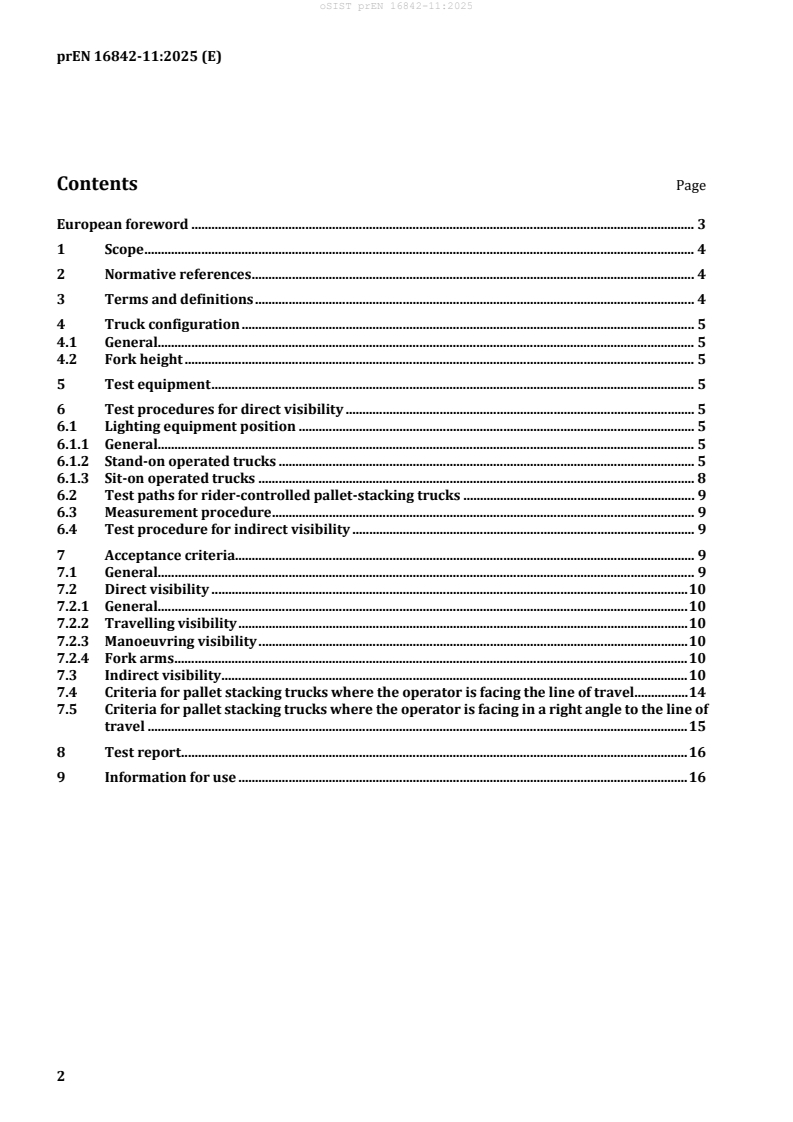
Contents Page
European foreword . 3
1 Scope . 4
2 Normative references . 4
3 Terms and definitions . 4
4 Truck configuration . 5
4.1 General. 5
4.2 Fork height . 5
5 Test equipment . 5
6 Test procedures for direct visibility . 5
6.1 Lighting equipment position . 5
6.1.1 General. 5
6.1.2 Stand-on operated trucks . 5
6.1.3 Sit-on operated trucks . 8
6.2 Test paths for rider-controlled pallet-stacking trucks . 9
6.3 Measurement procedure . 9
6.4 Test procedure for indirect visibility . 9
7 Acceptance criteria. 9
7.1 General. 9
7.2 Direct visibility . 10
7.2.1 General. 10
7.2.2 Travelling visibility . 10
7.2.3 Manoeuvring visibility . 10
7.2.4 Fork arms . 10
7.3 Indirect visibility . 10
7.4 Criteria for pallet stacking trucks where the operator is facing the line of travel . 14
7.5 Criteria for pallet stacking trucks where the operator is facing in a right angle to the line of
travel . 15
8 Test report . 16
9 Information for use . 16
oSIST prEN 16842-11:2025
prEN 16842-11:2025 (E)
European foreword
This document (prEN 16842-11:2025) has been prepared by Technical Committee CEN/TC 150
“Industrial Trucks – Safety”, the secretariat of which is held by BSI.
This document is currently submitted to the CEN Enquiry.
This document is intended to be used in combination with the requirements in EN 16842-1. The
EN 16842 series consists of the following parts under the general title “Powered industrial trucks –
Visibility – Test methods and verification”:
— part 1: General requirements;
— part 2: Sit-on counterbalance trucks and rough terrain masted trucks up to and including 10 000 kg
capacity;
— part 3: Reach trucks up to and including 10 000 kg capacity;
— part 4: Industrial variable reach trucks up to and including 10 000 kg capacity;
— part 5: Industrial variable reach trucks greater than 10 000 kg capacity;
— part 6: Sit-on counterbalance trucks and rough terrain masted trucks greater than 10 000 kg
capacity;
— part 7: Variable reach and masted container trucks handling freight containers of 6 m (20 ft) length
and longer;
— part 8: Stand on counterbalance trucks up to and including 10 000 kg capacity;
— part 9: Order-picking, lateral- and front-stacking trucks with elevating operator position;
— part 10: Towing and pushing tractors and burden carrier;
— part 11: Pallet stacking trucks (rider-controlled).
It is intended to develop the parts related to the following machinery:
— single side loader;
— multi-directional forklift truck;
— non-stacking low-lift straddle carrier (as defined in ISO 5053-1:2020, 3.18);
— stacking high-lift straddle carrier (as defined in ISO 5053-1:2020, 3.19).
oSIST prEN 16842-11:2025
prEN 16842-11:2025 (E)
1 Scope
This document specifies the requirements and test procedures for 360° visibility of self-propelled
industrial rider-controlled pallet-stacking trucks in accordance with ISO 5053-1 (herein after referred to
as trucks), without a load and it is intended to be used in conjunction with EN 16842-1.
This document also applies to pedestrian controlled trucks with foldable platform when used in ride-on
mode.
Pedestrian-controlled and pedestrian-propelled trucks are not covered by this document.
Where specific requirements in this part are modified from the general requirements in EN 16842-1, the
requirements of this part are truck specific and intended to be used for self-propelled industrial stand-
on pallet-stacking trucks.
This part of EN 16842 deals with all significant hazards, hazardous situations or hazardous events
relevant to the visibility of the operator for applicable machines when used as intended and under
conditions of misuse which are reasonably foreseeable by the manufacturer.
2 Normative references
The following documents are referred to in the text in such a way that some or all of their content
constitutes requirements of this document. For dated references, only the edition cited applies. For
undated references, the latest edition of the referenced document (including any amendments) applies.
EN 16842-1:2018, Powered industrial trucks — Visibility — Test methods and verification — Part 1:
General requirements
EN ISO 3691-1:2015, Industrial trucks —- Safety requirements and verification — Part 1: Self-propelled
industrial trucks, other than driverless trucks, variable-reach trucks and burden-carrier trucks
(ISO 3691-1:2011, including Cor 1:2013)
ISO 5053-1:2020, Industrial trucks — Vocabulary — Part 1: Types of industrial trucks
3 Terms and definitions
For the purposes of this document, the terms and definitions given in EN 16842-1:2018, ISO 5053-1:2020
and EN ISO 3691-1:2015 and the following apply.
NOTE Definition 3.1 of EN 16842-1:2018 is not applicable for stand-on straddle trucks covered by this part.
ISO and IEC maintain terminology databases for use in standardization at the following addresses:
— ISO Online browsing platform: available at https://www.iso.org/obp/
— IEC Electropedia: available at https://www.electropedia.org/
3.1
truck profile
contour which is determined by the largest rectangular width and length
parallel to the longitudinal axis of the truck, including the front vertical surface of the outriggers
Note 1 to entry: The blades of the fork arms are not taken into account.
As impacted by EN ISO 3691-1:2015/AC:2016 and EN ISO 3691-1:2015
...