

EN 1254-20:2021+A1:2025
(Main + Amendment)Copper and copper alloys - Plumbing fittings - Part 20: Definitions, thread dimensions, test methods, reference data and supporting information
- Abstract
This document contains definitions, thread dimension, reference data (minimum bore and wall thickness), supporting information (assembling instructions) and describes the test methods referenced by other parts of the EN 1254 series.
Thread dimensions comprise: wall thickness at threaded portions of fittings, dimensions of tail pipe ends for swivel fittings, dimensions of gas union connectors, thread dimensions and thread profile.
Test methods comprise: leak tightness under internal hydrostatic pressure, leak tightness under internal pneumatic pressure, integrity of fabricated fitting bodies or having an 'as cast' microstructure, resistance to pull out of joints to metallic tubes, resistance of joints with metallic tube to vibration, resistance of joints to static flexural force, leak tightness of joints under vacuum, the resistance of joints to temperature cycling, detecting non-pressed fitting ends, resistance to stress corrosion, detection of a carbon film on the surface of copper fittings, determination of mean depth of dezincification, resistance of joints to pressure cycling, disconnection and re-use, determining if the diameter and/or the length of engagement of a capillary end is/are within the specified tolerance, determining the minimum length of engagement of an integral solder or brazing ring socket having a formed groove.
- Status
- Published
- Publication Date
- 11-Feb-2025
- Technical Committee
- CEN/TC 133 - Copper and copper alloys
- Drafting Committee
- CEN/TC 133/WG 8 - Fittings
- Current Stage
- 9020 - Submission to 2 Year Review Enquiry - Review Enquiry
- Start Date
- 15-Jul-2026
- Completion Date
- 15-Jul-2026

Overview
EN 1254-20:2021+A1:2025 - published by CEN - is the part of the EN 1254 series that provides definitions, thread dimensions, reference data, test methods and supporting information for copper and copper-alloy plumbing fittings. It consolidates essential dimensional rules (thread profile, wall thickness, tail pipe and gas union connector dimensions), minimum bore and wall thickness reference data, assembly guidance and the detailed test methods referenced across the EN 1254 family. The document includes Amendment A1 (approved December 2024) and updates the 2021 edition.
Key topics and technical requirements
The standard concentrates on measurable, testable requirements that support safe, reliable copper fittings in plumbing and fuel-gas systems. Major technical topics include:
Thread dimensions and profiles
- Wall thickness at threaded portions
- Threaded end dimensions and thread profile
- Dimensions of tail pipe ends for swivel fittings
- Dimensions for gas union connectors
- Minimum bore and cross-sectional area requirements
Reference data and supporting information
- Minimum bore and wall thickness tables (reference data)
- Assembling instructions and supporting guidance for installers
Comprehensive test methods (described so they can be referenced by other EN 1254 parts), including:
- Leak tightness under internal hydrostatic and pneumatic pressure
- Leak tightness of joints under vacuum
- Resistance to pull-out and resistance to vibration
- Resistance to static flexural force and temperature cycling (liquid and fuel-gas applications)
- Resistance to pressure cycling, disconnection and re‑use
- Integrity of fabricated or 'as cast' fitting bodies
- Detection of non-pressed fitting ends and carbon films
- Resistance to stress corrosion and determination of mean depth of dezincification
- Methods for measuring capillary engagement and minimum engagement of solder/brazing ring sockets
Practical applications and users
Who uses EN 1254-20:2021+A1:2025:
- Manufacturers of copper and copper-alloy plumbing fittings - for design, quality control and type testing
- Component laboratories and test houses - to perform standardized test methods and report results
- Certification bodies and conformity assessors - to verify compliance with EN 1254 series requirements
- Specifiers, engineers and installers - for assembly guidance and dimensional compatibility checks in potable water, heating and fuel-gas installations
This standard supports product safety, interchangeability and performance verification across plumbing supply chains.
Related standards
- Other parts of the EN 1254 series (product-specific requirements and performance criteria)
- National adoptions of EN 1254-20 and related ISO/CEN standards for metallic fittings
Keywords: EN 1254-20:2021+A1:2025, copper fittings, thread dimensions, plumbing fittings standard, leak tightness test, dezincification, pressure cycling, CEN standard.
Relations
- Effective Date
- 27-Nov-2024
- Effective Date
- 27-Nov-2024
- Effective Date
- 04-Mar-2026
- Effective Date
- 04-Mar-2026
- Effective Date
- 04-Mar-2026
- Effective Date
- 04-Mar-2026
- Effective Date
- 28-Jan-2026
- Effective Date
- 28-Jan-2026
- Refers
EN 1333:2006 - Flanges and their joints - Pipework components - Definition and selection of PN - Effective Date
- 28-Jan-2026
- Effective Date
- 28-Jan-2026
- Refers
prEN 15116 - Ventilation in buildings - Chilled beams - Testing and rating of active chilled beams - Effective Date
- 28-Jan-2026
- Effective Date
- 28-Jan-2026
- Effective Date
- 28-Jan-2026
- Effective Date
- 28-Jan-2026
- Effective Date
- 28-Jan-2026
Get Certified
Connect with accredited certification bodies for this standard

Institut za varilstvo d.o.o. (Welding Institute)
Slovenia's leading welding institute since 1952. ISO 3834, EN 1090, pressure equipment certification, NDT personnel, welder qualification. Only IIW Au
Sponsored listings
Frequently Asked Questions
EN 1254-20:2021+A1:2025 is a standard published by the European Committee for Standardization (CEN). Its full title is "Copper and copper alloys - Plumbing fittings - Part 20: Definitions, thread dimensions, test methods, reference data and supporting information". This standard covers: This document contains definitions, thread dimension, reference data (minimum bore and wall thickness), supporting information (assembling instructions) and describes the test methods referenced by other parts of the EN 1254 series. Thread dimensions comprise: wall thickness at threaded portions of fittings, dimensions of tail pipe ends for swivel fittings, dimensions of gas union connectors, thread dimensions and thread profile. Test methods comprise: leak tightness under internal hydrostatic pressure, leak tightness under internal pneumatic pressure, integrity of fabricated fitting bodies or having an 'as cast' microstructure, resistance to pull out of joints to metallic tubes, resistance of joints with metallic tube to vibration, resistance of joints to static flexural force, leak tightness of joints under vacuum, the resistance of joints to temperature cycling, detecting non-pressed fitting ends, resistance to stress corrosion, detection of a carbon film on the surface of copper fittings, determination of mean depth of dezincification, resistance of joints to pressure cycling, disconnection and re-use, determining if the diameter and/or the length of engagement of a capillary end is/are within the specified tolerance, determining the minimum length of engagement of an integral solder or brazing ring socket having a formed groove.
This document contains definitions, thread dimension, reference data (minimum bore and wall thickness), supporting information (assembling instructions) and describes the test methods referenced by other parts of the EN 1254 series. Thread dimensions comprise: wall thickness at threaded portions of fittings, dimensions of tail pipe ends for swivel fittings, dimensions of gas union connectors, thread dimensions and thread profile. Test methods comprise: leak tightness under internal hydrostatic pressure, leak tightness under internal pneumatic pressure, integrity of fabricated fitting bodies or having an 'as cast' microstructure, resistance to pull out of joints to metallic tubes, resistance of joints with metallic tube to vibration, resistance of joints to static flexural force, leak tightness of joints under vacuum, the resistance of joints to temperature cycling, detecting non-pressed fitting ends, resistance to stress corrosion, detection of a carbon film on the surface of copper fittings, determination of mean depth of dezincification, resistance of joints to pressure cycling, disconnection and re-use, determining if the diameter and/or the length of engagement of a capillary end is/are within the specified tolerance, determining the minimum length of engagement of an integral solder or brazing ring socket having a formed groove.
EN 1254-20:2021+A1:2025 is classified under the following ICS (International Classification for Standards) categories: 23.040.40 - Metal fittings. The ICS classification helps identify the subject area and facilitates finding related standards.
EN 1254-20:2021+A1:2025 has the following relationships with other standards: It is inter standard links to EN 1254-20:2021/prA1, EN 1254-20:2021, ISO 2859-1:1999, ISO 7-1:1994, ISO 6957:1988, ISO 7-2:2000, EN 196-1:1994, EN 14989-1:2007, EN 1333:2006, EN 723:2009, prEN 15116, EN ISO 6708:1995, EN 1057:2006+A1:2010, EN ISO 21003-1:2008, EN ISO 6509-1:2014. Understanding these relationships helps ensure you are using the most current and applicable version of the standard.
EN 1254-20:2021+A1:2025 is available in PDF format for immediate download after purchase. The document can be added to your cart and obtained through the secure checkout process. Digital delivery ensures instant access to the complete standard document.
Standards Content (Sample)
SLOVENSKI STANDARD
01-april-2025
Baker in bakrove zlitine - Fitingi - 20. del: Definicije, mere navojev, preskusne
metode, referenčni podatki in dodatne informacije (vključno z dopolnilom A1)
Copper and copper alloys - Plumbing fittings - Part 20: Definitions, thread dimensions,
test methods, reference data and supporting information
Kupfer und Kupferlegierungen - Fittings - Teil 20: Definitionen, Gewindemaße,
Prüfverfahren, Referenzdaten und ergänzende Informationen
Cuivre et alliages de cuivre - Raccords - Partie 20 : Définitions, dimensions de filetage,
méthodes d'essai, données de référence et informations complémentaires
Ta slovenski standard je istoveten z: EN 1254-20:2021+A1:2025
ICS:
23.040.40 Kovinski fitingi Metal fittings
77.150.30 Bakreni izdelki Copper products
2003-01.Slovenski inštitut za standardizacijo. Razmnoževanje celote ali delov tega standarda ni dovoljeno.
EN 1254-20:2021+A1
EUROPEAN STANDARD
NORME EUROPÉENNE
February 2025
EUROPÄISCHE NORM
ICS 23.040.40 Supersedes EN 1254-20:2021
English Version
Copper and copper alloys - Plumbing fittings - Part 20:
Definitions, thread dimensions, test methods, reference
data and supporting information
Cuivre et alliages de cuivre - Raccords - Partie 20 : Kupfer und Kupferlegierungen - Fittings - Teil 20:
Définitions, dimensions de filetage, méthodes d'essai, Definitionen, Gewindemaße, Prüfverfahren,
données de référence et informations complémentaires Referenzdaten und ergänzende Informationen
This European Standard was approved by CEN on 23 November 2020 and includes Amendment 1 approved by CEN on 5
December 2024.
CEN members are bound to comply with the CEN/CENELEC Internal Regulations which stipulate the conditions for giving this
European Standard the status of a national standard without any alteration. Up-to-date lists and bibliographical references
concerning such national standards may be obtained on application to the CEN-CENELEC Management Centre or to any CEN
member.
This European Standard exists in three official versions (English, French, German). A version in any other language made by
translation under the responsibility of a CEN member into its own language and notified to the CEN-CENELEC Management
Centre has the same status as the official versions.
CEN members are the national standards bodies of Austria, Belgium, Bulgaria, Croatia, Cyprus, Czech Republic, Denmark, Estonia,
Finland, France, Germany, Greece, Hungary, Iceland, Ireland, Italy, Latvia, Lithuania, Luxembourg, Malta, Netherlands, Norway,
Poland, Portugal, Republic of North Macedonia, Romania, Serbia, Slovakia, Slovenia, Spain, Sweden, Switzerland, Türkiye and
United Kingdom.
EUROPEAN COMMITTEE FOR STANDARDIZATION
COMITÉ EUROPÉEN DE NORMALISATION
EUROPÄISCHES KOMITEE FÜR NORMUNG
CEN-CENELEC Management Centre: Rue de la Science 23, B-1040 Brussels
© 2025 CEN All rights of exploitation in any form and by any means reserved Ref. No. EN 1254-20:2021+A1:2025 E
worldwide for CEN national Members.
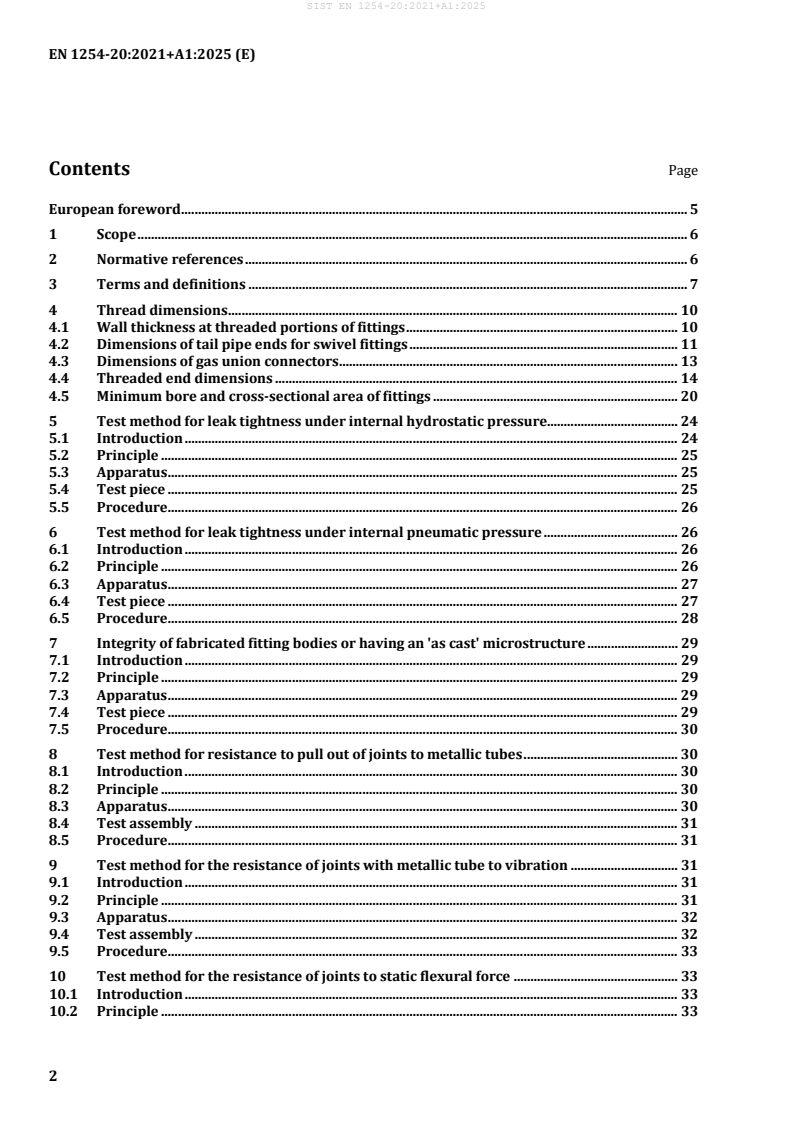
Contents Page
European foreword . 5
1 Scope . 6
2 Normative references . 6
3 Terms and definitions . 7
4 Thread dimensions . 10
4.1 Wall thickness at threaded portions of fittings . 10
4.2 Dimensions of tail pipe ends for swivel fittings . 11
4.3 Dimensions of gas union connectors. 13
4.4 Threaded end dimensions . 14
4.5 Minimum bore and cross-sectional area of fittings . 20
5 Test method for leak tightness under internal hydrostatic pressure. 24
5.1 Introduction . 24
5.2 Principle . 25
5.3 Apparatus . 25
5.4 Test piece . 25
5.5 Procedure . 26
6 Test method for leak tightness under internal pneumatic pressure . 26
6.1 Introduction . 26
6.2 Principle . 26
6.3 Apparatus . 27
6.4 Test piece . 27
6.5 Procedure . 28
7 Integrity of fabricated fitting bodies or having an 'as cast' microstructure . 29
7.1 Introduction . 29
7.2 Principle . 29
7.3 Apparatus . 29
7.4 Test piece . 29
7.5 Procedure . 30
8 Test method for resistance to pull out of joints to metallic tubes . 30
8.1 Introduction . 30
8.2 Principle . 30
8.3 Apparatus . 30
8.4 Test assembly . 31
8.5 Procedure . 31
9 Test method for the resistance of joints with metallic tube to vibration . 31
9.1 Introduction . 31
9.2 Principle . 31
9.3 Apparatus . 32
9.4 Test assembly . 32
9.5 Procedure . 33
10 Test method for the resistance of joints to static flexural force . 33
10.1 Introduction . 33
10.2 Principle . 33
10.3 Apparatus . 33
10.4 Test piece . 33
10.5 Procedure . 34
11 Test method for leak tightness of joints under vacuum . 35
11.1 Introduction . 35
11.2 Principle . 35
11.3 Apparatus . 35
11.4 Test piece . 36
11.5 Procedure . 36
12 Test method for the resistance of joints to temperature cycling (liquid applications) . 37
12.1 Introduction . 37
12.2 Principle . 37
12.3 Apparatus . 37
12.4 Test assembly . 37
12.5 Procedure . 39
13 Test method for the resistance of joints to temperature cycling (fuel gas
applications) . 39
13.1 Introduction . 39
13.2 Principle . 40
13.3 Apparatus . 40
13.4 Test assembly . 40
13.5 Procedure . 40
14 Method for detecting non-pressed fitting ends. 41
14.1 Introduction . 41
14.2 Principle . 41
14.3 Apparatus . 41
14.4 Test piece . 42
14.5 Procedure . 42
14.6 Results . 42
15 Determination of resistance to stress corrosion . 43
15.1 Introduction . 43
15.2 Test piece . 43
15.3 Procedure . 43
15.4 Test report. 43
16 Test method for detection of a carbon film on the surface of copper fittings . 43
16.1 Preparation of the test piece . 43
16.2 Procedure . 43
16.3 Detection and assessment of films . 44
17 Determination of mean depth of dezincification . 44
17.1 Introduction . 44
17.2 Procedure . 44
17.3 Expression of results . 44
18 Test method for the resistance of joints to pressure cycling . 45
18.1 Introduction . 45
18.2 Principle . 45
18.3 Apparatus . 45
18.4 Test pieces . 47
18.5 Procedure . 47
19 Test method for disconnection and re-use . 48
19.1 Introduction . 48
19.2 Principle . 48
19.3 Apparatus . 48
19.4 Test assembly . 48
19.5 Procedure . 48
20 Method for determining if the diameter and/or the length of engagement of a
capillary end is/are within the specified tolerance . 48
20.1 Principle . 48
20.2 Apparatus . 49
20.3 Test piece . 53
20.4 Procedure . 53
20.5 Results . 53
21 Method for determining the minimum length of engagement of an integral solder or
brazing ring socket having a formed groove . 53
21.1 Introduction . 53
21.2 Principle . 53
21.3 Apparatus . 53
21.4 Test piece . 54
21.5 Procedure . 54
21.6 Results . 54
22 !Minimum wall thickness" . 55
Annex A (informative) Assembling instructions . 56
Bibliography . 64
European foreword
This document (EN 1254-20:2021+A1:2025) has been prepared by Technical Committee CEN/TC 133
“Copper and copper alloys”, the secretariat of which is held by DIN.
This European Standard shall be given the status of a national standard, either by publication of an
identical text or by endorsement, at the latest by August 2025, and conflicting national standards shall be
withdrawn at the latest by August 2025.
Attention is drawn to the possibility that some of the elements of this document may be the subject of
patent rights. CEN shall not be held responsible for identifying any or all such patent rights.
This document includes Amendment 1 approved by CEN on 5 December 2024.
This document supersedes !EN 1254-20:2021".
The start and finish of text introduced or altered by amendment is indicated in the text by tags !".
!The need for an amendment was based on the following points:
— include a wall thickness table for copper alloy fittings used in systems according to EN ISO 15874,
EN ISO 15875, EN ISO 15876, EN ISO 15877, EN ISO 21003 and EN ISO 22391."
This document is a supporting standard describing the test methods used by the other parts of the
EN 1254 series.
EN 1254 comprises the following parts under the general title “Copper and copper alloys — Plumbing
fittings”:
— Part 1: Capillary fittings for soldering or brazing to copper tubes
— Part 2: Compression fittings for use with copper tubes
— Part 3: Compression fittings for use with plastics and multilayer pipes
— Part 4: Threaded fittings
— Part 5: Capillary fittings with short ends for brazing to copper tubes
— Part 6: Push-fit fittings for use with metallic tubes, plastics and multilayer pipes
— Part 7: Press fittings for use with metallic tubes
— Part 8: Press fittings for use with plastics and multilayer pipes
— Part 20: Definitions, thread dimensions, test methods, reference data and supporting information
According to the CEN-CENELEC Internal Regulations, the national standards organisations of the
following countries are bound to implement this European Standard: Austria, Belgium, Bulgaria, Croatia,
Cyprus, Czech Republic, Denmark, Estonia, Finland, France, Germany, Greece, Hungary, Iceland, Ireland,
Italy, Latvia, Lithuania, Luxembourg, Malta, Netherlands, Norway, Poland, Portugal, Republic of North
Macedonia, Romania, Serbia, Slovakia, Slovenia, Spain, Sweden, Switzerland, Turkey and the United
Kingdom.
1 Scope
This document contains definitions, thread dimension, reference data (minimum bore !and wall
thickness"), supporting information (assembling instructions) and describes the test methods
referenced by other parts of the EN 1254 series.
Thread dimensions comprise: wall thickness at threaded portions of fittings, dimensions of tail pipe ends
for swivel fittings, dimensions of gas union connectors, thread dimensions and thread profile.
Test methods comprise: leak tightness under internal hydrostatic pressure, leak tightness under internal
pneumatic pressure, integrity of fabricated fitting bodies or having an 'as cast' microstructure, resistance
to pull out of joints to metallic tubes, resistance of joints with metallic tube to vibration, resistance of
joints to static flexural force, leak tightness of joints under vacuum, the resistance of joints to temperature
cycling, detecting non-pressed fitting ends, resistance to stress corrosion, detection of a carbon film on
the surface of copper fittings, determination of mean depth of dezincification, resistance of joints to
pressure cycling, disconnection and re-use, determining if the diameter and/or the length of engagement
of a capillary end is/are within the specified tolerance, determining the minimum length of engagement
of an integral solder or brazing ring socket having a formed groove.
2 Normative references
The following documents are referred to in the text in such a way that some or all of their content
constitutes requirements of this document. For dated references, only the edition cited applies. For
undated references, the latest edition of the referenced document (including any amendments) applies.
EN 723, Copper and copper alloys - Combustion method for determination of the carbon content on the inner
surface of copper tubes or fittings
EN 1057, Copper and copper alloys - Seamless, round copper tubes for water and gas in sanitary and heating
applications
EN 1333:2006, Flanges and their joints - Pipework components - Definition and selection of PN
EN 10226-1, Pipe threads where pressure tight joints are made on the threads - Part 1: Taper external
threads and parallel internal threads - Dimensions, tolerances and designation
EN ISO 228-1, Pipe threads where pressure-tight joints are not made on the threads - Part 1: Dimensions,
tolerances and designation (ISO 228-1)
EN ISO 6509-1:2014, Corrosion of metals and alloys - Determination of dezincification resistance of copper
alloys with zinc - Part 1: Test method (ISO 6509-1:2014)
EN ISO 6708:1995, Pipework components - Definition and selection of DN (nominal size) (ISO 6708:1995)
EN ISO 21003-1:2008, Multilayer piping systems for hot and cold water installations inside buildings - Part
1: General (ISO 21003-1:2008)
ISO 7-1:1994, Pipe threads where pressure-tight joints are made on the threads - Part 1: Dimensions,
tolerances and designation
ISO 7-2, Pipe threads where pressure-tight joints are made on the threads - Part 2: Verification by means of
limit gauges
ISO 2859-1:1999, Sampling procedures for inspection by attributes - Part 1: Sampling schemes indexed by
acceptance quality limit (AQL) for lot-by-lot inspection
ISO 6957:1988, Copper alloys - Ammonia test for stress corrosion resistance
3 Terms and definitions
For the purposes of this document and other parts of the EN 1254 series, the following terms and
definitions apply.
ISO and IEC maintain terminological databases for use in standardization at the following addresses:
— IEC Electropedia: available at http://www.electropedia.org/
— ISO Online browsing platform: available at https://www.iso.org/obp
3.1
plumbing fitting
device used in a tube system for the purpose of connecting the tubes or pipes either to each other or to a
component part of the system
3.2
capillary end
end in which the joint is made by the flow of solder or brazing alloy by capillary action into the annular
space between the capillary end and its connecting part
3.3
end feed fitting
EF
plumbing fitting including one or more capillary ends where the solder or brazing alloy for the capillary
action is introduced externally into the annular space when a connection is made
3.4
integral solder ring fitting
ISR
plumbing fitting including one or more capillary ends that contains the solder alloy needed to make the
connection
3.5
integral brazing ring fitting
IBR
plumbing fitting including one or more capillary ends that contains the brazing alloy needed to make the
connection
3.6
socket
type of end defined by its internal diameter
3.7
male end
type of end defined by its external diameter
3.8
compression end
end in which a mechanical joint is formed by the tightening of a nut to compress a ring or sleeve onto the
outside wall of the tube, or clamp a flared portion of the tube to the body of a fitting
3.8.1
compression end, Type A, non manipulative
end that requires no preparation of the ends of the tube or pipe other than that they are cut square and
deburred, or chamfered when specified, and in which the joint is made by the compression of a ring or
sleeve onto the outside wall of the tube or pipe with or without additional sealing elements and with or
without an internal tube support
Note 1 to entry: The sealing element may be metallic or non-metallic.
3.8.2
compression end, Type B, manipulative
end that requires forming of the tube or pipe at its end, and in which the joint is made by compressing
the formed portion of the tube or pipe against the formed end of the fitting or a loose ring or sleeve within
the fitting/tube/pipe
3.9
union end
end which enables connection and disconnection with minimal disturbance of other pipe sections
Note 1 to entry: Union ends can be sphere to cone, cone to cone, cone to radius or flat face with a sealing member.
Note 2 to entry: Component parts of union ends from different manufacturers should not be regarded as
interchangeable.
3.10
interface thread
end that has male or female jointing or fastening thread, used to connect with a corresponding threaded
pipe or fitting
3.11
jointing thread
thread on a fitting end in which the joint is made pressure tight on the thread
3.12
fastening thread
thread to provide mechanical assembly of a joint in which the seal is not made on the thread
3.13
push-fit end
end which incorporates a sealing element and a gripping device
Note 1 to entry: The joint is made by pushing the tube into the fitting and a seal is achieved without the use of
heat or tools.
Note 2 to entry: In some designs, this type of joint can be disconnected and re-connected or disconnected and the
fitting re-used elsewhere.
3.14
supporting sleeve
device permanently inserted in the tube end to provide internal support for low strength tube or pipe
materials
!Note 1 to entry: The supporting sleeve may be a part of the fitting that sits within the bore of the pipe or
tube, or a separate component."
3.15
press connection
press end in which the joint is effected by the compression and permanent deformation of the ends of the
fitting and/or the tube or male end of a fitting with a pressing tool
3.15.1
radial press end
press end in which the joint is effected by radial compression of the ends of the fitting and the tube with
a pressing tool
3.15.2
axial press end
press end in which the joint is effected by axial movement of a compression sleeve with a tool to compress
the ends of the fitting and the tube
3.15.3
compression sleeve
sleeve moved along the axis of a pipe to compress a fitting end
3.16
pressing tools and jaws
mechanical device which, by closing jaws, either directly or indirectly (axial press end) causes radial
compression of the plumbing fitting end onto the connecting tube
3.17
reducer
fitting or an adaptor used to enable connections between pipework components of different nominal
diameters
3.18
adaptor fitting
fitting combining more than one type of end
3.19
nominal diameter
nominal diameter of the fitting end expressed as the nominal outside diameter of the connecting tube or
pipe
3.20
multilayer pipe
pipe comprising more than one layer, see definitions according to EN ISO 21003-1:2008, 3.1.1, 3.1.2 and
3.1.3
3.21
fuel gas
combustible gases which are gaseous at 15 °C and 1 013 mbar and are generally odorized for safety
reasons, are commonly referred to as manufactured gas, natural gas or liquefied petroleum gases (LPG)
Note 1 to entry: They are also referred to as first, second or third family gases (see EN 437:2018, Table 1).
3.22
maximum operating pressure
MOP
maximum operating pressure at which pipework intended for fluids can be operated under normal
operating conditions
3.23
PN
alphanumeric designation used for reference purposes related to a combination of mechanical and
dimensional characteristics of a component of a pipework system
Note 1 to entry: It comprises the letters PN followed by a dimensionless number.
Note 2 to entry: The maximum allowable pressure of a pipework component depends on the PN number, the
material and design of the component, its maximum allowable temperature, etc.
[SOURCE: EN 1333:2006, 2.1]
3.24
AQL
Acceptance Quality Limit (AQL) is defined in ISO 2859-1:1999, Table I and IIA
3.25
DN
alphanumeric designation of size for components of a pipework system, which is used for reference
purposes. It comprises the letters DN followed by a dimensionless whole number which is indirectly
related to the physical size, in millimetres, of the bore or outside diameter of the end connections
[SOURCE; EN ISO 6708:1995, 2.1]
4 Thread dimensions
4.1 Wall thickness at threaded portions of fittings
The minimum wall thickness at threaded portions of fittings, see Figure 1, shall be as expressed in Table 1
for the relevant diameters.
Figure 1 — Minimum wall thickness at threaded portions of fittings
Table 1 — Minimum wall thickness at threaded portions of fittings
Thread designation Minimum wall thickness of fitting
N
Wrought coppers Cast coppers
and copper alloys and copper
and continuously alloys
cast bar
mm
mm
1/8 1,0 1,0
1/4 1,0 1,0
3/8 1,1 1,1
1/2 1,2 1,2
3/4 1,4 1,5
1 1,5 1,8
1 1/4 1,6 1,8
1 1/2 1,8 2,0
2 1,9 2,3
2 1/2 2,0 2,4
3 2,3 2,6
4 2,8 2,9
4.2 Dimensions of tail pipe ends for swivel fittings
The dimensions of tail pipe ends for swivel fittings, see Figure 2, shall be as expressed in Table 2 for the
relevant thread size.
Key
1 wrought or cast alloy body
2 drawn tubular body
Figure 2 — Tail pipe ends for swivel fittings
Table 2 — Dimensions of tail pipe ends for swivel fittings
Dimension A B C D E F G
in mm mm mm mm mm mm mm mm mm mm mm mm mm
1/2 11,0 10,2 14,6 15,1 18,5 18,0 2,4 1,4 6,4 4,7 0,7 1,2 1,4
3/4 16,1 15,3 19,8 20,0 24,0 23,5 2,4 1,8 6,4 4,7 0,9 1,4 1,6
1 21,2 20,4 25,7 25,7 30,2 29,4 3,0 1,8 6,4 4,7 0,9 1,5 1,8
11/4 25,4 25,4 34,0 33,6 38,9 38,0 3,3 2,0 8,0 6,3 1,0 1,6 1,9
11/2 31,7 31,7 39,6 39,2 44,8 43,9 3,8 2,2 9,6 7,9 1,1 1,8 2,2
2 44,4 43,7 50,8 50,7 56,6 55,4 4,0 2,4 9,6 7,9 1,2 2,0 2,3
21/2 50,8 50,8 56,6 62,0 71,9 71,0 4,3 2,4 9,6 7,9 1,2 2,0 2,4
Nut thread size
Min. (Wrought or
drawn tube)
Min. (casting)
Max.
Max.
Max.
Min.
Min. (Wrought or cast)
Min. (Draw tube)
Max.
Min.
Min. (Draw tube)
Min. (Wrought)
Min. (Casting)
Dimension H J K L M N P R
in mm mm mm mm mm mm mm mm mm mm
1/2 17,0 7,9 2,5 4,5 6,0 5,5 4,5 15,1 14,9 6,0
3/4 22,3 7,9 3,1 4,5 6,0 5,5 4,5 20,4 20,2 6,0
1 28,0 7,9 3,4 5,5 8,0 5,5 4,5 27,1 26,9 6,0
11/4 36,9 9,5 3,9 5,5 8,0 7,0 5,5 34,6 34,4 6,0
11/2 42,6 9,5 4,7 5,5 8,0 7,0 5,5 41,2 41,1 6,0
2 54,3 12,7 4,7 5,5 8,0 7,5 5,5 50,1 49,9 6,0
21/2 60,2 12,7 5,0 6,5 8,0 8,5 6,5 65,2 64,9 7,0
Only dimensions A, B, D and F are relevant for the interface. The other dimensions are informative.
4.3 Dimensions of gas union connectors
The dimensions of fittings with gas union connectors, see Figure 3, shall be as expressed in Table 3 for
corresponding nominal size.
Key
1 seal defined by manufacturer
2 features for transmission of tightening torque, defined by manufacturer
Figure 3 — Gas union connector
Nut thread size
Max.
Min.
Min.
Min. (Taper
spigot)
Min. (Parrallel
and flat)
±0,25
±0,25
Max.
Min.
±0,25
Table 3 — Dimensions of gas union connectors
Dimensions in millimetres
Nominal Matching Union Nut
size thread
or pipe
t
DN d1 d2 d3 d4 d5 (d6) a (h) k l Min w D1 ) D2 m n s u v
1 1 1 1 1 1
10 Rp 3/8 13,0 14,0 20,0 23,5 ) ) 18,0 ) ) ) 11,4 ) G3/8 13,2 12 2,5 19,0 - -
15 Rp 1/2 17,0 18,0 25,0 27,5 25,7 25,9 21,8 20,5 2,5 6,0 29,0 15,0 10,0 G7/8 25,5 16,0 3,5 34,0 - -
20 Rp 3/4 21,0 23,0 31,0 34,5 33,4 33,6 28,8 24,0 2,5 7,0 33,5 16,3 12,5 G11/8 31,5 18,0 3,5 41,0 - -
25 Rp 1 26,5 28,5 37,0 41,0 39,7 39,9 34,5 28,0 4,5 8,0 40,5 19,1 16,5 G13/8 ) 37,5 21,0 4,0 48,0 - -
32 Rp 1 1/4 34,5 36,5 47,0 50,5 48,3 42,8 31,5 4,5 8,4 ) 21,4 18,0 G13/4 48,0 23,0 4,5 58,0 - -
) Not yet defined 1
) To ISO 228–1
) Not to ISO 228
details below
G1 3/8 44,3 42,8 41,4 2,31 11 1,48 0,32
4.4 Threaded end dimensions
4.4.1 General
The threaded end dimensions shall be in accordance with:
— For internal parallel threads, see Figure 4 and Table 4 or Figure 5 and Table 5;
— For external taper threads, see Figure 6 and Table 6 or see Figure 7 and Table 7;
— For external parallel threads, see Figure 8 and Table 8.
Thread details not specified in this part of this document shall conform to ISO 7 or EN 10226-1 or EN
ISO 228-1.
If a sealing face is provided at threaded portions of the fitting then the minimum outside diameter of the
face shall be in accordance with dimension C given in Table 8 fittings with “Internal EN ISO 228-1 parallel
threads.
For gas applications, national regulations in force can require adherence to specific standards for threads.
Alternative thread lengths or gauging systems should be agreed between the manufacturer and the
purchaser.
Major Dia
Pitch Dia
Minor Dia
Pitch
TPI
Thread Height
Root Radius
4.4.2 Internal ISO 7 parallel threads or EN 10226-1
Key
* optional bead for strength
N for minimum wall thickness see Table 1
Figure 4 — Internal ISO 7 parallel threads or EN 10226-1
Table 4 — Internal ISO 7 parallel threads or EN 10226-1
Dimensions in millimetres
a
A B D Diameter of body/sealing face E G
Thread Wrought coppers Cast coppers and
designation and copper alloys copper alloys
min. min. min. max. min.
Rp 1/8 7,4 11,6 11,8 0,9 4,5
Rp 1/4 11,0 15,2 15,4 1,3 7,0
Rp 3/8 11,4 19,1 19,1 1,3 7,0
Rp 1/2 15,0 23,8 23,8 1,8 9,0
Rp 3/4 16,3 29,3 29,7 1,8 10,0
Rp 1 19,1 36,3 36,9 2,3 11,5
Rp 1 1/4 21,4 45,6 46,2 2,3 13,5
Rp 1 1/2 21,4 51,4 52,0 2,3 13,5
Rp 2 25,7 63,7 64,3 2,3 17,0
Rp 2 1/2 30,2 80,4 80,8 2,3 18,5
Rp 3 33,3 93,5 94,0 2,3 21,0
Rp 4 39,3 120,0 121,0 2,3 26,0
a
At the option of the manufacturer, as an alternative to chamfer E, the first thread may be removed.
NOTE Refer to ISO 7 for thread details not listed in this table.
4.4.3 Internal EN ISO 228-1 parallel threads
Key
* optional bead for strength
N for minimum wall thickness see Table 1
Figure 5 — Internal EN ISO 228-1 parallel threads
Table 5 — Internal EN ISO 228-1 parallel threads
Dimensions in millimetres
a
A B D E G
Thread Wrought coppers and Cast coppers and
designation copper alloys copper alloys
min. min. min. max. min.
G 1/8 5,6 11,6 11,8 0,9 4,5
G 1/4 8,0 15,2 15,4 1,3 7,0
G 3/8 8,5 19,1 19,1 1,3 7,0
G 1/2 10,5 23,8 23,8 1,8 9,0
G 3/4 12,0 29,3 29,7 1,8 10,0
G 1 13,5 36,3 36,9 2,3 11,5
G 1 1/4 15,5 45,6 46,2 2,3 13,5
G 1 1/2 15,5 51,4 52,0 2,3 13,5
G 2 19,0 63,7 64,3 2,3 17,0
G 2 1/2 20,0 80,4 80,8 2,3 18,5
G 3 21,0 93,5 94,0 2,3 20,0
G 4 23,0 120,0 121,0 2,3 22,0
a
At the option of the manufacturer, as an alternative to chamfer E, the first thread may be removed.
NOTE 1 Fittings without undercut: By agreement between the purchaser and the manufacturer, fittings can be
supplied with either dimension B or dimension G [see Figure 5 b)]; designation or identification to be agreed.
NOTE 2 Refer to EN ISO 228–1 for thread details not listed in this table.
It is not recommended to use this thread in connection with external taper threads to ISO 7 because
satisfactory performance cannot be guaranteed.
4.4.4 External ISO 7 or EN 10226-1 taper threads
Key
1) fitting allowance
* thread runout (or thread undercut if provided) additional to fitting allowance
M gauge plane
N for minimum wall thickness see Table 1
Figure 6 — External ISO 7 or EN 10226-1 taper threads
Table 6 — External ISO 7 or EN 10226-1 taper threads
Dimensions in millimetres
a
A D E
Thread designation min. max.
R 1/8 4 0,9
R 1/4 6 1,3
R 3/8 9 1,3
R 1/2 10 1,8
R 3/4 18 1,8
R 1 23 2,3
R 1 1/4 29 2,3
R 1 1/2 36 2,3
R 2 47 2,3
R 2 1/2 55 2,3
R 3 59 2,3
R 4 75 2,3
a
For unequal ended or adaptor fittings, the smallest
diameter shall apply provided that this diameter does not
restrict other outlets.
NOTE 1 Refer to ISO 7 or EN 10226-1 for thread details not
listed in this table.
NOTE 2 Fitting allowance and gauge length come from
ISO 7-1:1994.
4.4.5 External Rk taper threads (modified ISO 7)
Key
M gauge plane
N for minimum wall thickness see Table 1
* thread runout (or thread undercut if provided) additional to dimension F
Figure 7 — External Rk taper threads (modified ISO 7)
Table 7 — External Rk taper threads (modified ISO 7)
Dimensions in millimetres
a
A F C D E
Thread Gauge length
designation
min. min. max. min. max.
Rk 1/8 1,5 2,6 4,5 4 0,6
Rk 1/4 2,3 4,0 6,6 6 0,9
Rk 3/8 2,3 4,0 6,6 9 0,9
Rk 1/2 3,2 4,2 8,5 10 1,2
Rk 3/4 3,2 5,4 9,5 18 1,2
Rk 1 4,0 5,6 10,5 23 1,5
Rk 1 1/4 4,0 6,9 12,0 29 1,5
Rk 1 1/2 4,0 8,0 12,6 36 1,5
Rk 2 5,2 9,0 13,6 47 1,5
Rk 2 1/2 5,8 9,3 16,3 55 1,5
Rk 3 5,8 11,0 17,0 59 1,5
Rk 4 6,9 14,7 21,0 76 1,5
a
For unequal ended or adaptor fittings, the smallest diameter shall apply provided that this diameter does not
restrict other outlets.
NOTE Refer to ISO 7 for thread details not listed in this table.
4.4.6 External EN ISO 228-1 parallel threads
Key
N for minimum wall thickness see Table 1
Figure 8 — External EN ISO 228-1 parallel threads
Table 8 — External EN ISO 228-1 parallel threads
Dimensions in millimetres
a b c
A B C D E R
Thread Wrought Runout or
designation or cast undercut
coppers
and
copper
alloys
min. max. min. min. max. min. max.
G 1/8 B 4,5 6,5 11,6 4 0,9 0,9 1,8
G 1/4 B 6,0 7,5 15,2 6 1,3 1,
...