

EN 1991-1-4:2026/prA1
(Amendment)Eurocode 1 - Actions on structures - Part 1-4: Wind actions
- Abstract
1.1 Scope of EN 1991-1-4
(1) This document gives rules for the determination of natural wind actions for the structural design of building and civil engineering works for each of the loaded areas under consideration. This includes actions applied to the whole structure or parts of it, as well as wind-exposed elements attached to the structure.
(2) This document is applicable to:
- buildings and other civil engineering works with heights up to 200 m;
- guyed masts, other open lattice structures and chimneys with heights up to 300 m;
- bridges having no span greater than 200 m.
(3) The rules contained in this document allow the evaluation of characteristic wind actions on land-based structures.
(4) This document is applicable to offshore coastal structures.
NOTE Additional or amended provisions can be necessary.
(5) This document does not give guidance on non-synoptic winds (e.g. thunderstorms, downbursts, microbursts, tornadoes, etc.), mixed wind climates, nor does it give guidance on how to account for local effects (e.g. thermal effects, funnelling, strong arctic thermal surface inversion, etc.).
(6) This document addresses simplified procedures for dynamic effects, mostly based on the assumption of a dominant single-mode response (see Annex E, Annex F and Annex G). General criteria for performing a full dynamic analysis under aerodynamic excitation are not treated in this document.
(7) Wind pressure effects of passing vehicles are outside the scope of this document.
NOTE See EN 1991 2 for wind effects from passing trains.
8) This document also provides guidance on wind tunnel testing and numerical modelling which can be needed or desirable when the shape or structural behaviour are unusual or do not strictly fall within the rules of the document, or in cases of unusual orography or other surroundings.
1.2 Assumptions
(1) The assumptions given in EN 1990-1:2023+A1:2026, 1.2 apply.
- Status
- Not Published
- Publication Date
- 24-Oct-2027
- Technical Committee
- CEN/TC 250 - Structural Eurocodes
- Drafting Committee
- CEN/TC 250/SC 1/WG 1 - Climatic actions
- Current Stage
- 4020 - Submission to enquiry - Enquiry
- Start Date
- 13-Aug-2026
- Due Date
- 24-Mar-2027
- Completion Date
- 13-Aug-2026

EN 1991-1-4:2026/prA1 is a CEN draft amendment to Eurocode 1, Part 1-4, on wind actions on structures. It updates the rules used to determine natural wind actions for structural design of buildings, civil engineering works, bridges, masts, chimneys and related elements. The draft modifies EN 1991-1-4:2026 and is submitted for enquiry and comment.
What does EN 1991-1-4:2026/prA1 specify?
EN 1991-1-4:2026/prA1 specifies amendments to the Eurocode rules for wind loading and the supporting calculation methods in Annexes A to I. The base document covers characteristic wind actions for land-based and offshore coastal structures, together with guidance for unusual shapes, behaviour, orography, wind tunnel testing and numerical modelling.
The scope in Clause 1 covers:
- buildings and civil engineering works up to 200 m
- guyed masts, other open lattice structures and chimneys up to 300 m
- bridges with no span greater than 200 m
It also excludes non-synoptic winds, mixed wind climates, local effects such as thermal or funnelling effects, wind pressure from passing vehicles, and full dynamic analysis under aerodynamic excitation.
| Annex | What it covers |
|---|---|
| Annex A | Terrain effects |
| Annex B | Pressure coefficients for pressures on surfaces |
| Annex C | Net pressure coefficients and force coefficients for canopies |
| Annex D | Force coefficients and friction coefficients |
| Annex E | Procedure for along-wind dynamic response |
| Annex F | Procedure for across-wind and torsional actions on susceptible buildings |
| Annex G | Procedure for across-wind dynamic and aeroelastic response of slender structures |
| Annex H | Dynamic characteristics of structures with linear elastic behaviour |
| Annex I | Response of steel lattice towers and guyed masts |
What are the key requirements of EN 1991-1-4:2026/prA1?
EN 1991-1-4:2026/prA1 mainly updates symbols, wording, figures, tables and calculation rules so the wind-load methods stay aligned across the document. In practice, the amendment affects how designers choose coefficients, define reference heights, and apply dynamic response procedures.
Scope and modelling updates
Clause 1 adds the preliminary design stage for buildings and civil engineering works up to 300 m, and it points users to Annex A for wind profiles up to that height. Clause 5 and Clause 6 adjust symbol usage and terminology in the wind-action and wind-velocity procedures. This matters because the calculation chain needs consistent symbols and definitions to avoid errors in design documents and software.
Surface pressure and area-based rules
Annex B is heavily revised for external global and external local pressure coefficients, including the selection of coefficients by loaded area and tributary area A. The updates clarify when to use coefficients for small elements and fixings, when to interpolate between area ranges, and how to treat zones and reference heights on buildings, roofs and special shapes. For practitioners, this affects cladding, fixings, roof design and envelope checks.
Special shapes and accessories
Annex C updates the canopy methods and signboard reference-height treatment. Annex D revises force and friction coefficients, including bridge-related pedestrian combinations and several shape-specific coefficient definitions. This is important for canopies, signs, tanks, silos, bridge decks and other exposed components that do not follow the basic building rules.
Dynamic response procedures
Annexes E, F and G update the along-wind, across-wind, torsional and aeroelastic response procedures, including symbol names, table entries and mode-shape descriptions. Annex H refines the dynamic characteristics used for structures with linear elastic behaviour, and Annex I updates the response rules for steel lattice towers and guyed masts. These changes matter where wind-induced vibration, resonance or aeroelastic effects can govern the design.
What terms does EN 1991-1-4:2026/prA1 define?
- National Annex - the national choices that each Member State uses for the values and options left open by the Eurocode text.
- Loaded area - the surface area under consideration when determining wind actions on part or all of a structure.
- Tributary area A - the area used to select or interpolate local pressure coefficients, especially for small elements and fixings.
- Reference height z_e - the height used to evaluate pressure or force coefficients for a zone or part of a structure.
- Basic wind velocity v_b0 - the fundamental wind-speed value used in bridge pedestrian combination checks.
- Reynolds number Re - the dimensionless flow parameter used in force and friction coefficient rules.
- Fundamental frequency - the vibration frequency used in the along-wind and across-wind dynamic response procedures.
Who uses EN 1991-1-4:2026/prA1?
Structural engineers, civil engineers, bridge designers and façade engineers use EN 1991-1-4:2026/prA1 to determine wind actions for design checks. Manufacturers and designers of canopies, signboards, tanks, silos, lattice towers, guyed masts and chimneys use it when component shape or vibration response matters.
Quality managers, checking engineers and authorities also use it to review calculation assumptions, National Annex choices and the need for wind tunnel testing or numerical modelling. It is especially relevant where the structure is tall, slender, unusual in shape, or exposed to complex terrain or coastal conditions.
What changed in EN 1991-1-4:2026/prA1 from the previous edition?
EN 1991-1-4:2026/prA1 modifies EN 1991-1-4:2026. The draft amendment states changes across the European Foreword, Introduction, Clause 1, Clause 3, Clause 5, Clause 6 and Annexes A to I.
The main changes are:
- added preliminary design stage scope up to 300 m
- added and revised National Annex choices
- corrected symbols and definitions
- updated wind-velocity and direction wording
- revised pressure-coefficient rules for surfaces, roofs and special cases
- updated canopies, signboards, tanks and silos methods
- revised dynamic-response procedures and structure-specific guidance
- added bridge pedestrian combination wording linked to EN 1990-1:2023+A1:2026
Which standards are used with EN 1991-1-4:2026/prA1?
- EN 1990-1:2023+A1:2026 - provides the general design assumptions applied in Clause 1 and is cited for the bridge pedestrian and wind combination context in Annex D.
- EN 1991-2 - provides the wind-effects reference for passing trains, which are outside the scope of this document.
What does the EN 1991-1-4:2026/prA1 document contain?
EN 1991-1-4:2026/prA1 contains amendment instructions rather than a complete standalone set of wind-load rules. It revises clause text, notes, figures, tables and formulas across the document to keep the calculation methods consistent.
The document includes updates to terrain-effect formulas, surface-pressure coefficient charts, canopy methods, force and friction coefficients, and dynamic-response procedures. It also amends figure captions and symbol definitions where those affect practical design use.
For designers and reviewers, the value of the amendment is in the detailed technical corrections to the existing Eurocode framework for wind actions.
Relations
- Effective Date
- 06-May-2026
Get Certified
Connect with accredited certification bodies for this standard

DIBt (Deutsches Institut für Bautechnik)
German Institute for Building Technology.
DIN CERTCO
DIN Group product certification.

Aboma Certification B.V.
Specialized in construction, metal, and transport sectors.
Sponsored listings
Frequently Asked Questions
EN 1991-1-4:2026/prA1 is a draft published by the European Committee for Standardization (CEN). Its full title is "Eurocode 1 - Actions on structures - Part 1-4: Wind actions". This standard covers: 1.1 Scope of EN 1991-1-4 (1) This document gives rules for the determination of natural wind actions for the structural design of building and civil engineering works for each of the loaded areas under consideration. This includes actions applied to the whole structure or parts of it, as well as wind-exposed elements attached to the structure. (2) This document is applicable to: - buildings and other civil engineering works with heights up to 200 m; - guyed masts, other open lattice structures and chimneys with heights up to 300 m; - bridges having no span greater than 200 m. (3) The rules contained in this document allow the evaluation of characteristic wind actions on land-based structures. (4) This document is applicable to offshore coastal structures. NOTE Additional or amended provisions can be necessary. (5) This document does not give guidance on non-synoptic winds (e.g. thunderstorms, downbursts, microbursts, tornadoes, etc.), mixed wind climates, nor does it give guidance on how to account for local effects (e.g. thermal effects, funnelling, strong arctic thermal surface inversion, etc.). (6) This document addresses simplified procedures for dynamic effects, mostly based on the assumption of a dominant single-mode response (see Annex E, Annex F and Annex G). General criteria for performing a full dynamic analysis under aerodynamic excitation are not treated in this document. (7) Wind pressure effects of passing vehicles are outside the scope of this document. NOTE See EN 1991 2 for wind effects from passing trains. 8) This document also provides guidance on wind tunnel testing and numerical modelling which can be needed or desirable when the shape or structural behaviour are unusual or do not strictly fall within the rules of the document, or in cases of unusual orography or other surroundings. 1.2 Assumptions (1) The assumptions given in EN 1990-1:2023+A1:2026, 1.2 apply.
1.1 Scope of EN 1991-1-4 (1) This document gives rules for the determination of natural wind actions for the structural design of building and civil engineering works for each of the loaded areas under consideration. This includes actions applied to the whole structure or parts of it, as well as wind-exposed elements attached to the structure. (2) This document is applicable to: - buildings and other civil engineering works with heights up to 200 m; - guyed masts, other open lattice structures and chimneys with heights up to 300 m; - bridges having no span greater than 200 m. (3) The rules contained in this document allow the evaluation of characteristic wind actions on land-based structures. (4) This document is applicable to offshore coastal structures. NOTE Additional or amended provisions can be necessary. (5) This document does not give guidance on non-synoptic winds (e.g. thunderstorms, downbursts, microbursts, tornadoes, etc.), mixed wind climates, nor does it give guidance on how to account for local effects (e.g. thermal effects, funnelling, strong arctic thermal surface inversion, etc.). (6) This document addresses simplified procedures for dynamic effects, mostly based on the assumption of a dominant single-mode response (see Annex E, Annex F and Annex G). General criteria for performing a full dynamic analysis under aerodynamic excitation are not treated in this document. (7) Wind pressure effects of passing vehicles are outside the scope of this document. NOTE See EN 1991 2 for wind effects from passing trains. 8) This document also provides guidance on wind tunnel testing and numerical modelling which can be needed or desirable when the shape or structural behaviour are unusual or do not strictly fall within the rules of the document, or in cases of unusual orography or other surroundings. 1.2 Assumptions (1) The assumptions given in EN 1990-1:2023+A1:2026, 1.2 apply.
EN 1991-1-4:2026/prA1 is classified under the following ICS (International Classification for Standards) categories: 91.010.30 - Technical aspects. The ICS classification helps identify the subject area and facilitates finding related standards.
EN 1991-1-4:2026/prA1 has the following relationships with other standards: It is inter standard links to EN 1991-1-4:2026. Understanding these relationships helps ensure you are using the most current and applicable version of the standard.
EN 1991-1-4:2026/prA1 is available in PDF format for immediate download after purchase. The document can be added to your cart and obtained through the secure checkout process. Digital delivery ensures instant access to the complete standard document.
Standards Content (Sample)
SLOVENSKI STANDARD
01-oktober-2026
Evrokod 1 - Vplivi na konstrukcije - 1-4. del: Vplivi vetra
Eurocode 1 - Actions on structures - Part 1-4: Wind actions
Eurocode 1 - Einwirkungen auf Tragwerke - Teil 1-4: Windlasten
Eurocode 1 - Actions sur les structures - Partie 1-4 : Actions du vent
Ta slovenski standard je istoveten z: EN 1991-1-4:2026/prA1
ICS:
91.010.30 Tehnični vidiki Technical aspects
2003-01.Slovenski inštitut za standardizacijo. Razmnoževanje celote ali delov tega standarda ni dovoljeno.
DRAFT
EUROPEAN STANDARD
EN 1991-1-4:2026
NORME EUROPÉENNE
EUROPÄISCHE NORM
prA1
July 2026
ICS
English Version
Eurocode 1 - Actions on structures - Part 1-4: Wind actions
Eurocode 1 - Actions sur les structures - Partie 1-4 : Eurocode 1 - Einwirkungen auf Tragwerke - Teil 1-4:
Actions du vent Windlasten
This draft amendment is submitted to CEN members for enquiry. It has been drawn up by the Technical Committee CEN/TC 250.
This draft amendment A1, if approved, will modify the European Standard EN 1991-1-4:2026. If this draft becomes an
amendment, CEN members are bound to comply with the CEN/CENELEC Internal Regulations which stipulate the conditions for
inclusion of this amendment into the relevant national standard without any alteration.
This draft amendment was established by CEN in three official versions (English, French, German). A version in any other
language made by translation under the responsibility of a CEN member into its own language and notified to the CEN-CENELEC
Management Centre has the same status as the official versions.
CEN members are the national standards bodies of Austria, Belgium, Bulgaria, Croatia, Cyprus, Czech Republic, Denmark, Estonia,
Finland, France, Germany, Greece, Hungary, Iceland, Ireland, Italy, Latvia, Lithuania, Luxembourg, Malta, Netherlands, Norway,
Poland, Portugal, Republic of North Macedonia, Romania, Serbia, Slovakia, Slovenia, Spain, Sweden, Switzerland, Türkiye and
United Kingdom.
Recipients of this draft are invited to submit, with their comments, notification of any relevant patent rights of which they are
aware and to provide supporting documentation.
Warning : This document is not a European Standard. It is distributed for review and comments. It is subject to change without
notice and shall not be referred to as a European Standard.
EUROPEAN COMMITTEE FOR STANDARDIZATION
COMITÉ EUROPÉEN DE NORMALISATION
EUROPÄISCHES KOMITEE FÜR NORMUNG
CEN-CENELEC Management Centre: Rue de la Science 23, B-1040 Brussels
© 2026 CEN All rights of exploitation in any form and by any means reserved Ref. No. EN 1991-1-4:2026/prA1:2026 E
worldwide for CEN national Members.
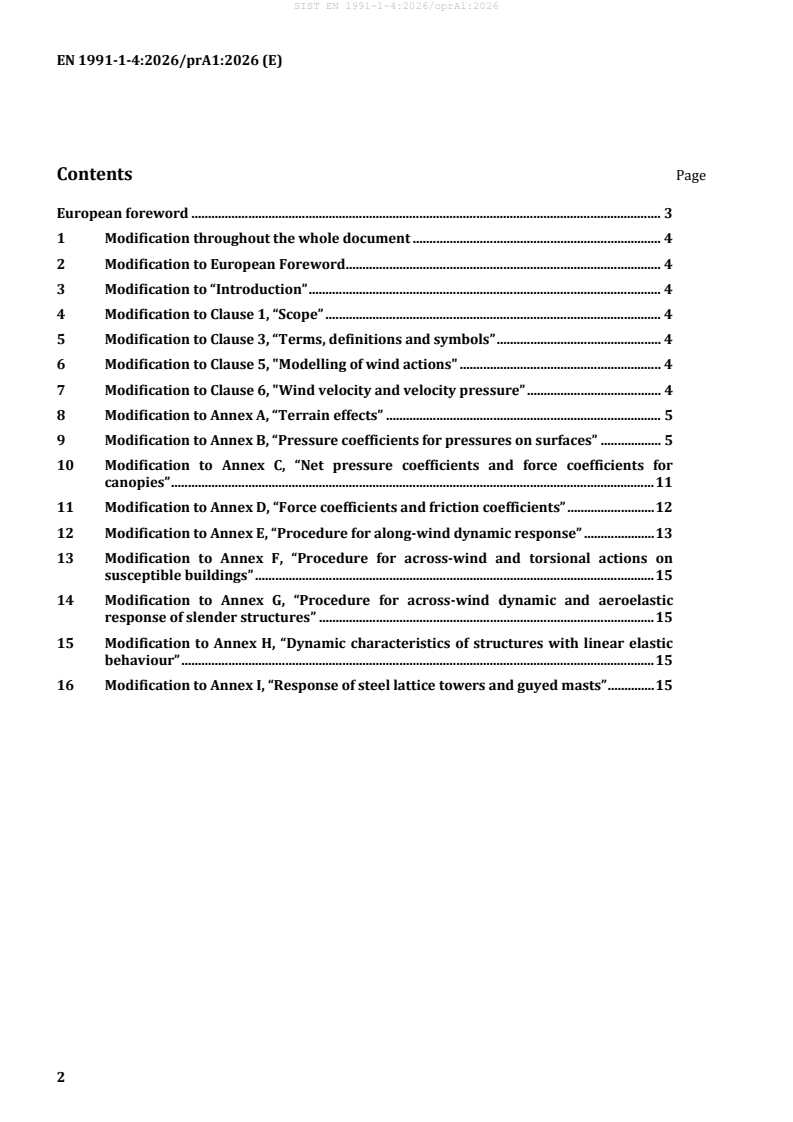
Contents Page
European foreword . 3
1 Modification throughout the whole document . 4
2 Modification to European Foreword . 4
3 Modification to “Introduction” . 4
4 Modification to Clause 1, “Scope” . 4
5 Modification to Clause 3, “Terms, definitions and symbols” . 4
6 Modification to Clause 5, "Modelling of wind actions" . 4
7 Modification to Clause 6, "Wind velocity and velocity pressure” . 4
8 Modification to Annex A, “Terrain effects” . 5
9 Modification to Annex B, “Pressure coefficients for pressures on surfaces” . 5
10 Modification to Annex C, “Net pressure coefficients and force coefficients for
canopies” . 11
11 Modification to Annex D, “Force coefficients and friction coefficients” . 12
12 Modification to Annex E, “Procedure for along-wind dynamic response” . 13
13 Modification to Annex F, “Procedure for across-wind and torsional actions on
susceptible buildings” . 15
14 Modification to Annex G, “Procedure for across-wind dynamic and aeroelastic
response of slender structures” . 15
15 Modification to Annex H, “Dynamic characteristics of structures with linear elastic
behaviour” . 15
16 Modification to Annex I, “Response of steel lattice towers and guyed masts” . 15
European foreword
This document (EN 1991-1-4:2026/prA1:2026) has been prepared by Technical Committee CEN/TC 250
“Structural Eurocodes”, the secretariat of which is held by BSI. CEN/TC 250 is responsible for all
Structural Eurocodes and has been assigned responsibility for structural and geotechnical design matters
by CEN.
This document is currently submitted to the CEN Enquiry.
This document will supersede EN 1991-1-4:2026.
NOTE Some modifications are purely editorial corrections to improve the quality of the document and these will
not be tagged in the consolidated publication, as noted after the modification.
The first generation of EN Eurocodes was published between 2002 and 2007. This document forms part
of the second generation of the Eurocodes, which have been prepared under Mandate M/515 issued to
CEN by the European Commission and the European Free Trade Association.
The Eurocodes have been drafted to be used in conjunction with relevant execution, material, product
and test standards, and to identify requirements for execution, materials, products and testing that are
relied upon by the Eurocodes.
The Eurocodes recognise the responsibility of each Member State and have safeguarded their right to
determine values related to regulatory safety matters at national level through the use of National
Annexes.
1 Modification throughout the whole document
Modify the symbol for the kinematic viscosity of the air “ν” to “ν ”.
air
2 Modification to European Foreword
Add the word “structures” between “slender” and “with” in list item a).
Add “guidance on” between “of” and “an” in list item c).
3 Modification to “Introduction”
0.5 Add the following references in the table with national choices: "B.3.1(1) - 2 choices" and "D.8.1(6)".
0.5 Replace in the table with national choices “B.3.1(3)" with "B.3.1(2)".
0.5 Replace in the table with national choices "B.3.1(5) - 2 choices" with "B.3.1(5)".
4 Modification to Clause 1, “Scope”
1.1(2) Delete the word “other” in the first list item.
1.1(2) Add a new second list item: “preliminary design stage of buildings and civil engineering works with
heights up to 300 m;”
1.1(2) Add the following note below the list: “NOTE For wind profiles up to 300 m, see Annex A.”
5 Modification to Clause 3, “Terms, definitions and symbols”
3.2.2 Delete the word “natural” in the definition of the symbol n .
x
6 Modification to Clause 5, "Modelling of wind actions"
5.4(10) Modify the symbol “b” to “d” in Formula (5.1) and in the definition below the formula.
5.4(11) Replace the word “may” with “can” in the list items a) and b).
5.4(11) Delete “, they should be” in list item c).
7 Modification to Clause 6, "Wind velocity and velocity pressure”
6.2(7) Replace Note 1 with "NOTE 1 For a Gumbel distribution (see Annex L), the shape parameter K is equal
to β/α, where α is the corresponding location parameter and β is the corresponding scale parameter."
6.3.2(1) Delete the word “permanent” in Table 6.1.
6.3.2(1) Replace “x ” with “x” in Formula 6.8.
s
6.3.2(3) Replace “nominal angular sector” with “nominal direction” in the key to Figure 6.1.
6.3.2(3) Replace “2” with “x”, “3” with “2” and “4” with “3” in the key to Figure 6.1.
6.3.2(3) Replace Figure 6.1 with the following new Figure:
8 Modification to Annex A, “Terrain effects”
A.3(1) Add “and civil engineering works or forest,” between the words “buildings” and “and” in the
description of terrain category IV in Figure A.1.
A.4(10) Replace “3,5” with “5,0” in Formula (A.9).
A.4(10) Replace “log” with “log ” in Formula (A.10) to Formula (A.13).
A.4(11) Replace “it” with “the factor s ”.
o
A.4(11) Replace “s = A in Formula (A.5)” with “s = A given by Formula (A.6)”.
o
A.7.1(2) Replace “A.7.2 should be substituted for 6.3.2 and A.7.3 should be substituted for 6.4” with “6.3.2
should be substituted by A.7.2 and 6.4 should be substituted by A.7.3”.
9 Modification to Annex B, “Pressure coefficients for pressures on surfaces”
B.3.1(1) Delete “, which is the area of the surface,”.
B.3.1(1) Add “, c , c and“ between “coefficients” and “c ”.
pe1 pe10 peA
B.3.1(1) Add “in this Annex” in the end of the note which is numbered Note 1.
B.3.1(1) Add the following three new notes after the existing NOTE
“NOTE 2 External pressure coefficients given in this Annex are the most unfavourable values obtained in a
range of wind angles θ = ±45° either side of the relevant orthogonal direction, to be used unless the National Annex
gives different values to cover alternative ranges of wind angles.
NOTE 3 The procedures for effect of the size of the loaded area are as given in this Clause B.3, unless the National
Annex gives different procedures.
NOTE 4 The external global pressure coefficients and external local pressure coefficients can produce symmetric
load patterns. The asymmetry of the action on the vertical surfaces arising when θ ≠ 0° is covered by B.3.1(6). The
asymmetry of the action on the roof surfaces arising when θ ≠ 0° is accounted for by the large values of the pressure
coefficients in zone F in B.3.3 through B.3.6.”
Replace “NOTE” with “NOTE 1“.
B.3.1(2) Replace “should” with “may”, and add in the end of the paragraph (before the note): “, when the
total surface area contributing to the wind actions, is larger than A = 50 m .”.
B.3.1(2) Number the existing NOTE as NOTE 3, and add the following new notes beforehand:
“NOTE 1 External global pressure coefficients are given in Clause B.3, unless the National A
...