

EN 1794-1:2018
(Main)Road traffic noise reducing devices - Non-acoustic performance - Part 1: Mechanical performance and stability requirements
General Information
- Abstract
This European Standard specifies criteria to categorize road traffic noise reducing devices according to basic mechanical performance under standard conditions of exposure, irrespective of the materials used. A range of conditions and optional requirements is provided in order to take into account the wide diversity of practice in Europe. Individual aspects of performance are covered separately in the annexes. Safety considerations in the event of damage to noise reducing devices are covered in EN 1794-2.
This European Standard covers the current behaviour of the product. In order to assess its long term performances, EN 14389-2 should be used.
NOTE The test procedure described in Annex A doesn't consider the fatigue effect.
- Status
- Withdrawn
- Publication Date
- 20-Feb-2018
- Withdrawal Date
- 29-Sep-2026
- Technical Committee
- CEN/TC 226 - Road equipment
- Drafting Committee
- CEN/TC 226/WG 6 - Noise reducing devices
- Current Stage
- 9960 - Withdrawal effective - Withdrawal
- Start Date
- 19-Dec-2018
- Completion Date
- 30-Sep-2026

Relations
- Effective Date
- 28-Feb-2018
- Effective Date
- 02-May-2018
- Refers
EN 1317-1:2010 - Road restraint systems - Part 1: Terminology and general criteria for test methods - Effective Date
- 28-Jan-2026
- Effective Date
- 28-Jan-2026
- Effective Date
- 28-Jan-2026
- Effective Date
- 28-Jan-2026
Get Certified
Connect with accredited certification bodies for this standard

Zavod za gradbeništvo Slovenije (ZAG) - Inšpekcija
ZAG inspection body for construction products, structures, and materials.
Sponsored listings
Frequently Asked Questions
EN 1794-1:2018 is a standard published by the European Committee for Standardization (CEN). Its full title is "Road traffic noise reducing devices - Non-acoustic performance - Part 1: Mechanical performance and stability requirements". This standard covers: This European Standard specifies criteria to categorize road traffic noise reducing devices according to basic mechanical performance under standard conditions of exposure, irrespective of the materials used. A range of conditions and optional requirements is provided in order to take into account the wide diversity of practice in Europe. Individual aspects of performance are covered separately in the annexes. Safety considerations in the event of damage to noise reducing devices are covered in EN 1794-2. This European Standard covers the current behaviour of the product. In order to assess its long term performances, EN 14389-2 should be used. NOTE The test procedure described in Annex A doesn't consider the fatigue effect.
This European Standard specifies criteria to categorize road traffic noise reducing devices according to basic mechanical performance under standard conditions of exposure, irrespective of the materials used. A range of conditions and optional requirements is provided in order to take into account the wide diversity of practice in Europe. Individual aspects of performance are covered separately in the annexes. Safety considerations in the event of damage to noise reducing devices are covered in EN 1794-2. This European Standard covers the current behaviour of the product. In order to assess its long term performances, EN 14389-2 should be used. NOTE The test procedure described in Annex A doesn't consider the fatigue effect.
EN 1794-1:2018 is classified under the following ICS (International Classification for Standards) categories: 93.080.30 - Road equipment and installations. The ICS classification helps identify the subject area and facilitates finding related standards.
EN 1794-1:2018 has the following relationships with other standards: It is inter standard links to EN 1794-1:2011, EN 1794-1:2018+AC:2018, EN 1317-1:2010, EN 1317-2:2010, EN 14389-2:2004, EN 1794-2:2020. Understanding these relationships helps ensure you are using the most current and applicable version of the standard.
EN 1794-1:2018 is available in PDF format for immediate download after purchase. The document can be added to your cart and obtained through the secure checkout process. Digital delivery ensures instant access to the complete standard document.
Standards Content (Sample)
2003-01.Slovenski inštitut za standardizacijo. Razmnoževanje celote ali delov tega standarda ni dovoljeno.Lärmschutzvorrichtungen an Straßen - Nichtakustische Eigenschaften - Teil 1: Mechanische Eigenschaften und Anforderungen an die StandsicherheitDispositifs de réduction du bruit du trafic routier - Performances non acoustiques - Partie 1 : Performances mécaniques et exigences en matière de stabilitéRoad traffic noise reducing devices - Non-acoustic performance - Part 1: Mechanical performance and stability requirements93.080.30Cestna oprema in pomožne napraveRoad equipment and installations17.140.30Emisija hrupa transportnih sredstevNoise emitted by means of transportICS:Ta slovenski standard je istoveten z:EN 1794-1:2018SIST EN 1794-1:2018en,fr,de01-april-2018SIST EN 1794-1:2018SLOVENSKI
STANDARDSIST EN 1794-1:20111DGRPHãþD
EUROPEAN STANDARD NORME EUROPÉENNE EUROPÄISCHE NORM
EN 1794-1
February
t r s z ICS
{ uä r z rä u r Supersedes EN
s y { væ sã t r s sEnglish Version
Road traffic noise reducing devices æ Nonæacoustic performance æ Part
sã Mechanical performance and stability requirements Dispositifs de réduction du bruit du trafic routier æ Performances non acoustiques æ Partie
s ã Performances mécaniques et exigences en matière de stabilité
Lärmschutzvorrichtungen an Straßen æ Nichtakustische Eigenschaften æ Teil
sã Mechanische Eigenschaften und Anforderungen an die Standsicherheit This European Standard was approved by CEN on
s u November
t r s yä
egulations which stipulate the conditions for giving this European Standard the status of a national standard without any alterationä Upætoædate lists and bibliographical references concerning such national standards may be obtained on application to the CENæCENELEC Management Centre or to any CEN memberä
translation under the responsibility of a CEN member into its own language and notified to the CENæCENELEC Management Centre has the same status as the official versionsä
CEN members are the national standards bodies of Austriaá Belgiumá Bulgariaá Croatiaá Cyprusá Czech Republicá Denmarká Estoniaá Finlandá Former Yugoslav Republic of Macedoniaá Franceá Germanyá Greeceá Hungaryá Icelandá Irelandá Italyá Latviaá Lithuaniaá Luxembourgá Maltaá Netherlandsá Norwayá Polandá Portugalá Romaniaá Serbiaá Slovakiaá Sloveniaá Spainá Swedená Switzerlandá Turkey and United Kingdomä
EUROPEAN COMMITTEE FOR STANDARDIZATION COMITÉ EUROPÉEN DE NORMALISATION EUROPÄISCHES KOMITEE FÜR NORMUNG
CEN-CENELEC Management Centre:
Rue de la Science 23,
B-1040 Brussels
t r s z CEN All rights of exploitation in any form and by any means reserved worldwide for CEN national Membersä Refä Noä EN
s y { væ sã t r s z ESIST EN 1794-1:2018
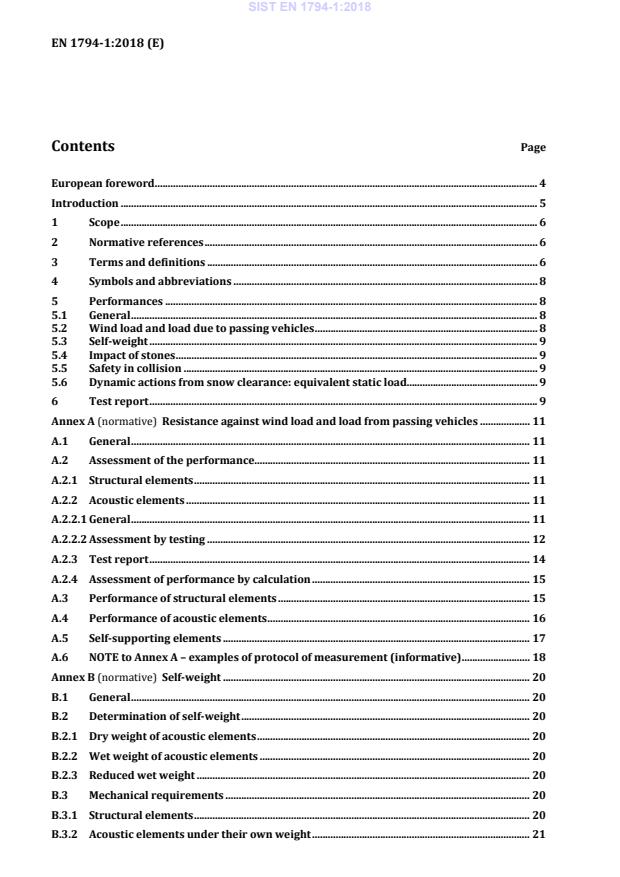
Resistance against wind load and load from passing vehicles . 11 A.1 General . 11 A.2 Assessment of the performance . 11 A.2.1 Structural elements . 11 A.2.2 Acoustic elements . 11 A.2.2.1 General . 11 A.2.2.2 Assessment by testing . 12 A.2.3 Test report . 14 A.2.4 Assessment of performance by calculation . 15 A.3 Performance of structural elements . 15 A.4 Performance of acoustic elements . 16 A.5 Self-supporting elements . 17 A.6 NOTE to Annex A – examples of protocol of measurement (informative) . 18 Annex B (normative)
Self-weight . 20 B.1 General . 20 B.2 Determination of self-weight . 20 B.2.1 Dry weight of acoustic elements . 20 B.2.2 Wet weight of acoustic elements . 20 B.2.3 Reduced wet weight . 20 B.3 Mechanical requirements . 20 B.3.1 Structural elements . 20 B.3.2 Acoustic elements under their own weight . 21 SIST EN 1794-1:2018
Impact of stones . 23 C.1 General . 23 C.2 Requirements . 23 C.3 Test method . 23 C.4 Test report . 24 Annex D (informative)
Safety in collision . 26 D.1 General . 26 D.2 Testing and calculations . 26 Annex E (normative)
Substitute load due to dynamic actions from snow clearance. 27 E.1 General . 27 E.2 Requirements . 27 E.2.1 Magnitude and height of the load . 27 E.2.2 Mechanical requirements . 27 E.3 Methods of assessment . 28 E.3.1 Calculations . 28 E.3.2 Load test . 28 E.4 Test report . 28 Bibliography . 30
load factor SF safety factor 5 Performances 5.1 General Under any of the loads specified in this Clause 5, elements shall not become detached from their supports or fixings may not fail. The influence of inhomogeneity shall be considered in the relevant verifications according to the specific Eurocodes if existing. All failure modes and deformation which may cause transient or permanent disorders should be considered. These modes can affect the overall behaviour of the structure or the behaviour of some elements. 5.2 Wind load and load due to passing vehicles The manufacturer shall provide the result of the assessments done according the methods described in Annex A. SIST EN 1794-1:2018
Dry weight: 0,70 kN
Reduced wet weight: 0,92 kN Resistance to loads
Structural elements
Normal (90°) load due to wind, static, external and self-weight:
Barrier height 3 m 5,2 kN/m
Barrier height 4 m 4,4 kN/m
Bending moment at ground level due to snow clearance: 15 kNm
Acoustic elements
Maximum vertical load (Annex B, B.3.2): 150 kN/m
a According to procedure a) Annex A
Fsafe 2,5 kN/m2
dsafe 20 mm
dmax for Fsafe .SF, with SF = 1,5 30 mm
b According to procedure b) Annex A
Fd50 3,0 kN/m2
dmax for Fd50 .SF, with SF = 1,5 60 mm
Normal (90°) load due to snow clearance the element can withstand: 14 kN a Test procedure when the sample under test cannot be charged up to a deflection of d = 50 mm. b Test procedure when the sample under test can be charged up to a deflection of d = 50 mm.
Resistance against wind load and load from passing vehicles A.1 General The objective of this annex is to provide assessment methods to demonstrate the capability of the product to withstand wind load and load from passing vehicles. The methods and criteria to assess the maximum load NRDs can withstand are provided within this annex. The methods for calculating the different loads that can act on NRDs are provided within Eurocode EN 1990 and Eurocode EN 1991. Requirements are set separately for acoustic and structural elements. In case acoustical and structural elements are not distinct, limits for structural elements apply. The temperature range, within limits of -40 °C to +70 °C, over which the requirements in A.3 to A.4 are met, shall be reported. NOTE In consideration of the various characteristics of the materials (inhomogeneity, creep, de-formations, ageing), an additional reduction of the bearing capacity may become necessary. A.2 Assessment of the performance A.2.1 Structural elements Structural elements are calculated according to the applicable Eurocodes. A.2.2 Acoustic elements A.2.2.1 General The acoustic elements shall be tested according to the following method. The load test shall be carried out on a representative sample which shall include an appropriate number of acoustic elements of the longest span for the element type, with posts or other supports similar to those used in practice. The supports shall be held in the horizontal plane and restrained from lateral movement and rotation. The supports may be propped if only the flexure of the acoustic elements is to be tested, otherwise the supports shall be fixed as in intended use. The test panel shall be allowed to reach equilibrium under laboratory conditions for at least 3 h before testing. Load tests shall be carried out at 20 °C. If the product is intended to be used at very low or very high temperatures, then the test may be repeated at -40 °C and/or +70 °C with appropriate conditioning time, if the material is regarded as being temperature sensitive. If the strength or stiffness of the load carrying material depends on temperature, the effect of temperature differing from range +10 to +30 shall be taken into consideration in testing if the intended temperature range is wider than presented above. Results shall show that temperature variation does not cause failure in the performance of joints (acoustic element detaches from posts in the lowest temperature of the specified range, connections (screw hole in the acoustic elements) allow for shrinkage and expansion in the whole range of temperatures specified by the manufacturer.
For NRD’s with asymmetrical design (geometry, characteristic of materials .), the results could be different on each side. In this case, the tests must be performed on the weakest side. In case of a family of products, the weakest product of the family has to be tested. SIST EN 1794-1:2018
Key F loading in kN/m2 d deflection in mm O horizontal support of the specimen, after 30 min, deflection reading for dselfweight 1 application of the addit
...