

FprEN 1482-3
(Main)Fertilizers, liming materials and inhibitors - Sampling and sample preparation - Part 3: Sampling of static heaps
- Abstract
This document is applicable to the sampling of solid fertilizers and liming materials that have a uniform composition and have no tendency to segregate.
NOTE 1 The term product is used throughout the body of this document and is understood to include fertilizers, liming materials and inhibitors unless otherwise indicated.
NOTE 2 Manufacturers, importers and sellers can choose to use this method to obtain samples of other products or blends as well as long as both parties to a transaction agree. The build-up of a static heap often leads to granulometric segregation, which makes the collection of a truly representative sample of many products and blends unlikely.
NOTE 3 It is the responsibility of manufacturers, importers and sellers, however, to ensure they supply a product that complies with its label declaration at the moment of delivery and fulfils the expectations of the end user at the moment of application.
NOTE 4 A method of obtaining a screening sample from a static heap can be found in Annex B.
- Status
- Not Published
- Publication Date
- 24-Feb-2027
- Technical Committee
- CEN/TC 260 - Fertilizers and liming materials
- Drafting Committee
- CEN/TC 260/WG 1 - Sampling

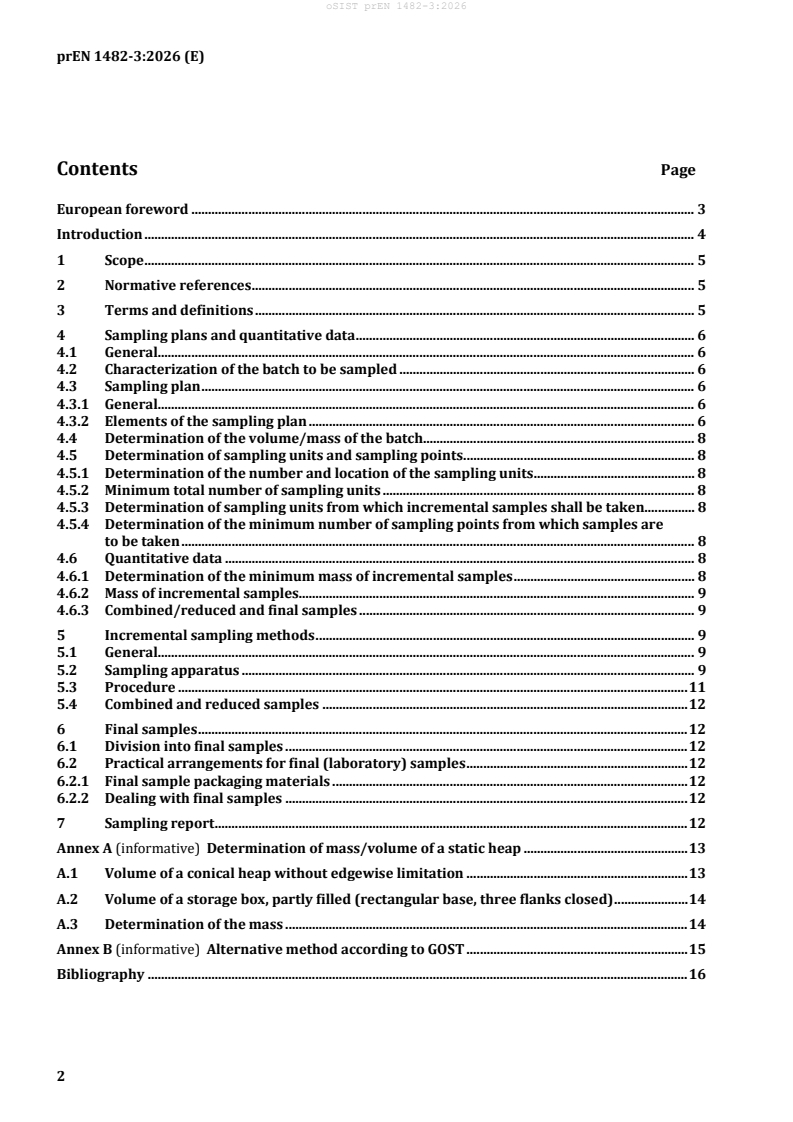
FprEN 1482-3 is a draft European Standard from CEN on sampling and sample preparation for fertilizers, liming materials and inhibitors. It specifies how to take representative samples from static heaps of solid fertilizers and liming materials with uniform composition and no tendency to segregate, so the batch can be checked against legal requirements and label declarations. It is mainly for manufacturers, importers, sellers and anyone who needs a defensible sample from bulk material stored as a heap.
What does FprEN 1482-3 specify?
FprEN 1482-3 applies to sampling static heaps of solid fertilizers and liming materials that are uniform and do not tend to segregate. In the document, the term product covers fertilizers, liming materials and inhibitors unless stated otherwise.
The document is organized into:
- Scope, normative references, terms and definitions
- Sampling plans and quantitative data
- Incremental sampling methods
- Final samples
- Sampling report
- Annex A and Annex B
| Annex | What it covers |
|---|---|
| Annex A | How to determine the mass or volume of a static heap |
| Annex B | An alternative screening method according to GOST |
Annex B is presented as a screening approach, not the method for showing compliance with legal requirements within the scope of this standard.
What are the key requirements of FprEN 1482-3?
FprEN 1482-3 requires the sampler to describe the batch before sampling, build a sampling plan, and take incremental samples from randomly selected sampling units across the heap. The central idea is to avoid sampling only the surface or one part of the heap, because that will not represent the batch.
Batch description and sampling plan
Clause 4.2 requires the batch to be characterized by type, texture, colour, storage conditions and foreign matter. If the whole batch carries the same description and statutory information, sampling may proceed under this document; if deterioration or contamination is evident, the batch may need to be split into parts.
Clause 4.3 says the sampling plan must define the batch boundary, the batch size, the number and location of sampling units, the units to be sampled, the sampling points and the minimum incremental sample mass. In practice, this means the sampler must plan and document where the samples come from.
Sampling units and sample masses
Clause 4.5 divides the batch into sampling units with roughly equal surface area. The minimum number of units depends on batch size: 10 units for 25 t or less, a square-root rule for batches above 25 t and up to 400 t, and 40 units above 400 t.
From those units, at least 10 are selected at random, and incremental samples are taken from random points within each selected unit. Clause 4.6 sets the minimum incremental sample mass at 250 g, or 500 g for liming materials coarser than 80 % passing 0.315 mm.
Sampling method and equipment
Clause 5 requires sampling to minimize changes in the sample, such as moisture changes, and to consider safety measures. The sampling apparatus must be clean, dry, inert and suitable for the particle size; its opening must be at least three times the size of the largest particle.
A sampling spear is the normal tool, while a tube shovel may be used for wet liming materials. Clause 5.3 says to reach into the heap at about 45° to the base or at right angles to the surface layer, and to exclude and document any visibly changed upper layer.
Combined, final samples and reporting
Clause 5.4 mixes all incremental samples into a combined sample, and Clause 6 then divides that combined sample into final samples and handles the laboratory samples according to EN 1482-1. Clause 7 requires a sampling report that follows EN 1482-1 as appropriate for bulk static heaps.
What terms does FprEN 1482-3 define?
- Sampling unit - the area of the surface of the material in the static heap from which samples are planned.
- Sampling point - a point within a sampling unit where material is actually taken.
- Static heap - a quantity of product stored in bulk as one mass.
- Uniform composition - a condition where each physical unit has the same quality traits.
- Product - the working term used in the document for fertilizers, liming materials and inhibitors.
Who uses FprEN 1482-3?
FprEN 1482-3 is used by manufacturers, importers and sellers who need to sample bulk material in storage before delivery or supply. It is also relevant to laboratories, inspectors and quality staff who assess whether a batch matches its label declaration, statutory information or expected use.
The document is especially practical when material is stored in large static heaps and moving the product for sampling is not possible or not practical.
What changed in FprEN 1482-3 from the previous edition?
FprEN 1482-3 will supersede EN 1482-3:2024. The European foreword states one significant technical change: the scope is extended to include sampling of uniform organic fertilizers and uniform organo-mineral fertilizers.
Which standards are used with FprEN 1482-3?
FprEN 1482-3 cites EN 1482-1:2024, which supplies general sampling provisions and the rules for combining, reducing, finalizing and reporting samples. It also cites prEN 12944-1 for general fertilizer vocabulary.
The foreword also places FprEN 1482-3 within the EN 1482 series:
- Part 1 - General sampling provisions
- Part 2 - General sample preparation provisions
- Part 3 - Sampling of static heaps
- Part 4 - Sampling for microbial presence
What does the FprEN 1482-3 document contain?
The document contains a worked sampling plan example for a conical heap, a table that links batch size to the minimum number of sampling units, and figures showing sampling apparatus and sampling positions. Annex A gives formulas and examples for estimating the volume or mass of a conical heap or partly filled storage box. Annex B describes an alternative GOST-based method for screening samples from static heaps.
Relations
- Effective Date
- 28-Jan-2026
- Effective Date
- 28-Jan-2026
- Effective Date
- 28-Jan-2026
- Effective Date
- 28-Jan-2026
- Effective Date
- 08-Oct-2025
Get Certified
Connect with accredited certification bodies for this standard

Control Union Certifications
Global certification for agriculture and sustainability.

ECOCERT
Organic and sustainability certification.

FSC International
Forest Stewardship Council certification.
Sponsored listings
Frequently Asked Questions
FprEN 1482-3 is a draft published by the European Committee for Standardization (CEN). Its full title is "Fertilizers, liming materials and inhibitors - Sampling and sample preparation - Part 3: Sampling of static heaps". This standard covers: This document is applicable to the sampling of solid fertilizers and liming materials that have a uniform composition and have no tendency to segregate. NOTE 1 The term product is used throughout the body of this document and is understood to include fertilizers, liming materials and inhibitors unless otherwise indicated. NOTE 2 Manufacturers, importers and sellers can choose to use this method to obtain samples of other products or blends as well as long as both parties to a transaction agree. The build-up of a static heap often leads to granulometric segregation, which makes the collection of a truly representative sample of many products and blends unlikely. NOTE 3 It is the responsibility of manufacturers, importers and sellers, however, to ensure they supply a product that complies with its label declaration at the moment of delivery and fulfils the expectations of the end user at the moment of application. NOTE 4 A method of obtaining a screening sample from a static heap can be found in Annex B.
This document is applicable to the sampling of solid fertilizers and liming materials that have a uniform composition and have no tendency to segregate. NOTE 1 The term product is used throughout the body of this document and is understood to include fertilizers, liming materials and inhibitors unless otherwise indicated. NOTE 2 Manufacturers, importers and sellers can choose to use this method to obtain samples of other products or blends as well as long as both parties to a transaction agree. The build-up of a static heap often leads to granulometric segregation, which makes the collection of a truly representative sample of many products and blends unlikely. NOTE 3 It is the responsibility of manufacturers, importers and sellers, however, to ensure they supply a product that complies with its label declaration at the moment of delivery and fulfils the expectations of the end user at the moment of application. NOTE 4 A method of obtaining a screening sample from a static heap can be found in Annex B.
FprEN 1482-3 is classified under the following ICS (International Classification for Standards) categories: 65.080 - Fertilizers. The ICS classification helps identify the subject area and facilitates finding related standards.
FprEN 1482-3 has the following relationships with other standards: It is inter standard links to EN ISO 11296-9:2022, CEN ISO/TS 23818-2:2022, EN ISO 11296-7:2019, EN ISO 11297-4:2018, EN 1482-3:2024. Understanding these relationships helps ensure you are using the most current and applicable version of the standard.
FprEN 1482-3 is associated with the following European legislation: EU Directives/Regulations: 2003/2003, 2019/1009; Standardization Mandates: M/564, M/564 Amd 1, M/564 Amd 2, M/XXX. When a standard is cited in the Official Journal of the European Union, products manufactured in conformity with it benefit from a presumption of conformity with the essential requirements of the corresponding EU directive or regulation.
FprEN 1482-3 is available in PDF format for immediate download after purchase. The document can be added to your cart and obtained through the secure checkout process. Digital delivery ensures instant access to the complete standard document.
Standards Content (Sample)
SLOVENSKI STANDARD
01-april-2026
Gnojila, sredstva za apnjenje in inhibitorji - Vzorčenje in priprava vzorcev - 3. del:
Vzorčenje statičnih kupov
Fertilizers, liming materials and inhibitors - Sampling and sample preparation - Part 3:
Sampling of static heaps
Düngemittel, Kalkdünger und Hemmstoffe - Probenahme und Probenvorbereitung — Teil
3: Probenahme aus statischen Haufwerken
Engrais, amendements minéraux basiques et inhibiteurs - Échantillonnage et préparation
de l’échantillon - Partie 3 : Échantillonnage des tas statiques
Ta slovenski standard je istoveten z: prEN 1482-3
ICS:
65.080 Gnojila Fertilizers
2003-01.Slovenski inštitut za standardizacijo. Razmnoževanje celote ali delov tega standarda ni dovoljeno.
DRAFT
EUROPEAN STANDARD
prEN 1482-3
NORME EUROPÉENNE
EUROPÄISCHE NORM
March 2026
ICS 65.080 Will supersede EN 1482-3:2024
English Version
Fertilizers, liming materials and inhibitors - Sampling and
sample preparation - Part 3: Sampling of static heaps
Engrais, amendements minéraux basiques et Düngemittel, Kalkdünger und Hemmstoffe -
inhibiteurs - Échantillonnage et préparation de Probenahme und Probenvorbereitung - Teil 3:
l'échantillon - Partie 3 : Échantillonnage des tas Probenahme aus statischen Haufwerken
statiques
This draft European Standard is submitted to CEN members for enquiry. It has been drawn up by the Technical Committee
CEN/TC 260.
If this draft becomes a European Standard, CEN members are bound to comply with the CEN/CENELEC Internal Regulations
which stipulate the conditions for giving this European Standard the status of a national standard without any alteration.
This draft European Standard was established by CEN in three official versions (English, French, German). A version in any other
language made by translation under the responsibility of a CEN member into its own language and notified to the CEN-CENELEC
Management Centre has the same status as the official versions.
CEN members are the national standards bodies of Austria, Belgium, Bulgaria, Croatia, Cyprus, Czech Republic, Denmark, Estonia,
Finland, France, Germany, Greece, Hungary, Iceland, Ireland, Italy, Latvia, Lithuania, Luxembourg, Malta, Netherlands, Norway,
Poland, Portugal, Republic of North Macedonia, Romania, Serbia, Slovakia, Slovenia, Spain, Sweden, Switzerland, Türkiye and
United Kingdom.
Recipients of this draft are invited to submit, with their comments, notification of any relevant patent rights of which they are
aware and to provide supporting documentation.
Warning : This document is not a European Standard. It is distributed for review and comments. It is subject to change without
notice and shall not be referred to as a European Standard.
EUROPEAN COMMITTEE FOR STANDARDIZATION
COMITÉ EUROPÉEN DE NORMALISATION
EUROPÄISCHES KOMITEE FÜR NORMUNG
CEN-CENELEC Management Centre: Rue de la Science 23, B-1040 Brussels
© 2026 CEN All rights of exploitation in any form and by any means reserved Ref. No. prEN 1482-3:2026 E
worldwide for CEN national Members.
prEN 1482-3:2026 (E)
Contents Page
European foreword . 3
Introduction . 4
1 Scope . 5
2 Normative references . 5
3 Terms and definitions . 5
4 Sampling plans and quantitative data . 6
4.1 General. 6
4.2 Characterization of the batch to be sampled . 6
4.3 Sampling plan . 6
4.3.1 General. 6
4.3.2 Elements of the sampling plan . 6
4.4 Determination of the volume/mass of the batch. 8
4.5 Determination of sampling units and sampling points . 8
4.5.1 Determination of the number and location of the sampling units . 8
4.5.2 Minimum total number of sampling units . 8
4.5.3 Determination of sampling units from which incremental samples shall be taken. 8
4.5.4 Determination of the minimum number of sampling points from which samples are
to be taken . 8
4.6 Quantitative data . 8
4.6.1 Determination of the minimum mass of incremental samples . 8
4.6.2 Mass of incremental samples. 9
4.6.3 Combined/reduced and final samples . 9
5 Incremental sampling methods . 9
5.1 General. 9
5.2 Sampling apparatus . 9
5.3 Procedure . 11
5.4 Combined and reduced samples . 12
6 Final samples . 12
6.1 Division into final samples . 12
6.2 Practical arrangements for final (laboratory) samples . 12
6.2.1 Final sample packaging materials . 12
6.2.2 Dealing with final samples . 12
7 Sampling report . 12
Annex A (informative) Determination of mass/volume of a static heap . 13
A.1 Volume of a conical heap without edgewise limitation . 13
A.2 Volume of a storage box, partly filled (rectangular base, three flanks closed) . 14
A.3 Determination of the mass . 14
Annex B (informative) Alternative method according to GOST . 15
Bibliography . 16
prEN 1482-3:2026 (E)
European foreword
This document (prEN 1482-3:2026) has been prepared by Technical Committee CEN/TC 260
“Fertilizers and liming materials”, the secretariat of which is held by DIN.
This document is currently submitted to the CEN Enquiry.
This document will supersede EN 1482-3:2024.
prEN 1482-3:2026 includes the following significant technical changes with respect to EN 1482-3:2024:
— extension of the scope to include sampling of uniform organic fertilizers and uniform organo-
mineral fertilizers.
EN 1482 “Fertilizers, liming materials and inhibitors — Sampling and sample preparation” consists of
four parts:
— Part 1: General sampling provisions;
— Part 2: General sample preparation provisions;
— Part 3: Sampling of static heaps;
— Part 4: Sampling for microbial presence.
This document has been prepared under a standardization request addressed to CEN by the European
Commission. The Standing Committee of the EFTA States subsequently approves these requests for its
Member States.
prEN 1482-3:2026 (E)
Introduction
Standardized methods of sampling and analysis are essential in uniformly establishing the compliance
of fertilizing products with legal requirements, as well as any information and/or declarations given on
their supply or readiness for supply.
The aim of these standardized methods is to obtain a representative sample of the whole batch supplied
or ready for supply. General methods to obtain such a sample are given in EN 1482-1.
However, where the product is stored in large static heaps it is not always possible or practical to put
the product into motion for a sampling method according to EN 1482-1 to be used. Research has found
that for a limited number of types of products a representative sample can be obtained by sampling
directly from the static heap.
This document describes the method to be used for sampling static heaps of the specified products
within its scope.
prEN 1482-3:2026 (E)
1 Scope
This document is applicable to the sampling of solid fertilizers and liming materials that have a uniform
composition and have no tendency to segregate.
NOTE 1 The term product is used throughout the body of this document and is understood to include
fertilizers, liming materials and inhibitors unless otherwise indicated.
NOTE 2 Manufacturers, importers and sellers can choose to use this method to obtain samples of other
products or blends as well as long as both parties to a transaction agree. The build-up of a static heap often leads
to granulometric segregation, which makes the collection of a truly representative sample of many products and
blends unlikely.
NOTE 3 It is the responsibility of manufacturers, importers and sellers, however, to ensure they supply a
product that complies with its label declaration at the moment of delivery and fulfils the expectations of the end
user at the moment of application.
NOTE 4 A method of obtaining a screening sample from a static heap can be found in Annex B.
2 Normative references
The following documents are referred to in the text in such a way that some or all of their content
constitutes requirements of this document. For dated references, only the edition cited applies. For
undated references, the latest edition of the referenced document (including any amendments) applies.
EN 1482-1:2024, Fertilizers, liming materials and inhibitors — Sampling and sample preparation —
Part 1: General sampling provisions
prEN 12944-1, Fertilizers, liming materials and inhibitors — Vocabulary — Part 1: General terms
3 Terms and definitions
For the purposes of this document, the terms and definit
...