


EN 13160-2:2016
(Main)Leak detection systems - Part 2: Requirements and test/assessment methods for pressure and vacuum systems
Leak detection systems - Part 2: Requirements and test/assessment methods for pressure and vacuum systems
This European Standard gives requirements and the corresponding test/assessment methods applicable to leak detection kits (leak detector) based on the measurement of pressure change. Leak detection kits are intended to be used with double skin, underground or above ground, pressurized or non-pressurized, tanks or pipework designed for water polluting liquids/fluids. The kits are usually composed of:
- measuring device;
- evaluation device;
- alarm device;
- pressure generator;
- pressure relief device;
- liquid stop device;
- condensate trap.
Leckanzeigesysteme - Teil 2: Anforderungen und Prüf-/Bewertungsmethoden für Über- und Unterdrucksysteme
Diese Europäische Norm legt Anforderungen an und die einschlägigen Prüf-/Bewertungsverfahren für Leckanzeiger (Leckdetektoren), die auf der Messung der Druckänderung basieren, fest. Leckanzeiger sind für den Einsatz an doppelwandigen, unterirdischen oder oberirdischen, druckbeaufschlagten oder nicht druck¬beaufschlagten Tanks oder Rohrleitungen für wassergefährdende Flüssigkeiten/Fluide bestimmt. Die Leckanzeiger bestehen in der Regel aus:
Messeinrichtung;
Auswerteeinrichtung;
Alarmeinrichtung;
Druckerzeuger;
Überdruckventil;
Flüssigkeitssperre;
Kondensatgefäß.
Systèmes de détection de fuites - Partie 2 : Exigences et méthodes d'essai/d'évaluation des systèmes sous pression et à dépression
La présente Norme européenne spécifie les exigences et les méthodes d'essai/d'évaluation correspondantes applicables aux kits de détection de fuites (indicateur de fuites) fondées sur le mesurage de la variation de pression. Les kits de détection de fuites sont destinés à être utilisés avec des réservoirs ou des tuyauteries à double paroi, souterrains ou aériens, sous pression ou non, conçus pour des liquides/fluides polluant l'eau. Les kits sont généralement constitués des éléments suivants :
- dispositif de mesurage ;
- dispositif d'évaluation ;
- dispositifs d'alarme ;
- générateur de pression ;
- dispositif de décharge de pression ;
- dispositif d'arrêt de remplissage ;
- purgeur de condensats.
Sistemi za kontrolo tesnosti - 2. del: Zahteve in metode za preskušanje in ocenjevanje tlačnih in vakuumskih sistemov
Ta standard določa zahteve ter ustrezne metode za preskušanje in ocenjevanje, ki se uporabljajo za komplete za kontrolo tesnosti (javljalnik puščanja), ki temeljijo na meritvah tlačnih sprememb. Kompleti za kontrolo tesnosti so namenjeni za uporabo dvoplaščnih, podzemnih ali nadzemnih rezervoarjev ali cevovodov, ki so ali niso pod tlakom, in so zasnovani za tekočine, ki onesnažujejo vodo. Kompleti so običajno sestavljeni iz:
– merilne naprave,
– naprave za ocenjevanje,
– alarmne naprave,
– generatorja tlaka,
– varnostnega ventila,
– naprave za zaustavitev tekočine,
– odvajalnika kondenzata.
General Information
- Status
- Withdrawn
- Publication Date
- 05-Jul-2016
- Withdrawal Date
- 13-Apr-2025
- Technical Committee
- CEN/TC 393 - Equipment for storage tanks and for service stations
- Drafting Committee
- CEN/TC 393/WG 2 - Leak detecting devices for tanks and pipes
- Current Stage
- 9960 - Withdrawal effective - Withdrawal
- Start Date
- 13-Nov-2024
- Completion Date
- 14-Apr-2025
- Directive
- 89/106/EEC - Construction products
Relations
- Effective Date
- 13-Jul-2016
- Effective Date
- 18-Sep-2024


Frequently Asked Questions
EN 13160-2:2016 is a standard published by the European Committee for Standardization (CEN). Its full title is "Leak detection systems - Part 2: Requirements and test/assessment methods for pressure and vacuum systems". This standard covers: This European Standard gives requirements and the corresponding test/assessment methods applicable to leak detection kits (leak detector) based on the measurement of pressure change. Leak detection kits are intended to be used with double skin, underground or above ground, pressurized or non-pressurized, tanks or pipework designed for water polluting liquids/fluids. The kits are usually composed of: - measuring device; - evaluation device; - alarm device; - pressure generator; - pressure relief device; - liquid stop device; - condensate trap.
This European Standard gives requirements and the corresponding test/assessment methods applicable to leak detection kits (leak detector) based on the measurement of pressure change. Leak detection kits are intended to be used with double skin, underground or above ground, pressurized or non-pressurized, tanks or pipework designed for water polluting liquids/fluids. The kits are usually composed of: - measuring device; - evaluation device; - alarm device; - pressure generator; - pressure relief device; - liquid stop device; - condensate trap.
EN 13160-2:2016 is classified under the following ICS (International Classification for Standards) categories: 23.020.01 - Fluid storage devices in general; 23.040.99 - Other pipeline components; 29.260.20 - Electrical apparatus for explosive atmospheres. The ICS classification helps identify the subject area and facilitates finding related standards.
EN 13160-2:2016 has the following relationships with other standards: It is inter standard links to EN 13160-2:2003, EN 13160-2:2016+A1:2024. Understanding these relationships helps ensure you are using the most current and applicable version of the standard.
EN 13160-2:2016 is associated with the following European legislation: EU Directives/Regulations: 305/2011, 89/106/EEC; Standardization Mandates: M/131. When a standard is cited in the Official Journal of the European Union, products manufactured in conformity with it benefit from a presumption of conformity with the essential requirements of the corresponding EU directive or regulation.
You can purchase EN 13160-2:2016 directly from iTeh Standards. The document is available in PDF format and is delivered instantly after payment. Add the standard to your cart and complete the secure checkout process. iTeh Standards is an authorized distributor of CEN standards.
Standards Content (Sample)
2003-01.Slovenski inštitut za standardizacijo. Razmnoževanje celote ali delov tega standarda ni dovoljeno.Leckanzeigesysteme - Teil 2: Anforderungen und Prüf-/Bewertungsverfahren für Über- und UnterdrucksystemeSystèmes de détection de fuites - Partie 2 : Exigences et méthodes d'essai/d'évaluation des kits en pression et en dépressionLeak detection systems - Part 2: Requirements and test/assessment methods for pressure and vacuum systems23.160Vakumska tehnologijaVacuum technology23.020.01Fluid storage devices in generalICS:Ta slovenski standard je istoveten z:EN 13160-2:2016SIST EN 13160-2:2016en,fr,de01-november-2016SIST EN 13160-2:2016SLOVENSKI
STANDARDSIST EN 13160-2:20031DGRPHãþD
EUROPEAN STANDARD NORME EUROPÉENNE EUROPÄISCHE NORM
EN 13160-2
July
t r s x ICS
t uä r t rä r sâ
t uä r v rä { {â
t {ä t x rä t r Supersedes EN
s u s x ræ tã t r r uEnglish Version
Leak detection systems æ Part
tã Requirements and systems Systèmes de détection de fuites æ Partie
tã Exigences et pression et à dépression
Leckanzeigesysteme æ Teil
tã Anforderungen und PrüfæUnterdrucksysteme This European Standard was approved by CEN on
z April
t r s xä
egulations which stipulate the conditions for giving this European Standard the status of a national standard without any alterationä Upætoædate lists and bibliographical references concerning such national standards may be obtained on application to the CENæCENELEC Management Centre or to any CEN memberä
translation under the responsibility of a CEN member into its own language and notified to the CENæCENELEC Management Centre has the same status as the official versionsä
CEN members are the national standards bodies of Austriaá Belgiumá Bulgariaá Croatiaá Cyprusá Czech Republicá Denmarká Estoniaá Finlandá Former Yugoslav Republic of Macedoniaá Franceá Germanyá Greeceá Hungaryá Icelandá Irelandá Italyá Latviaá Lithuaniaá Luxembourgá Maltaá Netherlandsá Norwayá Polandá Portugalá Romaniaá Slovakiaá Sloveniaá Spainá Swedená Switzerlandá Turkey and United Kingdomä
EUROPEAN COMMITTEE FOR STANDARDIZATION COMITÉ EUROPÉEN DE NORMALISATION EUROPÄISCHES KOMITEE FÜR NORMUNG
CEN-CENELEC Management Centre:
Avenue Marnix 17,
B-1000 Brussels
t r s x CEN All rights of exploitation in any form and by any means reserved worldwide for CEN national Membersä Refä Noä EN
s u s x ræ tã t r s x ESIST EN 13160-2:2016
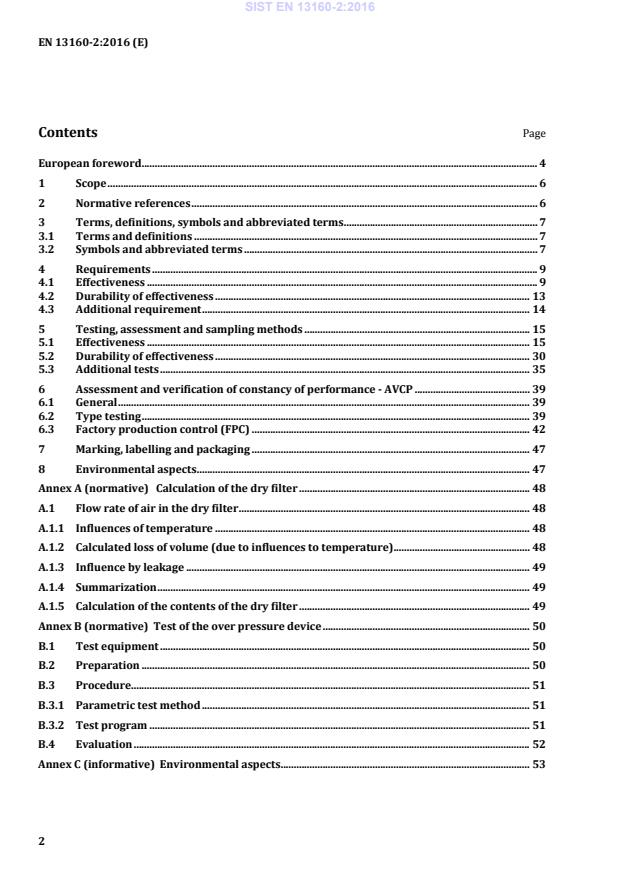
Calculation of the dry filter . 48 A.1 Flow rate of air in the dry filter . 48 A.1.1 Influences of temperature . 48 A.1.2 Calculated loss of volume (due to influences to temperature) . 48 A.1.3 Influence by leakage . 49 A.1.4 Summarization . 49 A.1.5 Calculation of the contents of the dry filter . 49 Annex B (normative)
Test of the over pressure device . 50 B.1 Test equipment . 50 B.2 Preparation . 50 B.3 Procedure. 51 B.3.1 Parametric test method . 51 B.3.2 Test program . 51 B.4 Evaluation . 52 Annex C (informative)
Environmental aspects . 53 SIST EN 13160-2:2016
Clauses of this European Standard addressing the provisions of the EU Directive Construction Products Regulation 305/2011/EU . 56 ZA.1 Scope and relevant characteristics . 56 ZA.2 Procedure for AVCP of pressure and vacuum leak detection kits . 57 ZA.2.1 System(s) of AVCP . 57 ZA.2.2 Declaration of performance (DoP) . 59 ZA.2.2.1 General . 59 ZA.2.2.2 Content . 59 ZA.2.2.3 Example of DoP . 60 ZA.3 CE marking and labelling . 62 Bibliography . 66
is the difference between m1 and m2 pa is the set pressure of the pressure relief valve, in Pascal pam is the measured set pressure of the pressure relief valve, in Pascal pAA is the relative pressure at control point “alarm off”, in Pascal pAE is the relative pressure at control point “alarm on”, in Pascal pe is the pressure of pam +5 % of the pressure relief valve, in Pascal pPA is the working pressure of the leak detection kit and corresponds to the relative pressure at control point “pump off”, in Pascal pPE is the pressure of the leak detection kit and corresponds to the relative pressure at control point “pump on”, in Pascal SIST EN 13160-2:2016
is the difference between pAE and pPA, in Pascal QL is the flow rate of air due to leaks, in cubic metres per year QS is the flow rate of air due to temperature variation exceeding opening pressure of the over pressure device, in cubic metres per year Qgas is the entire flow rate of air (QS + QL), in cubic metres per year R is the general gas constant (here for air) = 287 J/(kgK) T0 is 15 °C = 288 K T1 is T0 T2 T2 is T1 + 7,5 K T1 is the temperature increase according to Formula (A.1), in Kelvins T2 is the temperature increase according to Formula (A.2), in Kelvins V is the proportional reduction of the interstitial space caused by ingress of liquid for assurance of the alarm, in per cent VA is the deflated air volume (by the pressure relief valve) in the leak detector), in cubic metres Vk is the volume of interstitial space = 1 m3 Vmax is the max. volume of interstitial space, intended for this leak detector, in cubic metres VTF is the contents (volume) of the dry filter, in litres V0 is the entire volume of the interstitial space, in cubic metres V1 is the volume of the interstitial space at filling height h1, in cubic metres pm is (p1 + p2)/2 average working pressure (absolute), in Pascal ρG is the density of the groundwater, in kilograms per cubic metre ρP is the density of the stored product in the tank, in kilograms per cubic metre SIST EN 13160-2:2016
(1) pAE = 3 000 Pa + G „ hG „ g
(2) — For pipes The evaluation device shall evaluate the measuring device values. In case of a pressure drop in the interstitial space to the level before or at the value calculated in Formula (3) a signal shall be sent to the alarm device. pAE = 0,1 MPa + p0
(3) 4.1.2.3 Alarm device for over pressure The alarm device shall generate an audible and visible alarm. The audible alarm shall have a sound level of
· 70 dB (A) in a distance of minimum 1 m with a signal according to Table 1 of EN 981:1996+A1:2008 which shall be maintained for a minimum period of 36 h. The audible alarm may be able to be switched off, but the status off should be visible. The visible alarm shall be clearly indicated i.e. by a “red” light. The visible alarm shall have no switch off option. The alarm device should be designed for connecting an additional alarm device, e.g. signal horn. The output parameter shall be stated. A test possibility shall be provided to test the functionality of the audible and visible alarm. 4.1.2.4 Measuring device for vacuum Leak detection kit comprises of measuring device for vacuum to be connected to the interstitial space. The measuring device for vacuum shall fulfil the following requirements: — vacuum measuring range: given by the manufacturer; — repeatability of the measurement: according to manufacturer data; — overload protection against vacuum: minimum 1,1 times of the working vacuum (pPA), at least however 60 kPa (600 mbar); — if the measuring device is designed to be used on pressurized tanks or pipes, the measuring device shall withstand an overpressure of at least 1,1 times of the design pressure given by the manufacturer. A condensate trap shall be provided for all lowest points of the measuring line. The measuring device shall be connected to the interstitial space by a measuring line of 6 mm minimum diameter. The colour of this measuring line shall be red or marked in red. 4.1.2.5 Evaluation device for vacuum 4.1.2.5.1 General The operating condition of the evaluation device shall be clearly indicated, i.e. by a “green” light. The evaluation device shall be designed to be connected to an alarm device. SIST EN 13160-2:2016
100100000 Pa - pV = p in % (4) Due to the alarm pressure pAE the interstitial space is filled (in the case of a leak) up to the height h1 compared with the lowest point of the tank, see Formula (5): ρρ⋅⋅AEAE11PG =
or
= hg
g
pph (5) Under consideration of tank geometry or geodetic differences in the levels of the double wall pipe systems the volume of the interstitial space V1 at filling height h1 has to be determined by calculation (or by measurement in litres), see EN 13160-7. The alarm is considered reliable, if the following condition is fulfilled, see Formula (6): 10VVV <
(6) NOTE The above mentioned calculation would be carried out for tanks with a suction line down to the lowest point of the interstitial space. An analogue application is required for tanks without a suction line or for pipework, i.e. the line of reference for the height h1 is the horizontal line through the lowest point, at which the suction line is connected with or ends in the interstitial space. For tanks with a suction line down to the lowest point of the interstitial space it is the end of the suction line on the lowest point and for tanks without a suction line down to the lowest point of the interstitial space it is the suction nozzle at the top of the tank. 4.1.2.5.2 Without integrated vacuum generator For the application of these systems the following conditions shall be fulfilled: — a suction line (for the vacuum pump to be installed outside) which shall be led down to the lowest point of the interstitial space; or — at above-ground tanks, as an alternative, a control nozzle may be installed at the lowest point of the interstitial space. The vacuum pressure (relative value) at pAE shall be at least 35 kPa. The vacuum pressure (relative value) of the working pressure shall be at least 70 kPa. 4.1.2.5.3 With integrated vacuum generator The evaluation device with integrated vacuum generator for tanks and pipes shall evaluate the measuring device values. In case of a pressure rise in the interstitial space to the level before or at the value: a) as high as the pressure calculated according to Formula (7) pAE = 3 000 Pa +
„ g „ h
(7) or
· 70 dB (A) in a distance of minimum 1 m with a signal according to Table 1 of EN 981:1996+A1:2008 which shall be maintained for a minimum period of 36 h. The audible alarm may be able to be switched off but the status off should be visible. The alarm device should be designed for connecting an additional alarm device, e.g. signal horn. The output parameter shall be stated. The visible alarm shall be clearly indicated i.e. by a “red” light. The visible alarm shall have no switch off option. A test possibility shall be provided to test the functionality of the audible and visible alarm. 4.1.3 Replenishment rate of the medium (only if provided) 4.1.3.1 Vacuum and pressure generators with regulated flow rate The volume flow at the alarm pressure shall be (85 ± 15) l
® h-1 if a pressure/vacuum generator is used. The pressure/vacuum generator shall be connected to the interstitial space by an interconnecting line of the following minimum inside diameter: — 6 mm for air based systems; — 4 mm for inert gas based systems. The colour of this interconnecting line shall be white or clear or marked in white for indication. The total flow resistance of the interconnecting line between the pressure generator and the double skin tank or pipe may be not more than 1 kPa (10 mbar) at (85 ± 15) l
® h-1. NOTE This requirement is fulfilled for air-based systems, when the length of the interconnecting line is
¶ 50 m for an inner diameter of the interconnecting line of 6 mm. 4.1.3.2 Pressure / vacuum generator with time regulated flow The average volume flow (measured over a refill and a control period) at the alarm pressure shall be (85 ± 15) l
® h-1 if a pressure/vacuum generator is used. The pressure/vacuum generator shall be connected to the interstitial space by an interconnecting line of the following minimum inside diameter: — 6 mm for air based systems; — 4 mm for inert gas based systems. SIST EN 13160-2:2016
® h-1. NOTE This requirement is fulfilled for air-based systems, when the length of the interconnecting line is
¶ 50 m for an inner diameter of the interconnecting line of 6 mm. 4.1.4 Software (only if provided) The software, where provided, shall have a facility for self-checking by fulfilling the following requirements: — a self-diagnostic mode to test the integrity of the system at start up and periodically during use. A negative result of self-diagnostic mode shall result in an alarm condition; — a facility to check the consistency of the input and output data, malfunction shall result in an alarm condition. 4.1.5 Function and tightness of leak detection kit All leak detection kits shall — be equipped with a device for simulating a leak which shall result in an alarm; — withstand the operation pressure/vacuum as well as the pressure of tanks or pipes or the hydrostatic pressure of tanks and shall be tight under these conditions; — have an opening and closing pressure of the pressure relief device in the range given by the manufacturer. The devices for simulating a leak shall have clearly identified operating position. 4.2 Durability of effectiveness 4.2.1 Durability of effectiveness against temperature The temperature ranges for leak detection kits shall be as follows: — Type 1:
« t r °C to +60 °C; — Type 2: 0 °C to +40 °C; — Type 3:
« v r °C to +40 °C. 4.2.2 Durability of effectiveness against chemical attack Parts of leak detection kits which may come into contact with the liquid of the stored/conveyed product or its vapour shall be resistant. 4.2.3 Durability of effectiveness against fatigue through cycling of pressure Leak detection kits shall withstand 10 000 cycles of pressure changes. 4.2.4 Humidity measurement of the leak detection medium (only if provided) A dry filter shall be sized so that it has not to be exchanged within one year, provided a tight system. A device shall indicate proper function. SIST EN 13160-2:2016
Key 1 test sample 5 pressure vessel 1 l 2 measure line 6 pressure regulator valve 3 pressure/suction line 7 pressure generator 4 measuring device for pressure 8 valves Figure 1 — Measuring device for over pressure or vacuum 5.1.2.1.3 Procedure The tests shall be carried out at a temperature of (20 ± 5) °C. 1) Visual comparison of the data of the field of application compared with the data of the measuring device. 2) Test to check the repeatability. — The test sample shall be connected to the reference measuring device. With the pressure generator an overpressure shall be created until the switch value “Pump-off” is indicated. The corresponding value on the reference measuring device shall be noted. The test set-up shall be ventilated to until the switch value “Alarm-on” is indicated. The corresponding value on the reference measuring device shall be noted. — Then the test set-up shall be ventilated to atmospheric pressure. — The test procedure as described before needs be carried out once more. The noted values (set for pump-off and set for alarm-on) shall be compared. 3) Test to check the overload protection. — The openings of the test sample shall be closed with plugs. The test sample shall be pressurized with the overpressure generator to a pressure of 1,5 times of the working pressure of the measuring device (pPA). — Hold the pressure for (15 ± 1) min and then release to atmospheric condition. SIST EN 13160-2:2016
Key 1 leak detection kit 4 regulating valve 2 device for testing 5 test vessel 1 l for type-testing, volume for final production test can be defined by the manufacturer 3 reference testing device 6 connection lines (pressure/suction and measuring) 1 m each Figure 2 — Evaluation device for over pressure or vacuum The reference testing device shall be connected to the measuring line using the device for testing the operating condition designated by the manufacturer. 5.1.2.2.3 Procedure 1) Read the manual for the switch values pAE and pPA as well as for the intended use of tanks/pipes with their pressure values for pt2. — The following tests shall be carried out at a temperature of (20 ± 5) °C. 2) Open the regulating valve to ventilate the test vessel. — Set the power supply on the leak detection kit and check whether the green lamp is visible at angle of 45° (all sides) measured from the front plate. 3) Close the regulating valve and the pressure will build up in the test vessel. If the pressure rises too quickly then the regulating valve can be adjusted in a way that the pressure build up is slowly enough that the value for pAA and pPA can be clearly read on the reference testing device. Note the measured values. SIST EN 13160-2:2016
· 1 m2 and weighs at least 200 kg m-2. The absorption coefficient for sound shall be
¶ 0,05. — sound level meter class 2 according to EN 61672-1; — the continuous sound level of the surrounding shall be < 60 dB (A). 5.1.2.3.2 Preparation For the purpose of this test the leak detector with the signal device shall be mounted with the fastening device supplied by the manufacturer to a solid wall. 5.1.2.3.3 Procedure The audible signal device shall be sounded continuously for at least 36 h in a fatigue test. On completion of the fatigue test the sound level shall be measured. The arithmetic mean shall be taken from at least 3 measuring points. These measuring points shall be located approximately equidistant on a hemisphere extending over the leak detector front. The radius of the hemisphere shall be r = 1 m. The outer measuring points are to be SIST EN 13160-2:2016
· 70 dB (A) after the fatigue test. 5.1.2.4 Measuring device for vacuum 5.1.2.4.1 Test equipment The testing shall be carried out with the following equipment: — generator for overpressure; — generator for vacuum; — pressure regulator; — valves; — measuring device for pressure; with an accuracy of 0,6 % of the full scale range and a division of 0,5 %; — temperature sensor/thermometer with an accuracy of 1 K; — test sample (measuring device for vacuum combined with a pressure vessel of a volume of 1 l.); — connection lines (tubing), length of (1 ± 0,01) m. All measuring devices shall have a full scale, sensitivity, accuracy and repeatability in accordance with the acceptance criterion. 5.1.2.4.2 Preparation The test set-up shall be according to Figure 1. 5.1.2.4.3 Procedure The tests shall be carried out at a temperature of (20 ± 5) °C. 1) Visual comparison of the data of the field of application compared with the data of the measuring device. 2) Test to check the repeatability: — The test sample shall be connected to the reference measuring device. With the vacuum generator a vacuum shall be created until the switch value “Pump-off” is indicated. The corresponding value on the reference measuring device shall be noted. The test set-up shall be ventilated until the switch value “Alarm-on” is indicated. The corresponding value on the reference measuring device shall be noted. — Then the test set-up is ventilated to atmospheric pressure. — The test procedure as described before needs be carried out once more. — The noted values (set for pump-off and set for alarm-on) shall be compared. SIST EN 13160-2:2016
...
SIST EN 13160-2:2016 표준은 누수 탐지 시스템에 대한 요구사항과 시험/평가 방법을 제공합니다. 이 표준의 적용 범위는 압력 변화 측정을 기반으로 하는 누수 탐지 키트에 중점을 두고 있으며, 이 키트는 수질 오염 물질을 포함할 수 있는 액체/유체에 사용되도록 설계된 이중 스킨, 지하 또는 지상, 압력이 가해지거나 가해지지 않는 탱크 또는 배관과 함께 사용됩니다. 이 표준의 강점 중 하나는 누수 탐지 키트의 구성 요소인 측정 장치, 평가 장치, 알람 장치, 압력 발생기, 압력 완화 장치, 액체 정지 장치, 응축수 트랩과 같은 기술적 세부 사항을 명확히 규정하고 있다는 점입니다. 이러한 요소들은 사용자에게 종합적인 접근 방식을 제공하며, 시스템의 신뢰성과 효율성을 보장하는 데 기여합니다. 또한, 표준에는 각 구성 요소의 테스트 및 평가 방법이 포함되어 있어, 품질 관리 및 성능 보증을 위한 기준을 제공합니다. SIST EN 13160-2:2016 표준은 환경 보호 및 안전성과 직접적으로 관련이 있기 때문에, 산업 현장에서 매우 중요한 역할을 합니다. 누수 탐지 시스템의 적절한 사용은 물과 자원의 낭비를 줄이고, 오염 사고를 예방하는 데 기여합니다. 따라서 이 표준은 환경 관리와 관련된 여러 분야에서 반드시 준수해야 할 가이드라인으로 자리잡고 있습니다. 이 표준이 제공하는 명확한 요구사항과 시험 방법은 누수 탐지 시스템을 효과적으로 운영하고 유지 관리하는 데 필요한 기초를 다져 줍니다. 따라서 SIST EN 13160-2:2016은 누수 탐지 시스템의 효과성을 높이고, 지속 가능한 개발 목표를 달성하기 위한 필수적인 기준으로 평가받을 수 있습니다.
La norme EN 13160-2:2016 définit les exigences et les méthodes d'essai/évaluation pour les systèmes de détection de fuites, spécifiquement adaptés aux kits de détection de fuites qui reposent sur la mesure des variations de pression. Ce cadre normatif est particulièrement pertinent pour les environnements où sont utilisés des réservoirs ou des canalisations conçus pour des liquides polluants, qu'ils soient souterrains ou aériens, pressurisés ou non pressurisés. Les forces de cette norme résident dans sa capacité à fournir des lignes directrices claires et concises pour le développement et l'évaluation des kits de détection de fuites. La norme couvre un large éventail d'équipements, incluant les dispositifs de mesure, d'évaluation, d'alarme, ainsi que des composants essentiels tels que le générateur de pression et le dispositif de secours pour la pression. De plus, la présence de dispositifs tels que le piège à condensats et le dispositif d'arrêt liquide assure une approche intégrée pour la gestion des risques liés aux fuites. La pertinence de la norme EN 13160-2:2016 ne peut être sous-estimée dans le contexte actuel de la protection de l’environnement et de la gestion des fluides dangereux. En fournissant des méthodes éprouvées pour évaluer l’efficacité des systèmes de détection de fuites, cette norme contribue non seulement à la sécurité des infrastructures mais également à la préservation des ressources en eau. En somme, la norme EN 13160-2:2016 est un outil indispensable pour les professionnels impliqués dans la mise en œuvre et le contrôle des systèmes de détection de fuites, garantissant ainsi une conformité aux normes de sécurité environnementale pertinentes.
Die EN 13160-2:2016 ist eine bedeutende europäische Norm, die umfassende Anforderungen sowie Test- und Bewertungsmethoden für Leckageerkennungssysteme definiert. Diese Norm ist speziell auf Leckageerkennungskits ausgerichtet, die auf der Messung von Druckänderungen basieren. Der Anwendungsbereich umfasst eine Vielzahl von Szenarien, darunter doppelte Wandkonstruktionen, unterirdische und oberirdische Tanks sowie Rohrleitungen, die für wasserverunreinigende Flüssigkeiten ausgelegt sind. Somit ist die Norm für sowohl druckbeaufschlagte als auch drucklose Systeme relevant. Die Stärken der EN 13160-2:2016 liegen in der klaren Definition der Komponenten, die ein Leckageerkennungskit umfassen sollte, darunter Messvorrichtungen, Auswertungsgeräte, Alarmgeräte, Druckgeneratoren, Druckentlastungsgeräte, Flüssigkeitsstoppsysteme und Kondensatfallen. Diese detaillierte Aufzählung sorgt für eine hohe Zuverlässigkeit und Sicherheit der verwendeten Systeme, was besonders im Bereich des Umweltschutzes von großer Bedeutung ist. Die Relevanz dieser Norm kann nicht hoch genug eingeschätzt werden, insbesondere vor dem Hintergrund der zunehmenden Anforderungen an den Schutz von Gewässern und Böden. Indem sie klare Vorgaben zur Funktionsfähigkeit und den Prüfstandards für Leckageerkennungssysteme bietet, trägt die EN 13160-2:2016 erheblich zur Vermeidung von Umweltschäden bei. Insgesamt stellt die EN 13160-2:2016 eine essentielle Grundlage für Hersteller und Anwender von Leckageerkennungssystemen dar und hilft dabei, die Sicherheitsstandards in der Branche zu erhöhen.
SIST EN 13160-2:2016は、圧力と真空システムに関する漏れ検出システムの要件と試験/評価方法を明確に定義しています。この標準は、圧力変化の測定に基づく漏れ検出キット(漏れ検出器)に対する要求を提供しており、環境保護と安全性を確保するための重要な役割を果たします。 標準の範囲は、二重皮膜の地下または地上のタンク、圧力または非圧力のパイプラインに適用され、水を汚染する液体や流体に設計されています。これにより、漏れ検出装置は多様なインフラストラクチャに実装可能であり、特に重要な環境基準を遵守する際に非常に有用です。 この標準の強みは、適切な計測器、評価装置、警報装置、圧力発生器、圧力解放装置、液体停止装置、凝縮水トラップが含まれた完全な漏れ検出キットの要件をカバーしている点です。これにより、信頼性の高い漏れ検出が実現され、安全な運用が保証されます。 さらに、漏れの迅速な検出は、水質汚染の防止や環境への影響を最小限に抑えるための効果的な手段となります。このため、SIST EN 13160-2:2016は、業界全体における漏れ検出システムの整備において、非常に関連性が高いスタンダードと言えます。
The standard EN 13160-2:2016 addresses critical requirements and test/assessment methodologies for leak detection systems designed to assess pressure and vacuum systems. Its comprehensive scope encompasses leak detection kits specifically formulated to gauge pressure changes in various settings. This includes double skin, underground, or above-ground tanks and pipework that are either pressurized or non-pressurized, which are utilized for water polluting liquids and fluids. A significant strength of this standard lies in its detailed specifications for the components of leak detection kits. It delineates the essential parts required for effective operation, such as the measuring device, evaluation device, alarm device, pressure generator, pressure relief device, liquid stop device, and condensate trap. This thoroughness ensures that manufacturers and operators understand the necessary criteria for creating reliable leak detection systems that safeguard against environmental hazards. The relevance of EN 13160-2:2016 cannot be overstated in today's regulatory landscape, where the protection of water sources from potential contamination is of utmost importance. By setting forth explicit requirements and testing methods, the standard cultivates uniformity in compliance and operational effectiveness among leak detection systems, thereby enhancing both safety and environmental stewardship. This standard represents an essential tool for engineers and operators tasked with ensuring the integrity of storage facilities and the safe handling of hazardous materials.
Questions, Comments and Discussion
Ask us and Technical Secretary will try to provide an answer. You can facilitate discussion about the standard in here.
Loading comments...