

EN 12962:2011
(Main)Adhesives - Determination of elastic behaviour of liquid adhesives (elasticity index)
- Abstract
This European Standard specifies a test method to determine the elastic behaviour of and elastomeric monocomponent liquid adhesive under specified conditions.
This method is particularly suitable for production control.
- Status
- Published
- Publication Date
- 19-Apr-2011
- Withdrawal Date
- 30-Oct-2011
- Technical Committee
- CEN/TC 193 - Adhesives
- Current Stage
- 9093 - Decision to confirm - Review Enquiry
- Start Date
- 12-Jul-2023
- Completion Date
- 07-Oct-2026

Overview
EN 12962:2011 is a European Standard developed by CEN for the determination of elastic behaviour in liquid adhesives, specifically elastomeric monocomponent adhesives. It defines a practical test method to measure the elasticity index, which is crucial for production control and quality assurance in adhesive manufacturing. This standard ensures consistent and reliable results to optimize adhesive performance, particularly in applications involving porous substrates.
Understanding and controlling the elastic behaviour of adhesives helps improve their processability and bonding strength, making EN 12962:2011 vital for industries relying on adhesives for wood, leather, fabric, and other porous materials.
Key Topics
Elasticity Index Measurement
The standard specifies using a specially designed spindle dipped into the adhesive. When the spindle rotates at a constant speed, the adhesive climbs the spindle shaft to a certain height. This height represents the elasticity index in millimetres, indicating the adhesive’s elastic behaviour under controlled conditions.Test Conditions and Apparatus
Key equipment includes a 100 mm diameter beaker, a graduated spindle, a mechanical or electronic stirrer, and temperature-controlled environment at 23 ± 0.5 °C. Precise timing and weighing methods complement the measurement to ensure test reliability.Procedure Highlights
The adhesive sample must be prepared and conditioned per referenced standards EN 1067 and EN ISO 15605. The spindle is immersed slowly to avoid air bubbles, rotated at 300 ± 10 rpm for 30 seconds, and the height of adhesive rise is recorded. Two determinations are performed to calculate an average elasticity index.Result Expression and Reporting
Results are expressed as the mean elasticity index in millimetres rounded to the nearest millimetre. The test report must include references to EN 12962, identification details of the adhesive, test results, and any relevant conditions affecting the test.
Applications
Quality Control in Adhesive Production
The method outlined by EN 12962:2011 is particularly suitable for ongoing production monitoring, helping manufacturers maintain consistent adhesive elasticity and performance characteristics.Optimizing Adhesive Selection
By controlling the elasticity, this standard helps avoid common bonding issues such as insufficient substrate penetration or excessive absorption in porous materials. This leads to improved bond strength and durability.Industrial Adhesive Formulation
R&D teams use the test to fine-tune adhesive formulations for desired elasticity levels tailored to specific applications, balancing viscosity and elasticity for optimal application methods like brushing or rolling.Compliance and Standardization
Organizations across Europe utilize EN 12962 to harmonize testing methods, ensuring adhesives comply with recognized standards for elastic behaviour, promoting safer and more effective adhesive use.
Related Standards
- EN 923:2005+A1:2008 – Adhesives: Terms and Definitions
- EN 1067 – Adhesives: Examination and Preparation of Samples for Testing
- EN ISO 15605 – Adhesives: Sampling
- EN 12092 – Adhesives: Determination of Viscosity (related rheological property)
Utilizing these related standards together with EN 12962 ensures comprehensive testing covering sampling, terminology, viscosity, and elasticity - essential for full characterization of liquid adhesives.
Keywords: EN 12962:2011, liquid adhesives, elastic behaviour, elasticity index, test method, production control, elastomeric adhesives, adhesive quality, adhesive testing, European Standard, adhesive elasticity, porous substrates, adhesive viscosity, spindle test, CEN standards.
Relations
- Effective Date
- 08-Jun-2022
- Effective Date
- 28-Jan-2026
- Effective Date
- 28-Jan-2026
- Effective Date
- 28-Jan-2026
Get Certified
Connect with accredited certification bodies for this standard

DIN CERTCO
DIN Group product certification.

Smithers Quality Assessments
US management systems and product certification.
Sponsored listings
Frequently Asked Questions
EN 12962:2011 is a standard published by the European Committee for Standardization (CEN). Its full title is "Adhesives - Determination of elastic behaviour of liquid adhesives (elasticity index)". This standard covers: This European Standard specifies a test method to determine the elastic behaviour of and elastomeric monocomponent liquid adhesive under specified conditions. This method is particularly suitable for production control.
This European Standard specifies a test method to determine the elastic behaviour of and elastomeric monocomponent liquid adhesive under specified conditions. This method is particularly suitable for production control.
EN 12962:2011 is classified under the following ICS (International Classification for Standards) categories: 83.180 - Adhesives. The ICS classification helps identify the subject area and facilitates finding related standards.
EN 12962:2011 has the following relationships with other standards: It is inter standard links to EN 12962:2001, EN 1067:2005, EN 923:2005+A1:2008, EN ISO 15605:2004. Understanding these relationships helps ensure you are using the most current and applicable version of the standard.
EN 12962:2011 is available in PDF format for immediate download after purchase. The document can be added to your cart and obtained through the secure checkout process. Digital delivery ensures instant access to the complete standard document.
Standards Content (Sample)
2003-01.Slovenski inštitut za standardizacijo. Razmnoževanje celote ali delov tega standarda ni dovoljeno.HODVWLþQRVWLKlebstoffe - Bestimmung des elastischen Verhaltens flüssiger Klebstoffe (Elastizitätsindex)Adhésifs - Détermination du comportement élastique des adhésifs liquides (indice d'élasticité)Adhesives - Determination of elastic behaviour of liquid adhesives (elasticity index)83.180LepilaAdhesivesICS:Ta slovenski standard je istoveten z:EN 12962:2011SIST EN 12962:2011en,fr,de01-julij-2011SIST EN 12962:2011SLOVENSKI
STANDARDSIST EN 12962:20021DGRPHãþD
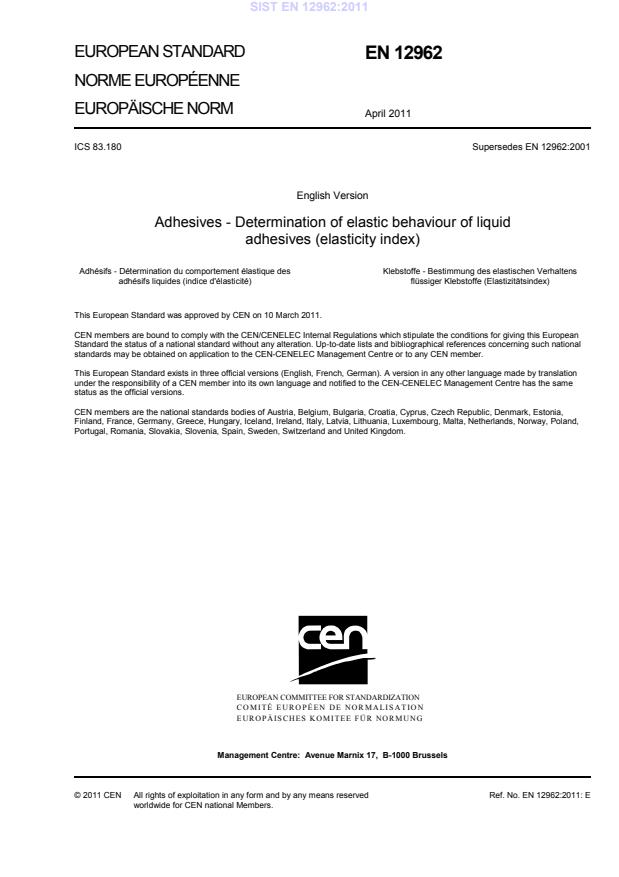
EUROPEAN STANDARD NORME EUROPÉENNE EUROPÄISCHE NORM
EN 12962
April 2011 ICS 83.180 Supersedes EN 12962:2001English Version
Adhesives - Determination of elastic behaviour of liquid adhesives (elasticity index)
Adhésifs - Détermination du comportement élastique des adhésifs liquides (indice d'élasticité)
Klebstoffe - Bestimmung des elastischen Verhaltens flüssiger Klebstoffe (Elastizitätsindex) This European Standard was approved by CEN on 10 March 2011.
CEN members are bound to comply with the CEN/CENELEC Internal Regulations which stipulate the conditions for giving this European Standard the status of a national standard without any alteration. Up-to-date lists and bibliographical references concerning such national standards may be obtained on application to the CEN-CENELEC Management Centre or to any CEN member.
This European Standard exists in three official versions (English, French, German). A version in any other language made by translation under the responsibility of a CEN member into its own language and notified to the CEN-CENELEC Management Centre has the same status as the official versions.
CEN members are the national standards bodies of Austria, Belgium, Bulgaria, Croatia, Cyprus, Czech Republic, Denmark, Estonia, Finland, France, Germany, Greece, Hungary, Iceland, Ireland, Italy, Latvia, Lithuania, Luxembourg, Malta, Netherlands, Norway, Poland, Portugal, Romania, Slovakia, Slovenia, Spain, Sweden, Switzerland and United Kingdom.
EUROPEAN COMMITTEE FOR STANDARDIZATION
COMITÉ EUROPÉEN DE NORMALISATION EUROPÄISCHES KOMITEE FÜR NORMUNG
Management Centre:
Avenue Marnix 17,
B-1000 Brussels © 2011 CEN All rights of exploitation in any form and by any means reserved worldwide for CEN national Members. Ref. No. EN 12962:2011: ESIST EN 12962:2011
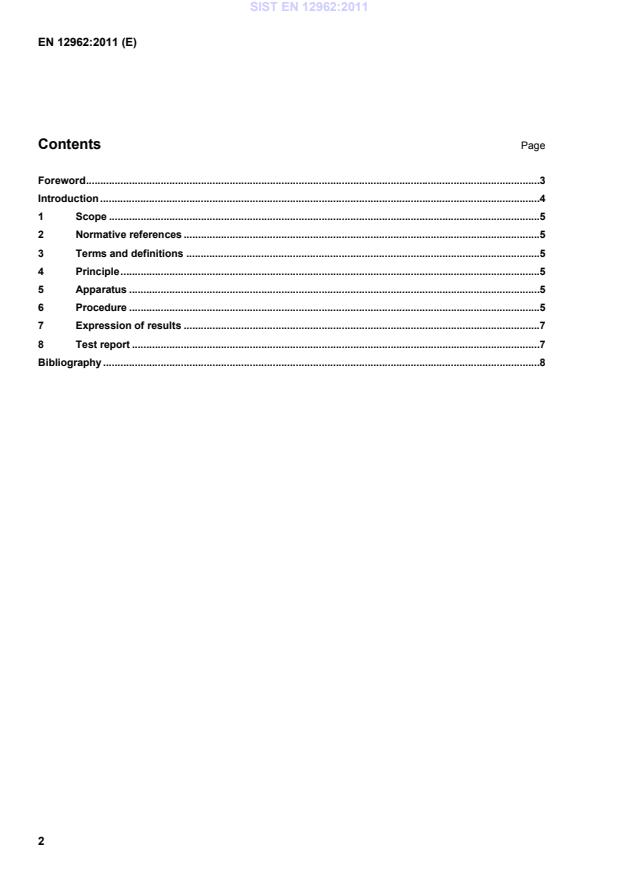
2 Contents Page Foreword .3Introduction .41 Scope .52 Normative references .53 Terms and definitions .54 Principle .55 Apparatus .56 Procedure .57 Expression of results .78 Test report .7Bibliography .8 SIST EN 12962:2011
3 Foreword This document (EN 12962:2011) has been prepared by Technical Committee CEN/TC 193 “Adhesives”, the secretariat of which is held by AENOR. This European Standard shall be given the status of a national standard, either by publication of an identical text or by endorsement, at the latest by October 2011, and conflicting national standards shall be withdrawn at the latest by October 2011. Attention is drawn to the possibility that some of the elements of this document may be the subject of patent rights. CEN [and/or CENELEC] shall not be held responsible for identifying any or all such patent rights. This document supersedes EN 12962:2001. The main modifications regarding the previous version are in Figure 1 and 6.10. SAFETY STATEMENT — Persons using this document should be familiar with the normal laboratory practice, if applicable. This document does not purport to address all of the safety problems, if any, associated with its use. It is the responsibility of the user to establish appropriate safety and health practices and to ensure compliance with any regulatory conditions. ENVIRONMENTAL STATEMENT — It is understood that some of the material permitted in this standard may have negative environmental impact. As technological advantages lead to acceptable alternatives for these materials, they will be eliminated from this standard to the extent possible. At the end of the test, the user of the standard should take care to carry out an appropriate disposal of the wastes, according to local regulation. According to the CEN/CENELEC Internal Regulations, the national standards organizations of the following countries are bound to implement this European Standard: Austria, Belgium, Bulgaria, Croatia, Cyprus, Czech Republic, Denmark, Estonia, Finla
...