

EN 18070:2025
(Main)Performance of wood adhesives exposed to high temperatures with regard to behaviour of load-bearing timber structures in fire - Test method, evaluation and classification
- Abstract
This document specifies a test method for comparing the compression shear strength of adhesive bonds in wood and solid wood after exposure to a target temperature for a specified duration of time.
This document is applicable to adhesives used in load bearing timber structures.
This document is not applicable to Epoxy- and two component Polyurethane-adhesives.
This method is intended to obtain data for the performance of wood adhesives at very high temperatures. The result of this comparison can be used to classify the adhesive with regard to the behaviour of load-bearing timber structures in fire.
- Status
- Published
- Publication Date
- 29-Jul-2025
- Technical Committee
- CEN/TC 193 - Adhesives
- Drafting Committee
- CEN/TC 193/SC 1/WG 13 - Fire behaviour
- Current Stage
- 6060 - Definitive text made available (DAV) - Publishing
- Start Date
- 30-Jul-2025
- Due Date
- 06-Mar-2026
- Completion Date
- 30-Jul-2025

Overview
EN 18070:2025 is a European Standard developed by CEN that specifies a test method for evaluating the performance of wood adhesives exposed to high temperatures, with a focus on their behavior in load-bearing timber structures during fire events. This standard details a comparative procedure for measuring the compression shear strength of adhesive bonds in wood versus solid wood after exposure to elevated temperatures for defined periods. The results of this method inform the classification of adhesives for use in fire-resilient timber construction.
This standard is applicable exclusively to adhesives intended for load-bearing timber structures, and specifically excludes Epoxy and two-component Polyurethane adhesives.
Key Topics
- High Temperature Performance: EN 18070:2025 outlines test methods to assess how well wood adhesives withstand exposure to target temperatures (such as 200°C, 220°C, 232°C, and 270°C), crucial for fire safety in timber structures.
- Compression Shear Strength Comparison: The procedure involves testing both adhesively bonded wood and solid wood to determine the ratio of their shear strengths after heat exposure.
- Test Procedure: Defined requirements for the preparation of test samples, selection of wood species (e.g., Norway spruce), conditioning, insertion of thermocouples for temperature monitoring, and execution of block shear tests.
- Classification of Adhesives: The outcomes are used to assign adhesives to specific temperature classes based on their residual performance, facilitating safe selection for fire-exposed applications.
- Reporting and Evaluation: Specifies comprehensive reporting of test data, including details on test conditions, wood and adhesive characteristics, temperature profiles, and shear strength results.
Applications
- Fire-Resistant Timber Structures: EN 18070:2025 provides a rigorous framework to ensure that adhesives used in load-bearing wood structures maintain integrity under fire conditions, critical for structural safety and regulatory compliance.
- Adhesive Selection and Specification: Manufacturers and engineers use this standard to classify adhesives and demonstrate that products meet necessary fire performance criteria for construction projects involving glued laminated timber (glulam) and bonded wood elements.
- Quality Assurance: Laboratories and quality control teams rely on these methods to validate the temperature resilience of adhesives, supporting CE marking and market acceptance across Europe.
- Product Development: Adhesive producers utilize the standard to guide product research and development focused on enhancing fire performance.
Related Standards
For comprehensive evaluation and conformity, EN 18070:2025 should be used in conjunction with relevant standards including:
- EN 14080:2013 - Timber structures - Glued laminated timber and glued solid timber - Requirements: Reference for block shear test methods and specifications for timber products.
- EN 923 - Adhesives - Terms and definitions: Defines terminology relevant to adhesive testing and classification.
- ASTM D 7247 - Standard test method for evaluating the shear strength of adhesive bonds in laminated wood products at elevated temperatures: Provides an additional reference for similar shear strength testing procedures under heat.
Practical Value
By providing a standardized approach to test, evaluate, and classify wood adhesives for high-temperature and fire scenarios, EN 18070:2025 supports safer design, specification, and construction of timber structures. Implementation of this standard enables stakeholders to:
- Ensure compliance with building code fire requirements for timber construction.
- Validate that adhesives exhibit adequate performance in real fire exposure scenarios.
- Improve confidence in the integrity and durability of glued wood assemblies in fire-prone environments.
- Facilitate harmonization in the European market for adhesives in engineered wood products.
Keywords: EN 18070:2025, wood adhesives, high temperature performance, fire testing, load-bearing timber structures, compression shear strength, adhesive classification, timber fire safety, glulam, CEN standard.
Relations
- Effective Date
- 28-Jan-2026
- Refers
EN 14080:2013 - Timber structures - Glued laminated timber and glued solid timber - Requirements - Effective Date
- 28-Jan-2026
Get Certified
Connect with accredited certification bodies for this standard

DIN CERTCO
DIN Group product certification.
Gozdarski inštitut Slovenije
Slovenian Forestry Institute. Forest management certification support, timber testing.

Smithers Quality Assessments
US management systems and product certification.
Sponsored listings
Frequently Asked Questions
EN 18070:2025 is a standard published by the European Committee for Standardization (CEN). Its full title is "Performance of wood adhesives exposed to high temperatures with regard to behaviour of load-bearing timber structures in fire - Test method, evaluation and classification". This standard covers: This document specifies a test method for comparing the compression shear strength of adhesive bonds in wood and solid wood after exposure to a target temperature for a specified duration of time. This document is applicable to adhesives used in load bearing timber structures. This document is not applicable to Epoxy- and two component Polyurethane-adhesives. This method is intended to obtain data for the performance of wood adhesives at very high temperatures. The result of this comparison can be used to classify the adhesive with regard to the behaviour of load-bearing timber structures in fire.
This document specifies a test method for comparing the compression shear strength of adhesive bonds in wood and solid wood after exposure to a target temperature for a specified duration of time. This document is applicable to adhesives used in load bearing timber structures. This document is not applicable to Epoxy- and two component Polyurethane-adhesives. This method is intended to obtain data for the performance of wood adhesives at very high temperatures. The result of this comparison can be used to classify the adhesive with regard to the behaviour of load-bearing timber structures in fire.
EN 18070:2025 is classified under the following ICS (International Classification for Standards) categories: 79.040 - Wood, sawlogs and sawn timber; 79.060.99 - Other wood-based panels; 83.180 - Adhesives. The ICS classification helps identify the subject area and facilitates finding related standards.
EN 18070:2025 has the following relationships with other standards: It is inter standard links to EN 923:2015, EN 14080:2013. Understanding these relationships helps ensure you are using the most current and applicable version of the standard.
EN 18070:2025 is available in PDF format for immediate download after purchase. The document can be added to your cart and obtained through the secure checkout process. Digital delivery ensures instant access to the complete standard document.
Standards Content (Sample)
SLOVENSKI STANDARD
01-oktober-2025
Delovanje lepil za les pri visokih temperaturah in požaru - Preskusne metode,
vrednotenje in razvrščanje
Performance of wood adhesives at high temperatures and fire - Test methods,
evaluation and classification.
Leistungseigenschaften von Holzklebstoffen bei hohen Temperaturen und im Brandfall -
Prüfverfahren, Bewertung und Klassifizierung
Performances des adhésifs pour bois à hautes températures et au feu - Méthodes
d’essai, évaluation et classification
Ta slovenski standard je istoveten z: EN 18070:2025
ICS:
79.040 Les, hlodovina in žagan les Wood, sawlogs and sawn
timber
83.180 Lepila Adhesives
2003-01.Slovenski inštitut za standardizacijo. Razmnoževanje celote ali delov tega standarda ni dovoljeno.
EN 18070
EUROPEAN STANDARD
NORME EUROPÉENNE
July 2025
EUROPÄISCHE NORM
ICS 79.040; 83.180
English Version
Performance of wood adhesives exposed to high
temperatures with regard to behaviour of load-bearing
timber structures in fire - Test method, evaluation and
classification
Performance des adhésifs pour bois exposés à des Leistungsfähigkeit von hohen Temperaturen
températures élevées en ce qui concerne le ausgesetzten Holzklebstoffen in Bezug auf das
comportement des structures porteuses en bois en Verhalten tragender Holzbauteile im Brandfall -
situation d'incendie - Méthode d'essai, évaluation et Prüfverfahren, Bewertung und Klassifizierung
classification
This European Standard was approved by CEN on 23 June 2025.
CEN members are bound to comply with the CEN/CENELEC Internal Regulations which stipulate the conditions for giving this
European Standard the status of a national standard without any alteration. Up-to-date lists and bibliographical references
concerning such national standards may be obtained on application to the CEN-CENELEC Management Centre or to any CEN
member.
This European Standard exists in three official versions (English, French, German). A version in any other language made by
translation under the responsibility of a CEN member into its own language and notified to the CEN-CENELEC Management
Centre has the same status as the official versions.
CEN members are the national standards bodies of Austria, Belgium, Bulgaria, Croatia, Cyprus, Czech Republic, Denmark, Estonia,
Finland, France, Germany, Greece, Hungary, Iceland, Ireland, Italy, Latvia, Lithuania, Luxembourg, Malta, Netherlands, Norway,
Poland, Portugal, Republic of North Macedonia, Romania, Serbia, Slovakia, Slovenia, Spain, Sweden, Switzerland, Türkiye and
United Kingdom.
EUROPEAN COMMITTEE FOR STANDARDIZATION
COMITÉ EUROPÉEN DE NORMALISATION
EUROPÄISCHES KOMITEE FÜR NORMUNG
CEN-CENELEC Management Centre: Rue de la Science 23, B-1040 Brussels
© 2025 CEN All rights of exploitation in any form and by any means reserved Ref. No. EN 18070:2025 E
worldwide for CEN national Members.
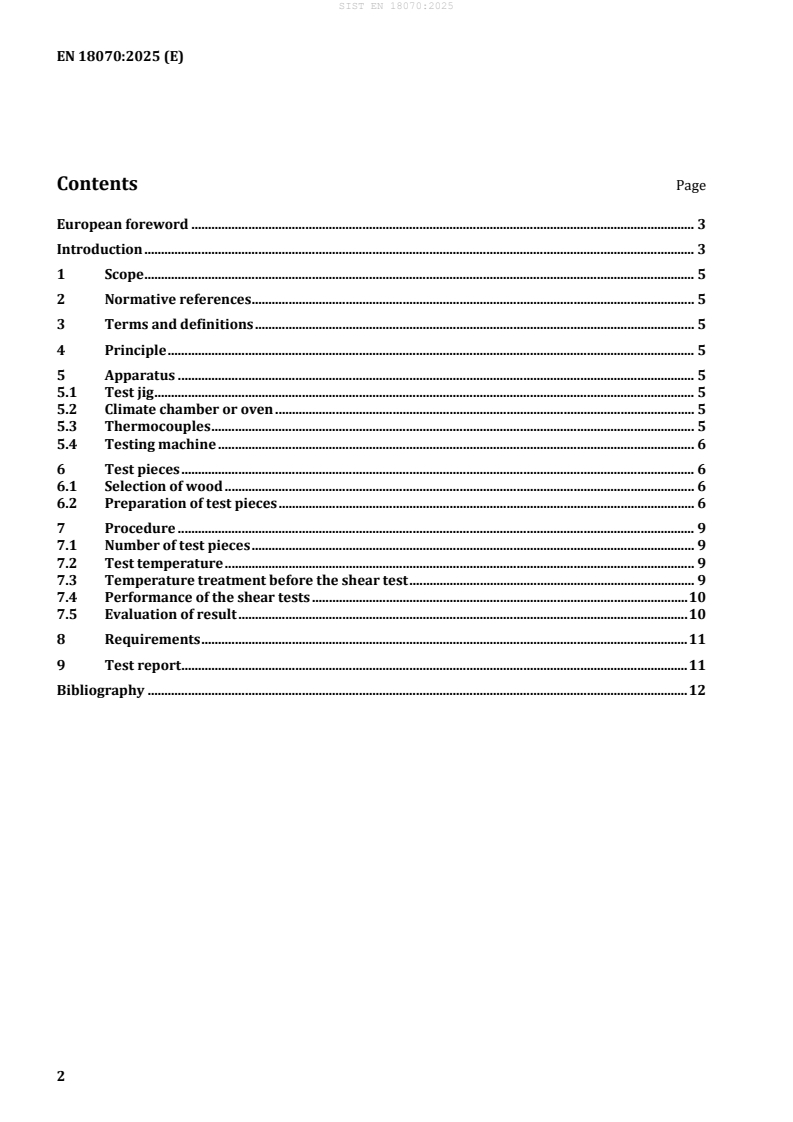
Contents Page
European foreword . 3
Introduction . 3
1 Scope . 5
2 Normative references . 5
3 Terms and definitions . 5
4 Principle . 5
5 Apparatus . 5
5.1 Test jig . 5
5.2 Climate chamber or oven . 5
5.3 Thermocouples . 5
5.4 Testing machine . 6
6 Test pieces . 6
6.1 Selection of wood . 6
6.2 Preparation of test pieces . 6
7 Procedure . 9
7.1 Number of test pieces . 9
7.2 Test temperature . 9
7.3 Temperature treatment before the shear test . 9
7.4 Performance of the shear tests . 10
7.5 Evaluation of result . 10
8 Requirements . 11
9 Test report . 11
Bibliography . 12
European foreword
This document (EN 18070:2025) has been prepared by Technical Committee CEN/TC 193 “Adhesives”,
the secretariat of which is held by UNE.
This European Standard shall be given the status of a national standard, either by publication of an
identical text or by endorsement, at the latest by January 2026, and conflicting national standards shall
be withdrawn at the latest by January 2026.
Attention is drawn to the possibility that some of the elements of this document may be the subject of
patent rights. CEN shall not be held responsible for identifying any or all such patent rights.
Any feedback and questions on this document should be directed to the users’ national standards body.
A complete listing of these bodies can be found on the CEN website.
According to the CEN-CENELEC Internal Regulations, the national standards organisations of the
following countries are bound to implement this European Standard: Austria, Belgium, Bulgaria,
Croatia, Cyprus, Czech Republic, Denmark, Estonia, Finland, France, Germany, Greece, Hungary, Iceland,
Ireland, Italy, Latvia, Lithuania, Luxembourg, Malta, Netherlands, Norway, Poland, Portugal, Republic of
North Macedonia, Romania, Serbia, Slovakia, Slovenia, Spain, Sweden, Switzerland, Türkiye and the
United Kingdom.
Introduction
Safety statement
Persons using this document are to be familiar with the normal laboratory practice, if applicable. This
document cannot address all of the safety problems, if any, associated with its use. It is the
responsibility of the user to establish appropriate safety and health practices and to ensure compliance
with any regulatory conditions.
Environmental statement
It is understood that some of the material permitted in this document can have negative environmental
impact. As technological advantages lead to better alternatives for these materials, they will be
eliminated from this document to the extent possible.
At the end of the test, the user of the document should take care to carry out an appropriate disposal of
the wastes, see local regulation for additional guidance.
1 Scope
This document specifies a test method for comparing the compression shear strength of adhesive bonds
in wood and solid wood after exposure to a target temperature for a specified duration of time.
This document is applicable to adhesives used in load bearing timber structures.
This document is not applicable to Epoxy- and two component Polyurethane-adhesives.
This method is intended to obtain data for the performance of wood adhesives at very high
temperatures. The result of this comparison can be used to classify the adhesive with regard to the
behaviour of load-bearing timber structures in fire.
2 Normative references
The following documents are referred to in the text in such a way that some or all of their content
constitutes requirements of this document. For dated references, only the edition cited applies. For
undated references, the latest edition of the referenced document (including any amendments) applies.
EN 923, Adhesives - Terms and definitions
EN 14080:2013, Timber structures - Glued laminated timber and glued solid timber - Requirements
3 Terms and definitions
For the purposes of this document the terms and definitions given in EN 923 apply.
ISO and IEC maintain terminology databases for use in standardization at the following addresses:
— ISO Online browsing platform: available at https://www.iso.org/obp
— IEC Electropedia: available at https://www.electropedia.org/
4 Principle
Adhesively bonded test pieces and solid wood test pieces are prepared. Both types of test pieces are
tested in a compression shear test according to EN 14080:2013, Annex D, after exposure to a test
temperature T. The ratio of compression shear strength of the adhesively bonded test pieces and the
solid wood test pieces is evaluated.
5 Apparatus
5.1 Test jig
Test equipment as specified in EN 14080:2013, Annex D for the performance of the shear test.
5.2 Climate chamber or oven
A climate chamber or oven for the heating of the test pieces, capable of maintaining the test
temperature T in the test piece within ±2 °C and having a sufficient air circulation to provide the
required temperature within the oven volume.
5.3 Thermocouples
Thermocouples capable of measuring the temperature in the test pieces to within ±2 °C. The recording
equipment shall have the same or smaller tolerances.
5.4 Testing machine
A testing machine with an accuracy of ±1 % of the load, capable of performing the block shear test
specified in EN 14080:2013, Annex D.
6 Test pieces
6.1 Selection of wood
Norway spruce (Picea abies L.) with a density of (450 ± 15) kg/m at 12 % moisture content shall be
used.
The material shall be straight-grained and preferably free from knots, reaction wood, machining defects
(such as chipped grain, dubbed ends, feed roll polish, coarse knife marks and feed roll compression) and
any drying defects such as case hardening, collapse, splits or checks. The raw material for the
preparation of the test pieces shall have dimensions of at least 60 mm (width) × 50 mm (height) and a
length of at least 800 mm.
The angle of the annual rings to the surface, as measured from the wide face, shall be between 45° and
90°.
6.2 Preparation of test pieces
The wood shall be conditioned at (20 ± 2) °C and a relative humidity of (65 ± 5) % until a moisture
content of (12 ± 1) % has been obtained.
Plane each lamination not more than 8 h before the bonding of the test pieces.
Solid wood block shear test pieces and adhesively bonded block shear test pieces shall be produced. To
ensure that all test pieces have a comparable wood quality, the solid wood test pieces and the
adh
...