

prEN 18224
(Main)Equipment for slaughterhouses - Fixed elevating platforms - Safety and cleaning requirements
- Abstract
1.1 This document applies to fixed elevating platforms used within the food industry when designing them. It specifies safety requirements for all types and sizes of fixed height-adjustable personnel platforms intended to move people to working positions for execution from the basket.
This document applies to fixed elevating platforms with a floor height < 3 m above ground level.
This document applies to fixed elevating platforms which maximum moving speed < 0,25 m/s in any direction.
A description of these fixed elevating platforms is given in Annex B.
These requirements take into account hazards that may arise from the transport, mounting, adjustment, maintenance and use of these fixed elevating platforms.
This document also specifies measures to prevent the consumer of the treated product from being exposed to the risk of infection and food-borne illness.
This document is applicable to design, construction and safety examinations and tests before fixed elevating platforms are first put into service.
1.2 This document does not cover the following significant hazards:
- electromagnetic compatibility;
- the use of any tool or ancillary equipment used on the fixed elevating platform.
1.3 This document does not apply:
- to the ancillary equipment installed on the platform;
- to the personal protective equipment;
- to the premises housing this machine;
- to animal skin remover machines nor to mobile elevating work platforms as defined in EN 280 1:2022.
Noise is not considered to be a significant hazard for these machines.
The list of significant hazards is given in the informative Annex C.
- Status
- Not Published
- Publication Date
- 22-Dec-2026
- Technical Committee
- CEN/TC 153 - Food processing machinery - Safety and hygiene specifications
- Drafting Committee
- CEN/TC 153/WG 14 - Machinery and equipment for slaughterhouses

prEN 18224 is a CEN draft European Standard for fixed elevating platforms used in slaughterhouses and the food industry. It specifies safety and cleaning requirements for fixed height-adjustable personnel platforms that move people to working positions from a basket, and it covers design, construction, verification, and tests before first use. As a type-C standard, it is intended for manufacturers, designers, operators, and safety bodies, and its machine-specific requirements take precedence over type-A and type-B standards when the machine is designed to this document.
What does prEN 18224 specify?
prEN 18224 applies to fixed elevating platforms with a floor height below 3 m above ground level and a maximum moving speed below 0.25 m/s in any direction. It covers hazards that can arise during transport, mounting, adjustment, maintenance, and use, and it also addresses hygienic risk so the treated product is not exposed to infection or food-borne illness.
The document applies to design, construction, and safety examinations and tests before first putting the platform into service. It excludes electromagnetic compatibility and the use of tools or ancillary equipment on the platform, and it does not apply to ancillary equipment, personal protective equipment, premises housing the machine, animal skin remover machines, or mobile elevating work platforms as defined in EN 280-1:2022.
| Annex | What it covers |
|---|---|
| Annex A | Design principles to ensure cleanability |
| Annex B | Description of fixed elevating platforms |
| Annex C | List of significant hazards |
| Annex ZA | Relationship with Regulation (EU) 2023/1230 |
The document is organized into Scope, Normative references, Terms and definitions, Safety requirements, Verification, and Information for use, followed by the annexes.
What are the key requirements of prEN 18224?
prEN 18224 is built around hazard zones on the platform and around the basket. The main practical message is that the platform must be designed so operators can work, clean, and maintain it without being exposed to falls, crushing, pinching, slip, electrical, hydraulic, pneumatic, or hygiene-related hazards.
Design, control, and load limits
Clause 4.2 requires the platform to be sized for its operating rates and maximum on-board mass, with the gantry fixed at the top and bottom. Movement of the basket must be controllable from the basket and from the ground, with ground control taking priority and being protected against unintended activation. The ground control must have direct visibility to the basket or the on-board controls, which matters in cleaning, maintenance, and rescue situations.
The safety-related control function must reach at least performance level c. The basket must be designed for one person at 125 kg including personal equipment, with an additional 125 kg for each extra person, and any ancillary equipment in the basket must be included in the strength calculation. The basket must also have end-of-stroke damping and a stop system at the upper end of travel.
Basket, access, and fall protection
Clause 4.3 gives the mechanical safety rules for the basket, access area, space under the basket, floor, lifting system, and side areas. A full guard-rail is preferred. If the working task needs an open or incomplete guard-rail, the document requires either an anchor point for personal fall protection equipment or a holding point for lanyard use.
The anchor point must be above the workstation, independent of the basket, clearly marked, and doubled for a two-person workstation. The holding point must be on a side with a complete guard-rail and also clearly marked. For access, the platform needs a self-closing movable barrier or a dedicated access device when the floor is raised above a defined threshold in the lowest position, and the access means must have handrails and non-slip steps.
Under-basket, floor, and moving-part hazards
The area under the basket is treated as a major crushing zone. The basket must use hold-to-run control, stop when the control is released, and include an emergency stop. Protection can be provided by fixed guards, interlocking guards, pressure-sensitive devices, optical devices, or a combination that achieves the same safety objective. The document also requires enough ground clearance to reduce foot-crushing risk and allows the basket to be locked in position for maintenance and cleaning, with visibility of the area under the basket from the locking point.
The floor must be non-slip in dry conditions, and pinch hazards around cylinders, chains, cables, belts, and guides must be controlled by guards, interlocks, safe distances, or anti-drop measures. The platform must also resist accidental basket drop if a lifting component or power supply fails.
Electrical, fluid-power, hygiene, and ergonomic provisions
Clause 4.4 requires electrical equipment to follow EN 60204-1, with control circuits at extra low voltage, hold-to-run motion control, stop category 0, and IPX6 protection for operating elements and live parts. Clause 4.5 covers hydraulic and pneumatic systems, including hose and component requirements and a normally closed device that keeps the basket stopped if the system fails.
Clause 4.6 requires the design to avoid awkward postures and excessive pushing or pulling, and it requires lifting or transport aids for parts above 25 kg. Clause 4.7 focuses on cleanability: the platform must drain liquids, avoid retained water, and use surfaces and removable parts that can be cleaned without creating new hazards.
Verification and instructions
Clause 5 requires verification by anchor-point testing, holding-point testing, and overload tests carried out before use and after relevant changes. Table 1 links each safety feature to visual checks, measurements, or tests, so the purchaser or manufacturer can see how compliance is checked in practice.
Clause 6 requires instructions, warning signs, and marking. The instructions must describe the platform, the number of people allowed on the basket, cleaning information, and the use of holding points and anchor points. The nameplate must include the manufacturer or supplier, year of construction, maximum number of people, maximum load, type or series, identification or serial number, nominal characteristics, and the reference to this document.
What terms does prEN 18224 define?
- Basket - the movable receptacle with a floor and guard-rail where the operator stands to carry out the work.
- Gantry - the fixed structure along which the basket moves vertically or at an angle.
- Fixed elevating platform - fixed machinery that moves persons to a working position from a mobile basket, including at least the gantry, basket, and controls.
- Collection floor - the reference surface used to collect liquids under the floor.
- Ground floor - the surface of the premises where the platform is fixed.
- Anchor point for personal protective equipment against falling down - the point where fall protection equipment is intended to be attached.
- Holding point for lanyard - the point that allows attachment of a restrained lanyard so the operator cannot fall out of the basket.
Who uses prEN 18224?
prEN 18224 is used by machine manufacturers, designers, and integrators who build fixed elevating platforms for slaughterhouses and food plants. It is also used by buyers, quality managers, installers, maintenance providers, and health and safety bodies when specifying, reviewing, inspecting, or servicing the equipment.
In practice, it helps people check platform geometry, access, guard-rail layout, controls, cleaning features, and verification tests before the machine is put into service.
Which standards are used with prEN 18224?
| Standard | What it contributes |
|---|---|
| EN ISO 12100 | General risk assessment and risk reduction principles |
| EN 1672-2 | Hygiene and cleanability requirements for food processing machinery |
| EN 16165 | Slip resistance evaluation for pedestrian surfaces |
| EN 60204-1 | Electrical equipment of machines |
| EN 60529 | IP code for enclosure protection |
| EN ISO 4413 | Hydraulic fluid power safety rules |
| EN ISO 4414 | Pneumatic fluid power safety rules |
| EN ISO 5774 | Textile-reinforced compressed-air hoses |
| EN ISO 18752 | Hydraulic hose and hose assembly specification |
| EN ISO 13849-1 | Safety-related parts of control systems |
| EN ISO 13850 | Emergency stop function |
| EN ISO 13856-3 | Pressure-sensitive protective devices |
| EN ISO 13857 | Safety distances to prevent reach into hazard zones |
| EN ISO 14119 | Interlocking devices associated with guards |
| EN ISO 14120 | General requirements for guards |
| EN ISO 14122-3 | Permanent means of access, including stairs, stepladders, and guard-rails |
| EN 354, EN 358, EN 360, EN 795 | Lanyards, work-positioning belts and lanyards, retractable fall arresters, and anchor devices |
| EN 280-1:2022 | Defines the mobile elevating work platform category excluded from this scope |
What does the prEN 18224 document contain?
The document contains technical requirements grouped by hazard area, plus figures that show basket layouts and cut-outs where guard-rails are incomplete. Annex A gives a cleanability-oriented design framework for the splash area, using hygiene and surface concepts from EN 1672-2.
Annex B explains how these platforms are typically arranged and used in slaughterhouse work, including basket shapes and access arrangements. Annex C maps the significant hazards by zone, and Annex ZA links the standard to Regulation (EU) 2023/1230 for conformity purposes.
Get Certified
Connect with accredited certification bodies for this standard

Control Union Certifications
Global certification for agriculture and sustainability.

ECOCERT
Organic and sustainability certification.

FSC International
Forest Stewardship Council certification.
Sponsored listings
Frequently Asked Questions
prEN 18224 is a draft published by the European Committee for Standardization (CEN). Its full title is "Equipment for slaughterhouses - Fixed elevating platforms - Safety and cleaning requirements". This standard covers: 1.1 This document applies to fixed elevating platforms used within the food industry when designing them. It specifies safety requirements for all types and sizes of fixed height-adjustable personnel platforms intended to move people to working positions for execution from the basket. This document applies to fixed elevating platforms with a floor height < 3 m above ground level. This document applies to fixed elevating platforms which maximum moving speed < 0,25 m/s in any direction. A description of these fixed elevating platforms is given in Annex B. These requirements take into account hazards that may arise from the transport, mounting, adjustment, maintenance and use of these fixed elevating platforms. This document also specifies measures to prevent the consumer of the treated product from being exposed to the risk of infection and food-borne illness. This document is applicable to design, construction and safety examinations and tests before fixed elevating platforms are first put into service. 1.2 This document does not cover the following significant hazards: - electromagnetic compatibility; - the use of any tool or ancillary equipment used on the fixed elevating platform. 1.3 This document does not apply: - to the ancillary equipment installed on the platform; - to the personal protective equipment; - to the premises housing this machine; - to animal skin remover machines nor to mobile elevating work platforms as defined in EN 280 1:2022. Noise is not considered to be a significant hazard for these machines. The list of significant hazards is given in the informative Annex C.
1.1 This document applies to fixed elevating platforms used within the food industry when designing them. It specifies safety requirements for all types and sizes of fixed height-adjustable personnel platforms intended to move people to working positions for execution from the basket. This document applies to fixed elevating platforms with a floor height < 3 m above ground level. This document applies to fixed elevating platforms which maximum moving speed < 0,25 m/s in any direction. A description of these fixed elevating platforms is given in Annex B. These requirements take into account hazards that may arise from the transport, mounting, adjustment, maintenance and use of these fixed elevating platforms. This document also specifies measures to prevent the consumer of the treated product from being exposed to the risk of infection and food-borne illness. This document is applicable to design, construction and safety examinations and tests before fixed elevating platforms are first put into service. 1.2 This document does not cover the following significant hazards: - electromagnetic compatibility; - the use of any tool or ancillary equipment used on the fixed elevating platform. 1.3 This document does not apply: - to the ancillary equipment installed on the platform; - to the personal protective equipment; - to the premises housing this machine; - to animal skin remover machines nor to mobile elevating work platforms as defined in EN 280 1:2022. Noise is not considered to be a significant hazard for these machines. The list of significant hazards is given in the informative Annex C.
prEN 18224 is classified under the following ICS (International Classification for Standards) categories: 65.040.20 - Buildings and installations for processing and storage of agricultural produce. The ICS classification helps identify the subject area and facilitates finding related standards.
prEN 18224 is associated with the following European legislation: EU Directives/Regulations: 2006/42/EC, 2023/1230; Standardization Mandates: M/396, M/605. When a standard is cited in the Official Journal of the European Union, products manufactured in conformity with it benefit from a presumption of conformity with the essential requirements of the corresponding EU directive or regulation.
prEN 18224 is available in PDF format for immediate download after purchase. The document can be added to your cart and obtained through the secure checkout process. Digital delivery ensures instant access to the complete standard document.
Standards Content (Sample)
SLOVENSKI STANDARD
01-november-2026
Oprema za klavnice - Trajno nameščene dvižne ploščadi - Zahteve za varnost in
čiščenje
Equipment for slaughterhouses - Fixed elevating platforms - Safety and cleaning
requirements
Einrichtungen für Schlachthäuser - Fest installierte Hebebühnen - Sicherheits- und
Reinigungsanforderungen
Equipements pour les abattoirs - Plates-formes élévatrices fixes - Prescriptons relatives
à la sécurité et à la nettoyabilité
Ta slovenski standard je istoveten z: prEN 18224
ICS:
65.040.20 Poslopja in naprave za Buildings and installations for
predelavo in skladiščenje processing and storage of
kmetijskih pridelkov agricultural produce
2003-01.Slovenski inštitut za standardizacijo. Razmnoževanje celote ali delov tega standarda ni dovoljeno.
DRAFT
EUROPEAN STANDARD
NORME EUROPÉENNE
EUROPÄISCHE NORM
October 2026
ICS
English Version
Equipment for slaughterhouses - Fixed elevating platforms
- Safety and cleaning requirements
Equipements pour les abattoirs - Plates-formes Einrichtungen für Schlachthäuser - Fest installierte
élévatrices fixes - Prescriptons relatives à la sécurité et Hebebühnen - Sicherheits- und
à la nettoyabilité Reinigungsanforderungen
This draft European Standard is submitted to CEN members for enquiry. It has been drawn up by the Technical Committee
CEN/TC 153.
If this draft becomes a European Standard, CEN members are bound to comply with the CEN/CENELEC Internal Regulations
which stipulate the conditions for giving this European Standard the status of a national standard without any alteration.
This draft European Standard was established by CEN in three official versions (English, French, German). A version in any other
language made by translation under the responsibility of a CEN member into its own language and notified to the CEN-CENELEC
Management Centre has the same status as the official versions.
CEN members are the national standards bodies of Austria, Belgium, Bulgaria, Croatia, Cyprus, Czech Republic, Denmark, Estonia,
Finland, France, Germany, Greece, Hungary, Iceland, Ireland, Italy, Latvia, Lithuania, Luxembourg, Malta, Netherlands, Norway,
Poland, Portugal, Republic of North Macedonia, Romania, Serbia, Slovakia, Slovenia, Spain, Sweden, Switzerland, Türkiye and
United Kingdom.
Recipients of this draft are invited to submit, with their comments, notification of any relevant patent rights of which they are
aware and to provide supporting documentation.
Warning : This document is not a European Standard. It is distributed for review and comments. It is subject to change without
notice and shall not be referred to as a European Standard.
EUROPEAN COMMITTEE FOR STANDARDIZATION
COMITÉ EUROPÉEN DE NORMALISATION
EUROPÄISCHES KOMITEE FÜR NORMUNG
CEN-CENELEC Management Centre: Rue de la Science 23, B-1040 Brussels
© 2026 CEN All rights of exploitation in any form and by any means reserved Ref. No. prEN 18224:2026 E
worldwide for CEN national Members.
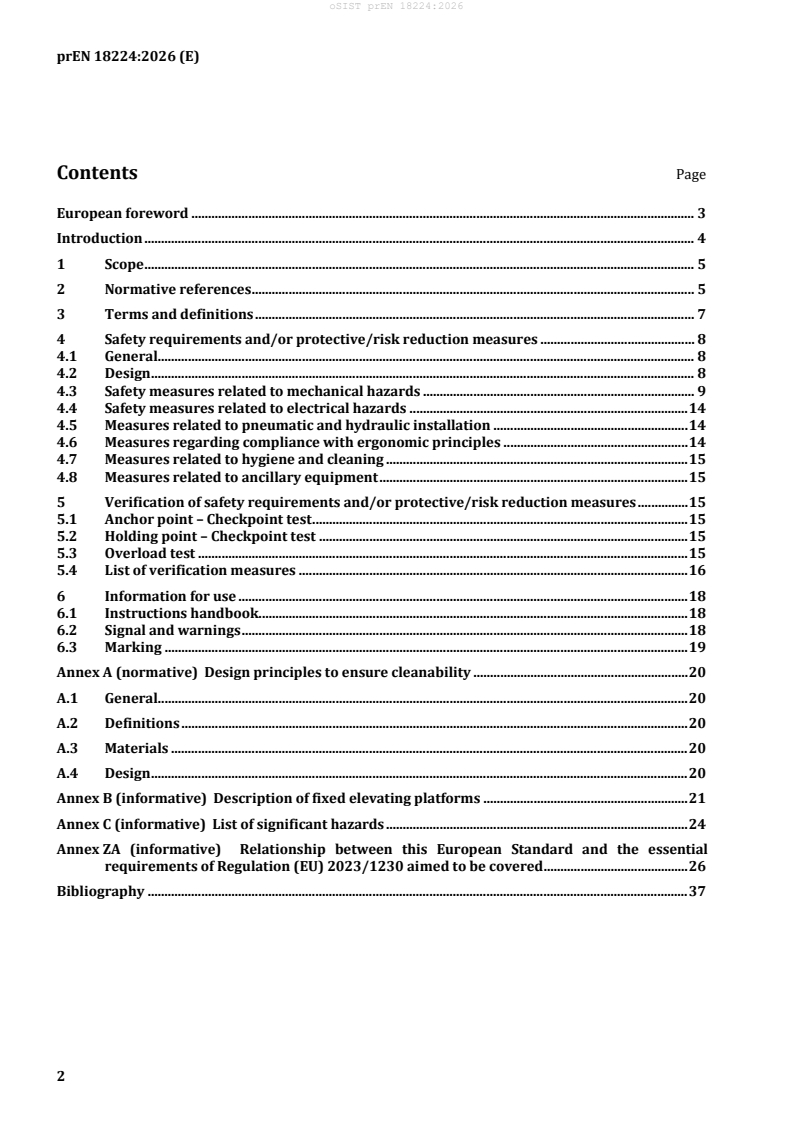
Contents Page
European foreword . 3
Introduction . 4
1 Scope . 5
2 Normative references . 5
3 Terms and definitions . 7
4 Safety requirements and/or protective/risk reduction measures . 8
4.1 General. 8
4.2 Design . 8
4.3 Safety measures related to mechanical hazards . 9
4.4 Safety measures related to electrical hazards . 14
4.5 Measures related to pneumatic and hydraulic installation . 14
4.6 Measures regarding compliance with ergonomic principles . 14
4.7 Measures related to hygiene and cleaning . 15
4.8 Measures related to ancillary equipment . 15
5 Verification of safety requirements and/or protective/risk reduction measures . 15
5.1 Anchor point – Checkpoint test . 15
5.2 Holding point – Checkpoint test . 15
5.3 Overload test . 15
5.4 List of verification measures . 16
6 Information for use . 18
6.1 Instructions handbook. 18
6.2 Signal and warnings . 18
6.3 Marking . 19
Annex A (normative) Design principles to ensure cleanability . 20
A.1 General. 20
A.2 Definitions . 20
A.3 Materials . 20
A.4 Design . 20
Annex B (informative) Description of fixed elevating platforms . 21
Annex C (informative) List of significant hazards . 24
Annex ZA (informative) Relationship between this European Standard and the essential
requirements of Regulation (EU) 2023/1230 aimed to be covered . 26
Bibliography . 37
European foreword
This document (prEN 18224:2026) has been prepared by Technical Committee CEN/TC 153 “Machinery
intended for use with foodstuffs and feed”, the secretariat of which is held by DIN.
This document is currently submitted to the CEN Enquiry.
This document has been prepared under a Standardization Request addressed to CEN by the European
Commission. The Standing Committee of the EFTA States subsequently approves these requests for its
Member States.
For relationship with EU Legislation, see informative Annex ZA, which is an integral part of this document.
Introduction
This document is a type-C standard as stated in EN ISO 12100.
This document is of relevance, in particular, for the following stakeholder groups representing the market
players with regard to machinery safety:
— machine manufacturers (small, medium and large enterprises);
— health and safety bodies (regulators, accident prevention organizations, market surveillance, etc.).
Others can be affected by the level of machinery safety achieved with the means of the document by the
above-mentioned stakeholder groups:
— machine users/employers (small, medium and large enterprises);
— machine users/employees (e.g. trade unions, organizations for people with special needs);
— service providers, e.g. for maintenance (small, medium and large enterprises);
— consumers (in the case of machinery intended for use by consumers).
The above-mentioned stakeholder groups have been given the possibility to participate at the drafting
process of this document.
The machinery concerned and the extent to which hazards, hazardous situations or hazardous events are
covered are indicated in the Scope of this document.
When requirements of this type-C standard are different from those which are stated in type-A or type-B
standards, the requirements of this type-C standard take precedence over the requirements of the other
standards for machines that have been designed and built according to the requirements of this type-C
standard.
1 Scope
1.1 This document applies to fixed elevating platforms used within the food industry when designing
them. It specifies safety requirements for all types and sizes of fixed height-adjustable personnel
platforms intended to move people to working positions for execution from the basket.
This document applies to fixed elevating platforms with a floor height < 3 m above ground level.
This document applies to fixed elevating platforms which maximum moving speed < 0,25 m/s in any
direction.
A description of these fixed elevating platforms is given in Annex B.
These requirements take into account hazards that may arise from the transport, mounting, adjustment,
maintenance and use of these fixed elevating platforms.
This document also specifies measures to prevent the consumer of the treated product from being
exposed to the risk of infection and food-borne illness.
This document is applicable to design, construction and safety examinations and tests before fixed
elevating platforms are first put into service.
1.2 This document does not cover the following significant hazards:
— electromagnetic compatibility;
— the use of any tool or ancillary equipment used on the fixed elevating platform.
1.3 This document does not apply:
— to the ancillary equipment installed on the platform;
— to the personal protective equipment;
— to the premises housing this machine;
— to animal skin remover machines nor to mobile elevating work platforms as defined in
EN 280-1:2022.
Noise is not considered to be a significant hazard for these machines.
The list of significant hazards is given in the informative Annex C.
2 Normative references
The following documents are referred to in the text in such a way that some or all of their content
constitutes requirements of this document. For dated references, only the edition cited applies. For
undated references, the latest edition of the referenced document (including any amendments) applies.
EN 354:2010, Personal fall protection equipment — Lanyards
EN 358:2018, Personal protective equipment for work positioning and prevention of falls from a height —
Belts and lanyards for work positioning or restraint
EN 360:2023, Personal fall protection equipment — Retractable type fall arresters
EN 795:2012, Personal fall protection equipment — Anchor devices
EN 1672-2:2020, Food processing machinery — Basic concepts — Part 2: Hygiene and cleanability
requirements
EN 16165:2021, Determination of slip resistance of pedestrian surfaces — Methods of evaluation
EN 60204-1:2018, Safety of machinery — Electrical equipment of machines — Part 1: General
requirements
EN 60529:1991, Degrees of protection provided by enclosures (IP code)
EN ISO 4413:2010, Hydraulic fluid power — General rules and safety requirements for systems and their
components (ISO 4413:2010)
EN ISO 4414:2010, Pneumatic fluid power — General rules and safety requirements for systems and their
components (ISO 4414:2010)
EN ISO 5774:2023, Plastics hoses — Textile-reinforced types for compressed-air applications —
Specification (ISO 5774:2023)
EN ISO 12100:2010, Safety of machinery — General principles for design — Risk assessment and risk
reduction (ISO 12100:2010)
EN ISO 13849-1:2023, Safety of machinery — Safety-related parts of control systems — Part 1: General
principles for design (ISO 13849-1:2023)
EN ISO 13850:2015, Safety of machinery - Emergency stop function — Principles for design (ISO
13850:2015)
EN ISO 13856-3:2013, Safety of machinery — Pressure-sensitive protective devices — Part 3: General
principles for design and testing of pressure-sensitive bumpers, plates, wires and similar devices (ISO 13856-
3:2013)
EN ISO 13857:2019, Safety of machinery — Safety distances to prevent hazard zones being reached by
upper and lower limbs (ISO 13857:2019)
EN ISO 14119:2025, Safety of machinery — Interlocking devices associated with guards — Principles for
design and selection (ISO 14119:2024)
EN ISO 14120:2015, Safety of machinery — Guards — General requirements for the design and
construction of fixed and movable guards (ISO 14120:2015)
EN ISO 14122-3:2016, Safety of machinery — Permanent means of access to machinery — Part 3: Stairs,
stepladders and guard-rails (ISO 14122-3:2016)
EN ISO 18752:2025, Rubber hoses and hose assemblies — Wire- or textile-reinforced single-pressure types
for hydraulic applications — Specification (ISO 18752:2025)
As impacted by EN 60204-1:2018/A1:2025.
As impacted by EN 60529:1991/A1:2000 and EN 60529:1991/A2:2013.
3 Terms and definitions
For the purposes of this document, the terms and definitions given in EN ISO 12100:2010 and the
following apply.
ISO and IEC maintain terminology databases for use in standardization at the following addresses:
— ISO Online browsing platform: available at https://www.iso.org/obp/
— IEC Electropedia: available at https://www.electropedia.org/
3.1
basket
receptacle consisting of a floor surrounded by a guard-rail which can be moved alongside a framework
with its load to the required position from which the work can be carried out
Note 1 to entry: The receptacle may have permanently ancillary equipment inside (e.g. steriliser) and outside (e.g.
stairs).
3.2
gantry
fixed structure along which the basket moves vertically or at an angle
3.3
fixed elevating platform
fixed machinery intended to move persons to a vertical position to perform work from a mobile basket
and consisting at least of a gantry crane and a work basket with its controls
3.4
floor
reference plane on which the operator's feet rest under normal working conditions
3.5
collection floor
reference surface to collect any liquids under the floor
3.6
ground floor
surface of the premises where the fixed elevating platform is fixed
3.7
guard-rail
device for protection against accidental fall sideways with which stairs/step ladders or landings,
platforms and walkways may be equipped
[SOURCE: EN ISO 14122-3:2016, 3.2]
3.8
guides
structure or set of structures along which the basket moves horizontally (back and forth) or laterally
3.9
access device
installation for getting on or off the basket
3.10
anchor point for personal protective equipment against falling down
point on an anchor system where personal fall protection equipment is intended to be attached
[SOURCE: EN 795:2012, 3.6]
3.11
holding point for lanyard
point with the movement of the basket allowing the attachment of a restrained lanyard which does not
allow the operator to fall out of the basket
3.12
knee rail
rigid element of the guard-rail placed parallel with the handrail, giving extra protection against the
passage of a bod
[SOURCE: EN ISO 14122-3:2016, 3.2.2]
4 Safety requirements and/or protective/risk reduction measures
4.1 General
The fixed elevating platform shall comply with the safety requirements and/or protective measures of
this clause. In addition, the machine shall be designed according to the principles of EN ISO 12100:2010
for relevant but not significant hazards which are not dealt with by this document.
4.2 Design
All components shall be sized to accommodate the operating rates and maximum on-board mass. The
gantry shall be fixed at the top and bottom.
The vertical movement of the basket shall be controlled from an on-board control on the basket and from
a ground control. The ground control facilitates ancillary operations (cleaning, maintenance) and assists
an operator in difficulty who can no longer operate the basket controls. This ground control shall have
priority over the on-board control and shall be protected against unintentional activation (e.g. a contact
with key or a lid-covered button). Any front and side movements are only controlled from the fixed
elevating platform. The ground control shall have a direct line of sight onto the basket or onto the on-
board control.
The safety function shall meet at least a performance level “c” specified in accordance with
EN ISO 13849-1:2023.
From the workstation and from ground floor, it shall not be possible to engage fingers between fixed and
moving parts. Safety distances shall be in accordance with EN ISO 13857:2019.
Fixed elevating platforms shall be designed for one person and a mass of 125 kg (mass of a person with
personal equipment); an additional 125 kg shall be provided for each additional person. The mass related
to ancillary equipment in the basket (steriliser, chute etc.) shall be included in the strength calculation of
the fixed elevating platform.
Fixed elevating platforms shall be equipped with end-of-stroke damping systems at the top and bottom.
Fixed elevating platforms shall be equipped with a stop system at the end of the upper stroke (e.g.
cylinder limit switch stop, etc.).
The control circuits for the fixed elevating platform movements can be hydraulic, electric or pneumatic.
Hot spots, related to energy and utilities (e.g. sterilisers), shall be protected from contact. Hot water
emissions shall be channelled.
The basket shall provide a minimum floor area of 1 m per intended operator, excluding the surface
covered by the intended apparatus used on the fixed elevating platform.
The minimum depth of the basket shall be 800 mm for one operator and 1 m for two or more operators.
The maximum moving speed of the basket shall be < 0,25 m/s in any direction.
4.3 Safety measures related to mechanical hazards
4.3.1 Zone 1: Basket
4.3.1.1 General
The design of baskets with full guard-rail shall be preferred (see Figure 1).
If the intended use of the fixed elevating platform requires one or more missing or incomplete guard rail
around the basket (e.g. for a carcass removal), additional measures according to 4.3.1.3 shall be fulfilled.
The guard rail should pass the load tests as defined by EN ISO 14122-3:2016.
Toe-plate shall prevent the risk of falling objects and people slipping out of the platform.
Key
A handrail
B knee rail
C toe-plate
X distance of 800 mm for one operator and 1 m for two or more operators
Figure 1 — Basket with full guard-rail
4.3.1.2 Working area with full guard-rail
The guard-rail shall have at least one rail or handrail placed at a default height of 1 100 mm from the floor
of the basket according to EN ISO 14122-3:2016, 7.1.
4.3.1.3 Work area with incomplete or missing guard-rail
4.3.1.3.1 General
The guard-rail shall have at least one rail or handrail placed at a default height of 1 100 mm from the floor
of the basket according to EN ISO 14122-3:2016, 7.1.
When a vertical cut-out is needed, it shall be designed so that a 250 mm diameter sphere cannot pass
between the vertical parts of the cut-out (see Y in Figure 2), then the guard-rail is considered complete.
If Y is < 250 mm, the guard-rail is considered as complete.
Key
Y vertical cut-out
Figure 2 — Basket without full guard-rail
If the guard-rail is incomplete or missing, one the following solution shall be provided:
a) the platform shall be equipped with an anchor point in accordance with EN 795:2012, the operator
is linked to this point with the relevant personal protective equipment (e.g. retractable fall arrester
according to EN 360:2023); or
b) the basket shall be equipped with a holding point, the operator is linked to this point with the relevant
personal protective equipment (e.g. lanyard with a fixed length according to EN 358:2018).
4.3.1.3.2 Anchor point
The anchor point shall be located above the workstation, but not in front of the working position (see
Figure 3).
Figure 3 — Working position
The anchor point shall be independent of the basket, and it shall be attached to a part of the platform
installed above the basket.
For a two-person workstation, the platform shall be equipped with two separate anchor points.
The anchor point shall be permanently and clearly marked on the platform.
4.3.1.3.3 Holding point
The holding point shall be secured on a side of the basket that has a complete guard-rail. This holding
point should be fixed or allow movement along the complete guard-rail.
The holding point shall be permanently and clearly marked on the platform.
4.3.2 Zone 2: Access to the basket
If access is from a side fitted with a full guard-rail, the interruption of the guard-rail at the access staircase
or step ladder shall be compensated for by a movable barrier consisting of a barrier opening towards the
inside of the basket and shall have a self-closing mechanism. The mechanism shall be able to close from
any position and shall withstand the energy/vibrations generated by a moving basket. In addition, the
shape of the movable barrier shall comply with EN ISO 14122-3:2016.
If the height of the floor of the basket is > 305 mm in the lowest position, an access device shall be
provided. This device shall have the following characteristics:
— a minimum passage width of 420 mm;
— a minimum going of 80 mm and an overlap between steps ≥ 0 mm (in accordance with
EN ISO 14122-3:2016, 6.1);
— supports the load of a person as defined in 4.2;
— equipped with handrail in accordance with EN ISO 14122-3:2016, 7.2.
The risk of slipping shall be avoided by using a non-slip surface on the steps that is easy to clean such as
stated in 4.3.4.
The step shall be in accordance with EN ISO 14122-3:2016, 5.5, except for the step of the boundary
between the fixed part and moving part, this one shall not exceed 305 mm.
For a basket height > 1 m, a handrail can be fitted on one side only of the access means.
4.3.3 Zone 3: Space under the basket and its equipment
The space under the basket is not in the field of vision of the operator working on the fixed elevating
platform.
The basket shall be equipped with hold-to-run control, for movement of the basket. The related control
device shall be located into the basket. The release of the hold-to-run control device shall stop every
movement of the basket. The stopping distance shall be ≤ 0,1 m. An emergency stop device shall be
provided on the basket according to EN ISO 12100:2010, 6.2.11.8, b). The emergency stop device shall be
in accordance with EN ISO 13850:2015. The safety function shall meet at least a performance level “c”
specified in accordance with EN ISO 13849-1:2023.
Hazards of trapping and crushing between basket and floor shall be prevented by one or a combination
of the following:
a) to prevent anybody from entering the space under the basket:
1) fixed enclosing guards on the floor according to EN ISO 14120:2015, 5.2.4, 5.3.7, 5.3.9 and 5.3.10
and/or fixed distance guards on the floor according to EN ISO 14120:2015, 5.2.4, 5.3.7, 5.3.9 and
5.3.10 and EN ISO 13857:2019, Table 1.
The distance between lower side of the guard and the floor shall be ≥ 100 mm and ≤ 120 mm.
2) interlocking guards on the floor according to EN ISO 14119:2025, Clauses 5, 6 and 7, and
EN ISO 14120:2015, 5.2.4, 5.3.7, 5.3.12 and 5.3.13. When the interlocking is trigged, the basket
moving with the maximum speed as defined in 4.2 and shall stop in ≤ 1 s.
The safety-related parts of the control system and the combination of these parts which
performs the safety function shall meet at least a performance level “c”, specified in accordance
with EN ISO 13849-1:2023.
If for protecting the zone where there is a crushing hazard between the basket and the floor,
when a combination of fixed guards with height complying with EN ISO 13857:2019, Table 1,
and interlocking guards is provided, the interlocking guard shall open outside the protected
area.
The distance between lower side of the guard and the floor shall be ≥ 100 mm and ≤ 120 mm.
Opening an interlocking guard shall activate the stop of every moving part of the machine before
the opening gap between the fixed and the movable parts exceeds 20 mm.
b) to detect someone under the basket and stop its movement:
1) pressure-sensitive device, in accordance with EN ISO 13856-3:2013, shall cover the entire
bottom part of the basket. The stopping time shall be ≤ 1 s. The safety function shall meet at least
a performance level “c” specified in accordance with EN ISO 13849-1:2023.
2) optical device mounted under the basket.
c) any other solution or combination of solutions as defined in indents a) and b) reaching the above-
mentioned objectives.
The risk of crushing the feet shall be prevented by construction, by limiting the downward stroke. The
ground and/or stair clearance shall be at least 120 mm according to EN ISO 13854:2019, Table 1.
In case of maintenance and cleaning, it shall be possible to move the basket and to lock it into a position.
This device shall be accessible from the ground, and the area under the basket shall be visible from the
position of the locking device. A voluntary action shall be necessary to unlock the device.
4.3.4 Zone 4: Floor
The floors shall be non-slip with a dynamic coefficient of friction > 0,3 in dry conditions, measured
according to EN 16165:2021.
4.3.5 Zone 5: Climbing and descending systems and guides
4.3.5.1 Safety measures against dangerous pinching phenomena
The fixed elevating platform design and the installation of the cylinders shall avoid the risk of pinching
between fixed and moving parts:
— by a guard that prevents the operator from reaching the cylinder; or
— by a hand plunger that pulls the hand out of the moving part of the cylinder.
Where chains and/or cables and/or belts are used, access to any danger zone of each moving part shall
be protected.
In case of movable protective covers, they shall be interlocked. The safety function shall meet at least a
performance level “c” specified in accordance with EN ISO 13849-1:2023.
Safety distances shall be in conformance with EN ISO 13857:2019, Table 4.
4.3.5.2 Risk of objects falling down from the basket
The basket shall provide surfaces and shapes to attach necessary ancillary equipment to prevent this
equipment from falling and/or tilting.
4.3.5.3 Risk of the basket dropping
The fixed elevating platform shall be fitted with a relevant device (according to the technology used for
the movement) to prevent the basket from dropping accidentally, particularly in the event of breaking of
any apparatus/device contributing to the vertical movement (elevation or descent) or of a power supply
failure.
If chains and/or cables and/or belts are used, their technical characteristics shall be defined using the
minimum safety coefficient of 5. The protective covers of the transmission system shall be easily
removable for maintenance purposes. The transmission gears / pulleys / wheels etc. shall be fitted with
relevant shapes, dimensions, apparatus to prevent any risk of deroping.
The machine shall be designed to prevent the operator from being thrown off balance.
4.3.6 Zone 6: Side area reached by horizontal movements of basket and guides
The basket shall be equipped with hold-to-run control, for movement of the basket. The related control
device shall be located into the basket. The release of the hold-to-run control device shall stop every
movement of the basket. The stopping distance shall be ≤ 0,1 m. An emergency stop device shall be
provided on the basket according to EN ISO 12100:2010, 6.2.11.8 b). The emergency stop device shall be
in accordance with EN ISO 13850:2015. The safety function shall meet at least a performance level “c”
specified in accordance with EN ISO 13849-1:2023.
Hazards of pinching and crushing between basket and horizontal obstacle (wall, structure etc.) shall be
prevented by keeping a minimum 180 mm clearance between the basket and the obstacle (if this zone is
accessible from the basket).
4.4 Safety measures related to electrical hazards
4.4.1 General
The electrical equipment shall comply with EN 60204-1:2018 .
The safety part of the control or emergency stop circuits shall be PL = c, according to
r
EN ISO 13849-1:2023. Additional requirements for electrical equipment are given in 4.4.2 to 4.4.4.
4.4.2 Control circuits
The control circuits shall be supplied with extra low voltage (< 50 V).
All motion controls
...