

prEN 13528
(Main)Ambient air quality - Diffusive samplers for the determination of concentrations of gases - Requirements, validation methods and use
- Abstract
This European Standard specifies performance requirements, validation methods and provides general instructions on the use of diffusive samplers for the determination of the concentration of gases in ambient air.
This standard applies to all stages of the measuring procedure, including preparation, deployment, transportation and storage. It includes general principles applicable to diffusive sampling and analysis. It enables manufacturers and users to adopt a consistent approach to sampler validation and provides a framework for the assessment of sampler performance.
- Status
- Not Published
- Publication Date
- 07-Sep-2027
- Technical Committee
- CEN/TC 264 - Air quality
- Current Stage
- 4020 - Submission to enquiry - Enquiry
- Start Date
- 30-Jul-2026
- Due Date
- 27-May-2026
- Completion Date
- 30-Jul-2026

prEN 13528 is a CEN draft European Standard for diffusive samplers used to determine concentrations of gases in ambient air. It specifies performance requirements, validation methods, and general instructions for use so manufacturers and users can apply a consistent approach to sampler validation and performance assessment.
What does prEN 13528 specify?
prEN 13528 covers the full measuring procedure for diffusive samplers in ambient air, from preparation and deployment to transportation and storage. It gives the framework for validating sampler performance and for using the sampler in a consistent way.
The document is organized into these main clauses:
- Clause 1 - Scope
- Clause 2 - Normative references
- Clause 3 - Terms and definitions
- Clause 4 - Operating principles
- Clause 5 - Performance requirements
- Clause 6 - Validation
- Clause 7 - Practical guidance
- Bibliography
In practice, that structure moves from the diffusion principle, to performance criteria, to how to test and report sampler behavior, and then to field handling and quality control.
What are the key requirements of prEN 13528?
Operating principles and sampling rate
prEN 13528 explains diffusive sampling as gas transport to a sorbent by a physical diffusion process. Clause 4.1 gives the diffusion basis for the collected mass, and Clause 4.2 shows how the diffusive sampling rate is linked to sampler geometry and the gas diffusion coefficient.
For a reader, this means the sampler design matters as much as the chemical method. The sampler must have a known diffusion path and area, and the sampling rate must be established for the compound of interest so the collected mass can be converted into an ambient concentration.
Clause 4.4 and 4.5 add that fluctuating concentrations, temperature, pressure, wind, precipitation, and humidity can affect performance. In practice, users need to know when the sampler stays representative and when environmental conditions may bias the result.
Performance requirements
Clause 5 requires the final result to be expressed in the same units as the limit value, if one exists. It also requires every measurement procedure to give an unambiguous result, so one analytical value corresponds to one concentration only.
Clause 5.3 requires sampler geometry to avoid transient effects and requires marking or packaging identification. The marking includes the manufacturer’s identification, sampler type, expiry date, batch identification, and a unique sampler ID. That matters for traceability, stock control, and field records.
Clause 5.4 requires an analytical method that is reliable, reproducible, and suitable for the analyte and sample matrix. It must have adequate sensitivity and selectivity, documented recovery checks, and traceable procedures.
Clause 5.5 sets the main sorbent expectations: high selectivity, sufficient capacity, good extraction or desorption efficiency, stable analyte retention, and low back diffusion. For solvent extraction, the extraction efficiency shall be at least 75% with a standard deviation not exceeding 10%. For thermal desorption, the desorption efficiency shall be at least 95% with a standard deviation not exceeding 10%.
Clause 5.6 defines the working range as the concentration interval where the response is linear and unambiguous. The lower end is set by detection and quantification limits, and the upper end by loss of linearity, for example through sorbent saturation.
Clause 5.7 to 5.9 require the influence of environmental conditions and measurement uncertainty to be specified. Clause 5.8 also requires practical limits for shelf life and storage: three months before use and two months after exposure are given as practical minimums, with results staying within 10% of the reference value.
Validation and test evidence
Clause 6 requires validation of the diffusive sampler for the intended application. Validation can be done in the laboratory, in the field, or both, and it must provide quantitative information such as sampling rate, working range, shelf life, and interferences.
Laboratory tests in Clause 6.2 use an exposure chamber and a known test gas mixture. Field tests must be carried out at representative sites and use an independent reference method for comparison. Clause 6.2.3 allows a reference method from an EU method, a CEN or ISO standard, or another method shown to be equivalent.
Clause 6.3 then sets the main performance tests: sampling rate, working range, sampler shelf life, analyte stability, precision, environmental influence, back diffusion, and desorption efficiency. Clause 6.5 requires a validation report that records the atmosphere tested, test sampler type, test conditions, results, acceptance criteria, unusual features, omitted operations, and the analytical procedure.
Practical use in the field
Clause 7 gives guidance on transport, deployment, sampling point selection, protection from adverse conditions, concentration calculation, reporting under standard conditions, re-use, and QA/QC. That is the part users apply when they move from validation to routine monitoring.
In practice, this clause tells users how to keep samples intact, where to place samplers, when to use shelters or filters, and how to maintain traceability and routine checks during surveys.
What terms does prEN 13528 define?
- ambient air - outdoor air in the troposphere, excluding indoor air and workplaces.
- analyte - the substance extracted from the sorbent and analysed to quantify the compound of interest.
- diffusive sampler - a device that samples gases by a passive physical process such as diffusion or permeation, without active air movement through the device.
- diffusive sampling rate - the rate at which the sampler collects a particular gas, usually expressed as a flow-equivalent rate.
- recovery - the ratio of analyte mass recovered from a sampling device to the mass applied.
- repeatability conditions - conditions where the same method gives independent results on identical test items in the same laboratory, with the same operator and equipment over a short time.
- validation - the process of evaluating a measuring procedure and checking that its performance meets preset criteria.
Who uses prEN 13528?
prEN 13528 is used by manufacturers of passive samplers, analytical laboratories, air quality monitoring organizations, and test houses that validate sampler performance. It also matters to quality managers and buyers who need to specify what a sampler must do before they approve it for use.
The document is relevant to ambient air monitoring, environmental testing, public health, and research work where gas concentrations are measured with diffusive samplers. Typical tasks include trend analysis, source-receptor studies, model verification, emission reduction studies, exposure data collection, citizen science projects, and mapping spatial variation in pollutant concentrations.
What changed in prEN 13528 from the previous edition?
prEN 13528 supersedes EN 13528-1:2002, EN 13528-2:2002, and EN 13528-3:2004. The foreword states that the technical change is a general review and reorganization of the content.
Which standards are used with prEN 13528?
prEN 13528 points to several related standards and guidance documents for validation, calibration atmospheres, uncertainty, and compound-specific applications.
| Document | What it contributes |
|---|---|
| EN ISO/IEC 17025:2017 | Competence framework for testing and calibration laboratories |
| JCGM 100:2008 | Guide for expressing measurement uncertainty |
| EN ISO 6145-4:2008, EN ISO 6145-5:2010, EN ISO 6145-6:2017, EN ISO 6145-7:2018, EN ISO 6145-8:2008, EN ISO 6145-9:2010, EN ISO 6145-10:2008 | Methods for preparing calibration gas mixtures for laboratory validation |
| EN 16339:2025 | Diffusive-sampling method for nitrogen dioxide in ambient air |
| EN 17346:2020 | Diffusive-sampling method for ammonia in ambient air |
| EN 14662-4:2005 and EN 14662-5:2005 | Benzene methods using diffusive sampling with thermal or solvent desorption |
| EN ISO 16017-2:2003 | VOC diffusive sampling method |
| ISO 16000-4:2011, EN ISO 16000-15:2008, ISO 16200-2:2000 | Related indoor air and workplace diffusive-sampling methods |
| Guidance for the Demonstration of Equivalence (GDE) | Field comparison approach when a reference method is used |
What does the prEN 13528 document contain?
The document contains the diffusion model, the sampling-rate equations, and the concentration calculation and standard-condition conversion formulas. It also includes figures showing the diffusion process, the effect of wind speed, the ambiguity of measurement response, and the sampling-rate determination.
It provides a table of laboratory conditions for environmental-effect testing, plus detailed procedures for validation tests such as sampling rate, working range, shelf life, analyte stability, precision, back diffusion, and desorption efficiency. The document also gives validation-report content, transport precautions, field deployment advice, and QA/QC practices for routine use.
Relations
- Effective Date
- 09-Feb-2026
- Effective Date
- 09-Feb-2026
- Effective Date
- 28-Jan-2026
- Effective Date
- 28-Jan-2026
- Effective Date
- 19-Jan-2023
- Effective Date
- 18-Jan-2023
- Effective Date
- 12-Oct-2022
Get Certified
Connect with accredited certification bodies for this standard

CIS Institut d.o.o.
Personal Protective Equipment (PPE) certification body. Notified Body NB-2890 for EU Regulation 2016/425 PPE.

Kiwa BDA Testing
Building and construction product certification.
Kmetijski inštitut Slovenije
Agricultural Institute of Slovenia. Soil testing, plant health, agricultural product analysis.
Sponsored listings
Frequently Asked Questions
prEN 13528 is a draft published by the European Committee for Standardization (CEN). Its full title is "Ambient air quality - Diffusive samplers for the determination of concentrations of gases - Requirements, validation methods and use". This standard covers: This European Standard specifies performance requirements, validation methods and provides general instructions on the use of diffusive samplers for the determination of the concentration of gases in ambient air. This standard applies to all stages of the measuring procedure, including preparation, deployment, transportation and storage. It includes general principles applicable to diffusive sampling and analysis. It enables manufacturers and users to adopt a consistent approach to sampler validation and provides a framework for the assessment of sampler performance.
This European Standard specifies performance requirements, validation methods and provides general instructions on the use of diffusive samplers for the determination of the concentration of gases in ambient air. This standard applies to all stages of the measuring procedure, including preparation, deployment, transportation and storage. It includes general principles applicable to diffusive sampling and analysis. It enables manufacturers and users to adopt a consistent approach to sampler validation and provides a framework for the assessment of sampler performance.
prEN 13528 is classified under the following ICS (International Classification for Standards) categories: 13.040.20 - Ambient atmospheres. The ICS classification helps identify the subject area and facilitates finding related standards.
prEN 13528 has the following relationships with other standards: It is inter standard links to EN 61375-3-1:2012, EN 61850-7-1:2011, CEN/TS 17363:2019, EN ISO 11073-10101:2020, EN 13528-3:2003, EN 13528-2:2002, EN 13528-1:2002. Understanding these relationships helps ensure you are using the most current and applicable version of the standard.
prEN 13528 is associated with the following European legislation: EU Directives/Regulations: 2008/50/EC. When a standard is cited in the Official Journal of the European Union, products manufactured in conformity with it benefit from a presumption of conformity with the essential requirements of the corresponding EU directive or regulation.
prEN 13528 is available in PDF format for immediate download after purchase. The document can be added to your cart and obtained through the secure checkout process. Digital delivery ensures instant access to the complete standard document.
Standards Content (Sample)
SLOVENSKI STANDARD
01-september-2026
Kakovost zunanjega zraka - Difuzijski vzorčevalniki za določanje koncentracij
plinov - Zahteve, metode validacije in uporaba
Ambient air quality - Diffusive samplers for the determination of concentrations of gases -
Requirements, validation methods and use
Außenluft - Passivsammler zur Bestimmung der Konzentration von Gasen -
Anforderungen und Prüfverfahren
Ta slovenski standard je istoveten z: prEN 13528
ICS:
13.040.20 Kakovost okoljskega zraka Ambient atmospheres
2003-01.Slovenski inštitut za standardizacijo. Razmnoževanje celote ali delov tega standarda ni dovoljeno.
DRAFT
EUROPEAN STANDARD
NORME EUROPÉENNE
EUROPÄISCHE NORM
July 2026
ICS Will supersede EN 13528-1:2002, EN 13528-2:2002,
EN 13528-3:2003
English Version
Ambient air quality - Diffusive samplers for the
determination of concentrations of gases - Requirements,
validation methods and use
Außenluft - Passivsammler zur Bestimmung der
Konzentration von Gasen - Anforderungen und
Prüfverfahren
This draft European Standard is submitted to CEN members for enquiry. It has been drawn up by the Technical Committee
CEN/TC 264.
If this draft becomes a European Standard, CEN members are bound to comply with the CEN/CENELEC Internal Regulations
which stipulate the conditions for giving this European Standard the status of a national standard without any alteration.
This draft European Standard was established by CEN in three official versions (English, French, German). A version in any other
language made by translation under the responsibility of a CEN member into its own language and notified to the CEN-CENELEC
Management Centre has the same status as the official versions.
CEN members are the national standards bodies of Austria, Belgium, Bulgaria, Croatia, Cyprus, Czech Republic, Denmark, Estonia,
Finland, France, Germany, Greece, Hungary, Iceland, Ireland, Italy, Latvia, Lithuania, Luxembourg, Malta, Netherlands, Norway,
Poland, Portugal, Republic of North Macedonia, Romania, Serbia, Slovakia, Slovenia, Spain, Sweden, Switzerland, Türkiye and
United Kingdom.
Recipients of this draft are invited to submit, with their comments, notification of any relevant patent rights of which they are
aware and to provide supporting documentation.
Warning : This document is not a European Standard. It is distributed for review and comments. It is subject to change without
notice and shall not be referred to as a European Standard.
EUROPEAN COMMITTEE FOR STANDARDIZATION
COMITÉ EUROPÉEN DE NORMALISATION
EUROPÄISCHES KOMITEE FÜR NORMUNG
CEN-CENELEC Management Centre: Rue de la Science 23, B-1040 Brussels
© 2026 CEN All rights of exploitation in any form and by any means reserved Ref. No. prEN 13528:2026 E
worldwide for CEN national Members.
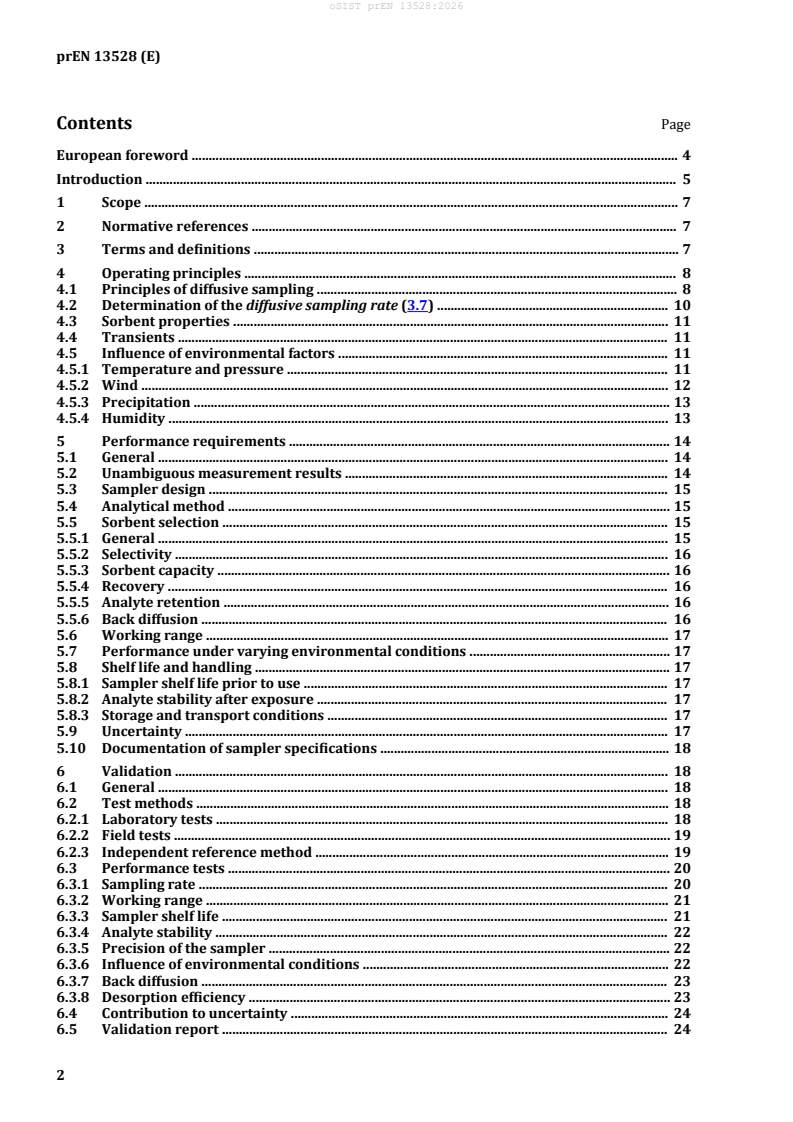
Contents Page
European foreword . 4
Introduction . 5
1 Scope . 7
2 Normative references . 7
3 Terms and definitions . 7
4 Operating principles . 8
4.1 Principles of diffusive sampling . 8
4.2 Determination of the diffusive sampling rate (3.7) . 10
4.3 Sorbent properties . 11
4.4 Transients . 11
4.5 Influence of environmental factors . 11
4.5.1 Temperature and pressure . 11
4.5.2 Wind . 12
4.5.3 Precipitation . 13
4.5.4 Humidity . 13
5 Performance requirements . 14
5.1 General . 14
5.2 Unambiguous measurement results . 14
5.3 Sampler design . 15
5.4 Analytical method . 15
5.5 Sorbent selection . 15
5.5.1 General . 15
5.5.2 Selectivity . 16
5.5.3 Sorbent capacity . 16
5.5.4 Recovery . 16
5.5.5 Analyte retention . 16
5.5.6 Back diffusion . 16
5.6 Working range . 17
5.7 Performance under varying environmental conditions . 17
5.8 Shelf life and handling . 17
5.8.1 Sampler shelf life prior to use . 17
5.8.2 Analyte stability after exposure . 17
5.8.3 Storage and transport conditions . 17
5.9 Uncertainty . 17
5.10 Documentation of sampler specifications . 18
6 Validation . 18
6.1 General . 18
6.2 Test methods . 18
6.2.1 Laboratory tests . 18
6.2.2 Field tests . 19
6.2.3 Independent reference method . 19
6.3 Performance tests . 20
6.3.1 Sampling rate . 20
6.3.2 Working range . 21
6.3.3 Sampler shelf life . 21
6.3.4 Analyte stability . 22
6.3.5 Precision of the sampler . 22
6.3.6 Influence of environmental conditions . 22
6.3.7 Back diffusion . 23
6.3.8 Desorption efficiency . 23
6.4 Contribution to uncertainty . 24
6.5 Validation report . 24
7 Practical guidance . 25
7.1 Transportation . 25
7.2 Field deployment . 25
7.2.1 General . 25
7.2.2 Sampling points . 25
7.2.3 Protection from adverse environmental conditions . 26
7.3 Calculation of concentration and reporting under standard conditions . 26
7.3.1 Calculation of concentration . 26
7.3.2 Reporting under standard conditions . 27
7.4 Re-use of samplers . 27
7.5 Quality assurance and quality control . 28
Bibliography . 29
European foreword
This document (prEN 13528:2026) has been prepared by Technical Committee CEN/TC 264 "Air
Quality", the secretariat of which is held by DIN.
This document is currently submitted to the CEN Enquiry.
This document will supersede EN 13528-1:2002, EN 13528-2:2002 and EN 13528-3:2004.
In comparison with the previous edition, the following technical modifications have been made:
— General review and reorganization of the content.
Introduction
Diffusive samplers are used to determine the concentrations of gases in ambient air . The measurement
procedure involves two main steps: first, the collection of the compound of interest using a diffusive
(passive) sampler; second, the extraction of the analyte from the sampler followed by its qüantification.
Diffusive samplers can be applied to measurements related to the protection of the environment and
human health, including:
— Analysis of trends in air quality to support legislative and policy objectives;
— Investigation of source–receptor relationships;
— Verification and validation of atmospheric models;
— Evaluation of emission reduction measures;
— Collection of exposure data for epidemiology or risk assessment;
— Citizen science projects;
— Identification of unknown analytes in air;
— Mapping of spatial variation of pollutant concentrations.
Diffusive sampling is an attractive alternative to fixed monitoring due to:
— Small sampler size, so that locations can be covered where fixed monitoring is difficült;
— No requirement for electrical power;
— Ability to cover areas with high spatial density;
— Cost effectiveness.
Diffusive samplers are particularly suitable for compounds of significant environmental and health
relevance within the framework of regulatory air quality monitoring. Directive (EU) 2024/2881[1]
specifies which measurement methods (fixed measurement, modelling, indicative measurement, or
objective estimation) are to be applied by Member States of the European Union in different situations,
taking into account factors such as concentration levels and site characteristics. Diffusive sampling is
most often used as indicative measurement, but it has also been used for fixed measurements by
demonstrating equivalence with the reference method in accordance with the Guidance for the
Demonstration of Equivalence (GDE) [2].
Passive sampling can be used to monitor air pollutants addressed in other frameworks, such as the 1999
UNECE Gothenburg Protocol [3] and the EU National Emissions Ceilings Directive, 2016/2284/EU) [4].
This document is the framework standard for the validation (3.14) and use of diffusive samplers in the
field of ambient air. The following documents describe the use of diffusive sampling for monitoring
specific pollutants in ambient air:
— Nitrogen dioxide (NO ) described in EN 16339:2025 [5];
— Ammonia (NH ) described in EN 17346:2020 [6];
— Benzene measurements by thermal desorption described in EN 14662-4:2005 [7];
— Benzene measurements by solvent desorption described in EN 14662-5:2005 [8];
— Volatile organic compounds (VOCs) by thermal desorption described in EN ISO 16017-2:2003 [9];
— Ambient air — Standard method for the measurement of organic ozone precursor concentrations
— Part 6: Diffusive sampling of formaldehyde on DNPH followed by offline HPLC/UV;
— Ambient air — Standard method for the measurement of organic ozone precursor concentrations
— Part 4: Diffusive sampling followed by thermal desorption and gas chromatography.
Besides these standards for ambient air, there are other standards for indoor air and/or workplace
exposure which include diffusive sampling:
— Formaldehyde (CH O) described in ISO 16000-4:2011 [10]
— Nitrogen dioxide (NO ) described in EN ISO 16000-15:2008 [11];
— Volatile organic compounds (VOCs) by thermal desorption described in EN ISO 16017-2:2003 [9];
— Volatile organic compounds (VOCs) by solvent desorption/gas chromatography described in ISO
16200-2:2000 [12].
NOTE It is the user's primary responsibility to choose appropriate procedures or devices that meet the
requirements in this document. One way of doing this is to obtain information or confirmation from the
manufacturer. Type testing, or more generally, the assessment of performance criteria of procedures or devices,
can be undertaken by the manufacturer, user, test house or research and development laboratory, as is most
appropriate.
1 Scope
This document specifies performance requirements, validation methods and provides general
instructions on the use of diffusive samplers for the determination of the concentration of gases in
ambient air.
This document applies to all stages of the measuring procedure, including preparation, deployment,
transportation and storage. It includes general principles applicable to diffusive sampling and analysis.
It enables manufacturers and users to adopt a consistent approach to sampler validation and provides
a framework for the assessment of sampler performance.
2 Normative references
There are no normative references in this document.
3 Terms and definitions
For the purposes of this document, the following terms and definitions apply.
— ISO Online browsing platform: available at http://www.iso.org/obp
— IEC Electropedia: available at http://www.electropedia.org/
3.1
ambient air
outdoor air in the troposphere, excluding indoor air and workplaces
3.2
analyte
substance extracted from the sorbent and analysed to quantify the compound of interest
Note 1 to entry: The analyte may not always be the same as the original compound due to interactions with the
sorbent.
3.3
sampling time
period of time for which the diffusive sampler is deployed to yield an average concentration of the
pollutant
Note 1 to entry: The term exposure period is often used to indicate the sampling time.
3.4
bias
expectation of error of estimation
[SOURCE: ISO 3534-1:2006 [13]]
3.5
recovery
ratio of the mass of analyte recovered from a sampling device to that applied
3.6
diffusive sampler
device which is capable of taking samples of gases from the atmosphere at a rate controlled by a physical
process such as gaseous diffusion through a static air layer or a porous material and/or permeation
through a membrane, but which does not involve the active movement of air through the device
Note 1 to entry: Active normally refers to the pumped movement of air.
3.7
diffusive sampling rate
rate at which the diffusive sampler (3.6) collects a particular gas from the atmosphere, typically
expressed in millilitres per minute (mL/min) or cubic meters per hour (m /h)
3.8
measuring procedure
procedure for sampling and analysing one or more pollutants in ambient air and including storage and
transportation of the sample
3.9
repeatability conditions
conditions where independent test results are obtained with the same method on identical test items
in the same laboratory by the same operator using the same equipment within short intervals of time
3.10
reproducibility conditions
conditions where test results are obtained with the same method on identical test items in different
laboratories with different operators using different equipment
3.11
selectivity
degree of independence from interferents
3.12
standard uncertainty
uncertainty of the result of a measurement expressed as a standard deviation
3.13
uncertainty (of measurement)
parameter, associated with the results of a measurement, that characterises the dispersion of values
that could reasonably be attributed to the measurand
Note 1 to entry: The parameter may be, for example, a standard deviation (or given multiple of it), or an interval
having a stated level of confidence.
Note 2 to entry: Uncertainty of measurement comprises, in general, many components. Some of these components
may be evaluated from the statistical distribution of the results of a series of measurements and can be
characterised by experimental standard deviations. The other components, which can also be characterised by
standard deviations, are evaluated from assumed probability distributions based on experience or other
information.
Note 3 to entry: It is understood that the result of a measurement is the best estimate of the value of a measurand,
and that all components of uncertainty, including those arising from systematic effects, such as components
associated with corrections and reference standards, contribute to this dispersion.
3.14
validation
process of evaluating the performance of a measuring procedure (3.8) and checking that the performance
meets certain pre-set criteria
4 Operating principles
4.1 Principles of diffusive sampling
The mass of the analyte (3.2) which can diffuse to a suitable sorbent within a given time is determined
by the Formula (1) which is derived from Fick's first law of diffusion[14]:
S·D C −C ·t
1 2
m = (1)
L
where
S
is the cross sectional area or diffusion surface (m );
D
is the diffusion coefficient of the compound in air (m /h);
C
is the concentration of the compound at the inlet surface of diffusion (µg/m );
C
is the concentration of the compound at the sorbent interface (µg/m );
m is the mass of analyte (3.2) collected by the sorbent during the sampling time (3.3) (µg);
L is the length of diffusion between the inlet surface and the sorbent interface (m);
t is the sampling time (3.3) (h).
NOTE For practical reasons non-SI units are used in Formula (1).
This Formula (1) describes the more general situation, in which C may be non-zero. In practice,
however, the formula is often simplified: ideally, C equals the concentration of the compound in the
ambient air (3.1) outside the diffusive sampler (3.6) (C), and C is zero, representing the “zero-sink”
condition.
Key
1 diffusion of the compound
2 cross-sectional area or diffusion surface (S) and concentration of the compound at the inlet surface of
diffusion (C )
3 sorbent
4 ambient concentration (C)
5 concentration at sorbent interface (C )
c concentration
d distance
L diffusion path length (L)
Figure 1 — Diagram of the diffusion process
The inlet of a sampler with cross sectional area S (position 2) defines the beginning of the diffusion path
of a compound with an ambient concentration (C=C ) A sorbent (position 3), which will reduce the
1 .
concentration at sorbent interface C (position 5) to zero (ideally) due to sorption or chemical reaction,
serves as the driving force for the diffusion along L.
A general overview of the principles of diffusive sampling is given in [15].
4.2 Determination of the diffusive sampling rate (3.7)
The diffusive sampling rate (3.7) (Formula (2)) is needed to calculate the mass concentration of the
compound of interest in ambient air (3.1) . It is determined by the geometry of the sampler and the
diffusion coefficient of the compound. The diffusion path length L is the distance between the sorbent
surface and the external face of the sampler. The effective length does not necessarily correspond to
the nominal length L because wind can alter the actual diffusion path as described in 4.5.2. The cross-
sectional area S is also defined by the geometry of the sampler and if the cross-section of the diffusion
path is not constant along its length, is defined by the narrowest portion.
The theoretical determination of the diffusive sampling rate (3.7) is given by:
where
v
is the diffusive sampling rate (3.7) at standard conditions (20°C, 101,3 kPa) (m /h);
S
is the cross-sectional area or diffusion surface (m );
D is the diffusion coefficient of the compound in air at standard conditions (20°C, 101,3
kPa) (m /h);
L is the length of diffusion between the inlet surface and the sorbent interface (m).
D ·S
0 (2)
v =
L
When Formula (1) and Formula (2) are combined, they form the basis for the empirical determination
of the diffusive sampling rate (3.7) , which can be expressed as:
where
v
is the diffusive sampling rate (3.7) at standard conditions (20°C, 101,3 kPa) (m /h);
m is the mass of the compound (µg);
t is the sampling time (3.3) (h);
C is the mass concentration at standard conditions (20°C, 101,3 kPa). This is a time-
weighted average concentration over the sampling period; (µg/m ).
m
(3)
v =
t·C
NOTE For practical reasons, the diffusive sampling rate (3.7) is often expressed in mL/min.
Alternatively, the diffusive sampling rate (3.7) can be expressed in different units, such as pg/(ppb·min).
The conversion under standard conditions from mL/min is provided in Formula (4) .
where
U is the diffusive sampling rate (3.7) at standard conditions (20°C, 101,3 kPa) (pg/
(ppb·min));
v is the diffusive sampling rate (3.7) at standard conditions (20°C, 101,3 kPa) (mL/min);
M is the molecular weight of the compound (g/mol);
V is the molar volume at standard conditions (20°C, 101,3 kPa) (L/mol).
M
M
(4)
U = v · ·10
0 0
V
M
4.3 Sorbent properties
The performance of a diffusive sampler (3.6) depends critically on the selection and use of a suitable
sorbent for the analyte (3.2) (s) of concern. In the case of an ideal sorbent, the sampling rate will be
constant over the exposure period. For non-ideal sorption conditions, the sampling rate may not be
constant and in that case it shall be ensured that the sampling rate function for the exposure period is
qüantified. The deviation from the ideal behaviour depends on the adsorption isotherm of the compound
and sorbent concerned, and may be modelled [16]. Deviations can arise from sorbent saturation, back
diffusion (reverse diffusion) and changes to the diffusion path length.
4.4 Transients
Simple derivations of Fick’s first law are based on steady-state conditions. In practical applications of
diffusive samplers, however, ambient pollutant concentrations often flüctüate significantly. This raises
the question of whether a sampler provides a truly time-integrated response (ignoring sorbent
effects, see 4.3), or whether short-lived transients may be missed before being captured by the sorbent.
Both theoretical [17] [18] [19] [20] and experimental studies [18] [21] [22] have shown that this is not
a concern, provided the total sampling period is much longer —typically at least ten times — than the
characteristic time constant, τ, of the sampler, which is given by:
where
τ is the residence time of a compound molecule in the diffusive path (h);
L is the length of diffusion between the inlet surface and the adsorbent interface (m);
D
is the diffusion coefficient of the compound in air (m /h).
L
(5)
τ =
D
4.5 Influence of environmental factors
4.5.1 Temperature and pressure
For an ideal diffusive sampler (3.6) , the dependence of the diffusive sampling rate (3.7) on absolute
temperature and pressure is governed by that of the diffusion coefficient of the compound. The latter
dependence is, according to Maxwell's Formula (6), given by:
n+1 −1
(6)
D = f T ,P
where
D is the diffusion coefficient of the compound of interest;
where (continued)
T is the absolute temperature;
P is the ambient pressure;
n is an exponent, with 0,5 < n < 1,0;
Since the diffusion coefficient is directly proportional to the sampling rate (see Formula (2) ), the
temperature and pressure dependence of the sampling rate is accordingly described by:
n+1 −1
(7)
v = f T ,P
where
v is the diffusive sampling rate (3.7) ;
T is the absolute temperature;
P is the ambient pressure;
n is an exponent, with 0,5 < n < 1,0.
4.5.2 Wind
Wind speed and direction (i.e. from the point of view of the sampler, the ambient air (3.1) face velocity
and the sampler orientation) can affect the performance of a diffusive sampler (3.6) because they may
inflüence the effective diffusion path length [23] [24] [25] [26]. The diffusive sampling rate (3.7) is a
function of the diffusive path length and the cross-sectional area of the sampler Formula (2) . The cross-
sectional area is defined by the geometry of the sampler and if the cross-section of the diffusion gap is
not constant along its length, it is defined by the narrowest portion. The diffusion path length is also
defined by the geometry of the sampler and is the distance between the sorbent surface and the external
face of the sampler. However, the path length L, may be greater (+ΔL) or smaller (-ΔL), depending on
the following circumstances.
Under conditions of low external wind speeds, the effective diffusion path length may be increased [25]
[26]. This is because a 'boundary layer' [23] [24] exists between the stagnant air within the sampler
and the moving air outside and contributes to the effective diffusion path length. In reality, there is an
area outside the sampler where there is a transition between static air and moving air, but this is
equivalent to an extra length (ΔL) of static air, which shall be included in the value of L. The value of ΔL
depends on the external geometry of the sampler. It also decreases with increasing air velocity. Its
significance depends on the value of the nominal path length of the diffusive sampler (3.6) . Thus a
sampler with a small cross-section and long internal air gap will be relatively unaffected by air velocity,
whilst a short sampler with a wider cross-variation will be significantly affected. This is borne out in
practice, as has been demonstrated with samplers of varying length [25] [26]. Low sampling rates are
observed at low air velocities, but increase to a plateau value as the boundary layer effect becomes
insignificant.
Under conditions of high external wind speeds, the effective diffusion path length may be decreased
[27] [28] [29] [30] [31] [32] [33]. This is because external high airflows disturb the static air layer within
the sampler, which reduces the effective air gap by a (different) factor ΔL.
The overall effect is therefore an S-shaped curve as shown in Figure 2 .
Key
1 measured concentration C
2 air velocity across sampler
3 minimum velocity
4 maximum velocity
5 110 % of C
plateau
6 C
plateau
7 90 % of C
plateau
Figure 2 — Typical relationship between air velocity and measured concentration for diffusive
samplers
4.5.3 Precipitation
Rain or melted snow can block the sampling surfaces [34], reducing the effective cross-sectional area
of the sampler and directly affecting the sampling rate. During such blockages, the sampling rate is
altered, which increases measurement uncertainty.
4.5.4 Humidity
High humidity can affect the sorption capacity of hydrophilic sorbents, such as charcoal and molecular
sieves. This typically reduces the sampling time (3.3) at a given concentration before sorbent saturation
occurs, leading to non-linear sampling due to a significant C term in Formula (1).
Very high humidity can also reduce the effective diffusive sampling rate (3.7) if condensation forms on
the inner walls of the sampler, thereby decreasing the cross-sectional area. A similar effect can occur
when protective filters are used, if condensation blocks the filter pores.
Conversely, extremely dry conditions can affect samplers that rely on water for chemical reactions, such
as NO samplers, potentially reducing performance due to changes in sorbent properties [35].
5 Performance requirements
5.1 General
The final result of a measuring procedure (3.8) shall be expressed in the same units as those of the limit
value, if available. This may be achieved directly or by means of a suitable conversion.
5.2 Unambiguous measurement results
Every measurement procedure shall produce an unambiguous result for the concentration of the
pollutant being measured. This requires that each analytically determined value corresponds to one
concentration only. Accordingly, within the range shown in Figure 3 plots A and B are unambiguous,
plot C is ambiguous above point I, and plot D is ambiguous above point II.
Key
1 is the measurement result
2 is the concentration of the compound of interest
Figure 3 — Relationship between measurement result and concentration of the compound of
interest
5.3 Sampler design
The geometry of the sampler shall ensure that transient effects do not affect the measurement (4.4).
This requirement is generally met when the total sampling period is substantially longer than the
characteristic time constant τ of the sampler.
The sampler shall provide a suitable area for identification and shall be marked. The marking shall
include at least the following information:
— Manufacturer’s identification;
— diffusive sampler (3.6) type;
— Expiry date;
— Batch identification;
— Unique sampler identification (e.g. number, barcode, or QR code).
Where space is limited or marking directly on the sampler could cause contamination (e.g. from inks or
adhesives in VOC sampling), the marking may be placed on the sampler packaging.
5.4 Analytical method
This standard does not specify detailed requirements for the analytical method, as these may vary
depending on the type of sampler and the analyte (3.2) of interest. However, an analytical method shall
be applied that is reliable, reproducible, and appropriate for the analyte (3.2) and sampling matrix.
Where possible, established and validated analytical methods should be used. The chosen method shall
meet the following general requirements:
— Adequate sensitivity and selectivity (3.11) for the analyte (3.2) ;
— Precision and accuracy compatible with the intended measurement purpose;
— Suitability for the sample type and preparation procedure;
— Compliance with relevant quality assurance and quality control procedures, including
calibration and recovery (3.5) checks.
The method shall be documented and traceable, ensuring that the measured concentrations are
representative of the analyte (3.2) collected by the sampler.
More information on testing can be found in EN ISO/IEC 17025:2017 [36].
5.5 Sorbent selection
5.5.1 General
In general, the selection of a sorbent requires:
— High selectivity (3.11)
— Süfficient sorbent capacity
— High extraction or desorption efficiency
— Stable analyte (3.2) retention
— Low back diffusion
These criteria collectively ensure accurate and reliable sampling under the intended operating
conditions.
5.5.2 Selectivity
High selectivity (3.11) ensures preferential retention of the target analytes over potential interferents.
Selectivity requirements depend on prior knowledge of the air composition.
— If the air composition is not fully known in advance, the measurement procedure shall ensure high
selectivity, taking into account measurement uncertainty and potential interferences.
— If the air composition is qualitatively known, the selectivity requirement may be lower, provided
that the recorded value can be fully attributed to the pollutant of interest and is not significantly
affected (increased or decreased) by other components.
— Known cross-sensitivities of the sorbent shall be documented and communicated.
5.5.3 Sorbent capacity
Sorbent capacity should exceed the expected analyte (3.2) load to avoid saturation at the upper limit of
the working range.
5.5.4 Recovery
High extraction or desorption efficiency allows quantitative recovery (3.5) of the analyte (3.2) during
the analysis.
Two desorption procedures are typically used: solvent extraction and thermal desorption. The
requirement for the extraction and desorption efficiency, in each case are as follows:
— Solvent extraction: For samplers involving solvent extraction, extraction efficiency shall be
determined experimentally and shall be higher than or equal to 75% with a standard deviation not
exceeding 10%.
— Thermal desorption: For samplers involving thermal desorption, the desorption efficiency shall
be determined experimentally and shall be higher than or equal to 95% with a standard deviation
not exceeding 10%.
Procedures to determine extraction and desorption efficiency are described in 6.3.8
5.5.5 Analyte retention
Stable analyte (3.2) retention ensures that the analyte remains chemically and physically stable on the
sorbent during collection, storage, and transport. Analyte stability during sampling can be determined
experimentally as described in 6.3.4. Analyte stability during storage and transport can be determined
experimentally as described in 6.3.3.
5.5.6 Back diffusion
Low back diffusion minimizes loss of the analyte (3.2) from the sorbent back into the sampling
environment during exposure.
Back diffusion, sometimes called reverse diffusion, can happen where, some time after sampling has
started, the vapour pressure of the analyte at the sorbent surface, C , is greater than the external
concentration, C , for example if a sampler is first exposed to a high concentration and then to a much
lower or even zero concentration (see Figure 1 ). This type of exposure profile can occur in certain
applications, and the magnitude of any error introduced will depend on whether the period of high
concentration occurs at the beginning, middle, or end of the sampling period.
5.6 Working range
The working range refers to the concentration interval within which the measurement method meets
the following requirements:
— It delivers an unambiguous result (see 5.2);
— It shows a linear relationship between the concentration of the target compound in air and the
amount of analyte (3.2) collected and analysed in the sampler (see 4.1).
Within this range, the sampling rate can be considered constant.
The upper limit of the working range is defined by the linearity of the sampling rate. This limit is
reached, for example, when sorbent saturation effects occur.
The lower limits are defined by the detection limit and the qüantification limit:
— The limit of detection is typically expressed as three times the standard deviation of the blank value;
— The limit of qüantification is typically expressed as ten times the standard deviation of the blank
value.
5.7 Performance under varying environmental conditions
The performance of a diffusive sampling method may be affected by environmental factors (see 4.5).
The impact of temperature, pressure, wind, humidity, and precipitation on the measurement result shall
be specified.
5.8 Shelf life and handling
5.8.1 Sampler shelf life prior to use
The shelf life of the diffusive sampler (3.6) prior to exposure shall be specified. For practical reasons, the
minimum shelf life shall be three months. At the end of the shelf life, the measurement results shall not
differ by more than 10% from the original values.
5.8.2 Analyte stability after exposure
The stability of the collected analyte (3.2) during storage prior to analysis shall be specified. For practical
reasons, a minimum stability of two months is required. The mean value of the recovery (3.5) after
storage shall not differ by more than 10 % from the value before storage.
5.8.3 Storage and transport conditions
The conditions under which diffusive samplers are stored prior to and after exposure shall be specified.
Storage shall ensure that neither the sampler nor the collected analyte (3.2) is compromised. Examples
of relevant storage conditions include: maintaining the sampler within a specified temperature range
(e.g. 5–25 °C), protecting it from direct sunlight, avoiding excessive humidity, and using cooling if
required for sensitive analytes.
5.9 Uncertainty
The measurement uncertainty shall be specified for a diffusive sampling measurement method. When
samplers are used for regulatory air quality monitoring, the measurement uncertainty shall be reported
for the relevant limit value of the pollutant.
The overall measurement uncertainty shall be evaluated applying the GUM guideline [37] to the factors
inflüencing the diffusive sampling method. In addition, when a reference method is available, the
equivalence of the diffusive sampling method can be established following the demonstration of
equivalence guidelines [2] with the related uncertainties estimated through comparison in the field.
This demonstration of equivalence and its uncertainty are valid for the inflüencing factors over the
range encountered at the field sites.
5.10 Documentation of sampler specifications
Manufacturers of passive samplers, whether for commercial purposes or otherwise, shall document the
specifications of the passive sampling method and make them available to the user. The following
specifications shall be provided:
— Designated use;
— Working range;
— Sampling rate for the compound of interest within the specified working range, and, if applicable,
any known dependence on concentration and/or averaging time;
— Shelf life prior to exposure;
— analyte (3.2) stability after exposure;
— Storage and transport conditions;
— Information on the inflüence of environmental conditions, such as wind, temperature, and
humidity;
— Measurement uncertainty; if a limit value exists, the measurement uncertainty corresponding to
the concentration of the limit value shall be specified;
— All known cross-sensitivities;
— Instructions for the proper handling of the passive sampler, including the sampling procedure;
— Response time, where appropriate;
— Analysis by an external laboratory: if the analysis is carried out by an external laboratory rather
than by the manufacturer, information on the analytical method, including the extraction or
desorption procedure, and on the calculation of results, including the use of correction factors
where applicable, shall be provided.
6 Validation
6.1 General
The performance of diffusive samplers shall be validated to ensure their reliability, accuracy, and
suitability for the intended application. validation (3.14) shall provide quantitative information on
sampler characteristics, e.g. sampling rate, working range, shelf life, and potential interferences.
Validation can be performed in the laboratory and/or in field tests. The parameters to be tested and the
procedures to be followed are outlined below
6.2 Test methods
6.2.1 Laboratory tests
Laboratory validation (3.14) shall be carried out in an exposure chamber using laboratory apparatus
and resources. The test system shall consist of a dynamic setup capable of generating, pre-mixing, and
delivering a known concentration of the test gas in air. Several techniques are available for generating
test atmospheres, including:
— Dynamic dilution using concentrated gas cylinders (EN ISO 6145-7:2018 [38]);
...