

EN 60312-1:2017/A11:2022
(Amendment)Vacuum cleaners for household use - Part 1: Dry vacuum cleaners - Methods for measuring the performance
General Information
- Abstract
This International Standard is applicable for measurements of the performance of dry vacuum cleaners for household use in or under conditions similar to those in households. The purpose of this standard is to specify essential performance characteristics of dry vacuum cleaners being of interest to the users and to describe methods for measuring these characteristics.
- Status
- Published
- Publication Date
- 28-Jul-2022
- Technical Committee
- CLC/TC 59X - Consumer information related to household electrical appliances
- Current Stage
- 6060 - Document made available - Publishing
- Start Date
- 29-Jul-2022
- Due Date
- 02-Dec-2021
- Completion Date
- 29-Jul-2022


Overview
EN 60312-1:2017/A11:2022 (CLC/CENELEC) is an amendment to the European standard that specifies methods for measuring the performance of dry vacuum cleaners for household use. Applicable under conditions similar to normal households, the standard defines essential performance characteristics and repeatable test procedures so manufacturers, test laboratories and regulators can assess cleaning effectiveness, airflow characteristics and emissions reliably. Amendment A11 (approved March 2022) updates and clarifies test requirements and equipment details.
Key topics and technical requirements
The amendment modifies the original Part 1 test methods and covers a comprehensive set of performance and durability topics, including:
- Scope and normative references governing test environments and reporting.
- General test conditions: atmospheric conditions, voltage/frequency, running‑in, equipment configuration and mechanical operator requirements.
- Test materials and setup: test carpets, mineral dust (Type 4), fibres, threads, moulding granules and cushions.
- Cleaning performance tests:
- Dust removal from hard floors (including crevices) and carpets
- Debris removal from hard floors and carpets
- Dust removal along walls, fibre removal from carpets and upholstery, thread removal
- Maximum usable dust receptacle volume and performance with a loaded receptacle
- Air data and filtration:
- Airflow, suction pressure, and fractional filtration efficiency
- Dust re‑emission and total emissions during cleaning
- Durability and usability tests:
- Motion resistance, cleaning under furniture, radius of operation
- Hose deformation, flexibility and repeated bending tests
- Impact resistance of detachable heads, bump test, life test
- Other measurements: noise level and energy consumption test considerations.
Practical applications and who uses this standard
EN 60312-1:2017/A11:2022 is used to:
- Support product development and R&D by defining repeatable lab methods to quantify cleaning performance.
- Provide objective data for performance claims and competitive comparison in specifications and marketing materials.
- Guide independent test laboratories and certification bodies conducting compliance and comparative tests.
- Help manufacturers optimize filtration systems, dust receptacle design and cleaning heads.
- Inform retailers, consumer organizations and regulators assessing safety, emissions and declared performance.
Typical users: vacuum cleaner manufacturers, test labs, product certifiers, design engineers, QA teams and consumer testing organizations.
Related standards
- Other parts of the EN 60312 series and national adoptions of this European standard.
- National/regulatory documents that reference EN test methods for household appliances (see CENELEC member listings for national versions).
Relations
- Effective Date
- 09-Feb-2026
- Effective Date
- 09-Feb-2026
- Effective Date
- 07-May-2019
Frequently Asked Questions
EN 60312-1:2017/A11:2022 is a amendment published by CLC. Its full title is "Vacuum cleaners for household use - Part 1: Dry vacuum cleaners - Methods for measuring the performance". This standard covers: This International Standard is applicable for measurements of the performance of dry vacuum cleaners for household use in or under conditions similar to those in households. The purpose of this standard is to specify essential performance characteristics of dry vacuum cleaners being of interest to the users and to describe methods for measuring these characteristics.
This International Standard is applicable for measurements of the performance of dry vacuum cleaners for household use in or under conditions similar to those in households. The purpose of this standard is to specify essential performance characteristics of dry vacuum cleaners being of interest to the users and to describe methods for measuring these characteristics.
EN 60312-1:2017/A11:2022 is classified under the following ICS (International Classification for Standards) categories: 97.080 - Cleaning appliances. The ICS classification helps identify the subject area and facilitates finding related standards.
EN 60312-1:2017/A11:2022 has the following relationships with other standards: It is inter standard links to EN 16898:2022, EN 16898:2022+A1:2023, EN 60312-1:2017. Understanding these relationships helps ensure you are using the most current and applicable version of the standard.
EN 60312-1:2017/A11:2022 is associated with the following European legislation: EU Directives/Regulations: 2009/125/EC, 2017/1369, 666/2013; Standardization Mandates: M/540. When a standard is cited in the Official Journal of the European Union, products manufactured in conformity with it benefit from a presumption of conformity with the essential requirements of the corresponding EU directive or regulation.
EN 60312-1:2017/A11:2022 is available in PDF format for immediate download after purchase. The document can be added to your cart and obtained through the secure checkout process. Digital delivery ensures instant access to the complete standard document.
Standards Content (Sample)
SLOVENSKI STANDARD
01-november-2022
Sesalniki za uporabo v gospodinjstvu - 1. del: Sesalniki za suho čiščenje - Metode
za merjenje lastnosti - Dopolnilo A11
Vacuum cleaners for household use - Part 1: Dry vacuum cleaners - Methods for
measuring the performance
Staubsauger für den Hausgebrauch - Teil 1: Trockensauger - Prüfverfahren zur
Bestimmung der Gebrauchseigenschaften
Aspirateurs de poussière à usage domestique - Partie 1: Aspirateurs a sec - Méthodes
de mesure de laptitude à la function
Ta slovenski standard je istoveten z: EN 60312-1:2017/A11:2022
ICS:
97.080 Aparati za čiščenje Cleaning appliances
2003-01.Slovenski inštitut za standardizacijo. Razmnoževanje celote ali delov tega standarda ni dovoljeno.
EUROPEAN STANDARD EN 60312-1:2017/A11
NORME EUROPÉENNE
EUROPÄISCHE NORM July 2022
ICS 97.080
English Version
Vacuum cleaners for household use - Part 1: Dry vacuum
cleaners - Methods for measuring the performance
Aspirateurs de poussière à usage domestique - Partie 1: Staubsauger für den Hausgebrauch - Teil 1: Trockensauger
Aspirateurs à sec - Méthodes de mesure de l'aptitude à la - Prüfverfahren zur Bestimmung der
fonction Gebrauchseigenschaften
This amendment A11 modifies the European Standard EN 60312-1:2017; it was approved by CENELEC on 2022-03-21. CENELEC
members are bound to comply with the CEN/CENELEC Internal Regulations which stipulate the conditions for giving this amendment the
status of a national standard without any alteration.
Up-to-date lists and bibliographical references concerning such national standards may be obtained on application to the CEN-CENELEC
Management Centre or to any CENELEC member.
This amendment exists in three official versions (English, French, German). A version in any other language made by translation under the
responsibility of a CENELEC member into its own language and notified to the CEN-CENELEC Management Centre has the same status as
the official versions.
CENELEC members are the national electrotechnical committees of Austria, Belgium, Bulgaria, Croatia, Cyprus, the Czech Republic,
Denmark, Estonia, Finland, France, Germany, Greece, Hungary, Iceland, Ireland, Italy, Latvia, Lithuania, Luxembourg, Malta, the
Netherlands, Norway, Poland, Portugal, Republic of North Macedonia, Romania, Serbia, Slovakia, Slovenia, Spain, Sweden, Switzerland,
Türkiye and the United Kingdom.
European Committee for Electrotechnical Standardization
Comité Européen de Normalisation Electrotechnique
Europäisches Komitee für Elektrotechnische Normung
CEN-CENELEC Management Centre: Rue de la Science 23, B-1040 Brussels
© 2022 CENELEC All rights of exploitation in any form and by any means reserved worldwide for CENELEC Members.
Ref. No. EN 60312-1:2017/A11:2022 E
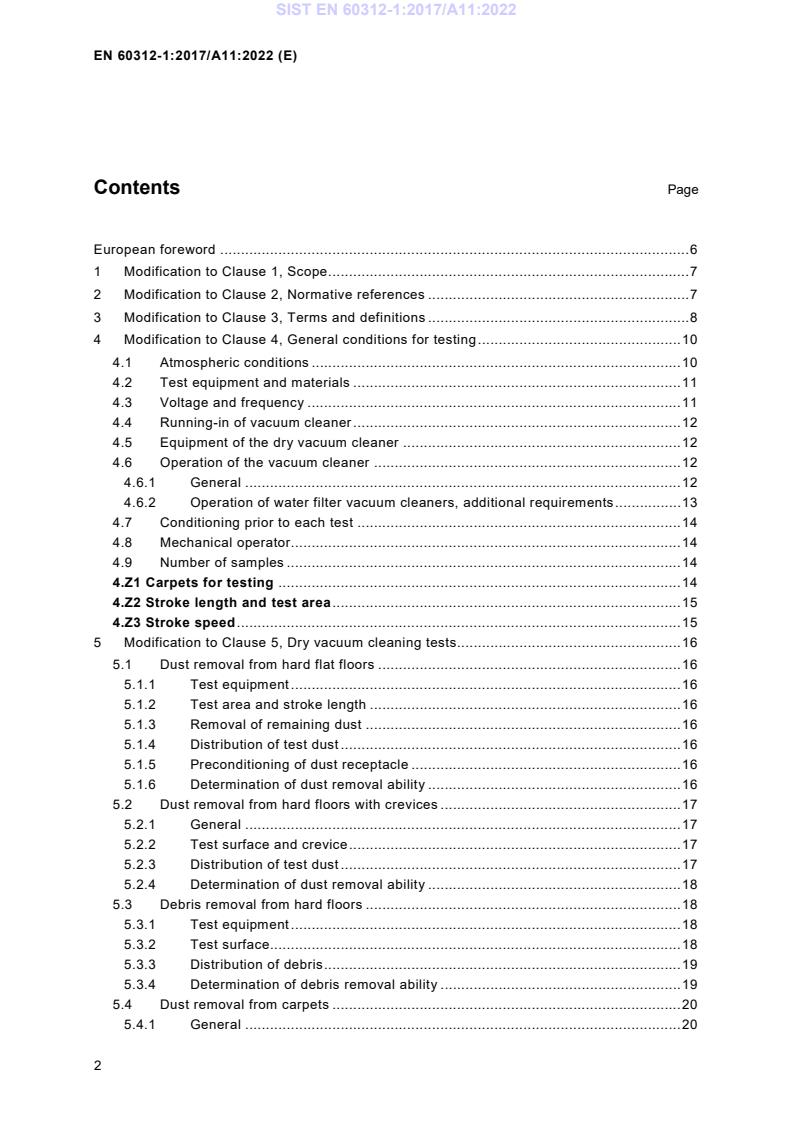
Contents Page
European foreword . 6
1 Modification to Clause 1, Scope . 7
2 Modification to Clause 2, Normative references . 7
3 Modification to Clause 3, Terms and definitions . 8
4 Modification to Clause 4, General conditions for testing . 10
4.1 Atmospheric conditions . 10
4.2 Test equipment and materials . 11
4.3 Voltage and frequency . 11
4.4 Running-in of vacuum cleaner . 12
4.5 Equipment of the dry vacuum cleaner . 12
4.6 Operation of the vacuum cleaner . 12
4.6.1 General . 12
4.6.2 Operation of water filter vacuum cleaners, additional requirements . 13
4.7 Conditioning prior to each test . 14
4.8 Mechanical operator. 14
4.9 Number of samples . 14
4.Z1 Carpets for testing . 14
4.Z2 Stroke length and test area . 15
4.Z3 Stroke speed . 15
5 Modification to Clause 5, Dry vacuum cleaning tests. 16
5.1 Dust removal from hard flat floors . 16
5.1.1 Test equipment . 16
5.1.2 Test area and stroke length . 16
5.1.3 Removal of remaining dust . 16
5.1.4 Distribution of test dust . 16
5.1.5 Preconditioning of dust receptacle . 16
5.1.6 Determination of dust removal ability . 16
5.2 Dust removal from hard floors with crevices . 17
5.2.1 General . 17
5.2.2 Test surface and crevice . 17
5.2.3 Distribution of test dust . 17
5.2.4 Determination of dust removal ability . 18
5.3 Debris removal from hard floors . 18
5.3.1 Test equipment . 18
5.3.2 Test surface. 18
5.3.3 Distribution of debris . 19
5.3.4 Determination of debris removal ability . 19
5.4 Dust removal from carpets . 20
5.4.1 General . 20
5.4.2 Test carpet and equipment . 20
5.4.3 Test area and stroke length . 20
5.4.4 Conditioning of test carpet . 20
5.4.5 Distribution of test dust . 21
5.4.6 Embedding of dust into carpet . 21
5.4.7 Preconditioning of dust receptacle . 21
5.4.8 Determination of dust removal ability . 21
5.5 Debris removal from carpet . 22
5.5.1 Test equipment . 22
5.5.2 Distribution of debris . 23
5.5.3 Determination of debris removal ability . 23
5.6 Dust removal along walls . 24
5.6.1 Test equipment and materials . 24
5.6.2 Distribution of test dust . 24
5.6.3 Determination of dust removal ability along walls . 24
5.7 Fibre removal from carpets . 25
5.7.1 General . 25
5.7.2 Test carpet . 25
5.7.3 Distribution of fibres . 25
5.7.4 Determination of fibre removal ability from carpets . 26
5.8 Fibre removal from upholstery . 28
5.8.1 General . 28
5.8.2 Test cushion . 28
5.8.3 Distribution of fibres . 28
5.8.4 Determination of fibre removal ability from upholstery . 29
5.9 Thread removal from carpets . 30
5.9.1 Test carpet . 30
5.9.2 Distribution of threads . 30
5.9.3 Determination of thread removal ability . 31
5.10 Maximum usable volume of the dust receptacle . 31
5.10.1 General . 31
5.10.2 Conditions for test . 31
5.10.3 Introduction of moulding granules . 32
5.10.4 Determination of maximum usable volume of dust receptacle . 32
5.11 Air data . 32
5.11.1 Purpose . 32
5.11.2 Conditions for test . 33
5.11.3 Test equipment . 33
5.11.4 Mounting dry vacuum cleaner to test chamber for air data test . 33
5.11.5 Determination of air data . 33
5.12 Performance with loaded dust receptacle . 34
5.12.1 Purpose . 34
5.12.2 Determination of suction pressure change with loaded dust receptacle . 34
5.12.3 Throttling to simulate loaded dust receptacle . 37
5.12.4 Determination of performance with loaded dust receptacle . 37
5.13 Total emissions while vacuum cleaning . 37
5.13.1 Purpose . 37
5.13.2 Test conditions . 38
5.13.3 Test equipment . 38
5.13.4 Test carpet . 38
5.13.5 Test chamber setup and conditioning . 38
5.13.6 Test sample and material setup . 38
5.13.7 Positioning the test unit . 38
5.13.8 Test procedure . 39
5.13.9 Reporting . 39
5.14 Dust re-emission and fractional filtration efficiency of the dry vacuum cleaner. 39
5.14.1 General . 39
5.14.2 Test conditions . 39
5.14.3 Determining the test dust quantity . 40
5.14.4 Dust re-emission for the entire range of particle size . 40
5.14.5 Fractional filtration efficiency . 46
6 Modification to Clause 6, Miscellaneous tests . 48
6.1 General . 48
6.2 Motion resistance . 48
6.2.1 Purpose . 48
6.2.2 Test carpet, hard floor surface, and test equipment . 48
6.2.3 Determination of motion resistance . 49
6.3 Cleaning under furniture. 49
6.3.1 Determination of free furniture height . 49
6.4 Radius of operation . 49
6.4.1 Purpose . 49
6.4.2 Conditions for measurement . 49
6.5 Impact resistance for detachable cleaning heads . 49
6.5.1 Purpose . 49
6.5.3 Determination of impact resistance . 49
6.6 Deformation of hose and connecting tubes . 50
6.6.1 Purpose . 50
6.6.3 Determination of permanent deformation . 50
6.7 Bump test . 50
6.7.1 Purpose . 50
6.7.2 Test equipment . 50
6.7.3 Test procedure . 50
6.8 Flexibility of the hose . 50
6.8.3 Determination of the flexibility of the hose . 50
6.9 Repeated bending of the hose . 50
6.9.1 Primary hose testing . 50
6.9.2 Secondary hose testing . 53
6.10 Life test . 53
6.15 Noise Level . 54
6.16 Energy consumption . 54
6.16.Z1 General . 54
7 Modification to Clause 7, Test material and equipment . 59
7.1 General . 59
7.2 Material for tests . 59
7.2.1 Test carpets. 59
7.2.2 Mineral dust – Type 4 . 59
7.2.3 Fibre material . 59
7.2.4 Thread material . 60
7.2.5 Moulding granules . 60
7.2.6 Test cushion . 60
7.3 Equipment for measurements . 61
7.3 Equipment for tests . 61
Test plate with crevice . 61
7.3.4 Hold-downs and guides. 61
7.3.5 Mechanical dust spreader (optional) . 62
7.3.6 Rollers for embedding . 62
7.3.7 Equipment for air data measurement . 62
7.3.8 Test equipment for determining the fractional filtration efficiency and dust
re-emission of the dry vacuum cleaner . 63
8 Modification to Annex A . 71
9 Modification to Annex B . 71
10 Modification to Annex C . 72
11 Modification to Annex ZA . 72
12 Modification to Annex ZB . 74
13 Addition of annexes . 78
Annex ZC (normative) Maintenance of the RSB . 79
Annex ZD (normative) Hard floorboard realization, floor support and floor pattern . 83
Annex ZE (normative) Maximum operational power . 85
14 Modification to the Bibliography . 86
European foreword
This document (EN 60312-1:2017/A11:2022) has been prepared by CLC/TC 59X “Performance of
household and similar electrical appliances”.
The following dates are fixed:
• latest date by which this document has to be (dop) 2023-03-21
implemented at national level by publication of
an identical national standard or by
endorsement
• latest date by which the national standards (dow) 2025-03-21
conflicting with this document have to be
withdrawn
This document modifies by common modifications EN 60312-1:2017, which consists of the text of
IEC 60312-1:2010+A1:2011 prepared by IEC/SC 59F ”Surface cleaning appliances” of IEC/TC 59
”Performance of household and similar electrical appliances”.
Significant technical differences are:
a) rephrased subclause 4.6 on the operation of the dry vacuum cleaner;
b) new debris pick-up test for hard floor and carpet;
c) improvement of test with loaded dust receptacle in subclause 5.9;
d) inclusion of a new subclause 5.10 on total emissions while vacuum cleaning;
e) new durability test for secondary hoses;
f) two normative Annexes on the description and maintenance of the reference vacuum cleaner
system RSB.
The addition of new tests has changed the structure of almost the entire Clause 5. Furthermore, changes
have been made in numerous subclauses. Therefore, the entire Clause 5 has been inserted as an
amendment.
Attention is drawn to the possibility that some of the elements of this document may be the subject of
patent rights. CENELEC shall not be held responsible for identifying any or all such patent rights.
This document has been prepared under a Standardization Request given to CENELEC by the
European Commission and the European Free Trade Association.
This document is foreseen as a document for future Commission Delegated Regulation on labelling and
future Commission Regulation on ecodesign for vacuum cleaners.
Any feedback and questions on this document should be directed to the users’ national committee. A
complete listing of these bodies can be found on the CENELEC website.
1 Modification to Clause 1, Scope
Replace with:
“This document is applicable for measurements of the performance of mains-operated dry vacuum
cleaners, including water filter vacuum cleaners for household or similar use.
NOTE 1 Measurements of the performance of mains-operated commercial dry vacuum cleaners are found in
EN IEC 62885-8.
The purpose of this document is to specify essential performance characteristics of dry vacuum
cleaners which are of interest to users and to describe methods for measuring these characteristics.
NOTE 2 Due to the influence of environmental conditions, variations in time, origin of test materials and
proficiency of the operator, some of the described test methods will give more reliable results when applied for
comparative testing of a number of appliances at the same time, in the same laboratory and by the same operator.
NOTE 3 The methods here can be applied with modifications for surface-cleaning product types or technologies
not currently covered within the scope.
For safety requirements, reference is made to EN 60335-1 and EN 60335-2-2.
A recommendation on information for the consumer at the point of sale is given in Annex B.”
2 Modification to Clause 2, Normative references
Add the following references:
“
IEC/TS 62885-1:2020, Surface cleaning machines – Part 1: General requirements on test material and
test equipment
EN IEC 60704-2-1:2020, Household and similar electrical appliances - Test code for the determination
of airborne acoustical noise - Part 2-1: Particular requirements for dry vacuum cleaners
Delete the following references:
“
IEC 60704-1, Household and similar electrical appliances – Test code for the determination of airborne
acoustical noise – Part 1: General requirements
ISO 554, Standard atmospheres for conditioning and/or testing — Specifications
ISO 679, Cement — Test methods — Determination of strength
ISO 1763, Textile floor coverings — Determination of number of tufts and/or loops per unit length and
per unit area
ISO 1765, Machine-made textile floor coverings — Determination of thickness
ISO 1766, Textile floor coverings — Determination of thickness of pile above the substrate
ISO 2424, Textile floor coverings — Vocabulary
ISO 8543, Textile floor coverings — Methods for determination of mass
3 Modification to Clause 3, Terms and definitions
3.1
dry vacuum cleaner
Replace the word “ambient” with phrase “ambient air”.
3.2
upright vacuum cleaner
Replace the phrase “vacuum cleaner” with “dry vacuum cleaner”.
3.3
cleaning head
Replace the phrase “vacuum cleaner” with “dry vacuum cleaner”.
3.4
active nozzle
Replace Note by:
Note 1 to entry: The agitation device can be driven by an incorporated electric motor (motorized nozzle), an
incorporated turbine powered by the air flow (air-turbine nozzle), or an incorporated friction or gear mechanism
actuated by moving the cleaning head over the surface to be cleaned (mechanical nozzle).
Delete term entry 3.9 “cleaning cycle”
3.10
stroke pattern
Replace by:
“arrangement of the forward strokes and return strokes on the surface to be cleaned”
3.11
parallel pattern
Replace by:
“stroke pattern where the forward strokes and the return strokes are congruent and are carried out in
the direction of the carpet pile (direction of manufacture) unless otherwise specified”
3.12
stroke speed
Replace by:
“speed of the cleaning head, moved as uniformly as possible, during a forward stroke or a return
stroke”
3.14
double stroke
Replace by:
“one forward and one backward movement of the cleaning head performed according to the appropriate
stroke pattern”
3.15
forward stroke
Replace Note by:
“
Note 1 to entry: On test carpets, forward strokes are carried out in the direction of the carpet pile.”
3.Z1
reference vacuum cleaner system
Replace title and definition with:
“
3.Z1
reference vacuum cleaner system RSB
electrically operated laboratory equipment intended to provide different laboratories with a similarly
constructed vacuum cleaner to measure the reference dust removal ability on carpets for passive and
active nozzles to improve the reproducibility of results
Note 1 to entry: The reference vacuum cleaner system RSB may be used with active or passive nozzles.
Note 2 to entry: The reference vacuum cleaner system RSB is not intended for tests other than dust pick-up
from Wilton test carpets.
Note 3 to entry: The reference vacuum cleaner system RSB is described in Annex ZB. Maintenance of the RSB
is described in Annex ZC.
Note 4 to entry: The reference vacuum cleaner system RSB is required for measurements in accordance with
legislation in the European Union.”
3.Z2
hybrid vacuum cleaner
Replace by:
“dry vacuum cleaner that can be either mains and/or battery-operated”
3.Z3
battery operated active nozzle
Replace title and definition with:
“
cordless active nozzle
cleaning head provided on a mains-operated machine with an agitation device to assist dirt removal
driven by a battery-operated motor”
3.Z4
cylinder vacuum cleaner
Replace by:
“portable dry vacuum cleaner having a nozzle separated from the cleaner housing by a hose; in use,
only the nozzle is guided over the surface area to be cleaned
Note 1 to entry: These dry vacuum cleaners are generally floor-supported.
Note 2 to entry: The dry vacuum cleaner may have detachable passive or active nozzles, attachments, and
tubes for both floor and above the floor cleaning.”
3.Z6
water filter system
Replace the word “which” with “that”.
Add:
“
3.Z7
hand-held cleaner
dry vacuum cleaner that will not be used on the floor by the user from an erect standing position
Note 1 to entry: The hand-held dry vacuum cleaner may also be used on stairs from a standing position.
3.Z8
in-house reference vacuum cleaner
electrically operated laboratory equipment designated for internal comparison within a laboratory
3.Z9
maximum operational power
power level that the machine is not capable of exceeding in any operating condition set either by the
user or automatically by the appliance
3.Z10
stroke
single traverse of the cleaning head over the test area
3.Z11
test
entirety or superset of all trials and trial batches of all samples to be measured for a single vacuum
cleaner model
3.Z12
trial
single instance of a performance measurement carried out under identical conditions that can be
repeated multiple times
3.Z13
tube
rigid length or lengths of hollow pipe that connect the end of the hose to various vacuum cleaner
accessories
Note 1 to entry: The tube may be of fixed length, in multiple parts or telescopic, passive or energized.”
4 Modification to Clause 4, General conditions for testing
4.1 Atmospheric conditions
Replace with:
“Unless otherwise specified, the test procedures and measurements shall be carried out under the
following conditions:
Standard atmosphere 23/50
Temperature: (23 ± 2) °C
Relative humidity: (50 ± 5) %
Absolute air pressure: 91,3 kPa to 106,3 kPa
Temperature and humidity conditions within the specified ranges are required for good repeatability and
reproducibility. Care should be taken to avoid changes during a test.
For test procedures and measurements carried out at other than standard atmospheric conditions, the
ambient temperature shall be maintained at (23 ± 5) °C.”
Delete the Note in Clause 4.1.
4.2 Test equipment and materials
Replace with:
“
4.2.1 General
To minimize the influence of electrostatic phenomena, measurements on carpets shall be carried out on
a flat floor consisting of a smooth untreated pine plywood or equivalent panel, at least 15 mm thick and
of a size equal to or larger than the test carpet.
Equipment and materials for measurements (devices, test carpets, test dust, etc.) to be used in a test
shall, prior to the test, be stored for at least 16 h at standard atmospheric conditions in accordance with
4.1.
Carpets that have already been used shall be stored unbeaten at standard atmospheric conditions in
accordance with 4.1.
When not in use, carpets shall be hanging free, or lying flat, pile upwards and uncovered. Carpets shall
not be rolled when stored between testing. Carpets that have been rolled shall be laid flat for a minimum
of 16 h before use.
4.2.2 Pile direction
Machine or manufacturing direction is an indication of the projected pile direction for carpet production.
Pile direction is what is important for dust pick-up (DPU) testing.
If the pile direction is clearly parallel to the test bed, as is required by the applicable test procedures, the
carpet is acceptable for use for that test. If the pile direction is at an angle to the test bed, the laboratory
will be required to decide as to that carpet panel's usability for relevant comparative testing.
NOTE The procedure for determining pile direction can be found in IEC TS 62885-1:2020.”
4.3 Voltage and frequency
Replace 2nd paragraph with:
“Dry vacuum cleaners designed for DC only shall be operated at DC. Dry vacuum cleaners designed
for both AC and DC shall be operated at AC. Dry vacuum cleaners not marked with rated frequency
shall be operated at either (50 ± 1) Hz or (60 ± 1) Hz with a total harmonic distortion of ≤ 3 %, as is
common in the country of use.”
Replace the phrase “vacuum cleaner” with “dry vacuum cleaner” in 3rd paragraph.
Replace 4th paragraph with:
“If the rated voltage differs from the nominal system voltage of the country concerned, measurements
carried out at rated voltage can give test results that are misleading for the consumer, and additional
measurements can be required. If the test voltage differs from the rated voltage, this shall be reported.”
4.4 Running-in of vacuum cleaner
Replace the phrase “vacuum cleaner” with “dry vacuum cleaner,”.
4.5 Equipment of the dry vacuum cleaner
Replace the phrase “vacuum cleaner” with “dry vacuum cleaner” in the 1st paragraph.
Replace 2nd paragraph with:
“If the dry vacuum cleaner is provided with a reusable dust receptacle (as the sole original dust
receptacle or as an enclosure for disposable dust receptacles), the dust receptacle and any additional
filters removable without the aid of tools shall, prior to each measurement, be cleaned according to the
manufacturer's instructions until its mass is within 1 % or 2°g of its original mass, whichever is the lower.”
Replace the 4th and 5th paragraph with:
“For dry vacuum cleaners equipped with separation devices, being part of the appliance, used to
separate the dust from the air flow and/or having additional filters to be changed or cleaned by the user,
without the use of tools, the change in mass of such specific devices shall be taken into account for dust
removal ability.
Dry vacuum cleaners with disposable or reusable dust receptacles may have secondary filtration stage
devices which do not collect meaningful dust in removal ability tests, but which do impact on filtration
and life tests. Replacement and/or maintenance of such devices shall be in accordance with relevant
clauses and carried out according to the manufacturer's instructions.“
4.6 Operation of the vacuum cleaner
Replace title with:
“Operation of the dry vacuum cleaner”
4.6.1 General
Replace with:
“The grip of cleaners with suction hose or the handle of other cleaners shall be held at a height of
(800 ± 50) mm above the test surface. Any telescopic tubes or sticks shall be extended to maximum
length. For nozzles without pivoting connectors, it shall be ensured that the bottom of the cleaning head
be made parallel with the test surface by adjusting the handle height within the tolerances. If this is not
possible, the length of a telescopic tube or stick may be adjusted. Any adjustment shall be reported.
During measurements where the agitation device of an active nozzle is not used as in normal operation,
the agitation device shall be running but not in contact with any surface.
The following wording regarding declaration and compliance shall also apply to EN IEC 60704-2-1:2020:
“For declaration and compliance purposes, related tests conducted on a surface type (carpet or hard
surface with or without crevice) shall be conducted with the same dry vacuum cleaner setting
configurations such as power, cleaning head and cleaning head setting.”
Related tests are:
— tests measuring the dust removal from carpet, the debris removal from carpet, the energy
consumption for cleaning a carpet, and the noise level on carpet.
— tests measuring the dust removal from hard floor with crevices, the debris removal from hard floor,
the energy consumption for cleaning a hard floor with crevices, and the noise level on hard floor.
Unless otherwise specified, the dry vacuum cleaner setting configurations, such as power, cleaning
head and cleaning head setting, shall be used, and adjusted in accordance with the manufacturer's
instructions for the surface to be cleaned (e.g. carpet or hard floor) for the test to be carried out.
In the absence of unambiguous instructions within the manufacturer's instructions, the product shall be
tested with settings that are in accordance with any explicitly clear text, symbol or pictogram that is
identifiable on the product.
If, after following the above order of checks, the tester believes the device under test to be in a
configuration that is ambiguous, or that multiple configurations are possible with no way to clearly
determine which is the most suitable for a given task, then the manufacturer shall be contacted for
additional guidance.
Complete details of the settings used for each cleaning task, such as suction power, height settings and
the like shall be recorded in the test documentation.
If values for the performance of a product measured in accordance with this document are
published/declared, e.g. in the technical documentation, accurate and unambiguous details of the
settings that were used during the test procedure shall be provided.
NOTE Performance in other settings or combinations can differ from the results in the declaration settings,
however this document does not address those results.”
4.6.2 Operation of water filter vacuum cleaners, additional requirements
4.6.2.1 Determining the water loss
Replace with:
“Prior to the preconditioning the water loss of the water filter vacuum cleaner shall be determined.
The water filter vacuum cleaner shall be run according to the manufacturer's instructions for a period
of 10 min with the suction nozzle lifted 20 mm from the floor in accordance with 4.1. Before and after
this running time of 10 min the mass of the water filter system shall be measured with an accuracy of at
least 0,1 g. This trial shall be repeated 3 times and an average of these 3 trials shall be noted.
Since ambient conditions have a significant influence on the water loss, standard conditions shall be
carefully maintained.”
4.6.2.2 Filter conditions
Replace with:
“
4.6.2.2.1 For dust and debris removal from hard flat floors and from carpets
If the value measured according with 4.6.2.1 is lower than 0,1 g/min, the water filter vacuum cleaner
shall be used in accordance with the manufacturer's instructions for the dust removal from hard flat floors
and carpet.
The water filter vacuum cleaner should not be moved to minimize loss of water.
NOTE 1 The mass of water lost during the measuring time is low and has no relevant influence on the test result.
If the value measured according to 4.6.2.1 is equal or higher than 0,1 g/min and the water filter vacuum
cleaner is equipped with a dust collection system that does not use water, this collecting system shall
be included to determine the dust and debris removal from hard flat floors and dust and debris removal
from carpet.
The air data in accordance with 5.11 shall be measured with the water filter system used according to
the manufacturer's instructions. Then the vacuum cleaner shall be equipped with the dust collecting
system without water and the maximum airflow shall be adjusted to ± 3 % of the measured values with
water filter system.
In all other cases, the dust and the debris removal from hard flat floors and from carpets shall be
performed using the dust collecting box (see 7.3.Z2) as pre-filter system. The vacuum cleaner shall be
used in accordance with the manufacturer's instructions.
The dust collecting box is equipped with a synthetic filter bag properly sized for the dust collecting box.
NOTE 2 The filter bag from the reference vacuum cleaner system RSB in accordance with 3.Z1 can be used.
For measuring dust pick-up, the filter bag can be handled in the same way it is handled in the reference vacuum
cleaner system RSB.
4.6.2.2.2 For all other tests with water filter vacuum cleaners
The vacuum cleaner and its attachments shall be used and adjusted in accordance with the
manufacturer's instructions for normal operation for the test to be carried out.
“
4.7 Conditioning prior to each test
Replace the words “vacuum cleaner” by “dry vacuum cleaner”.
4.8 Mechanical operator
Replace with:
“In order to achieve reliable results, certain tests require the cleaning head to be moved at uniform
speed over the test area and without exerting an additional force against the test surface.
It is recommended to simulate the handling of the dry vacuum cleaner by using a mechanical operator
such as that described in 7.3.12.”
4.9 Number of samples
Replace the phrases “vacuum cleaner” by “dry vacuum cleaner”.
Delete the NOTE.
Add as paragraph after the 1st paragraph as follows:
“For increased confidence in the test results, a minimum of three samples of a dry vacuum cleaner
should be tested. Some performance tests may require additional samples or replacement parts if
performance is adversely impacted by testing. If additional samples or replacement parts are used, they
should be recorded in the report.
Tests carried out to simulate stresses that a dry vacuum cleaner may be exposed to during normal
use, possibly causing impairment of the cleaner's performance, can require additional samples of
replaceable parts. Such tests shall be carried out at the end of the test programme.
”
4.Z1 Reference vacuum cleaner system
Delete Clause 4.Z1 “Reference vacuum cleaner system”.
Add:
“
4.Z1 Carpets for testing
NOTE 1 The reference cleaner referred to in this document is a product designated within a laboratory for
internal comparison and is not suitable for inter-laboratory comparisons.
Test carpets used in a laboratory for the determination of dust removal ability will, over time, change
from their original condition, for instance due to wear or gradual filling with dust. Therefore, the in-house
reference cleaner as defined in 3.Z8 shall be used to regularly check the carpet conditions as a
verification of the test results obtained and recorded.
If a reference vacuum cleaner system RSB as defined in 3.Z1 is present, this should be used for
monitoring Wilton test carpet conditions by comparing the values for calibrated and reference dust pick-
up, DPU and DPU , of the RSB.
cal ref
NOTE 2 DPU and DPU are defined in Clause ZB.5.
cal ref
If the difference between DPU and DPU is greater than 5 percentage points, it is recommended
cal ref
to:
— replace the carpet, and/or
— re-adjust the RSB, and/or
— check the laboratory conditions and testing procedure.
Given that dust pick-up ability can differ between carpets used for active nozzles or passive
nozzles, the result from tests between active nozzles and pa
...