


EN 61180:2016
(Main)High-voltage test techniques for low-voltage equipment - Definitions, test and procedure requirements, test equipment
High-voltage test techniques for low-voltage equipment - Definitions, test and procedure requirements, test equipment
IEC 61180:2016 is applicable to dielectric tests with direct voltage; dielectric tests with alternating voltage; dielectric tests with impulse voltage and test equipment used for dielectric tests on low-voltage equipment. This standard is applicable only to tests on equipment having a rated voltage of not more than 1 kV a.c. or 1,5 kV d.c. This standard is applicable to type and routine tests for objects which are subjected to high voltage tests as specified by the technical committee. The test equipment comprises a voltage generator and a measuring system. This standard covers test equipment in which the measuring system is protected against external interference and coupling by appropriate screening, for example a continuous conducting shield. Therefore, simple comparison tests are sufficient to ensure valid results. This standard is not intended to be used for electromagnetic compatibility tests on electric or electronic equipment. Tests with the combination of impulse voltages and currents are covered by IEC 61000-4-5. This standard provides the relevant technical committees as far as possible with: - defined terms of both general and specific applicability; - general requirements regarding test objects and test procedures; - methods for generation and measurement of test voltages; - test procedures; - methods for the evaluation of test results and to indicate criteria for acceptance; - requirements concerning approved measuring devices and checking methods and measurement uncertainty. Alternative test procedures may be required and these should be specified by the relevant technical committees. Care should be taken if the test object has voltage limiting devices, as they may influence the results of the test. The relevant technical committees should provide guidance for testing objects equipped with voltage limiting devices. This 1st edition of IEC 61180 cancels and replaces the 1st edition of IEC 61180-1, issued in 1992, and the 1st edition of IEC 61180-2, issued in 1994. Key words: High Voltage Test Techniques, Dielectric Tests, Disruptive Discharge, Withstand Voltage.
Hochspannungs-Prüftechnik für Niederspannungsgeräte - Begriffe, Prüfung und Prüfbedingungen, Prüfgeräte
Techniques des essais à haute tension pour matériel à basse tension - Définitions, exigences et modalités relatives aux essais, matériel d'essai
L'IEC 61180:2016 est applicable aux essais diélectriques en tension continue, aux essais diélectriques en tension alternative, aux essais diélectriques en tension de choc et au matériel d'essai utilisé pour effectuer des essais diélectriques sur des matériels à basse tension. La présente Norme n'est applicable qu'aux essais de matériels dont la tension assignée ne dépasse pas 1 kV en courant alternatif ou 1,5 kV en courant continu. La présente Norme est applicable aux essais de type et aux essais individuels de série pour les objets qui sont soumis à des essais à haute tension tels que spécifiés par le comité d'études. Le matériel d'essai est constitué d'un générateur de tension et d'un système de mesure. La présente Norme concerne le matériel d'essai dont le système de mesure est protégé contre les perturbations et les couplages externes par un système d'écrans approprié, par exemple, un écran conducteur continu. En conséquence, des essais de comparaison simples sont suffisants pour assurer la validité des résultats. La présente Norme n'est pas destinée à être utilisée pour les essais de compatibilité électromagnétique de matériel électrique ou électronique. Les essais qui combinent des tensions et des courants de choc sont couverts par l'IEC 61000-4-5. La présente norme spécifie autant que possible aux comités d'études concernés des termes définis d'application générale ou particulière, des exigences générales relatives aux objets en essai et aux modalités d'essai, des méthodes pour produire et mesurer les tensions d'essai, des modalités d'essai, des méthodes d'interprétation des résultats d'essai et d'indication des critères d'acceptation, des exigences concernant les dispositifs de mesure certifiés et les méthodes de vérification, une incertitude de mesure. Des variantes aux modalités d'essai peuvent être exigées et il convient qu'elles soient spécifiées par les comités d'études concernés. Il convient de déterminer si l'objet en essai comporte des dispositifs limiteurs de tension dans la mesure où ils peuvent influer sur les résultats de l'essai. Il convient que les comités d'études concernés fournissent des lignes directrices concernant les essais auxquels sont soumis les objets équipés de dispositifs limiteurs de tension. Cette première édition de l'IEC 61180 annule et remplace la première édition de l'IEC 61180-1, publiée en 1992, et la première édition de l'IEC 61180-2, publiée en 1994. Mots-clés: Techniques des essais à haute tension, essais diélectriques, décharge disruptive, tension de tenue.
Tehnike visokonapetostnega preskušanja nizkonapetostne opreme - Definicije, preskusne in postopkovne zahteve, preskusna oprema
IEC 61180 se uporablja za: – dielektrične preskuse z enosmerno napetostjo; – dielektrične preskuse z izmenično napetostjo; – dielektrične preskuse z udarno napetostjo; – preskusno opremo, ki se uporablja za dielektrične preskuse nizkonapetostne opreme. Ta standard se uporablja samo za preskuse opreme z nazivno napetostjo največ 1 kV pri izmeničnem toku ali 1,5 kV pri enosmernem toku. Ta standard se uporablja za tipske in rutinske preskuse za predmete, izpostavljene visokonapetostnim preskusom, kot določi tehnični odbor. Preskusna oprema zajema generator napetosti in merilni sistem. Ta standard obravnava preskusno opremo, pri kateri je merilni sistem zaščiten pred zunanjimi motnjami in sklopi na podlagi ustreznega presejanja (npr. neprekinjena prevodna zaščita). Za zagotavljanje veljavnih rezultatov tako zadostujejo preprosti primerjalni preskusi. Ta standard ni namenjen za uporabo pri preskusih elektromagnetne združljivosti električne ali elektronske opreme.
General Information
Relations
Overview
EN 61180:2016 (CLC adoption of IEC 61180:2016) defines high-voltage test techniques for low‑voltage equipment, covering dielectric and disruptive-discharge tests using direct, alternating and impulse voltages. It applies to type and routine tests on equipment with rated voltages up to 1 kV a.c. or 1.5 kV d.c. The standard specifies requirements for test procedures, test equipment (voltage generators and measuring systems) and measurement uncertainty, and replaces earlier EN 61180-1/-2 editions.
Key topics and technical requirements
- Scope of dielectric tests: direct voltage, alternating voltage and impulse voltage dielectric tests and measurement methods.
- Test equipment: requirements for voltage generators and approved measuring systems that are protected against external interference (e.g., continuous conducting shields).
- Definitions and terms: standardized terminology for disruptive discharge, withstand voltage, impulse parameters and measurement characteristics.
- Test procedures: guidance for selection and execution of type tests and routine tests, including atmospheric correction and specimen conditioning.
- Measurement and calibration: methods for generation and accurate measurement of test voltages, scale factor determination, calibration by comparison, dynamic behaviour and influence of load.
- Uncertainty and acceptance criteria: procedures to evaluate measurement uncertainty (GUM-based), record keeping, and criteria for pass/fail decisions.
- Limitations and interfaces: not intended for EMC testing; combination impulse voltage/current tests are instead covered by IEC 61000‑4‑5. Special attention required for devices with voltage‑limiting components (e.g., varistors).
Applications and users
Who uses EN 61180:
- Test laboratories and accredited calibration labs performing dielectric and withstand voltage tests.
- Manufacturers of low-voltage electrical equipment and components (motors, switchgear, transformers, household appliances) for type and routine testing.
- Certification and conformity assessment bodies establishing test programs and acceptance criteria.
- Design and safety engineers developing insulation coordination and verification test plans.
- Test equipment manufacturers producing HV generators and measuring systems compliant with EN 61180.
Practical uses:
- Verifying insulation strength and withstand voltage of products.
- Establishing validated measurement setups and calibration intervals.
- Producing reproducible dielectric test reports with quantified measurement uncertainty.
- Ensuring compliance with product safety requirements and aiding technical committees in specifying alternative procedures when needed.
Related standards
- IEC/EN 60060 series (high‑voltage test techniques)
- IEC 61000‑4‑5 (surge/impulse tests)
- IEC 60664‑1 (insulation coordination)
- IEC 61083 series (instruments/software for impulse measurements)
- ISO/IEC Guide 98‑3 (GUM - uncertainty of measurement)
Keywords: High Voltage Test Techniques, Dielectric Tests, Disruptive Discharge, Withstand Voltage, EN 61180, low‑voltage equipment, measurement uncertainty.
Frequently Asked Questions
EN 61180:2016 is a standard published by CLC. Its full title is "High-voltage test techniques for low-voltage equipment - Definitions, test and procedure requirements, test equipment". This standard covers: IEC 61180:2016 is applicable to dielectric tests with direct voltage; dielectric tests with alternating voltage; dielectric tests with impulse voltage and test equipment used for dielectric tests on low-voltage equipment. This standard is applicable only to tests on equipment having a rated voltage of not more than 1 kV a.c. or 1,5 kV d.c. This standard is applicable to type and routine tests for objects which are subjected to high voltage tests as specified by the technical committee. The test equipment comprises a voltage generator and a measuring system. This standard covers test equipment in which the measuring system is protected against external interference and coupling by appropriate screening, for example a continuous conducting shield. Therefore, simple comparison tests are sufficient to ensure valid results. This standard is not intended to be used for electromagnetic compatibility tests on electric or electronic equipment. Tests with the combination of impulse voltages and currents are covered by IEC 61000-4-5. This standard provides the relevant technical committees as far as possible with: - defined terms of both general and specific applicability; - general requirements regarding test objects and test procedures; - methods for generation and measurement of test voltages; - test procedures; - methods for the evaluation of test results and to indicate criteria for acceptance; - requirements concerning approved measuring devices and checking methods and measurement uncertainty. Alternative test procedures may be required and these should be specified by the relevant technical committees. Care should be taken if the test object has voltage limiting devices, as they may influence the results of the test. The relevant technical committees should provide guidance for testing objects equipped with voltage limiting devices. This 1st edition of IEC 61180 cancels and replaces the 1st edition of IEC 61180-1, issued in 1992, and the 1st edition of IEC 61180-2, issued in 1994. Key words: High Voltage Test Techniques, Dielectric Tests, Disruptive Discharge, Withstand Voltage.
IEC 61180:2016 is applicable to dielectric tests with direct voltage; dielectric tests with alternating voltage; dielectric tests with impulse voltage and test equipment used for dielectric tests on low-voltage equipment. This standard is applicable only to tests on equipment having a rated voltage of not more than 1 kV a.c. or 1,5 kV d.c. This standard is applicable to type and routine tests for objects which are subjected to high voltage tests as specified by the technical committee. The test equipment comprises a voltage generator and a measuring system. This standard covers test equipment in which the measuring system is protected against external interference and coupling by appropriate screening, for example a continuous conducting shield. Therefore, simple comparison tests are sufficient to ensure valid results. This standard is not intended to be used for electromagnetic compatibility tests on electric or electronic equipment. Tests with the combination of impulse voltages and currents are covered by IEC 61000-4-5. This standard provides the relevant technical committees as far as possible with: - defined terms of both general and specific applicability; - general requirements regarding test objects and test procedures; - methods for generation and measurement of test voltages; - test procedures; - methods for the evaluation of test results and to indicate criteria for acceptance; - requirements concerning approved measuring devices and checking methods and measurement uncertainty. Alternative test procedures may be required and these should be specified by the relevant technical committees. Care should be taken if the test object has voltage limiting devices, as they may influence the results of the test. The relevant technical committees should provide guidance for testing objects equipped with voltage limiting devices. This 1st edition of IEC 61180 cancels and replaces the 1st edition of IEC 61180-1, issued in 1992, and the 1st edition of IEC 61180-2, issued in 1994. Key words: High Voltage Test Techniques, Dielectric Tests, Disruptive Discharge, Withstand Voltage.
EN 61180:2016 is classified under the following ICS (International Classification for Standards) categories: 19.080 - Electrical and electronic testing. The ICS classification helps identify the subject area and facilitates finding related standards.
EN 61180:2016 has the following relationships with other standards: It is inter standard links to EN 61180-2:1994, EN 61180-1:1994. Understanding these relationships helps ensure you are using the most current and applicable version of the standard.
You can purchase EN 61180:2016 directly from iTeh Standards. The document is available in PDF format and is delivered instantly after payment. Add the standard to your cart and complete the secure checkout process. iTeh Standards is an authorized distributor of CLC standards.
Standards Content (Sample)
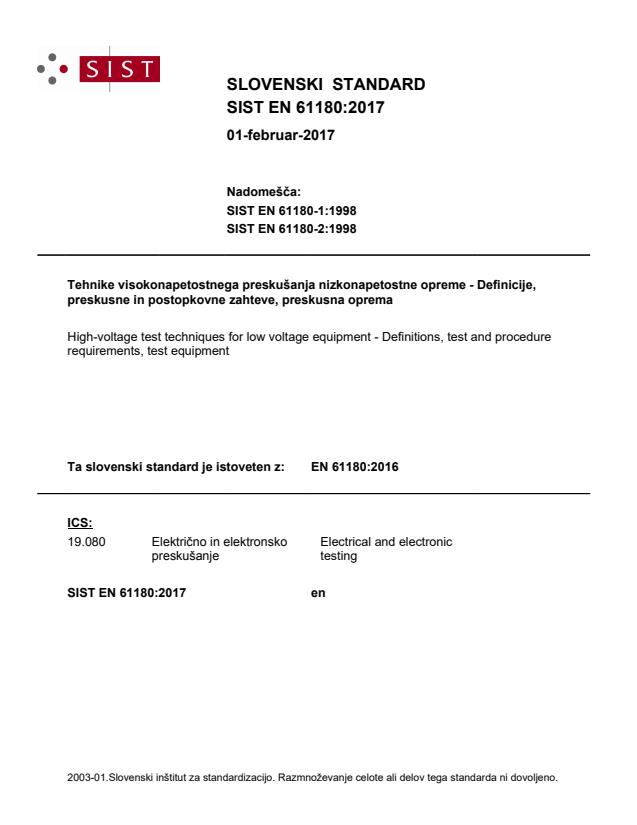
2003-01.Slovenski inštitut za standardizacijo. Razmnoževanje celote ali delov tega standarda ni dovoljeno.Tehnike visokonapetostnega preskušanja nizkonapetostne opreme - Definicije, preskusne in postopkovne zahteve, preskusna opremaHigh-voltage test techniques for low voltage equipment - Definitions, test and procedure requirements, test equipment19.080SUHVNXãDQMHElectrical and electronic testingICS:Ta slovenski standard je istoveten z:EN 61180:2016SIST EN 61180:2017en01-februar-2017SIST EN 61180:2017SLOVENSKI
STANDARDSIST EN 61180-2:1998SIST EN 61180-1:19981DGRPHãþD
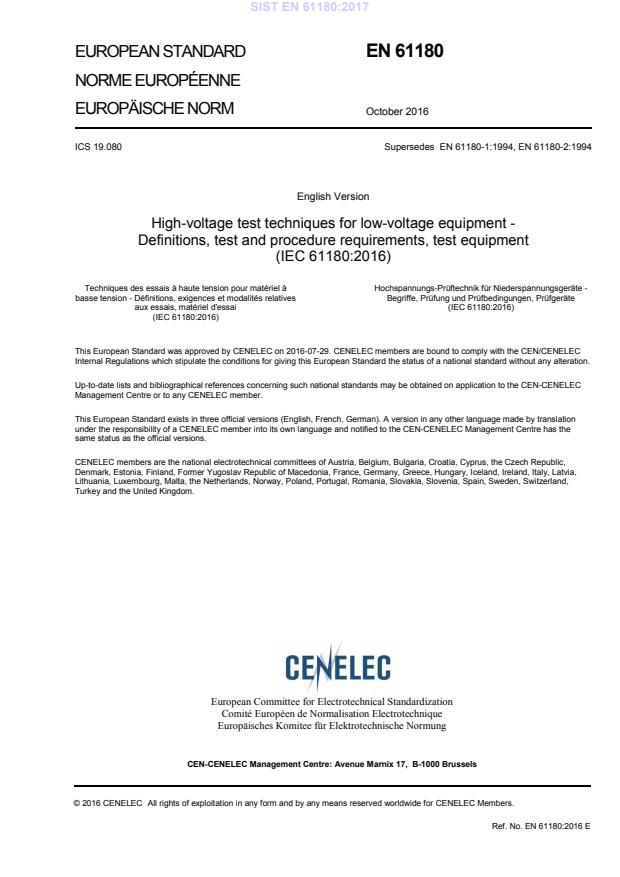
EUROPEAN STANDARD NORME EUROPÉENNE EUROPÄISCHE NORM
EN 61180
October 2016 ICS 19.080
Supersedes
EN 61180-1:1994, EN 61180-2:1994
English Version
High-voltage test techniques for low-voltage equipment - Definitions, test and procedure requirements, test equipment (IEC 61180:2016)
Techniques des essais à haute tension pour matériel à basse tension - Définitions, exigences et modalités relatives aux essais, matériel d'essai (IEC 61180:2016)
Hochspannungs-Prüftechnik für Niederspannungsgeräte - Begriffe, Prüfung und Prüfbedingungen, Prüfgeräte (IEC 61180:2016) This European Standard was approved by CENELEC on 2016-07-29. CENELEC members are bound to comply with the CEN/CENELEC Internal Regulations which stipulate the conditions for giving this European Standard the status of a national standard without any alteration. Up-to-date lists and bibliographical references concerning such national standards may be obtained on application to the CEN-CENELEC Management Centre or to any CENELEC member.
This European Standard exists in three official versions (English, French, German). A version in any other language made by translation under the responsibility of a CENELEC member into its own language and notified to the CEN-CENELEC Management Centre has the same status as the official versions. CENELEC members are the national electrotechnical committees of Austria, Belgium, Bulgaria, Croatia, Cyprus, the Czech Republic, Denmark, Estonia, Finland, Former Yugoslav Republic of Macedonia, France, Germany, Greece, Hungary, Iceland, Ireland, Italy, Latvia, Lithuania, Luxembourg, Malta, the Netherlands, Norway, Poland, Portugal, Romania, Slovakia, Slovenia, Spain, Sweden, Switzerland, Turkey and the United Kingdom. European Committee for Electrotechnical Standardization
Comité Européen de Normalisation Electrotechnique Europäisches Komitee für Elektrotechnische Normung CEN-CENELEC Management Centre: Avenue Marnix 17,
B-1000 Brussels © 2016 CENELEC All rights of exploitation in any form and by any means reserved worldwide for CENELEC Members.
Ref. No. EN 61180:2016 E SIST EN 61180:2017
This document supersedes EN 61180-1:1994 and EN 61180-2:1994. Attention is drawn to the possibility that some of the elements of this document may be the subject of patent rights. CENELEC [and/or CEN] shall not be held responsible for identifying any or all such patent rights. Endorsement notice The text of the International Standard IEC 61180:2016 was approved by CENELEC as a European Standard without any modification. In the official version, for Bibliography, the following notes have to be added for the standards indicated: IEC 61000-4-5:2014 NOTE Harmonized as EN 61000-4-5:2014 (not modified). IEC 61010-1 NOTE Harmonized as EN 61010-1. IEC 61010-2-030:2010 NOTE Harmonized as EN 61010-2-030:2010 (not modified). SIST EN 61180:2017
Normative references to international publications with their corresponding European publications The following documents, in whole or in part, are normatively referenced in this document and are indispensable for its application. For dated references, only the edition cited applies. For undated references, the latest edition of the referenced document (including any amendments) applies. NOTE 1 When an International Publication has been modified by common modifications, indicated by (mod), the relevant EN/HD applies. NOTE 2 Up-to-date information on the latest versions of the European Standards listed in this annex is available here: www.cenelec.eu.
Publication Year Title EN/HD Year IEC 60060-1 2010
High-voltage test techniques -
Part 1: General definitions and test requirements EN 60060-1 2010
IEC 60060-2 2010
High-voltage test techniques -
Part 2: Measuring systems EN 60060-2 2011
IEC 60068-1 2013
Environmental testing -
Part 1: General and guidance EN 60068-1 2014
IEC 60335 series
Household and similar electrical appliances - Safety
EN 60335 series
IEC 60664-1 2007
Insulation coordination for equipment within low-voltage systems -
Part 1: Principles, requirements and tests EN 60664-1 2007
IEC 61083-1 2001
Instruments and software used for measurement in high-voltage impulse tests -
Part 1: Requirements for instruments EN 61083-1 2001
IEC 61083-2 2013
Instruments and software used for measurement in high-voltage and high-current tests -
Part 2: Requirements for software for tests with impulse voltages and currents EN 61083-2 2013
ISO/IEC Guide 98-3 2008
Uncertainty of measurement -
Part 3: Guide to the expression of uncertainty in measurement (GUM:1995) - -
IEC 61180 Edition 1.0 2016-06 INTERNATIONAL STANDARD NORME INTERNATIONALE High-voltage test techniques for low-voltage equipment – Definitions, test and procedure requirements, test equipment
Techniques des essais à haute tension pour matériel à basse tension – Définitions, exigences et modalités relatives aux essais, matériel d'essai
INTERNATIONAL ELECTROTECHNICAL COMMISSION COMMISSION ELECTROTECHNIQUE INTERNATIONALE
ICS 19.080
ISBN 978-2-8322-3366-5
– 2 – IEC 61180:2016 © IEC 2016 CONTENTS FOREWORD . 5 1 Scope . 7 2 Normative references. 7 3 Terms and definitions . 8 3.1 General terms . 8 3.2 Definitions related to disruptive discharge and test voltages . 8 3.3 Characteristics related to the test equipment . 9 3.4 Characteristics related to direct voltage tests . 9 3.5 Characteristics related to alternating voltage tests . 10 3.6 Characteristics related to impulse tests (see Figure 1) . 11 3.7 Definitions relating to tolerance and uncertainty . 12 4 General requirements . 13 4.1 General . 13 4.2 Atmospheric conditions for test procedures and verification of test equipment . 14 4.3 Procedures for qualification and use of measuring systems . 14 4.3.1 General principles . 14 4.3.2 Schedule of performance tests . 15 4.3.3 Requirements for the record of performance . 15 4.3.4 Uncertainty . 15 4.4 Tests and test requirements for an approved measuring system and its components . 16 4.4.1 Calibration – Determination of the scale factor . 16 4.4.2 Influence of load . 18 4.4.3 Dynamic behaviour . 18 4.4.4 Short-term stability . 19 4.4.5 Long-term stability . 19 4.4.6 Ambient temperature effect . 20 4.4.7 Uncertainty calculation of the scale factor . 20 4.4.8 Uncertainty calculation of time parameter measurement (impulse voltages only) . 22 5 Tests with direct voltage . 25 5.1 General . 25 5.2 Test voltage . 25 5.2.1 Requirements for the test voltage . 25 5.2.2 Generation of the test voltage . 25 5.2.3 Measurement of the test voltage . 25 5.3 Test procedures . 26 5.3.1 Withstand voltage tests . 26 6 Tests with alternating voltage . 27 6.1 Test voltage . 27 6.1.1 Requirements for the test voltage . 27 6.1.2 Generation of the test voltage . 27 6.1.3 Measurement of the test voltage . 28 6.2 Test procedures . 30 6.2.1 Withstand voltage tests . 30 7 Tests with impulse voltage . 30 SIST EN 61180:2017
IEC 61180:2016 © IEC 2016 – 3 – 7.1 Test voltage . 30 7.1.1 General . 30 7.1.2 Requirements for the test voltage . 31 7.1.3 Generation of the test voltage . 31 7.1.4 Measurement of the test voltage and determination of impulse shape . 32 7.2 Test procedures . 32 7.2.1 Verification of impulse voltage waveshape . 32 7.2.2 Impulse voltage tests . 32 7.3 Measurement of the test voltage . 32 7.3.1 Requirements for an approved measuring system . 32 7.3.2 Uncertainty contributions . 33 7.3.3 Dynamic behaviour . 33 7.3.4 Requirements for measuring instrument . 33 8 Reference measurement systems . 33 8.1 Requirements for reference measuring systems . 33 8.1.1 Direct voltage. 33 8.1.2 Alternating voltage . 33 8.1.3 Impulse voltages . 33 8.2 Calibration of a reference measuring system . 33 8.2.1 General . 33 8.2.2 Reference method: comparative measurement . 34 8.3 Interval between successive calibrations of reference measuring systems . 34 8.4 Use of reference measuring systems . 34 Annex A (informative)
Uncertainty of measurement . 35 A.1 General . 35 A.2 Terms and definitions in addition to 3.7 . 35 A.3 Model function . 36 A.4 Type A evaluation of standard uncertainty . 36 A.5 Type B evaluation of standard uncertainty . 37 A.6 Combined standard uncertainty . 38 A.7 Expanded uncertainty . 39 A.8 Effective degrees of freedom . 40 A.9 Uncertainty budget . 40 A.10 Statement of the measurement result . 41 Annex B (informative)
Example for the calculation of measuring
uncertainties in high-voltage measurements . 43 Annex C (informative)
Atmospheric correction . 47 C.1 Standard reference atmosphere . 47 C.2 Atmospheric correction factor . 47 C.2.1 General . 47 C.2.2 Humidity correction factor k2 . 47 C.2.3 Air density correction factor k1 . 48 Bibliography . 49
Figure 1 – Full impulse voltage time parameters . 11 Figure 2 – Calibration by comparison over the full voltage range . 17 Figure 3 – Uncertainty contributions of the calibration
(example with a minimum of 5 voltage levels) . 18 SIST EN 61180:2017
– 4 – IEC 61180:2016 © IEC 2016 Figure 4 – Shaded area for acceptable normalised amplitude-frequency
responses of measuring systems intended for single fundamental frequencies fnom
(to be tested in the range (1….7) fnom) . 29 Figure 5 – Shaded area for acceptable normalised amplitude-frequency
responses of measuring systems intended for a range of fundamental frequencies fnom1 to fnom2 (to be tested in the range fnom1 to 7 fnom2) . 29 Figure 6 – 1,2/50 µs standard impulse voltage . 31 Figure A.1 – Normal probability distribution p(x) . 42 Figure A.2 – Rectangular probability distribution p(x) . 42
Table 1 – Tests required for an approved direct voltage measuring system . 26 Table 2 – Minimum currents of the test circuit . 27 Table 3 – Tests required for an approved alternating voltage measuring system . 30 Table 4 – Tests required for an approved impulse voltage measuring system . 33 Table A.1 – Coverage factor k for effective degrees of freedom eff (p = 95,45 %) . 40 Table A.2 – Schematic of an uncertainty budget . 41 Table B.1 – Result of the comparison measurement up to 500 V at a single voltage level . 44 Table B.2 – Summary of results for h = 5 voltage levels (VXmax = 500 V) . 45 Table B.3 – Uncertainty budget of the assigned scale factor FX . 46
IEC 61180:2016 © IEC 2016 – 5 – INTERNATIONAL ELECTROTECHNICAL COMMISSION ____________
HIGH-VOLTAGE TEST TECHNIQUES FOR LOW-VOLTAGE EQUIPMENT –
Definitions, test and procedure requirements, test equipment
FOREWORD 1) The International Electrotechnical Commission (IEC) is a worldwide organization for standardization comprising all national electrotechnical committees (IEC National Committees). The object of IEC is to promote international co-operation on all questions concerning standardization in the electrical and electronic fields. To this end and in addition to other activities, IEC publishes International Standards, Technical Specifications, Technical Reports, Publicly Available Specifications (PAS) and Guides (hereafter referred to as “IEC Publication(s)”). Their preparation is entrusted to technical committees; any IEC National Committee interested in the subject dealt with may participate in this preparatory work. International, governmental and non-governmental organizations liaising with the IEC also participate in this preparation. IEC collaborates closely with the International Organization for Standardization (ISO) in accordance with conditions determined by agreement between the two organizations. 2) The formal decisions or agreements of IEC on technical matters express, as nearly as possible, an international consensus of opinion on the relevant subjects since each technical committee has representation from all interested IEC National Committees.
3) IEC Publications have the form of recommendations for international use and are accepted by IEC National Committees in that sense. While all reasonable efforts are made to ensure that the technical content of IEC Publications is accurate, IEC cannot be held responsible for the way in which they are used or for any misinterpretation by any end user. 4) In order to promote international uniformity, IEC National Committees undertake to apply IEC Publications transparently to the maximum extent possible in their national and regional publications. Any divergence between any IEC Publication and the corresponding national or regional publication shall be clearly indicated in the latter. 5) IEC itself does not provide any attestation of conformity. Independent certification bodies provide conformity assessment services and, in some areas, access to IEC marks of conformity. IEC is not responsible for any services carried out by independent certification bodies. 6) All users should ensure that they have the latest edition of this publication. 7) No liability shall attach to IEC or its directors, employees, servants or agents including individual experts and members of its technical committees and IEC National Committees for any personal injury, property damage or other damage of any nature whatsoever, whether direct or indirect, or for costs (including legal fees) and expenses arising out of the publication, use of, or reliance upon, this IEC Publication or any other IEC Publications.
8) Attention is drawn to the Normative references cited in this publication. Use of the referenced publications is indispensable for the correct application of this publication. 9) Attention is drawn to the possibility that some of the elements of this IEC Publication may be the subject of patent rights. IEC shall not be held responsible for identifying any or all such patent rights. International Standard IEC 61180 has been prepared by IEC technical committee 42: High-voltage and high-current test techniques. This 1st edition of IEC 61180 cancels and replaces the 1st edition of IEC 61180-1, issued in 1992, and the 1st edition of IEC 61180-2, issued in 1994. The text of this standard is based on the following documents: FDIS Report on voting 42/341/FDIS 42/342/RVD
Full information on the voting for the approval of this standard can be found in the report on voting indicated in the above table. This publication has been drafted in accordance with the ISO/IEC Directives, Part 2. SIST EN 61180:2017
– 6 – IEC 61180:2016 © IEC 2016 The committee has decided that the contents of this publication will remain unchanged until the stability date indicated on the IEC website under "http://webstore.iec.ch" in the data related to the specific publication. At this date, the publication will be
• reconfirmed, • withdrawn, • replaced by a revised edition, or • amended.
IMPORTANT – The 'colour inside' logo on the cover page of this publication indicates that it contains colours which are considered to be useful for the correct understanding of its contents. Users should therefore print this document using a colour printer.
IEC 61180:2016 © IEC 2016 – 7 – HIGH-VOLTAGE TEST TECHNIQUES FOR LOW-VOLTAGE EQUIPMENT –
Definitions, test and procedure requirements, test equipment
1 Scope This International Standard is applicable to: – dielectric tests with direct voltage; – dielectric tests with alternating voltage; – dielectric tests with impulse voltage; – test equipment used for dielectric tests on low-voltage equipment. This standard is applicable only to tests on equipment having a rated voltage of not more than 1 kV a.c. or 1,5 kV d.c. This standard is applicable to type and routine tests for objects which are subjected to high voltage tests as specified by the technical committee. The test equipment comprises a voltage generator and a measuring system. This standard covers test equipment in which the measuring system is protected against external interference and coupling by appropriate screening, for example a continuous conducting shield. Therefore, simple comparison tests are sufficient to ensure valid results. This standard is not intended to be used for electromagnetic compatibility tests on electric or electronic equipment
NOTE Tests with the combination of impulse voltages and currents are covered by IEC 61000-4-5. This standard provides the relevant technical committees as far as possible with: – defined terms of both general and specific applicability; – general requirements regarding test objects and test procedures; – methods for generation and measurement of test voltages; – test procedures; – methods for the evaluation of test results and to indicate criteria for acceptance; – requirements concerning approved measuring devices and checking methods; – measurement uncertainty.
Alternative test procedures may be required and these should be specified by the relevant technical committees. Care should be taken if the test object has voltage limiting devices, as they may influence the results of the test. The relevant technical committees should provide guidance for testing objects equipped with voltage limiting devices. 2 Normative references The following documents, in whole or in part, are normatively referenced in this document and are indispensable for its application. For dated references, only the edition cited applies. For SIST EN 61180:2017
– 8 – IEC 61180:2016 © IEC 2016 undated references, the latest edition of the referenced document (including any amendments) applies. IEC 60060-1:2010, High-voltage test techniques – Part 1: General definitions and test requirements IEC 60060-2:2010, High-voltage test techniques – Part 2: Measuring systems IEC 60068-1:2013, Environmental testing – Part 1: General and guidance IEC 60335(all parts): Household and similar electrical appliances – Safety IEC 60664-1:2007, Insulation co-ordination for equipment within low-voltage systems – Part 1: Principles, requirements and tests IEC 61083-1:2001, Instruments and software used for measurement in high-voltage impulse test – Part 1: Requirements for instruments IEC 61083-2:2013, Instruments and software used for measurement in high-voltage and high-current tests – Part 2: Requirements for software for tests with impulse voltages and currents ISO/IEC Guide 98-3:2008, Uncertainty of measurement – Part 3: Guide to the expression of uncertainty in measurements (GUM) 3 Terms and definitions For the purposes of this document, the following terms and definitions apply. 3.1 General terms 3.1.1
clearance distance between two conductive parts along a string stretched across the shortest path between these conductive parts
[SOURCE: IEC 60050-441:1984, 441-17-31] 3.1.2
creepage distance shortest distance along the surface of a solid insulating material between two conductive parts
[SOURCE: IEC 60050-151: 2001, 151-15-50] 3.2 Definitions related to disruptive discharge and test voltages 3.2.1
disruptive discharge failure of insulation under electric stress, in which the discharge completely bridges the insulation under test, reducing the voltage between electrodes to practically zero 3.2.2
withstand voltage specified voltage value which characterizes the insulation of the object with regard to a withstand test SIST EN 61180:2017
IEC 61180:2016 © IEC 2016 – 9 – Note 1 to entry: Unless otherwise specified, withstand voltages are referred to standard reference atmospheric conditions (see 4.2). 3.3 Characteristics related to the test equipment 3.3.1
calibration set of operations that establishes, by reference to standards, the relationship which exists, under specified conditions, between an indication and a result of a measurement Note 1 to entry: The determination of the scale factor is included in the calibration. [SOURCE: IEC 60050-311:2001, 311-01-09, modified: note modified] 3.3.2
type test conformity test made on one or more items representative of the production
Note 1 to entry: For a measuring system, this is a test performed on a component or on a complete measuring system of the same design to characterize it under operating conditions. [SOURCE: IEC 60050-151: 2001, 151-16-16, modified:note added]
3.3.3
routine test conformity test made on each individual item during or after manufacture Note 1 to entry: This is a test performed on each component or on each complete measuring system to characterize it under operating conditions. [SOURCE: IEC 60050-151: 2001, 151-16-17, modified:note added] 3.3.4
performance test test performed on a complete measuring system to characterize it under operating conditions 3.3.5
test equipment complete set of devices needed to generate and measure the test voltage or current applied to a test object 3.3.6
reference measuring system measuring system with its calibration traceable to relevant national and/or international standards, and having sufficient accuracy and stability for use in the approval of other systems by making simultaneous comparative measurements with specific types of waveform and ranges of voltage 3.3.7
assigned scale factor scale factor of a measuring system determined at the most recent performance test Note 1 to entry: A measuring system may have more than one assigned scale factor; for example, it may have several ranges, each with a different scale factor. 3.4 Characteristics related to direct voltage tests 3.4.1
value of the test voltage arithmetic mean value SIST EN 61180:2017
– 10 – IEC 61180:2016 © IEC 2016 3.4.2
ripple periodic deviation from the arithmetic mean value of the test voltage 3.4.3
ripple amplitude half the difference between the maximum and minimum values Note 1 to entry: In cases where the ripple shape is nearly sinusoidal, true r.m.s. values multiplied by √=2 are acceptable for determination of the ripple amplitude. 3.4.4
ripple factor ratio of the ripple amplitude to the value of test voltage 3.5 Characteristics related to alternating voltage tests 3.5.1
peak value average of the magnitudes of the positive and negative maximum values 3.5.2
r.m.s. value square root of the mean value of the square of the voltage values during a complete cycle 3.5.3
true r.m.s. value value obtained from ∫=TttiTI02)(1drms where 0 is the time instant (t = 0) of an a.c. periodic wave, convenient for the beginning of integration; T
is the time taken over an integral number of cycles; i(t) is the instantaneous value of the current. Note 1 to entry: The true r.m.s. value can in general be calculated from a digitized record of any periodic waveform, provided a sufficient number of samples have been taken. Note 2 to entry: In cases with varying frequency, no strict formula for true r.m.s. value can be given. 3.5.4
total harmonic distortion THD
the ratio of the rms value of the harmonic content of an alternating quantity to the rms value of the fundamental component of the quantity [SOURCE: IEC 60050-551: 1998, 551-17-06] SIST EN 61180:2017
IEC 61180:2016 © IEC 2016 – 11 – 3.6 Characteristics related to impulse tests (see Figure 1)
Figure 1 – Full impulse voltage time parameters Note 1 to entry: Oscillations are negligible. 3.6.1
impulse voltage intentionally applied aperiodic transient voltage which usually rises rapidly to a peak value and then falls more slowly to zero 3.6.2
peak value maximum value 3.6.3
value of the test voltage for an impulse without overshoot or oscillations, its peak value Note 1 to entry: The determination of the peak value, in the case of oscillations or overshoot on standard impulses, is considered in IEC 60060-1. 3.6.4
front time
T1 virtual parameter defined as 1/0,6 times the interval T between the instants when the impulse is 30 % and 90 % of the peak value on the test voltage curve (points A and B, Figure 1) 3.6.5
virtual origin
O1 instant preceding point A, of the test voltage curve (see Figure 1) by a time 0,3 T1 Note 1 to entry: For records having linear time scales, this is the intersection with the time axis of a straight line drawn through the reference points A and B on the front. IEC U 1,0 0,9 0,5 0,3 0 T′
T T2 t B A O1 O T1 T1 = T/ 0,6 T′ = 0,3 T1 = 0,5 T SIST EN 61180:2017
– 12 – IEC 61180:2016 © IEC 2016 3.6.6
time to half-value
T2 virtual parameter defined as the time interval between the virtual origin O1 and the instant when the voltage has decreased to half the peak value 3.6.7
recorded curve graphical or digital representation of the test data of an impulse voltage 3.7 Definitions relating to tolerance and uncertainty 3.7.1
tolerance permitted difference between the measured value and the specified value 3.7.2
uncertainty of measurement parameter, associated with the result of a measurement, that characterizes the dispersion of the values that could be reasonably attributed to the measurand
Note 1 to entry: Uncertainty is positive and given without sign. [SOURCE: IEC 60050-311:2001, 311-01-02] 3.7.3
error
measured quantity value minus a reference quantity value [SOURCE: ISO/IEC Guide 98-3:2008, GUM 2.3.2] 3.7.4
standard uncertainty
u uncertainty of the result of a measurement expressed as a standard deviation Note 1 to entry: The standard uncertainty associated with an estimate of a measurand has the same dimension as the measurand. Note 2 to entry: In some cases, the relative standard uncertainty of a measurement may be appropriate. The relative standard uncertainty of measurement is the standard uncertainty divided by the measurand, and is therefore dimensionless. [SOURCE: ISO/IEC Guide 98-3:2008, GUM 2.3.1] 3.7.5
combined standard uncertainty
uc standard uncertainty of the result of a measurement when that result is obtained from the values of a number of other quantities, equal to the positive square root of a sum of terms, the terms being the variances or covariances of these other quantities weighted according to how the measurement result varies with changes in these quantities [SOURCE: ISO/IEC Guide 98-3:2008, GUM 2.3.4] SIST EN 61180:2017
IEC 61180:2016 © IEC 2016 – 13 – 3.7.6
expanded uncertainty
U quantity defining an interval about the result of a measurement that may be expected to encompass a large fraction of the distribution of values that could reasonably be attributed to the measurand Note 1 to entry: Expanded uncertainty is the closest match to the term “overall uncertainty”. Note 2 to entry: The true, but unknown test-voltage value may lie outside the limits given by the uncertainty because the coverage probability is < 100 % (see 3.7.7). [SOURCE: ISO/IEC Guide 98-3:2008, GUM 2.3.5, modified:notes added] 3.7.7
coverage factor k numerical factor used as multiplier of the combined standard uncertainty in order to obtain an expanded uncertainty Note 1 to entry: For 95 % coverage probability and normal (Gaussian) probability distribution the coverage factor is approximately k = 2. [SOURCE: ISO/IEC Guide 98-3:2008, GUM 2.3.6, modified:note added] 3.7.8
type A evaluation method of evaluation of an uncertainty by statistical analysis of a series of observations 3.7.9
type B evaluation method of evaluation of an uncertainty by means other than statistical analysis of a series of observations 3.7.10
national metrology institute institute designated by national decision to develop and maintain national measurement standards for one or more quantities 4 General requirements 4.1 General Unless otherwise specified by the relevant technical committee, the test object should be clean and dry, stabilized to ambient environmental conditions and the voltage application shall be as specified in the relevant clauses of this standard. The test procedures applicable to particular types of test objects, should be specified by the relevant technical committee, having regard to such factors as: • the required accuracy of test results; • the random nature of the observed phenomenon and any polarity dependence of the measured characteristics; • the possibility of progressive deterioration with repeated voltage applications. This includes for example, the polarity to be used, the preferred order if both polarities are to be used, the number of applications and the interval between applications, and any conditioning and preconditioning. SIST EN 61180:2017
– 14 – IEC 61180:2016 © IEC 2016 The connections between the test equipment and the object subjected to the high voltage test shall be direct and as short as possible. Loops of the connections should be avoided to minimize oscillations on the front of the impulse. The leads should be as close to each other as possible in order to minimize the area between the leads.
These requirements shall also apply for the qualification of the measuring system, e.g. the test equipment to be calibrated and the reference measuring system. The manufacturer of the test equipment shall give information on the characteristics of the test equipment, so that the generated voltage is still within the allowed tolerances when testing the object subjected to the high voltage test. 4.2 Atmospheric conditions for test procedures and verification of test equipment The atmospheric conditions for test procedures and the verification of test equipment shall be those stated for testing in IEC 60068-1: Temperature 15 °C to 35 °C Air pressure 86 kPa to 106 kPa Relative humidity 25 % to 75 % Absolute humidity
≤ 22 g/m3 The actual atmospheric conditions during the test shall be recorded. For the purpose of testing, where the atmospheric conditions are within the ranges specified in this standard, corrections to the test voltage due to variations of the temperature, humidity and air pressure do not need to be applied. When the atmospheric conditions during the test are not within the ranges specified in this standard, the method in Annex C shall be used, by agreement, for test voltage correction. 4.3 Procedures for qualification and use of measuring systems 4.3.1 General principles Every approved measuring system shall undergo initial tests, followed by periodic performance tests throughout its service life, as specified in 4.3.2. The initial tests consist of type tests and routine tests. The performance tests shall prove that the measuring systems can measure the intended test voltages within the uncertainties given in this standard, and that the measurements are traceable to national and/or international standards of measurement. The system is approved only for the arrangements and operating conditions included in its record of performance, as specified in 4.3.3. A major requirement for measuring systems is stability within the specified range of operating conditions so that the scale factor remains constant over long periods. The assigned scale factor is determined in the performance test by calibration. Any calibration shall be traceable to national and/or international standards. The user shall ensure that any calibration is performed by competent personnel using reference measuring systems and suitable procedures. Alternatively, any user may choose to have the performance tests made by a national metrology institute or by a calibration laboratory accredited for the quantity to be calibrated.
IEC 61180:2016 © IEC 2016 – 15 – Calibrations performed by a national metrology institute, or by a laboratory accredited for the quantities calibrated and reported under the accreditation, are considered traceable to national and/or international standards. In all cases, the user shall include the test data in the record of performance. 4.3.2 Schedule of performance tests To maintain the quality of a measuring system, the assigned scale factor(s) shall be determined by periodic performance tests. The interval between performance tests shall be not longer than 1 year unless otherwise stated by the manufacturer and based on experience demonstrating long-term stability. Performance tests shall be made following major repairs to the measuring system and whenever a circuit arrangement that is beyond the limits given in the record of performance is to be used. 4.3.3 Requirements for the record of performance The results of all tests, including the conditions under which the results were obtained, shall be kept in the record of performance (stored in paper format or electronically if permitted by quality systems and local laws) established and maintained by the user. The record of performance shall uniquely identify the components of the measuring system and shall be structured so that performance of the measuring system can be traced over time. The record of performance shall comprise at least the following information:
• General description of the measuring system. • Results of type and routine tests on the measuring system. • Results of subsequent performance tests on the measuring system. The general description of the measuring system usually comprises main data and capabilities of the measuring system, such as the rated operating voltage, waveform(s), range(s) of clearances, operating time, or maximum rate of voltage applications. For many measuring systems, information on the transmission system as well as high-voltage and ground-return arrangements are important. If required, a description is also given of components of the measuring system, including for example the type and identification of the measuring instrument. 4.3.4 Uncertainty The uncertainty of all measurements made under this International Standard shall be evaluated according to ISO/IEC Guide 98-3. Uncertainty of measurement shall be distinguished from the tolerance. A pass/fail decision is based solely on the measured value in relation to the pass/fail criteria. The measurement uncertainty shall not be applied to the measured value to make the pass/fail decision. Procedures for evaluating uncertainties given in 4.4.7 are specified in accordance with the principles of ISO/IEC Guide 98-3, and are considered sufficient for the instrumentation and measurement arrangements commonly used in high-voltage testing. However, users may select other appropriate procedures from ISO/IEC Guide 98-3, some of which are outlined in Annex A and Annex B. In general, the measurand to be considered is the scale factor of the measuring system, but in some cases other quantities, such as the time parameters of an impulse voltage and their associated errors, should also be considered. NOTE 1 Other measurands for specific converting devices are in common use. For example, a voltage divider is characterized by the voltage ratio and its uncertainty in the assigned measurement ranges used. A voltage transformer is characterized by the ratio error, the phase displacement and the corresponding uncertainties. SIST EN 61180:2017
– 16 – IEC 61180:2016 © IEC 2016 According to the ISO/IEC Guide 98-3, the uncertainty of a measurement is determined by combining the uncertainty contributions of Type A and Type B (see 4.4.7). These contributions are obtained from measurement results, manufacturers’ handbooks, calibration certificates and from estimating reasonable values of the influence quantities during the measurement. Influence quantities considered in 4.4 include temperature effects, influence of the load, dynamic behaviour of the measuring system and long and short term stability influence. Other effects, including limited resolution of the measuring instrument, may be included if necessary. The uncertainty shall be given as the expanded uncertainty for a coverage probability of approximately 95 % corresponding to a coverage factor k=2 under the assumption of a normal distribution. NOTE 2 In this International Standard, the uncertainties of the scale factor and of voltage measurement (4.4.1 to 4.4.6) are expressed by the relative uncertainties instead of the absolute uncertainty normally considered in the ISO/IEC Guide 98-3. 4.4 Tests and test requirements for an approved measuring system and its components 4.4.1 Calibration – Determination of the scale factor The assigned scale factor of the measuring system shall be determined by calibration according to the specified performance tests. The assigned scale factor is a single value for the assigned measurement range. If necessary, several assigned measurement ranges with different scale factors may be defined. Scale factor(s) is (are) determined for a c
...
La norme EN 61180:2016, intitulée « Techniques d'essai à haute tension pour les équipements basse tension - Définitions, exigences d'essai et équipements de test », est une référence essentielle pour les tests diélectriques concernant les équipements fonctionnant à des tensions ne dépassant pas 1 kV en courant alternatif ou 1,5 kV en courant continu. Son champ d'application est clairement défini, se concentrant sur les essais de type et de routine de matériel soumis à des tests à haute tension, garantissant ainsi une cohérence dans les protocoles d’essai. Parmi les points forts de cette norme, on note qu'elle fournit des définitions précises des termes employés et des exigences générales relatives aux objets de test et aux procédures d’essai. Elle stipule également des méthodes pour la génération et la mesure des tensions d'essai, ce qui améliore la fiabilité des résultats obtenus. L’inclusion d’une protection contre les interférences externes, par le biais de systèmes de mesure adéquatement blindés, assure la validité des résultats, rendant les tests comparatifs simples suffisants. Cette norme est particulièrement pertinente pour les comités techniques qui nécessitent une structure de référence claire pour effectuer des tests diélectriques. Elle aborde également les méthodes d'évaluation des résultats de test et établit des critères d'acceptation, ce qui est crucial pour les procédures de vérification de la conformité des équipements. De plus, la norme appelle à la prudence lorsqu'il s'agit d'objets de test équipés de dispositifs de limitation de tension, suggérant que ceux-ci pourraient influencer les résultats. L’EN 61180:2016 remplace deux normes antérieures, renforçant ainsi son intégration dans le cadre normatif actuel pour les techniques d'essai à haute tension. Elle est un outil indispensable pour garantir la sécurité et l'efficacité des équipements basse tension soumis à des essais à haute tension, apportant une réponse structurée aux exigences du secteur.
SIST EN 61180:2017 표준은 저전압 장비를 위한 고전압 시험 기술에 대한 명확한 정의와 요구 사항을 제공합니다. 이 표준의 범위는 주로 1 kV 교류 또는 1.5 kV 직류의 정격 전압을 갖는 장비에 대한 절연 시험에 적용됩니다. 또한, 이 표준은 고전압 시험을 받는 물체에 대한 형식 및 일상 시험을 포함하고 있습니다. 이 표준의 강점 중 하나는 테스트 장비에 대한 철저한 규정입니다. 테스트 장비는 전압 발생기와 측정 시스템을 포함하며, 측정 시스템은 외부 간섭으로부터 보호되는 적절한 차폐 장치가 마련되어 있습니다. 이러한 보호 장치는 정확한 결과를 보장하기 위해 필수적이며, 단순 비교 시험을 통해 유효성을 검증할 수 있습니다. 또한, SIST EN 61180:2017은 시험 결과의 평가 방법 및 수용 기준을 명확히 정의하고 있습니다. 이를 통해 테스트 객체 및 절차에 대한 일반 요구 사항을 제공하며, 측정 장치와 체크 방법 및 측정 불확실성에 대한 요구 사항도 포함되어 있습니다. 이러한 요소들은 모든 관련 기술 위원회가 사용할 수 있도록 설계되어 있어, 장비의 신뢰성과 안전성을 높이는 데 큰 기여를 합니다. 특히, 고전압 시험 기술은 전기적 또는 전자적 장비의 전자기 적합성 시험과는 목적으로 다릅니다. 이러한 차별화는 TEST의 정확성을 높이며, 관련 기술 위원회가 전압 제한 장치가 장착된 시험 물체에 대한 시험 지침을 제공할 수 있도록 합니다. SIST EN 61180:2017은 1992년에 발행된 IEC 61180-1의 1판과 1994년에 발행된 IEC 61180-2의 1판을 대체하며, 고전압 시험 기술에 대한 현대적 접근을 제시합니다. 이 표준은 각종 절연 시험 및 방전 견딜 수 있는 전압을 평가하는 데 있어 중요한 기준을 제공합니다. 이러한 측면에서, SIST EN 61180:2017은 전기 장비의 안전성과 성능을 보장하는 데 필수적인 문서로 자리잡고 있습니다.
標準EN 61180:2016は、低電圧設備に対する高電圧試験技術に関する重要な標準であり、その範囲は直接電圧、交流電圧、インパルス電圧による絶縁試験および低電圧設備の絶縁試験に使用される試験機器に適用されます。この標準は、定格電圧が1 kV a.c.または1.5 kV d.c.を超えない設備にのみ適用され、高電圧試験を受ける対象に対する型式試験およびルーチン試験に特に重要です。 この標準の強みは、試験と手順の要件に関して明確に定義された用語を提供し、試験対象および手順に関する一般的な要件を明確にする点にあります。試験電圧の生成と測定に関する方法、試験手順の詳細、試験結果の評価および合格基準の指標が含まれており、これにより試験がより一層信頼性の高いものとなります。 また、試験機器は、外部干渉および結合から保護された測定システムを含んでおり、連続導電シールドなどの適切なスクリーンによって保護されています。このため、シンプルな比較試験で有効な結果を確保することができると言えます。 試験オブジェクトに電圧制限装置がある場合、これが試験結果に影響を及ぼす可能性があるため、注意が必要です。関連の技術委員会は、電圧制限装置を備えた試験対象の試験に関するガイダンスを提供することが求められます。 さらに、IEC 61180:2016は、1992年に発行されたIEC 61180-1の初版および1994年に発行されたIEC 61180-2の初版をキャンセルし、置き換えるものであり、その重要性と関連性を強調しています。この標準は、高電圧試験技術、絶縁試験、破壊放電、耐電圧に関する基準を提供しており、特に低電圧設備の試験において非常に有用です。
The EN 61180:2016 standard presents a comprehensive framework for high-voltage test techniques specifically tailored for low-voltage equipment. Its well-defined scope covers dielectric tests using direct voltage, alternating voltage, and impulse voltage, all pertinent to equipment rated at no more than 1 kV a.c. or 1.5 kV d.c. This specificity ensures that the standard addresses the nuances of high voltage testing, which is crucial for maintaining the safety and reliability of low-voltage equipment. One of the significant strengths of this standard lies in its systematic approach to defining both general and specific terms relevant to high voltage test techniques. This clarity in terminology ensures that all stakeholders, including manufacturers and testing laboratories, can operate with a common understanding, thereby enhancing the consistency and reliability of test results. Furthermore, the standard establishes general requirements for test objects and procedures, providing a solid foundation for conducting high voltage tests that adhere to stringent safety and performance criteria. Additionally, the EN 61180:2016 standard details methods for generating and measuring test voltages, ensuring that test procedures are not only reliable but also repeatable. By outlining evaluation methods for test results and acceptance criteria, the standard equips industry professionals with the necessary tools to interpret data effectively and derive meaningful conclusions from the testing processes. The inclusion of requirements concerning approved measuring devices and methods for assessing measurement uncertainty further strengthens its relevance. This aspect is critical as high voltage tests often require precision measurement to ensure that results are not only valid but can be replicated under different circumstances. Moreover, the requirement for appropriate shielding in the measuring system to mitigate external interference exemplifies the standard's commitment to producing accurate and reliable test results. The provision for alternative test procedures indicates the standard's flexibility, acknowledging the diverse array of equipment types and configurations that may necessitate individualized approaches. It is important to note the standard's exclusion of electromagnetic compatibility tests, emphasizing its focused nature on high voltage testing. This targeted scope allows for a more nuanced application of the standard, directing efforts and resources towards enhancing the safety and performance of low-voltage equipment under high voltage conditions. In summary, the EN 61180:2016 standard stands out as a critical reference for high voltage test techniques in low-voltage equipment. Its detailed framework, clear definitions, structured test procedures, and sensitivity to measurement reliability and external factors make it an indispensable tool for professionals engaged in dielectric tests and ensuring the integrity of equipment performance under high voltage conditions.
Die Norm EN 61180:2016 stellt einen wesentlichen Bezugspunkt für die Hochspannungstesttechniken an Niederspannungsgeräten dar. Sie bietet eine umfassende Grundlage für die Durchführung von dielektrischen Tests, einschließlich solcher mit Gleichspannung, Wechselspannung und Impulsüberspannungen. Diese Norm hat den klaren Anwendungsbereich, der sich auf Prüfungen von Geräten mit einer Nennspannung von maximal 1 kV a.c. oder 1,5 kV d.c. konzentriert, und regelt sowohl Typ- als auch Routineprüfungen am technischen Gerät. Die Stärken der Norm liegen in ihrer systematischen Herangehensweise an die Testmethoden und -verfahren. Sie definiert nicht nur die relevanten Begriffe, sondern legt auch allgemeine Anforderungen an Testobjekte und Testvorgänge fest. Die methodischen Ansätze zur Erzeugung und Messung von Prüfspannungen sind detailliert und die vorgeschriebenen Testverfahren sorgen für Vergleichbarkeit und Validität der Ergebnisse. Besonders hervorzuheben ist der Schutz der Messtechnik gegen äußere Störungen, was durch geeignete Abschirmungen, wie beispielsweise kontinuierliche leitende Schilde, erreicht wird. Solche Maßnahmen minimieren die Messunsicherheit und garantieren zuverlässige Testergebnisse. Die Norm behandelt auch die Bewertung der Testergebnisse und definiert Kriterien für die Akzeptanz, was für die Relevanz dieser Norm in der Praxis von Bedeutung ist. Darüber hinaus werden Anforderungen an prüfbare Messgeräte und Methoden zur Überprüfung von Messungen deutlich kommuniziert, was die Anwendbarkeit in einem breiteren technischen Kontext sicherstellt. Eine weitere Stärke besteht darin, dass alternative Prüfmethoden berücksichtigt werden können, wobei eine Anleitung durch die relevanten technischen Gremien für Objekte mit Spannungsbegrenzer notwendig ist. Die Beziehung der EN 61180 zur IEC 61000-4-5, die die Tests mit Impulswechselspannungen und -strömen regelt, zeigt die sorgfältige Abgrenzung und Spezifizierung, die in modernen Normen erforderlich ist. Die Erneuerung und Aktualisierung dieser Norm - die die frühere Norm IEC 61180-1 und IEC 61180-2 ersetzt - ist ein wichtiger Schritt zur Anpassung an gegenwärtige Anforderungen und Technologien im Bereich der Hochspannungstesttechniken. Insgesamt bietet die EN 61180:2016 eine wertvolle und gut durchdachte Anleitung für Fachleute und technische Gremien, die sich mit dielektrischen Tests an Niederspannungsgeräten beschäftigen. Dies unterstreicht ihre Relevanz und Bedeutung für die Sicherstellung der Qualität und Sicherheit in der Elektrotechnik.
Questions, Comments and Discussion
Ask us and Technical Secretary will try to provide an answer. You can facilitate discussion about the standard in here.
Loading comments...