

prEN IEC 60335-2-69:2026/prAA:2026
(Amendment)Household and similar electrical appliances - Safety - Part 2-69: Particular requirements for wet and dry vacuum cleaners, including power brush for commercial use
- Abstract
This standard deals with the safety of electrical motor-operated vacuum cleaners, including back-pack vacuum cleaners, and dust extractors, for wet suction, dry suction, or wet and dry suction, intended for commercial indoor or outdoor use with or without attachments. These machines may be provided with a blowing or inflating function. The inner diameter of the dust container connector to the suction hose shall not exceed 200 mm. It also deals with the safety of centrally-sited vacuum cleaners, excluding the installation of the system. Attention is drawn to the fact that additional requirements on the safe installation of centrally-sited vacuum cleaners are not addressed by this standard but need to be taken into account. This standard applies to machines for commercial use. The following list, although not comprehensive, gives an indication of locations that are included in the scope: – public use areas such as hotels, schools, hospitals; – industrial locations, for example factories and manufacturing shops; – retail outlets, for example shops and supermarkets; – business premises, for example offices and banks; – all uses other than normal housekeeping purposes. These machines are not equipped with a traction drive. The following power systems are covered: – mains powered motors up to a rated voltage of 250 V for single-phase appliances and 480 V for other appliances, – battery-operated motors. This standard also applies to machines handling hazardous dust, such as asbestos, and combustible dust in other than an explosive dust atmosphere. Additional requirements for machines handling hazardous dust are given in normative Annex AA. Attention is drawn to the fact that in many countries additional requirements on hazardous substances might apply. Radioactive substances are not covered by definition of hazardous dust for the purposes of this standard. This standard does not apply to – vacuum cleaners and water-suction cleaning appliances for household use (IEC 60335-2-2); – floor treatment machines for commercial use (IEC 60335-2-67, IEC 60335-2-72); – spray extraction machines for commercial use (IEC 60335-2-68); IEC 60335-2-67 and IEC 60335-2-68 cover only machines without traction drive. – hand-held mains-operated electrical garden blowers, vacuums and blower vacuums (IEC 60335-2-100); – hand-held and transportable motor-operated electric tools (IEC 60745 series, IEC 61029 series, IEC 62841 series); – appliances for medical purposes (IEC 60601-1); – machines designed for use in corrosive environments; – machines designed for picking up liquids with a flash point below 55 °C; – machines designed for use in explosive environments (dust, vapour or gas), except those designed for use in zone 22; – machines intended to vacuum ash from fireplaces, chimneys, ovens, ashtrays and similar places of ash accumulation.
- Status
- Not Published
- Publication Date
- 05-Jun-2028
- Technical Committee
- CLC/TC 61 - Safety of household and similar electrical appliances
- Drafting Committee
- CLC/TC 61/WG 10 - Commercial cleaning machines
- Current Stage
- 4020 - Enquiry circulated - Enquiry
- Start Date
- 04-Sep-2026
- Due Date
- 23-Feb-2027
- Completion Date
- 04-Sep-2026

prEN IEC 60335-2-69:2026/prAA:2026 is a CENELEC draft amendment to the European safety standard for wet and dry vacuum cleaners, including power brush for commercial use. It modifies the requirements for commercial-use vacuum cleaners, dust extractors, and centrally-sited vacuum cleaners, with added attention to instructions, noise, vibration, and hazardous dust handling. It is aimed at manufacturers, test laboratories, and conformity assessors that need to check how these machines are marked, documented, and tested.
What does prEN IEC 60335-2-69:2026/prAA:2026 specify?
prEN IEC 60335-2-69:2026/prAA:2026 specifies amendments to the safety standard for electrical motor-operated vacuum cleaners for commercial indoor or outdoor use. The underlying scope covers wet suction, dry suction, and wet-and-dry suction machines, including backpack vacuum cleaners, dust extractors, machines with blowing or inflating functions, and centrally-sited vacuum cleaners.
The document applies to machines with mains-powered motors up to 250 V for single-phase appliances and 480 V for other appliances, or battery-operated motors. It sets a limit for the inner diameter of the dust container connector to the suction hose at 200 mm, and it points out that installation requirements for centrally-sited systems are outside the machine standard itself.
| Annex | What it covers |
|---|---|
| AA | Additional requirements for machines handling hazardous dust |
| EE | Airborne noise emission information used in instructions |
| FF | Vibration emission information, including repeated shock vibration |
| ZA | Normative references and corresponding European publications |
| ZC | Special national conditions for Finland and Switzerland |
| ZZA | Relationship to Directive 2014/35/EU |
| ZZB | Relationship to Regulation (EU) 2023/1230 |
| ZZC | Relationship to Directive 2014/53/EU |
The scope excludes household vacuum cleaners, floor treatment machines, spray extraction machines, hand-held garden blowers and vacuums, hand-held and transportable electric tools, medical devices, machines for corrosive environments, machines for liquids below 55 °C flash point, explosive environments except zone 22, ash vacuuming machines, and toys shaped like appliances.
What are the key requirements of prEN IEC 60335-2-69:2026/prAA:2026?
The amendment mainly strengthens the information that must accompany the appliance and adds requirements for noise and vibration declaration. It also updates how the document treats foreseeable hazards, digital instructions, and contact details for the manufacturer.
Scope and hazard treatment
Clause 1 adds that the document addresses reasonably foreseeable hazards of intended use for people and domestic animals. It also states that leakage current is compared with touch current as defined in IEC 60990, which matters when testing accessible parts for electric shock risk.
Clause 1 also treats noise as a relevant hazard when the generated level is LpA > 70 dB(A). In practice, that means noise data are not optional background information - they are part of the safety information that users and purchasers may need.
Marking and instructions
Clause 7 requires the appliance to show a website, email address, or other digital contact for the manufacturer, or else the packaging or an accompanying document must carry it. This helps users and service staff identify where to get help or documentation.
If instructions are provided digitally, the appliance, packaging, or accompanying document must explain how to access them. The instructions must also be readable on a suitable display, printable, downloadable, and savable so they remain available even if the machine breaks down.
Clause 7 also adds that the instructions must mention foreseeable misuse and, where relevant, its effect on safe use. It also requires a statement that repairs are to be carried out by competent persons, which supports safer servicing.
Noise and vibration
Annex EE and Annex FF are made normative. The instructions must include airborne noise emission information from Annex EE.2.7 and vibration emission information from Clause FF.2.
Annex FF also introduces the repeated shock vibration value pF, determined in accordance with EN ISO 5349-3. The note in the annex makes clear that peaks at the beginning or end of a work cycle are ignored when they do not represent repeated shock behaviour.
National conditions
Annex ZC gives special national conditions for Finland and Switzerland. These cover matters such as outdoor use at low temperature, socket-outlet use, test conditions, and plug or socket-outlet requirements for certain water-suction cleaning machines.
What terms does prEN IEC 60335-2-69:2026/prAA:2026 define?
- Touch current - The current that may flow through the human body when an accessible part is touched.
- Radio appliance - Used here with the same meaning as radio equipment.
- Appliance - Used here with the same meaning as equipment, and where applicable includes machine.
- Hazardous dust - Dust such as asbestos and combustible dust in a non-explosive dust atmosphere; radioactive substances are excluded for this purpose.
- Competent persons - People qualified to carry out repairs.
- Digital instructions - Instructions supplied electronically and made accessible for printing, downloading, and saving.
- pF - The vibration emission value for repeated shock vibrations measured under EN ISO 5349-3.
Who uses prEN IEC 60335-2-69:2026/prAA:2026?
Manufacturers of commercial wet and dry vacuum cleaners, backpack vacuum cleaners, dust extractors, and centrally-sited vacuum systems use this document when designing products and writing instructions. Test laboratories, quality managers, safety engineers, and buyers use it to check marking, noise, vibration, hazardous-dust suitability, and the documents that must accompany the appliance in commercial buildings, industrial sites, shops, offices, and similar locations.
What changed in prEN IEC 60335-2-69:2026/prAA:2026 from the previous edition?
prEN IEC 60335-2-69:2026/prAA:2026 states that EN 60335-2-69:2012 is superseded. The amendment introduces additional requirements for instructions and requirements for shock and vibration measurement.
It also adds digital contact marking, access to digital instructions, wording on foreseeable misuse, repair by competent persons, and mandatory noise and vibration information in the instructions. Annex EE and Annex FF are changed from informative to normative.
Which standards are used with prEN IEC 60335-2-69:2026/prAA:2026?
| Standard | What it contributes |
|---|---|
| EN IEC 60335-1:2023 | The general safety base for household and similar electrical appliances |
| IEC 60990 | Methods for evaluating touch current / leakage current through the human body |
| ISO 3743-1, ISO 3744, ISO 9614-2 | Sound power measurement methods for machinery noise |
| ISO 4871 | Declaration and verification of noise emission values |
| ISO 5349-1, ISO 5349-3 | Hand-transmitted vibration measurement and repeated shock vibration |
| ISO 11201, ISO 11203 | Emission sound pressure level at the work station and other positions |
Annex ZA also maps other referenced publications, including IEC 60079-32-2, IEC 60335-2-41, IEC 61540, ISO 6344-2, ISO 7731, and ISO 13849-1, where those topics are relevant.
What does the prEN IEC 60335-2-69:2026/prAA:2026 document contain?
The document is a modification text rather than a full base standard. It revises the Introduction, Scope, Normative references, Marking and instructions, Annexes, and Bibliography.
Its content focuses on the parts of the safety standard that matter for commercial wet and dry vacuum cleaners in practice: what the product covers, what users must be told, which noise and vibration data must be provided, and how European and national reference documents are linked.
Relations
- Effective Date
- 20-Jan-2026
Frequently Asked Questions
prEN IEC 60335-2-69:2026/prAA:2026 is a draft published by CLC. Its full title is "Household and similar electrical appliances - Safety - Part 2-69: Particular requirements for wet and dry vacuum cleaners, including power brush for commercial use". This standard covers: This standard deals with the safety of electrical motor-operated vacuum cleaners, including back-pack vacuum cleaners, and dust extractors, for wet suction, dry suction, or wet and dry suction, intended for commercial indoor or outdoor use with or without attachments. These machines may be provided with a blowing or inflating function. The inner diameter of the dust container connector to the suction hose shall not exceed 200 mm. It also deals with the safety of centrally-sited vacuum cleaners, excluding the installation of the system. Attention is drawn to the fact that additional requirements on the safe installation of centrally-sited vacuum cleaners are not addressed by this standard but need to be taken into account. This standard applies to machines for commercial use. The following list, although not comprehensive, gives an indication of locations that are included in the scope: – public use areas such as hotels, schools, hospitals; – industrial locations, for example factories and manufacturing shops; – retail outlets, for example shops and supermarkets; – business premises, for example offices and banks; – all uses other than normal housekeeping purposes. These machines are not equipped with a traction drive. The following power systems are covered: – mains powered motors up to a rated voltage of 250 V for single-phase appliances and 480 V for other appliances, – battery-operated motors. This standard also applies to machines handling hazardous dust, such as asbestos, and combustible dust in other than an explosive dust atmosphere. Additional requirements for machines handling hazardous dust are given in normative Annex AA. Attention is drawn to the fact that in many countries additional requirements on hazardous substances might apply. Radioactive substances are not covered by definition of hazardous dust for the purposes of this standard. This standard does not apply to – vacuum cleaners and water-suction cleaning appliances for household use (IEC 60335-2-2); – floor treatment machines for commercial use (IEC 60335-2-67, IEC 60335-2-72); – spray extraction machines for commercial use (IEC 60335-2-68); IEC 60335-2-67 and IEC 60335-2-68 cover only machines without traction drive. – hand-held mains-operated electrical garden blowers, vacuums and blower vacuums (IEC 60335-2-100); – hand-held and transportable motor-operated electric tools (IEC 60745 series, IEC 61029 series, IEC 62841 series); – appliances for medical purposes (IEC 60601-1); – machines designed for use in corrosive environments; – machines designed for picking up liquids with a flash point below 55 °C; – machines designed for use in explosive environments (dust, vapour or gas), except those designed for use in zone 22; – machines intended to vacuum ash from fireplaces, chimneys, ovens, ashtrays and similar places of ash accumulation.
This standard deals with the safety of electrical motor-operated vacuum cleaners, including back-pack vacuum cleaners, and dust extractors, for wet suction, dry suction, or wet and dry suction, intended for commercial indoor or outdoor use with or without attachments. These machines may be provided with a blowing or inflating function. The inner diameter of the dust container connector to the suction hose shall not exceed 200 mm. It also deals with the safety of centrally-sited vacuum cleaners, excluding the installation of the system. Attention is drawn to the fact that additional requirements on the safe installation of centrally-sited vacuum cleaners are not addressed by this standard but need to be taken into account. This standard applies to machines for commercial use. The following list, although not comprehensive, gives an indication of locations that are included in the scope: – public use areas such as hotels, schools, hospitals; – industrial locations, for example factories and manufacturing shops; – retail outlets, for example shops and supermarkets; – business premises, for example offices and banks; – all uses other than normal housekeeping purposes. These machines are not equipped with a traction drive. The following power systems are covered: – mains powered motors up to a rated voltage of 250 V for single-phase appliances and 480 V for other appliances, – battery-operated motors. This standard also applies to machines handling hazardous dust, such as asbestos, and combustible dust in other than an explosive dust atmosphere. Additional requirements for machines handling hazardous dust are given in normative Annex AA. Attention is drawn to the fact that in many countries additional requirements on hazardous substances might apply. Radioactive substances are not covered by definition of hazardous dust for the purposes of this standard. This standard does not apply to – vacuum cleaners and water-suction cleaning appliances for household use (IEC 60335-2-2); – floor treatment machines for commercial use (IEC 60335-2-67, IEC 60335-2-72); – spray extraction machines for commercial use (IEC 60335-2-68); IEC 60335-2-67 and IEC 60335-2-68 cover only machines without traction drive. – hand-held mains-operated electrical garden blowers, vacuums and blower vacuums (IEC 60335-2-100); – hand-held and transportable motor-operated electric tools (IEC 60745 series, IEC 61029 series, IEC 62841 series); – appliances for medical purposes (IEC 60601-1); – machines designed for use in corrosive environments; – machines designed for picking up liquids with a flash point below 55 °C; – machines designed for use in explosive environments (dust, vapour or gas), except those designed for use in zone 22; – machines intended to vacuum ash from fireplaces, chimneys, ovens, ashtrays and similar places of ash accumulation.
prEN IEC 60335-2-69:2026/prAA:2026 is classified under the following ICS (International Classification for Standards) categories: 97.080 - Cleaning appliances. The ICS classification helps identify the subject area and facilitates finding related standards.
prEN IEC 60335-2-69:2026/prAA:2026 has the following relationships with other standards: It is inter standard links to prEN IEC 60335-2-69:2026. Understanding these relationships helps ensure you are using the most current and applicable version of the standard.
prEN IEC 60335-2-69:2026/prAA:2026 is associated with the following European legislation: EU Directives/Regulations: 2014/53/EU, 2023/1230; Standardization Mandates: M/536, M/605. When a standard is cited in the Official Journal of the European Union, products manufactured in conformity with it benefit from a presumption of conformity with the essential requirements of the corresponding EU directive or regulation.
prEN IEC 60335-2-69:2026/prAA:2026 is available in PDF format for immediate download after purchase. The document can be added to your cart and obtained through the secure checkout process. Digital delivery ensures instant access to the complete standard document.
Standards Content (Sample)
SLOVENSKI STANDARD
01-november-2026
Gospodinjski in podobni električni aparati - Varnost - 2-69. del: Posebne zahteve
za sesalnike za suho in mokro sesanje, vključno s krtačo, za komercialno uporabo
- Dopolnilo AA
Household and similar electrical appliances - Safety - Part 2-69: Particular requirements
for wet and dry vacuum cleaners, including power brush for commercial use
Sicherheit elektrischer Geräte für den Hausgebrauch und ähnliche Zwecke - Teil 2-69:
Besondere Anforderungen für Staub- und Wassersauger einschließlich kraftbetriebener
Bürsten für den gewerblichen Gebrauch
Appareils électrodomestiques et analogues - Sécurité - Partie 2-69: Règles particulières
pour les aspirateurs fonctionnant en présence d'eau ou à sec à usage commercial
Ta slovenski standard je istoveten z: prEN IEC 60335-2-69:2026/prAA:2026
ICS:
97.080 Aparati za čiščenje Cleaning appliances
oSIST prEN IEC 60335-2- en
69:2026/oprAA:2026
2003-01.Slovenski inštitut za standardizacijo. Razmnoževanje celote ali delov tega standarda ni dovoljeno.
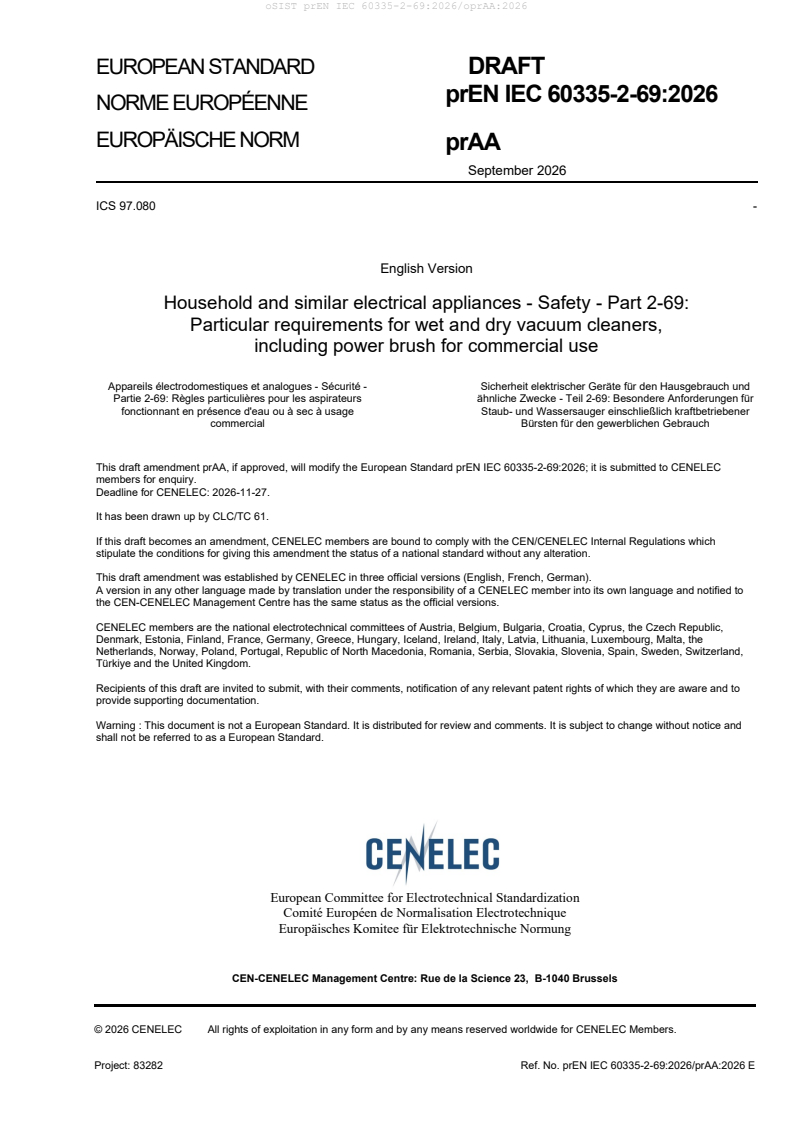
EUROPEAN STANDARD DRAFT
prEN IEC 60335-2-69:2026
NORME EUROPÉENNE
EUROPÄISCHE NORM
prAA
September 2026
ICS 97.080 -
English Version
Household and similar electrical appliances - Safety - Part 2-69:
Particular requirements for wet and dry vacuum cleaners,
including power brush for commercial use
Appareils électrodomestiques et analogues - Sécurité - Sicherheit elektrischer Geräte für den Hausgebrauch und
Partie 2-69: Règles particulières pour les aspirateurs ähnliche Zwecke - Teil 2-69: Besondere Anforderungen für
fonctionnant en présence d'eau ou à sec à usage Staub- und Wassersauger einschließlich kraftbetriebener
commercial Bürsten für den gewerblichen Gebrauch
This draft amendment prAA, if approved, will modify the European Standard prEN IEC 60335-2-69:2026; it is submitted to CENELEC
members for enquiry.
Deadline for CENELEC: 2026-11-27.
It has been drawn up by CLC/TC 61.
If this draft becomes an amendment, CENELEC members are bound to comply with the CEN/CENELEC Internal Regulations which
stipulate the conditions for giving this amendment the status of a national standard without any alteration.
This draft amendment was established by CENELEC in three official versions (English, French, German).
A version in any other language made by translation under the responsibility of a CENELEC member into its own language and notified to
the CEN-CENELEC Management Centre has the same status as the official versions.
CENELEC members are the national electrotechnical committees of Austria, Belgium, Bulgaria, Croatia, Cyprus, the Czech Republic,
Denmark, Estonia, Finland, France, Germany, Greece, Hungary, Iceland, Ireland, Italy, Latvia, Lithuania, Luxembourg, Malta, the
Netherlands, Norway, Poland, Portugal, Republic of North Macedonia, Romania, Serbia, Slovakia, Slovenia, Spain, Sweden, Switzerland,
Türkiye and the United Kingdom.
Recipients of this draft are invited to submit, with their comments, notification of any relevant patent rights of which they are aware and to
provide supporting documentation.
Warning : This document is not a European Standard. It is distributed for review and comments. It is subject to change without notice and
shall not be referred to as a European Standard.
European Committee for Electrotechnical Standardization
Comité Européen de Normalisation Electrotechnique
Europäisches Komitee für Elektrotechnische Normung
CEN-CENELEC Management Centre: Rue de la Science 23, B-1040 Brussels
© 2026 CENELEC All rights of exploitation in any form and by any means reserved worldwide for CENELEC Members.
Project: 83282 Ref. No. prEN IEC 60335-2-69:2026/prAA:2026 E
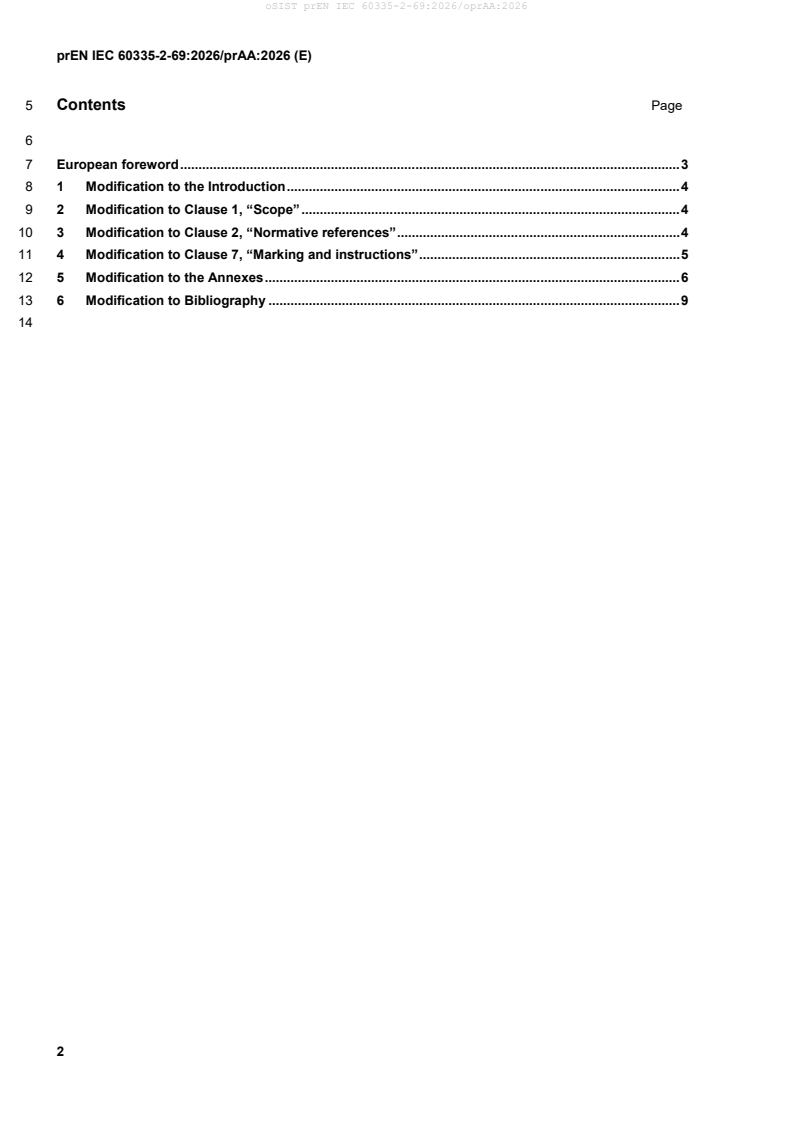
5 Contents Page
7 European foreword . 3
8 1 Modification to the Introduction . 4
9 2 Modification to Clause 1, “Scope” . 4
10 3 Modification to Clause 2, “Normative references” . 4
11 4 Modification to Clause 7, “Marking and instructions” . 5
12 5 Modification to the Annexes . 6
13 6 Modification to Bibliography . 9
15 European foreword
16 This document (prEN IEC 60335-2-69:2026/prAA:2026) consists of the text prepared by CLC/TC 61 "Safety
17 of household and similar electrical appliances".
18 This document is currently submitted to the Enquiry.
19 The following dates are proposed:
• latest date by which the existence of this document has to be (doa) dav + 6 months
announced at national level
• latest date by which this document has to be implemented at (dop) dav + 12 months
national level by publication of an identical
national standard or by endorsement
• latest date by which the national standards conflicting with this (dow) dav + 36 months
document have to be withdrawn (to be confirmed or
modified when voting)
20 This document is read in conjunction with prEN IEC 60335-2-69:2026.
21 prEN IEC 60335-2-69:2026/prAA:2026 includes the following significant technical modifications:
22 — introduce additional requirements for instructions;
23 — introduce requirements for shock and vibration measurement.
24 The numbering system for European clauses, subclauses, notes, tables, figures and annexes that are
25 additional to those in the IEC standard are prefixed with the letter “Z”.
Secretary’s note: The text contained in the Secretary’s notes will be removed from the standard before
publication, as it is provided solely to inform stakeholders about the reasons for introducing the
European common modifications.
26 1 Modification to the Introduction
27 Delete the words “manufacturer's”.
28 2 Modification to Clause 1, “Scope”
29 Add the following paragraph before the last one.
30 “With European Amendment A11 the EN 60335-2-69:2012 is superseded.
31 This European Amendment A11, supplements or modifies the corresponding clauses of the standards below:
32 – EN IEC 60335-1:2023 (Part 1)
33 – EN IEC 60335-2-69:2026 (Part 2)
34 This document deals with the reasonably foreseeable hazards of intended use presented by appliances that
35 are encountered by all persons and domestic animals when this is not in contradiction with the intended or
36 reasonably foreseeable use of the appliance.
37 For the purpose of this document, the measurement of the leakage current is compared with the touch current
38 as defined in IEC 60990, which specifies the methods for evaluating the current that may flow through the
39 human body when an accessible part is touched.
40 For the purpose of this document, the term “appliance” includes the term “machine” where applicable.
41 This document deal with specific requirements on noise emitted from these appliances because the
42 generated noise is LpA > 70 dB(A) and it is considered to be a relevant hazard.
43 This document contains requirements for appliances with radio function, remote communication, and
44 remote operation.
45 For the scope of this document, the term “radio appliance” is used with the same meaning of “radio
46 equipment”.
47 For the scope of this document, the term “appliance” is used with the same meaning of “equipment”.
48 When in the clauses of this document are mentioned the “IEC” or “ISO” standards, see the related version of
49 EN standards in normative annex ZA.”
50 Add the following dashed item in the paragraph starting with “This standard does not apply to:“
51 “— toys, including those shaped like an appliance.”
52 3 Modification to Clause 2, “Normative references”
53 Addition:
54 EN IEC 60335-1:2023, Household and similar electrical appliances - Safety - Part 1: General requirements
55 ISO 3743-1, Acoustics — Determination of sound power levels and sound energy levels of noise sources
56 using sound pressure — Engineering methods for small movable sources in reverberant fields — Part 1:
57 Comparison method for a hard-walled test room
58 ISO 3744:2025, Acoustics - Determination of sound power levels and sound energy levels of noise sources
59 using sound pressure - Engineering methods for an essentially free field over a reflecting plane
60 ISO 4871:1996, Acoustics - Declaration and verification of noise emission values of machinery and
61 equipment
As impacted by EN IEC 60335-1:2023/A11:2023 and EN IEC 60335-1:2023/prAB:2025.
As impacted by EN IEC 60335-1:2023/A11:2023 and EN IEC 60335-1:2023/prAB:2025.
62 ISO 5349-1, Mechanical vibration — Measurement and evaluation of human exposure to hand-transmitted
63 vibration — Part 1: General requirements
64 ISO 5349-3:2025, Mechanical vibration - Measurement and evaluation of human exposure to hand-
65 transmitted vibration - Part 3: Isolated and repeated shocks using the frequency range of ISO 5349-1
66 ISO 9614-2:1996, Acoustics - Determination of sound power levels of noise sources using sound intensity -
67 Part 2: Measurement by scanning
68 ISO 11201, Acoustics - Noise emitted by machinery and equipment - Determination of emission sound
69 pressure levels at a work station and at other specified positions in an essentially free field over a reflecting
70 plane with negligible environmental corrections
71 ISO 11203:1995, Acoustics — Noise em
...