

CLC/TS 50712:2024
(Main)Railway applications - Current collection systems - Technical criteria for the interaction between pantograph and overhead contact lines on electrified roads
General Information
- Abstract
This document defines the general characteristics applicable to pantographs for ERS, to enable dynamic current collection of road vehicles from an overhead contact line system. It furthermore defines the electrical and mechanical interface between a pantograph and the infrastructure and between a pantograph and the vehicle. The document also specifies tests for the pantograph. It includes recommendations for a common safety concept that is related to the electric vehicle and power supply infrastructure and gives recommendations for the maintenance of the pantograph. This document is applicable to: - Two-pole pantographs on commercial vehicles during operation on electrified public roads and highways. This document is not applicable to: - trolley busses and their electric equipment; - vehicles in private applications on roads in restricted areas such as truck trolley applications in mines; - commercial freight vehicles or electric busses with static-only charging systems at e.g. loading/unloading facilities or bus stops.
- Status
- Published
- Publication Date
- 12-Dec-2024
- Technical Committee
- CLC/TC 9X - Electrical and electronic applications for railways
- Drafting Committee
- CLC/TC 9X - Electrical and electronic applications for railways
- Current Stage
- 6060 - Document made available - Publishing
- Start Date
- 13-Dec-2024
- Due Date
- 05-Mar-2025
- Completion Date
- 13-Dec-2024

Overview
CLC/TS 50712:2024 - Railway applications: Current collection systems provides technical criteria for the interaction between pantographs and overhead contact line systems (OCLS) used to enable dynamic current collection for road vehicles on electrified roads (Electric Road Systems, ERS). The Technical Specification defines the mechanical and electrical interfaces between pantograph, vehicle and infrastructure, specifies test and simulation methods, and gives recommendations on safety concepts and maintenance. It applies specifically to two-pole pantographs on commercial vehicles operating on public roads and highways and explicitly excludes trolleybuses, private restricted-area installations, and static-only charging systems.
Key topics and requirements
- Interface definitions: mechanical and electrical interfaces between pantograph, vehicle and OCLS (clearance, mounting, connector interfaces).
- Pantograph characteristics: geometry, collector head dimensions, contact strip behaviour, angle of attack and dynamic range.
- Infrastructure properties: contact wire geometry, uplift, contact forces, electrical characteristics and clearance gauges (see Annex B).
- Safety concept: system safety requirements for ERS vehicles and recommendations for a common safety approach between vehicle and power supply infrastructure (including failure modes and safe states).
- Testing & simulation: test catalogue, static/dynamic tests, crash/mounting verification, pantograph excitation and verification measures (detailed test definitions and simulation levels).
- Operational & maintenance guidance: recommendations for pantograph maintenance, EMC/ESD considerations, environmental conditions and operator responsibilities (Annex C).
- Communication and control: control interface definitions and example CAN bus messages for pantograph control (Annex D).
- Normative references and coordinate systems: includes terms, definitions and coordinate references (e.g., ISO coordinate conventions).
Practical applications and users
This Technical Specification is essential for:
- Vehicle manufacturers designing ERS-capable commercial vehicles and pantograph assemblies.
- Pantograph and OCLS manufacturers developing interoperable current-collection equipment.
- Infrastructure operators planning, installing and maintaining overhead contact line systems for roads.
- Systems integrators and testing laboratories performing type, static and dynamic tests and simulations.
- Regulators and safety assessors evaluating ERS deployments and cross-system safety concepts.
Practical uses include developing compliant pantograph designs, defining vehicle–infrastructure interfaces, creating test protocols, planning maintenance regimes, and ensuring safe integration between power supply and vehicles.
Related standards
- CENELEC technical framework and national implementations of the TS.
- Normative references cited within the specification (coordinate systems, EMC/ESD standards and related rail/electrotechnical standards).
Keywords: CLC/TS 50712:2024, pantograph, overhead contact line, ERS, electric road systems, OCLS, dynamic current collection, pantograph testing, vehicle-infrastructure interface, maintenance, safety concept.
Get Certified
Connect with accredited certification bodies for this standard

IMQ S.p.A. (Certification)
Italian electrical product certification.

IRIS Certification (UNIFE)
International Railway Industry Standard certification.

SLG Prüf- und Zertifizierungs GmbH
German testing and certification body.
Sponsored listings
Frequently Asked Questions
CLC/TS 50712:2024 is a technical specification published by CLC. Its full title is "Railway applications - Current collection systems - Technical criteria for the interaction between pantograph and overhead contact lines on electrified roads". This standard covers: This document defines the general characteristics applicable to pantographs for ERS, to enable dynamic current collection of road vehicles from an overhead contact line system. It furthermore defines the electrical and mechanical interface between a pantograph and the infrastructure and between a pantograph and the vehicle. The document also specifies tests for the pantograph. It includes recommendations for a common safety concept that is related to the electric vehicle and power supply infrastructure and gives recommendations for the maintenance of the pantograph. This document is applicable to: - Two-pole pantographs on commercial vehicles during operation on electrified public roads and highways. This document is not applicable to: - trolley busses and their electric equipment; - vehicles in private applications on roads in restricted areas such as truck trolley applications in mines; - commercial freight vehicles or electric busses with static-only charging systems at e.g. loading/unloading facilities or bus stops.
This document defines the general characteristics applicable to pantographs for ERS, to enable dynamic current collection of road vehicles from an overhead contact line system. It furthermore defines the electrical and mechanical interface between a pantograph and the infrastructure and between a pantograph and the vehicle. The document also specifies tests for the pantograph. It includes recommendations for a common safety concept that is related to the electric vehicle and power supply infrastructure and gives recommendations for the maintenance of the pantograph. This document is applicable to: - Two-pole pantographs on commercial vehicles during operation on electrified public roads and highways. This document is not applicable to: - trolley busses and their electric equipment; - vehicles in private applications on roads in restricted areas such as truck trolley applications in mines; - commercial freight vehicles or electric busses with static-only charging systems at e.g. loading/unloading facilities or bus stops.
CLC/TS 50712:2024 is classified under the following ICS (International Classification for Standards) categories: 29.280 - Electric traction equipment; 45.060.10 - Tractive stock. The ICS classification helps identify the subject area and facilitates finding related standards.
CLC/TS 50712:2024 is associated with the following European legislation: EU Directives/Regulations: 2023/1804, 2023/1804-1, 2023/1804-2; Standardization Mandates: M/581. When a standard is cited in the Official Journal of the European Union, products manufactured in conformity with it benefit from a presumption of conformity with the essential requirements of the corresponding EU directive or regulation.
CLC/TS 50712:2024 is available in PDF format for immediate download after purchase. The document can be added to your cart and obtained through the secure checkout process. Digital delivery ensures instant access to the complete standard document.
Standards Content (Sample)
SLOVENSKI STANDARD
01-februar-2025
Železniške naprave - Sistemi za odjem toka - Tehnični kriteriji za interaktivnost
med pantografom in nadzemnim voznim vodom na elektrificiranih cestah
Railway applications - Current collection systems - Technical criteria for the interaction
between pantograph and overhead contact lines on electrified roads
Bahnanwendungen - Stromabnehmer - Technische Kriterien für das Zusammenwirken
zwischen Dachstromabnehmer und Oberleitung auf elektrifizierten Straßen
Applications ferroviaires - Systèmes de captage de courant - Critères techniques
d’interaction entre le pantographe et la ligne aérienne de contact sur routes electrifiées
Ta slovenski standard je istoveten z: CLC/TS 50712:2024
ICS:
29.280 Električna vlečna oprema Electric traction equipment
45.060.10 Vlečna vozila Tractive stock
2003-01.Slovenski inštitut za standardizacijo. Razmnoževanje celote ali delov tega standarda ni dovoljeno.
TECHNICAL SPECIFICATION CLC/TS 50712
SPÉCIFICATION TECHNIQUE
TECHNISCHE SPEZIFIKATION December 2024
ICS 29.280; 45.060.10
English Version
Railway applications - Current collection systems - Technical
criteria for the interaction between pantograph and overhead
contact lines on electrified roads
Applications ferroviaires - Systèmes de captage de courant Bahnanwendungen - Stromabnahmesysteme - Technische
- Critères techniques d'interaction entre le pantographe et la Kriterien für das Zusammenwirken zwischen
ligne aérienne de contact sur routes electrifiées Dachstromabnehmer und Oberleitungen auf elektrifizierten
Straßen
This Technical Specification was approved by CENELEC on 2024-11-18.
CENELEC members are required to announce the existence of this TS in the same way as for an EN and to make the TS available promptly
at national level in an appropriate form. It is permissible to keep conflicting national standards in force.
CENELEC members are the national electrotechnical committees of Austria, Belgium, Bulgaria, Croatia, Cyprus, the Czech Republic,
Denmark, Estonia, Finland, France, Germany, Greece, Hungary, Iceland, Ireland, Italy, Latvia, Lithuania, Luxembourg, Malta, the
Netherlands, Norway, Poland, Portugal, Republic of North Macedonia, Romania, Serbia, Slovakia, Slovenia, Spain, Sweden, Switzerland,
Türkiye and the United Kingdom.
European Committee for Electrotechnical Standardization
Comité Européen de Normalisation Electrotechnique
Europäisches Komitee für Elektrotechnische Normung
CEN-CENELEC Management Centre: Rue de la Science 23, B-1040 Brussels
© 2024 CENELEC All rights of exploitation in any form and by any means reserved worldwide for CENELEC Members.
Ref. No. CLC/TS 50712:2024 E
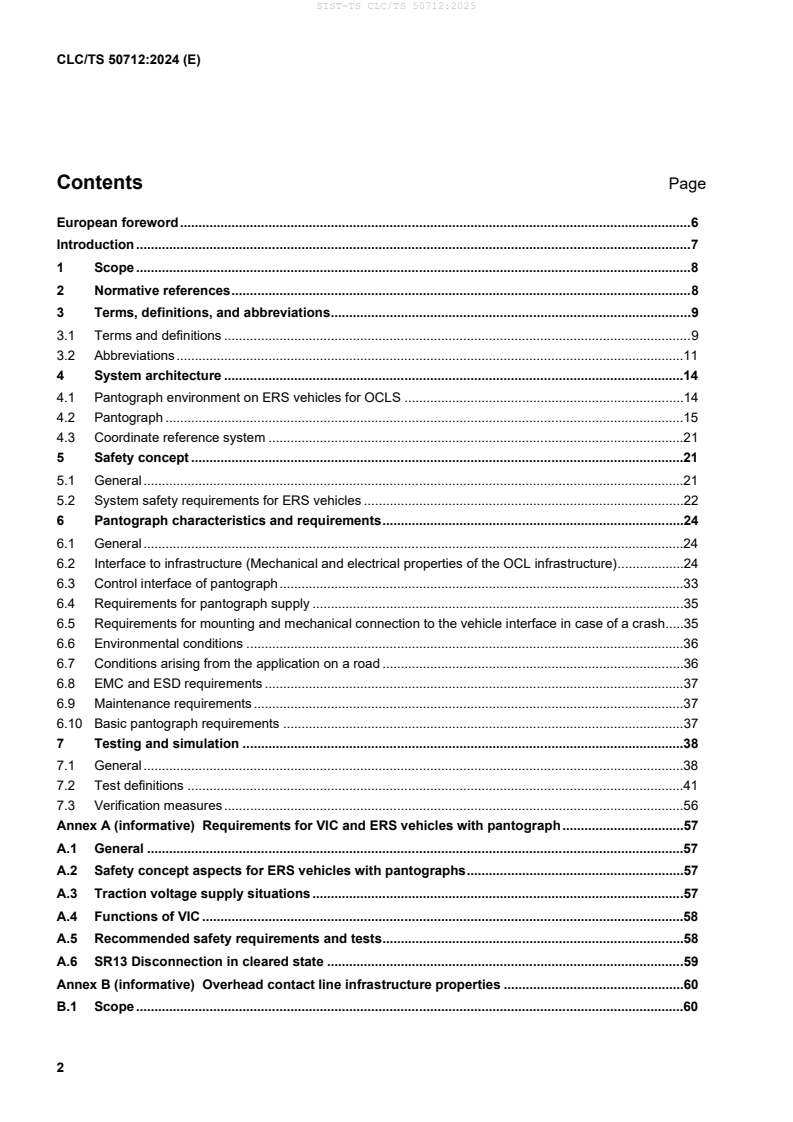
Contents Page
European foreword . 6
Introduction . 7
1 Scope . 8
2 Normative references . 8
3 Terms, definitions, and abbreviations . 9
3.1 Terms and definitions . 9
3.2 Abbreviations .11
4 System architecture .14
4.1 Pantograph environment on ERS vehicles for OCLS .14
4.2 Pantograph .15
4.3 Coordinate reference system .21
5 Safety concept .21
5.1 General .21
5.2 System safety requirements for ERS vehicles .22
6 Pantograph characteristics and requirements .24
6.1 General .24
6.2 Interface to infrastructure (Mechanical and electrical properties of the OCL infrastructure) .24
6.3 Control interface of pantograph .33
6.4 Requirements for pantograph supply .35
6.5 Requirements for mounting and mechanical connection to the vehicle interface in case of a crash.35
6.6 Environmental conditions .36
6.7 Conditions arising from the application on a road .36
6.8 EMC and ESD requirements .37
6.9 Maintenance requirements .37
6.10 Basic pantograph requirements .37
7 Testing and simulation .38
7.1 General .38
7.2 Test definitions .41
7.3 Verification measures .56
Annex A (informative) Requirements for VIC and ERS vehicles with pantograph .57
A.1 General .57
A.2 Safety concept aspects for ERS vehicles with pantographs .57
A.3 Traction voltage supply situations .57
A.4 Functions of VIC .58
A.5 Recommended safety requirements and tests.58
A.6 SR13 Disconnection in cleared state .59
Annex B (informative) Overhead contact line infrastructure properties .60
B.1 Scope .60
B.2 Road characteristics . 60
B.3 Capacity and service life of the OCL system . 61
B.4 General geometric definitions . 62
B.5 OCLS Properties . 62
B.6 Contact forces . 70
B.7 ERS clearance requirements . 70
B.8 Electrical properties of the OCL . 79
Annex C (informative) Responsibilities of the infrastructure operators of ERS featuring OCLS . 80
C.1 General . 80
C.2 Organisational premises . 80
C.3 Operational monitoring. 80
C.4 Recommendations for OCLS operator processes . 82
Annex D (informative) CAN bus communication . 85
Annex E (informative) Overview electric roads system and their environment . 88
Bibliography . 90
Tables
Table 1 — Pantograph interface . 15
Table 2 — Pantograph components and ERS vehicle heights . 17
Table 3 — Pantograph states and safety recommendations . 18
Table 4 — Safety requirements overview . 22
Table 5 — Pantograph components and ERS vehicle heights . 28
Table 6 — Pantograph clearance requirements . 30
Table 7 — Traction power supply voltage limits . 32
Table 8 — Traction power supply current limits . 32
Table 9 — Simulation levels for crash profile (taken from N3 in UN ECE R100) . 36
Table 10 — catalogue of tests . 39
Table 11 — Definition of pantograph dimensions . 41
Table 12 — Collector head excitation . 51
Table A.1 — Recommended safety requirements and tests . 59
Table B.1 — Standard contact wire specifications . 62
Table B.2 — National example for minimum contact wire height and vertical space for contact wire .63
Table B.3 — Contact wire vertical position parameters, all values measured perpendicular to the
idealized top of the road surface (R) .65
Table B.4 — Contact wire height variables .65
Table B.5 — Contact wire uplift parameters .66
Table B.6 — contact wire differential heights parameters and maximum permissible values .67
Table B.7 — maximum change of contact wire height, measured for each contact wire .67
Table B.8 — Contact wire horizontal position parameters .67
Table B.9 — Defined points along the OCL (side view) .69
Table B.10 — Classification of clearance gauges for standard situations .72
Table B.11 — Composition of category A structure gauge clearance .73
Table B.12 — Composition of category B structure gauge clearance .74
Table B.13 — Composition of category C structure gauge clearances .76
Table B.14 — Composition of category D structure gauge clearances .77
Table B.15 — Structure gauge - width of clearances .78
Table B.16 — Electrical clearance values (static/dynamic) .79
Table D.1 — ENA_PAN_SYS CAN frame description.85
Table D.2 — ENA_PAN_SYS CAN signals description .85
Table D.3 — PAN_ENA_SYS CAN frame description.86
Table D.4 — PAN_ENA_SYS CAN signals description .86
Table E.1 — Technical domains for ERS safety concept .89
Figures
Figure 1 — Pantograph, OCLS and vehicle schematic showing interfaces between sub-systems,
see Table 1 for interface descriptions .14
Figure 2 — Pantograph terminology and height definitions .16
Figure 3 — States for pantograph operation .17
Figure 4 — Example for the arrangement of electrical layers of ERS vehicles .20
Figure 5 — Coordinate system according to ISO 8855 .21
Figure 6 — Main dimensions of collector heads . 25
Figure 7 — Angle of attack α at contact wire, measured towards idealized road surface . 26
Figure 8 — Pantograph terminology and height definitions . 27
Figure 9 — Exemplary ERS zones, lanes, and clearance gauge for ERS vehicles . 29
Figure 10 — Clearance gauge detail with both contact wires in perspective of driving direction . 30
Figure 11 — Traction current as a function of the vehicle’s velocity . 33
Figure 12 — height deviation between left and right contact strips . 38
Figure 13 — Pantograph dimensions . 41
Figure 14 — Static heights of the pantograph that are to be tested, identifiers according to
Figure 1, please note that the base reference is subject to the variable vehicle chassis. . 43
Figure 15 — Test visualization for lowering tests . 54
Figure 16 — Simulation of damaged ADD . 55
Figure B.1 — Working range of the contact wire in standard installations . 63
Figure B.2 — Contact wire vertical position parameters and relation to pantograph heights . 64
Figure B.3 — Contact wire uplift and parameters (Left, Right). 66
Figure B.4 — maximum permissible contact wire differential heights . 66
Figure B.5 — Overlap span (plan view, exemplary design for anchoring, representation without
electrical connections) . 68
Figure B.6 — Defined points along the OCLS (side view, idealized) . 68
Figure B.7 — Minimum angle of attack α in the limit case with maximum inclination of the
pantograph φ and maximum pantograph horn angle β . 71
PAN, max H, max
Figure B.8 — Category A structure gauge schematic . 72
Figure B.9 — Category B structure gauge schematic . 74
Figure B.10 — Category C structure gauge schematic . 75
Figure B.11 — Category D structure gauge schematic . 76
Figure B.12 — Structure gauge – width of clearance . 78
Figure B.13 — Structural gauge – lateral clearances, L1 as defined in Figure 8 . 78
Figure E.1 — ERS and their environment . 88
European foreword
This document (CLC/TS 50712:2024) has been prepared by CLC/TC 9X “Electrical and electronic applications
for railways”.
Attention is drawn to the possibility that some of the elements of this document may be the subject of patent
rights. CENELEC shall not be held responsible for identifying any or all such patent rights.
Any feedback and questions on this document should be directed to the users’ national committee. A complete
listing of these bodies can be found on the CENELEC website.
Introduction
This document will help to establish a common technical base for overhead contact line type electric road
systems (ERS) being built in public field trials in different European states. It enables vehicles and likewise
infrastructure providers to develop and produce components and systems for interoperable use.
The main aspects being considered are:
— normative references to vehicle and infrastructure standards;
— definition of the pantograph to contact line system interface;
— requirements for safety concepts and provisions in contact line operation;
— requirements for test, operation, and maintenance of pantographs on commercial vehicles;
— distinction of use cases for externally supplied commercial electric road vehicles (informative).
To reduce carbon dioxide and other emissions caused by road traffic, ERS are being widely discussed and
tested in public field trials on different European roads and highways. In this document, the pantograph of an
overhead contact line type ERS is described. This ERS uses an overhead contact line system, a power supply
and a pantograph to draw electrical energy from a static supply system suspended above a highway to power
the propulsion and the battery charging of an electric road vehicle while driving.
As road traffic is highly internationalised and standardized, ERS solutions for commercial vehicles need to be
standardized to allow interoperable and international vehicle operation.
This document’s scope is limited to pantograph type current collectors for ERS. The electrical power supply of
a commercial road vehicle within ERS is achieved through the collection of current from the overhead contact
wires with a suitable pantograph system installed on the vehicle.
As the roadway cannot be used as an electrical return conductor, a 2-pole (positive and negative) contact line
system and pantograph are employed. The overhead contact line (OCL) system and the connected vehicles
form an electric circuit with the feeder system. This allows for electrical power flow between them. This is
considered in terms of electrical safety concepts and protective provisions.
The pantograph and the overhead contact line system (OCLS) are separate mechanically oscillating sub-
systems. The design of the sliding contact between them ensures continuous contact and allows for minimum
wear of both contact partners conductor and pantograph carbon strips.
1 Scope
This document defines the general characteristics applicable to pantographs for ERS, to enable dynamic current
collection of road vehicles from an overhead contact line system. It furthermore defines the electrical and
mechanical interface between a pantograph and the infrastructure and between a pantograph and the vehicle.
The document also specifies tests for the pantograph. It includes recommendations for a common safety
concept that is related to the electric vehicle and power supply infrastructure and gives recommendations for
the maintenance of the pantograph.
This document is applicable to:
— Two-pole pantographs on commercial vehicles during operation on electrified public roads and highways.
This document is not applicable to:
— trolley busses and their electric equipment;
— vehicles in private applications on roads in restricted areas such as truck trolley applications in mines;
— commercial freight vehicles or electric busses with static-only charging systems at e.g. loading/unloading
facilities or bus stops.
2 Normative references
The following documents are referred to in the text in such a way that some or all of their content constitutes
requirements of this document. For dated references, only the edition cited applies. For undated references, the
latest edition of the referenced document (including any amendments) applies.
EN 50119:2020, Railway applications — Fixed installations — Electric traction overhead contact lines
EN 50124-1:2017, Railway applications — Insulation coordination — Part 1: Basic requirements — Clearances
and creepage distances for all electrical and electronic equipment
EN 50124-2:2017, Railway applications — Insulation coordination — Part 2: Overvoltages and related
protection
EN 50317:2012, Railway applications — Current collection systems — Requirements for and validation of
measurements of the dynamic interaction between pantograph and overhead contact line
EN 60068-2-64:2008, Environmental testing — Part 2-64: Tests — Test Fh: Vibration, broadband random and
guidance (IEC 60068-2-64:2008)
EN 61000-4-2, Electromagnetic compatibility — Part 4-2: Testing and measurement techniques — Electrostatic
discharge immunity test (IEC 61000-4-2)
ISO 4892-2:2013, Plastics — Methods of exposure to laboratory light sources — Part 2: Xenon-arc lamps
ISO 6469-3:2021, Electrically propelled road vehicles — Safety specifications — Part 3: Electrical safety
EN ISO 9227, Corrosion tests in artificial atmospheres — Salt spray tests (ISO 9227:2022)
ISO 10605, Road vehicles — Test methods for electrical disturbances from electrostatic discharge
ISO 11452 (all parts), Road vehicles — Component test methods for electrical disturbances from narrowband
radiated electromagnetic energy
ISO 16750-1, Road vehicles — Environmental conditions and testing for electrical and electronic equipment;
Part 1: General
ISO 16750-2, Road vehicles — Environmental conditions and testing for electrical and electronic equipment;
Part 2: Electrical loads
ISO 16750-3, Road vehicles — Environmental conditions and testing for electrical and electronic equipment;
Part 3: Mechanical loads
ISO 16750-4, Road vehicles — Environmental conditions and testing for electrical and electronic equipment;
Part 4: Climatic loads
ISO 16750-5, Road vehicles — Environmental conditions and testing for electrical and electronic equipment —
Part 5: Chemical loads
ISO 26262-5:2018, Road vehicles — Functional safety — Part 5: Product development at the hardware level
3 Terms, definitions, and abbreviations
3.1 Terms and definitions
For the purposes of this document, the following general terms and definitions apply.
ISO and IEC maintain terminology databases for use in standardization at the following addresses:
— ISO Online browsing platform: available at https://www.iso.org/obp
— IEC Electropedia: available at https://electropedia.org/
3.1.1
electric road system
ERS
system that enables power transfer to electric road system vehicles whilst they are driving and during standstill
Note 1 to entry: By integrating power transfer technology into existing road infrastructure, the road itself will be accessible
to both vehicles that use power transmission and other vehicles.
3.1.2
ERS vehicle
vehicle which is equipped to utilize the power supply of an ERS
Note 1 to entry: The vehicle is compatible with an OCLS type of ERS and contains pantograph, Enable device and VIC
(Vehicle Infeed Circuit, Annex A).
3.1.3
ERS route
stretch or road section, which is equipped with an ERS infrastructure, in this case with an OCLS
3.1.4
pantograph
apparatus for collecting current from one or more contact wires, formed of a hinged device designed to allow
vertical movement of the pantograph head
Note 1 to entry: Vehicle mounted device to establish an electrical connection with the overhead contact lines. Can be lifted
upwards to OCL to transfer current from OCL to vehicle and vice versa.
[SOURCE: IEC 60050-811:2017, 811-32-02, modified – The note 1 to entry has been added]
3.1.5
pantograph collector head
part of the pantograph supported by the frame which includes contact strips, horns and may include a
suspension
Note 1 to entry: An ERS pantograph is usually equipped with two collector heads; one for each polarity. Other variants can
exist.
3.1.6
enable device
device controlling the use of a pantograph (rising and lowering) depending on various inputs, such as drivers
command, vehicle states and data gathered by sensors connected to the enable device
Note 1 to entry: Depending on the enable device’s integration into the OEM vehicle, it can be used either as responsible for
the functional safety decision whether it is safe to connect and stay connected or not, or as an assistance system to reduce
error risks from driver operation.
3.1.7
vehicle infeed circuit
VIC
necessary components to utilize the power transferred from the OCL with the pantograph that are not part of
the vehicles usual drive train
Note 1 to entry: See Annex A.
3.1.8
original equipment manufacturer
OEM
manufacturer of the ERS vehicle
Note 1 to entry: Vehicle with or without VIC.
3.1.9
integrator
entity which integrates pantograph and/or VIC in vehicle
Note 1 to entry: Could be an OEM or a third party.
3.1.10
static contact force
force of one collector head towards its corresponding contact line measured while standstill of the vehicle
3.1.11
dynamic contact force
contact force of one collector head towards contact line during operation measured while vehicle is driving
3.1.12
contact cycle
cycle starting with a pantograph rising from cleared state until it is connected to the OCL in nominal height and
ends once the pantograph has returned to its lowest position
Note 1 to entry: Unsuccessful attempts are also covered.
3.1.13
automatic dropping device
ADD
device that initiates immediate lowering of the pantograph in event of contact strip failure
Note 1 to entry: See also EN 50206-1:2010, 4.8.
3.1.14
collector head
part of the pantograph, at least comprised of one contact strip and the respective suspension system for
connection to one contact wire
3.1.15
pantograph pole
electrical pole of the pantograph (e.g., positive, or negative)
Note 1 to entry: The pantograph and OCL of the ERS feature at least two electric poles with different electrical potentials.
3.1.16
controller area network bus
CAN bus
communication bus standard (message-based protocol) used for communication between vehicle and
pantograph
Note 1 to entry: Definition according to SAE J1939:2018 – ISO 11898.
3.1.17
cleared state
position of the pantograph when fully retracted and ready for operation
3.2 Abbreviations
Abbreviation Explanation
A Pantograph Clearance value: Height of the mechanical clearance profile above the
idealized road surface
ADD Automatic Dropping Device
ASIL Automotive safety integrity level
CAN Controller Area Network
CSM Common safety methods
CTI Comparative Tracking Index
CW Contact wire, sometime CW1, CW2 as denomination of each wire
CW Contact wire uplift due to pantograph contact force
UL
CW Maximum permissible contact wire uplift in case of an accident
UL, ac
CW Maximum permissible contact wire uplift during regular operation
UL, op
DC Direct Current
EMC Electromagnetic compatibility
ERS Electric road system
ESD Electrostatic discharge
FIT Failure in time
FMEA Failure Mode and Effects Analysis
GND Ground (0 V)
G OCL Structure gauge: Category A vertical clearance
A,v
Abbreviation Explanation
G OCL Structure gauge: Category B vertical clearance
B,v
G OCL Structure gauge: Category C vertical clearance
C,v
G OCL Structure gauge: Category D vertical clearance
D,v
HARA Hazard Analysis and Risk Assessment
H Maximum permitted vehicle height
max, veh
H Minimum clearance below contact wire
clearance
HCW Contact wire height (left)
L
HCW Maximum contact wire height (incl. contact wire uplift CW )
max UL
HCW Maximum operation height of contact wire
max,op
HCW Maximum contact wire height (static, in resting position)
max,stat
HCW Minimum contact wire height (in resting position, non-operational)
min
HCW Nominal height of contact wire
n
HCW Contact wire height in operation
op
HCW Lifting / lowering range of contact wire
range
HCW Safety clearance height/safety height of vehicle and pantograph
safe
HCW Static (not connected) contact wire height
stat
HCW Contact wire height (right)
R
IR ERS infrastructure required
I Maximum continuous current above 5 km/h
max,per
I Permanent current for vehicle velocity 0 km/h to 5 km/h
max,05
KP/NTV Known type of pantograph on new type of vehicle
LC Maximum conductive length of a contact strip
max
L1 Pantograph Clearance value: Radius of clearance area for pantograph at the sides
L2 Pantograph Clearance value: Angle of the clearance profile to the side of the contact
wires in any height.
L3 Pantograph Clearance value: Width of the clearance profile to the side of the contact
wires in any height
L4 Pantograph Clearance value: Height of the mechanical clearance profile above the
contact wires in any height
L5 Pantograph Clearance value: Height of the electrical clearance profile above the
mechanical clearance profile
L7 Pantograph Clearance value: Lifted height of the contact wires when in contact to
pantograph above the idealized road surface
L8 Pantograph-OCL Clearance value: Distance between the edges of both contact wires
CW
NP New pantograph
Abbreviation Explanation
NP/NV New pantograph on new vehicle
NTP New type of pantograph
NTP/ATV New type of pantograph on any type of vehicle
OCL Overhead contact line
OCLS Overhead contact line system, lines, poles, and all other equipment needed to install
an overhead contact line
OEM Original equipment manufacturer
PAN Pantograph
R Idealized road surface
RT Routine Test
SR Safety Requirement
TS Technical Specification
TT Type Test
t Process time of Automatic Dropping Device (ADD)
ADD
U Lowest voltage treshhold for disconnect
dis
U Highest permanent voltage
max,1
U Highest non-permanent voltage
max,2
U Long-term overvoltage
max,3
U Lowest non-permanent voltage
min,1
U Lowest permanent voltage
min,2
U Nominal voltage
n
VIC Vehicle Infeed Circuit
v maximum design speed (incl. dynamic reserves)
des,OCL
Based on permissible maximum vehicle speed v
max
v Maximum permitted vehicle speed
max
α pantograph-OCL clearance: Angle of attack to contact wire
ΔHCW Maximum vertical deviation between the two contact lines (in any state operation /
max
resting)
4 System architecture
4.1 Pantograph environment on ERS vehicles for OCLS
Vehicles intended for use with a pantograph in an OCLS are divided into general subsystems as defined in
Figure 1. The figure shows the main interfaces, and it also defines the related standards for the subsystems.
Key
1 OCL infrastructure
2 pantograph communication
2.1 enable device control
2.2 vehicle control
3 pantograph supply
4 VIC
5 mounting
6 environment
7 maintenance
Figure 1 — Pantograph, OCLS and vehicle schematic showing interfaces between sub-systems, see
Table 1 for interface descriptions
Figure 1 shows functional subsystems of vehicles suitable for usage in OCLS. The first subsystem is the base
electric vehicle. The VIC contains all equipment necessary to transform and handle the energy supply of the
OCLS for the vehicles drive system. Next to the pantograph, that transfers the current from the OCL to the
vehicle, an enable device is defined as a separate subsystem. The purpose of the enable device is to decide
whether it is safe to connect the pantograph to the OCL, stay connected to the OCL or if the pantograph shall
disconnect from the OCL. However, the enable device may be integrated into one of the other subsystems. The
designated interfaces 1 - 7 will be used as a structure to describe interface properties in Clause 6. The defined
interfaces of the pantograph are labelled as defined in Table 1.
Table 1 — Pantograph interface
Number of Interface Description
Interface
1 OCL infrastructure Electrical and mechanical interface, see Annex B of this
specification and 6.2 for a detailed description.
2 Pantograph Pantograph communication interface to other systems
communication
2.1 Enable device Control interface, see 6.3
control
2.2 Vehicle control Control interface, see 6.3.
3 Pantograph Low voltage and compressed air supply from vehicle, see 6.4
supply
4 VIC Traction supply from OCL, see Annex A
5 Mounting Mechanical interface including loads, 6.5
6 Environment Environmental conditions for design and operation, see 6.6
7 Maintenance Interface for maintenance and service operation, proprietary
interface, not further defined within this document
The VIC may be integrated into the vehicle or be contained within the base frame below the pantograph. The
individual components may also be distributed over the vehicle and the base frame.
The pantograph components are explained in detail within the next subclauses. All components of the three
other subsystems are just exemplary and may be part of other specifications.
4.2 Pantograph
4.2.1 General
The main function of the pantograph is to transfer a current from the OCL to the vehicle. The pantograph shall
also be able to connect and disconnect to the OCL. The third function is the insulation system of the pantograph
that prevents risks of electrical shocks. These functions are distributed over the mechanical subsystems.
A pantograph designed for the usage in ERS environments consists of three mechanical subsystems. The
collector head carries the contact strips, the arms move the collector head up and down and the main frame
usually contains the drive system, the control system and is the mounting interface to the vehicle.
4.2.2 Pantograph design and heights
Figure 2 shows a sketch of a pantograph as an example and does not exclude other types of pantographs like
diamond type, for example. The figure defines the main components of an ERS pantograph and its basic
operating dimensions. This document mainly covers the blue parts of the drawing (No. 1 to 3).
Key
A maximum pantograph height in cleared state
C nominal operating height of pantograph
R clean idealized road surface (without snow/ice)
1 collector heads
2 arms
3 main frame
4 base frame
5 vehicle frame
6 contact wire
Figure 2 — Pantograph terminology and height definitions
As shown in Figure 2, various heights and ranges of movement for the pantograph mounted on an ERS vehicle
are defined perpendicular (at a right-angle, z-direction) in reference to the idealized road surface. The
pantographs position when fully retracted and ready for operation is defined as the cleared state. More details
can be found in Table 2.
Table 2 — Pantograph components and ERS vehicle heights
No. Title Description
A Maximum pantograph Height of vehicle with pantograph if not in use, above idealized
height in cleared state road surface (R).
C nominal operating Typical operating height of the pantograph mounted on ERS
height of pantograph vehicle; height might differ between countries
R Clean idealized road Reference for all above defined heights
surface (without
snow/ice)
1 Collector heads Part of pantograph
2 Arms Part of pantograph
3 Main frame Part of pantograph
4 Base frame Mounted on vehicle frame, carries pantograph, could be part of
the vehicle, the pantograph or be manufactured by a third party.
5 Vehicle frame Part of the vehicle chassis
6 Contact wire Part of the OCLs which is in contact with the pantograph’s
collector heads
4.2.3 Physical pantograph states
The pantograph shall be either on or off. Due to errors or unforeseen events, it shall be able to change its state
from any state to off. During normal operation (no errors), the pantograph shall be in a cleared state (resting in
lowest position) when switched on (see also Figure 3).
To change to a connected state, the pantograph shall be in rising state for a short time (see 6.10.2). From
connected state the pantograph shall change to lowering state first and then return to cleared state. If rising
state is aborted, the pantograph shall change from rising to lowering state. Due to safety concerns the
pantograph shall never change state from lowering to rising without entering cleared state first.
To enable a variety of service and maintenance works the pantograph shall also allow the change from cleared
to maintenance state, see Figure 4.
Figure 3 — States for pantograph operation
Table 3 contains further definitions on pantograph states which shall be transmitted via the communication
interface (No. 2 in Figure 1) towards vehicle and enable device. See Clause 5 for safety relevant details of the
description within the table.
A lateral movement of the pantograph collector heads is possible, e.g. to adjust its relative position towards the
contact wire. The definition of this function is not part of this document.
Table 3 — Pantograph states and safety recommendations
Pantograph Description
state
transmitted via
communication
interface
0: Initializing The current state and position are unknown. The pantograph shall be lowered or be
raised, e.g. during service in this state. After power is switched on the pantograph shall
be in this state for e.g. self-tests for normal operation.
1: Cleared The pantograph shall be in its lowest position (cleared position) and without faults. All
(mechanic actuators shall be deactivated. Only in this state a rising request (ENABLE) shall lead
state) to rising state in normal operation.
2: Rising The pantograph shall be rising but has no or no safe contact with the OCL in this state.
(mechanic The pantograph shall be without faults. The duration of this state (6.10.2) shall be
state) limited. If the pantograph does not detect an OCL within 7,0 s, it shall stop rising and
shall lower.
3: Lowering The pantograph shall be lowering in this state but shall not be in cleared state. It shall
(mechanic be without faults. The duration of this state shall be limited. If the pantograph does not
state) detect the cleared state within 3,5 s, it shall change into state “Cleared Position Error”.
4: Connected The pantograph shall be raised in this state and shall have safe contact with the OCL.
(mechanic It shall be without faults.
state)
5: Maintenance The pantograph shall be in maintenance state if maintenance state is activated e.g. by
a maintenance key switch or another device. Safety measures within pantograph could
be deactivated and information about faults could not be provided. It shall not be
allowed to drive within this state. It shall be handled in the same way, like state
“Cleared Position Error”.
6: Warning The pantograph shall be in this state if a fault occurred within the pantograph. The
pantograph shall be in cleared position or lower to the cleared position. It shall be
possible to drive within this state but shall not be possible to trigger the rising of the
pantograph. If it was a temporary fault, the pantograph shall go to state “Cleared” after
a few seconds. Otherwise, it shall stay in this state until power off. The pantograph
shall be inspected in a workshop, if it is permanently in state “Warning” or if this state
occurs very often.
7: Cleared The pantograph shall be in this state if it should be in cleared position, but it is not.
...