


IEC TS 61334-5-2:1998
(Main)Distribution automation using distribution line carrier systems - Part 5-2: Lower layer profiles - Frequency shift keying (FSK) profile
Distribution automation using distribution line carrier systems - Part 5-2: Lower layer profiles - Frequency shift keying (FSK) profile
This technical report of type 2 describes a lower layer profile that includes the medium access control sublayer, the physical signalling sublayer and the mains attachment units. This profile uses the FSK modulation technique that offers the advantage of low cost implementation, robustness and immunity againt noise and interferences.
This publication is of high relevance for Smart Grid.
Automatisation de la distribution à l'aide de systèmes de communication à courants porteurs - Partie 5-2: Profils des couches basses - Profil FSK (modulation par déplacement de fréquence)
Ce rapport technique de type 2 décrit un profil des couches basses qui inclut la sous-couche MAC (accès au support), la sous-couche PLS (signalisation physique) et les MAU (unités de raccordement au secteur). Le présent profil utilise les techniques de modulation FSK, qui offrent l'avantage d'une mise en oeuvre bon marché, une robustesse et une résistance au bruit et aux interférences.
General Information
- Status
- Published
- Publication Date
- 14-May-1998
- Technical Committee
- TC 57 - Power systems management and associated information exchange
- Drafting Committee
- WG 9 - TC 57/WG 9
- Current Stage
- PPUB - Publication issued
- Start Date
- 15-May-1998
- Completion Date
- 31-Jan-1998
Overview
IEC TS 61334-5-2:1998 is a technical specification published by the International Electrotechnical Commission (IEC) under the title “Distribution automation using distribution line carrier systems – Part 5-2: Lower layer profiles – Frequency shift keying (FSK) profile.” This document provides a standardized lower layer profile for distribution automation communication systems utilizing distribution line carrier (DLC) technology, with a focus on the use of the frequency shift keying (FSK) modulation technique.
The scope includes the definition of the medium access control (MAC) sublayer, physical signalling (PLS) sublayer, and mains attachment units (MAU). FSK modulation is highlighted in this standard for its cost-effectiveness, robustness, and resistance to electrical noise and interference, making it suitable for the demanding environments in which distribution automation operates. The standard is particularly relevant for smart grid applications, facilitating reliable power system communications over existing distribution lines.
Key Topics
IEC TS 61334-5-2 addresses several core aspects of DLC systems:
- Medium Access Control (MAC) Sublayer: Defines protocols and services for managing access to the communication channel, supporting both connection-oriented and connectionless modes.
- Physical Signalling (PLS) Sublayer: Describes the physical interface and signalling required for reliable data transmission over power lines using FSK.
- Mains Attachment Unit (MAU): Specifies electrical and functional characteristics for interfacing communication modems with power distribution lines, including parameters such as modulation rate and frequency range.
- FSK Modulation Profile: Details the application of frequency shift keying as the primary modulation method for data exchange, ensuring transmission integrity in noisy power line environments.
- Frame and Interface Structures: Outlines data frame formats, MAC-to-LLC, MAC-to-physical, and MAC-to-management interfaces, ensuring standardized communication workflows.
Applications
The practical value of IEC TS 61334-5-2 is realized in several key areas:
- Smart Grid Communication: Enhances the reliability and scalability of communication networks essential for real-time monitoring, control, and automation in modern smart grid initiatives.
- Distribution Automation: Supports automation systems for fault detection, remote switching, power quality measurement, and data acquisition over distribution networks.
- Interoperability: Enables equipment from different manufacturers to communicate over distribution lines using standardized lower-layer profiles, promoting vendor-neutral solutions.
- Cost Optimization: The specification allows electricity utilities to leverage existing power line infrastructure for communication, reducing the need for additional cabling or wireless solutions.
- Robustness in Harsh Environments: The FSK profile offers increased immunity to noise and interference, which are common in the electrical distribution environment.
Related Standards
Organizations and professionals applying IEC TS 61334-5-2 may also benefit from familiarity with related standards:
- IEC 61334 Series: Covers additional profiles, higher-layer protocols, and system architecture for DLC-based automation.
- IEC 60870 Series: Defines protocols for telecontrol equipment and systems, often used for supervisory control and data acquisition (SCADA) in power systems.
- IEC 61850: Addresses communication networks and systems for substations and broader smart grid interoperability.
- IEEE 1901: Specifies broadband over power line (BPL) communications for more data-intensive applications.
- ISO/IEC 14908 & ANSI/CEA-709: Focus on open systems for control networks, which may complement DLC-based automation.
By adhering to IEC TS 61334-5-2:1998, utilities and manufacturers foster reliable, standardized, and future-ready distribution automation systems, supporting the evolution and expansion of smart grids globally.
Buy Documents
IEC TS 61334-5-2:1998 - Distribution automation using distribution line carrier systems - Part 5-2: Lower layer profiles - Frequency shift keying (FSK) profile
IEC TS 61334-5-2:1998 - Distribution automation using distribution line carrier systems - Part 5-2: Lower layer profiles - Frequency shift keying (FSK) profile Released:5/15/1998
Get Certified
Connect with accredited certification bodies for this standard

IMQ S.p.A. (Certification)
Italian electrical product certification.

SLG Prüf- und Zertifizierungs GmbH
German testing and certification body.

UL Solutions
Global safety science company with testing, inspection and certification.
Sponsored listings
Frequently Asked Questions
IEC TS 61334-5-2:1998 is a technical specification published by the International Electrotechnical Commission (IEC). Its full title is "Distribution automation using distribution line carrier systems - Part 5-2: Lower layer profiles - Frequency shift keying (FSK) profile". This standard covers: This technical report of type 2 describes a lower layer profile that includes the medium access control sublayer, the physical signalling sublayer and the mains attachment units. This profile uses the FSK modulation technique that offers the advantage of low cost implementation, robustness and immunity againt noise and interferences. This publication is of high relevance for Smart Grid.
This technical report of type 2 describes a lower layer profile that includes the medium access control sublayer, the physical signalling sublayer and the mains attachment units. This profile uses the FSK modulation technique that offers the advantage of low cost implementation, robustness and immunity againt noise and interferences. This publication is of high relevance for Smart Grid.
IEC TS 61334-5-2:1998 is classified under the following ICS (International Classification for Standards) categories: 29.240.20 - Power transmission and distribution lines; 33.200 - Telecontrol. Telemetering. The ICS classification helps identify the subject area and facilitates finding related standards.
IEC TS 61334-5-2:1998 is available in PDF format for immediate download after purchase. The document can be added to your cart and obtained through the secure checkout process. Digital delivery ensures instant access to the complete standard document.
Standards Content (Sample)
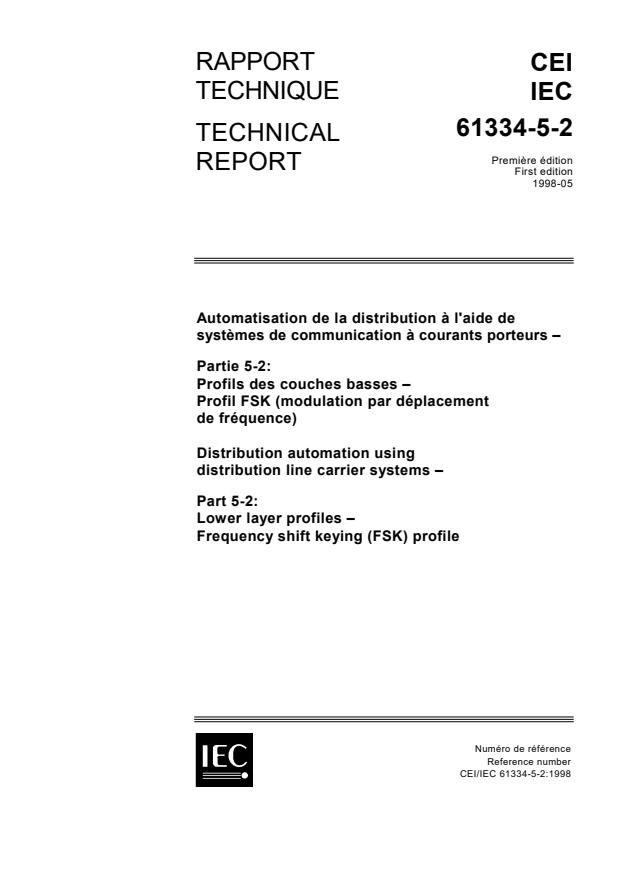
RAPPORT
CEI
TECHNIQUE
IEC
61334-5-2
TECHNICAL
Première édition
REPORT
First edition
1998-05
Automatisation de la distribution à l'aide de
systèmes de communication à courants porteurs –
Partie 5-2:
Profils des couches basses –
Profil FSK (modulation par déplacement
de fréquence)
Distribution automation using
distribution line carrier systems –
Part 5-2:
Lower layer profiles –
Frequency shift keying (FSK) profile
Numéro de référence
Reference number
CEI/IEC 61334-5-2:1998
Numéros des publications Numbering
Depuis le 1er janvier 1997, les publications de la CEI As from 1 January 1997 all IEC publications are issued
sont numérotées à partir de 60000. with a designation in the 60000 series.
Publications consolidées Consolidated publications
Les versions consolidées de certaines publications de Consolidated versions of some IEC publications
la CEI incorporant les amendements sont disponibles. including amendments are available. For example,
Par exemple, les numéros d’édition 1.0, 1.1 et 1.2 edition numbers 1.0, 1.1 and 1.2 refer, respectively, to
indiquent respectivement la publication de base, la the base publication, the base publication
publication de base incorporant l’amendement 1, et la incorporating amendment 1 and the base publication
publication de base incorporant les amendements 1 incorporating amendments 1 and 2.
et 2.
Validité de la présente publication Validity of this publication
Le contenu technique des publications de la CEI est The technical content of IEC publications is kept under
constamment revu par la CEI afin qu'il reflète l'état constant review by the IEC, thus ensuring that the
actuel de la technique. content reflects current technology.
Des renseignements relatifs à la date de Information relating to the date of the reconfirmation of
reconfirmation de la publication sont disponibles dans the publication is available in the IEC catalogue.
le Catalogue de la CEI.
Les renseignements relatifs à des questions à l’étude et Information on the subjects under consideration and
des travaux en cours entrepris par le comité technique work in progress undertaken by the technical
qui a établi cette publication, ainsi que la liste des committee which has prepared this publication, as well
publications établies, se trouvent dans les documents ci- as the list of publications issued, is to be found at the
dessous: following IEC sources:
• «Site web» de la CEI* • IEC web site*
• Catalogue des publications de la CEI • Catalogue of IEC publications
Publié annuellement et mis à jour régulièrement Published yearly with regular updates
(Catalogue en ligne)* (On-line catalogue)*
• Bulletin de la CEI • IEC Bulletin
Disponible à la fois au «site web» de la CEI* et Available both at the IEC web site* and as a
comme périodique imprimé printed periodical
Terminologie, symboles graphiques Terminology, graphical and letter
et littéraux symbols
En ce qui concerne la terminologie générale, le lecteur For general terminology, readers are referred to
se reportera à la CEI 60050: Vocabulaire Electro- IEC 60050: International Electrotechnical Vocabulary
technique International (VEI). (IEV).
Pour les symboles graphiques, les symboles littéraux For graphical symbols, and letter symbols and signs
et les signes d'usage général approuvés par la CEI, le approved by the IEC for general use, readers are
lecteur consultera la CEI 60027: Symboles littéraux à referred to publications IEC 60027: Letter symbols to
utiliser en électrotechnique, la CEI 60417: Symboles be used in electrical technology, IEC 60417: Graphical
graphiques utilisables sur le matériel. Index, relevé et symbols for use on equipment. Index, survey and
compilation des feuilles individuelles, et la CEI 60617: compilation of the single sheets and IEC 60617:
Symboles graphiques pour schémas. Graphical symbols for diagrams.
* Voir adresse «site web» sur la page de titre. * See web site address on title page.
RAPPORT
CEI
TECHNIQUE
IEC
61334-5-2
TECHNICAL
Première édition
REPORT
First edition
1998-05
Automatisation de la distribution à l'aide de
systèmes de communication à courants porteurs –
Partie 5-2:
Profils des couches basses –
Profil FSK (modulation par déplacement
de fréquence)
Distribution automation using
distribution line carrier systems –
Part 5-2:
Lower layer profiles –
Frequency shift keying (FSK) profile
Numéro de référence
Reference number
CEI/IEC 61334-5-2:1998
– 2 – 61334-5-2 © CEI:1998
SOMMAIRE
Pages
AVANT-PROPOS . 8
Articles
1 Généralités. 12
1.1 Domaine d’application et objet. 12
1.2 Références normatives. 12
1.3 Acronymes. 14
2 Structure du profil des couches basses . 16
2.1 Sous-couche MAC. 16
2.2 Sous-couche PLS. 18
2.3 MAU. 18
3 Sous-couche MAC. 18
3.1 Généralités. 18
3.2 Classes de service. 20
3.2.1 Classes de service en mode orienté connexion (CO) . 20
3.2.2 Classes de service en mode sans connexion (CL) . 24
3.3 Services MAC. 30
3.4 Interfaces entre MAC et LLC . 30
3.4.1 MA_Data.request. 30
3.4.1.1 Fonction. 30
3.4.1.2 Structure . 30
3.4.1.3 Utilisation . 30
3.4.2 MA_Data.indication. 32
3.4.2.1 Fonction. 32
3.4.2.2 Structure. 32
3.4.2.3 Utilisation. 32
3.4.3 MA_Data.confirm. 32
3.4.3.1 Fonction. 32
3.4.3.2 Structure. 32
3.4.3.3 Utilisation. 32
3.5 Interfaces entre MAC et la couche Physique. 32
3.6 Interface entre MAC et la couche Gestion. 34
3.6.1 Fonction. 34
3.6.2 Structure. 34
3.6.3 Utilisation. 34
3.7 Format de la trame MAC . 34
3.8 Trame MAC. 36
61334-5-2 © IEC:1998 – 3 –
CONTENTS
Page
FOREWORD . 9
Clause
1 General. 13
1.1 Scope and object . 13
1.2 Normative references. 13
1.3 Acronyms. 15
2 The lower layer profile structure . 17
2.1 MAC sublayer. 17
2.2 PLS sublayer. 19
2.3 MAU. 19
3 MAC sublayer. 19
3.1 Overview. 19
3.2 Classes of service. 21
3.2.1 Class of service in connection oriented (CO) mode . 21
3.2.2 Class of service in connectionless (CL) mode . 25
3.3 MAC services. 31
3.4 MAC to LLC interfaces . 31
3.4.1 MA_Data.request. 31
3.4.1.1 Function. 31
3.4.1.2 Structure. 31
3.4.1.3 Use. 31
3.4.2 MA_Data.indication. 33
3.4.2.1 Function. 33
3.4.2.2 Structure. 33
3.4.2.3 Use. 33
3.4.3 MA_Data.confirm. 33
3.4.3.1 Function. 33
3.4.3.2 Structure. 33
3.4.3.3 Use. 33
3.5 MAC to Physical layer interfaces . 33
3.6 MAC to Layer Management Interface. 35
3.6.1 Function. 35
3.6.2 Structure. 35
3.6.3 Use. 35
3.7 MAC frame format. 35
3.8 MAC frame. 37
– 4 – 61334-5-2 © CEI:1998
Articles Pages
3.9 Eléments de la trame MAC. 36
3.9.1 Preamble = préambule . 36
3.9.2 Flag = délimiteur . 38
3.9.3 Address = adresse . 38
3.9.4 Control = commande . 38
3.9.4.1 Style de répétition 1. 38
3.9.4.2 Style de répétition 2. 42
3.9.5 Repetition = répétition . 44
3.9.6 Information. 46
3.9.7 Frame Checking Sequence (FCS) = séquence de contrôle de trame . 46
3.10 Trame MAC invalide. 46
3.11 Procédures MAC. 46
3.11.1 Procédures MACph. 46
3.11.1.1 Transmettre une trame. 46
3.11.1.2 Recevoir une trame . 48
3.11.1.3 Détection d'un retard de phase AC . 48
3.11.2 Procédures MACre. 48
3.11.3 Procédures de répétitions MAC de Style 1 . 52
3.11.3.1 Service_Class = 1 . 52
3.11.3.2 Service_Class = 2 . 52
3.11.4 Procédure de répétition MAC de Style 2. 54
3.12 Gestion des répétitions. 60
3.13 Changements d'état de MAC . 62
3.13.1 Tableau de changements d'état pour une exploitation de Style 1. 62
3.13.2 Description des états. 64
3.13.3 Description des changements d'état . 66
3.13.4 Description des actions . 66
3.13.5 Notation utilisée dans le tableau de changements d'état . 68
4 Sous-couche PLS. 68
4.1 Spécification de service PLS . 68
4.1.1 Description globale du service . 68
4.1.2 Spécifications détaillées des services . 68
4.1.2.1 Ph_Data.request. 68
4.1.2.2 Ph_Data.confirm. 70
4.1.2.3 Ph_Data.indication. 70
4.1.2.4 Ph_ZC.indication. 72
4.2 Structure et synchronisation des trames . 72
4.2.1 Structure des trames . 72
4.2.2 Synchronisation des trames. 74
61334-5-2 © IEC:1998 – 5 –
Clause Page
3.9 Elements of the MAC frame. 37
3.9.1 Preamble. 37
3.9.2 Flag. 39
3.9.3 Address. 39
3.9.4 Control. 39
3.9.4.1 Repetition Style 1. 39
3.9.4.2 Repetition Style 2. 43
3.9.5 Repetition. 45
3.9.6 Information. 47
3.9.7 Frame Checking Sequence (FCS) . 47
3.10 MAC invalid frame. 47
3.11 MAC procedures. 47
3.11.1 MACph procedures. 47
3.11.1.1 Transmit a frame . 47
3.11.1.2 Receive a frame . 49
3.11.1.3 Detection of the AC phase delay . 49
3.11.2 MACre procedures. 49
3.11.3 MAC repetition procedures Style 1. 53
3.11.3.1 Service_Class = 1. 53
3.11.3.2 Service_Class = 2. 53
3.11.4 MAC repetition procedures Style 2. 55
3.12 Repetition management. 61
3.13 MAC state transition. 63
3.13.1 State transition table for the operation Style 1. 63
3.13.2 State description. 65
3.13.3 Event descriptions. 67
3.13.4 Actions description. 67
3.13.5 Notation used in the transition table. 69
4 PLS sublayer. 69
4.1 PLS service specification . 69
4.1.1 General description of the service. 69
4.1.2 Detailed specification of the service. 69
4.1.2.1 Ph_Data.request. 69
4.1.2.2 Ph_Data.confirm. 71
4.1.2.3 Ph_Data.indication. 71
4.1.2.4 Ph_ZC.indication. 73
4.2 Frame structure and synchronization . 73
4.2.1 Frame structure. 73
4.2.2 Frame synchronization. 75
– 6 – 61334-5-2 © CEI:1998
Articles Pages
4.3 Caractéristiques de MI . 74
4.3.1 Description globale des caractéristiques . 74
4.3.2 Description détaillée des signaux. 74
4.3.2.1 Transmit Data (TD = transmettre des données) . 74
4.3.2.2 Receive Data (RD = recevoir des données) . 74
4.3.2.3 Mode Control (MC = mode de contrôle) . 76
4.3.2.4 Bit Clock (BC = horloge bit) . 76
4.3.2.5 Zero Crossing (ZC = passage par zéro) . 76
4.4 Description des procédures . 76
4.4.1 Description des états du composant PLS. 76
4.4.2 Description des changements d'état du composant PLS. 76
4.4.3 Description des actions du composant PLS . 78
5 MAU. 80
5.1 Généralités. 80
5.2 Caractéristiques générales. 80
5.2.1 Vitesse de modulation . 80
5.2.2 Plage de fréquences. 80
5.2.3 Circuits d'échange optionnels . 82
5.3 Caractéristiques des modems de moyenne tension. 82
5.3.1 Impédance nominale d'entrée/sortie . 82
5.3.2 Impédance de charge. 82
5.3.3 Puissance nominale du signal de sortie . 82
5.3.4 Bande de fréquence nominale du signal (BN) . 84
5.3.5 Masque de transmission. 84
5.3.6 Stabilisation de la porteuse. 84
5.3.7 Sensibilité en entrée. 84
5.3.8 Plage dynamique de l'entrée. 84
5.3.9 Taux d'erreur par bit. 84
5.3.10 Risques de récupération de l'horloge . 84
5.4 Caractéristiques de modems en basse tension . 84
5.4.1 Bandes de fréquences. 84
5.4.2 Impédance d'entrée-sortie. 86
5.4.3 Impédance de charge. 86
5.4.4 Masque de transmission. 86
5.4.5 Stabilisation de la fréquence du signal. 86
5.4.6 Sensibilité en entrée. 86
5.4.7 Plage dynamique en entrée . 86
5.4.8 Taux d'erreur par bit. 86
5.4.9 Risques de récupération de l'horloge . 86
61334-5-2 © IEC:1998 – 7 –
Clause Page
4.3 MI characteristics. 75
4.3.1 General description of the characteristics . 75
4.3.2 Detailed description of the signals . 75
4.3.2.1 Transmit Data (TD). 75
4.3.2.2 Receive Data (RD). 75
4.3.2.3 Mode Control (MC) . 77
4.3.2.4 Bit Clock (BC). 77
4.3.2.5 Zero Crossing (ZC) . 77
4.4 Description of the procedures. 77
4.4.1 PLS component state descriptions. 77
4.4.2 PLS component event descriptions . 77
4.4.3 PLS component action descriptions . 79
5 MAU. 81
5.1 General. 81
5.2 General characteristics. 81
5.2.1 Modulation rate. 81
5.2.2 Frequency range. 81
5.2.3 Optional interchange circuits . 83
5.3 MV modem characteristics . 83
5.3.1 Nominal input-output impedance. 83
5.3.2 Load impedance. 83
5.3.3 Nominal signal output power. 83
5.3.4 Nominal signal frequency band (BN). 85
5.3.5 Transmission mask. 85
5.3.6 Carrier stabilization. 85
5.3.7 Input sensitivity. 85
5.3.8 Input dynamic range . 85
5.3.9 Bit error rate. 85
5.3.10 Recovered clock jitter. 85
5.4 LV modem characteristics . 85
5.4.1 Frequency bands. 85
5.4.2 Input-output impedance. 87
5.4.3 Load impedance. 87
5.4.4 Transmission mask. 87
5.4.5 Signal frequency stabilization . 87
5.4.6 Input sensitivity. 87
5.4.7 Input dynamic range . 87
5.4.8 Bit error rate. 87
5.4.9 Recovered clock jitter. 87
– 8 – 61334-5-2 © CEI:1998
COMMISSION ÉLECTROTECHNIQUE INTERNATIONALE
_________
AUTOMATISATION DE LA DISTRIBUTION À L'AIDE DE SYSTÈMES
DE COMMUNICATION À COURANTS PORTEURS –
Partie 5-2: Profils des couches basses –
Profil FSK (modulation par déplacement de fréquence)
AVANT-PROPOS
1) La CEI (Commission Electrotechnique Internationale) est une organisation mondiale de normalisation composée
de l'ensemble des comités électrotechniques nationaux (Comités nationaux de la CEI). La CEI a pour objet de
favoriser la coopération internationale pour toutes les questions de normalisation dans les domaines de
l'électricité et de l'électronique. A cet effet, la CEI, entre autres activités, publie des Normes Internationales.
Leur élaboration est confiée à des comités d'études, aux travaux desquels tout Comité national intéressé par le
sujet traité peut participer. Les organisations internationales, gouvernementales et non gouvernementales, en
liaison avec la CEI, participent également aux travaux. La CEI collabore étroitement avec l'Organisation
Internationale de Normalisation (ISO), selon des conditions fixées par accord entre les deux organisations.
2) Les décisions ou accords officiels de la CEI concernant les questions techniques, représentent, dans la mesure
du possible un accord international sur les sujets étudiés, étant donné que les Comités nationaux intéressés
sont représentés dans chaque comité d’études.
3) Les documents produits se présentent sous la forme de recommandations internationales. Ils sont publiés
comme normes, rapports techniques ou guides et agréés comme tels par les Comités nationaux.
4) Dans le but d'encourager l'unification internationale, les Comités nationaux de la CEI s'engagent à appliquer de
façon transparente, dans toute la mesure possible, les Normes Internationales de la CEI dans leurs normes
nationales et régionales. Toute divergence entre la recommandation de la CEI et la norme nationale
correspondante doit être indiquée en termes clairs dans cette dernière.
5) La CEI n’a fixé aucune procédure concernant le marquage comme indication d’approbation et sa responsabilité
n’est pas engagée quand un matériel est déclaré conforme à l’une de ses normes.
6) L’attention est attirée sur le fait que certains des éléments de la présente Norme internationale peuvent faire
l’objet de droits de propriété intellectuelle ou de droits analogues. La CEI ne saurait être tenue pour
responsable de ne pas avoir identifié de tels droits de propriété et de ne pas avoir signalé leur existence.
La tâche principale des comités d’études de la CEI est d’élaborer des Normes internationales.
Exceptionnellement, un comité d’études peut proposer la publication d’un rapport technique de
l’un des types suivants:
• type 1, lorsque, en dépit de maints efforts, l’accord requis ne peut être réalisé en faveur de
la publication d’une Norme internationale;
• type 2, lorsque le sujet en question est encore en cours de développement technique ou
lorsque, pour une raison quelconque, la possibilité d’un accord pour la publication d’une
Norme internationale peut être envisagée pour l’avenir mais pas dans l’immédiat;
• type 3, lorsqu’un comité d’études a réuni des données de nature différente de celles qui
sont normalement publiées comme Normes internationales, cela pouvant comprendre, par
exemple, des informations sur l’état de la technique.
Les rapports techniques des types 1 et 2 font l’objet d’un nouvel examen trois ans au plus tard
après leur publication afin de décider éventuellement de leur transformation en Normes
internationales. Les rapports techniques du type 3 ne doivent pas nécessairement être révisés
avant que les données qu’ils contiennent ne soient plus jugées valables ou utiles.
61334-5-2 © IEC:1998 – 9 –
INTERNATIONAL ELECTROTECHNICAL COMMISSION
_________
DISTRIBUTION AUTOMATION USING
DISTRIBUTION LINE CARRIER SYSTEMS –
Part 5-2: Lower layer profiles –
Frequency shift keying (FSK) profile
FOREWORD
1) The IEC (International Electrotechnical Commission) is a worldwide organization for standardization comprising
all national electrotechnical committees (IEC National Committees). The object of the IEC is to promote
international co-operation on all questions concerning standardization in the electrical and electronic fields. To
this end and in addition to other activities, the IEC publishes International Standards. Their preparation is
entrusted to technical committees; any IEC National Committee interested in the subject dealt with may
participate in this preparatory work. International, governmental and non-governmental organizations liaising
with the IEC also participate in this preparation. The IEC collaborates closely with the International Organization
for Standardization (ISO) in accordance with conditions determined by agreement between the two
organizations.
2) The formal decisions or agreements of the IEC on technical matters express, as nearly as possible, an
international consensus of opinion on the relevant subjects since each technical committee has representation
from all interested National Committees.
3) The documents produced have the form of recommendations for international use and are published in the form
of standards, technical reports or guides and they are accepted by the National Committees in that sense.
4) In order to promote international unification, IEC National Committees undertake to apply IEC International
Standards transparently to the maximum extent possible in their national and regional standards. Any
divergence between the IEC Standard and the corresponding national or regional standard shall be clearly
indicated in the latter.
5) The IEC provides no marking procedure to indicate its approval and cannot be rendered responsible for any
equipment declared to be in conformity with one of its standards.
6) Attention is drawn to the possibility that some of the elements of this International Standard may be the subject
of patent rights. The IEC shall not be held responsible for identifying any or all such patent rights.
The main task of IEC technical committees is to prepare International Standards. In
exceptional circumstances, a technical committee may propose the publication of a technical
report of one of the following types:
• type 1, when the required support cannot be obtained for the publication of an International
Standard, despite repeated efforts;
• type 2, when the subject is still under technical development or where for any other reason
there is the future but no immediate possibility of an agreement on an International
Standard;
• type 3, when a technical committee has collected data of a different kind from that which is
normally published as an International Standard, for example "state of the art".
Technical reports of types 1 and 2 are subject to review within three years of publication to
decide whether they can be transformed into International Standards. Technical reports of
type 3 do not necessarily have to be reviewed until the data they provide are considered to be
no longer valid or useful.
– 10 – 61334-5-2 © CEI:1998
La CEI 61334-5-2, rapport technique de type 2, a été établie par le comité d'études 57 de la
CEI: Conduite des systèmes de puissance et communications associées.
Le texte de ce rapport technique est issu des documents suivants:
Projet de comité Rapport de vote
57/272/CDV 57/301/RVC
Le rapport de vote indiqué dans le tableau ci-dessus donne toute information sur le vote ayant
abouti à l'approbation de ce rapport technique.
Le présent document est publié dans la série des rapports techniques de
type 2 (conformément au paragraphe G.3.2.2 de la partie 1 des
Directives CEI/ISO) comme «norme prospective d’application provisoire»
dans le domaine du profil FSK pour l’automatisation de la distribution à
l’aide de systèmes de communication à courants porteurs, car il est
urgent d’avoir des indications sur la meilleure façon d’utiliser les normes
dans ce domaine afin de répondre à un besoin déterminé.
Ce document ne doit pas être considéré comme une «Norme
internationale». Il est proposé pour une mise en oeuvre provisoire, dans
le but de recueillir des informations et d’acquérir de l’expérience quant à
son application dans la pratique. Il est de règle d’envoyer les obser-
vations éventuelles relatives au contenu de ce document au Bureau
Central de la CEI.
Il sera procédé à un nouvel examen de ce rapport technique de type 2
trois ans au plus tard après sa publication, avec la faculté d’en prolonger
la validité pendant trois autres années, de la transformer en Norme
internationale ou de l’annuler.
61334-5-2 © IEC:1998 – 11 –
IEC 61334-5-2, which is a technical report of type 2, has been prepared by IEC technical
committee 57: Power system control and associated communications.
The text of this technical report is based on the following documents:
Committee draft Report on voting
57/272/CDV 57/301/RVC
Full information on the voting for the approval of this technical report can be found in the report
on voting indicated in the above table.
This document is issued in the type 2 technical report series of
publications (according to G.3.2.2 of part 1 of the IEC/ISO Directives) as
a “prospective standard for provisional application” in the field of
frequency shift keying (FSK) profile for distribution automation using
distribution line carrier systems because there is an urgent requirement
for guidance on how standards in this field should be used to meet an
identified need.
This document is not to be regarded as an “International Standard”. It is
proposed for provisional application so that information and experience
of its use in practice may be gathered. Comments on the content of this
document should be sent to the IEC Central Office.
A review of this type 2 technical report will be carried out not later than
three years after its publication, with the options of extension for a
further three years or conversion to an International Standard or
withdrawal.
– 12 – 61334-5-2 © CEI:1998
AUTOMATISATION DE LA DISTRIBUTION À L'AIDE DE SYSTÈMES
DE COMMUNICATION À COURANTS PORTEURS –
Partie 5-2: Profils des couches basses –
Profil FSK (modulation par déplacement de fréquence)
1 Généralités
1.1 Domaine d’application et objet
Le présent rapport technique de type 2 décrit un profil des couches basses qui inclut la sous-
couche MAC (accès au support), la sous-couche PLS (signalisation physique) et les MAU
(unités de raccordement au secteur) en vue de contribuer à la construction d'un jeu de normes
pour une communication efficace sur les réseaux en moyenne et basse tension pour les
systèmes à courants porteurs (DLC, Distribution Line Carrier).
Le présent profil utilise les techniques de modulation FSK, qui offrent l'avantage d'une mise en
oeuvre bon marché, une robustesse et une résistance au bruit et aux interférences. La qualité
de la transmission est en outre prévisible quand on connaît quelques paramètres du support de
transmission. Utilisant une interface normalisée des signaux électriques, le modem est adapté
à différentes techniques de modulation.
Des approches techniques diverses sont utilisées pour le développement des communications pour
les systèmes DLC. En conséquence, des profils de bas niveau variés sont actuellement réalisables,
avec des résultats acceptables en termes de performance et de coûts. Les différences entre les
divers cas sont souvent mineures et il est possible de retrouver une racine commune. Le présent
rapport décrit un profil de bas niveau qui rassemble des expériences communes.
Conformément à la structure du modèle d'interconnexion des systèmes ouverts, un profil de
bas niveau représente une interface à la sous-couche LLC (contrôle de liaison logique) et il se
compose de sous-couches telles que MAC, PLS et MAU qui présentent entre elles des
interfaces bien connues.
La sous-couche MAC décrite ici fournit une interface à la fois avec le LLC en mode sans
connexion (CL) (voir CEI 61334-4-32) et le LLC en mode orienté connexion (CO) (voir la
CEI 61334-4-33).
L'utilisation de MAC est différente pour chaque cas à cause de la longueur de la trame et de la
séquence des trames sur le support. Pour améliorer l'efficacité de la communication,
différentes classes de service sont fournies. Un usage adéquat des classes de service et des
paramètres associés permet une surveillance des transferts ainsi que des temps d'attente des
processus impliqués dans la communication.
1.2 Références normatives
Les documents normatifs suivants contiennent des dispositions qui, par suite de la référence
qui y est faite, constituent des dispositions valables pour la présente partie de la CEI 61334.
Au moment de la publication, les éditions indiquées étaient en vigueur. Tout document normatif
est sujet à révision et les parties prenantes aux accords fondés sur la présente partie de la
CEI 61334 sont invitées à rechercher la possibilité d'appliquer les éditions les plus récentes
des documents normatifs indiqués ci-après. Les membres de la CEI et de l'ISO possèdent le
registre des Normes internationales en vigueur.
CEI 60495:1993, Equipements terminaux à courants porteurs sur lignes d’énergie, à bande
latérale unique
61334-5-2 © IEC:1998 – 13 –
DISTRIBUTION AUTOMATION USING
DISTRIBUTION LINE CARRIER SYSTEMS –
Part 5-2: Lower layer profiles –
Frequency shift keying (FSK) profile
1 General
1.1 Scope and object
This technical report of type 2 describes a lower layer profile that includes the medium access
control (MAC) sublayer, the physical signalling (PLS) sublayer and the mains attachment units
(MAU), with the purpose of giving a contribution to build up a set of standards for effective
communication on MV and LV network for distribution line carrier (DLC) systems.
This profile uses the FSK modulation technique that offers the advantages of low cost
implementation, robustness and immunity against noise and interferences. Furthermore, the
transmission quality is predictable knowing few parameters of the transmission medium. Using
standard electrical signal interface to the modem, the profile is effective for different
modulation techniques.
Different technical approaches in developing communication for DLC systems are in progress.
As a consequence, at present different low level profiles are feasible with acceptable results in
terms of performance and cost-effectiveness. In many cases, the differences amongst
solutions are minor and it is possible to find a common root. This report describes a low level
profile that assembles some common experience.
According to the structure of the open system interconnection model, the low level profile
should present a standard interface to the logical link control (LLC) sublayer and consists of
sublayers such as the MAC sublayer, PLS and MAU, that present well-defined interface to each
other.
The MAC sublayer here described interfaces both the LLC connectionless (CL) (see
IEC 61334-4-32) and the LLC connection oriented (CO) (see IEC 61334-4-33).
The use of the MAC in the two cases is different due to the frame length and the frame
sequence on the medium. To improve the efficiency of the communication, different classes of
service are given. The proper use of the class of service and related parameters allow users
control of the transfer and waiting time of the processes involved in the transmission.
1.2 Normative references
The following normative documents contain provisions which, through reference in this text,
constitute provisions of this part of IEC 61334. At the time of publication, the editions indicated
were valid. All normative documents are subject to revision,
...
IEC TS 61334-5-2 ®
Edition 1.0 1998-05
TECHNICAL
SPECIFICATION
SPECIFICATION
TECHNIQUE
Distribution automation using distribution line carrier systems –
Part 5-2: Lower layer profiles – Frequency shift keying (FSK) profile
Automatisation de la distribution à l’aide de systèmes de communication à
courants porteurs –
Partie 5-2: Profils des couches basses – Profil FSK (modulation par déplacement
de fréquence)
Copyright © 1998 IEC, Geneva, Switzerland
All rights reserved. Unless otherwise specified, no part of this publication may be reproduced or utilized in any form
or by any means, electronic or mechanical, including photocopying and microfilm, without permission in writing from
either IEC or IEC's member National Committee in the country of the requester. If you have any questions about IEC
copyright or have an enquiry about obtaining additional rights to this publication, please contact the address below or
your local IEC member National Committee for further information.
Droits de reproduction réservés. Sauf indication contraire, aucune partie de cette publication ne peut être reproduite
ni utilisée sous quelque forme que ce soit et par aucun procédé, électronique ou mécanique, y compris la photocopie
et les microfilms, sans l'accord écrit de l'IEC ou du Comité national de l'IEC du pays du demandeur. Si vous avez des
questions sur le copyright de l'IEC ou si vous désirez obtenir des droits supplémentaires sur cette publication, utilisez
les coordonnées ci-après ou contactez le Comité national de l'IEC de votre pays de résidence.
IEC Secretariat Tel.: +41 22 919 02 11
3, rue de Varembé info@iec.ch
CH-1211 Geneva 20 www.iec.ch
Switzerland
About the IEC
The International Electrotechnical Commission (IEC) is the leading global organization that prepares and publishes
International Standards for all electrical, electronic and related technologies.
About IEC publications
The technical content of IEC publications is kept under constant review by the IEC. Please make sure that you have the
latest edition, a corrigendum or an amendment might have been published.
IEC publications search - webstore.iec.ch/advsearchform IEC Products & Services Portal - products.iec.ch
The advanced search enables to find IEC publications by a Discover our powerful search engine and read freely all the
variety of criteria (reference number, text, technical publications previews. With a subscription you will always
committee, …). It also gives information on projects, replaced have access to up to date content tailored to your needs.
and withdrawn publications.
Electropedia - www.electropedia.org
IEC Just Published - webstore.iec.ch/justpublished
The world's leading online dictionary on electrotechnology,
Stay up to date on all new IEC publications. Just Published
containing more than 22 300 terminological entries in English
details all new publications released. Available online and
and French, with equivalent terms in 19 additional languages.
once a month by email.
Also known as the International Electrotechnical Vocabulary
(IEV) online.
IEC Customer Service Centre - webstore.iec.ch/csc
If you wish to give us your feedback on this publication or
need further assistance, please contact the Customer Service
Centre: sales@iec.ch.
A propos de l'IEC
La Commission Electrotechnique Internationale (IEC) est la première organisation mondiale qui élabore et publie des
Normes internationales pour tout ce qui a trait à l'électricité, à l'électronique et aux technologies apparentées.
A propos des publications IEC
Le contenu technique des publications IEC est constamment revu. Veuillez vous assurer que vous possédez l’édition la
plus récente, un corrigendum ou amendement peut avoir été publié.
Recherche de publications IEC - IEC Products & Services Portal - products.iec.ch
webstore.iec.ch/advsearchform Découvrez notre puissant moteur de recherche et consultez
La recherche avancée permet de trouver des publications IEC gratuitement tous les aperçus des publications. Avec un
en utilisant différents critères (numéro de référence, texte, abonnement, vous aurez toujours accès à un contenu à jour
comité d’études, …). Elle donne aussi des informations sur adapté à vos besoins.
les projets et les publications remplacées ou retirées.
Electropedia - www.electropedia.org
IEC Just Published - webstore.iec.ch/justpublished
Le premier dictionnaire d'électrotechnologie en ligne au
Restez informé sur les nouvelles publications IEC. Just
monde, avec plus de 22 300 articles terminologiques en
Published détaille les nouvelles publications parues.
anglais et en français, ainsi que les termes équivalents dans
Disponible en ligne et une fois par mois par email.
19 langues additionnelles. Egalement appelé Vocabulaire
Electrotechnique International (IEV) en ligne.
Service Clients - webstore.iec.ch/csc
Si vous désirez nous donner des commentaires sur cette
publication ou si vous avez des questions contactez-nous:
sales@iec.ch.
IEC TS 61334-5-2 ®
Edition 1.0 1998-05
TECHNICAL
SPECIFICATION
SPECIFICATION
TECHNIQUE
Distribution automation using distribution line carrier systems –
Part 5-2: Lower layer profiles – Frequency shift keying (FSK) profile
Automatisation de la distribution à l’aide de systèmes de communication à
courants porteurs –
Partie 5-2: Profils des couches basses – Profil FSK (modulation par
déplacement de fréquence)
INTERNATIONAL
ELECTROTECHNICAL
COMMISSION
COMMISSION
ELECTROTECHNIQUE
INTERNATIONALE
ICS 29.240.20; 33.200 ISBN 2-8318-4302-2
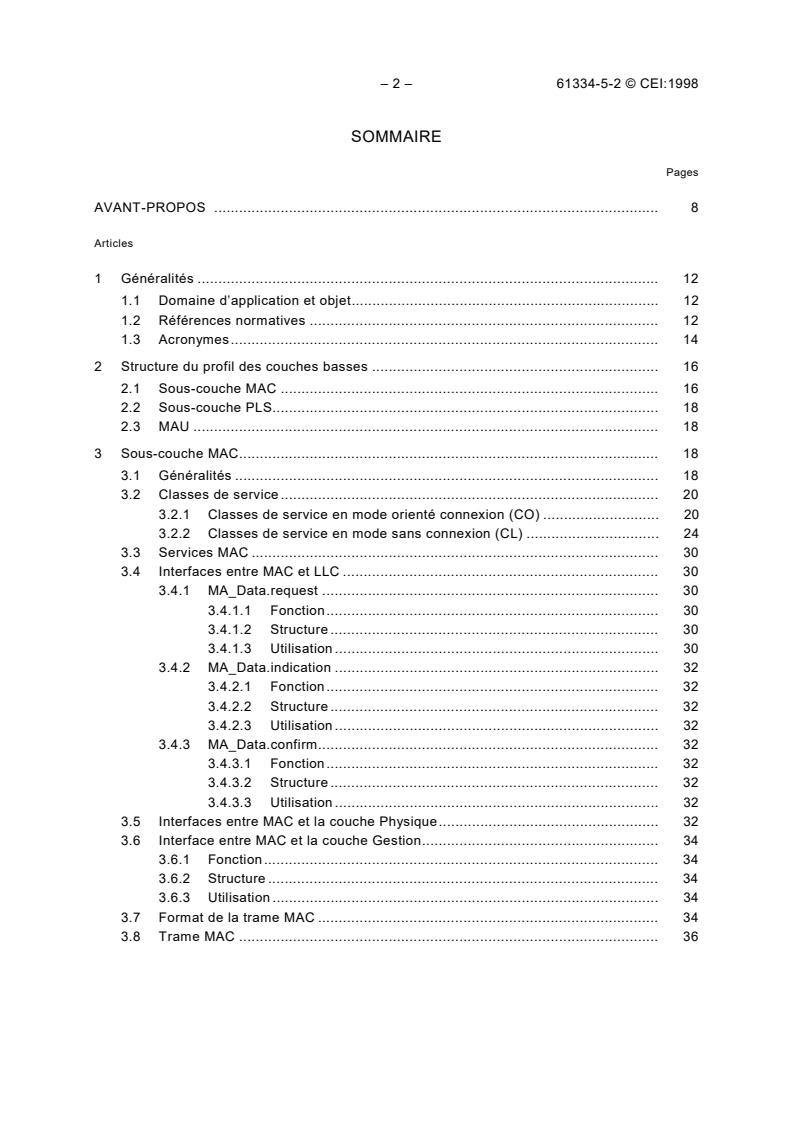
– 2 – 61334-5-2 © CEI:1998
SOMMAIRE
Pages
AVANT-PROPOS . 8
Articles
1 Généralités. 12
1.1 Domaine d’application et objet. 12
1.2 Références normatives. 12
1.3 Acronymes. 14
2 Structure du profil des couches basses . 16
2.1 Sous-couche MAC. 16
2.2 Sous-couche PLS. 18
2.3 MAU. 18
3 Sous-couche MAC. 18
3.1 Généralités. 18
3.2 Classes de service. 20
3.2.1 Classes de service en mode orienté connexion (CO) . 20
3.2.2 Classes de service en mode sans connexion (CL) . 24
3.3 Services MAC. 30
3.4 Interfaces entre MAC et LLC . 30
3.4.1 MA_Data.request. 30
3.4.1.1 Fonction. 30
3.4.1.2 Structure . 30
3.4.1.3 Utilisation . 30
3.4.2 MA_Data.indication. 32
3.4.2.1 Fonction. 32
3.4.2.2 Structure. 32
3.4.2.3 Utilisation. 32
3.4.3 MA_Data.confirm. 32
3.4.3.1 Fonction. 32
3.4.3.2 Structure. 32
3.4.3.3 Utilisation. 32
3.5 Interfaces entre MAC et la couche Physique. 32
3.6 Interface entre MAC et la couche Gestion. 34
3.6.1 Fonction. 34
3.6.2 Structure. 34
3.6.3 Utilisation. 34
3.7 Format de la trame MAC . 34
3.8 Trame MAC. 36
61334-5-2 © IEC:1998 – 3 –
CONTENTS
Page
FOREWORD . 9
Clause
1 General. 13
1.1 Scope and object . 13
1.2 Normative references. 13
1.3 Acronyms. 15
2 The lower layer profile structure . 17
2.1 MAC sublayer. 17
2.2 PLS sublayer. 19
2.3 MAU. 19
3 MAC sublayer. 19
3.1 Overview. 19
3.2 Classes of service. 21
3.2.1 Class of service in connection oriented (CO) mode . 21
3.2.2 Class of service in connectionless (CL) mode . 25
3.3 MAC services. 31
3.4 MAC to LLC interfaces . 31
3.4.1 MA_Data.request. 31
3.4.1.1 Function. 31
3.4.1.2 Structure. 31
3.4.1.3 Use. 31
3.4.2 MA_Data.indication. 33
3.4.2.1 Function. 33
3.4.2.2 Structure. 33
3.4.2.3 Use. 33
3.4.3 MA_Data.confirm. 33
3.4.3.1 Function. 33
3.4.3.2 Structure. 33
3.4.3.3 Use. 33
3.5 MAC to Physical layer interfaces . 33
3.6 MAC to Layer Management Interface. 35
3.6.1 Function. 35
3.6.2 Structure. 35
3.6.3 Use. 35
3.7 MAC frame format. 35
3.8 MAC frame. 37
– 4 – 61334-5-2 © CEI:1998
Articles Pages
3.9 Eléments de la trame MAC. 36
3.9.1 Preamble = préambule . 36
3.9.2 Flag = délimiteur . 38
3.9.3 Address = adresse . 38
3.9.4 Control = commande . 38
3.9.4.1 Style de répétition 1. 38
3.9.4.2 Style de répétition 2. 42
3.9.5 Repetition = répétition . 44
3.9.6 Information. 46
3.9.7 Frame Checking Sequence (FCS) = séquence de contrôle de trame . 46
3.10 Trame MAC invalide. 46
3.11 Procédures MAC. 46
3.11.1 Procédures MACph. 46
3.11.1.1 Transmettre une trame. 46
3.11.1.2 Recevoir une trame . 48
3.11.1.3 Détection d'un retard de phase AC . 48
3.11.2 Procédures MACre. 48
3.11.3 Procédures de répétitions MAC de Style 1 . 52
3.11.3.1 Service_Class = 1 . 52
3.11.3.2 Service_Class = 2 . 52
3.11.4 Procédure de répétition MAC de Style 2. 54
3.12 Gestion des répétitions. 60
3.13 Changements d'état de MAC . 62
3.13.1 Tableau de changements d'état pour une exploitation de Style 1. 62
3.13.2 Description des états. 64
3.13.3 Description des changements d'état . 66
3.13.4 Description des actions . 66
3.13.5 Notation utilisée dans le tableau de changements d'état . 68
4 Sous-couche PLS. 68
4.1 Spécification de service PLS . 68
4.1.1 Description globale du service . 68
4.1.2 Spécifications détaillées des services . 68
4.1.2.1 Ph_Data.request. 68
4.1.2.2 Ph_Data.confirm. 70
4.1.2.3 Ph_Data.indication. 70
4.1.2.4 Ph_ZC.indication. 72
4.2 Structure et synchronisation des trames . 72
4.2.1 Structure des trames . 72
4.2.2 Synchronisation des trames. 74
61334-5-2 © IEC:1998 – 5 –
Clause Page
3.9 Elements of the MAC frame. 37
3.9.1 Preamble. 37
3.9.2 Flag. 39
3.9.3 Address. 39
3.9.4 Control. 39
3.9.4.1 Repetition Style 1. 39
3.9.4.2 Repetition Style 2. 43
3.9.5 Repetition. 45
3.9.6 Information. 47
3.9.7 Frame Checking Sequence (FCS) . 47
3.10 MAC invalid frame. 47
3.11 MAC procedures. 47
3.11.1 MACph procedures. 47
3.11.1.1 Transmit a frame . 47
3.11.1.2 Receive a frame . 49
3.11.1.3 Detection of the AC phase delay . 49
3.11.2 MACre procedures. 49
3.11.3 MAC repetition procedures Style 1. 53
3.11.3.1 Service_Class = 1. 53
3.11.3.2 Service_Class = 2. 53
3.11.4 MAC repetition procedures Style 2. 55
3.12 Repetition management. 61
3.13 MAC state transition. 63
3.13.1 State transition table for the operation Style 1. 63
3.13.2 State description. 65
3.13.3 Event descriptions. 67
3.13.4 Actions description. 67
3.13.5 Notation used in the transition table. 69
4 PLS sublayer. 69
4.1 PLS service specification . 69
4.1.1 General description of the service. 69
4.1.2 Detailed specification of the service. 69
4.1.2.1 Ph_Data.request. 69
4.1.2.2 Ph_Data.confirm. 71
4.1.2.3 Ph_Data.indication. 71
4.1.2.4 Ph_ZC.indication. 73
4.2 Frame structure and synchronization . 73
4.2.1 Frame structure. 73
4.2.2 Frame synchronization. 75
– 6 – 61334-5-2 © CEI:1998
Articles Pages
4.3 Caractéristiques de MI . 74
4.3.1 Description globale des caractéristiques . 74
4.3.2 Description détaillée des signaux. 74
4.3.2.1 Transmit Data (TD = transmettre des données) . 74
4.3.2.2 Receive Data (RD = recevoir des données) . 74
4.3.2.3 Mode Control (MC = mode de contrôle) . 76
4.3.2.4 Bit Clock (BC = horloge bit) . 76
4.3.2.5 Zero Crossing (ZC = passage par zéro) . 76
4.4 Description des procédures . 76
4.4.1 Description des états du composant PLS. 76
4.4.2 Description des changements d'état du composant PLS. 76
4.4.3 Description des actions du composant PLS . 78
5 MAU. 80
5.1 Généralités. 80
5.2 Caractéristiques générales. 80
5.2.1 Vitesse de modulation . 80
5.2.2 Plage de fréquences. 80
5.2.3 Circuits d'échange optionnels . 82
5.3 Caractéristiques des modems de moyenne tension. 82
5.3.1 Impédance nominale d'entrée/sortie . 82
5.3.2 Impédance de charge. 82
5.3.3 Puissance nominale du signal de sortie . 82
5.3.4 Bande de fréquence nominale du signal (BN) . 84
5.3.5 Masque de transmission. 84
5.3.6 Stabilisation de la porteuse. 84
5.3.7 Sensibilité en entrée. 84
5.3.8 Plage dynamique de l'entrée. 84
5.3.9 Taux d'erreur par bit. 84
5.3.10 Risques de récupération de l'horloge . 84
5.4 Caractéristiques de modems en basse tension . 84
5.4.1 Bandes de fréquences. 84
5.4.2 Impédance d'entrée-sortie. 86
5.4.3 Impédance de charge. 86
5.4.4 Masque de transmission. 86
5.4.5 Stabilisation de la fréquence du signal. 86
5.4.6 Sensibilité en entrée. 86
5.4.7 Plage dynamique en entrée . 86
5.4.8 Taux d'erreur par bit. 86
5.4.9 Risques de récupération de l'horloge . 86
61334-5-2 © IEC:1998 – 7 –
Clause Page
4.3 MI characteristics. 75
4.3.1 General description of the characteristics . 75
4.3.2 Detailed description of the signals . 75
4.3.2.1 Transmit Data (TD). 75
4.3.2.2 Receive Data (RD). 75
4.3.2.3 Mode Control (MC) . 77
4.3.2.4 Bit Clock (BC). 77
4.3.2.5 Zero Crossing (ZC) . 77
4.4 Description of the procedures. 77
4.4.1 PLS component state descriptions. 77
4.4.2 PLS component event descriptions . 77
4.4.3 PLS component action descriptions . 79
5 MAU. 81
5.1 General. 81
5.2 General characteristics. 81
5.2.1 Modulation rate. 81
5.2.2 Frequency range. 81
5.2.3 Optional interchange circuits . 83
5.3 MV modem characteristics . 83
5.3.1 Nominal input-output impedance. 83
5.3.2 Load impedance. 83
5.3.3 Nominal signal output power. 83
5.3.4 Nominal signal frequency band (BN). 85
5.3.5 Transmission mask. 85
5.3.6 Carrier stabilization. 85
5.3.7 Input sensitivity. 85
5.3.8 Input dynamic range . 85
5.3.9 Bit error rate. 85
5.3.10 Recovered clock jitter. 85
5.4 LV modem characteristics . 85
5.4.1 Frequency bands. 85
5.4.2 Input-output impedance. 87
5.4.3 Load impedance. 87
5.4.4 Transmission mask. 87
5.4.5 Signal frequency stabilization . 87
5.4.6 Input sensitivity. 87
5.4.7 Input dynamic range . 87
5.4.8 Bit error rate. 87
5.4.9 Recovered clock jitter. 87
– 8 – 61334-5-2 © CEI:1998
COMMISSION ÉLECTROTECHNIQUE INTERNATIONALE
_________
AUTOMATISATION DE LA DISTRIBUTION À L'AIDE DE SYSTÈMES
DE COMMUNICATION À COURANTS PORTEURS –
Partie 5-2: Profils des couches basses –
Profil FSK (modulation par déplacement de fréquence)
AVANT-PROPOS
1) La CEI (Commission Electrotechnique Internationale) est une organisation mondiale de normalisation composée
de l'ensemble des comités électrotechniques nationaux (Comités nationaux de la CEI). La CEI a pour objet de
favoriser la coopération internationale pour toutes les questions de normalisation dans les domaines de
l'électricité et de l'électronique. A cet effet, la CEI, entre autres activités, publie des Normes Internationales.
Leur élaboration est confiée à des comités d'études, aux travaux desquels tout Comité national intéressé par le
sujet traité peut participer. Les organisations internationales, gouvernementales et non gouvernementales, en
liaison avec la CEI, participent également aux travaux. La CEI collabore étroitement avec l'Organisation
Internationale de Normalisation (ISO), selon des conditions fixées par accord entre les deux organisations.
2) Les décisions ou accords officiels de la CEI concernant les questions techniques, représentent, dans la mesure
du possible un accord international sur les sujets étudiés, étant donné que les Comités nationaux intéressés
sont représentés dans chaque comité d’études.
3) Les documents produits se présentent sous la forme de recommandations internationales. Ils sont publiés
comme normes, rapports techniques ou guides et agréés comme tels par les Comités nationaux.
4) Dans le but d'encourager l'unification internationale, les Comités nationaux de la CEI s'engagent à appliquer de
façon transparente, dans toute la mesure possible, les Normes Internationales de la CEI dans leurs normes
nationales et régionales. Toute divergence entre la recommandation de la CEI et la norme nationale
correspondante doit être indiquée en termes clairs dans cette dernière.
5) La CEI n’a fixé aucune procédure concernant le marquage comme indication d’approbation et sa responsabilité
n’est pas engagée quand un matériel est déclaré conforme à l’une de ses normes.
6) L’attention est attirée sur le fait que certains des éléments de la présente Norme internationale peuvent faire
l’objet de droits de propriété intellectuelle ou de droits analogues. La CEI ne saurait être tenue pour
responsable de ne pas avoir identifié de tels droits de propriété et de ne pas avoir signalé leur existence.
La tâche principale des comités d’études de la CEI est d’élaborer des Normes internationales.
Exceptionnellement, un comité d’études peut proposer la publication d’un rapport technique de
l’un des types suivants:
• type 1, lorsque, en dépit de maints efforts, l’accord requis ne peut être réalisé en faveur de
la publication d’une Norme internationale;
• type 2, lorsque le sujet en question est encore en cours de développement technique ou
lorsque, pour une raison quelconque, la possibilité d’un accord pour la publication d’une
Norme internationale peut être envisagée pour l’avenir mais pas dans l’immédiat;
• type 3, lorsqu’un comité d’études a réuni des données de nature différente de celles qui
sont normalement publiées comme Normes internationales, cela pouvant comprendre, par
exemple, des informations sur l’état de la technique.
Les rapports techniques des types 1 et 2 font l’objet d’un nouvel examen trois ans au plus tard
après leur publication afin de décider éventuellement de leur transformation en Normes
internationales. Les rapports techniques du type 3 ne doivent pas nécessairement être révisés
avant que les données qu’ils contiennent ne soient plus jugées valables ou utiles.
61334-5-2 © IEC:1998 – 9 –
INTERNATIONAL ELECTROTECHNICAL COMMISSION
_________
DISTRIBUTION AUTOMATION USING
DISTRIBUTION LINE CARRIER SYSTEMS –
Part 5-2: Lower layer profiles –
Frequency shift keying (FSK) profile
FOREWORD
1) The IEC (International Electrotechnical Commission) is a worldwide organization for standardization comprising
all national electrotechnical committees (IEC National Committees). The object of the IEC is to promote
international co-operation on all questions concerning standardization in the electrical and electronic fields. To
this end and in addition to other activities, the IEC publishes International Standards. Their preparation is
entrusted to technical committees; any IEC National Committee interested in the subject dealt with may
participate in this preparatory work. International, governmental and non-governmental organizations liaising
with the IEC also participate in this preparation. The IEC collaborates closely with the International Organization
for Standardization (ISO) in accordance with conditions determined by agreement between the two
organizations.
2) The formal decisions or agreements of the IEC on technical matters express, as nearly as possible, an
international consensus of opinion on the relevant subjects since each technical committee has representation
from all interested National Committees.
3) The documents produced have the form of recommendations for international use and are published in the form
of standards, technical reports or guides and they are accepted by the National Committees in that sense.
4) In order to promote international unification, IEC National Committees undertake to apply IEC International
Standards transparently to the maximum extent possible in their national and regional standards. Any
divergence between the IEC Standard and the corresponding national or regional standard shall be clearly
indicated in the latter.
5) The IEC provides no marking procedure to indicate its approval and cannot be rendered responsible for any
equipment declared to be in conformity with one of its standards.
6) Attention is drawn to the possibility that some of the elements of this International Standard may be the subject
of patent rights. The IEC shall not be held responsible for identifying any or all such patent rights.
The main task of IEC technical committees is to prepare International Standards. In
exceptional circumstances, a technical committee may propose the publication of a technical
report of one of the following types:
• type 1, when the required support cannot be obtained for the publication of an International
Standard, despite repeated efforts;
• type 2, when the subject is still under technical development or where for any other reason
there is the future but no immediate possibility of an agreement on an International
Standard;
• type 3, when a technical committee has collected data of a different kind from that which is
normally published as an International Standard, for example "state of the art".
Technical reports of types 1 and 2 are subject to review within three years of publication to
decide whether they can be transformed into International Standards. Technical reports of
type 3 do not necessarily have to be reviewed until the data they provide are considered to be
no longer valid or useful.
– 10 – 61334-5-2 © CEI:1998
La CEI 61334-5-2, rapport technique de type 2, a été établie par le comité d'études 57 de la
CEI: Conduite des systèmes de puissance et communications associées.
Le texte de ce rapport technique est issu des documents suivants:
Projet de comité Rapport de vote
57/272/CDV 57/301/RVC
Le rapport de vote indiqué dans le tableau ci-dessus donne toute information sur le vote ayant
abouti à l'approbation de ce rapport technique.
Le présent document est publié dans la série des rapports techniques de
type 2 (conformément au paragraphe G.3.2.2 de la partie 1 des
Directives CEI/ISO) comme «norme prospective d’application provisoire»
dans le domaine du profil FSK pour l’automatisation de la distribution à
l’aide de systèmes de communication à courants porteurs, car il est
urgent d’avoir des indications sur la meilleure façon d’utiliser les normes
dans ce domaine afin de répondre à un besoin déterminé.
Ce document ne doit pas être considéré comme une «Norme
internationale». Il est proposé pour une mise en oeuvre provisoire, dans
le but de recueillir des informations et d’acquérir de l’expérience quant à
son application dans la pratique. Il est de règle d’envoyer les obser-
vations éventuelles relatives au contenu de ce document au Bureau
Central de la CEI.
Il sera procédé à un nouvel examen de ce rapport technique de type 2
trois ans au plus tard après sa publication, avec la faculté d’en prolonger
la validité pendant trois autres années, de la transformer en Norme
internationale ou de l’annuler.
61334-5-2 © IEC:1998 – 11 –
IEC 61334-5-2, which is a technical report of type 2, has been prepared by IEC technical
committee 57: Power system control and associated communications.
The text of this technical report is based on the following documents:
Committee draft Report on voting
57/272/CDV 57/301/RVC
Full information on the voting for the approval of this technical report can be found in the report
on voting indicated in the above table.
This document is issued in the type 2 technical report series of
publications (according to G.3.2.2 of part 1 of the IEC/ISO Directives) as
a “prospective standard for provisional application” in the field of
frequency shift keying (FSK) profile for distribution automation using
distribution line carrier systems because there is an urgent requirement
for guidance on how standards in this field should be used to meet an
identified need.
This document is not to be regarded as an “International Standard”. It is
proposed for provisional application so that information and experience
of its use in practice may be gathered. Comments on the content of this
document should be sent to the IEC Central Office.
A review of this type 2 technical report will be carried out not later than
three years after its publication, with the options of extension for a
further three years or conversion to an International Standard or
withdrawal.
– 12 – 61334-5-2 © CEI:1998
AUTOMATISATION DE LA DISTRIBUTION À L'AIDE DE SYSTÈMES
DE COMMUNICATION À COURANTS PORTEURS –
Partie 5-2: Profils des couches basses –
Profil FSK (modulation par déplacement de fréquence)
1 Généralités
1.1 Domaine d’application et objet
Le présent rapport technique de type 2 décrit un profil des couches basses qui inclut la sous-
couche MAC (accès au support), la sous-couche PLS (signalisation physique) et les MAU
(unités de raccordement au secteur) en vue de contribuer à la construction d'un jeu de normes
pour une communication efficace sur les réseaux en moyenne et basse tension pour les
systèmes à courants porteurs (DLC, Distribution Line Carrier).
Le présent profil utilise les techniques de modulation FSK, qui offrent l'avantage d'une mise en
oeuvre bon marché, une robustesse et une résistance au bruit et aux interférences. La qualité
de la transmission est en outre prévisible quand on connaît quelques paramètres du support de
transmission. Utilisant une interface normalisée des signaux électriques, le modem est adapté
à différentes techniques de modulation.
Des approches techniques diverses sont utilisées pour le développement des communications pour
les systèmes DLC. En conséquence, des profils de bas niveau variés sont actuellement réalisables,
avec des résultats acceptables en termes de performance et de coûts. Les différences entre les
divers cas sont souvent mineures et il est possible de retrouver une racine commune. Le présent
rapport décrit un profil de bas niveau qui rassemble des expériences communes.
Conformément à la structure du modèle d'interconnexion des systèmes ouverts, un profil de
bas niveau représente une interface à la sous-couche LLC (contrôle de liaison logique) et il se
compose de sous-couches telles que MAC, PLS et MAU qui présentent entre elles des
interfaces bien connues.
La sous-couche MAC décrite ici fournit une interface à la fois avec le LLC en mode sans
connexion (CL) (voir CEI 61334-4-32) et le LLC en mode orienté connexion (CO) (voir la
CEI 61334-4-33).
L'utilisation de MAC est différente pour chaque cas à cause de la longueur de la trame et de la
séquence des trames sur le support. Pour améliorer l'efficacité de la communication,
différentes classes de service sont fournies. Un usage adéquat des classes de service et des
paramètres associés permet une surveillance des transferts ainsi que des temps d'attente des
processus impliqués dans la communication.
1.2 Références normatives
Les documents normatifs suivants contiennent des dispositions qui, par suite de la référence
qui y est faite, constituent des dispositions valables pour la présente partie de la CEI 61334.
Au moment de la publication, les éditions indiquées étaient en vigueur. Tout document normatif
est sujet à révision et les parties prenantes aux accords fondés sur la présente partie de la
CEI 61334 sont invitées à rechercher la possibilité d'appliquer les éditions les plus récentes
des documents normatifs indiqués ci-après. Les membres de la CEI et de l'ISO possèdent le
registre des Normes internationales en vigueur.
Equipements terminaux à courants porteurs sur lignes d’énergie, à bande
CEI 60495:1993,
latérale unique
61334-5-2 © IEC:1998 – 13 –
DISTRIBUTION AUTOMATION USING
DISTRIBUTION LINE CARRIER SYSTEMS –
Part 5-2: Lower layer profiles –
Frequency shift keying (FSK) profile
1 General
1.1 Scope and object
This technical report of type 2 describes a lower layer profile that includes the medium access
control (MAC) sublayer, the physical signalling (PLS) sublayer and the mains attachment units
(MAU), with the purpose of giving a contribution to build up a set of standards for effective
communication on MV and LV network for distribution line carrier (DLC) systems.
This profile uses the FSK modulation technique that offers the advantages of low cost
implem
...
Questions, Comments and Discussion
Ask us and Technical Secretary will try to provide an answer. You can facilitate discussion about the standard in here.
Loading comments...