


IEC 61334-4-42:1996
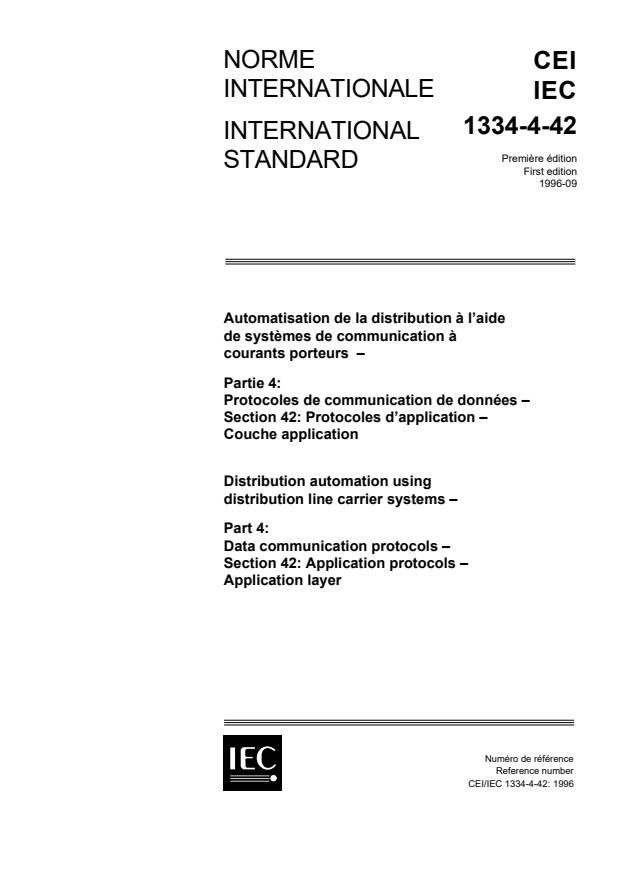
(Main)Distribution automation using distribution line carrier systems -Part 4: Data communication protocols - Section 42: Applicationprotocols - Application layer
Distribution automation using distribution line carrier systems -Part 4: Data communication protocols - Section 42: Applicationprotocols - Application layer
Describes the rules used to design an application service element, the ISO connectionless ACSE (Application Control Service Element), and the DLMS Application Service Element.
This publication is of high relevance for Smart Grid.
Automatisation de la distribution à l'aide de systèmes decommunication à courants porteurs - Partie 4: Protocoles decommunication de données - Section 42: Protocoles d'application -Couche application
Décrit les règles utilisées pour définir les éléments de service d'une application, les ACSE de l'ISO en mode sans connexion, et "DLMS Application Service Element" (éléments de service d'application de DLMS).
General Information
- Status
- Published
- Publication Date
- 08-Oct-1996
- Technical Committee
- TC 57 - Power systems management and associated information exchange
- Drafting Committee
- WG 9 - TC 57/WG 9
- Current Stage
- PPUB - Publication issued
- Start Date
- 09-Oct-1996
- Completion Date
- 30-Sep-1996
Overview
IEC 61334-4-42:1996 is an essential international standard developed by the International Electrotechnical Commission (IEC) for the automation of electrical distribution using distribution line carrier (DLC) systems. This part of the IEC 61334 series specifically addresses the data communication protocols at the application layer. Its primary purpose is to define the rules for designing an application service element, covering both the ISO connectionless Application Control Service Element (ACSE) and the DLMS (Device Language Message Specification) Application Service Element. The document’s framework is highly relevant for the evolving Smart Grid sector, providing robust guidance for reliable, interoperable, and efficient communication across electrical distribution networks.
Key Topics
- Application Layer Design: Defines concepts for structuring communication at the application layer, including application processes, entities, and associations.
- DLMS and ACSE Usage: Details how the DLMS Application Service Element and ISO’s connectionless ACSE are implemented for DLC systems.
- Naming, Addressing, and Service Conventions: Establishes references and definitions for naming, addressing, service types (confirmed, non-confirmed), and procedures critical to standardized operations.
- Message Structure and Encoding: Outlines usage and mapping of protocol data units, abstract syntax specification, and encoding rules for efficient message processing.
- Interoperability Rules: Provides structuring rules to ensure interoperability and potential extensions to other communication media or additional protocol layers.
- Smart Grid Enablement: Supports advanced distribution automation applications, underpinning core smart grid functionalities.
Applications
IEC 61334-4-42:1996’s guidelines serve a range of practical applications in the domain of distribution automation, including but not limited to:
- Remote Control and Monitoring: Enables utilities to efficiently control and supervise distribution network devices such as switches, breakers, and transformers using carrier-based data transmission.
- Smart Grid Components: Supports data exchange for smart metering, demand response, and distributed energy resources within smart grid environments.
- Public Infrastructure: Facilitates control of public lighting systems, road traffic lights, and other municipal utilities over existing power lines, reducing the need for additional communication cabling.
- Automatic Meter Reading (AMR): Provides the foundation for automatic, remote collection of consumption data, enhancing billing accuracy and operational efficiency.
- Order Broadcast and Customer Interface Control: Allows for effective sending of control commands and interaction with customer premises equipment using standardized protocols.
The standard is applicable to both low and medium voltage distribution networks, ensuring scalable, future-proof solutions for current and upcoming utility communication needs.
Related Standards
IEC 61334-4-42 works in conjunction with a broader family of IEC and ISO standards, ensuring comprehensive coverage and interoperability in automated distribution networks:
- IEC 61334-4-1: Reference model for DLC communication systems.
- IEC 61334-4-32: Specifies data link layer logical link control for DLC systems.
- IEC 61334-4-41: Focuses on distribution line message specifications at the application protocol level.
- ISO 7498 and ISO 7498-3: Define the OSI reference model, naming, and addressing principles.
- ISO/IEC 9545: Outlines the application layer structure in open systems interconnection.
- ISO/IEC 8824 and 8825: Detail Abstract Syntax Notation One (ASN.1) and its encoding rules for data communication.
- ISO 8649 and Amendment 2: Set requirements for the Association Control Service Element, including connectionless-mode service.
Practical Value
By providing structured, internationally-recognized rules for application layer protocols in distribution automation, IEC 61334-4-42:1996 enables the deployment of interoperable, scalable, and efficient smart grid communication solutions. Utilities, system integrators, and equipment manufacturers benefit from enhanced reliability, robust data exchange, and simplified integration across diverse infrastructures-all critical for the digital transformation of power distribution networks. This standard is a cornerstone document for any organization involved in Smart Grid automation, smart metering systems, and distribution line carrier communications.
Get Certified
Connect with accredited certification bodies for this standard

IMQ S.p.A. (Certification)
Italian electrical product certification.

SLG Prüf- und Zertifizierungs GmbH
German testing and certification body.

UL Solutions
Global safety science company with testing, inspection and certification.
Sponsored listings
Frequently Asked Questions
IEC 61334-4-42:1996 is a standard published by the International Electrotechnical Commission (IEC). Its full title is "Distribution automation using distribution line carrier systems -Part 4: Data communication protocols - Section 42: Applicationprotocols - Application layer". This standard covers: Describes the rules used to design an application service element, the ISO connectionless ACSE (Application Control Service Element), and the DLMS Application Service Element. This publication is of high relevance for Smart Grid.
Describes the rules used to design an application service element, the ISO connectionless ACSE (Application Control Service Element), and the DLMS Application Service Element. This publication is of high relevance for Smart Grid.
IEC 61334-4-42:1996 is classified under the following ICS (International Classification for Standards) categories: 29.240.20 - Power transmission and distribution lines; 33.200 - Telecontrol. Telemetering. The ICS classification helps identify the subject area and facilitates finding related standards.
IEC 61334-4-42:1996 is available in PDF format for immediate download after purchase. The document can be added to your cart and obtained through the secure checkout process. Digital delivery ensures instant access to the complete standard document.
Standards Content (Sample)
NORME
CEI
INTERNATIONALE
IEC
1334-4-42
INTERNATIONAL
Première édition
STANDARD
First edition
1996-09
Automatisation de la distribution à l’aide
de systèmes de communication à
courants porteurs –
Partie 4:
Protocoles de communication de données –
Section 42: Protocoles d’application –
Couche application
Distribution automation using
distribution line carrier systems –
Part 4:
Data communication protocols –
Section 42: Application protocols –
Application layer
Numéro de référence
Reference number
CEI/IEC 1334-4-42: 1996
Validité de la présente publication Validity of this publication
Le contenu technique des publications de la CEI est cons- The technical content of IEC publications is kept under
tamment revu par la CEI afin qu'il reflète l'état actuel de constant review by the IEC, thus ensuring that the content
la technique. reflects current technology.
Des renseignements relatifs à la date de reconfirmation de Information relating to the date of the reconfirmation of the
la publication sont disponibles auprès du Bureau Central de publication is available from the IEC Central Office.
la CEI.
Les renseignements relatifs à ces révisions, à l'établis- Information on the revision work, the issue of revised
sement des éditions révisées et aux amendements peuvent editions and amendments may be obtained from IEC
être obtenus auprès des Comités nationaux de la CEI et National Committees and from the following IEC
dans les documents ci-dessous: sources:
• Bulletin de la CEI • IEC Bulletin
• Annuaire de la CEI • IEC Yearbook
Publié annuellement Published yearly
• Catalogue des publications de la CEI • Catalogue of IEC publications
Publié annuellement et mis à jour régulièrement Published yearly with regular updates
Terminologie Terminology
En ce qui concerne la terminologie générale, le lecteur se For general terminology, readers are referred to IEC 50:
reportera à la CEI 50: Vocabulaire Electrotechnique Inter- International Electrotechnical Vocabulary (IEV), which is
national (VEI), qui se présente sous forme de chapitres issued in the form of separate chapters each dealing
séparés traitant chacun d'un sujet défini. Des détails with a specific field. Full details of the IEV will be
complets sur le VEI peuvent être obtenus sur demande. supplied on request. See also the IEC Multilingual
Voir également le dictionnaire multilingue de la CEI. Dictionary.
Les termes et définitions figurant dans la présente publi- The terms and definitions contained in the present publi-
cation ont été soit tirés du VEI, soit spécifiquement cation have either been taken from the IEV or have been
approuvés aux fins de cette publication. specifically approved for the purpose of this publication.
Symboles graphiques et littéraux Graphical and letter symbols
Pour les symboles graphiques, les symboles littéraux et les For graphical symbols, and letter symbols and signs
signes d'usage général approuvés par la CEI, le lecteur approved by the IEC for general use, readers are referred to
consultera: publications:
– la CEI 27: Symboles littéraux à utiliser en – IEC 27: Letter symbols to be used in electrical
électro-technique; technology;
– la CEI 417: Symboles graphiques utilisables – IEC 417: Graphical symbols for use on
sur le matériel. Index, relevé et compilation des equipment. Index, survey and compilation of the
feuilles individuelles; single sheets;
– la CEI 617: Symboles graphiques pour schémas; – IEC 617: Graphical symbols for diagrams;
et pour les appareils électromédicaux, and for medical electrical equipment,
– la CEI 878: Symboles graphiques pour – IEC 878: Graphical symbols for electromedical
équipements électriques en pratique médicale. equipment in medical practice.
Les symboles et signes contenus dans la présente publi- The symbols and signs contained in the present publication
cation ont été soit tirés de la CEI 27, de la CEI 417, de la have either been taken from IEC 27, IEC 417, IEC 617
CEI 617 et/ou de la CEI 878, soit spécifiquement approuvés and/or IEC 878, or have been specifically approved for the
aux fins de cette publication. purpose of this publication.
Publications de la CEI établies par le IEC publications prepared by the same
même comité d'études technical committee
L'attention du lecteur est attirée sur les listes figurant à la fin The attention of readers is drawn to the end pages of this
de cette publication, qui énumèrent les publications de la publication which list the IEC publications issued by the
CEI préparées par le comité d'études qui a établi la technical committee which has prepared the present
présente publication. publication.
NORME
CEI
INTERNATIONALE
IEC
1334-4-42
INTERNATIONAL
Première édition
STANDARD
First edition
1996-09
Automatisation de la distribution à l’aide
de systèmes de communication à
courants porteurs –
Partie 4:
Protocoles de communication de données –
Section 42: Protocoles d’application –
Couche application
Distribution automation using
distribution line carrier systems –
Part 4:
Data communication protocols –
Section 42: Application protocols –
Application layer
CEI 1996 Droits de reproduction réservés Copyright - all rights reserved
Aucune partie de cette publication ne peut être reproduite ni No part of this publication may be reproduced or utilized
utilisée sous quelque forme que ce soit et par aucun procédé, in any form or by any means, electronic or mechanical,
électronique ou mécanique, y compris la photocopie et les including photocopying and microfilm, without permission
microfilms, sans l'accord écrit de l'éditeur. in writing from the publisher
Bureau central de la Commission Electrotechnique Internationale 3, rue de Varembé Genève, Suisse
CODE PRIX
Commission Electrotechnique Internationale
X
International Electrotechnical Commission PRICE CODE
Pour prix, voir catalogue en vigueur
For price, see current catalogue
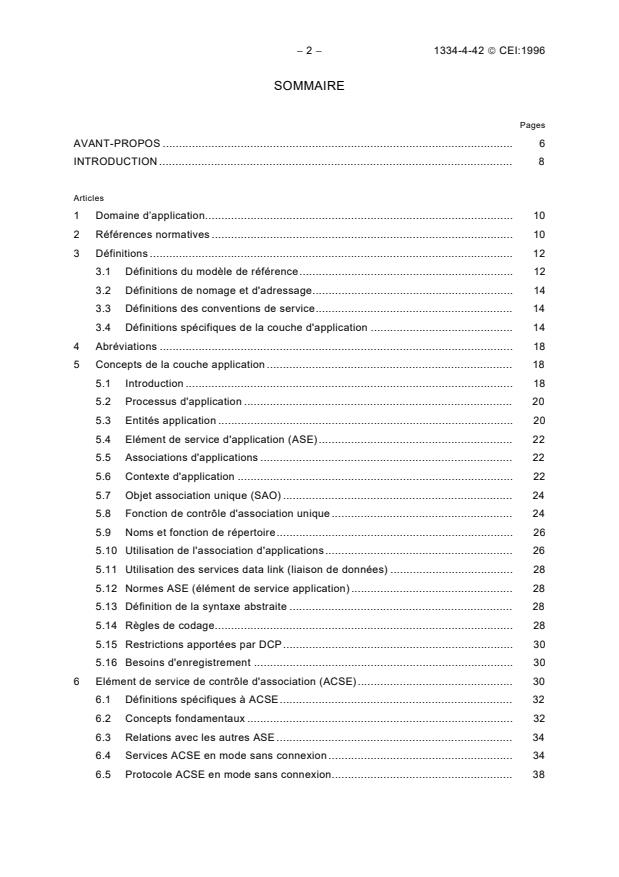
− 2 − 1334-4-42 CEI:1996
SOMMAIRE
Pages
AVANT-PROPOS . 6
INTRODUCTION . 8
Articles
1 Domaine d’application. 10
2 Références normatives . 10
3 Définitions. 12
3.1 Définitions du modèle de référence. 12
3.2 Définitions de nomage et d'adressage. 14
3.3 Définitions des conventions de service. 14
3.4 Définitions spécifiques de la couche d'application . 14
4 Abréviations. 18
5 Concepts de la couche application . 18
5.1 Introduction. 18
5.2 Processus d'application. 20
5.3 Entités application. 20
5.4 Elément de service d'application (ASE). 22
5.5 Associations d'applications. 22
5.6 Contexte d'application. 22
5.7 Objet association unique (SAO) . 24
5.8 Fonction de contrôle d'association unique . 24
5.9 Noms et fonction de répertoire. 26
5.10 Utilisation de l'association d'applications. 26
5.11 Utilisation des services data link (liaison de données) . 28
5.12 Normes ASE (élément de service application) . 28
5.13 Définition de la syntaxe abstraite . 28
5.14 Règles de codage. 28
5.15 Restrictions apportées par DCP. 30
5.16 Besoins d'enregistrement. 30
6 Elément de service de contrôle d'association (ACSE). 30
6.1 Définitions spécifiques à ACSE. 32
6.2 Concepts fondamentaux. 32
6.3 Relations avec les autres ASE . 34
6.4 Services ACSE en mode sans connexion . 34
6.5 Protocole ACSE en mode sans connexion. 38
1334-4-42 IEC:1996 − 3 −
CONTENTS
Page
FOREWORD . 7
INTRODUCTION . 9
Clause
1 Scope. 11
2 Normative references. 11
3 Definitions. 13
3.1 Reference model definitions. 13
3.2 Naming and addressing definitions . 15
3.3 Service conventions definitions. 15
3.4 Application layer specific definitions. 15
4 Abbreviations. 19
5 Application layer concepts . 19
5.1 Introduction. 19
5.2 Application processes. 21
5.3 Application entities. 21
5.4 Application service elements. 23
5.5 Application-associations. 23
5.6 Application context. 23
5.7 Single association object . 25
5.8 Single association control function . 25
5.9 Names and directory functions. 27
5.10 Use of application-association . 27
5.11 Use of the data link services . 29
5.12 Application service element standards . 29
5.13 Abstract syntax definition. 29
5.14 Encoding rules . 29
5.15 DCP restrictions . 31
5.16 Registration requirements. 31
6 Association control service element (ACSE). 31
6.1 ACSE specific definitions. 33
6.2 Basic concepts. 33
6.3 Relationship with other ASEs. 35
6.4 Connectionless-mode ACSE service . 35
6.5 Connectionless-mode ACSE protocol. 39
− 4 − 1334-4-42 CEI:1996
Articles Pages
7 Entité application de DLMS. 42
7.1 Généralités. 42
7.2 Structure générale. 42
7.3 L'ASE client-DLMS. 50
7.4 L'ASE serveur-DLMS. 50
8 Eléments de procédure du protocole . 52
8.1 Conventions de description. 52
8.2 Correspondance avec ACSE et les services data link (liaison de données) . 52
8.3 Entrée et sortie de l'environnement DLMS . 56
8.4 Exploitation dans l'environnement DLMS. 66
Annexes
A Contexte d'application par défaut . 84
B Bibliographie . 88
1334-4-42 IEC:1996 − 5 −
Clause Page
7 DLMS application entity . 43
7.1 Overview. 43
7.2 General structure. 43
7.3 Client-DLMS ASE. 51
7.4 Server-DLMS ASE. 51
8 Elements of protocol procedure . 53
8.1 Descriptive convention. 53
8.2 Mapping to ACSE and data link services . 53
8.3 Entering and leaving the DLMS environment. 57
8.4 Operating in the DLMS environment . 67
Annexes
A Default application context. 85
B Bibliography . 89
− 6 − 1334-4-42 CEI:1996
COMMISSION ÉLECTROTECHNIQUE INTERNATIONALE
____________
AUTOMATISATION DE LA DISTRIBUTION À L’AIDE DE SYSTÈMES
DE COMMUNICATION À COURANTS PORTEURS –
Partie 4: Protocoles de communication de données –
Section 42: Protocoles d’application – Couche application
AVANT-PROPOS
1) La CEI (Commission Electrotechnique Internationale) est une organisation mondiale de normalisation
composée de l'ensemble des comités électrotechniques nationaux (Comités nationaux de la CEI). La CEI a
pour objet de favoriser la coopération internationale pour toutes les questions de normalisation dans les
domaines de l'électricité et de l'électronique. A cet effet, la CEI, entre autres activités, publie des Normes
Internationales. Leur élaboration est confiée à des comités d'études, aux travaux desquels tout Comité
national intéressé par le sujet traité peut participer. Les organisations internationales, gouvernementales et
non gouvernementales, en liaison avec la CEI, participent également aux travaux. La CEI collabore
étroitement avec l'Organisation Internationale de Normalisation (ISO), selon des conditions fixées par accord
entre les deux organisations.
2) Les décisions ou accords officiels de la CEI concernant les questions techniques, représentent, dans la
mesure du possible un accord international sur les sujets étudiés, étant donné que les Comités nationaux
intéressés sont représentés dans chaque comité d’études.
3) Les documents produits se présentent sous la forme de recommandations internationales. Ils sont publiés
comme normes, rapports techniques ou guides et agréés comme tels par les Comités nationaux.
4) Dans le but d'encourager l'unification internationale, les Comités nationaux de la CEI s'engagent à appliquer
de façon transparente, dans toute la mesure possible, les Normes internationales de la CEI dans leurs normes
nationales et régionales. Toute divergence entre la norme de la CEI et la norme nationale ou régionale
correspondante doit être indiquée en termes clairs dans cette dernière.
5) La CEI n’a fixé aucune procédure concernant le marquage comme indication d’approbation et sa
responsabilité n’est pas engagée quand un matériel est déclaré conforme à l’une de ses normes.
6) L’attention est attirée sur le fait que certains des éléments de la présente Norme internationale peuvent faire
l’objet de droits de propriété intellectuelle ou de droits analogues. La CEI ne saurait être tenue pour
responsable de ne pas avoir identifié de tels droits de propriété et de ne pas avoir signalé leur existence.
La Norme internationale CEI 1334-4-42 a été établie par le comité d’études 57 de la CEI:
Conduite des systèmes de puissance et communications associées.
Le texte de cette norme est issu des documents suivants:
FDIS Rapport de vote
57/265/FDIS 57/293/RVD
Le rapport de vote indiqué dans le tableau ci-dessus donne toute information sur le vote ayant
abouti à l'approbation de cette norme.
L’annexe A fait partie intégrante de cette norme.
L’annexe B est donnée uniquement à titre d’information.
1334-4-42 IEC:1996 − 7 −
INTERNATIONAL ELECTROTECHNICAL COMMISSION
_________
DISTRIBUTION AUTOMATION USING DISTRIBUTION
LINE CARRIER SYSTEMS –
Part 4: Data communication protocols –
Section 42: Application protocols − Application layer
FOREWORD
1) The IEC (International Electrotechnical Commission) is a worldwide organization for standardization
comprising all national electrotechnical committees (IEC National Committees). The object of the IEC is to
promote international co-operation on all questions concerning standardization in the electrical and electronic
fields. To this end and in addition to other activities, the IEC publishes International Standards. Their
preparation is entrusted to technical committees; any IEC National Committee interested in the subject dealt
with may participate in this preparatory work. International, governmental and non-governmental organizations
liaising with the IEC also participate in this preparation. The IEC collaborates closely with the International
Organization for Standardization (ISO) in accordance with conditions determined by agreement between the
two organizations.
2) The formal decisions or agreements of the IEC on technical matters express, as nearly as possible, an
international consensus of opinion on the relevant subjects since each technical committee has representation
from all interested National Committees.
3) The documents produced have the form of recommendations for international use and are published in the
form of standards, technical reports or guides and they are accepted by the National Committees in that
sense.
4) In order to promote international unification, IEC National Committees undertake to apply IEC International
Standards transparently to the maximum extent possible in their national and regional standards. Any
divergence between the IEC Standard and the corresponding national or regional standard shall be clearly
indicated in the latter.
5) The IEC provides no marking procedure to indicate its approval and cannot be rendered responsible for any
equipment declared to be in conformity with one of its standards.
6) Attention is drawn to the possibility that some of the elements of this International Standard may be the
subject of patent rights. The IEC shall not be held responsible for identifying any or all such patent rights.
International Standard IEC 1334-4-42 has been prepared by IEC technical committee 57:
Power system control and associated communications.
The text of this standard is based on the following documents:
FDIS Report on voting
57/265/FDIS 57/293/RVD
Full information on the voting for the approval of this standard can be found in the report on
voting indicated in the above table.
Annex A forms an integral part of this standard.
Annex B is for information only.
− 8 − 1334-4-42 CEI:1996
INTRODUCTION
La couche application supporte la spécification d'applications DLMS ainsi que la gestion des
applications de chaque station. DCP (protocole de communication de données) utilise les
normes ISO ACSE (éléments de service de contrôle d'association) en mode sans connexion,
ainsi que les éléments de services d'applications de DLMS et la gestion.
1334-4-42 IEC:1996 − 9 −
INTRODUCTION
The application layer supports the DLMS application specification and the management
application of each station. DCP makes use of the connectionless ACSE ISO standards and of
the application service elements DLMS and management.
− 10 − 1334-4-42 CEI:1996
AUTOMATISATION DE LA DISTRIBUTION À L’AIDE DE SYSTÈMES
DE COMMUNICATION À COURANTS PORTEURS –
Partie 4: Protocoles de communication de données –
Section 42: Protocoles d’application – Couche application
1 Domaine d’application
Les spécifications fournies dans les sections de la CEI 1334-4 s’appliquent à la communication
par la technique dite des courants porteurs (DLC), à la fois sur les réseaux basse et moyenne
tension. La palette d'applications servies par ce procédé de communication est étendue et ne
saurait être décrite de façon exhaustive dans la présente section; on peut citer à titre
d'exemple le contrôle et la surveillance de réseaux de distribution, la diffusion de commandes,
le contrôle des interfaces clientèles, de l'éclairage public, la supervision des feux de
signalisation routière, le relevé automatique de compteurs, etc.
La présente section de la CEI 1334-4 décrit les règles utilisées pour définir les éléments de
service d'une application, les ACSE de l'ISO en mode sans connection, et "DLMS Application
Service Element" (éléments de service d'application de DLMS).
Des extensions à d'autres supports de communication sont également autorisés.
L'interfaçage des services DLMS est basé sur une pile de protocoles à trois couches. Des
extensions futures à des piles de protocoles de plus de trois couches sont possibles et peuvent
utiliser les règles décrites dans la présente section. Dans un tel cas, l'interface DLMS avec les
couches inférieures devrait être modifiée: la spécification des critères d'interfaçage sera traitée
dans des annexes correspondantes, toujours en respectant les règles définies dans la présente
section.
2 Références normatives
Les documents normatifs suivants contiennent des dispositions qui, par suite de la référence
qui y est faite, constituent des dispositions valables pour la présente section de la CEI 1334-4.
Au moment de la publication, les éditions indiquées étaient en vigueur. Tout document normatif
est sujet à révision et les parties prenantes aux accords fondés sur la présente section de la
CEI 1334-4 sont invitées à rechercher la possibilité d'appliquer les éditions les plus récentes
des documents normatifs indiqués ci-après. Les membres de la CEI et de l'ISO possèdent le
registre des Normes internationales en vigueur.
Automatisation de la distribution à l’aide de systèmes de communication à
CEI 1334-4-1: 1996,
courants porteurs – Partie 4: Protocoles de communication de données − Section 1: Modèle de
référence du système de communication
CEI 1334-4-32: 1996, Automatisation de la distribution à l’aide de systèmes de communication
à courants porteurs – Partie 4: Protocoles de communication de données − Section 32: Couche
liaison de données − Contrôle de liaison logique (LLC)
CEI 1334-4-41: 1996, Automatisation de la distribution à l’aide de systèmes de communication
à courants porteurs – Partie 4: Protocoles de communication de données − Section 41:
Protocoles d'application − Spécification des messages de ligne de distribution
1334-4-42 IEC:1996 − 11 −
DISTRIBUTION AUTOMATION USING DISTRIBUTION
LINE CARRIER SYSTEMS –
Part 4: Data communication protocols –
Section 42: Application protocols − Application layer
1 Scope
The specifications of the sections of IEC 1334-4 apply to the communication through the so-
called distribution line carrier technology (DLC) on both low and medium voltage distribution
networks. The application range based on telecommunication processes is wide and cannot be
described exhaustively in this section; application examples are: control and monitoring of the
distribution network, order broadcast, control of user interfaces, public lighting, traffic lights
supervision, automatic meter reading, etc.
This section of IEC 1334-4 describes the rules used to design an application service element,
the ISO connectionless ACSE, and the DLMS Application Service Element.
Extensions to other communication media are also allowed.
The mapping of the DLMS services is based on the three-layer stack. Future extensions to
stacks of more than three layers are possible and may use the rules described in this section.
In such a case, the DLMS interface with the underlying layers should be remapped to the new
one: the specification of the mapping criteria will be dealt with in corresponding appendices, in
respect of the rules defined in this section.
2 Normative references
The following normative documents contain provisions which, through reference in this text,
constitute provisions of this section of IEC 1334-4. At the time of publication, the editions
indicated were valid. All normative documents are subject to revision, and parties to
agreements based on this section of IEC 1334-4 are encouraged to investigate the possibility of
applying the most recent editions of the normative documents indicated below. Members of IEC
and ISO maintain registers of currently valid International Standards.
IEC 1334-4-1:1996, Distribution automation using distribution line carrier systems – Part 4:
Data communication protocols – Section 1: Reference model of the communication system
IEC 1334-4-32: 1996, Distribution automation using distribution line carrier systems – Part 4:
Data communication protocols – Section 32: Data link layer − Logical link control (LLC)
IEC 1334-4-41: 1996, Distribution automation using distribution line carrier systems – Part 4:
Data communication protocols – Section 41: Application protocols – Distribution line message
specification
− 12 − 1334-4-42 CEI:1996
ISO 7498: 1984, Systèmes de traitement de l'information – Interconnexion des systèmes
ouverts – Modèle de référence de base
ISO 7498-3: 1989, Systèmes de traitement de l'information – Interconnexion de systèmes
ouverts – Modèle de référence de base – Partie 3: Dénomination et adressage
ISO/TR 8509: 1987, Systèmes de traitement de l'information – Interconnexion de systèmes
ouverts – Conventions de service
ISO 8649: 1988, Systèmes de traitement de l'information – Interconnexion de systèmes ouverts
– Définition du service pour l'élément de service de contrôle d'association
Amendement 2 (1991): Service ACSE en mode sans connexion
ISO/IEC 8824: 1990, Technologies de l'information – Interconnexion de systèmes ouverts –
Spécification de la notation de syntaxe abstraite numéro 1 (ASN.1)
(Publiée actuellement en anglais seulement)
ISO/IEC 8825: 1990, Technologies de l’information – Interconnexion de systèmes ouverts –
Spécification de règles de base pour coder la notation de syntaxe abstraite numéro une
(ASN.1)
(Publiée actuellement en anglais seulement)
ISO/IEC 9545: 1994, Systèmes de traitement de l'information – Interconnexion de systèmes
ouverts (OSI) – Structure de la couche application
(Publiée actuellement en anglais seulement)
3 Définitions
Pour les besoins de la présente Norme internationale, les définitions suivantes s'appliquent:
3.1 Définitions du modèle de référence
La présente section est basée sur des concepts développés dans l'ISO 7498 et utilise les
termes suivants qui y sont définis:
a) couche application;
b) processus d'application;
c) entité d'application;
d) (N)-function (fonction (N));
e) (N)-layer (couche (N));
f) (N)-protocol (protocole (N));
g) (N)-protocol-control-information (information de contrôle du protocole (N));
h) (N)-protocol-data-unit (unité de données de protocole (N));
i) système ouvert réel.
1334-4-42 IEC:1996 − 13 −
ISO 7498: 1984, Information processing systems − Open Systems Interconnection – Basic
Reference Model
ISO 7498-3: 1989, Information processing systems − Open Systems Interconnection – Basic
Reference Model – Part 3: Naming and Addressing
ISO/TR 8509: 1987, Information processing systems − Open Systems Interconnection –
Services conventions
ISO 8649: 1988, Information processing systems − Open Systems Interconnection – Service
definition for the Association Control Service Element
Amendment 2 (1991): Connectionless-mode ACSE service
ISO/IEC 8824: 1990, Information technology − Open Systems Interconnection − Specification of
Abstract Syntax Notation One (ASN.1)
ISO/IEC 8825: 1990, Information technology – Open Systems Interconnection – Specification of
Basic Encoding Rules for Abstract Syntax Notation One (ASN.1)
ISO/IEC 9545: 1994, Information technology – Open Systems Interconnection – Application
layer structure
3 Definitions
For the purposes of this International Standard, the following definitions apply:
3.1 Reference model definitions
This section is based on the concepts developed in ISO 7498 and makes use of the following
terms defined in it:
a) application layer;
b) application process;
c) application entity;
d) (N) – function;
e) (N) – layer;
f) (N) – protocol;
g) (N) – protocol-control-information;
h) (N) – protocol-data-unit;
i) real open system.
− 14 − 1334-4-42 CEI:1996
3.2 Définitions de nomage et d'adressage
La présente section utilise les termes suivants:
a) titre d'un processus d'application;
b) qualificateur d'entité d'application;
c) titre d'une entité application;
d)application-process invocation-identifier (identificateur d'invocation de processus
d'application);
e) application-entity invocation-identifier (identificateur d'invocation d'entité application).
3.3 Définitions des conventions de service
La présente section utilise les termes suivants définis dans l'ISO/TR 8509:
a) fournisseur de service;
b) utilisateur d'un service;
c) service confirmé;
d) service non confirmé;
e) service initialisé par le fournisseur;
f) primitive;
g) primitive de demande;
h) primitive d'indication;
i) primitive de réponse;
j) primitive de confirmation.
3.4 Définitions spécifiques de la couche d'application
3.4.1 L'association application-association
Relation coopérative entre deux entités application, constituée par l'échange des application-
protocol-control-information (information de contrôle de protocole d'application) à l'aide des
services data link (liaison de données). Elle rend possible la communication d'information ainsi
que la coordination de leur exploitation conjointe pour un cas de communication.
3.4.2 Contexte d’application
Ensemble identifié explicitement d’application-service-éléments (éléments de service
d'application) relatifs aux choix et règles partagés par deux invocations d'entités application,
nécessaires à l'interfonctionnement des entités application d'une association d'application.
3.4.3 Application-directory-function (fonction de répertoire d'application)
Fonction d'application qui traite des adresses de liaison de données, des titres d'entité
d'application, de l'information d'adressage du protocole d'application afin détablir une
correspondance entre ces catégories d'informations.
3.4.4 Application-entity-invocation (invocation d'entité application)
Utilisation spécifique de tout ou partie des capacités d'une entité application en support des
exigences de communication d'une invocation de processus d'application.
1334-4-42 IEC:1996 − 15 −
3.2 Naming and addressing definitions
This section makes use of the following terms:
a) application-process title;
b) application-entity qualifier;
c) application-entity title;
d) application-process invocation-identifier;
e) application-entity invocation-identifier.
3.3 Service conventions definitions
This section makes use of the following terms defined in ISO/TR 8509:
a) service-provider;
b) service-user;
c) confirmed service;
d) non-confirmed service;
e) provider-initiated service;
f) primitive;
g) request (primitive);
h) indication (primitive);
i) response (primitive);
j) confirm (primitive).
3.4 Application layer specific definitions
3.4.1 Application-association, association
A co-operative relationship between two applications-entities, formed by their exchange of
application-protocol-control-information through their use of data link services. The relationship
enables the communication of information and the co-ordination of their joint operation for an
instance of communication.
3.4.2 Application context
An explicitly identified set of application-service-elements, related options and rules shared in
common by two application entity-invocations that are necessary for the interworking of
application-entities in an application-association.
3.4.3 Application-directory-function
An application-function that processes data link addresses, application-entity-titles, and
application-protocol-addressing-information to provide mapping among these categories of
information.
3.4.4 Application-entity-invocation
A specific use of part or all of the capabilities of a given application-entity in support of the
communications requirements of an application-process-invocation.
− 16 − 1334-4-42 CEI:1996
3.4.5 Application-entity-type (type d'entité application)
Ensemble spécifique (dit type) de fonctions d'entité application qui partagent des
caractéristiques communes. Un tel type peut être référencé par un nom.
3.4.6 Application-function (fonction d’application)
Partie autonome identifiable de l'activité d'une entité application.
3.4.7 Application-process-invocation (invocation d’un processus d’application)
Utilisation spécifique de tout ou partie des capacités d'un processus d'application à l'occasion
d'une utilisation spécifique de traitement de l'information.
3.4.8 Application-process-type (type de processus d’application)
Ensemble spécifique (dit type) de fonctions de processus d'application qui partagent des
caractéristiques communes et qui peuvent être référencées par un nom.
3.4.9 Application-protocol (protocole d’application)
Ensemble de règles et de formats (sémantiques et syntaxiques) qui détermine le comportement
en communication d'une entité application dans l'accomplissement d'une fonction application.
3.4.10 Application-protocol-addressing-information (information d’adressage de protocole
d’application)
Les éléments des protocoles d'application qui contiennent des informations d'adressage.
3.4.11 Application-protocol-control-information (information de contrôle de protocole
application)
L'information échangée entre les entités application utilisant le service data link (liaison de
données) pour coordonner leur exploitation conjointe. Ces informations sont contenues dans
les unités de protocole d'application (application PDU)
3.4.12 Application-protocol-data-unit (unité de données du protocole application)
Unité d'information, spécifiée dans un protocole application, qui se compose d'informations de
contrôle de protocole application et éventuellement d'informations des utilisateurs.
3.4.13 Application-service-element (ASE) (élément de service d'application)
Ensemble de fonctions qui fournissent à des invocations d'entités application qui
interfonctionnent, des moyens satisfaisant des besoins spécifiques pour une seule association
d'applications.
NOTE −Cette définition telle qu'elle est spécifiée dans l'ISO/IEC 9545 affine la définition originale d'élément
de service d'application dans l'ISO 7498.
3.4.14 Association-control-service-element (élément de service de contrôle d'association)
Elément de service d'application qui fournit le seul moyen consistant pour établir et terminer
toutes les associations d'applications.
1334-4-42 IEC:1996 − 17 −
3.4.5 Application-entity-type
A specific set (called type) of application-entity functions that share common characteristics.
Such a type may be referenced with a name.
3.4.6 Application-function
An identifiable stand alone part of the activity of application-entities.
3.4.7 Application-process-invocation
A specific utilization of part or all of the capabilities of a given application-process in support of
a specific occasion of information processing.
3.4.8 Application-process-type
A specific set (called type) of application-process functions that share common characteristics.
Such a type may be referenced with a name.
3.4.9 Application-protocol
A set of rules and formats (semantic and syntactic) which determines the communication
behaviour of application-entities in the performance of application-functions.
3.4.10 Application-protocol-addressing-information
Those elements of the application-protocol-control-information which contain addressing
information.
3.4.11 Application-protocol-control-information
The information exchanged between application-entities using data link services, to co-ordinate
their joint operation. This information is contained in application-protocol-data-unit.
3.4.12 Application-protocol-data-unit
A unit of information, specified in an application-protocol, that consists of application-protocol-
control-information and, possibly, user information.
3.4.13 Application-service-element
A set of functions that provide a capability for the interworking of application-entity-invocations
for a specific purpose on a single application-association.
NOTE − This definition refines the original definition of application-service-elements in ISO 7498, but is as
specified in ISO/IEC 9545.
3.4.14 Association-control-service-element
An application-service-element that provides a single consistent means for establishing and
terminating all application-associations.
− 18 − 1334-4-42 CEI:1996
4 Abréviations
Pour les besoins de la présente Norme internationale, les abréviations suivantes s'appliquent:
AA :association d'applications;
ACSE : élément de service de contrôle d'association;
AE : entité application;
AEI : invocation d'entité application;
AP : processus d'application;
APAI : information d'adressage de protocole d'application;
APCI : information de contrôle de protocole d'application;
APDU : unité de données de protocole d'application;
ASE : élément de service d'application;
DASE : élément de service d'application DLMS;
DLMS : spécification de message de ligne de distribution;
OSI : interconnexion des systèmes ouverts.
5 Concepts de la couche application
Le présent article décrit les concepts de la couche application tels qu'ils sont décrits dans
l'ISO/IEC 9545.
Les concepts développés dans la présente norme ont été étudiés pour le modèle OSI à sept
couches dans le mode avec connexion. DCP utilise un modèle à trois couches et le mode sans
connexion, mais ces concepts s'appliquent toujours.
Cet article réutilise donc la plupart des concepts de l'ISO/IEC 9545 ainsi que la structure avec
les considérations suivantes:
– comme il n'y a pas de couche présentation, toutes les références à cette couche sont
supprimées et les fonctionnalités nécessaires sont fournies directement par la couche
application;
– la couche application utilise directement les services data link (liaison de données);
– l'ACSE référencé par la spécification DCP n'utilise que des services non confirmés tels
qu'ils sont définis dans l'amendement 2 de l'ISO 8649.
5.1 Introduction
Les normes OSI sont prévues pour satisfaire les besoins de communication des applications
(par exemple les tâches de traitement de l'information) qui demandent une coordination
d'activités de traitement dans deux ou plusieurs systèmes réels ouverts. En particulier, les
normes de la couche application de l'OSI définissent des procédures pour le support du
traitement distribué de l'information.
1334-4-42 IEC:1996 − 19 −
4 Abbreviations
For the purposes of this International Standard, the following abbreviations apply:
AA : application-association;
ACSE : association control service element;
AE : application entity;
AEI : application entity invocation;
AP : application process;
APAI : application protocol addressing information;
APCI : application protocol control information;
APDU : application protocol data unit;
ASE : application service element;
DASE : DLMS application service element;
DLMS : distribution line message specification;
OSI : open systems interconnection.
5 Application layer concepts
This clause describes the application layer concepts as they are defined in ISO/IEC 9545.
The concepts developed in this standard were designed for the seven layers connection
oriented OSI model. DCP makes use of a three layers connectionless model, but the concepts
still apply.
This specification, then, re-uses most of the ISO/IEC 9545 concepts and structure with the
following special considerations:
– because no presentation layer is available, all references to it are removed and its
necessary functionalities are performed directly by the application layer;
– the application layer makes a direct use of the data link services;
– the ACSE referenced by the DCP specification uses only unconfirmed services as defined
in the ISO 8649 amendment 2.
5.1 Introduction
Standards for OSI are intended to support the communication requirements of applications (that
is information processing tasks) requiring co-ordinated processing activities in two or more real
open systems. In particular, standards for the OSI application layer define procedures for the
support of distributed information processing.
− 20 − 1334-4-42 CEI:1996
La couche application est supportée par les couches de niveau
...
Questions, Comments and Discussion
Ask us and Technical Secretary will try to provide an answer. You can facilitate discussion about the standard in here.
Loading comments...