


IEC 61334-4-32:1996
(Main)Distribution automation using distribution line carrier systems - Part 4: Data communication protocols - Section 32: Data link layer - Logical link control (LLC)
Distribution automation using distribution line carrier systems - Part 4: Data communication protocols - Section 32: Data link layer - Logical link control (LLC)
Covers the services required of, or by, the DCP Logical Link Control (LLC) sublayer entity at the logical interfaces with the application layer and the MAC sublayer.
This publication is of high relevance for Smart Grid.
Automatisation de la distribution à l'aide de systèmes de communication à courants porteurs - Partie 4: Protocoles de communication de données - Section 32: Couche liaison de données - Contrôle de liaison logique (LLC)
Décrit pour une entité de sous-couche LLC, Logical Link Control, les services offerts à la couche application et les services demandés à la sous-couche MAC.
General Information
- Status
- Published
- Publication Date
- 25-Sep-1996
- Technical Committee
- TC 57 - Power systems management and associated information exchange
- Drafting Committee
- WG 9 - TC 57/WG 9
- Current Stage
- PPUB - Publication issued
- Start Date
- 26-Sep-1996
- Completion Date
- 30-Nov-1996
Overview
IEC 61334-4-32:1996 is an international standard published by the International Electrotechnical Commission (IEC) that specifies requirements for the Logical Link Control (LLC) sublayer as part of distribution automation using distribution line carrier (DLC) systems. This standard focuses specifically on the data link layer's logical link control aspects, detailing the services required at the logical interfaces between the application layer and the Media Access Control (MAC) sublayer.
Designed to support reliable and interoperable communication within automated distribution networks, this standard outlines the primitives, parameters, and service interactions necessary for robust data exchange. It is highly relevant to Smart Grid applications, where secure, efficient, and standardized communication protocols are essential to support automation, control, and monitoring across the power distribution infrastructure.
Key Topics
- Scope of LLC Sublayer: Defines the logical link control sublayer's responsibilities in providing services to the application layer and requesting services from the MAC sublayer, following the OSI reference model.
- Service Primitives: Specifies connectionless service primitives for transmitting and receiving packets, including:
- DL_Data.request, DL_Data.confirm, DL_Data.indication
- DL_Reply and DL_Update_Reply primitives for handling unsolicited data transfers
- DL_Broadcast.request for management and broadcast communication
- Interface Specifications: Details the information flow, including parameters such as source and destination addresses, link service access points (LSAP), and transmission statuses.
- Protocol Data Unit (PDU) Structure: Defines the formation and fields of LLC PDUs, enabling standardized data packaging for reliable transmission.
- Procedural Flows and State Tables: Outlines the operation sequences and state transitions for both sender and receiver entities in DLC communication systems.
- Interoperability Considerations: Provides for future expansion, including potential upgrades to connection-oriented transmission and additional protocol layers.
Applications
IEC 61334-4-32:1996 delivers crucial benefits for smart grid distribution automation systems by promoting standardized, interoperable communication:
- Smart Grid Communications: Enables automated control, monitoring, and protection functions within the electrical distribution network using distribution line carrier technology.
- Seamless Integration: Supports integration and interoperability between multi-vendor automation solutions by establishing common protocols at the data link layer.
- Remote Control and Monitoring: Facilitates real-time data transmission for status updates, fault detection, and event notifications, enhancing operational efficiency and reliability.
- Scalable Automation: Provides a framework for extending automation capabilities within distribution networks, accommodating new services and protocols as technology evolves.
- Efficient Resource Management: Supports broadcast and unsolicited messaging to enable efficient distribution of system information without excess network overhead.
Related Standards
To ensure consistency and interoperability, IEC 61334-4-32:1996 must be considered alongside related standards:
- IEC 61334-4-1: Reference model for distribution automation communication systems using distribution line carrier.
- ISO 7498: OSI Basic Reference Model - foundational for layer and sublayer structures in data communication.
- Other IEC 61334 standards: Parts and sections addressing physical, MAC, and application layers for comprehensive smart grid communication solutions.
These standards collectively enable the secure, efficient, and reliable operation of modern automated distribution networks, supporting the ongoing development of intelligent energy infrastructure.
By following IEC 61334-4-32:1996, utilities and solution vendors can implement robust data link layer protocols, laying the groundwork for advanced distribution automation and smart grid initiatives essential for resilient and efficient power delivery.
Get Certified
Connect with accredited certification bodies for this standard

IMQ S.p.A. (Certification)
Italian electrical product certification.

SLG Prüf- und Zertifizierungs GmbH
German testing and certification body.

UL Solutions
Global safety science company with testing, inspection and certification.
Sponsored listings
Frequently Asked Questions
IEC 61334-4-32:1996 is a standard published by the International Electrotechnical Commission (IEC). Its full title is "Distribution automation using distribution line carrier systems - Part 4: Data communication protocols - Section 32: Data link layer - Logical link control (LLC)". This standard covers: Covers the services required of, or by, the DCP Logical Link Control (LLC) sublayer entity at the logical interfaces with the application layer and the MAC sublayer. This publication is of high relevance for Smart Grid.
Covers the services required of, or by, the DCP Logical Link Control (LLC) sublayer entity at the logical interfaces with the application layer and the MAC sublayer. This publication is of high relevance for Smart Grid.
IEC 61334-4-32:1996 is classified under the following ICS (International Classification for Standards) categories: 29.240.20 - Power transmission and distribution lines; 33.200 - Telecontrol. Telemetering. The ICS classification helps identify the subject area and facilitates finding related standards.
IEC 61334-4-32:1996 is available in PDF format for immediate download after purchase. The document can be added to your cart and obtained through the secure checkout process. Digital delivery ensures instant access to the complete standard document.
Standards Content (Sample)
NORME
CEI
INTERNATIONALE
IEC
1334-4-32
INTERNATIONAL
Première édition
STANDARD
First edition
1996-09
Automatisation de la distribution à l’aide
de systèmes de communication à
courants porteurs –
Partie 4:
Protocoles de communication de données –
Section 32: Couche liaison de données –
Contrôle de liaison logique (LLC)
Distribution automation using
distribution line carrier systems –
Part 4:
Data communication protocols –
Section 32: Data link layer –
Logical link control (LLC)
Numéro de référence
Reference number
CEI/IEC 1334-4-32: 1996
Validité de la présente publication Validity of this publication
Le contenu technique des publications de la CEI est cons- The technical content of IEC publications is kept under
tamment revu par la CEI afin qu'il reflète l'état actuel de constant review by the IEC, thus ensuring that the content
la technique. reflects current technology.
Des renseignements relatifs à la date de reconfirmation de Information relating to the date of the reconfirmation of the
la publication sont disponibles auprès du Bureau Central de publication is available from the IEC Central Office.
la CEI.
Les renseignements relatifs à ces révisions, à l'établis- Information on the revision work, the issue of revised
sement des éditions révisées et aux amendements peuvent editions and amendments may be obtained from IEC
être obtenus auprès des Comités nationaux de la CEI et National Committees and from the following IEC
dans les documents ci-dessous: sources:
• Bulletin de la CEI • IEC Bulletin
• Annuaire de la CEI • IEC Yearbook
Publié annuellement Published yearly
• Catalogue des publications de la CEI • Catalogue of IEC publications
Publié annuellement et mis à jour régulièrement Published yearly with regular updates
Terminologie Terminology
En ce qui concerne la terminologie générale, le lecteur se For general terminology, readers are referred to IEC 50:
reportera à la CEI 50: Vocabulaire Electrotechnique Inter- International Electrotechnical Vocabulary (IEV), which is
national (VEI), qui se présente sous forme de chapitres issued in the form of separate chapters each dealing
séparés traitant chacun d'un sujet défini. Des détails with a specific field. Full details of the IEV will be
complets sur le VEI peuvent être obtenus sur demande. supplied on request. See also the IEC Multilingual
Voir également le dictionnaire multilingue de la CEI. Dictionary.
Les termes et définitions figurant dans la présente publi- The terms and definitions contained in the present publi-
cation ont été soit tirés du VEI, soit spécifiquement cation have either been taken from the IEV or have been
approuvés aux fins de cette publication. specifically approved for the purpose of this publication.
Symboles graphiques et littéraux Graphical and letter symbols
Pour les symboles graphiques, les symboles littéraux et les For graphical symbols, and letter symbols and signs
signes d'usage général approuvés par la CEI, le lecteur approved by the IEC for general use, readers are referred to
consultera: publications:
– la CEI 27: Symboles littéraux à utiliser en – IEC 27: Letter symbols to be used in electrical
électro-technique; technology;
– la CEI 417: Symboles graphiques utilisables – IEC 417: Graphical symbols for use on
sur le matériel. Index, relevé et compilation des equipment. Index, survey and compilation of the
feuilles individuelles; single sheets;
– la CEI 617: Symboles graphiques pour schémas; – IEC 617: Graphical symbols for diagrams;
et pour les appareils électromédicaux, and for medical electrical equipment,
– la CEI 878: Symboles graphiques pour – IEC 878: Graphical symbols for electromedical
équipements électriques en pratique médicale. equipment in medical practice.
Les symboles et signes contenus dans la présente publi- The symbols and signs contained in the present publication
cation ont été soit tirés de la CEI 27, de la CEI 417, de la have either been taken from IEC 27, IEC 417, IEC 617
CEI 617 et/ou de la CEI 878, soit spécifiquement approuvés and/or IEC 878, or have been specifically approved for the
aux fins de cette publication. purpose of this publication.
Publications de la CEI établies par le IEC publications prepared by the same
même comité d'études technical committee
L'attention du lecteur est attirée sur les listes figurant à la fin The attention of readers is drawn to the end pages of this
de cette publication, qui énumèrent les publications de la publication which list the IEC publications issued by the
CEI préparées par le comité d'études qui a établi la technical committee which has prepared the present
présente publication. publication.
NORME
CEI
INTERNATIONALE
IEC
1334-4-32
INTERNATIONAL
Première édition
STANDARD
First edition
1996-09
Automatisation de la distribution à l’aide
de systèmes de communication à
courants porteurs –
Partie 4:
Protocoles de communication de données –
Section 32: Couche liaison de données –
Contrôle de liaison logique (LLC)
Distribution automation using
distribution line carrier systems –
Part 4:
Data communication protocols –
Section 32: Data link layer –
Logical link control (LLC)
CEI 1996 Droits de reproduction réservés Copyright - all rights reserved
Aucune partie de cette publication ne peut être reproduite ni No part of this publication may be reproduced or utilized
utilisée sous quelque forme que ce soit et par aucun procédé, in any form or by any means, electronic or mechanical,
électronique ou mécanique, y compris la photocopie et les including photocopying and microfilm, without permission
microfilms, sans l'accord écrit de l'éditeur. in writing from the publisher
Bureau central de la Commission Electrotechnique Internationale 3, rue de Varembé Genève Suisse
CODE PRIX
Commission Electrotechnique Internationale
V
International Electrotechnical Commission PRICE CODE
Pour prix, voir catalogue en vigueur
For price, see current catalogue
− 2 − 1334-4-32 CEI:1996
SOMMAIRE
Pages
AVANT-PROPOS . 6
Articles
1 Généralités. 8
1.1 Domaine d'application et objet . 8
1.2 Références normatives. 8
2 Spécification des services LLC . 12
2.1 Description des interactions. 12
2.2 DL_Data.request. 16
2.3 DL_Data.confirm. 18
2.4 DL_Data.indication. 20
2.5 DL_Reply.request. 22
2.6 DL_Reply.confirm. 22
2.7 DL_Reply.indication. 24
2.8 DL_Update_Reply.request. 26
2.9 DL_Update_Reply.confirm. 28
2.10 DL_Update_Reply.indication. 30
2.11 DL_Broadcast.request. 30
3 Interface entre les sous-couches MAC et LLC . 32
3.1 Description des interactions. 32
3.2 Service MA_Data.request. 32
3.3 Service MA_Data.confirm. 34
3.4 MA_Data.indication. 34
4 Structure des unités de données LLC (LLC_PDU) . 36
4.1 Structure générale. 36
4.2 Format des LLC_PDU. 36
4.3 Champ de contrôle . 40
4.4 Champ adresse. 42
4.5 LLC_ PDU invalides. 44
5 Description des procédures LLC . 44
5.1 Description générale. 44
5.2 Tableaux d'états de l'émetteur et du récepteur . 46
5.3 Description des tableaux de transition d'état . 62
Tableaux
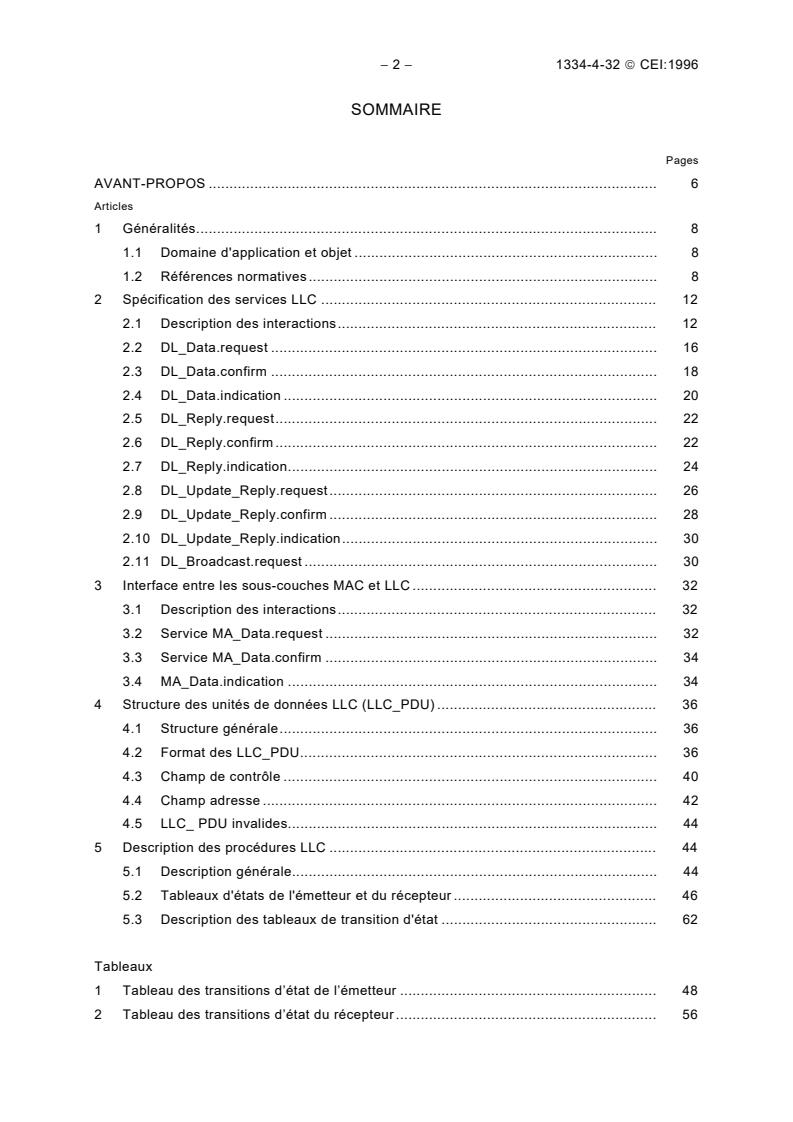
1 Tableau des transitions d’état de l’émetteur . 48
2 Tableau des transitions d’état du récepteur . 56
1334-4-32 IEC:1996 − 3 −
CONTENTS
Page
FOREWORD . 7
Clause
1 General. 9
1.1 Scope and object. 9
1.2 Normative references. 9
2 LLC service specification . 13
2.1 Overview of interactions . 13
2.2 DL_Data.request. 17
2.3 DL_Data.confirm. 19
2.4 DL_Data.indication. 21
2.5 DL_Reply.request. 23
2.6 DL_Reply.confirm. 23
2.7 DL_Reply.indication. 25
2.8 DL_Update_Reply.request. 27
2.9 DL_Update_Reply.confirm. 29
2.10 DL_Update_Reply.indication. 31
2.11 DL_Broadcast.request. 31
3 LLC to MAC sublayer interface . 33
3.1 Overview of interactions . 33
3.2 MA_Data.request. 33
3.3 MA_Data.confirm. 35
3.4 MA_Data.indication. 35
4 LLC protocol data unit structure (LLC_PDU). 37
4.1 General. 37
4.2 LLC_PDU format. 37
4.3 Control field. 41
4.4 Address field. 43
4.5 Invalid LLC_PDU. 45
5 LLC procedures description . 45
5.1 Overview of the procedures . 45
5.2 Sender and receiver state tables. 47
5.3 Transitions table description . 63
Tables
1 Sender state transition table . 49
2 Receiver state transition table. 57
− 4 − 1334-4-32 CEI:1996
Figures Pages
1 Relation de la sous-couche LLC avec le modèle de référence . 10
2 Emission de données sans accusé de réception. 12
3 Update_Reply. 14
4 Reply Data on Request. 14
5 Exemple de transmission . 16
6 Format de la LLC_PDU. 38
7 Champ de commande. 40
8 DSAP et SSAP . 44
9 Diagramme d’état SDN . 52
10 Diagramme d’état RDR . 54
11 Diagramme d’état du récepteur . 60
1334-4-32 IEC:1996 − 5 −
Figures Page
1 Relationship to reference model. 11
2 Send Data Non-acknowledged . 13
3 Update_Reply. 15
4 Reply Data on Request. 15
5 Transmission example . 17
6 LLC_PDU format . 39
7 Control field. 41
8 DSAP and SSAP . 45
9 SDN state diagram . 53
10 RDR state diagram . 55
11 Receiver state diagram. 61
− 6 − 1334-4-32 CEI:1996
COMMISSION ÉLECTROTECHNIQUE INTERNATIONALE
_________
AUTOMATISATION DE LA DISTRIBUTION À L’AIDE DE SYSTÈMES
DE COMMUNICATION À COURANTS PORTEURS –
Partie 4: Protocoles de communication de données –
Section 32: Couche liaison de données –
Contrôle de liaison logique (LLC)
AVANT-PROPOS
1) La CEI (Commission Electrotechnique Internationale) est une organisation mondiale de normalisation
composée de l'ensemble des comités électrotechniques nationaux (Comités nationaux de la CEI). La CEI a
pour objet de favoriser la coopération internationale pour toutes les questions de normalisation dans les
domaines de l'électricité et de l'électronique. A cet effet, la CEI, entre autres activités, publie des Normes
Internationales. Leur élaboration est confiée à des comités d'études, aux travaux desquels tout Comité
national intéressé par le sujet traité peut participer. Les organisations internationales, gouvernementales et
non gouvernementales, en liaison avec la CEI, participent également aux travaux. La CEI collabore
étroitement avec l'Organisation Internationale de Normalisation (ISO), selon des conditions fixées par accord
entre les deux organisations.
2) Les décisions ou accords officiels de la CEI concernant les questions techniques, représentent, dans la
mesure du possible un accord international sur les sujets étudiés, étant donné que les Comités nationaux
intéressés sont représentés dans chaque comité d’études.
3) Les documents produits se présentent sous la forme de recommandations internationales. Ils sont publiés
comme normes, rapports techniques ou guides et agréés comme tels par les Comités nationaux.
4) Dans le but d'encourager l'unification internationale, les Comités nationaux de la CEI s'engagent à appliquer
de façon transparente, dans toute la mesure possible, les Normes internationales de la CEI dans leurs normes
nationales et régionales. Toute divergence entre la norme de la CEI et la norme nationale ou régionale
correspondante doit être indiquée en termes clairs dans cette dernière.
5) La CEI n’a fixé aucune procédure concernant le marquage comme indication d’approbation et sa
responsabilité n’est pas engagée quand un matériel est déclaré conforme à l’une de ses normes.
6) L’attention est attirée sur le fait que certains des éléments de la présente Norme internationale peuvent faire
l’objet de droits de propriété intellectuelle ou de droits analogues. La CEI ne saurait être tenue pour
responsable de ne pas avoir identifié de tels droits de propriété et de ne pas avoir signalé leur existence.
La norme internationale CEI 1334-4-32 a été établie par le comité d’études 57 de la CEI:
Conduite des systèmes de puissance et communications associées.
Le texte de cette norme est issu des documents suivants:
FDIS Rapport de vote
57/266/FDIS 57/292/RVD
Le rapport de vote indiqué dans le tableau ci-dessus donne toute information sur le vote ayant
abouti à l'approbation de cette norme.
1334-4-32 IEC:1996 − 7 −
INTERNATIONAL ELECTROTECHNICAL COMMISSION
_________
DISTRIBUTION AUTOMATION USING DISTRIBUTION
LINE CARRIER SYSTEMS –
Part 4: Data communication protocols –
Section 32: Data link layer –
Logical link control (LLC)
FOREWORD
1) The IEC (International Electrotechnical Commission) is a worldwide organization for standardization
comprising all national electrotechnical committees (IEC National Committees). The object of the IEC is to
promote international co-operation on all questions concerning standardization in the electrical and electronic
fields. To this end and in addition to other activities, the IEC publishes International Standards. Their
preparation is entrusted to technical committees; any IEC National Committee interested in the subject dealt
with may participate in this preparatory work. International, governmental and non-governmental organizations
liaising with the IEC also participate in this preparation. The IEC collaborates closely with the International
Organization for Standardization (ISO) in accordance with conditions determined by agreement between the
two organizations.
2) The formal decisions or agreements of the IEC on technical matters express, as nearly as possible, an
international consensus of opinion on the relevant subjects since each technical committee has representation
from all interested National Committees.
3) The documents produced have the form of recommendations for international use and are published in the
form of standards, technical reports or guides and they are accepted by the National Committees in that
sense.
4) In order to promote international unification, IEC National Committees undertake to apply IEC International
Standards transparently to the maximum extent possible in their national and regional standards. Any
divergence between the IEC Standard and the corresponding national or regional standard shall be clearly
indicated in the latter.
5) The IEC provides no marking procedure to indicate its approval and cannot be rendered responsible for any
equipment declared to be in conformity with one of its standards.
6) Attention is drawn to the possibility that some of the elements of this International Standard may be the
subject of patent rights. The IEC shall not be held responsible for identifying any or all such patent rights.
International Standard IEC 1334-4-32 has been prepared by IEC technical committee 57:
Power system control and associated communications.
The text of this standard is based on the following documents:
FDIS Report on voting
57/266/FDIS 57/292/RVD
Full information on the voting for the approval of this standard can be found in the report on
voting indicated in the above table.
− 8 − 1334-4-32 CEI:1996
AUTOMATISATION DE LA DISTRIBUTION À L’AIDE DE SYSTÈMES
DE COMMUNICATION À COURANTS PORTEURS –
Partie 4: Protocoles de communication de données –
Section 32: Couche liaison de données –
Contrôle de liaison logique (LLC)
1 Généralités
1.1 Domaine d’application et objet
La présente section de la CEI 1334-4 décrit pour une entité de sous-couche LLC, Logical Link
Control, les services offerts à la couche application et les services demandés à la sous-couche
MAC.
En règle générale, les services d'une couche (ou d'une sous-couche) se définissent comme
étant les possibilités offertes à un utilisateur de la couche supérieure. Pour fournir ses services,
une couche (ou sous-couche) s'appuie sur les services requis de la couche (ou sous-couche)
immédiatement inférieure.
Les services sont spécifiés par description du flux d'informations entre la couche application et
la sous-couche MAC, c'est-à-dire par description des primitives et paramètres qui caractérisent
chaque service.
Ces primitives sont associées à une transmission du type sans connexion.
NOTES
1 La présente section se réfère au modèle de référence à trois couches décrit dans la CEI 1334-4-1 mais des
ouvertures sont ménagées pour de futures extensions de ce modèle à plus de trois couches.
2 Dans la présente section, une ouverture est aussi ménagée pour de futures extensions au mode de
transmission avec connexion.
Dans le présent article, on se référera au modèle de référence OSI selon la norme ISO 7498.
1.2 Références normatives
Les documents normatifs suivants contiennent des dispositions qui, par suite de la référence
qui y est faite, constituent des dispositions valables pour la présente section de la CEI 1334-4.
Au moment de la publication, les éditions indiquées étaient en vigueur. Tout document normatif
est sujet à révision et les parties prenantes aux accords fondés sur la présente section de la
CEI 1334-4 sont invitées à rechercher la possibilité d’appliquer les éditions les plus récentes
des documents normatifs indiqués ci-après. Les membres de la CEI et de l’ISO possèdent le
registre des Normes internationales en vigueur.
CEI 1334-4-1:1996, Automatisation de la distribution à l’aide de systèmes de communication à
courants porteurs − Partie 4: Protocoles de communication de données − Section 1: Modèle de
référence du système de communication
ISO 7498: 1984, Systèmes de traitement de l'information – Interconnexion de systèmes ouverts –
Modèle de référence de base
1334-4-32 IEC:1996 − 9 −
DISTRIBUTION AUTOMATION USING DISTRIBUTION
LINE CARRIER SYSTEMS –
Part 4: Data communication protocols –
Section 32: Data link layer –
Logical link control (LLC)
1 General
1.1 Scope and object
This section of IEC 1334-4 covers the services required of, or by, the DCP Logical Link Control
(LLC) sublayer entity at the logical interfaces with the application layer and the MAC sublayer.
In general, the services of a layer (or a sublayer) are the capabilities which it offers to a user in
the next layer. In order to provide its service, a layer (or a sublayer) builds its functions on the
services which it requires from the next lower layer or sublayer.
Services are specified by describing the information flow between the application layer and the
MAC-sublayer. That is by describing the service primitives and parameters which characterize
each service.
These primitives are associated with the connectionless transmission.
NOTES
1 This section refers to the three-layer reference model described in IEC 1334-4-1 but provisions are made for
future extensions of this model to more than three layers.
2 Provisions are also made in this section for future extensions to connection oriented transmission.
In this clause, reference is made to the OSI reference model ISO 7498.
1.2 Normative references
The following normative documents contain provisions which, through reference in this text,
constitute provisions of this section of IEC 1334-4. At the time of publication, the editions
indicated were valid. All normative documents are subject to revision, and parties to
agreements based on this section of IEC 1334-4 are encouraged to investigate the possibility of
applying the most recent editions of the normative documents indicated below. Members of IEC
and ISO maintain registers of currently valid International Standards.
IEC 1334-4-1:1996, Distribution automation using distribution line carrier systems − Part 4:
Data communication protocols − Section 1: Reference model of the communication system
ISO 7498: 1984, Information processing systems – Open Systems Interconnection – Basic
Reference Model
− 10 − 1334-4-32 CEI:1996
Application layer
LLC sublayer
MAC sublayer
Physical layer
Figure 1 – Relation de la sous-couche LLC avec le modèle de référence
1334-4-32 IEC:1996 − 11 −
Application layer
LLC sublayer
MAC sublayer
Physical layer
Figure 1 – Relationship to reference model
− 12 − 1334-4-32 CEI:1996
2 Spécification des services LLC
Le présent article décrit les services demandés à la sous-couche LLC par la couche
application, tels que celle-ci les perçoit. Ces services permettent à une entité de la couche
application locale, d'échanger des paquets de données avec des entités de couche application
homologues distantes, à l'aide des opérations définies dans la sous-couche LLC. Ces services
sont décrits de manière abstraite.
2.1 Description des interactions
2.1.1 Services de base
Trois services de base sont proposés couramment dans le modèle OSI pour les principaux
besoins de transmission:
– DL_Data.request
– DL_Data.confirm
– DL_Data.indication
Ces services ne font pas l'objet d'un accusé de réception et sont du mode sans connexion.
Application LLC MAC MAC Application
LLC
sublayer
layer sublayer sublayer sublayer layer
Figure 2 – Emission de données sans accusé de réception
2.1.2 Services non sollicités
Il est proposé six services pour permettre de transférer des L_SDU (unités de données de
service de niveau LLC) non sollicités entre une entité de couche application distante et l'entité
de couche application locale:
– DL_Reply.request
– DL_Reply.indication
– DL_Reply.confirm
1334-4-32 IEC:1996 − 13 −
2 LLC service specification
This clause specifies the services required of the LLC sublayer by the application layer, as
viewed from the application layer, to allow a local application layer entity to exchange packets
with remote peer application layer entities using DCP LLC operations at the logical link control
sublayer. The services are described in an abstract way.
2.1 Overview of interactions
2.1.1 Basic services
Three ground services are proposed as usual in the OSI model for the main transmission
purposes:
– DL_Data.request
– DL_Data.confirm
– DL_Data.indication
These services are non-acknowledged and in connectionless mode.
Application LLC MAC MAC LLC Application
layer sublayer sublayer sublayer sublayer layer
Figure 2 – Send Data Non-acknowledged
2.1.2 Unsolicited services
Six services are proposed for providing facilities to transfer unsolicited L_SDU between a
remote application layer entity and the local application layer entity:
– DL_Reply.request
– DL_Reply.indication
– DL_Reply.confirm
− 14 − 1334-4-32 CEI:1996
Les services DL_Reply sont destinés à demander à l'entité de sous-couche LLC distante
d'émettre une L_SDU préalablement préparée.
– DL_Update_Reply.request
– DL_Update_Reply.indication
– DL_Update_Reply.confirm
Les services DL_Update_Reply sont destinés à préparer et demander des services DL_Reply.
Application LLC MAC MAC LLC Application
sublayer
layer sublayer sublayer sublayer layer
Figure 3 – Update_Reply
Application LLC MAC MAC LLC Application
layer sublayer sublayer sublayer sublayer layer
Figure 4 – Reply Data on Request
1334-4-32 IEC:1996 − 15 −
The DL_Reply.services are designed for asking the remote LLC sublayer entity to send a
previously prepared L_SDU.
– DL_Update_Reply.request
– DL_Update_Reply.indication
– DL_Update_Reply.confirm
The DL_Update_Reply services are designed to prepare DL_Reply services.
Application LLC MAC MAC LLC Application
layer sublayer sublayer sublayer sublayer layer
Figure 3 – Update_Reply
Application LLC MAC MAC LLC Application
layer sublayer sublayer sublayer sublayer layer
Figure 4 – Reply Data on Request
− 16 − 1334-4-32 CEI:1996
Application
LLC MAC MAC LLC Application
sublayer sublayer
layer sublayer
sublayer layer
Figure 5 – Exemple de transmission
2.1.3 Service de gestion
Le service suivant est disponible pour des besoins de gestion:
– DL_Broadcast.request
Ce service utilise les moyens de transmission en diffusion disponible dans l'entité de sous-
couche MAC. Ce service est utilisé pour transmettre très peu de données à toutes les entités
LLC homologues.
2.2 DL_Data.request
2.2.1 Fonction
La primitive DL_Data.request est transmise à l'entité de la sous-couche LLC afin de demander
qu'une L_SDU soit émise vers une entité (ou des entités) de sous-couche LLC distante(s) à
l'aide des procédures de transmission LLC.
2.2.2 Structure
La sémantique de la primitive est la suivante:
DL_Data.request (
Destination_LSAP,
Source_LSAP,
Destination_address,
L_SDU,
Link_class
)
Les paramètres Destination_LSAP et Source_LSAP spécifient les LSAP, Link Service Access
Point (point d'accès au service livraison) distants et locaux impliqués dans la transmission des
unités de données.
1334-4-32 IEC:1996 − 17 −
Application
LLC MAC MAC LLC Application
sublayer sublayer
layer sublayer
sublayer layer
Figure 5 – Transmission example
2.1.3 Management service
One service is provided for management purposes:
– DL_Broadcast.request
This service uses the broadcast facilities available at the MAC sublayer entity. This service is
used to transmit very few data to all peer LLC sublayer entities.
2.2 DL_Data.request
2.2.1 Function
The DL_Data.request primitive is passed to the LLC sublayer entity to request that an L_SDU
be sent to a remote LLC sublayer entity or entities using the LLC transmission procedures.
2.2.2 Structure
The semantics of the primitive are as follows:
DL_Data.request (
Destination_LSAP,
Source_LSAP,
Destination_address,
L_SDU,
Link_class
)
The Source_LSAP and Destination_LSAP parameters specify the local and remote LSAPs
involved in the data unit transmission.
− 18 − 1334-4-32 CEI:1996
Le paramètre Destination_address spécifie l'adresse de la station distante impliquée dans la
transmission des unités de données.
Le paramètre L_SDU spécifie l'unité de donnée de service devant être transférée par l'entité de
sous-couche LLC vers l'entité (ou les entités) de sous-couche LLC homologue(s).
Le paramètre Link_class est réservé pour de futures extensions du service de transmission de
DL_Data.
2.2.3 Application
Cette primitive est générée par l'entité de couche application à chaque fois que des données
sont émises vers une ou des entités de couche application homologues.
A la réception de cette primitive, l'entité de sous-couche LLC ajoute tous les champs
spécifiques LLC (précisés plus loin) et transmet la L_PDU (unité de données de protocole de
niveau LLC) de format approprié aux couches inférieures du protocole pour transfert vers
l'entité (ou les entités) de sous-couche LLC homologue(s).
La réception de cette primitive provoque l'émission d'une primitive MA_Data.request afin de
transférer la demande vers l'entité de sous-couche MAC.
2.3 DL_Data.confirm
2.3.1 Fonction
La primitive DL_Data.confirm délivre une confirmation locale de la transmission de la L_PDU.
Cette primitive n'a qu'une signification locale et fournit une réponse appropriée à l'entité de
couche application qui a initialisé une primitive DL_Data.request, cette réponse indiquant le
succès ou l'échec local de la demande, telle que spécifiée par les niveaux inférieurs.
2.3.2 Structure
La sémantique de la primitive est la suivante:
DL_Data.confirm (
Destination_LSAP,
Source_LSAP,
Destination_address,
Transmission_Status
)
Les paramètres Destination_LSAP et Source_LSAP spécifient les LSAP distants et locaux
impliqués dans la transmission des unités de données. Le paramètre Source_LSAP spécifie le
LSAP qui a délivré une primitive DL_Data.request suite à laquelle la confirmation doit être
envoyée.
Le paramètre Destination_address spécifie l'adresse de la station distante impliquée dans la
transmission des unités de données.
Le paramètre Transmission_Status sert à communiquer l'information concernant l'état de la
transmission à l'entité locale de couche application qui a émis la demande. Il sert à indiquer le
succès ou l'échec de la primitive associée DL_Data.request précédente.
1334-4-32 IEC:1996 − 19 −
The Destination_address parameter specifies the address of the remote station involved in the
data unit transmission.
The L_SDU parameter specifies the link data unit to be transferred by the LLC sublayer entity
to the peer LLC sublayer entity or entities.
The Link_class parameter is reserved for future DL_Data transfer service extension.
2.2.3 Use
This primitive is generated by the application layer entity whenever data is transmitted to a peer
application layer entity or entities.
The receipt of this primitive will cause the LLC sublayer entity to append all LLC specific fields
(given below) and pass the properly formed L_PDU to the lower layers of protocol for transfer
to the peer LLC sublayer entity or entities.
The receipt of this primitive will generate a MA_Data.request for transfer to the MAC sublayer
entity.
2.3 DL_Data.confirm
2.3.1 Function
The DL_Data.confirm issues a local confirmation of the transmission of the L_PDU. This
primitive has only local significance and provides an appropriate response to the application
layer entity which initiated a DL_Data.request primitive indicating the local success or failure of
the request, as specified by the lower levels.
2.3.2 Structure
The semantics of the primitive are as follows:
DL_Data.confirm (
Destination_LSAP,
Source_LSAP,
Destination_address,
Transmission_Status
)
The Source_LSAP and Destination_LSAP parameters specify the local and remote LSAPs
involved in the data unit transmission. The Source_LSAP parameter specifies the LSAP which
has previously issued a DL_Data.request and to which the confirm has to be sent.
The Destination_address parameter specifies the address of the remote station involved in the
data unit transmission.
The Transmission_Status parameter is used to pass status information back to the local
requesting application layer entity. It is used to indicate the success or failure of the previous
associated DL_Data.request primitive.
− 20 − 1334-4-32 CEI:1996
2.3.3 Application
Cette primitive est générée en réponse à une primitive DL_Data.request vers l'entité de couche
application locale. Cette primitive est générée suite à l'arrivée d'une primitive de service
MA_Data.confirm délivrée par l'entité de sous-couche MAC locale.
Il est supposé que l'entité de couche application dispose de suffisamment d'informations pour
associer la réponse à la demande appropriée.
2.4 DL_Data.indication
2.4.1 Fonction
La primitive DL_Data.indication est transmise depuis la sous-couche LLC vers l'entité (ou les
entités) de couche application pour indiquer l'arrivée d'une L_PDU. Elle définit le transfert de
données de l'entité de sous-couche LLC vers l'entité (ou les entités) de couche application.
2.4.2 Structure
La sémantique de la primitive est la suivante:
DL_Data.indication (
Destination_LSAP,
Source_LSAP,
Destination_address,
Source_address,
L_SDU,
Link_class
)
Les paramètres Destination_LSAP et Source_LSAP spécifient les LSAP distants et locaux
concernés par la transmission des unités de données. Le paramètre Destination_LSAP peut
être soit une adresse individuelle soit une adresse de groupe selon ce qui est spécifié dans la
L_PDU entrante.
Les paramètres Destination_address et Source_address spécifient l'adresse des stations,
locale et distante impliquées dans la transmission des unités de données. Le paramètre
Destination_address peut être soit une adresse individuelle, soit une adresse de groupe.
Le paramètre L_SDU spécifie l'unité de données de service liaison qui a été reçue par l'entité
de sous-couche LLC.
Le paramètre Link_class est réservé pour de futures extensions du service de transmission de
DL_Data.
2.4.3 Application
La primitive DL_Data.indication est transmise d'une entité de sous-couche LLC vers une ou des
entités de couche application afin d'indiquer l'arrivée d'une primitive MA_Data.indication sur
l'entité de sous-couche LLC locale suite à l'action d'une entité distante utilisatrice de la liaison
de données.
Ces L_PDU ne sont signalées que si le paramètre Destination_address désigne l'un des LSAP
locaux par une adresse individuelle ou de groupe.
1334-4-32 IEC:1996 − 21 −
2.3.3 Use
This primitive is generated in response to a DL_Data.request primitive back to the local
application layer entity. This primitive is generated on an incoming MA_Data.confirm service
issued by the local MAC sublayer entity.
It is assumed that sufficient information is available to the application layer entity to associate
the response with the appropriate request.
2.4 DL_Data.indication
2.4.1 Function
The DL_Data.indication primitive is passed from the LLC sublayer to the application layer entity
or entities to indicate the arrival of a L_PDU. This primitive defines the transfer of data from the
LLC sublayer entity to the application layer entity or entities.
2.4.2 Structure
The semantics of the primitive are as follows:
DL_Data.indication (
Destination_LSAP,
Source_LSAP,
Destination_address,
Source_address,
L_SDU,
Link_class
)
The Destination_LSAP and Source_LSAP parameters specify the local and remote LSAPs
involved in the data unit transmission. The Destination_LSAP may be either an individual or a
group address as specified by the incoming L_PDU.
The Destination_address and Source_address parameters specify the address of the local and
of the remote stations involved in the data unit transmission. The Destination_address may be
either an individual or a group address.
The L_SDU parameter specifies the link service data unit which has been received by the LLC
sublayer entity.
The Link_class parameter is reserved for future DL_Data transfer service extensions.
2.4.3 Use
The DL_Data.indication is passed from the LLC sublayer entity to the application layer entity or
entities to indicate the arrival of a MA_Data.indication from a remote data link user entity to the
local LLC sublayer entity.
Such L_PDU are reported only if the Destination_address designates one of the local LSAPs by
a group or unique address.
− 22 − 1334-4-32 CEI:1996
2.5 DL_Reply.request
2.5.1 Fonction
La primitive DL_Reply.request est transmise à l'entité de sous-couche LLC pour demander
qu'une L_SDU précédemment préparée soit envoyée en retour par une station distante.
2.5.2 Structure
La sémantique de la primitive est la suivante:
DL_Reply.request (
Destination_LSAP,
Source_LSAP,
Destination_address,
Length_allowed
)
Les paramètres Source_LSAP et Destination_LSAP spécifient les LSAP locaux et distants
impliqués dans l'échange d'unités de données. Le paramètre Destination_LSAP ne doit pas
être une adresse de groupe.
Le paramètre Destination_address spécifie l'adresse de la station distante impliquée dans la
transmission des unités de données. Ce ne doit pas être une adresse de groupe.
Le paramètre Length_allowed (longueur_autorisée) caractérise la longueur maximale de la
L_SDU que l'utilisateur LLC distant a le droit d'envoyer en retour.
2.5.3 Application
Quand elle est générée, cette primitive est transmise de l'entité de sous-couche LLC locale à
l'entité de sous-couche LLC distante pour demander la transmission de la L_SDU
préalablement formatée. La longueur de cette L_SDU ne doit pas dépasser celle du paramètre
Length_allowed.
La réception de cette primitive, si elle est valide, générera une primitive MA_Data.request pour
le transfert vers l'entité LLC homologue.
2.6 DL_Reply.confirm
2.6.1 Fonction
La primitive DL_Reply.confirm est transmise d'une entité de sous-couche LLC vers une ou des
entités de couche application pour indiquer l'arrivée d'une L_PDU demandée précédemment
par une primitive DL_Reply.request. La primitive DL_Reply.confirm définit le transfert de
données depuis l'entité de sous-couche LLC vers l'entité de couche application.
2.6.2 Structure
La sémantique de la primitive est la suivante:
DL_Reply.confirm (
Destination_LSAP,
Source_LSAP,
Destination_address,
Source_address,
Transmission_Status,
L_SDU
)
1334-4-32 IEC:1996 − 23 −
2.5 DL_Reply.request
2.5.1 Function
DL_Reply.request primitive is passed to the LLC sublayer entity to request that a previously
prepared L_SDU be returned from a remote station.
2.5.2 Structure
The semantics of the primitive are as follows:
DL_Reply.request (
Destination_LSAP,
Source_LSAP,
Destination_address,
Length_allowed
)
The Source_LSAP and Destination_LSAP parameters specify the local and remote LSAPs
involved in the data unit exchange. The Destination_LSAP shall not be a group address.
The Destination_address parameter specifies the address of the remote station involved in the
data unit transmission. The Destination_address must not be a group address.
The Length_allowed parameter characterizes the maximum length of the L_SDU the remote
LLC user is allowed to send in return.
2.5.3 Use
When generated, this primitive is passed from the local LLC sublayer entity to the remote LLC
sublayer entity to request the transmission of the previously formed L_SDU. The length of this
L_SDU shall not exceed the Length_allowed paramet
...
Questions, Comments and Discussion
Ask us and Technical Secretary will try to provide an answer. You can facilitate discussion about the standard in here.
Loading comments...