


IEC 61334-3-1:1998
(Main)Distribution automation using distribution line carrier systems - Part 3-1: Mains signalling requirements - Frequency bands and output levels
Distribution automation using distribution line carrier systems - Part 3-1: Mains signalling requirements - Frequency bands and output levels
Applies to electrical equipment used in distribution line carrier systems on both medium-voltage and low-voltage distribution networks. Specifies requirements such as frequency bands, output levels, spurious emissions, etc.
This publication is of high relevance for Smart Grid.
Automatisation de la distribution à l'aide de systèmes de communication à courants porteurs - Partie 3-1:Prescriptions pour la signalisation sur réseaux - Bandes de fréquences et niveaux de sortie
S'applique aux équipements électriques utilisés dans les systèmes de communication à courants porteurs pour réseaux de distribution en moyenne et basse tension. Spécifie les exigences comme bandes de fréquence, niveaux de sortie, émissions parasites, etc.
General Information
- Status
- Published
- Publication Date
- 23-Nov-1998
- Technical Committee
- TC 57 - Power systems management and associated information exchange
- Drafting Committee
- WG 9 - TC 57/WG 9
- Current Stage
- PPUB - Publication issued
- Start Date
- 24-Nov-1998
- Completion Date
- 31-Dec-1998
Overview
IEC 61334-3-1:1998 is an international standard developed by the International Electrotechnical Commission (IEC) that specifies the signalling requirements for distribution automation using distribution line carrier (DLC) systems. This standard applies to electrical equipment used in both medium-voltage (MV) and low-voltage (LV) distribution networks, focusing on key parameters such as frequency bands, output levels, and limitations on spurious emissions. Its implementation is crucial for the reliable and interference-free operation of communication over power lines, which is a foundational technology for Smart Grid systems.
Key Topics
- Frequency Bands: IEC 61334-3-1 defines the usable frequency range for DLC systems, generally spanning from 3 kHz to 500 kHz for MV networks, with specific assignments dependent on national regulations and the needs of existing radio and broadcasting services.
- Signal Output Levels: The standard specifies nominal signal output power limits, offering options such as 1 W or 5 W, with defined decrease rates over frequency to minimize interference.
- Spurious Emissions: Strict limits are set for emissions outside the nominal signal frequency band to prevent interference with other communication and radio systems, particularly in the 30 kHz to 500 kHz range.
- Input-Output Impedance: Typical nominal input-output impedance values are specified, ensuring equipment compatibility and efficiency for both balanced and unbalanced connections.
- Interference and Coexistence: Guidelines are provided to limit mutual influence and interference between DLC equipment and other communication or electronic devices. Special attention is given to avoiding interference with safety-critical systems and ensuring compliance with local or international regulations.
- Regulatory Compliance: The standard stresses that adherence to IEC 61334-3-1 does not override national or local transmission regulations. It is essential for manufacturers and utilities to ensure their DLC equipment meets both the IEC standard and regional legislative requirements.
Applications
- Smart Grid Integration: As an enabling technology for Smart Grid, distribution automation using line carrier systems depends on signal integrity and reliability. Following IEC 61334-3-1 helps ensure robust two-way communication for real-time control, monitoring, and data collection.
- Energy Management: Utilities use DLC systems standardized by IEC 61334-3-1 for applications such as load management, demand response, outage detection, and remote switching.
- Industrial Automation: Factories and installations with complex electrical networks employ DLC systems adhering to this standard to streamline communications without the need for additional cabling.
- Substation and Feeder Automation: Automated control and monitoring of substations and distribution feeders leverage DLC communication as guided by IEC 61334-3-1, improving operational efficiency and reliability.
- Retrofit and Modernization: The standard supports legacy and new DLC equipment interoperability, facilitating upgrades or expansions of existing power distribution networks.
Related Standards
To ensure comprehensive compliance and optimal performance, IEC 61334-3-1 should be considered alongside the following standards:
- IEC 60495: Single sideband power-line carrier terminals.
- IEC 60663: Planning of (single-sideband) power-line carrier systems.
- IEC 61000-3-8: Electromagnetic compatibility (EMC) - Emission levels and frequency bands for signalling on low-voltage installations.
- CISPR 16-1: Specification for radio disturbance and immunity measuring apparatus and methods.
- IEC 60050(161): International Electrotechnical Vocabulary – Electromagnetic compatibility.
Practical Value
The adoption of IEC 61334-3-1 provides clear specification for the deployment and operation of DLC systems in medium- and low-voltage networks, ensuring minimal interference with other communication services and reliable powerline communication for automation. This is particularly important for Smart Grid infrastructure, where data transmission integrity and security are paramount. By fulfilling the requirements specified in this standard, utilities, equipment manufacturers, and system integrators can achieve improved interoperability, regulatory compliance, and future-proofing of their distribution automation solutions.
Get Certified
Connect with accredited certification bodies for this standard

IMQ S.p.A. (Certification)
Italian electrical product certification.

SLG Prüf- und Zertifizierungs GmbH
German testing and certification body.

UL Solutions
Global safety science company with testing, inspection and certification.
Sponsored listings
Frequently Asked Questions
IEC 61334-3-1:1998 is a standard published by the International Electrotechnical Commission (IEC). Its full title is "Distribution automation using distribution line carrier systems - Part 3-1: Mains signalling requirements - Frequency bands and output levels". This standard covers: Applies to electrical equipment used in distribution line carrier systems on both medium-voltage and low-voltage distribution networks. Specifies requirements such as frequency bands, output levels, spurious emissions, etc. This publication is of high relevance for Smart Grid.
Applies to electrical equipment used in distribution line carrier systems on both medium-voltage and low-voltage distribution networks. Specifies requirements such as frequency bands, output levels, spurious emissions, etc. This publication is of high relevance for Smart Grid.
IEC 61334-3-1:1998 is classified under the following ICS (International Classification for Standards) categories: 29.240.20 - Power transmission and distribution lines; 33.200 - Telecontrol. Telemetering. The ICS classification helps identify the subject area and facilitates finding related standards.
IEC 61334-3-1:1998 is available in PDF format for immediate download after purchase. The document can be added to your cart and obtained through the secure checkout process. Digital delivery ensures instant access to the complete standard document.
Standards Content (Sample)
NORME
CEI
INTERNATIONALE
IEC
61334-3-1
INTERNATIONAL
Première édition
STANDARD
First edition
1998-11
Automatisation de la distribution à l'aide
de systèmes de communication
à courants porteurs –
Partie 3-1:
Prescriptions pour la signalisation sur réseaux –
Bandes de fréquences et niveaux de sortie
Distribution automation using distribution line
carrier systems –
Part 3-1:
Mains signalling requirements –
Frequency bands and output levels
Numéro de référence
Reference number
CEI/IEC 61334-3-1:1998
Numéros des publications Numbering
Depuis le 1er janvier 1997, les publications de la CEI As from 1 January 1997 all IEC publications are
sont numérotées à partir de 60000. issued with a designation in the 60000 series.
Publications consolidées Consolidated publications
Les versions consolidées de certaines publications de Consolidated versions of some IEC publications
la CEI incorporant les amendements sont disponibles. including amendments are available. For example,
Par exemple, les numéros d’édition 1.0, 1.1 et 1.2 edition numbers 1.0, 1.1 and 1.2 refer, respectively, to
indiquent respectivement la publication de base, la the base publication, the base publication incor-
publication de base incorporant l’amendement 1, et porating amendment 1 and the base publication
la publication de base incorporant les amendements 1 incorporating amendments 1 and 2.
et 2.
Validité de la présente publication Validity of this publication
Le contenu technique des publications de la CEI est The technical content of IEC publications is kept under
constamment revu par la CEI afin qu'il reflète l'état constant review by the IEC, thus ensuring that the
actuel de la technique. content reflects current technology.
Des renseignements relatifs à la date de reconfir- Information relating to the date of the reconfirmation of
mation de la publication sont disponibles dans le the publication is available in the IEC catalogue.
Catalogue de la CEI.
Les renseignements relatifs à des questions à l’étude et Information on the subjects under consideration and
des travaux en cours entrepris par le comité technique work in progress undertaken by the technical
qui a établi cette publication, ainsi que la liste des committee which has prepared this publication, as well
publications établies, se trouvent dans les documents ci- as the list of publications issued, is to be found at the
dessous: following IEC sources:
• «Site web» de la CEI* • IEC web site*
• Catalogue des publications de la CEI • Catalogue of IEC publications
Publié annuellement et mis à jour régulièrement Published yearly with regular updates
(Catalogue en ligne)* (On-line catalogue)*
• Bulletin de la CEI • IEC Bulletin
Disponible à la fois au «site web» de la CEI* Available both at the IEC web site* and
et comme périodique imprimé as a printed periodical
Terminologie, symboles graphiques Terminology, graphical and letter
et littéraux symbols
En ce qui concerne la terminologie générale, le lecteur For general terminology, readers are referred to
se reportera à la CEI 60050: Vocabulaire Electro- IEC 60050: International Electrotechnical Vocabulary
technique International (VEI). (IEV).
Pour les symboles graphiques, les symboles littéraux For graphical symbols, and letter symbols and signs
et les signes d'usage général approuvés par la CEI, le approved by the IEC for general use, readers are
lecteur consultera la CEI 60027: Symboles littéraux à referred to publications IEC 60027: Letter symbols to
utiliser en électrotechnique, la CEI 60417: Symboles be used in electrical technology, IEC 60417: Graphical
graphiques utilisables sur le matériel. Index, relevé et symbols for use on equipment. Index, survey and
compilation des feuilles individuelles, et la CEI 60617: compilation of the single sheets and IEC 60617:
Symboles graphiques pour schémas. Graphical symbols for diagrams.
* Voir adresse «site web» sur la page de titre. * See web site address on title page.
NORME
CEI
INTERNATIONALE
IEC
61334-3-1
INTERNATIONAL
Première édition
STANDARD
First edition
1998-11
Automatisation de la distribution à l'aide
de systèmes de communication
à courants porteurs –
Partie 3-1:
Prescriptions pour la signalisation sur réseaux –
Bandes de fréquences et niveaux de sortie
Distribution automation using distribution line
carrier systems –
Part 3-1:
Mains signalling requirements –
Frequency bands and output levels
IEC 1998 Droits de reproduction réservés Copyright - all rights reserved
Aucune partie de cette publication ne peut être reproduite ni No part of this publication may be reproduced or utilized in
utilisée sous quelque forme que ce soit et par aucun any form or by any means, electronic or mechanical,
procédé, électronique ou mécanique, y compris la photo- including photocopying and microfilm, without permission in
copie et les microfilms, sans l'accord écrit de l'éditeur. writing from the publisher.
International Electrotechnical Commission 3, rue de Varembé Geneva, Switzerland
Telefax: +41 22 919 0300 e-mail: inmail@iec.ch IEC web site http://www.iec.ch
CODE PRIX
Commission Electrotechnique Internationale
PRICE CODE N
International Electrotechnical Commission
Pour prix, voir catalogue en vigueur
For price, see current catalogue
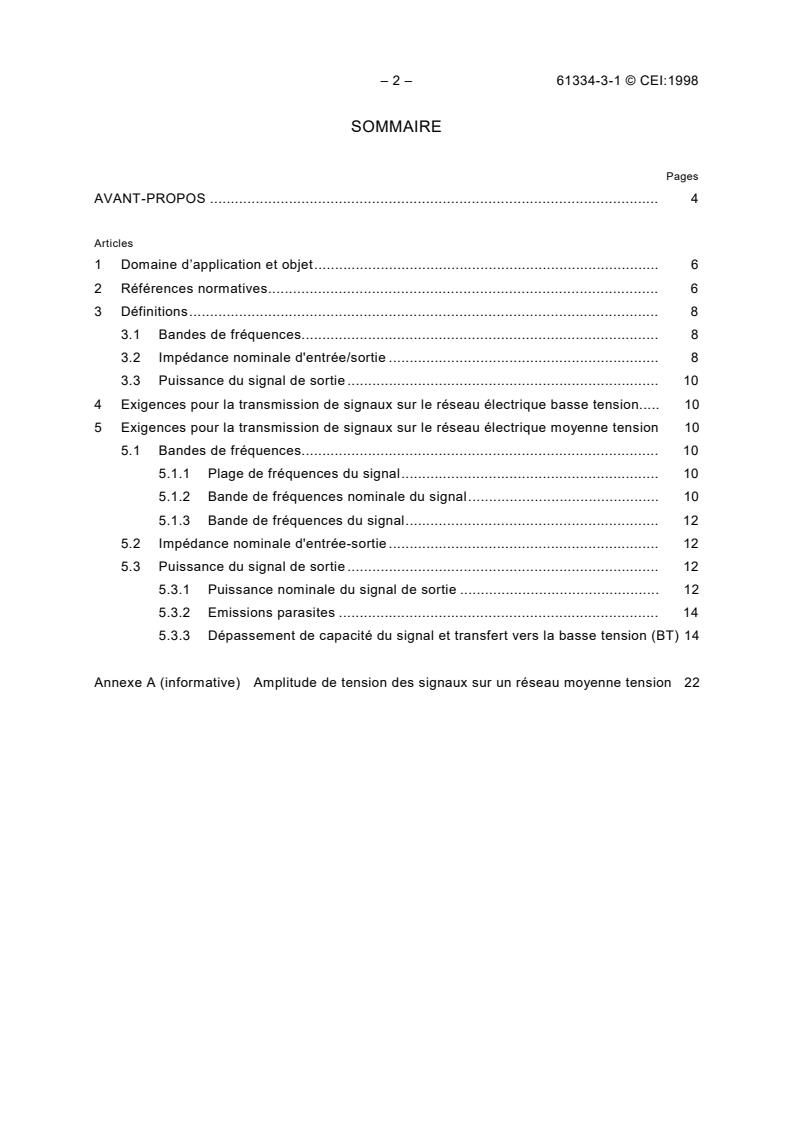
– 2 – 61334-3-1 © CEI:1998
SOMMAIRE
Pages
AVANT-PROPOS . 4
Articles
1 Domaine d’application et objet. 6
2 Références normatives. 6
3 Définitions. 8
3.1 Bandes de fréquences. 8
3.2 Impédance nominale d'entrée/sortie . 8
3.3 Puissance du signal de sortie . 10
4 Exigences pour la transmission de signaux sur le réseau électrique basse tension. 10
5 Exigences pour la transmission de signaux sur le réseau électrique moyenne tension 10
5.1 Bandes de fréquences. 10
5.1.1 Plage de fréquences du signal. 10
5.1.2 Bande de fréquences nominale du signal. 10
5.1.3 Bande de fréquences du signal. 12
5.2 Impédance nominale d'entrée-sortie . 12
5.3 Puissance du signal de sortie . 12
5.3.1 Puissance nominale du signal de sortie . 12
5.3.2 Emissions parasites. 14
5.3.3 Dépassement de capacité du signal et transfert vers la basse tension (BT) 14
Annexe A (informative) Amplitude de tension des signaux sur un réseau moyenne tension 22
61334-3-1 © IEC:1998 – 3 –
CONTENTS
Page
FOREWORD . 5
Clause
1 Scope and object . 7
2 Normative references. 7
3 Definitions . 9
3.1 Frequency bands. 9
3.2 Nominal input-output impedance . 9
3.3 Signal output power . 11
4 Low-voltage mains signalling requirements . 11
5 Medium-voltage mains signalling transmission requirements . 11
5.1 Frequency bands. 11
5.1.1 Signal frequency range . 11
5.1.2 Nominal signal frequency band . 11
5.1.3 Signal frequency band . 13
5.2 Nominal input-output impedance . 13
5.3 Signal output power . 13
5.3.1 Nominal signal output power . 13
5.3.2 Spurious emission. 15
5.3.3 Signal spillover and transfer to LV. 15
Annex A (informative) Signal-voltage amplitude on MV network. 23
– 4 – 61334-3-1 © CEI:1998
COMMISSION ÉLECTROTECHNIQUE INTERNATIONALE
___________
AUTOMATISATION DE LA DISTRIBUTION À L’AIDE DE SYSTÈMES
DE COMMUNICATION À COURANTS PORTEURS –
Partie 3-1: Prescriptions pour la signalisation sur réseaux –
Bandes de fréquences et niveaux de sortie
AVANT-PROPOS
1) La CEI (Commission Electrotechnique Internationale) est une organisation mondiale de normalisation composée
de l'ensemble des comités électrotechniques nationaux (Comités nationaux de la CEI). La CEI a pour objet de
favoriser la coopération internationale pour toutes les questions de normalisation dans les domaines de
l'électricité et de l'électronique. A cet effet, la CEI, entre autres activités, publie des Normes internationales.
Leur élaboration est confiée à des comités d'études, aux travaux desquels tout Comité national intéressé par le
sujet traité peut participer. Les organisations internationales, gouvernementales et non gouvernementales, en
liaison avec la CEI, participent également aux travaux. La CEI collabore étroitement avec l'Organisation
Internationale de Normalisation (ISO), selon des conditions fixées par accord entre les deux organisations.
2) Les décisions ou accords officiels de la CEI concernant les questions techniques représentent, dans la mesure
du possible un accord international sur les sujets étudiés, étant donné que les Comités nationaux intéressés
sont représentés dans chaque comité d’études.
3) Les documents produits se présentent sous la forme de recommandations internationales. Ils sont publiés
comme normes, rapports techniques ou guides et agréés comme tels par les Comités nationaux.
4) Dans le but d'encourager l'unification internationale, les Comités nationaux de la CEI s'engagent à appliquer de
façon transparente, dans toute la mesure possible, les Normes internationales de la CEI dans leurs normes
nationales et régionales. Toute divergence entre la norme de la CEI et la norme nationale ou régionale
correspondante doit être indiquée en termes clairs dans cette dernière.
5) La CEI n’a fixé aucune procédure concernant le marquage comme indication d’approbation et sa responsabilité
n’est pas engagée quand un matériel est déclaré conforme à l’une de ses normes.
6) L’attention est attirée sur le fait que certains des éléments de la présente Norme internationale peuvent faire
l’objet de droits de propriété intellectuelle ou de droits analogues. La CEI ne saurait être tenue pour
responsable de ne pas avoir identifié de tels droits de propriété et de ne pas avoir signalé leur existence.
La Norme internationale CEI 61334-3-1 a été établie par le comité d’études 57 de la CEI:
Conduite des systèmes de puissance et communications associées.
Le texte de cette norme est issu des documents suivants:
FDIS Rapport de vote
57/373/FDIS 57/380/RVD
Le rapport de vote indiqué dans le tableau ci-dessus donne toute information sur le vote ayant
abouti à l'approbation de cette norme.
L’annexe A est donnée uniquement à titre d’information
61334-3-1 © IEC:1998 – 5 –
INTERNATIONAL ELECTROTECHNICAL COMMISSION
___________
DISTRIBUTION AUTOMATION USING
DISTRIBUTION LINE CARRIER SYSTEMS –
Part 3-1: Mains signalling requirements –
Frequency bands and output levels
FOREWORD
1) The IEC (International Electrotechnical Commission) is a worldwide organization for standardization comprising
all national electrotechnical committees (IEC National Committees). The object of the IEC is to promote
international co-operation on all questions concerning standardization in the electrical and electronic fields. To
this end and in addition to other activities, the IEC publishes International Standards. Their preparation is
entrusted to technical committees; any IEC National Committee interested in the subject dealt with may
participate in this preparatory work. International, governmental and non-governmental organizations liaising
with the IEC also participate in this preparation. The IEC collaborates closely with the International Organization
for Standardization (ISO) in accordance with conditions determined by agreement between the two
organizations.
2) The formal decisions or agreements of the IEC on technical matters express, as nearly as possible, an
international consensus of opinion on the relevant subjects since each technical committee has representation
from all interested National Committees.
3) The documents produced have the form of recommendations for international use and are published in the form
of standards, technical reports or guides and they are accepted by the National Committees in that sense.
4) In order to promote international unification, IEC National Committees undertake to apply IEC International
Standards transparently to the maximum extent possible in their national and regional standards. Any
divergence between the IEC Standard and the corresponding national or regional standard shall be clearly
indicated in the latter.
5) The IEC provides no marking procedure to indicate its approval and cannot be rendered responsible for any
equipment declared to be in conformity with one of its standards.
6) Attention is drawn to the possibility that some of the elements of this International Standard may be the subject
of patent rights. The IEC shall not be held responsible for identifying any or all such patent rights.
International Standard IEC 61334-3-1 has been prepared by IEC technical committee 57:
Power system control and associated communications.
The text of this standard is based on the following documents:
FDIS Report on voting
57/373/FDIS 57/380/RVD
Full information on the voting for the approval of this standard can be found in the report on
voting indicated in the above table.
Annex A is for information only.
– 6 – 61334-3-1 © CEI:1998
AUTOMATISATION DE LA DISTRIBUTION À L’AIDE DE SYSTÈMES
DE COMMUNICATION À COURANTS PORTEURS –
Partie 3-1: Prescriptions pour la signalisation sur réseaux –
Bandes de fréquences et niveaux de sortie
1 Domaine d’application et objet
La présente partie de la CEI 61334 s'applique aux équipements électriques utilisés dans les
systèmes de communication à courants porteurs (DLC) pour les réseaux de distribution en
moyenne (MT) et basse (BT) tension.
Elle spécifie les exigences (bandes de fréquences, niveaux de sortie, émissions parasites,
etc.), respectivement pour les réseaux de distribution MT et BT.
Elle spécifie les limites des perturbations dans la plage de fréquences comprise entre 3 kHz et
30 MHz. La limite supérieure de fréquence a été fixée à 30 MHz conformément aux
recommandations du CISPR pour les perturbations induites.
Elle ne spécifie pas la méthode de modulation du signal ni la méthode de codage, pas plus que
les dispositifs fonctionnels.
Elle n’inclut pas d’exigences ni d’essais d’environnement.
NOTE – Dans la plupart des pays la transmission est soumise à la législation. La conformité à la présente norme
n'implique pas l'autorisation d'établir une communication sur un réseau public de distribution, entre les réseaux
publics de distribution et les installations du client, ou entre des installations de clients, dans tous les cas où ce ne
serait pas autrement autorisé.
L'objet de la présente norme est de limiter les influences mutuelles entre les équipements de
transmission de signaux dans les installations électriques et entre ces équipements et d'autres
équipements. Le présente norme est en outre prévue pour limiter les interférences provoquées
par les équipements de transmission de signaux sur les équipements électroniques sensibles.
Dans certains cas, les interférences provoquées par d'autres équipements électriques peuvent
provoquer de mauvais fonctionnements des équipements de signalisation sur réseaux. Les
instructions d'installation et d'exploitation fournies avec chaque dispositif fournissent des lignes
directrices pour le bon usage ainsi que des avertissements contre les usages incorrects. Si
nécessaire, une notice est attachée de façon sûre à chaque produit, donnant en substance les
avertissements suivants:
Il ne faut pas utiliser la transmission de signaux sur le réseau électrique pour la conduite
d'équipements qui pourraient devenir dangereux pour les personnes ou pour les biens, s'ils
sont mis en marche involontairement ou s'ils présentent un quelconque défaut de fonction-
nement.
2 Références normatives
Les documents normatifs suivants contiennent des dispositions qui, par suite de la référence
qui y est faite, constituent des dispositions valables pour la présente partie de la CEI 61334.
Au moment de sa publication, les éditions indiquées étaient en vigueur. Tout document
normatif est sujet à révision et les parties prenantes aux accords fondés sur la présente partie
de la CEI 61334 sont invitées à rechercher la possibilité d'appliquer les éditions les plus
récentes des documents normatifs indiqués ci-après. Les membres de la CEI et de l'ISO
possèdent le registre des Normes internationales en vigueur.
61334-3-1 © IEC:1998 – 7 –
DISTRIBUTION AUTOMATION USING
DISTRIBUTION LINE CARRIER SYSTEMS –
Part 3-1: Mains signalling requirements –
Frequency bands and output levels
1 Scope and object
This part of IEC 61334 applies to electrical equipment to be used in distribution line carrier
(DLC) systems on both medium-voltage (MV) and low-voltage (LV) distribution networks.
It specifies the requirements (frequency bands, output levels, spurious emissions, etc.) for MV
and LV distribution networks respectively.
It specifies disturbance limits in the frequency range from 3 kHz up to 30 MHz. The upper
frequency limit has been fixed at 30 MHz according to the CISPR recommendations for
conducted disturbances.
It does not specify the signal modulation methods nor the coding methods nor functional
features.
Environmental requirements and tests are not included.
NOTE – In most countries the transmission is subject to regulation. Compliance with this standard does not imply
permission to establish communication on a public supply network, between public supply networks and consumer
installations, or between consumer installations where this would not otherwise be allowed.
The object of this standard is to limit mutual influence between signal transmission equipment
in electrical installations and between such equipment and other equipment. In addition, this
standard is intended to limit interference caused by signal transmission equipment to sensitive
electronic equipment.
In some cases, interference caused by other electrical equipment may lead to misoperation of
the mains signalling equipment. Guidance on proper use and warning of improper use are
included in the installation and operating instructions supplied with each item of equipment.
Where appropriate, a notice is attached securely to each product giving the substance of the
following warning:
Mains signalling must not be used to control equipment that could become a hazard to people
or property if it inadvertently operates or fails to operate in any way.
2 Normative references
The following normative documents contain provisions which, through reference in this text,
constitute provisions of this part of IEC 61334. At the time of publication, the editions indicated
were valid. All normative documents are subject to revision, and parties to agreements based
on this part of IEC 61334 are encouraged to investigate the possibility of applying the most
recent editions of the normative documents indicated below. Members of IEC and ISO maintain
registers of currently valid International Standards.
– 8 – 61334-3-1 © CEI:1998
CEI 60050(161):1990, Vocabulaire Electrotechnique International (VEI) – Chapitre 161:
Compatibilité électomagnétique
CEI 60495:1993, Equipements terminaux à courants porteurs sur lignes d’énergie, à bande
latérale unique
CEI 60663:1980, Conception des systèmes à courants porteurs (à bande latérale unique) sur
lignes d’énergie
CEI 61000-3-8:1997, Compatibilité électromagnétique (CEM) – Partie 3: Limites – Section 8:
Transmission de signaux dans les installations électriques à basse tension – Niveaux
d’émission, bandes de fréquences et niveaux de perturbations électromagnétiques
CISPR 16-1:1993, Spécifications des méthodes et des appareils de mesure des perturbations
radioélectriques et de l’immunité aux perturbations radioélectriques – Partie 1: Appareils de
mesure des perturbations radioélectriques et de l’immunité aux perturbations radioélectriques
3 Définitions
Pour les besoins de la présente partie de la CEI 61334, les définitions suivantes s'appliquent.
Pour les autres termes utilisés dans cette partie mais qui ne sont pas définis ci-dessous se
référer à la CEI 60050(161).
3.1 Bandes de fréquences
3.1.1
plage de fréquences du signal
totalité de la bande disponible pour l'utilisation de la ligne de distribution
3.1.2
bande de fréquences de base
subdivision élémentaire de la plage de fréquences du signal ou la partie de cette dernière
dédiée à un canal émission réception simple d'une ligne de distribution d'énergie (voir la
CEI 60495 et la CEI 60663)
3.1.3
bande de fréquences nominale du signal
bande de fréquences à laquelle fonctionne un émetteur ou récepteur DLC particulier
3.1.4
bande de fréquences du signal
bande de fréquences qui contient au moins 99 % de la puissance du signal
3.2 Impédance nominale d'entrée/sortie
3.2.1
impédance nominale d'entrée/sortie
valeur de l'impédance prévue pour un circuit d'entrée ou de sortie et pour laquelle on applique
les exigences requises
61334-3-1 © IEC:1998 – 9 –
IEC 60050(161):1990, International Electrotechnical Vocabulary (IEV) – Chapter 161:
Electromagnetic compatibility
IEC 60495:1993, Single sideband power-line carrier terminals
IEC 60663:1980, Planning of (single-sideband) power-line carrier systems
IEC 61000-3-8:1997, Electromagnetic compatibility (EMC) – Part 3: Limits – Section 8:
Signalling on low-voltage electrical installations – Emission levels, frequency bands and
electromagnetic disturbance levels
CISPR 16-1:1993, Specification for radio disturbance and immunity measuring apparatus and
methods – Part 1: Radio disturbance and immunity measuring apparatus
3 Definitions
For the purpose of this part of IEC 61334, the following definitions apply.
For other terms used in this part but not defined below, refer to IEC 60050(161).
3.1 Frequency bands
3.1.1
signal frequency range
total band available for distribution line carrier use
3.1.2
basic frequency band
elementary subdivision of the signal frequency range or part thereof allocated to a single
power-line carrier (see IEC 60495 and IEC 60663) transmit or receive channel
3.1.3
nominal signal frequency band
frequency band in which a particular DLC transmitter or receiver operates
3.1.4
signal frequency band
frequency band which contains at least 99 % of the signal power
3.2 Nominal input-output impedance
3.2.1
nominal input-output impedance
value of impedance for which an input or output circuit has been designed and for which the
prescribed requirements apply
– 10 – 61334-3-1 © CEI:1998
3.3 Puissance du signal de sortie
3.3.1
puissance nominale du signal de sortie
PEP (Peak Envelope Power = enveloppe des pics de puissance) disponible dans la bande de
fréquences nominale du signal.
Il faut que la puissance nominale du signal de sortie soit compatible avec les exigences
relatives aux émissions parasites.
La puissance nominale du signal de sortie est, à partir d'ici, donnée en dBm parce que
l'impédance nominale en entrée et en sortie est parfaitement définie (voir 5.3).
3.3.2
émissions parasites
émissions sur une ou plusieurs fréquences situées en dehors de la bande de fréquences du
signal
Les émissions parasites comprennent les harmoniques, les signaux parasites et les produits
intermodulations.
4 Exigences pour la transmission de signaux
sur le réseau électrique basse tension
La CEI 61000-3-8 s’applique en ce qui concerne les réseaux de distribution basse tension.
NOTE – Dans certains pays, les règles nationales prévalent sur les prescriptions de la CEI 61000-3-8.
5 Exigences pour la transmission de signaux
sur le réseau électrique moyenne tension
5.1 Bandes de fréquences
5.1.1 Plage de fréquences du signal
La plage de fréquences du signal s’étend de 3 kHz à 500 kHz.
L'utilisation de fréquences dans cette bande doit être limitée à la distribution d'électricité.
Les systèmes DLC ne doivent pas provoquer d'interférences ave
...
Questions, Comments and Discussion
Ask us and Technical Secretary will try to provide an answer. You can facilitate discussion about the standard in here.
Loading comments...