


IEC 61334-3-22:2001
(Main)Distribution automation using distribution line carrier systems - Part 3-22: Mains signalling requirements - MV phase-to-earth and screen-to-earth intrusive coupling devices
Distribution automation using distribution line carrier systems - Part 3-22: Mains signalling requirements - MV phase-to-earth and screen-to-earth intrusive coupling devices
Establishes definitions, requirements, methods of testing and rated values for phase-to-earth capacitive and screen-to-earth intrusive inductive coupling devices to be used in medium voltage DLC systems.
This publication is of high relevance for Smart Grid.
Automatisation de la distribution à l'aide de systèmes de communication à courants porteurs - Partie 3-22: Exigences concernant la transmission des signaux sur le secteur - Dispositifs de couplage intrusif phase-terre et blindage-terre MT
Enonce des définitions, des exigences, des méthodes d'essai et des valeurs nominales pour les dispositifs de couplage phase-terre capacitifs et blindage-terre inductifs intrusifs devant être utilisés sur des systèmes DLC moyenne tension.
General Information
- Status
- Published
- Publication Date
- 11-Jan-2001
- Technical Committee
- TC 57 - Power systems management and associated information exchange
- Drafting Committee
- WG 9 - TC 57/WG 9
- Current Stage
- PPUB - Publication issued
- Start Date
- 12-Jan-2001
- Completion Date
- 15-Oct-2000
Overview
IEC 61334-3-22:2001 is an international standard developed by the International Electrotechnical Commission (IEC) focusing on distribution automation using distribution line carrier (DLC) systems. Specifically, this part addresses mains signalling requirements for medium voltage (MV) phase-to-earth capacitive and screen-to-earth intrusive inductive coupling devices. These devices enable reliable carrier frequency communication across power distribution networks, essential for Smart Grid automation, remote monitoring, and control.
The standard sets out definitions, requirements, test methods, and rated values for the targeted coupling devices, ensuring compatibility, safety, and performance in MV-DLC applications. This is key for grid modernization initiatives and the growing demand for secure, efficient power system communications.
Key Topics
Scope and Applicability
- Applies to MV phase-to-earth capacitive and screen-to-earth intrusive inductive coupling devices.
- Excludes non-intrusive inductive coupling devices.
- Ensures efficient signal transmission and personnel safety.
Device Definitions
- Details both phase-to-earth and screen-to-earth coupling methods.
- Specifies roles such as impedance matching, galvanic isolation, and surge protection.
Service and Environmental Conditions
- Devices must function reliably indoors and outdoors, under varying temperature and climate classes per IEC 60870-2-2.
- Rated for power networks from DC to 60 Hz.
General and Safety Requirements
- Addresses insulation, safety features, protection against overvoltage, and overcurrent.
- Requires clear labeling, including service class and rating plate per section 5.6.
Testing Methods
- Specifies standardized test procedures for ensuring compliance and robust performance under operational stresses.
Applications
IEC 61334-3-22:2001 is integral to the deployment and operation of Smart Grid systems, facilitating:
- Reliable Communication: Enables the transmission of control, monitoring, and automation signals over power lines in medium voltage distribution networks.
- Grid Automation: Supports intelligent management of substations, remote switching, and transformer control.
- Operational Efficiency: Reduces the need for additional communication infrastructure by using existing power lines for data transfer.
- Safety Enhancement: Establishes protective measures to safeguard system components and personnel.
- Cost-Effectiveness: Standardizes device characteristics, promoting interoperability and reducing deployment costs.
Utility companies, system integrators, and equipment manufacturers use this standard to ensure their products and systems are compatible, robust, and aligned with modern distribution automation requirements.
Related Standards
Several IEC standards are referenced or closely related to IEC 61334-3-22:2001, providing a comprehensive framework for power line carrier systems and associated equipment:
- IEC 60060-1: High voltage test techniques - General definitions and test requirements.
- IEC 60358: Coupling capacitors and capacitor dividers - Relevant for the design and selection of capacitive coupling devices.
- IEC 60870-2-2: Telecontrol equipment and systems - Operating and environmental conditions for telecommunication in substations.
- IEC 61334 Series: The broader IEC 61334 series addresses various aspects of distribution line carrier systems, including other types of coupling devices and communication protocols.
Practical Value
Implementing IEC 61334-3-22 ensures:
- Interoperability among equipment from different manufacturers.
- Consistent safety and performance across global deployments.
- Facilitation of Smart Grid upgrades, especially for utilities transitioning to advanced, automated networks.
Standardized MV phase-to-earth and screen-to-earth coupling devices are foundational for robust distribution line communication, directly supporting efficient grid operations and the future growth of intelligent power systems.
Buy Documents
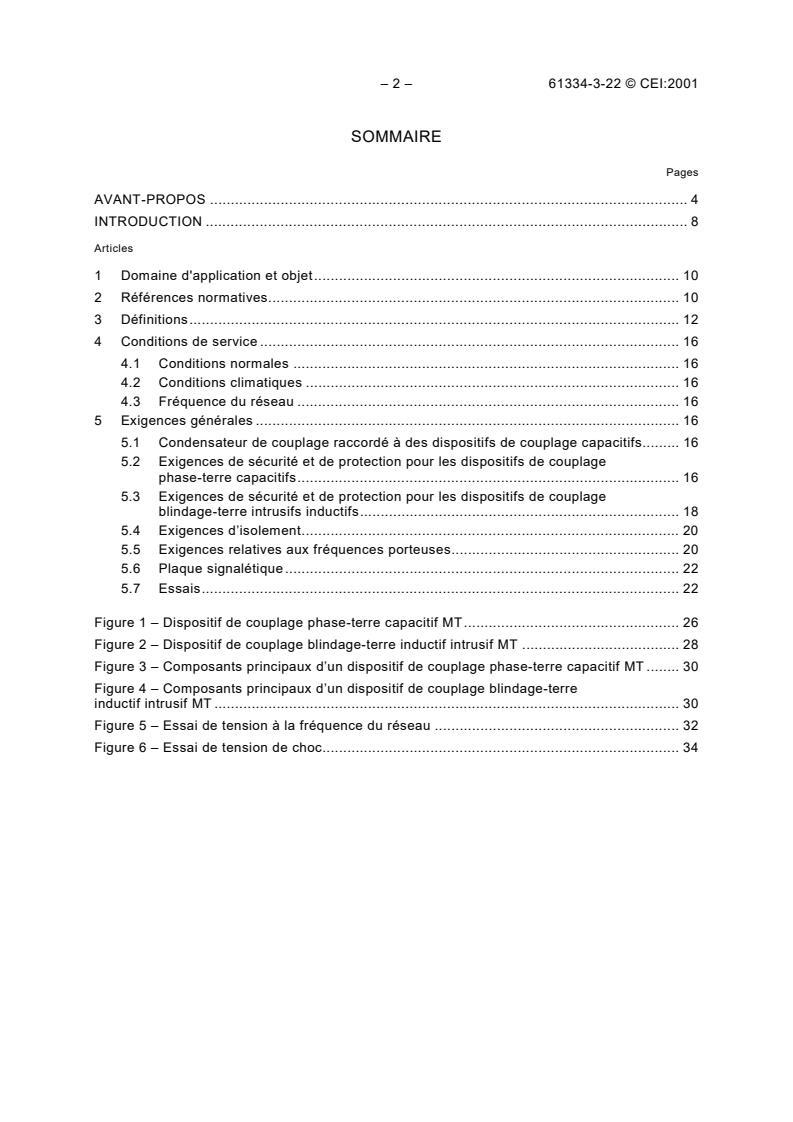
IEC 61334-3-22:2001 - Distribution automation using distribution line carrier systems - Part 3-22: Mains signalling requirements - MV phase-to-earth and screen-to-earth intrusive coupling devices Released:1/12/2001
Get Certified
Connect with accredited certification bodies for this standard

IMQ S.p.A. (Certification)
Italian electrical product certification.

SLG Prüf- und Zertifizierungs GmbH
German testing and certification body.

UL Solutions
Global safety science company with testing, inspection and certification.
Sponsored listings
Frequently Asked Questions
IEC 61334-3-22:2001 is a standard published by the International Electrotechnical Commission (IEC). Its full title is "Distribution automation using distribution line carrier systems - Part 3-22: Mains signalling requirements - MV phase-to-earth and screen-to-earth intrusive coupling devices". This standard covers: Establishes definitions, requirements, methods of testing and rated values for phase-to-earth capacitive and screen-to-earth intrusive inductive coupling devices to be used in medium voltage DLC systems. This publication is of high relevance for Smart Grid.
Establishes definitions, requirements, methods of testing and rated values for phase-to-earth capacitive and screen-to-earth intrusive inductive coupling devices to be used in medium voltage DLC systems. This publication is of high relevance for Smart Grid.
IEC 61334-3-22:2001 is classified under the following ICS (International Classification for Standards) categories: 29.240.20 - Power transmission and distribution lines; 33.200 - Telecontrol. Telemetering. The ICS classification helps identify the subject area and facilitates finding related standards.
IEC 61334-3-22:2001 is available in PDF format for immediate download after purchase. The document can be added to your cart and obtained through the secure checkout process. Digital delivery ensures instant access to the complete standard document.
Standards Content (Sample)
NORME CEI
INTERNATIONALE IEC
61334-3-22
INTERNATIONAL
Première édition
STANDARD
First edition
2001-01
Automatisation de la distribution à l'aide
de systèmes de communication
à courants porteurs –
Partie 3-22:
Exigences concernant la transmission
des signaux sur le secteur –
Dispositifs de couplage intrusif phase-terre
et blindage-terre MT
Distribution automation using distribution
line carrier systems –
Part 3-22:
Mains signalling requirements –
MV phase-to-earth and screen-to-earth
intrusive coupling devices
Numéro de référence
Reference number
CEI/IEC 61334-3-22:2001
Numérotation des publications Publication numbering
Depuis le 1er janvier 1997, les publications de la CEI As from 1 January 1997 all IEC publications are
sont numérotées à partir de 60000. Ainsi, la CEI 34-1 issued with a designation in the 60000 series. For
devient la CEI 60034-1. example, IEC 34-1 is now referred to as IEC 60034-1.
Editions consolidées Consolidated editions
Les versions consolidées de certaines publications de la The IEC is now publishing consolidated versions of its
CEI incorporant les amendements sont disponibles. Par publications. For example, edition numbers 1.0, 1.1
exemple, les numéros d’édition 1.0, 1.1 et 1.2 indiquent and 1.2 refer, respectively, to the base publication,
respectivement la publication de base, la publication de the base publication incorporating amendment 1 and
base incorporant l’amendement 1, et la publication de the base publication incorporating amendments 1
base incorporant les amendements 1 et 2. and 2.
Informations supplémentaires Further information on IEC publications
sur les publications de la CEI
Le contenu technique des publications de la CEI est The technical content of IEC publications is kept
constamment revu par la CEI afin qu'il reflète l'état under constant review by the IEC, thus ensuring that
actuel de la technique. Des renseignements relatifs à the content reflects current technology. Information
cette publication, y compris sa validité, sont dispo- relating to this publication, including its validity, is
nibles dans le Catalogue des publications de la CEI available in the IEC Catalogue of publications
(voir ci-dessous) en plus des nouvelles éditions, (see below) in addition to new editions, amendments
amendements et corrigenda. Des informations sur les and corrigenda. Information on the subjects under
sujets à l’étude et l’avancement des travaux entrepris consideration and work in progress undertaken by the
par le comité d’études qui a élaboré cette publication, technical committee which has prepared this
ainsi que la liste des publications parues, sont publication, as well as the list of publications issued,
également disponibles par l’intermédiaire de: is also available from the following:
• Site web de la CEI (www.iec.ch) • IEC Web Site (www.iec.ch)
• Catalogue des publications de la CEI • Catalogue of IEC publications
Le catalogue en ligne sur le site web de la CEI The on-line catalogue on the IEC web site
(www.iec.ch/catlg-f.htm) vous permet de faire des (www.iec.ch/catlg-e.htm) enables you to search
recherches en utilisant de nombreux critères, by a variety of criteria including text searches,
comprenant des recherches textuelles, par comité technical committees and date of publication. On-
d’études ou date de publication. Des informations line information is also available on recently
en ligne sont également disponibles sur les issued publications, withdrawn and replaced
nouvelles publications, les publications rempla- publications, as well as corrigenda.
cées ou retirées, ainsi que sur les corrigenda.
• IEC Just Published
• IEC Just Published
Ce résumé des dernières publications parues
This summary of recently issued publications
(www.iec.ch/JP.htm) est aussi disponible par
(www.iec.ch/JP.htm) is also available by email.
courrier électronique. Veuillez prendre contact
Please contact the Customer Service Centre (see
avec le Service client (voir ci-dessous) pour plus
below) for further information.
d’informations.
• Service clients
• Customer Service Centre
Si vous avez des questions au sujet de cette
If you have any questions regarding this
publication ou avez besoin de renseignements
publication or need further assistance, please
supplémentaires, prenez contact avec le Service
contact the Customer Service Centre:
clients:
Email: custserv@iec.ch
Email: custserv@iec.ch
Tél: +41 22 919 02 11
Tel: +41 22 919 02 11
Fax: +41 22 919 03 00
Fax: +41 22 919 03 00
.
NORME CEI
INTERNATIONALE IEC
61334-3-22
INTERNATIONAL
Première édition
STANDARD
First edition
2001-01
Automatisation de la distribution à l'aide
de systèmes de communication
à courants porteurs –
Partie 3-22:
Exigences concernant la transmission
des signaux sur le secteur –
Dispositifs de couplage intrusif phase-terre
et blindage-terre MT
Distribution automation using distribution
line carrier systems –
Part 3-22:
Mains signalling requirements –
MV phase-to-earth and screen-to-earth
intrusive coupling devices
IEC 2001 Droits de reproduction réservés Copyright - all rights reserved
Aucune partie de cette publication ne peut être reproduite ni No part of this publication may be reproduced or utilized in
utilisée sous quelque forme que ce soit et par aucun procédé, any form or by any means, electronic or mechanical,
électronique ou mécanique, y compris la photocopie et les including photocopying and microfilm, without permission in
microfilms, sans l'accord écrit de l'éditeur. writing from the publisher.
International Electrotechnical Commission 3, rue de Varembé Geneva, Switzerland
Telefax: +41 22 919 0300 e-mail: inmail@iec.ch IEC web site http://www.iec.ch
CODE PRIX
Commission Electrotechnique Internationale
Q
PRICE CODE
International Electrotechnical Commission
Pour prix, voir catalogue en vigueur
For price, see current catalogue
– 2 – 61334-3-22 © CEI:2001
SOMMAIRE
Pages
AVANT-PROPOS . 4
INTRODUCTION .8
Articles
1 Domaine d'application et objet. 10
2 Références normatives. 10
3 Définitions. 12
4 Conditions de service . 16
4.1 Conditions normales . 16
4.2 Conditions climatiques . 16
4.3 Fréquence du réseau . 16
5 Exigences générales . 16
5.1 Condensateur de couplage raccordé à des dispositifs de couplage capacitifs. 16
5.2 Exigences de sécurité et de protection pour les dispositifs de couplage
phase-terre capacitifs. 16
5.3 Exigences de sécurité et de protection pour les dispositifs de couplage
blindage-terre intrusifs inductifs. 18
5.4 Exigences d’isolement. 20
5.5 Exigences relatives aux fréquences porteuses. 20
5.6 Plaque signalétique. 22
5.7 Essais. 22
Figure 1 – Dispositif de couplage phase-terre capacitif MT. 26
Figure 2 – Dispositif de couplage blindage-terre inductif intrusif MT . 28
Figure 3 – Composants principaux d’un dispositif de couplage phase-terre capacitif MT . 30
Figure 4 – Composants principaux d’un dispositif de couplage blindage-terre
inductif intrusif MT . 30
Figure 5 – Essai de tension à la fréquence du réseau . 32
Figure 6 – Essai de tension de choc. 34
61334-3-22 © IEC:2001 – 3 –
CONTENTS
Page
FOREWORD . 5
INTRODUCTION .9
Clause
1 Scope and object . 11
2 Normative references . 11
3 Definitions. 13
4 Service conditions . 17
4.1 Standard conditions . 17
4.2 Climatic conditions . 17
4.3 Power frequency . 17
5 General requirements. 17
5.1 Coupling capacitor connected to capacitive coupling devices . 17
5.2 Safety and protection requirements on phase-to-earth capacitive
coupling devices . 17
5.3 Safety and protection requirements on screen-to-earth intrusive
inductive coupling devices. 19
5.4 Insulation requirements . 21
5.5 Carrier-frequency requirements . 21
5.6 Rating plate . 23
5.7 Tests . 23
Figure 1 – MV phase-to-earth capacitive coupling device . 27
Figure 2 – MV screen-to-earth intrusive inductive coupling device . 29
Figure 3 – Main components of an MV phase-to-earth capacitive coupling device. 31
Figure 4 – Main components of an MV screen-to-earth intrusive inductive coupling device. 31
Figure 5 – Power frequency voltage test. 33
Figure 6 – Impulse voltage test . 35
– 4 – 61334-3-22 © CEI:2001
COMMISSION ÉLECTROTECHNIQUE INTERNATIONALE
____________
AUTOMATISATION DE LA DISTRIBUTION À L'AIDE DE SYSTÈMES
DE COMMUNICATION À COURANTS PORTEURS –
Partie 3-22: Exigences concernant la transmission
des signaux sur le secteur –
Dispositifs de couplage intrusif phase-terre et blindage-terre MT
AVANT-PROPOS
1) La CEI (Commission Electrotechnique Internationale) est une organisation mondiale de normalisation composée
de l'ensemble des comités électrotechniques nationaux (Comités nationaux de la CEI). La CEI a pour objet de
favoriser la coopération internationale pour toutes les questions de normalisation dans les domaines de
l'électricité et de l'électronique. A cet effet, la CEI, entre autres activités, publie des Normes internationales.
Leur élaboration est confiée à des comités d'études, aux travaux desquels tout Comité national intéressé par le
sujet traité peut participer. Les organisations internationales, gouvernementales et non gouvernementales, en
liaison avec la CEI, participent également aux travaux. La CEI collabore étroitement avec l'Organisation
Internationale de Normalisation (ISO), selon des conditions fixées par accord entre les deux organisations.
2) Les décisions ou accords officiels de la CEI concernant les questions techniques représentent, dans la mesure
du possible un accord international sur les sujets étudiés, étant donné que les Comités nationaux intéressés
sont représentés dans chaque comité d’études.
3) Les documents produits se présentent sous la forme de recommandations internationales. Ils sont publiés
comme normes, spécifications techniques, rapports techniques ou guides et agréés comme tels par les Comités
nationaux.
4) Dans le but d'encourager l'unification internationale, les Comités nationaux de la CEI s'engagent à appliquer de
façon transparente, dans toute la mesure possible, les Normes internationales de la CEI dans leurs normes
nationales et régionales. Toute divergence entre la norme de la CEI et la norme nationale ou régionale
correspondante doit être indiquée en termes clairs dans cette dernière.
5) La CEI n’a fixé aucune procédure concernant le marquage comme indication d’approbation et sa responsabilité
n’est pas engagée quand un matériel est déclaré conforme à l’une de ses normes.
La Norme internationale CEI 61334-3-22 a été établie par le comité d'études 57 de la CEI:
Conduite des systèmes de puissance et communications associées.
Le texte de cette norme est issu des documents suivants:
FDIS Rapport de vote
57/477/FDIS 57/486/RVD
Le rapport de vote indiqué dans le tableau ci-dessus donne toute information sur le vote ayant
abouti à l'approbation de cette norme.
La Commission Electrotechnique Internationale (CEI) attire l'attention sur le fait qu'il est
déclaré que la conformité aux dispositions de la Norme Internationale peut impliquer
l'utilisation d'un brevet concernant les dispositifs de couplage capacitif.
Le CEI ne prend pas position quant à la preuve, la validité et la portée de ces droits de
propriété.
61334-3-22 © IEC:2001 – 5 –
INTERNATIONAL ELECTROTECHNICAL COMMISSION
____________
DISTRIBUTION AUTOMATION USING DISTRIBUTION
LINE CARRIER SYSTEMS –
Part 3-22: Mains signalling requirements –
MV phase-to-earth and screen-to-earth intrusive coupling devices
FOREWORD
1) The IEC (International Electrotechnical Commission) is a worldwide organization for standardization comprising
all national electrotechnical committees (IEC National Committees). The object of the IEC is to promote
international co-operation on all questions concerning standardization in the electrical and electronic fields. To
this end and in addition to other activities, the IEC publishes International Standards. Their preparation is
entrusted to technical committees; any IEC National Committee interested in the subject dealt with may
participate in this preparatory work. International, governmental and non-governmental organizations liaising
with the IEC also participate in this preparation. The IEC collaborates closely with the International Organization
for Standardization (ISO) in accordance with conditions determined by agreement between the two
organizations.
2) The formal decisions or agreements of the IEC on technical matters express, as nearly as possible, an
international consensus of opinion on the relevant subjects since each technical committee has representation
from all interested National Committees.
3) The documents produced have the form of recommendations for international use and are published in the form
of standards, technical specifications, technical reports or guides and they are accepted by the National
Committees in that sense.
4) In order to promote international unification, IEC National Committees undertake to apply IEC International
Standards transparently to the maximum extent possible in their national and regional standards. Any
divergence between the IEC Standard and the corresponding national or regional standard shall be clearly
indicated in the latter.
5) The IEC provides no marking procedure to indicate its approval and cannot be rendered responsible for any
equipment declared to be in conformity with one of its standards.
International Standard IEC 61334-3-22 has been prepared by IEC technical committee 57:
Power system control and associated communications.
The text of this standard is based on the following documents:
FDIS Report on voting
57/477/FDIS 57/486/RVD
Full information on the voting for the approval of this standard can be found in the report on
voting indicated in the above table.
The International Electrotechnical Commission (IEC) draws attention to the fact that it is
claimed that compliance with this International Standard may involve the use of a patent
concerning capacitive coupling devices.
The IEC takes no position concerning the evidence, validity and scope of this patent right.
– 6 – 61334-3-22 © CEI:2001
Le détenteur de ces droits de propriété a donné l'assurance à la CEI qu'il consent à négocier
des licences avec des demandeurs du monde entier, en des termes et à des conditions
raisonnables et non discriminatoires. A ce propos, la déclaration du détenteur des droits de
propriété est enregistrée à la CEI. Des informations peuvent être obtenues auprès de:
ABB Research Limited
CH-5401 Baden
L'attention est par ailleurs attirée sur le fait que certains des éléments de la présente Norme
internationale peuvent faire l'objet de droits de propriété autres que ceux mentionnés ci-
dessus. La CEI ne saurait être tenue pour responsable de ne pas avoir dûment signalé tout ou
partie de ces droits de propriété.
Cette publication a été rédigée selon les Directives ISO/CEI, Partie 3.
Le comité a décidé que le contenu de cette publication ne sera pas modifié avant 2010. A cette
date, la publication sera
reconduite;
supprimée;
remplacée par une édition révisée, ou
amendée.
61334-3-22 © IEC:2001 – 7 –
The holder of this patent right has assured the IEC that he is willing to negotiate licences under
reasonable and non-discriminatory terms and conditions with applicants throughout the world.
In this respect, the statement of the holder of this patent right is registered with the IEC.
Information may be obtained from:
ABB Research Limited
CH-5401 Baden
Attention is drawn to the possibility that some of the elements of this International Standard
may be the subject of patent rights other than those identified above. IEC shall not be held
responsible for identifying any or all such patent rights.
This publication has been drafted in accordance with the ISO/IEC Directives, Part 3.
The committee has decided that the contents of this publication will remain unchanged
until 2010. At this date, the publication will be
reconfirmed;
withdrawn;
replaced by a revised edition, or
amended.
– 8 – 61334-3-22 © CEI:2001
INTRODUCTION
Les prescriptions de la CEI 61334-3-21 s’appliquent aux dispositifs de couplage phase-phase
capacitifs isolés pour les systèmes de lignes de puissance à courants porteurs des DLC
(systèmes de communication à courants porteurs).
Toutefois, aucune norme internationale n’est disponible quant à l’application des dispositifs de
couplage blindage-terre inductifs intrusifs.
En outre, le dispositif de couplage mis à la terre déjà normalisé pour les systèmes de
communication à courants porteurs à haute tension tels qu’ils sont décrits dans la CEI 60481
n’est pas adapté à l’application de DLC sur les réseaux MT (moyenne tension) pour les raisons
suivantes:
– d’un point de vue technique, les caractéristiques du réseau diffèrent énormément entre les
réseaux HT (haute tension) et MT;
– la manutention de l’équipement HT et MT nécessite des moyens opérationnels différents;
– d’un point de vue économique, il convient que le coût du dispositif de couplage soit aussi
bas que possible.
Ces considérations amènent à normaliser d’autres dispositifs de couplage tels que le dispositif
de couplage phase-terre capacitif MT et le dispositif de couplage blindage-terre inductif intrusif.
Les figures 1 et 2 montrent des solutions. D’autres solutions pourront apparaître par la suite.
Au fur et à mesure que d’autres dispositifs de couplage seront normalisés, de nouvelles parties
seront ajoutées à la CEI 61334.
61334-3-22 © IEC:2001 – 9 –
INTRODUCTION
Requirements of IEC 61334-3-21 are applicable for phase-to-phase isolated capacitive
coupling devices for power-line carrier systems on distribution line carriers (DLC).
However, no international standard is available for the application of screen-to-earth intrusive
inductive coupling devices.
Furthermore the already standardised earthed capacitive coupling device for high voltage
power-line carrier systems as described by IEC 60481 is not suitable for the application of DLC
on medium voltage (MV) networks for the following reasons:
– from a technical point of view, network characteristics differ considerably from HV to MV
networks;
– handling of HV and MV equipment requires different operational means;
– from an economical point of view, the coupling device should have a price as low as
possible.
These considerations have led to the present standardisation of other coupling devices such as
the MV phase-to-earth capacitive coupling device and the screen-to-earth intrusive inductive
coupling device. Figures 1 and 2 show solutions for these devices. Additional solutions may
become available later.
As other coupling devices are standardised, new parts to IEC 61334 will be added.
– 10 – 61334-3-22 © CEI:2001
AUTOMATISATION DE LA DISTRIBUTION À L'AIDE DE SYSTÈMES
DE COMMUNICATION À COURANTS PORTEURS –
Partie 3-22: Exigences concernant la transmission
des signaux sur le secteur –
Dispositifs de couplage intrusif phase-terre et blindage-terre MT
1 Domaine d'application et objet
La présente partie de la CEI 61334 s'applique aux dispositifs de couplage phase-terre
capacitifs et blindage-terre inductifs intrusifs MT pour les systèmes de communication à
courants porteurs (systèmes DLC) à moyenne tension. Les dispositifs de couplage inductifs
non intrusifs n’entrent pas dans le domaine d’application de la présente norme.
Le dispositif de couplage assure
a) l’émission/réception efficace des signaux aux fréquences porteuses entre l’émetteur-
récepteur DLC et la ligne d’énergie;
b) la sécurité du personnel et la protection des parties à basse tension de l’installation contre
les effets de la tension à la fréquence du réseau et les surtensions transitoires.
L’objet de la présente partie de la CEI 61334 est d’énoncer des définitions, des exigences, des
méthodes d’essai et des valeurs nominales pour les dispositifs de couplage phase-terre
capacitifs et blindage-terre inductifs intrusifs devant être utilisés sur des systèmes DLC
moyenne tension.
2 Références normatives
Les documents normatifs suivants contiennent des dispositions qui, par suite de la référence
qui y est faite, constituent des dispositions valables pour la présente partie de la CEI 61334.
Pour les références datées, les amendements ultérieurs ou les révisions de ces publications ne
s’appliquent pas. Toutefois, les parties prenantes aux accords fondés sur la présente partie de
la CEI 61334 sont invitées à rechercher la possibilité d'appliquer les éditions les plus récentes
des documents normatifs indiqués ci-après. Pour les références non datées, la dernière édition
du document normatif en référence s’applique. Les membres de la CEI et de l'ISO possèdent
le registre des Normes internationales en vigueur.
CEI 60060-1: Techniques des essais à haute tension – Partie 1: Définitions et prescriptions
générales relatives aux essais
CEI 60358: Condensateurs de couplage et diviseurs capacitifs
CEI 60870-2-2: Matériels et systèmes de téléconduite – Partie 2: Conditions de fonctionnement –
Section 2: Conditions d’environnement (influences climatiques, mécaniques et autres influences
non électriques)
61334-3-22 © IEC:2001 – 11 –
DISTRIBUTION AUTOMATION USING DISTRIBUTION
LINE CARRIER SYSTEMS –
Part 3-22: Mains signalling requirements –
MV phase-to-earth and screen-to-earth intrusive coupling devices
1 Scope and object
This part of IEC 61334 is applicable to MV phase-to-earth capacitive and screen-to-earth
intrusive inductive coupling devices for medium voltage (MV) distribution line carrier (DLC)
systems. Non-intrusive inductive coupling devices are not within the scope of this standard.
The coupling device ensures
a) the efficient transmission/reception of carrier-frequency signals between the DLC
transceiver and the power line;
b) the safety of personnel and the protection of the low-voltage parts of the installation against
the effects of the power-frequency voltage and transient overvoltages.
The object of this part of IEC 61334 is to establish definitions, requirements, methods of testing
and rated values for phase-to-earth capacitive and screen-to-earth intrusive inductive coupling
devices to be used in MV-DLC systems.
2 Normative references
The following normative documents contain provisions which, through reference in this text,
constitute provisions of part of IEC 61334. For dated references, subsequent amendments to,
or revisions of, any of these publications do not apply. However, parties to agreements based
on this part of IEC 61334 are encouraged to investigate the possibility of applying the most
recent editions of the normative documents indicated below. For undated references, the latest
edition of the normative document referred to applies. Members of IEC and ISO maintain
registers of currently valid International Standards.
IEC 60060-1: High voltage test techniques – Part 1: General definitions and test requirements
IEC 60358: Coupling capacitors and capacitor dividers
IEC 60870-2-2: Telecontrol equipment and systems – Part 2: Operating conditions – Section 2:
Environmental conditions (climatic, mechanical and other non-electrical influences)
– 12 – 61334-3-22 © CEI:2001
3 Définitions
Pour les besoins de la présente partie de la CEI 61334, les définitions suivantes s'appliquent.
3.1
méthode de couplage phase-terre MT
méthode dans laquelle le dispositif de couplage est raccordé entre le conducteur de l’une des
phases de la ligne d’énergie et la terre
3.2
méthode de couplage blindage-terre MT
méthode dans laquelle le dispositif de couplage est raccordé entre le blindage du câble de la
ligne d’énergie et la terre
NOTE Le couplage peut être réalisé via
– un coupleur intrusif lorsqu’un coupleur est introduit entre le blindage du câble et la terre, ou
– un coupleur non intrusif tel qu’une âme fendue, lorsque le coupleur est monté autour du blindage du câble MT
ou autour du câble de terre. Dans ce dernier cas, la boucle blindage-terre constitue l’enroulement primaire d’un
transformateur de couplage.
3.3
méthode de couplage phase-phase MT
méthode dans laquelle le dispositif de couplage est raccordé entre le conducteur de l’une des
phases et le conducteur d’une autre phase de la ligne d’énergie isolée du potentiel de terre
3.4
dispositif de couplage
ensemble des dispositifs de couplage capacitifs et des dispositifs de couplage inductifs
intrusifs
3.5
dispositif de couplage capacitif
ensemble des éléments qui contribuent à assurer, en combinaison avec le condensateur de
couplage associé, l’émission/réception dans des conditions spécifiées des signaux à
fréquences porteuses entre la ligne d’énergie et l’émetteur-récepteur DLC. Le dispositif de
couplage capacitif contribue à réaliser tout ou partie des fonctions décrites ci-après (voir la
figure 3):
– synchronisation à la valeur désirée de la fréquence porteuse. Cette fonction peut être
assurée par un dispositif de synchronisation;
– adaptation d’impédance entre la ligne d’énergie et l’équipement DLC. Cette fonction peut
être assurée par un transformateur ou un autotransformateur;
– isolement galvanique entre les bornes des sections primaires et secondaires du dispositif de
couplage capacitif. Cette fonction peut être remplie, le cas échéant, par le transformateur
mentionné plus haut;
– mise à la terre du courant de fréquence du réseau dérivé par le condensateur de couplage.
Cette fonction peut être réalisée par une inductance, appelée bobine d'absorption, ou par
l’enroulement primaire du transformateur mentionné plus haut, le cas échéant;
– limitation, aux bornes du dispositif de couplage, des surtensions provenant de la ligne
d’énergie. Cette fonction peut être assurée par des parafoudres disposés convenablement
dans le dispositif de couplage;
– protection contre les surintensités au niveau de la borne primaire. Cette fonction peut être
remplie par un fusible, en série avec le condensateur de couplage.
NOTE Dans la pratique, la décision d’installer un fusible est souvent prise par le client en fonction des exigences
locales et de la conception du système de lignes de puissance. Par conséquent, cette décision peut faire l’objet
d’un accord explicite entre le client et le constructeur.
61334-3-22 © IEC:2001 – 13 –
3 Definitions
For the purposes of this part of IEC 61334, the following definitions apply.
3.1
MV phase-to-earth coupling method
method in which the coupling device is connected between the conductor of one phase of the
power line and earth
3.2
MV screen-to-earth coupling method
method in which the coupling device is connected between the screen of the power line cable
and earth
NOTE Coupling may be achieved by
– an intrusive coupler where a coupler is introduced between cable screen and earth, or
– a non-intrusive coupler such as a split core, where the coupler is mounted around the screen of the MV cable or
around the earthing lead. In this latter case the screen-earth loop builds up the primary winding of a coupling
transformer.
3.3
MV phase-to-phase coupling method
method in which the coupling device is connected between the conductor of one phase and the
conductor of another phase of the power line isolated from the earth potential
3.4
coupling device
set of capacitive coupling devices and intrusive inductive coupling devices
3.5
capacitive coupling device
arrangement of elements which contributes to ensuring, together with the associated coupling
capacitor, the transmission/reception, under prescribed conditions, of carrier-frequency signals
between the power line and the DLC transceivers. The capacitive coupling device contributes
to all or part of the functions described below (see figure 3):
– tuning at the desired carrier-frequency value. This function may be performed by a tuning
device;
– impedance matching between the power line and the DLC equipment. This function may be
performed by a transformer or autotransformer;
– galvanic isolation between primary and secondary section terminals of the capacitive
coupling device. This function may be performed by the above-mentioned transformer if
present;
– draining to earth of the power-frequency current derived by the coupling capacitor. This
function may be performed by an inductance, termed drain coil, or by the primary winding of
the previously mentioned transformer, if present;
– limitation of voltage surges coming from the power line at the terminals of the capacitive
coupling device. This function may be performed by surge arresters suitably arranged in the
coupling device;
– overc
...
Questions, Comments and Discussion
Ask us and Technical Secretary will try to provide an answer. You can facilitate discussion about the standard in here.
Loading comments...