


IEC 62282-2-100:2020
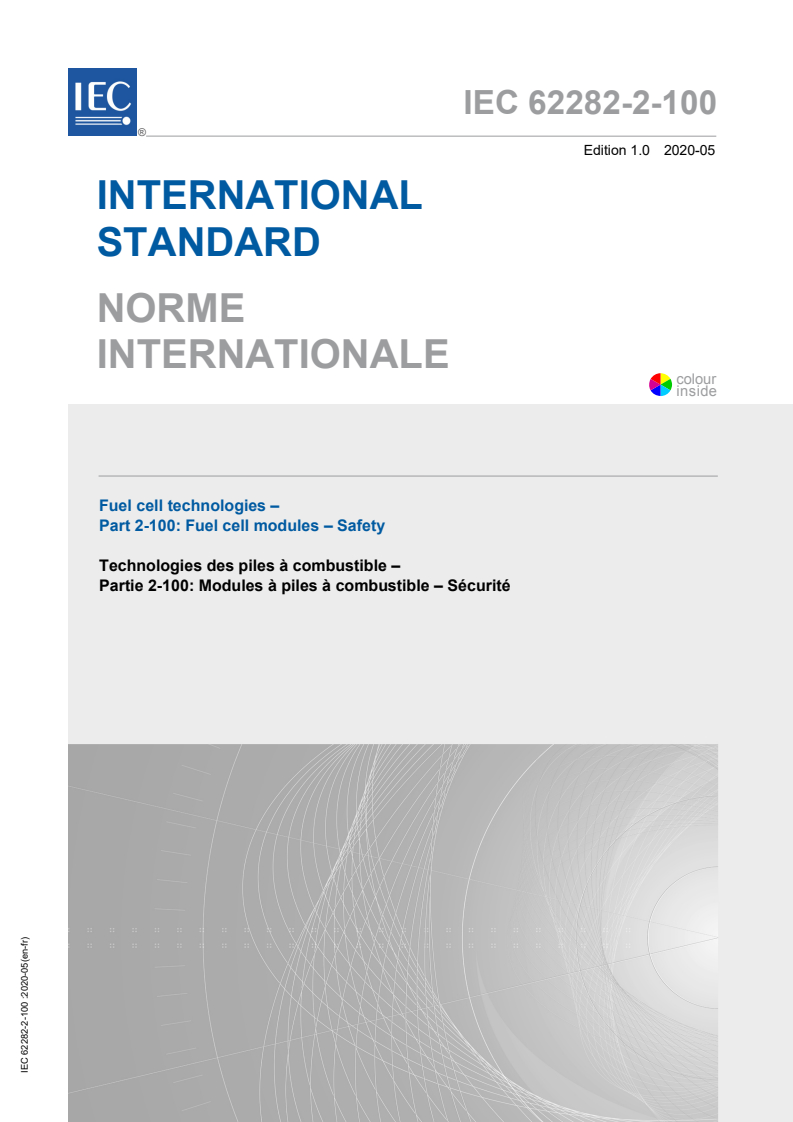
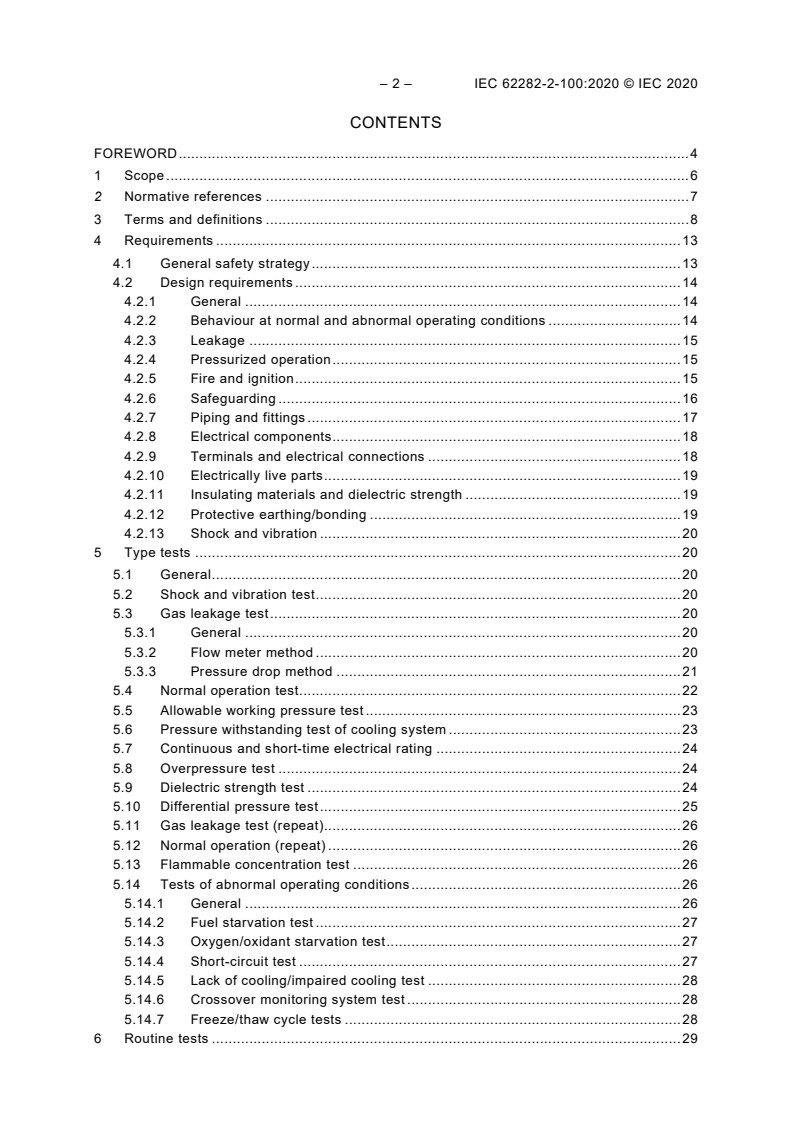
(Main)Fuel cell technologies - Part 2-100: Fuel cell modules - Safety
General Information
- Abstract
IEC 62282-2-100:2020 provides safety related requirements for construction, operation under normal and abnormal conditions and the testing of fuel cell modules. This document deals with conditions that can yield hazards to persons and cause damage outside the fuel cell modules. Protection against damage inside the fuel cell modules is not addressed in this document, provided it does not lead to hazards outside the module. These requirements can be superseded by other standards for equipment containing fuel cell modules as required for particular applications.
This first edition cancels and replaces IEC 62282-2, published in 2012. This edition includes the following significant technical changes with respect to IEC 622822:2012:
• update of definitions, in particular fuel cell module for normal operation;
• leakage values under normal and abnormal operation have been addressed;
• a delayed ignition test has been included;
• protective measures to limit gas leakage have been included;
• the requirements for insulation between live parts and SELV have been updated;
• the general safety strategy has been modified to reflect the needs for different application standards; the modifications are in line with similar modifications made to IEC 62282-3-100;
• the electrical components clause has been modified to reflect the needs for different application standards; the modifications are in line with similar modifications made to IEC 62282-3-100;
• protective earthing as part of the module or bonding as a measure within the installation has been introduced;
• a dielectric strength test has been completely updated by referring to IEC 62744-1 for voltages up to 1 000 V AC/1 500 V DC;
• a new “pressure drop method” leakage test method has been included;
• a new Annex addressing significant hazards, hazardous situations and events dealt with in this document, and linked to 4.1 (General safety strategy) has been added.
The contents of the corrigendum of November 2023 have been included in this copy.
- Status
- Published
- Publication Date
- 06-May-2020
- Technical Committee
- TC 105 - Fuel cell technologies
- Drafting Committee
- MT 102 - TC 105/MT 102
- Current Stage
- PPUB - Publication issued
- Start Date
- 07-May-2020
- Completion Date
- 17-Apr-2020
Relations
- Effective Date
- 05-Sep-2023
- Effective Date
- 13-Oct-2023
Get Certified
Connect with accredited certification bodies for this standard

DNV
DNV is an independent assurance and risk management provider.

Lloyd's Register
Lloyd's Register is a global professional services organisation specialising in engineering and technology.
DNV Energy Systems
Energy and renewable energy certification.
Sponsored listings
Frequently Asked Questions
IEC 62282-2-100:2020 is a standard published by the International Electrotechnical Commission (IEC). Its full title is "Fuel cell technologies - Part 2-100: Fuel cell modules - Safety". This standard covers: IEC 62282-2-100:2020 provides safety related requirements for construction, operation under normal and abnormal conditions and the testing of fuel cell modules. This document deals with conditions that can yield hazards to persons and cause damage outside the fuel cell modules. Protection against damage inside the fuel cell modules is not addressed in this document, provided it does not lead to hazards outside the module. These requirements can be superseded by other standards for equipment containing fuel cell modules as required for particular applications. This first edition cancels and replaces IEC 62282-2, published in 2012. This edition includes the following significant technical changes with respect to IEC 622822:2012: • update of definitions, in particular fuel cell module for normal operation; • leakage values under normal and abnormal operation have been addressed; • a delayed ignition test has been included; • protective measures to limit gas leakage have been included; • the requirements for insulation between live parts and SELV have been updated; • the general safety strategy has been modified to reflect the needs for different application standards; the modifications are in line with similar modifications made to IEC 62282-3-100; • the electrical components clause has been modified to reflect the needs for different application standards; the modifications are in line with similar modifications made to IEC 62282-3-100; • protective earthing as part of the module or bonding as a measure within the installation has been introduced; • a dielectric strength test has been completely updated by referring to IEC 62744-1 for voltages up to 1 000 V AC/1 500 V DC; • a new “pressure drop method” leakage test method has been included; • a new Annex addressing significant hazards, hazardous situations and events dealt with in this document, and linked to 4.1 (General safety strategy) has been added. The contents of the corrigendum of November 2023 have been included in this copy.
IEC 62282-2-100:2020 provides safety related requirements for construction, operation under normal and abnormal conditions and the testing of fuel cell modules. This document deals with conditions that can yield hazards to persons and cause damage outside the fuel cell modules. Protection against damage inside the fuel cell modules is not addressed in this document, provided it does not lead to hazards outside the module. These requirements can be superseded by other standards for equipment containing fuel cell modules as required for particular applications. This first edition cancels and replaces IEC 62282-2, published in 2012. This edition includes the following significant technical changes with respect to IEC 622822:2012: • update of definitions, in particular fuel cell module for normal operation; • leakage values under normal and abnormal operation have been addressed; • a delayed ignition test has been included; • protective measures to limit gas leakage have been included; • the requirements for insulation between live parts and SELV have been updated; • the general safety strategy has been modified to reflect the needs for different application standards; the modifications are in line with similar modifications made to IEC 62282-3-100; • the electrical components clause has been modified to reflect the needs for different application standards; the modifications are in line with similar modifications made to IEC 62282-3-100; • protective earthing as part of the module or bonding as a measure within the installation has been introduced; • a dielectric strength test has been completely updated by referring to IEC 62744-1 for voltages up to 1 000 V AC/1 500 V DC; • a new “pressure drop method” leakage test method has been included; • a new Annex addressing significant hazards, hazardous situations and events dealt with in this document, and linked to 4.1 (General safety strategy) has been added. The contents of the corrigendum of November 2023 have been included in this copy.
IEC 62282-2-100:2020 is classified under the following ICS (International Classification for Standards) categories: 27.070 - Fuel cells. The ICS classification helps identify the subject area and facilitates finding related standards.
IEC 62282-2-100:2020 has the following relationships with other standards: It is inter standard links to IEC 62282-2:2012, IEC 62282-2-100:2020/COR1:2023. Understanding these relationships helps ensure you are using the most current and applicable version of the standard.
IEC 62282-2-100:2020 is available in PDF format for immediate download after purchase. The document can be added to your cart and obtained through the secure checkout process. Digital delivery ensures instant access to the complete standard document.