

IEC 60761-2:2026
(Main)Radiation protection instrumentation - Equipment for continuous monitoring of radioactivity in gaseous effluents - Part 2: Specific requirements for radioactive aerosol monitors including transuranic aerosols
General Information
- Abstract
IEC 60761-2:2026 is applicable to equipment intended for simultaneous, delayed or discrete sequential measurement of aerosols in gaseous effluents discharged into the environment.
It is applicable to equipment designed to fulfil the following functions:
- the measurement of the volumetric activity (Bq/m3) of the aerosols in either gaseous effluents or the released total activity of aerosols (Bq), or both;
- the actuation of an alarm signal when either a predetermined volumetric activity or a predetermined total released activity of aerosols is exceeded.
This equipment is intended for measurement over a wide range of activity, including very small quantities in the presence of a much larger natural background. The daughters of 222Rn (radon) and 220Rn (thoron) are naturally occurring aerosols contributing to the natural background.
The objective of this document is to establish specific standard requirements, including technical characteristics and general test conditions, and to give examples of acceptable methods for aerosol effluent monitors.
The general requirements, technical characteristics, test procedures, radiation characteristics, electrical, mechanical, safety and environmental characteristics are given in IEC 60761-1. Unless otherwise stated, these requirements apply to this document.
This International Standard is to be used in conjunction with IEC 60761-1:2002. This third edition cancels and replaces the second edition published in 2002. This edition includes the following significant technical changes with respect to the previous edition:
- more precise tests for air-flow were added:
- sampled volume correctness;
- flow-rate robustness;
- uncertainties have been taken into account for the reference response test;
- addition of tests against aerosol granulometry variation;
- creating a uniform functionality test for all environmental, electromagnetic and mechanical tests and a requirement for the coefficient of variation of each nominal mean reading.
- Status
- Published
- Publication Date
- 11-May-2026
- Technical Committee
- SC 45B - Radiation protection instrumentation
- Drafting Committee
- WG 5 - TC 45/SC 45B/WG 5
- Current Stage
- PPUB - Publication issued
- Start Date
- 12-May-2026
- Completion Date
- 15-May-2026
Buy Documents
iec60761-2{ed3.0}en - Radiation protection instrumentation - Equipment for continuous monitoring of radioactivity in gaseous effluents - Part 2: Specific requirements for radioactive aerosol monitors including transuranic aerosols
iec60761-2{ed3.0}fr - Instrumentation pour la radioprotection - Équipements de surveillance en continu de la radioactivité dans les effluents gazeux - Partie 2: Exigences particulieres aux moniteurs d'aérosols radioactifs, y compris les aérosols transuraniens
Overview
IEC 60761-2:2026 sets out international requirements for radiation protection instrumentation specifically tailored to the continuous monitoring of radioactivity in gaseous effluents, with an emphasis on equipment for detecting radioactive aerosols, including transuranic aerosols. This standard, developed by the International Electrotechnical Commission (IEC), is applicable to instruments intended for simultaneous, delayed, or sequential measurement of aerosols within gaseous effluents discharged to the environment.
The key aims of IEC 60761-2:2026 are to specify technical requirements, general test conditions, and to provide acceptable methods for type and performance testing of radioactive aerosol monitors. This ensures reliable detection and measurement of both extremely low and high levels of radioactivity, while considering significant natural backgrounds, such as those from radon and thoron decay products. The standard works in conjunction with IEC 60761-1, which addresses general requirements, and reflects the latest advances in detection precision and robust functionality.
Key Topics
Measurement Capabilities:
- Determination of aerosol volumetric activity (Bq/m³) or total released activity (Bq), or both, within gaseous effluents.
- Alarm actuation when user-defined thresholds of aerosol activity are exceeded.
Sensitivity and Discrimination:
- Wide dynamic measurement range for aerosol activity, sensitive enough to detect small concentrations amidst high natural background levels.
- Specific procedures to address interference from natural aerosols (e.g., radon/thoron daughters).
Technical Advancements:
- Enhanced testing procedures for air-flow, including accuracy of sampled volume and robustness of flow rate.
- Incorporation of uncertainties into reference response evaluations.
- New tests accommodating variations in aerosol granulometry (particle size distributions).
- Uniform functionality tests across environmental, electromagnetic, and mechanical test settings, including requirements for coefficient of variation in measurements.
System Classification and Requirements:
- Classification according to detection type (alpha, beta, gamma, or mixed) and filter/collection methodology.
- Requirements for alarm signals (visual, audible), air-tight sampling, collection efficiency for defined particle sizes, and ease of maintenance and decontamination.
Applications
Environmental Monitoring:
Essential in nuclear facilities, research reactors, power plants, or laboratories for assuring that gaseous emissions comply with environmental release limits and regulatory requirements.Occupational Safety:
Provides workers and operators early warning of unsafe radiological conditions by continuously monitoring for radioactive aerosols in work areas and at release points.Regulatory Compliance:
Enables sites involved in radioactive material handling, processing, or generation to demonstrate compliance with international and national standards for radiation safety and emissions.Laboratory Analysis:
Supports post-collection analysis by providing standardized collection mediums and documentation. This aids in retrospective or more detailed radiological assessments.
Related Standards
IEC 60761-1:2002:
General requirements, technical characteristics, and test procedures for continuous monitoring equipment for radioactivity in gaseous effluents.IEC 61578:1997:
Calibration and control of radon compensation efficiency in alpha and/or beta-airborne aerosol monitors - methods of test.IEC 60050-395:
International Electrotechnical Vocabulary for nuclear instrumentation, including key terms and definitions applicable to this domain.Other Parts of the IEC 60761 series:
- Part 3: Monitors for radioactive noble gases
- Part 4: Monitors for radioactive iodine
- Part 5: Monitors for tritium
IEC 60761-2:2026 plays a critical role in standardizing the safety, reliability, and performance of radioactive aerosol monitors in gaseous effluent monitoring. Conformance helps ensure that environmental and workplace radiological surveillance is robust, consistent, and meets global best practices for radiation protection instrumentation.
Relations
- Effective Date
- 05-Sep-2023
Buy Documents
iec60761-2{ed3.0}en - Radiation protection instrumentation - Equipment for continuous monitoring of radioactivity in gaseous effluents - Part 2: Specific requirements for radioactive aerosol monitors including transuranic aerosols
iec60761-2{ed3.0}fr - Instrumentation pour la radioprotection - Équipements de surveillance en continu de la radioactivité dans les effluents gazeux - Partie 2: Exigences particulieres aux moniteurs d'aérosols radioactifs, y compris les aérosols transuraniens
Get Certified
Connect with accredited certification bodies for this standard

CIS Institut d.o.o.
Personal Protective Equipment (PPE) certification body. Notified Body NB-2890 for EU Regulation 2016/425 PPE.

Kiwa BDA Testing
Building and construction product certification.
Kmetijski inštitut Slovenije
Agricultural Institute of Slovenia. Soil testing, plant health, agricultural product analysis.
Sponsored listings
Frequently Asked Questions
IEC 60761-2:2026 is a standard published by the International Electrotechnical Commission (IEC). Its full title is "Radiation protection instrumentation - Equipment for continuous monitoring of radioactivity in gaseous effluents - Part 2: Specific requirements for radioactive aerosol monitors including transuranic aerosols". This standard covers: IEC 60761-2:2026 is applicable to equipment intended for simultaneous, delayed or discrete sequential measurement of aerosols in gaseous effluents discharged into the environment. It is applicable to equipment designed to fulfil the following functions: - the measurement of the volumetric activity (Bq/m3) of the aerosols in either gaseous effluents or the released total activity of aerosols (Bq), or both; - the actuation of an alarm signal when either a predetermined volumetric activity or a predetermined total released activity of aerosols is exceeded. This equipment is intended for measurement over a wide range of activity, including very small quantities in the presence of a much larger natural background. The daughters of 222Rn (radon) and 220Rn (thoron) are naturally occurring aerosols contributing to the natural background. The objective of this document is to establish specific standard requirements, including technical characteristics and general test conditions, and to give examples of acceptable methods for aerosol effluent monitors. The general requirements, technical characteristics, test procedures, radiation characteristics, electrical, mechanical, safety and environmental characteristics are given in IEC 60761-1. Unless otherwise stated, these requirements apply to this document. This International Standard is to be used in conjunction with IEC 60761-1:2002. This third edition cancels and replaces the second edition published in 2002. This edition includes the following significant technical changes with respect to the previous edition: - more precise tests for air-flow were added: - sampled volume correctness; - flow-rate robustness; - uncertainties have been taken into account for the reference response test; - addition of tests against aerosol granulometry variation; - creating a uniform functionality test for all environmental, electromagnetic and mechanical tests and a requirement for the coefficient of variation of each nominal mean reading.
IEC 60761-2:2026 is applicable to equipment intended for simultaneous, delayed or discrete sequential measurement of aerosols in gaseous effluents discharged into the environment. It is applicable to equipment designed to fulfil the following functions: - the measurement of the volumetric activity (Bq/m3) of the aerosols in either gaseous effluents or the released total activity of aerosols (Bq), or both; - the actuation of an alarm signal when either a predetermined volumetric activity or a predetermined total released activity of aerosols is exceeded. This equipment is intended for measurement over a wide range of activity, including very small quantities in the presence of a much larger natural background. The daughters of 222Rn (radon) and 220Rn (thoron) are naturally occurring aerosols contributing to the natural background. The objective of this document is to establish specific standard requirements, including technical characteristics and general test conditions, and to give examples of acceptable methods for aerosol effluent monitors. The general requirements, technical characteristics, test procedures, radiation characteristics, electrical, mechanical, safety and environmental characteristics are given in IEC 60761-1. Unless otherwise stated, these requirements apply to this document. This International Standard is to be used in conjunction with IEC 60761-1:2002. This third edition cancels and replaces the second edition published in 2002. This edition includes the following significant technical changes with respect to the previous edition: - more precise tests for air-flow were added: - sampled volume correctness; - flow-rate robustness; - uncertainties have been taken into account for the reference response test; - addition of tests against aerosol granulometry variation; - creating a uniform functionality test for all environmental, electromagnetic and mechanical tests and a requirement for the coefficient of variation of each nominal mean reading.
IEC 60761-2:2026 is classified under the following ICS (International Classification for Standards) categories: 13.280 - Radiation protection. The ICS classification helps identify the subject area and facilitates finding related standards.
IEC 60761-2:2026 has the following relationships with other standards: It is inter standard links to IEC 60761-2:2002. Understanding these relationships helps ensure you are using the most current and applicable version of the standard.
IEC 60761-2:2026 is available in PDF format for immediate download after purchase. The document can be added to your cart and obtained through the secure checkout process. Digital delivery ensures instant access to the complete standard document.
Standards Content (Sample)
IEC 60761-2 ®
Edition 3.0 2026-05
INTERNATIONAL
STANDARD
Radiation protection instrumentation - Equipment for continuous monitoring of
radioactivity in gaseous effluents -
Part 2: Specific requirements for radioactive aerosol monitors including
transuranic aerosols
ICS 13.280 ISBN 978-2-8327-1232-0
All rights reserved. Unless otherwise specified, no part of this publication may be reproduced or utilized in any form or
by any means, electronic or mechanical, including photocopying and microfilm, without permission in writing from either
IEC or IEC's member National Committee in the country of the requester. If you have any questions about IEC copyright
or have an enquiry about obtaining additional rights to this publication, please contact the address below or your local
IEC member National Committee for further information.
IEC Secretariat Tel.: +41 22 919 02 11
3, rue de Varembé info@iec.ch
CH-1211 Geneva 20 www.iec.ch
Switzerland
About the IEC
The International Electrotechnical Commission (IEC) is the leading global organization that prepares and publishes
International Standards for all electrical, electronic and related technologies.
About IEC publications
The technical content of IEC publications is kept under constant review by the IEC. Please make sure that you have the
latest edition, a corrigendum or an amendment might have been published.
IEC publications search - IEC Products & Services Portal - products.iec.ch
webstore.iec.ch/advsearchform Discover our powerful search engine and read freely all the
The advanced search enables to find IEC publications by a publications previews, graphical symbols and the glossary.
variety of criteria (reference number, text, technical With a subscription you will always have access to up to date
committee, …). It also gives information on projects, content tailored to your needs.
replaced and withdrawn publications.
Electropedia - www.electropedia.org
The world's leading online dictionary on electrotechnology,
IEC Just Published - webstore.iec.ch/justpublished
Stay up to date on all new IEC publications. Just Published containing more than 22 500 terminological entries in English
details all new publications released. Available online and and French, with equivalent terms in 25 additional languages.
once a month by email. Also known as the International Electrotechnical Vocabulary
(IEV) online.
IEC Customer Service Centre - webstore.iec.ch/csc
If you wish to give us your feedback on this publication or
need further assistance, please contact the Customer
Service Centre: sales@iec.ch.
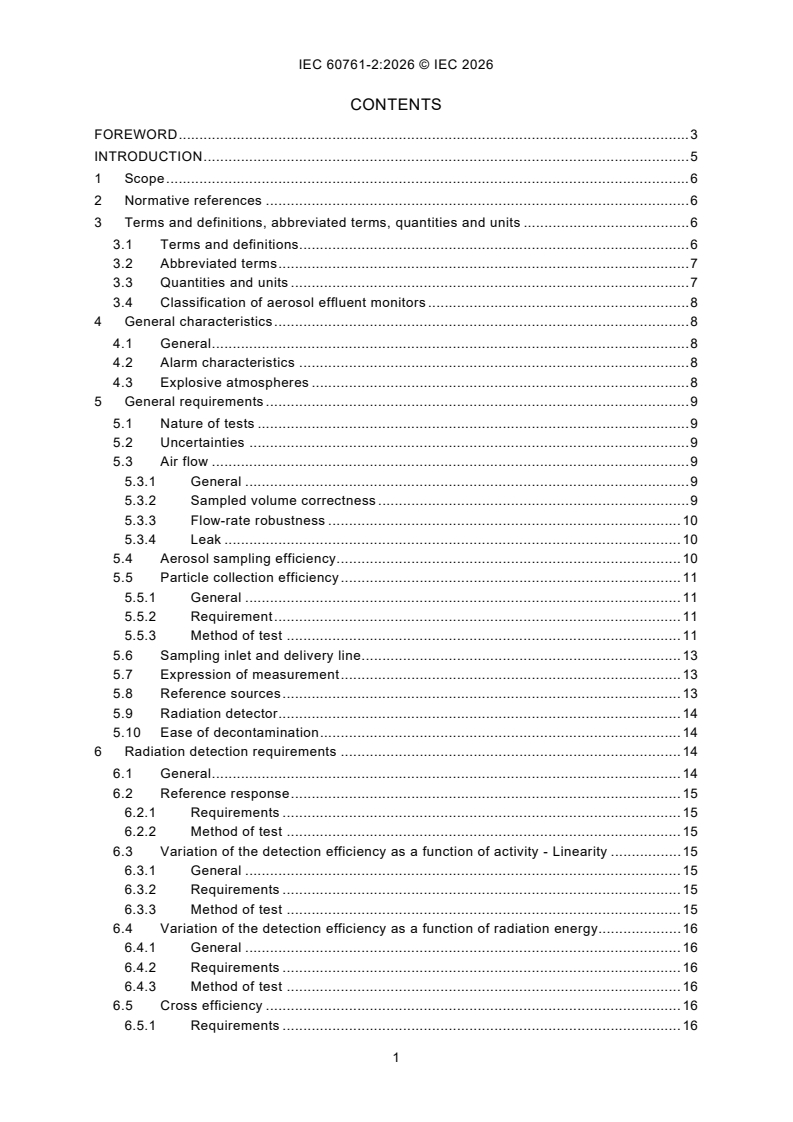
CONTENTS
FOREWORD . 3
INTRODUCTION . 5
1 Scope . 6
2 Normative references . 6
3 Terms and definitions, abbreviated terms, quantities and units . 6
3.1 Terms and definitions. 6
3.2 Abbreviated terms . 7
3.3 Quantities and units . 7
3.4 Classification of aerosol effluent monitors . 8
4 General characteristics . 8
4.1 General . 8
4.2 Alarm characteristics . 8
4.3 Explosive atmospheres . 8
5 General requirements . 9
5.1 Nature of tests . 9
5.2 Uncertainties . 9
5.3 Air flow . 9
5.3.1 General . 9
5.3.2 Sampled volume correctness . 9
5.3.3 Flow-rate robustness . 10
5.3.4 Leak . 10
5.4 Aerosol sampling efficiency . 10
5.5 Particle collection efficiency . 11
5.5.1 General . 11
5.5.2 Requirement . 11
5.5.3 Method of test . 11
5.6 Sampling inlet and delivery line . 13
5.7 Expression of measurement . 13
5.8 Reference sources . 13
5.9 Radiation detector . 14
5.10 Ease of decontamination . 14
6 Radiation detection requirements . 14
6.1 General . 14
6.2 Reference response . 15
6.2.1 Requirements . 15
6.2.2 Method of test . 15
6.3 Variation of the detection efficiency as a function of activity - Linearity . 15
6.3.1 General . 15
6.3.2 Requirements . 15
6.3.3 Method of test . 15
6.4 Variation of the detection efficiency as a function of radiation energy. 16
6.4.1 General . 16
6.4.2 Requirements . 16
6.4.3 Method of test . 16
6.5 Cross efficiency . 16
6.5.1 Requirements . 16
6.5.2 Method of test . 17
6.6 Response to radioactive gases . 17
6.6.1 Requirements . 17
6.6.2 Method of test . 17
222 220
6.7 Response to Rn and Rn daughters . 17
6.8 Compensation of natural activity . 18
6.8.1 General . 18
6.8.2 Requirements . 18
6.8.3 Method of test . 18
6.9 Reference response with natural activity . 18
6.9.1 Requirements . 18
6.9.2 Method of test . 18
6.10 Response to aerosol granulometry variation (optional) . 19
6.10.1 General . 19
6.10.2 Requirement . 19
6.10.3 Method of test . 19
7 Environmental requirements . 19
8 Mechanical requirements . 19
9 Electromagnetic requirements . 19
10 Documentation . 19
10.1 Operation and maintenance manual . 19
10.2 Type test report . 20
Annex A (informative) List of radionuclides suitable for tests with variation of beta
energy . 24
Bibliography . 26
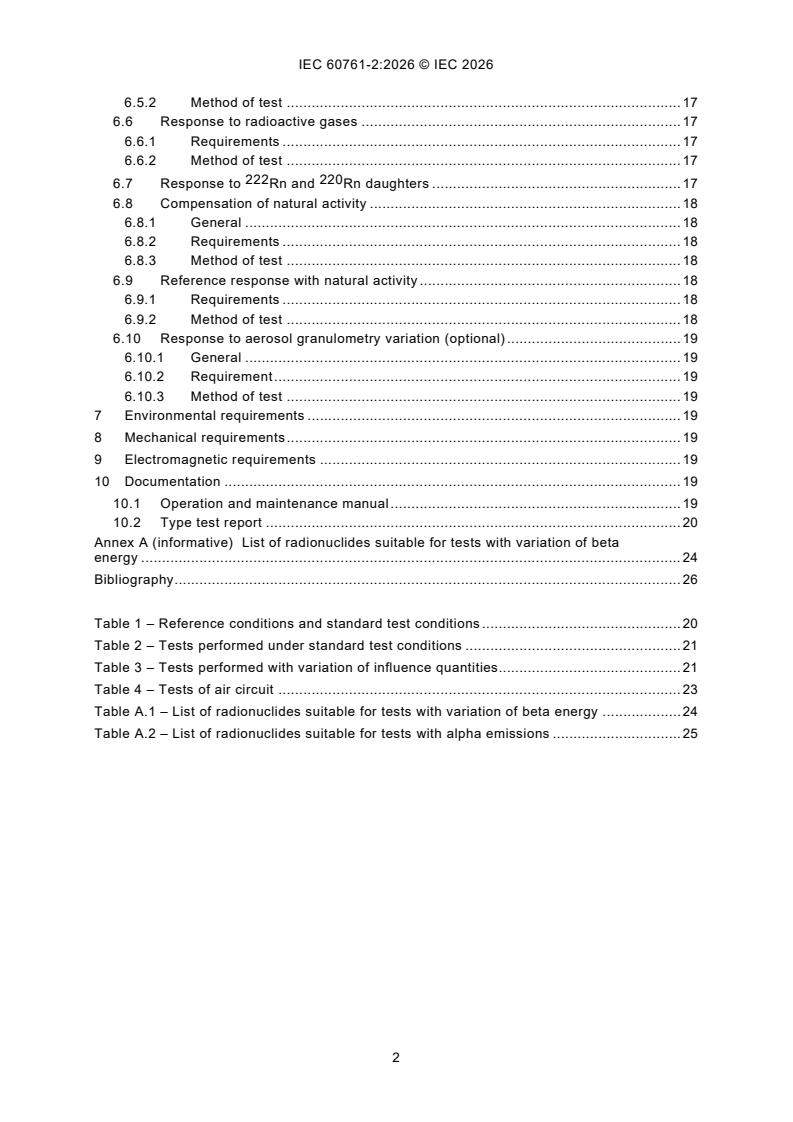
Table 1 – Reference conditions and standard test conditions . 20
Table 2 – Tests performed under standard test conditions . 21
Table 3 – Tests performed with variation of influence quantities. 21
Table 4 – Tests of air circuit . 23
Table A.1 – List of radionuclides suitable for tests with variation of beta energy . 24
Table A.2 – List of radionuclides suitable for tests with alpha emissions . 25
INTERNATIONAL ELECTROTECHNICAL COMMISSION
____________
Radiation protection instrumentation - Equipment for continuous
monitoring of radioactivity in gaseous effluents -
Part 2: Specific requirements for radioactive aerosol
monitors including transuranic aerosols
FOREWORD
1) The International Electrotechnical Commission (IEC) is a worldwide organization for standardization comprising
all national electrotechnical committees (IEC National Committees). The object of IEC is to promote international
co-operation on all questions concerning standardization in the electrical and electronic fields. To this end and
in addition to other activities, IEC publishes International Standards, Technical Specifications, Technical Reports,
Publicly Available Specifications (PAS) and Guides (hereafter referred to as “IEC Publication(s)”). Their
preparation is entrusted to technical committees; any IEC National Committee interested in the subject dealt with
may participate in this preparatory work. International, governmental and non-governmental organizations liaising
with the IEC also participate in this preparation. IEC collaborates closely with the International Organization for
Standardization (ISO) in accordance with conditions determined by agreement between the two organizations.
2) The formal decisions or agreements of IEC on technical matters express, as nearly as possible, an international
consensus of opinion on the relevant subjects since each technical committee has representation from all
interested IEC National Committees.
3) IEC Publications have the form of recommendations for international use and are accepted by IEC National
Committees in that sense. While all reasonable efforts are made to ensure that the technical content of IEC
Publications is accurate, IEC cannot be held responsible for the way in which they are used or for any
misinterpretation by any end user.
4) In order to promote international uniformity, IEC National Committees undertake to apply IEC Publications
transparently to the maximum extent possible in their national and regional publications. Any divergence between
any IEC Publication and the corresponding national or regional publication shall be clearly indicated in the latter.
5) IEC itself does not provide any attestation of conformity. Independent certification bodies provide conformity
assessment services and, in some areas, access to IEC marks of conformity. IEC is not responsible for any
services carried out by independent certification bodies.
6) All users should ensure that they have the latest edition of this publication.
7) No liability shall attach to IEC or its directors, employees, servants or agents including individual experts and
members of its technical committees and IEC National Committees for any personal injury, property damage or
other damage of any nature whatsoever, whether direct or indirect, or for costs (including legal fees) and
expenses arising out of the publication, use of, or reliance upon, this IEC Publication or any other IEC
Publications.
8) Attention is drawn to the Normative references cited in this publication. Use of the referenced publications is
indispensable for the correct application of this publication.
9) IEC draws attention to the possibility that the implementation of this document may involve the use of (a)
patent(s). IEC takes no position concerning the evidence, validity or applicability of any claimed patent rights in
respect thereof. As of the date of publication of this document, IEC had not received notice of (a) patent(s), which
may be required to implement this document. However, implementers are cautioned that this may not represent
the latest information, which may be obtained from the patent database available at https://patents.iec.ch. IEC
shall not be held responsible for identifying any or all such patent rights.
IEC 60761-2 has been prepared by subcommittee 45B: Radiation protection instrumentation, of
IEC technical committee 45: Nuclear instrumentation. It is an International Standard.
This International Standard is to be used in conjunction with IEC 60761-1:2002.
This third edition cancels and replaces the second edition published in 2002. This edition
constitutes a technical revision.
This edition includes the following significant technical changes with respect to the previous
edition:
a) more precise tests for air-flow were added:
1) sampled volume correctness;
2) flow-rate robustness;
b) uncertainties have been taken into account for the reference response test;
c) addition of tests against aerosol granulometry variation;
d) creating a uniform functionality test for all environmental, electromagnetic and mechanical
tests and a requirement for the coefficient of variation of each nominal mean reading.
The text of this International Standard is based on the following documents:
Draft Report on voting
45B/1109/FDIS 45B/1114/RVD
Full information on the voting for its approval can be found in the report on voting indicated in
the above table.
The language used for the development of this International Standard is English.
This document was drafted in accordance with ISO/IEC Directives, Part 2, and developed in
accordance with ISO/IEC Directives, Part 1 and ISO/IEC Directives, IEC Supplement, available
at www.iec.ch/members_experts/refdocs. The main document types developed by IEC are
described in greater detail at www.iec.ch/publications.
A list of all parts in the IEC 60761 series, published under the general title Radiation protection
instrumentation - Equipment for continuous monitoring of radioactivity in gaseous effluents, can
be found on the IEC website.
Future documents in this series will carry the new general title as cited above. Titles of existing
documents in this series will be updated at the time of the next edition.
The committee has decided that the contents of this document will remain unchanged until the
stability date indicated on the IEC website under webstore.iec.ch in the data related to the
specific document. At this date, the document will be
– reconfirmed,
– withdrawn, or
– revised.
INTRODUCTION
IEC 60761 consists of the following parts, under the general title: Radiation protection
instrumentation - Equipment for continuous monitoring of radioactivity in gaseous effluents.
Part 1: General requirements
Part 2: Specific requirements for radioactive aerosol monitors including transuranic aerosols
Part 3: Specific requirements for radioactive noble gas monitors
Part 4: Specific requirements for radioactive iodine monitors
Part 5: Specific requirements for tritium monitors
1 Scope
This part of IEC 60761 is applicable to equipment intended for simultaneous, delayed or discrete
sequential measurement of aerosols in gaseous effluents discharged into the environment.
It is applicable to equipment designed to fulfil the following functions:
– the measurement of the volumetric activity (Bq/m ) of the aerosols in either gaseous
effluents or the released total activity of aerosols (Bq), or both;
– the actuation of an alarm signal when either a predetermined volumetric activity or a
predetermined total released activity of aerosols is exceeded.
This equipment is intended for measurement over a wide range of activity, including very small
quantities in the presence of a much larger natural background. The daughters of Rn (radon)
and Rn (thoron) are naturally occurring aerosols contributing to the natural background. The
discrimination against natural activity can be an important problem in monitoring low level
activity. In order to provide more and better information, complementary or retrospective
laboratory analysis of the filters after collection can be performed.
The objective of this document is to establish specific standard requirements, including
technical characteristics and general test conditions, and to give examples of acceptable
methods for aerosol effluent monitors.
The general requirements, technical characteristics, test procedures, radiation characteristics,
electrical, mechanical, safety and environmental characteristics are given in IEC 60761-1.
Unless otherwise stated, these requirements apply to this document.
2 Normative references
The following documents are referred to in the text in such a way that some or all of their content
constitutes requirements of this document. For dated references, only the edition cited applies.
For undated references, the latest edition of the referenced document (including any
amendments) applies.
IEC 60050-395, International Electrotechnical Vocabulary - Part 395: Nuclear instrumentation:
Physical phenomena, basic concepts, instruments, systems, equipment and detectors
IEC 60761-1:2002, Equipment for continuous monitoring of radioactivity in gaseous effluents -
Part 1: General requirements
IEC 61578:1997, Radiation protection instrumentation - Calibration and verification of the
effectiveness of radon compensation for alpha and/or beta aerosol measuring instruments -
Test methods
3 Terms and definitions, abbreviated terms, quantities and units
3.1 Terms and definitions
For the purposes of this document, the terms and definitions given in IEC 60050-395 and the
following apply.
ISO and IEC maintain terminology databases for use in standardization at the following
addresses:
- IEC Electropedia: available at https://www.electropedia.org/
- ISO Online browsing platform: available at https://www.iso.org/obp
3.1.1
aerosol
suspension of fine solid particles or liquid droplets in air or another gas
3.1.2
aerodynamic equivalent diameter
diameter of a unit-density sphere having the same gravitational-settling velocity as the particle
in question
3.1.3
activity median aerodynamic diameter
AMAD
aerodynamic particle diameter for which 50 % of the aerosol activity is associated with sizes
smaller than (or larger than) that particular size
3.1.4
aerosol monitor
equipment designed for the continuous, delayed or sequential measurement of an aerosol
activity in gaseous effluents discharged into the environment
3.1.5
total equivalent thickness
equivalent window thickness (or density thickness), generally expressed in mass per unit area
), that a particle emitted normally from the surface of the aerosol collection medium
(mg/cm
traverses to reach the sensitive volume of the detector
Note 1 to entry: This thickness includes the distance covered in air plus the thickness of the entry window of the
detector, thickness which can include any coating over the detector for protection against radioactive contamination,
noxious chemicals or water vapour.
3.1.6
source efficiency
largest of the two quotients, of the surface emission rate by the number of particles of the same
type created or released per unit time, either within the source thickness or within the source
saturation layer
3.1.7
alarm
audible, visual, or other signal activated when the instrument reading exceeds a pre-set value
or falls outside of a pre-set range, or when the instrument detects the presence of the source
of radiation according to a pre-set condition
3.1.8
background level
radiation field in which the instrument is intended to operate which includes background
produced by naturally occurring radioactive material
3.2 Abbreviated terms
AMAD activity median aerodynamic diameter
3.3 Quantities and units
. The definitions of
In the present document, units of the International System (SI) are used
radiation quantities are given in IEC 60050-395.
___________
1 th
International Bureau of Weights and Measures: The International System of Units, 9 edition, 2019.
The following units can also be used:
-19
– for energy: electron-volt (symbol: eV), 1 eV = 1,602 176 634 × 10 J;
– for time: years (symbol: y), days (symbol: d), hours (symbol: h), minutes (symbol: min);
– for temperature: degrees Celsius (symbol: ºC), 0 ºC = 273,15 K.
Multiples and submultiples of SI units are used, when practicable, according to the SI system.
3.4 Classification of aerosol effluent monitors
The equipment can be classified according to the type of measuring method such as:
– gross gamma aerosol monitors;
– gross beta aerosol monitors;
– gross alpha aerosol monitors;
– gross alpha and gross beta aerosol monitors;
– alpha spectroscopy monitors;
– gamma spectroscopy monitors.
It can also be classified according to the method of operation (see bibliography) such as:
– equipment with static filter sampler and simultaneous measurement;
– equipment with moving filter sampler and simultaneous measurement;
– equipment with moving filter sampler and delayed measurement;
– equipment with moving filter sampler and simultaneous and delayed measurement;
– equipment with static filter sampler and simultaneous measurement combined with a moving
filter sampler and either simultaneous or delayed measurement;
– equipment with impactor;
– equipment with electrostatic precipitator.
4 General characteristics
4.1 General
Monitors tested using this document are used to detect and indicate the presence of the
airborne contamination. It should alert if so. The alarm requirements shall be agreed between
the manufacturer and the purchaser.
4.2 Alarm characteristics
a) Indicator – The instrument shall alert the user when an alarm occurs (e.g. visual indicator
that enables the operator to view without removal of the device from its wearing position,
vibration alarm intensity that can be sensed by the user, etc.).
b) Alarm type – The instrument shall have audible and visual alarms. The frequency of an
audible alarm should be within the range of 1 kHz to 4 kHz. Where an intermittent alarm is
provided, the signal interval shall not exceed 2 s. The alarm volume at a distance of 30 cm
from the alarm source shall be at least 80 dB(A) and shall not exceed 105 dB(A).
c) The instrument audible alarm shall be capable of being acknowledged and silenced by the
user.
4.3 Explosive atmospheres
The manufacturer shall state whether or not the instrument is certified for use in explosive
atmospheres and its category. Proof of certification shall be provided when claimed.
Certification should be based on IEC 60079-11 or equivalent standard.
5 General requirements
5.1 Nature of tests
The required standard test conditions for environmental quantities, such as temperature and
humidity, as well as those for other quantities that can influence the performance of the
instrument, are given in Table 1. Acceptable testing ranges for these quantities shall be met,
except where the effect of the condition or quantity itself is being tested.
The tests in this document are to be considered as type tests unless otherwise stated. The user
can employ parts of the standard as acceptance tests, although any or all can be considered
as acceptance tests by agreement between manufacturer and purchaser.
Where no method of test is described for a requirement, it is understood to mean that either the
information for the method of test is contained in the requirement or the characteristic
requirement can be verified by observation or by consultation of the manufacturer’s
specifications.
These tests are listed in Table 2, Table 3 and Table 4. They shall be carried out in accordance
with IEC 60761-1.
5.2 Uncertainties
The uncertainties to assess a test shall not be considered, unless stated otherwise by
agreement between the purchaser and the manufacturer.
5.3 Air flow
5.3.1 General
The requirements of IEC 60761-1 are applicable.
Additionally, the air or gas pump shall be capable of holding the variation of pressure induced
by normal operating conditions (maximum expected sampling time, collection media or back-up
filter, atmospheric dust, mass concentration contributing to blockage, etc.), so that there shall
not be a reduction from nominal air flow-rate and no error in the value of total air volume
sampled at the end of the sampling. A protection filter should be used to minimize contamination
of the pump.
In all cases, the instrument shall be designed to prevent flow blockage or malfunctioning of the
collection device in its ability to retain particles.
An alarm shall be fitted to detect the absence, rupture or blockage of the collection medium.
By agreement between the purchaser and the manufacturer, the requirements can be adapted.
5.3.2 Sampled volume correctness
5.3.2.1 Requirements
The requirements of IEC 60761-1 are applicable.
The air or gas pump shall be capable of holding the variation of pressure induced by normal
operating conditions so that there shall not be a reduction from nominal air flow-rate of more
than 10 % and an error in the value of total air volume sampled of more than 8 % at the end of
the sampling.
5.3.2.2 Method of test
The instrument air flow is compared to a reference flowmeter. Over 24 h of normal operating
condition, the total air volume sampled shall not differ by less than 8 % to the reference air
volume and the flow-rate less than 10 % of the nominal flow-rate.
5.3.3 Flow-rate robustness
5.3.3.1 Requirement
The air or gas pump shall be capable of holding the variation of pressure induced by normal
operating conditions so that there shall not be a reduction from nominal air flow-rate of more
than 10 % and an error in the value of total air volume sampled of more than 8 % at the end of
the sampling.
5.3.3.2 Method of test
The instrument air flow is compared to a reference flowmeter. An aerosol is injected into the
instrument. Its characteristics are by agreement between the manufacturer and the purchaser.
The aerosol median diameters in mass should be 0,4 µm and 4 µm and its concentration
25 µg/m .
Over 4 h under the conditions, the total air volume sampled shall not differ by less than 8 % to
the reference air volume and the flow-rate less than 10 % of the nominal flow-rate.
5.3.4 Leak
5.3.4.1 General
This test is intended to provide a measure of the external leakage, but not the internal leakage
around the filter holder or other retention devices.
5.3.4.2 Requirement
The leakage of air or gas into the assembly upstream of the flow-rate metering shall be less
than 5 % of the nominal flow-rate.
5.3.4.3 Method of test
The rate of leakage shall be measured by means of two volume meters or flow-rate meters;
these shall be calibrated to better than 1 % relative to one another. The filter holder shall be
fitted with a clean filter or with other particle retention devices. One apparatus shall be placed
upstream of the assembly and the other downstream of the filter holder or other retention device
and immediately upstream of the flow-rate meter incorporated in the assembly. A series of ten
consecutive measurements shall be made at convenient time intervals (even after a heavy
deposit). The means of the measured upstream and downstream flow-rates shall not differ by
more than 5 % over normal sampling periods. If applicable, corrections shall be made for air
pressure differences.
5.4 Aerosol sampling efficiency
The manufacturer shall state the collection efficiency of the sampling device for at least particles
over a range of 0,1 µm to 10 µm aerodynamic equivalent diameter or other values agreed upon
by the manufacturer and the purchaser. The efficiency values shall be given for the normal
operating conditions, for example air sampling flow-rate.
NOTE 50 % of particles with aerodynamic diameter less than 10 µm are capable of penetrating into the pulmonary
region of the lung (EN 481).
5.5 Particle collection efficiency
5.5.1 General
The collection surface can have different geometries according to the method of operation of
the assembly (see Clause 4):
– circular, for example, for static filter assemblies or cassette systems where filter papers are
moved under a detector or circular impactor;
– square or rectangular, for example, for moving filter assemblies, or rectangular impactor
designs.
NOTE For moving filters, square or rectangular geometry allows a simplification for calculations.
For equipment measuring alpha radiation that uses a detector to view the collection medium, it
is important to minimize, as much as possible, the absorption of alpha radiation by the collection
medium.
Significant non-uniformity of deposition of aerosols collected on the filters shall be avoided.
The design of the aerosol retention device shall minimize deposition on surfaces other than the
collection media.
The filter-holder design characteristics (dimensions, geometry, filter support, etc.) shall take
account of the mechanical strength of the filters used and the characteristics of the air (or gas)
sampling pump.
For simultaneous sampling and measuring assemblies, the measurement of aerosol volumetric
activity can be disturbed by radioactive gases, such as 41Ar, 85Kr, 133Xe, etc., liable to be
present in the sampled air (or gas). This shall be minimized by the special geometry of cavities
located near the detector in front of and behind the filter and the corresponding reduction of
dead volumes.
The design shall minimize leaks, particularly internal leaks causing the flow to bypass the
collection media.
Access to the collection media shall be designed in such a manner as to permit fast and easy
removal without risk of damage to the detection device and minimum risk to the operator when
a high level of activity has been accumulated.
To improve the accuracy and sensitivity of the measurements, the equipment should be
designed so that complementary laboratory analyses of the media after collection can be
performed. In addition, the collection media can provide a means of verification of the
instrumental measurements. Also, in the case of a failure of the electronic part of the instrument,
the medium analysis can serve as a back-up to the measurements.
5.5.2 Requirement
The collection efficiency shall not differ by more than 10 % of the value stated by the manu-
facturer for each given size of particle.
5.5.3 Method of test
The particle diameter and range of sizes used in the measurement of the collection efficiency
of the sampling system shall be agreed upon between the manufacturer and the purchaser, for
example depending upon the diameter of the aerosol to be monitored, the collection efficiency
of the filter media versus particle size, etc.
Various types of aerosols are suitable for use in the collection efficiency tests and include, for
example:
– non-radioactive aerosols with particles having a fluorescent tracer;
– non-radioactive aerosols composed of latex or polystyrene spheres;
– radioactive aerosols.
Collection efficiency shall be tested by introducing a sample of air containing particles of the
appropriate median aerodynamic diameter into the inlet sampling pipe. The distribution can be
polydispersed with a small geometric standard deviation. The sampling equipment shall be
operating under standard test conditions, for example flow-rate.
After the shutdown of the sampling equipment, the amount of aerosol collected on the sampling
medium shall be determined. In addition, the total amount of aerosol available at the monitor
inlet shall also be determined. This can be done by an independent measurement of the
sampled amount of aerosol, or by determining:
– the amount of aerosol collected on the internal surfaces of the inlet line and other surfaces
of the air circuit upstream of the collection medium,
– the amount of aerosol downstream of the collection medium.
The sampling efficiency (E ) of the monitor shall be calculated as:
m
C
M
E ×100
m
C
T
where
C is the amount deposited on the collection medium;
M
C is the total amount of aerosol which has penetrated into the monitor during the test.
T
It is recommended, if practical, that the total amount of aerosol (C ) be determined by an
T
alternative method as a means of verifying the values obtained. Such methods include the
measurement of the concentration of aerosols which enter into the instrument by various
instrumental techniques, for example spectrophotometer, particle analyser, reference sampling,
etc.
If the total aerosol sampled is determined by the sum of the material collected within the monitor,
then the total amount of aerosol (C ) (activity, mass or number of particles) is given by:
T
C= C+CC+
T MU D
where
C is the amount recovered from the internal surfaces of the air circuit upstream of the
U
collection medium;
C is the amount collected downstream of the collection medium.
D
=
5.6 Sampling inlet and delivery line
In addition to the general requirements of IEC 60761-1, the following characteristics shall be
considered and shall be agreed between manufacturer and purchaser:
– the nature of the materials used, paying particular attention to electrostatic effects and to
chemical corrosion. For example: some plastic materials with electrical charge built-up shall
be avoided in order to prevent electrostatic deposition of particles on the walls of the pipe;
– the minimum distance between inlet and outlet to avoid any recirculation;
– the maximum distance between the inlet and the collection media;
– the sampling pipe cross-section, air flow-rate characteristics and the position of the inlet
sampling pipe so as to maintain representative sampling;
– the temperature and pressure control of the sampling line to prevent condensation.
5.7 Expression of measurement
In accordance with the requirements of IEC 60761-1, the electronic measuring assembly
associated with the detector shall provide a reading expressed directly in unit activity
(Bq, Bq/m ).
The conventionally true activity (volumetric, surface, …) of the reference source shall be known
with an uncertainty of less than ±10 % (k = 2).
The manufacturer shall state the response of the monitor and the radionuclides for which it
applies.
5.8 Reference sources
For the determination of the reference response during type tests, the reference source should
be a radioactive aerosol in air with a known volumetric activity and with a known activity median
aerodynamic diameter (AMAD) of approximately 0,4 µm. For aerosol monitors using special
collection techniques such as inertial impaction, a reference aerosol of appropriate AMAD
should be used. When calibrating the equipment, the actual self-absorption factor for activity
deposited in the filter shall be determined. The characteristics of a possible reference source
are described in IEC 61578.
As an alternative to the use of calibrated radioactive aerosols, a calibrated monitor can be used.
The reference beta radiation shall normally be provided by a reference source such as CI,
204 137 239
TI, or Cs, and the reference alpha radiation provided by a reference source of Pu or
241 137
Am and by a reference source of Cs for gamma radiation. Alternative reference radiation
sources can be used by agreement between manufacturer and purchaser.
A list of some suitable radionuclides is given in Annex A, Table A.1 for β emitters and Table A.2
for α emitters.
The reference source shall be traceable to a national primary standard.
The sources used for the tests with variation of beta energy are defined as special sources.
The special sources should be high efficiency solid sources. By way of information, a list of
some suitable radionuclides is given in Annex A.
For transuranic aerosol monitors using alpha spectrometry, natural background can be used to
calibrate the energy spectrum.
The conventionally true volumetric activity of the reference source shall be known with an
uncertainty of less than ±10 % (k = 2).
The conventionally true surface emission rate of all solid test sources shall be known with an
uncertainty of less than ±10 % (k = 2).
5.9 Radiation detector
The manufacturer shall specify the detector characteristics, including the detector dimensions
and transmission characteristics (for example effective area, thickness, etc.) of any protective
screens. The manufacturer should also specify the variation of detection efficiency with particle
energy.
The useful detection surface area of the detector should be approximately equal to that of the
aerosol collecting surface.
For gross activity measurement, the detector can be larger than the collection medium.
For α spectroscopic measurement, the two dimensions should be similar.
The maximum total equivalent window thickness (normal to the source surface at the entrance
to the useful volume of the detector) shall be chosen according to the type of radiation detected:
– gross alpha measurement: less than 2 mg/cm (loss of energy equivalent to 3,2 MeV);
– gross beta measurement: the total equivalent thickness shall be appropriate to the particle
energy spectrum to be detected. The manufacturer shall state the total equivalent thickness;
– alpha spectrometry: adapted to the detector technique;
– gamma rays: adapted to the detector technique.
When spectroscopy is used, the manufacturer shall specify the energy resolution for alpha
particles in the energy range of interest considering air gap and detector characteristics. The
conditions under which the measurements are made shall be specified, for example
222 220
approximate level of natural ( Rn and Rn) radiation background.
5.10 Ease of decontamination
Where the sensitive surface of the radiation detector is in contact with the gaseous medium
containing the radioactive aerosols, special care shall be taken in the design to facilitate
decontamination of the detector head. Wherever possible, the detector head shall be protected
by applying a thin coating in front of the detector window that can be easily exchangeable or
decontaminated.
6 Radiation detection requirements
6.1 General
Unless otherwise agreed upon between the manufacturer and the purchaser, the type test
should include tests of response to at least one aerosol which the instrument is intended to
measure.
These tests shall be undertaken under standard test conditions and shall be carried out with air
(or gas) flow-rate, unless it can be demonstrated that this is unnecessary in relation to normal
working conditions where radon activity is being drawn into the assembly.
The dynamic tests shall be performed in a laboratory with the instrument in full operation. A
known radioactive aerosol (volumetric activity, particle size and radionuclide composition) is
generated and introduced into the sampling inlet while monitoring all standard test conditions.
Depending on the purpose, dynamic tests can be performed with or without radon daughters
(see IEC 61578).
By agreement between the manufacturer and the purchaser, a static method with solid sources
can be employed provided this adequately tests the equipment. In this case, generally, the
detection efficiency is verified instead of the monitor response.
Equipment shall be designed to limit, as far as possible, the influence of ionizing radiations
other than those specified. The manufacturer shall specify the interferences of other ionizing
radiation.
6.2 Reference response
6.2.1 Requirements
The reference response shall
...
IEC 60761-2 ®
Edition 3.0 2026-05
NORME
INTERNATIONALE
Instrumentation pour la radioprotection - Équipements de surveillance en
continu de la radioactivité dans les effluents gazeux -
Partie 2: Exigences particulières aux moniteurs d'aérosols radioactifs, y compris
les aérosols transuraniens
ICS 13.280 ISBN 978-2-8327-1232-0
Droits de reproduction réservés. Sauf indication contraire, aucune partie de cette publication ne peut être reproduite ni
utilisée sous quelque forme que ce soit et par aucun procédé, électronique ou mécanique, y compris la photocopie et
les microfilms, sans l'accord écrit de l'IEC ou du Comité national de l'IEC du pays du demandeur. Si vous avez des
questions sur le copyright de l'IEC ou si vous désirez obtenir des droits supplémentaires sur cette publication, utilisez
les coordonnées ci-après ou contactez le Comité national de l'IEC de votre pays de résidence.
IEC Secretariat Tel.: +41 22 919 02 11
3, rue de Varembé info@iec.ch
CH-1211 Geneva 20 www.iec.ch
Switzerland
A propos de l'IEC
La Commission Electrotechnique Internationale (IEC) est la première organisation mondiale qui élabore et publie des
Normes internationales pour tout ce qui a trait à l'électricité, à l'électronique et aux technologies apparentées.
A propos des publications IEC
Le contenu technique des publications IEC est constamment revu. Veuillez vous assurer que vous possédez l’édition la
plus récente, un corrigendum ou amendement peut avoir été publié.
Recherche de publications IEC - IEC Products & Services Portal - products.iec.ch
webstore.iec.ch/advsearchform Découvrez notre puissant moteur de recherche et consultez
La recherche avancée permet de trouver des publications gratuitement tous les aperçus des publications, symboles
IEC en utilisant différents critères (numéro de référence, graphiques et le glossaire. Avec un abonnement, vous aurez
texte, comité d’études, …). Elle donne aussi des toujours accès à un contenu à jour adapté à vos besoins.
informations sur les projets et les publications remplacées
ou retirées. Electropedia - www.electropedia.org
Le premier dictionnaire d'électrotechnologie en ligne au
IEC Just Published - webstore.iec.ch/justpublished monde, avec plus de 22 500 articles terminologiques en
Restez informé sur les nouvelles publications IEC. Just anglais et en français, ainsi que les termes équivalents
dans 25 langues additionnelles. Egalement appelé
Published détaille les nouvelles publications parues.
Disponible en ligne et une fois par mois par email. Vocabulaire Electrotechnique International (IEV) en ligne.
Service Clients - webstore.iec.ch/csc
Si vous désirez nous donner des commentaires sur cette
publication ou si vous avez des questions contactez-
nous: sales@iec.ch.
SOMMAIRE
AVANT-PROPOS . 3
INTRODUCTION . 5
1 Domaine d’application . 6
2 Références normatives . 6
3 Termes et définitions, abréviations, grandeurs et unités . 7
3.1 Termes et définitions . 7
3.2 Abréviations . 8
3.3 Grandeurs et unités . 8
3.4 Classification des moniteurs d'effluents d'aérosols . 8
4 Caractéristiques générales . 9
4.1 Généralités . 9
4.2 Caractéristiques des alarmes . 9
4.3 Atmosphères explosives . 9
5 Exigences générales . 9
5.1 Nature des essais . 9
5.2 Incertitudes . 9
5.3 Débit d’air . 10
5.3.1 Généralités . 10
5.3.2 Exactitude du volume échantillonné . 10
5.3.3 Robustesse du débit . 10
5.3.4 Fuites . 11
5.4 Rendement de prélèvement d'aérosols . 11
5.5 Rendement de collecte des particules . 11
5.5.1 Généralités . 11
5.5.2 Exigence . 12
5.5.3 Méthode d'essai . 12
5.6 Orifice de prélèvement et conduit de transfert . 13
5.7 Expression des mesures . 13
5.8 Sources de référence . 14
5.9 Détecteur de rayonnement . 14
5.10 Facilité de décontamination . 15
6 Exigences de détection des rayonnements . 15
6.1 Généralités . 15
6.2 Réponse de référence . 15
6.2.1 Exigences . 15
6.2.2 Méthode d'essai . 16
6.3 Variation du rendement de détection en fonction de l'activité - Linéarité . 16
6.3.1 Généralités . 16
6.3.2 Exigences . 16
6.3.3 Méthode d'essai . 16
6.4 Variation du rendement de détection en fonction de l'énergie du
rayonnement . 16
6.4.1 Généralités . 16
6.4.2 Exigences . 17
6.4.3 Méthode d'essai . 17
6.5 Rendement croisé . 17
6.5.1 Exigences . 17
6.5.2 Méthode d'essai . 18
6.6 Réponse aux gaz radioactifs . 18
6.6.1 Exigences . 18
6.6.2 Méthode d'essai . 18
222 220
6.7 Réponses aux produits de filiation du Rn et du Rn. 18
6.8 Compensation de l'activité naturelle . 19
6.8.1 Généralités . 19
6.8.2 Exigences . 19
6.8.3 Méthode d'essai . 19
6.9 Réponse de référence en fonction de l'activité naturelle . 19
6.9.1 Exigences . 19
6.9.2 Méthode d'essai . 19
6.10 Réponse à la variation granulométrique de l'aérosol (facultatif) . 20
6.10.1 Généralités . 20
6.10.2 Exigence . 20
6.10.3 Méthode d'essai . 20
7 Exigences d'environnement . 20
8 Exigences mécaniques . 20
9 Exigences électromagnétiques . 20
10 Documentation . 20
10.1 Manuel d'utilisation et de maintenance . 20
10.2 Rapport d’essai de type . 21
Annexe A (informative) Liste des radionucléides appropriés aux essais de variation de
l'énergie bêta . 25
Bibliographie . 27
Tableau 1 – Conditions de référence et conditions normales d'essais . 21
Tableau 2 – Essais effectués dans les conditions normales d'essais . 22
Tableau 3 – Essais effectués avec variation des grandeurs d'influence . 23
Tableau 4 – Essais du circuit aéraulique . 24
Tableau A.1 – Liste des radionucléides appropriés aux essais de variation de
l'énergie bêta . 25
Tableau A.2 – Liste des radionucléides appropriés aux essais d'émissions alpha . 26
COMMISSION ÉLECTROTECHNIQUE INTERNATIONALE
____________
Instrumentation pour la radioprotection - Équipements de surveillance
en continu de la radioactivité dans les effluents gazeux -
Partie 2: Exigences particulières aux moniteurs d'aérosols radioactifs,
y compris les aérosols transuraniens
AVANT-PROPOS
1) La Commission Électrotechnique Internationale (IEC) est une organisation mondiale de normalisation composée
de l'ensemble des comités électrotechniques nationaux (Comités nationaux de l’IEC). L’IEC a pour objet de
favoriser la coopération internationale pour toutes les questions de normalisation dans les domaines de
l'électricité et de l'électronique. À cet effet, l’IEC – entre autres activités – publie des Normes internationales,
des Spécifications techniques, des Rapports techniques, des Spécifications accessibles au public (PAS) et des
Guides (ci-après dénommés "Publication(s) de l’IEC"). Leur élaboration est confiée à des comités d'études, aux
travaux desquels tout Comité national intéressé par le sujet traité peut participer. Les organisations
internationales, gouvernementales et non gouvernementales, en liaison avec l’IEC, participent également aux
travaux. L’IEC collabore étroitement avec l'Organisation Internationale de Normalisation (ISO), selon des
conditions fixées par accord entre les deux organisations.
2) Les décisions ou accords officiels de l’IEC concernant les questions techniques représentent, dans la mesure du
possible, un accord international sur les sujets étudiés, étant donné que les Comités nationaux de l’IEC intéressés
sont représentés dans chaque comité d’études.
3) Les Publications de l’IEC se présentent sous la forme de recommandations internationales et sont agréées
comme telles par les Comités nationaux de l’IEC. Tous les efforts raisonnables sont entrepris afin que l’IEC
s'assure de l'exactitude du contenu technique de ses publications; l’IEC ne peut pas être tenue responsable de
l'éventuelle mauvaise utilisation ou interprétation qui en est faite par un quelconque utilisateur final.
4) Dans le but d'encourager l'uniformité internationale, les Comités nationaux de l’IEC s'engagent, dans toute la
mesure possible, à appliquer de façon transparente les Publications de l’IEC dans leurs publications nationales
et régionales. Toutes divergences entre toutes Publications de l’IEC et toutes publications nationales ou
régionales correspondantes doivent être indiquées en termes clairs dans ces dernières.
5) L’IEC elle-même ne fournit aucune attestation de conformité. Des organismes de certification indépendants
fournissent des services d'évaluation de conformité et, dans certains secteurs, accèdent aux marques de
conformité de l’IEC. L’IEC n'est responsable d'aucun des services effectués par les organismes de certification
indépendants.
6) Tous les utilisateurs doivent s'assurer qu'ils sont en possession de la dernière édition de cette publication.
7) Aucune responsabilité ne doit être imputée à l’IEC, à ses administrateurs, employés, auxiliaires ou mandataires,
y compris ses experts particuliers et les membres de ses comités d'études et des Comités nationaux de l’IEC,
pour tout préjudice causé en cas de dommages corporels et matériels, ou de tout autre dommage de quelque
nature que ce soit, directe ou indirecte, ou pour supporter les coûts (y compris les frais de justice) et les dépenses
découlant de la publication ou de l'utilisation de cette Publication de l’IEC ou de toute autre Publication de l’IEC,
ou au crédit qui lui est accordé.
8) L'attention est attirée sur les références normatives citées dans cette publication. L'utilisation de publications
référencées est obligatoire pour une application correcte de la présente publication.
9) L'IEC attire l'attention sur le fait que la mise en application du présent document peut entraîner l'utilisation d'un
ou de plusieurs brevets. L'IEC ne prend pas position quant à la preuve, à la validité et à l'applicabilité de tout
droit de brevet revendiqué à cet égard. À la date de publication du présent document, l'IEC n'a pas reçu
notification qu'un ou plusieurs brevets pouvaient être nécessaires à sa mise en application. Toutefois, il y a lieu
d'avertir les responsables de la mise en application du présent document que des informations plus récentes
sont susceptibles de figurer dans la base de données de brevets, disponible à l'adresse https://patents.iec.ch.
L'IEC ne saurait être tenue pour responsable de ne pas avoir identifié de tels droits de brevets.
L’IEC 60761-2 a été établie par le sous-comité 45B: Instrumentation pour la radioprotection, du
comité d'études 45 de l'IEC: Instrumentation nucléaire. Il s'agit d'une Norme internationale.
La présente Norme internationale doit être utilisée conjointement avec l'IEC 60761-1:2002.
Cette troisième édition annule et remplace la deuxième édition parue en 2002. Cette édition
constitue une révision technique.
Cette édition inclut les modifications techniques significatives suivantes par rapport à l'édition
précédente:
a) ajout d'essais plus précis pour le débit d'air;
1) exactitude du volume échantillonné;
2) robustesse du débit;
b) prise en compte des incertitudes pour l'essai de réponse de référence;
c) ajout d'essais contre la variation granulométrique de l'aérosol;
d) création d'un essai de fonctionnalité uniforme pour tous les essais environnementaux,
électromagnétiques et mécaniques, et d'une exigence relative au coefficient de variation de
chaque valeur moyenne nominale lue.
Le texte de cette Norme internationale est issu des documents suivants:
Projet Rapport de vote
45B/1109/FDIS 45B/1114/RVD
Le rapport de vote indiqué dans le tableau ci-dessus donne toute information sur le vote ayant
abouti à son approbation.
La langue employée pour l'élaboration de cette Norme internationale est l'anglais.
Ce document a été rédigé selon les Directives ISO/IEC, Partie 2, il a été développé selon les
Directives ISO/IEC, Partie 1 et les Directives ISO/IEC, Supplément IEC, disponibles sous
www.iec.ch/members_experts/refdocs. Les principaux types de documents développés par
l'IEC sont décrits plus en détail sous www.iec.ch/publications.
Une liste de toutes les parties de la série IEC 60761, publiées sous le titre général
Instrumentation pour la radioprotection - Équipements de surveillance en continu de la
radioactivité dans les effluents gazeux, se trouve sur le site web de l’IEC.
Les futurs documents de cette série porteront le nouveau titre général cité ci-dessus. Le titre
des documents qui existent déjà dans cette série sera mis à jour lors de leur prochaine édition.
Le comité a décidé que le contenu de ce document ne sera pas modifié avant la date de stabilité
indiquée sur le site web de l'IEC sous webstore.iec.ch dans les données relatives au document
recherché. À cette date, le document sera
– reconduit,
– supprimé, ou
– révisé.
INTRODUCTION
L'IEC 60761 comprend les parties suivantes, publiées sous le titre général: Instrumentation
pour la radioprotection - Équipements de surveillance en continu de la radioactivité dans les
effluents gazeux.
Partie 1: Exigences générales
Partie 2: Exigences particulières aux moniteurs d'aérosols radioactifs, y compris les aérosols
transuraniens
Partie 3: Exigences particulières aux moniteurs de gaz rares radioactifs
Partie 4: Exigences particulières aux moniteurs d'iode radioactif
Partie 5: Exigences particulières aux moniteurs de tritium
1 Domaine d’application
La présente partie de l'IEC 60761 s'applique aux équipements destinés au mesurage simultané,
au mesurage en différé ou au mesurage séquentiel discret des aérosols dans les effluents
gazeux rejetés dans l'environnement.
Elle s'applique aux équipements conçus pour remplir les fonctions suivantes:
– le mesurage de l'activité volumique (Bq/m ) des aérosols dans les effluents gazeux ou de
l'activité totale des aérosols rejetés (Bq), ou les deux;
– le déclenchement d'un signal d'alarme lorsqu'un niveau d'activité volumique ou d'activité
totale prédéterminées des aérosols rejetés est dépassé.
Ces équipements sont destinés au mesurage sur une large plage d'activité, y compris de très
petites grandeurs en présence d'un bruit de fond naturel beaucoup plus important. À ce bruit
222 220
de fond naturel contribuent en particulier les produits de filiation du Rn (radon) et Rn
(thoron), qui sont des aérosols d'origine naturelle. La discrimination de l'activité naturelle peut
constituer un problème important pour la surveillance des faibles niveaux d'activité. Afin
d'améliorer la quantité et la qualité des informations, des analyses complémentaires ou
rétrospectives des filtres en laboratoire peuvent être effectuées après la collecte.
L'objectif du présent document est de définir des exigences normatives spécifiques, et
notamment les caractéristiques techniques et les conditions générales d'essai, et de donner
des exemples de méthodes acceptables pour les moniteurs d'effluents d'aérosols.
Les exigences générales, les caractéristiques techniques, les procédures d'essai, les
caractéristiques des rayonnements, les caractéristiques électriques, mécaniques, de sécurité
et d'environnement sont définies dans l'IEC 60761-1. Sauf indication contraire, ces exigences
s'appliquent au présent document.
2 Références normatives
Les documents suivants sont cités dans le texte de sorte qu'ils constituent, pour tout ou partie
de leur contenu, des exigences du présent document. Pour les références datées, seule
l'édition citée s'applique. Pour les références non datées, la dernière édition du document de
référence s'applique (y compris les éventuels amendements).
IEC 60050-395, Vocabulaire Électrotechnique International - Partie 395: Instrumentation
nucléaire: Phénomènes physiques, notions fondamentales, instruments, systèmes,
équipements et détecteurs
IEC 60761-1:2002, Équipements de surveillance en continu de la radioactivité dans les
effluents gazeux - Partie 1: Exigences générales
IEC 61578:1997, Instrumentation pour la radioprotection - Étalonnage et contrôle de l'efficacité
de la compensation radon des instruments de mesure des aérosols radioactifs émetteurs alpha
et/ou bêta - Méthodes d'essais
3 Termes et définitions, abréviations, grandeurs et unités
3.1 Termes et définitions
Pour les besoins du présent document, les termes et définitions de l'IEC 60050-395 ainsi que
les suivants s'appliquent.
L'ISO et l'IEC tiennent à jour des bases de données terminologiques destinées à être utilisées
en normalisation, consultables aux adresses suivantes:
- IEC Electropedia: disponible à l'adresse https://www.electropedia.org/
- ISO Online browsing platform: disponible à l’adresse https://www.iso.org/obp
3.1.1
aérosol
suspension de particules solides fines ou de gouttelettes liquides dans l'air ou dans un autre
gaz
3.1.2
diamètre aérodynamique équivalent
diamètre d'une sphère de densité 1 ayant la même vitesse de sédimentation que la particule
étudiée
3.1.3
diamètre aérodynamique médian en activité
AMAD
diamètre aérodynamique des particules pour lequel 50 % de l'activité des aérosols est associée
à des tailles plus petites (ou plus grandes) que la taille donnée
Note 1 à l'article: L’abréviation "AMAD" est dérivée du terme anglais développé correspondant "activity median
aerodynamic diameter".
3.1.4
moniteur d'aérosols
équipement conçu pour le mesurage en continu, le mesurage en différé ou le mesurage
séquentiel de l'activité des aérosols contenus dans les effluents gazeux rejetés dans
l'environnement
3.1.5
épaisseur équivalente totale
épaisseur équivalente de la fenêtre (ou densité d'épaisseur), généralement exprimée en masse
surfacique (mg/cm ), que traverse une particule émise normalement depuis la surface du milieu
collecteur des aérosols, pour atteindre le volume sensible du détecteur
Note 1 à l'article: Cette épaisseur inclut la distance parcourue dans l'air et l'épaisseur de la fenêtre d'entrée du
détecteur, épaisseur qui peut comprendre tout revêtement interposé devant le détecteur pour le protéger contre la
contamination radioactive, les produits chimiques nocifs ou la vapeur d'eau.
3.1.6
rendement d'une source
le plus grand des deux quotients, du taux d'émission surfacique par le nombre de particules du
même type créé ou libéré par unité de temps, d'une part dans l'épaisseur de la source ou d'autre
part dans la couche de saturation de la source
3.1.7
alarme
signal sonore, visuel ou d'une autre nature qui est émis lorsque la valeur lue sur l'instrument
dépasse une valeur prédéfinie ou sort d'une plage prédéfinie ou lorsque l'instrument détecte la
présence de la source de rayonnement conformément à une condition prédéfinie
3.1.8
niveau de bruit de fond
champ de rayonnement dans lequel l'instrument est destiné à être utilisé et qui inclut le bruit
de fond produit par la présence de matériaux radioactifs d'origine naturelle
3.2 Abréviations
AMAD activity median aerodynamic diameter (diamètre aérodynamique médian en activité)
3.3 Grandeurs et unités
Dans le présent document, les unités du Système International (SI) sont utilisées . Les
définitions relatives aux grandeurs de rayonnement sont données dans l'IEC 60050-395.
Les unités suivantes peuvent également être utilisées:
-19
– pour l'énergie: électronvolt (symbole: eV), 1 eV = 1,602 176 634 x 10 J;
– pour le temps: années (symbole: y), jours (symbole: d), heures (symbole: h), minutes
(symbole: min);
– pour la température: degrés Celsius (symbole: ºC), 0 ºC = 273,15 K.
Les multiples et sous-multiples d'unités SI sont utilisés, dans la mesure du possible, selon le
système SI.
3.4 Classification des moniteurs d'effluents d'aérosols
Les équipements peuvent être classés selon le type de méthode de mesure, notamment:
– moniteurs d'aérosols gamma (mesurage global);
– moniteurs d'aérosols bêta (mesurage global);
– moniteurs d'aérosols alpha (mesurage global);
– moniteurs mixtes d'aérosols alpha et bêta (mesurage global);
– moniteurs utilisant la spectroscopie alpha;
– moniteurs utilisant la spectroscopie gamma.
Ils peuvent également être classés selon le mode de fonctionnement (voir la bibliographie):
– équipements d'échantillonnage à filtre fixe et mesurage simultané;
– équipements d'échantillonnage à filtre à déroulement et mesurage simultané;
– équipements d'échantillonnage à filtre à déroulement et mesurage différé;
– équipements d'échantillonnage à filtre à déroulement et mesurage simultané et différé;
– équipements d'échantillonnage à filtre fixe et mesurage simultané combiné à un équipement
d'échantillonnage à filtre à déroulement et mesurage simultané ou différé;
– équipements à impacteur;
– équipements à dispositif de précipitation électrostatique.
___________
1 e
Bureau international des poids et mesures: Système International d’unités, 9 édition, 2019.
4 Caractéristiques générales
4.1 Généralités
Les moniteurs soumis à l'essai selon le présent document sont utilisés pour détecter et indiquer
la présence de la contamination atmosphérique. Il convient que l'instrument émette une alerte
si cela est nécessaire. Les exigences relatives à alarme doivent faire l'objet d'un accord entre
le constructeur et l'acheteur.
4.2 Caractéristiques des alarmes
a) Indicateur – L'instrument doit alerter l'utilisateur lorsqu'une alarme se déclenche (par
exemple, indicateur visuel permettant à l'opérateur de visualiser l'alarme sans retirer le
dispositif de sa position de port, intensité d'alarme par vibration pouvant être perçue par
l'utilisateur, etc.).
b) Type d'alarme – L'instrument doit disposer d'alarmes sonores et visuelles. Il convient que
la fréquence d'une alarme sonore soit comprise dans la plage de 1 kHz à 4 kHz. Dans le
cas d'une alarme intermittente, l'intervalle entre les signaux ne doit pas dépasser 2 s. Le
volume de l'alarme à une distance de 30 cm de la source de l'alarme doit être d'au moins
80 dB(A) et ne doit pas dépasser 105 dB(A).
c) L'alarme sonore de l'instrument doit pouvoir être acquittée et mise en sourdine par
l'utilisateur.
4.3 Atmosphères explosives
Le constructeur doit indiquer si l'instrument est certifié ou non pour une utilisation dans des
atmosphères explosives, ainsi que la catégorie de l'instrument. Une preuve de certification doit
être fournie lorsqu'elle est demandée. Il convient d'établir la certification selon l'IEC 60079-11
ou selon une norme équivalente.
5 Exigences générales
5.1 Nature des essais
Les conditions normales d'essais exigées pour les grandeurs d'environnement, telles que la
température et l'humidité, ainsi que celles d'autres grandeurs pouvant influencer les
performances de l'instrument, sont indiquées dans le Tableau 1. Pour ces grandeurs, des
plages d'essai acceptables doivent être respectées, sauf si l'effet de la condition ou de la
grandeur est lui-même l'objet de l'essai.
Sauf indication contraire, les essais du présent document doivent être considérés comme des
essais de type. L'utilisateur peut utiliser des parties de la norme comme essais de réception,
même si tout ou partie des essais peuvent être considérés comme des essais de réception par
accord entre le constructeur et l'acheteur.
Lorsqu'aucune méthode d'essai n'est décrite pour une exigence, il est admis que soit les
informations relatives à la méthode d'essai sont contenues dans l'exigence, soit l'exigence
spécifique peut être vérifiée par observation ou par consultation des spécifications du
constructeur.
Ces essais sont indiqués dans le Tableau 2, le Tableau 3 et le Tableau 4. Ils doivent être
effectués conformément à l'IEC 60761-1.
5.2 Incertitudes
Les incertitudes pour évaluer un essai ne doivent pas être prises en compte, sauf indication
contraire par accord entre le constructeur et l'acheteur.
5.3 Débit d’air
5.3.1 Généralités
Les exigences de l'IEC 60761-1 s'appliquent.
Par ailleurs, la pompe à air ou à gaz doit être capable de supporter les variations de pression
rencontrées dans les conditions de fonctionnement normal (temps de prélèvement maximal
prévu, type de milieu collecteur ou de filtre de sortie, empoussièrement atmosphérique,
concentration massique contribuant au colmatage, etc.), de sorte qu'il ne doit y pas avoir de
réduction du débit nominal d'air ni d'erreur sur la valeur du volume total d'air prélevé à la fin du
prélèvement. Il convient d'utiliser un filtre de protection pour réduire le plus possible la
contamination de la pompe.
Dans tous les cas, l'instrument doit être conçu pour éviter le colmatage ou le dysfonctionnement
du dispositif de collecte dans sa capacité à retenir les particules.
L'instrument doit comporter une alarme pour détecter l'absence, la rupture ou le colmatage du
milieu collecteur.
En accord avec l'acheteur et le constructeur, les exigences peuvent être adaptées.
5.3.2 Exactitude du volume échantillonné
5.3.2.1 Exigences
Les exigences de l'IEC 60761-1 s'appliquent.
La pompe à air ou à gaz doit être capable de supporter les variations de pression rencontrées
dans les conditions de fonctionnement normal, de sorte qu'il ne doit pas y avoir de réduction
du débit nominal d'air supérieure à 10 % ni d'erreur sur la valeur du volume total d'air prélevé
supérieure à 8 % à la fin du prélèvement.
5.3.2.2 Méthode d'essai
Le débit d'air de l'instrument est comparé à un débitmètre de référence. Sur une période de
24 h en conditions de fonctionnement normal, le volume d'air total prélevé ne doit pas s'écarter
de moins de 8 % du volume d'air de référence et le débit doit être inférieur à 10 % du débit
nominal.
5.3.3 Robustesse du débit
5.3.3.1 Exigence
La pompe à air ou à gaz doit être capable de supporter les variations de pression rencontrées
dans les conditions de fonctionnement normal, de sorte qu'il ne doit pas y avoir de réduction
du débit nominal d'air supérieure à 10 % ni d'erreur sur la valeur du volume total d'air prélevé
supérieure à 8 % à la fin du prélèvement.
5.3.3.2 Méthode d'essai
Le débit d'air de l'instrument est comparé à un débitmètre de référence. Un aérosol est injecté
dans l'instrument. Ses caractéristiques sont fixées par accord entre le constructeur et
l'acheteur. Il convient que les diamètres médians de l'aérosol en masse soient de 0,4 μm et
.
4 μm et que sa concentration soit de 25 μg/m
Sur une période de 4 h dans ces conditions, le volume d'air total prélevé ne doit pas s'écarter
de moins de 8 % du volume d'air de référence et le débit doit être inférieur à 10 % du débit
nominal.
5.3.4 Fuites
5.3.4.1 Généralités
Cet essai a pour objet de mesurer les fuites externes, mais pas les fuites internes autour du
porte-filtre ou d'autres dispositifs de retenue.
5.3.4.2 Exigence
La fuite d'air ou de gaz dans l'ensemble en amont du mesurage du débit doit être inférieure à
5 % du débit nominal.
5.3.4.3 Méthode d'essai
Le taux de fuite doit être mesuré au moyen de deux débitmètres volumétriques qui doivent être
étalonnés l'un par rapport à l'autre avec une précision meilleure que 1 %. Le porte-filtre doit
être équipé d'un filtre propre ou d'autres dispositifs de retenue des particules. Un appareil doit
être placé en amont de l'ensemble. L'autre appareil doit être placé en aval du porte-filtre ou de
tout autre dispositif de retenue, immédiatement en amont du débitmètre incorporé à l'ensemble.
Une série de dix mesurages consécutifs doit être réalisée à des intervalles de temps appropriés
(même après un fort dépôt). La moyenne des débits mesurés en amont et en aval ne doit pas
s'écarter de plus de 5 % sur des durées normales de prélèvement. S'il y a lieu, des corrections
doivent être effectuées pour prendre en compte les différences de pression d'air.
5.4 Rendement de prélèvement d'aérosols
Le constructeur doit indiquer le rendement de collecte du dispositif de prélèvement au moins
pour les particules de diamètre aérodynamique équivalent compris entre 0,1 µm et 10 µm ou
d'autres valeurs fixées par accord entre le constructeur et l'acheteur. Les valeurs de rendement
doivent être indiquées pour les conditions de fonctionnement normal, en particulier pour le débit
de prélèvement d'air.
NOTE 50 % des particules dont le diamètre aérodynamique est inférieur à 10 µm peuvent pénétrer dans la région
pulmonaire (EN 481).
5.5 Rendement de collecte des particules
5.5.1 Généralités
La surface de collecte peut avoir des géométries différentes selon le mode de fonctionnement
de l'ensemble (voir l'Article 4):
– circulaire, par exemple pour les ensembles à filtre fixe ou les systèmes à cassette dans
lesquels les papiers filtres passent sous un détecteur ou un impacteur circulaire;
– carrée ou rectangulaire, par exemple pour les ensembles à filtre à déroulement ou à
impacteur rectangulaire.
NOTE Pour les filtres à déroulement, la géométrie carrée ou rectangulaire permet de simplifier les calculs.
Lorsque les équipements mesurent le rayonnement alpha à l'aide d'un détecteur placé face au
milieu collecteur, il est important de réduire le plus possible l'absorption du rayonnement alpha
par le milieu collecteur.
Une hétérogénéité significative des dépôts d'aérosols recueillis sur les filtres doit être évitée.
La conception du dispositif de retenue d'aérosols doit être telle que les dépôts sur les surfaces
autres que le milieu collecteur soient réduits le plus possible.
Les caractéristiques de conception du porte-filtre (dimensions, géométrie, support du filtre, etc.)
doivent être établies en fonction de la résistance mécanique des filtres utilisés et des
caractéristiques de la pompe de prélèvement d'air (ou de gaz).
Dans les ensembles à prélèvement et à mesurage simultanés, le mesurage de l'activité
volumique des aérosols peut être perturbé par des gaz radioactifs tels que 41Ar, 85Kr, 133Xe,
etc., susceptibles d'être présents dans l'air (ou le gaz) prélevé. Cette influence doit être réduite
le plus possible par une géométrie spéciale des cavités situées près du détecteur, en amont et
en aval du filtre, et par une réduction correspondante des volumes morts.
La conception doit réduire le plus possible les fuites, en particulier les fuites internes qui
peuvent provoquer le contournement du milieu collecteur.
L'accès au milieu collecteur doit être conçu de façon à permettre son remplacement facile et
rapide sans risque d'endommagement du dispositif de détection et avec un risque minimal pour
l'opérateur en cas d'accumulation d'un niveau élevé d'activité.
Pour améliorer l'exactitude et la sensibilité des mesurages, il convient de concevoir des
équipements afin de pouvoir effectuer des analyses complémentaires des milieux collecteurs
en laboratoire après la collecte. En outre, les milieux collecteurs peuvent donner un moyen de
vérifier les mesurages instrumentaux. En cas de défaillance de la partie électronique des
instruments, l'analyse du milieu peut être utilisée pour des mesurages a posteriori.
5.5.2 Exigence
Le rendement de collecte ne doit pas s'écarter de plus de 10 % de la valeur indiquée par le
constructeur pour chaque taille donnée de particules.
5.5.3 Méthode d'essai
Le diamètre des particules et la plage de tailles utilisées pour mesurer le rendement de collecte
du système de prélèvement doivent faire l'objet d'un accord entre le constructeur et l'acheteur,
par exemple en considérant le diamètre de l'aérosol à surveiller et le rendement du milieu filtrant
en fonction des dimensions de particules, etc.
Différents types d'aérosols sont appropriés pour les essais de rendement de collecte des filtres,
par exemple:
– des aérosols non radioactifs dont les particules portent un traceur fluorescent;
– des aérosols non radioactifs composés de sphères de latex ou de polystyrène;
– des aérosols radioactifs.
Le rendement de collecte doit être vérifié par essai en injectant à l'entrée du tuyau
d'échantillonnage un échantillon d'air contenant des particules du diamètre aérodynamique
médian approprié. La distribution peut être polydispersée avec un faible écart-type
géométrique. L'équipement de prélèvement doit fonctionner dans les conditions normales
d'essais, par exemple débit.
Après l'arrêt du matériel de prélèvement, la quantité d'aérosol recueillie sur le milieu de
prélèvement doit être déterminée. En outre, la quantité totale d'aérosol disponible à l'entrée du
moniteur doit également être déterminée. Cette dernière peut être déterminée par un mesurage
indépendant de la quantité d'aérosol prélevée ou par la détermination de:
– la quantité d'aérosol recueillie sur les surfaces internes du conduit de prélèvement et les
autres surfaces du circuit aéraulique en amont du milieu collecteur;
– la quantité d'aérosol recueillie en aval du milieu collecteur.
Le rendement de prélèvement (E ) du moniteur doit être calculé comme suit:
m
C
M
E ×100
m
C
T
où
C est la quantité d'aérosol recueillie sur le milieu collecteur;
M
C est la quantité totale d'aérosol qui a pénétré dans le moniteur pendant l'essai.
T
Il est recommandé, dans la mesure du possible, de déterminer la quantité totale d'aérosol (C )
T
par une autre méthode de façon à vérifier les valeurs obtenues. Ces méthodes comprennent le
mesurage de la concentration des aérosols qui pénètrent dans l'instrument par différentes
techniques instrumentales, par exemple spectrophotomètre, analyseur de particules,
prélèvement de référence, etc.
Si la quantité totale prélevée est déterminée par la somme des particules recueillies dans le
moniteur, la quantité totale d'aérosol (C ) (activité, masse ou nombre de particules) est donnée
T
par:
C= C+CC+
T MU D
où
C est la quantité d'aérosol recueillie sur les surfaces internes du circuit aéraulique en amont
U
du milieu collecteur;
C est la quantité d'aérosol recueillie en aval du milieu collecteur.
D
5.6 Orifice de prélèvement et conduit de transfert
Outre les exigences générales de l'IEC 60761-1, les caractéristiques suivantes doivent être
prises en compte et doivent faire l'objet d'un accord entre le constructeur et l'acheteur:
– la nature des matériaux utilisés en faisant particulièrement attention aux effets
électrostatiques et à la corrosion chimique. Par exemple: des matériaux plastiques dont la
charge électrique augmente doivent être évités pour prévenir les dépôts électrostatiques de
particules sur les parois du conduit;
– la distance minimale entre l'entrée et l'évacuation pour éviter la recirculation;
– la distance maximale entre l'entrée et le milieu collecteur;
– la section du tuyau d'échantillonnage, les caractéristiques du débit d'air et la position du
tuyau d'échantillonnage, de façon à conserver un prélèvement représentatif;
– le contrôle de la température et de la pression du conduit de prélèvement pour éviter la
condensation.
5.7 Expression des mesures
Conformément aux exigences de l'IEC 60761-1, l'ensemble électronique de mesure associé au
).
détecteur doit fournir une lecture directement exprimée en unités d'activité (Bq, Bq/m
L'activité (volumique, surfacique, etc.) conventionnellement vraie de la source de référence doit
être connue avec une incertitude inférieure à ±10 % (k = 2).
Le constructeur doit indiquer la réponse du moniteur et les radionucléides auxquels elle
s'applique.
=
5.8 Sources de référence
Pour déterminer la réponse de référence pendant les essais de type, il convient d'utiliser comme
source de référence un aérosol radioactif dans l'air d'activité volumique connue et de diamètre
aérodynamique médian en activité (AMAD) connu d'environ 0,4 µm. Pour les moniteurs
d'aérosols qui utilisent des techniques de collecte particulières, telles qu'une obstruction
inertielle, il convient d'utiliser un aérosol de référence d'AMAD approprié. Lors de l'étalonnage
de l'équipement, le coefficient d'autoabsorption réelle de l'activité déposée sur le filtre doit
normalement être déterminé. Les caractéristiques d'une source de référence possible sont
décrites dans l'IEC 61578.
En lieu et place des aérosols radioactifs étalonnés, un moniteur étalonné peut être utilisé.
Le rayonnement bêta de référence doit normalement être fourni par une source de référence
36 204 137
de CI, de TI ou de Cs, le rayonnement alpha de référence par une source de référence
239 241 137
de Pu ou de Am et le rayonnement gamma par une source de référence de Cs.
D'autres sources de rayonnement de référence peuvent être utilisées par accord entre le
constructeur et l'acheteur.
Une liste de quelques radionucléides appropriés est fournie à l'Annexe A, Tableau A.1 pour les
émetteurs β et Tableau A.2 pour les émetteurs α.
La source de référence doit être identifiable par rapport à un étalon primaire national.
Les sources utilisées pour les essais avec variation de l'énergie bêta sont définies comme
sources spéciales. Il convient que les sources spéciales soient des sources solides de haut
rendement. À titre d'information, une liste de quelques radionucléides appropriés est fournie à
l'Annexe A.
Pour les moniteurs d'aérosols transuraniens utilisant
...