

IEC 63395:2026
(Main)Sustainable management of waste electrical and electronic equipment (e-waste)
- Abstract
IEC 63395:2026 specifies requirements and provides guidance for the sustainable management of waste electrical and electronic equipment (e-waste) for all process steps, from collection to returning recovered products, components, materials or energy to the value chain. It includes traceability, monitoring and evaluation of the e-waste flow, recovery rate and recovery quality.
The document is intended for use by an organization involved in e-waste management seeking to manage its responsibilities in a systematic manner.
The requirements set by this document will help an organization to achieve sustainability outcomes within the context of e-waste management, including:
- enhancement of organizations’ performance in relation to quality, environment and occupational health and safety;
- fulfilment of compliance obligations.
The document is applicable to any organization, regardless of its size, type and nature.
This document applies to the environmental, health and safety, and quality aspects of e-waste management activities that the organization determines it can either control or influence, from a lifecycle perspective.
NOTE 1 Social aspects – e.g. employment creation, conflict minerals, employment conditions – are not addressed directly but indirectly through the benefits of sustainable management of e-waste.
NOTE 2 Additional local requirements or regulations can apply.
This document is a basic environment horizontal publication focusing on essential requirements and is primarily intended for use by committees in the preparation of publications within the area of environment in accordance with the principles laid down in IEC Guide 123. Wherever applicable, it is the responsibility of committees to make use of environment basic publications in the preparation of their environment group and product publications. Committees can apply this document directly to products when they do not develop a product publication in the area of environment.
- Status
- Published
- Publication Date
- 10-Jun-2026
- Technical Committee
- TC 111 - Environmental standardization for electrical and electronic products and systems
- Drafting Committee
- WG 18 - End-of-life management and assessment
- Current Stage
- PPUB - Publication issued - 60 Publication
- Start Date
- 11-Jun-2026
- Due Date
- 26-Jun-2026
- Completion Date
- 26-Jun-2026
Buy Documents
IEC 63395:2026 - Sustainable management of waste electrical and electronic equipment (e-waste)
iec63395{ed1.0}fr - Gestion durable des déchets d'équipements électriques et électroniques (e-déchets)
IEC 63395:2026 is an IEC International Standard on the sustainable management of waste electrical and electronic equipment (e-waste). It specifies requirements and guidance for organizations that collect, handle, sort, recover, recover energy from, or dispose of e-waste, with traceability, monitoring, and recovery quality built into the process. It is written as a horizontal environmental basic publication, so it can support environmental publications and can also be applied directly where no product-specific environmental publication exists.
What does IEC 63395:2026 specify?
IEC 63395:2026 covers the whole e-waste flow, from collection to returning recovered products, components, materials, or energy to the value chain. It focuses on environmental, health and safety, and quality aspects that the organization can control or influence, using a life-cycle perspective.
IEC 63395:2026 is intended for any organization involved in e-waste management, regardless of size, type, or nature. Social aspects are not addressed directly; the scope treats them only through the wider benefits of sustainable e-waste management. The scope also notes that local legal or regulatory requirements can apply alongside the standard.
The document is organized into clauses on principles, the process flow, the QEHS management system, and then the operational chain from collection through disposal. It includes two normative annexes that expand the management-system requirements and the method for choosing the recovery route.
| Annex | What it covers |
|---|---|
| A | QEHS management-system requirements for e-waste management |
| B | Methodology for choosing the recovery path |
What are the key requirements of IEC 63395:2026?
IEC 63395:2026 is built around a QEHS management system and a stepwise operational chain. In practice, the standard asks an organization to control the full route of e-waste, from receiving it to deciding whether it goes to product recovery, component recovery, material recovery, energy recovery, or disposal.
Management system, competence, and records
- Clause 6 and Annex A require a documented QEHS management system that covers all e-waste activities and can be integrated into existing quality, environmental, or occupational health and safety systems. This matters because the organization has to define scope, responsibilities, document control, audits, and improvement for the whole chain.
- Clause 6.2.2 requires competence and training for all relevant QEHS aspects, plus a manual that describes risks, control procedures, worker roles, and the consequences of not following the procedures. If PPE is needed, workers must be trained in its correct use.
Traceability and performance control
- Clause 6.3.1 requires a traceability system with documented procedures and records for e-waste received and treated by the organization. The system has to cover incoming inspection, proof of traceability through contracted organizations, and evidence for any waste sent to disposal.
- Clause 6.3.2 requires monitoring and evaluation of the e-waste flow, the recovery rate, and recovery quality. In practical terms, the organization needs data, not just procedures, to show whether the system is working and where the results are weak.
Collection, handling, and recovery-route choice
- Clause 7 requires e-waste to be kept separate from other waste streams and handled, stored, and transported in ways that reduce damage and prevent release of hazardous substances. This is important because mixing, breakage, or crushing can reduce recovery value and increase environmental and safety risks.
- Clause 8 requires criteria for identifying incoming e-waste, classifying it, and choosing the right recovery route. It includes inspection, verification, and initial functionality tests, so the organization can decide early whether the material is suitable for product, component, or material recovery.
- Clause 9 requires e-waste and non-electronic waste to be sorted, and e-waste to be separated by type as early as possible and kept separate through treatment. This helps keep suitable material streams clean enough for higher-value recovery.
Product, component, and material recovery
- Clause 10 covers product and component recovery through refurbishment, repair, and remanufacturing. It includes incoming inspection, packaging and labelling information, warranty-related points, functional and safety tests, cleaning, final tests, and data security, including data destruction where needed.
- Clause 11 gives the requirements for material recovery. It prioritizes dismantling and disassembly before shredding, requires safe battery handling, and sets rules for depollution, including keeping hazardous substances separate and documenting what was removed and where it was sent.
- Clause 12 limits energy recovery to e-waste that cannot be recovered as a product, component, or material. Clause 13 then requires any remaining non-recoverable e-waste to go to safe disposal, with traceability maintained for that route.
Recovery hierarchy and methodology
- Clause 4 and Annex B put the environmental priority on preventing waste and extending product life before moving to material recovery, energy recovery, and disposal. Annex B gives a three-step method: assess product recovery potential first, then component recovery potential, then material recovery potential. That sequence matters because it steers organizations toward the highest-value and usually least resource-intensive route.
What terms does IEC 63395:2026 define?
- Déchet électronique (e-déchet, DEEE): An electrical or electronic equipment that the holder discards or must discard, including components, subassemblies, and consumables present when it is discarded.
- Traçabilité: The ability to trace the origin, history, location, implementation, or characteristics of a product, including where it came from and how it moved through recovery or disposal.
- Voie de revalorisation: The type and sequence of processes used to recover products, components, or materials from collected e-waste.
- Potentiel de revalorisation: The potential of e-waste to be recovered as products, components, or materials, based on factors such as functionality, reparability, legal compliance, and available downstream options.
- Revalorisation des produits ou des composants: A controlled process that returns functional products or components to service for the same or a different use, including routes such as refurbishment, repair, and remanufacturing.
- Revalorisation matérielle: A controlled transformation of end-of-life products or waste into useful materials, usually after dismantling and depollution.
- Réflexion cycle de vie: Taking environmental, health, and safety aspects into account across the whole life of a product, including the return of recovered products, components, or materials into use.
Who uses IEC 63395:2026?
IEC 63395:2026 is used by organizations across the e-waste chain, including municipalities, retailers, traders, eco-organismes, commercial recycling and waste-treatment companies, reuse organizations, repair organizations, refurbishment workshops, dismantling workshops, and refining or smelting companies. It also applies to organizations that work with livelihood workers or subcontractors, because the standard expects controlled practices across the chain.
In practice, quality managers, environmental managers, buyers, site managers, and health and safety teams use it to design collection systems, set traceability rules, choose recovery routes, define storage and transport controls, and document recovery and disposal outcomes. IEC committees also use it as a horizontal environmental basic publication when preparing environmental or product publications.
What does the IEC 63395:2026 document contain?
IEC 63395:2026 combines a management-system framework with operational requirements for the full e-waste flow. Figure 1 maps the process flow, and Table 1 lists example organizations and operators involved in collection, classification, triage, and destructive recovery processes.
Clause 10 contains the detailed treatment paths for refurbishment, repair, remanufacturing, component recovery, and data destruction. Clause 11 covers dismantling, depollution, battery handling, and monitoring of depollution effectiveness.
Clause 12 addresses energy recovery, and Clause 13 addresses safe disposal for waste that cannot be recovered in any other way. Annex A expands the QEHS management-system requirements, while Annex B gives decision diagrams for choosing the recovery route.
Buy Documents
IEC 63395:2026 - Sustainable management of waste electrical and electronic equipment (e-waste)
iec63395{ed1.0}fr - Gestion durable des déchets d'équipements électriques et électroniques (e-déchets)
Get Certified
Connect with accredited certification bodies for this standard

BSI Group
BSI (British Standards Institution) is the business standards company that helps organizations make excellence a habit.

Bureau Veritas
Bureau Veritas is a world leader in laboratory testing, inspection and certification services.

DNV
DNV is an independent assurance and risk management provider.
Sponsored listings
Frequently Asked Questions
IEC 63395:2026 is a standard published by the International Electrotechnical Commission (IEC). Its full title is "Sustainable management of waste electrical and electronic equipment (e-waste)". This standard covers: IEC 63395:2026 specifies requirements and provides guidance for the sustainable management of waste electrical and electronic equipment (e-waste) for all process steps, from collection to returning recovered products, components, materials or energy to the value chain. It includes traceability, monitoring and evaluation of the e-waste flow, recovery rate and recovery quality. The document is intended for use by an organization involved in e-waste management seeking to manage its responsibilities in a systematic manner. The requirements set by this document will help an organization to achieve sustainability outcomes within the context of e-waste management, including: - enhancement of organizations’ performance in relation to quality, environment and occupational health and safety; - fulfilment of compliance obligations. The document is applicable to any organization, regardless of its size, type and nature. This document applies to the environmental, health and safety, and quality aspects of e-waste management activities that the organization determines it can either control or influence, from a lifecycle perspective. NOTE 1 Social aspects – e.g. employment creation, conflict minerals, employment conditions – are not addressed directly but indirectly through the benefits of sustainable management of e-waste. NOTE 2 Additional local requirements or regulations can apply. This document is a basic environment horizontal publication focusing on essential requirements and is primarily intended for use by committees in the preparation of publications within the area of environment in accordance with the principles laid down in IEC Guide 123. Wherever applicable, it is the responsibility of committees to make use of environment basic publications in the preparation of their environment group and product publications. Committees can apply this document directly to products when they do not develop a product publication in the area of environment.
IEC 63395:2026 specifies requirements and provides guidance for the sustainable management of waste electrical and electronic equipment (e-waste) for all process steps, from collection to returning recovered products, components, materials or energy to the value chain. It includes traceability, monitoring and evaluation of the e-waste flow, recovery rate and recovery quality. The document is intended for use by an organization involved in e-waste management seeking to manage its responsibilities in a systematic manner. The requirements set by this document will help an organization to achieve sustainability outcomes within the context of e-waste management, including: - enhancement of organizations’ performance in relation to quality, environment and occupational health and safety; - fulfilment of compliance obligations. The document is applicable to any organization, regardless of its size, type and nature. This document applies to the environmental, health and safety, and quality aspects of e-waste management activities that the organization determines it can either control or influence, from a lifecycle perspective. NOTE 1 Social aspects – e.g. employment creation, conflict minerals, employment conditions – are not addressed directly but indirectly through the benefits of sustainable management of e-waste. NOTE 2 Additional local requirements or regulations can apply. This document is a basic environment horizontal publication focusing on essential requirements and is primarily intended for use by committees in the preparation of publications within the area of environment in accordance with the principles laid down in IEC Guide 123. Wherever applicable, it is the responsibility of committees to make use of environment basic publications in the preparation of their environment group and product publications. Committees can apply this document directly to products when they do not develop a product publication in the area of environment.
IEC 63395:2026 is classified under the following ICS (International Classification for Standards) categories: 13.020.01 - Environment and environmental protection in general; 29.100.01 - Components for electrical equipment in general. The ICS classification helps identify the subject area and facilitates finding related standards.
IEC 63395:2026 is available in PDF format for immediate download after purchase. The document can be added to your cart and obtained through the secure checkout process. Digital delivery ensures instant access to the complete standard document.
Standards Content (Sample)
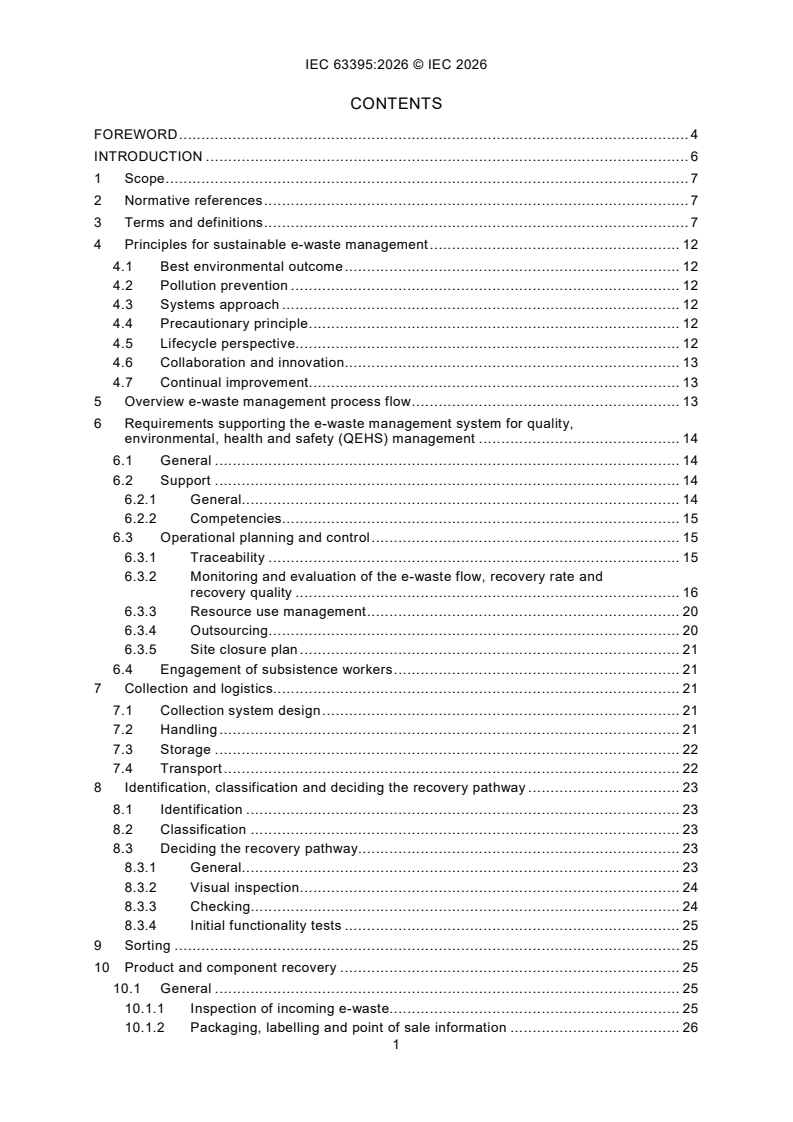
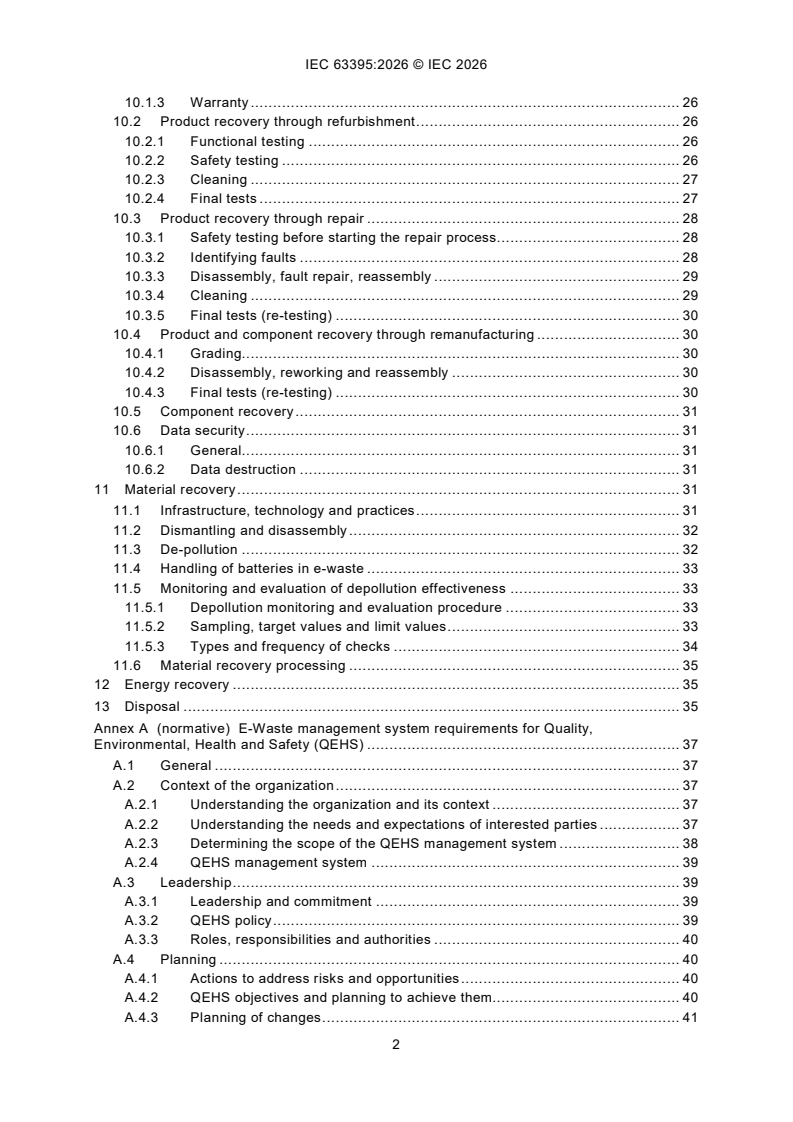
Contents
- 1 Scope
- 2 Normative references
- 3 Terms and definitions
- 3.1 e-waste
- 3.2 hazardous material
- 3.3 hazardous substance
- 3.4 organization
- 3.5 compliance obligation
- 3.6 record
- 3.7 documented information
- 3.8 traceability
- 3.9 transboundary movement
- 3.10 recovery pathway
- 3.11 recovery potential
- 3.12 product or component recovery
- 3.13 material recovery
- 3.14 energy recovery
- 3.15 input
- 3.16 output
- 3.17 throughput
- 3.18 identification
- 3.19 classification
- 3.20 pollutant
- 3.21 disposal
- 3.22 treatment
- 3.23 life cycle perspective
- 3.24 repair
- 3.25 refurbishment
- 3.26 remanufacture
- 4 Principles for sustainable e-waste management
- 4.1 Best environmental outcome
- 4.2 Pollution prevention
- 4.3 Systems approach
- 4.4 Precautionary principle
- 4.5 Lifecycle perspective
- 4.6 Collaboration and innovation
- 4.7 Continual improvement
- 5 Overview e-waste management process flow
- 6.1 General
- 6.2 Support
- 6.3 Operational planning and control
- 6.4 Engagement of subsistence workers
- 7 Collection and logistics
- 7.1 Collection system design
- 7.2 Handling
- 7.3 Storage
- 7.4 Transport
- 8 Identification, classification and deciding the recovery pathway
- 8.1 Identification
- 8.2 Classification
- 8.3 Deciding the recovery pathway
- 9 Sorting
- 10 Product and component recovery
- 10.1 General
- 10.2 Product recovery through refurbishment
- 10.3 Product recovery through repair
- 10.4 Product and component recovery through remanufacturing
- 10.5 Component recovery
- 10.6 Data security
- 11 Material recovery
- 11.1 Infrastructure, technology and practices
- 11.2 Dismantling and disassembly
- 11.3 De-pollution
- 11.4 Handling of batteries in e-waste
- 11.5 Monitoring and evaluation of depollution effectiveness
- 11.6 Material recovery processing
- 12 Energy recovery
- 13 Disposal
- Annex A
- Annex B
- Bibliography
INTRODUCTION Electrical and electronic equipment has become a defining and ubiquitous feature of modern life, which has raised living standards in most of the countries worldwide. Globally, the slow adoption of sustainable practices for the management of waste electrical and electronic equipment (e-waste) means that environmental impacts due to, for example, resource consumption, greenhouse gas emissions, and hazardous substance releases continue unabated.
As a result, many countries face challenges related to considerable environmental and human health risks caused by inadequately managed e-waste.
This is all the more critical as collection and recovery activities are failing to keep up with total e-waste generation. According to the Global E-waste Monitor 2024, less than a quarter of e- waste generated was officially documented as collected and recycled. Electronic waste generation is rising five times faster than documented e-waste recycling. This document sets out requirements for the sustainable management of e-waste, thereby contributing to the following objectives:
- protecting human health and safety and the environment;
- maximizing resource circularity through the recovery of e-waste products, components and materials;
- optimizing the quality of recovered products, components and materials;
- minimizing the quantity of e-waste being disposed of;
- preventing unsustainable and unsafe e-waste recovery and disposal practices;
- preventing or minimizing, or both, pollution and emissions;
- providing a framework for assuring the environmental sustainability of output of product, component and material recovery operations;
- preventing shipments of e-waste to operators whose activities do not conform with this document or a comparable set of requirements.
1 Scope
This document specifies requirements and provides guidance for the sustainable management of waste electrical and electronic equipment (e-waste) for all process steps, from collection to returning recovered products, components, materials or energy to the value chain. It includes traceability, monitoring and evaluation of the e-waste flow, recovery rate and recovery quality. This document is intended for use by an organization involved in e-waste management seeking to manage its responsibilities in a systematic manner.
The requirements set by this document will help an organization to achieve sustainability outcomes within the context of e-waste management, including:
- enhancement of organizations' performance in relation to quality, environment and occupational health and safety;
- fulfilment of compliance obligations.
This document is applicable to any organization, regardless of its size, type and nature. This document applies to the environmental, health and safety, and quality aspects of e-waste management activities that the organization determines it can either control or influence, from a lifecycle perspective.
NOTE 1 Social aspects – e.g. employment creation, conflict minerals, employment conditions – are not addressed directly but indirectly through the benefits of sustainable management of e-waste. NOTE 2 Additional local requirements or regulations can apply. This document is a basic environment horizontal publication focusing on essential requirements and is primarily intended for use by committees in the preparation of publications within the area of environment in accordance with the principles laid down in IEC Guide 123. Wherever applicable, it is the responsibility of committees to make use of environment basic publications in the preparation of their environment group and product publications. Committees can apply this document directly to products when they do not develop a product publication in the area of environment.
2 Normative references
There are no normative references in this document.
3 Terms and definitions
For the purposes of this document, the following terms and definitions apply. ISO and IEC maintain terminology databases for use in standardization at the following addresses:
- IEC Electropedia: available at https://www.electropedia.org/
- ISO Online browsing platform: available at https://www.iso.org/obp
3.1 e-waste
WEEE waste electrical or electronic equipment electrical or electronic equipment that the holder discards or is required to discard Note 1 to entry: All components, sub-assemblies and consumables which are part of the equipment at the time the equipment is discarded, even if not attached to the product when discarded, are also considered as e-waste. [SOURCE: IEC FDIS 60050-193:2026, 193-04-02, modified – Note 1 to entry has been added.]
3.2 hazardous material
material containing one or more hazardous substances
3.3 hazardous substance
substance which can adversely affect human health or the environment with immediate or retarded effect, either by itself or through interaction with other factors Note 1 to entry: Hazardous substances are typically identified by international or national regulations.
3.4 organization
person or group of people that has its own functions with responsibilities, authorities and relationships to achieve its objectives Note 1 to entry: The concept of organization includes, but is not limited to sole trader, company, corporation, firm, enterprise, authority, partnership, charity, or institution, or part or combination thereof, whether incorporated or not, public or private.
[SOURCE ISO 9000:2015, 3.2.1, modified – In Note 1 to entry, the term "association" has been deleted; Note 2 to entry has been deleted.]
3.5 compliance obligation
legal requirement that an organization must comply with and other requirements that an organization must or chooses to comply with Note 1 to entry: Compliance obligations can arise from mandatory requirements, such as applicable laws and regulations, or voluntary commitments, such as organizational and industry standards, contractual relationships, codes of practice and agreements with community groups or non-governmental organizations. [SOURCE: ISO 14001:2015, 3.2.9, modified – The plural form of the term has been changed to its singular form, the admitted term has been deleted, verbal form "has to" has been changed to "must", Note 1 to entry has been deleted.]
3.6 record
document stating results achieved or providing evidence of activities performed Note 1 to entry: Records can be used, for example, to formalize traceability and to provide evidence of verification, preventive action, and corrective action.
Note 2 to entry: Generally, records need not be under revision control. [SOURCE: ISO 9000:2015, 3.8.10]
3.7 documented information
information required to be controlled and maintained by an organization and the medium on which it is contained Note 1 to entry: Documented information can be in any format and media, and from any source. Note 2 to entry: Documented information can refer to:
- the environmental management system, including related processes;
- information created in order for the organization to operate (can be referred to as documentation);
- evidence of results achieved (can be referred to as records). [SOURCE: ISO 14001:2015, 3.3.2]
3.8 traceability
<circular economy and material efficiency> ability to trace the origin, history, application, location or certain characteristics of a product Note 1 to entry: The term "traceability" is also defined in the context of electrical and electronic measurements (IEV 311-01-15).
Note 2 to entry: When considering a product, traceability can be related to:
- the origin of materials and parts;
- the history of the processing;
- the distribution and localization of products, including their recovery pathways and final disposal of nonrecoverable fractions. [SOURCE: IEC FDIS 60050-193:2026, 193-01-09, modified – At the end of the definition, "or material" has been deleted, Note 2 to entry has been added.]
3.9 transboundary movement
movement of e-waste across a national border from one country to another
3.10 recovery pathway
type and sequence of processes applied to recover products, components and materials from e-waste collected
3.11 recovery potential
potential of e-waste to be recovered as products, components or materials Note 1 to entry: Criteria used to determine the recovery potential include environmental, social and economic benefit; functionality, usability and repairability of the e-waste; legal compliance; available recovery technologies; available downstream recovery organizations or end markets.
3.12 product or component recovery
controlled process whereby functioning products or components are recovered from end-of-life products or waste and are brought back to use for the same or different purpose Note 1 to entry: Processes for product recovery can include refurbishment, remanufacture and repurposing. Note 2 to entry: Processes for component recovery can include disassembly, cleaning, and testing. Note 3 to entry: Recovery of components for subsequent recovery of the materials contained in the components is considered as material recovery.
Note 4 to entry: Recovery is considered completed when the "criteria for completed recovery" in 6.6.2.2 are fulfilled. [SOURCE: IEC FDIS 60050:193:2025, 193-04-05, modified – "parts" replaced with "components", Note 3 to entry and Note 4 to entry has been added]
3.13 material recovery
controlled processing of end-of-life products or waste to produce useful material Note 1 to entry: Processes for material recovery can include dismantling, depollution, grinding, shredding, milling, concentration, homogenization, refining, etc. as well as chemical processes excluding chemical recycling of polymeric waste.
Note 2 to entry: The result of the material recovery is either alternate material or material that will be further processed in material recycling.
Note 3 to entry: Material recovery results in circular material, i.e. material that can be recovered again. Note 4 to entry: Recovery of components for subsequent recovery of the materials contained in the components is considered as material recovery [SOURCE: IEC 60050-193:2026, 193-04-07, modified – The Figure has been deleted, Note 1 to entry "as well as chemical processes excluding chemical recycling of polymeric waste" has been added, Note 4 to entry has been replaced with new Note 4 to entry]
3.14 energy recovery
production of useful energy through direct and controlled combustion or other processing of waste EXAMPLE Producing hot water, steam and/or electricity are common means for energy recovery. [SOURCE: IEC 60050-904:2014, 904-04-03, modified – Note 1 to entry was transformed into an example and "Waste incinerators" has been deleted]
3.15 input
product, material or energy flow that enters a process Note 1 to entry: Products and materials include raw materials, intermediate products and co-products. [SOURCE: ISO 14044:2006, 3.21, modified – In the definition, term "unit" has been deleted]
3.16 output
product, material or energy flow that leaves a process Note 1 to entry: Products and materials include raw materials, intermediate products, co-products, and releases. [SOURCE: ISO 14044:2006, 3.25, modified – In the definition, term "unit" has been deleted]
3.17 throughput
total quantity of a product, material or energy flow that passes through a process Note 1 to entry: Products and materials include raw materials, intermediate products, co-products, and releases.
3.18 identification
process of recognizing the attributes that identify the object [SOURCE: ISO 16678:2014, 2.1.7]
3.19 classification
attribute-based differentiation Note 1 to entry: An attribute is defined by a list of enumerators. [SOURCE: ISO 23150:2023, 3.3.3]
3.20 pollutant
substance which either alone or in combination with other substances or through its products of degradation or emissions can have a harmful effect on human health or the environment [SOURCE: ISO 16000-32:2014, 3.7, modified – In the definition, "or can lead to a reduction in the value or restriction in the use of the building" has been deleted.]
3.21 disposal
final disposal treatment that does not lead to the recovery of product, parts, materials or energy [SOURCE: IEC FDIS 60050-193:2026, 193-04-28, modified – term "disposal" is used as preferred term, the figure has been deleted, the note to entry has been deleted.]
3.22 treatment
any process step that occurs after collection
3.23 life cycle perspective
consideration of the environmental, health and safety aspects relating to a product during its entire life cycle Note 1 to entry: The life cycle is considered to be circular and to include the return of recovered products, components or materials to use or production.
[SOURCE: ISO 14050:2020, 3.6.33, modified – The preferred term "life cycle thinking" and the abbreviated term "LCT" have been deleted, in the definition, "health and safety aspects" has been added, Note 1 to entry has been added.]
3.24 repair
direct action taken to effect restoration Note 1 to entry: Repair includes fault localization, fault diagnosis, fault correction and function checkout. [SOURCE: IEC 60050-192:2015, 192-06-14]
3.25 refurbishment
refurbishing reconditioning industrial process to restore or improve a used product or part within the limits of its original or predetermined design Note 1 to entry: Original or predetermined design includes form, functionality, performance and safety aspects. Note 2 to entry: Refurbishment can extend the remaining lifetime of the product. Note 3 to entry: The identity of the product or part shall be maintained (e.g. serial or type number).
3.26 remanufacture
remanufacturing industrial process to create a product by combining different parts from used products and including, where necessary, new parts Note 1 to entry: The product must be given a new identity (e.g. serial or type number). [SOURCE: IEC 60050-193:2026, 193-06-04, modified – "remanufacturing" has been changed to preferred term, the reference to the figure has been deleted.]
4 Principles for sustainable e-waste management
4.1 Best environmental outcome
This principle aims to deliver the best environmental outcome from a lifecycle perspective, generally prioritising, waste prevention and extending product life (product and component recovery) over recycling (material recovery), energy recovery and disposal. NOTE Resource conservation is integral to the Best environmental outcome.
4.2 Pollution prevention
This principle aims to promote the use of processes, practices, techniques, materials, products, services or energy that avoid, reduce or control (separately or in combination) the creation, emission or discharge of any type of pollutant or waste, in order to reduce adverse environmental impacts.
4.3 Systems approach
This principle aims to promote an approach that fosters understanding how an organization's activities impact the process flow within the e-waste recovery system and anticipating outcomes resulting from the behaviour of different organizations within the system.
4.4 Precautionary principle
This principle aims to promote preventive action against the use of practices or substances identified as potentially harmful in the absence of scientific evidence or certainty.
4.5 Lifecycle perspective
This principle aims to promote the systematic consideration of the environmental impacts of products over their lifecycle to inform decisions about the sustainable management of e-waste.
4.6 Collaboration and innovation
This principle aims to promote the development and implementation of networks and mechanisms for collaboration that facilitate innovative technologies and practices for the recovery of resources contained in e-waste.
4.7 Continual improvement
This principle aims to promote an approach to implement recurring activities to continually enhance organizations' sustainable e-waste management performance.
5 Overview e-waste management process flow
The conceptualization adopted in this document applies circular economy thinking and the best environmental outcome principle whereby waste prevention and extending product life (product and component recovery) are generally prioritised over recycling (material recovery), energy recovery and disposal. This document enables organisations to implement this approach in practice by using the Methodology for deciding the Recovery Pathway (see 8.3 and Annex B). Figure 1 illustrates the e-waste management process flow as conceptualized in this document.
Figure 1 – E-waste management process flow chart Different process steps are not necessarily undertaken at one single location or by one single organization. The applicable process steps depend on the activities and processes undertaken by the organization.
Table 1 below shows the range of different organizations that can be involved in the e-waste management process flow.
Table 1 – Organizations and operators Processes and activities Examples of organizations involved in the processes and activities Collection – Municipalities; - Commercial waste and recycling companies; - Reuse organizations such as non-profit reuse operators, charitable and aid organizations, community organizations and commercial resellers; - Waste collection associations or cooperatives; - Groups and individuals engaged in subsistence activities; - Retailers; - Dealers, traders; - Producer responsibility organizations (PROs).
Classification and sorting These processes occur along the whole value chain and so are conducted by all types of organizations.
Non-destructive processes – Municipalities; used for the preparation of - Commercial resellers; materials, products or components for recovery - Repair organizations; - Reuse organizations; - Refurbishing workshops; - Commercial waste and recycling companies; - Charitable and aid organizations; - Community organizations; - Dismantling workshops; - Groups and individuals engaged in subsistence activities; - Work integration programs.
Destructive processes for – Commercial waste and recycling companies material recovery - Refining or re-melting companies
This document sets out management system requirements (Clause 6) and operational requirements in line with the e-waste management process chain (Clause 7 to Clause 13). 6 Requirements supporting the e-waste management system for quality, environmental, health and safety (QEHS) management
6.1 General
The organization shall establish a managements system in accordance with the general requirements described in Annex A and the specific e-waste management related requirements described in 6.2 to 6.4.
The system for e-waste management can be integrated with any existing quality, environmental or occupational health and safety management system the organization has in place. The organization's management system boundary shall cover all the organization's e-waste related activities.
6.2 Support
6.2.1 General
Support actions shall address QEHS. The following additional requirements also apply.
6.2.2 Competencies
The organization shall identify skill and training requirements related to all its QEHS aspects. Training programmes shall be delivered at a level suitable to the trainee in form, manner and language.
The organization shall develop and maintain a handbook detailing information about:
...
Contents
- 1 Domaine d'application
- 2 Références normatives
- 3 Termes et définitions
- 3.1 déchet électronique
- 3.2 matériau dangereux
- 3.3 substance dangereuse
- 3.4 organisme
- 3.5 obligation de conformité
- 3.6 enregistrement
- 3.7 information documentée
- 3.8 traçabilité
- 3.9 mouvement transfrontalier
- 3.10 voie de revalorisation
- 3.11 potentiel de revalorisation
- 3.12 revalorisation des produits ou des composants
- 3.13 revalorisation matérielle
- 3.14 revalorisation énergétique
- 3.15 intrant
- 3.16 extrant
- 3.17 flux de production
- 3.18 identification
- 3.19 classification
- 3.20 polluant
- 3.21 élimination
- 3.22 traitement
- 3.23 réflexion cycle de vie
- 3.24 réparation
- 3.25 remise en état
- 3.26 refabrication
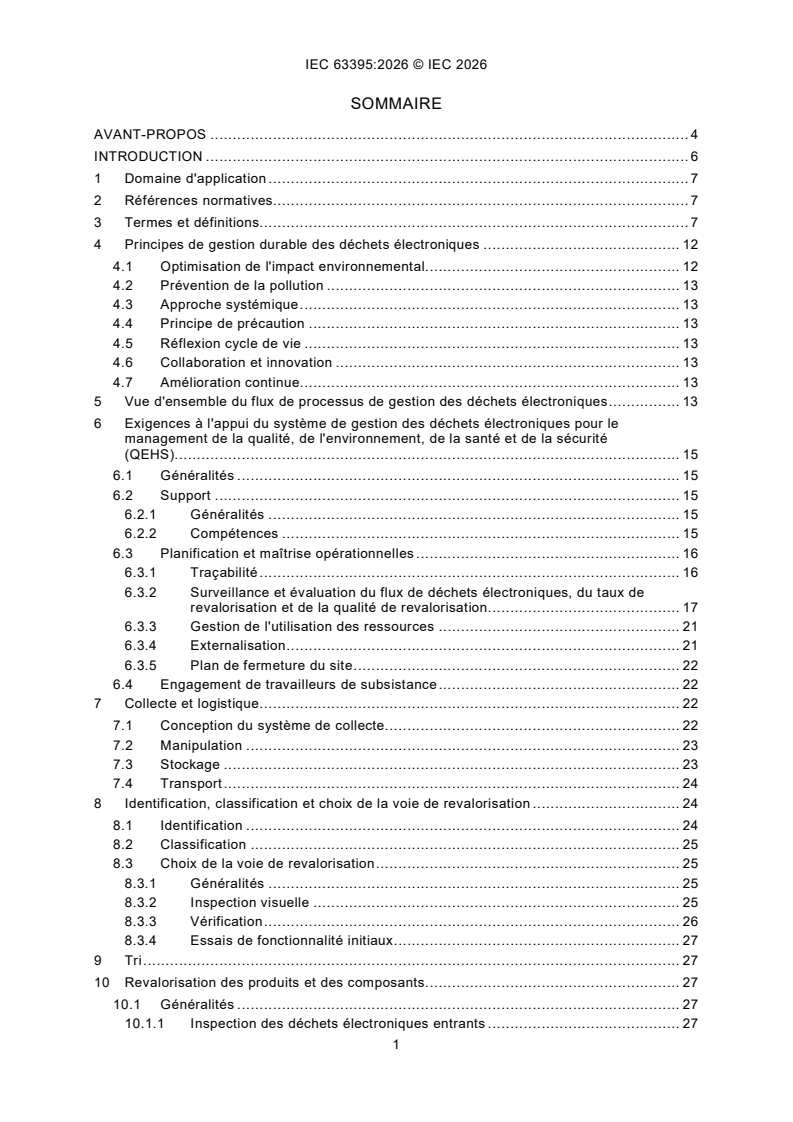
- 4 Principes de gestion durable des déchets électroniques
- 4.1 Optimisation de l'impact environnemental
- 4.2 Prévention de la pollution
- 4.3 Approche systémique
- 4.4 Principe de précaution
- 4.5 Réflexion cycle de vie
- 4.6 Collaboration et innovation
- 4.7 Amélioration continue
- 5 Vue d'ensemble du flux de processus de gestion des déchets électroniques
- 6 Exigences à l'appui du système de gestion des déchets électroniques pour
- 6.1 Généralités
- 6.2 Support
- 6.3 Planification et maîtrise opérationnelles
- 6.4 Engagement de travailleurs de subsistance
- 7 Collecte et logistique
- 7.1 Conception du système de collecte
- 7.2 Manipulation
- 7.3 Stockage
- 7.4 Transport
- 8 Identification, classification et choix de la voie de revalorisation
- 8.1 Identification
- 8.2 Classification
- 8.3 Choix de la voie de revalorisation
- 9 Tri
- 10 Revalorisation des produits et des composants
- 10.1 Généralités
- 10.2 Revalorisation des produits par la remise en état
- 10.3 Revalorisation des produits par réparation
- 10.4 Revalorisation des produits et des composants par refabrication
- 10.5 Revalorisation des composants
- 10.6 Sécurité des données
- 11 Revalorisation matérielle
- 11.1 Infrastructure, technologie et pratiques
- 11.2 Démantèlement et démontage
- 11.3 Dépollution
- 11.4 Manipulation des batteries dans les déchets électroniques
- 11.5 Surveillance et évaluation de l'efficacité de la dépollution
- 11.6 Processus de revalorisation matérielle
- 12 Revalorisation énergétique
- 13 Élimination
- Bibliographie
INTRODUCTION Les équipements électriques et électroniques sont devenus une caractéristique déterminante et omniprésente de la vie moderne, qui a permis d'améliorer le niveau de vie dans la majorité des pays du monde.
Au niveau mondial, la lenteur de l'adoption de pratiques durables pour la gestion des déchets d'équipements électriques et électroniques (e-déchets) signifie que les impacts environnementaux, par exemple la consommation de ressources, l'émission de gaz à effet de serre et la libération de substances dangereuses, perdurent.
En conséquence, les déchets électroniques mal gérés exposent de nombreux pays à des défis considérables pour l'environnement et la santé humaine.
Cette situation est d'autant plus importante que les activités de collecte et de revalorisation ne parviennent pas à suivre le rythme de la production totale de déchets électroniques. Selon le Rapport mondial sur les déchets d'équipements électriques et électroniques 2024, moins d'un quart des déchets électroniques générés ont été officiellement documentés comme ayant été collectés et recyclés. La production de déchets électroniques augmente cinq fois plus vite que le recyclage documenté des e-déchets. Le présent document définit les exigences relatives à la gestion durable des déchets électroniques, contribuant ainsi à la réalisation des objectifs suivants:
- protection de la santé et de la sécurité des personnes, ainsi que de l'environnement;
- optimisation de la circularité des ressources par la revalorisation des produits, composants et matériaux des déchets électroniques;
- optimisation de la qualité des produits, composants et matériaux revalorisés;
- réduction de la quantité de déchets électroniques éliminés;
- prévention des pratiques non durables et dangereuses de revalorisation et d'élimination des déchets électroniques;
- prévention ou réduction, ou les deux, de la pollution et des émissions;
- fourniture d'un cadre pour assurer la durabilité environnementale des résultats des opérations de revalorisation des produits, composants et matériaux;
- prévention des transferts de déchets électroniques vers des exploitants dont les activités ne sont pas conformes au présent document ou à un ensemble comparable d'exigences.
1 Domaine d'application
Le présent document spécifie les exigences et fournit des recommandations pour la gestion durable des déchets d'équipements électriques et électroniques (e-déchets) pour toutes les étapes du processus, depuis la collecte jusqu'au retour des produits, des composants, des matériaux ou de l'énergie revalorisés dans la chaîne de valeur. Cela inclut la traçabilité, la surveillance et l'évaluation du flux de déchets électroniques, du taux de revalorisation et de la qualité de revalorisation.
Le présent document est destiné à être utilisé par tout organisme impliqué dans la gestion des déchets électroniques et qui cherche à gérer ses responsabilités de manière systématique. Les exigences définies dans le présent document permettent à un organisme d'obtenir des résultats en matière de développement durable dans le contexte de la gestion des déchets électroniques, notamment:
- l'amélioration des performances des organismes en matière de qualité, d'environnement, de santé et de sécurité au travail;
- le respect des obligations de conformité.
Le présent document s'applique à tout organisme, indépendamment de sa taille, de son type et de sa nature.
Le présent document s'applique aux aspects des activités de gestion des déchets électroniques liés à l'environnement, à la santé et à la sécurité des personnes, ainsi qu'à la qualité, que l'organisme estime pouvoir maîtriser ou influencer, en prenant en considération la réflexion cycle de vie.
NOTE 1 Les aspects sociaux, tels que la création d'emplois, les minerais de conflit ou les conditions d'emploi, ne sont pas abordés directement, mais indirectement par le biais des avantages de la gestion durable des déchets électroniques.
NOTE 2 Des exigences ou réglementations locales supplémentaires peuvent s'appliquer. Le présent document est une publication horizontale environnementale fondamentale qui met l'accent sur les exigences essentielles et est principalement destiné à être utilisé par les comités pour l'élaboration de publications relevant du domaine de l'environnement, conformément aux principes énoncés dans le Guide 123 de l'IEC. Le cas échéant, il incombe aux comités d'utiliser les publications environnementales fondamentales dans le cadre de l'élaboration de leurs publications environnementales et leurs publications de produits. Les comités peuvent appliquer le présent document directement aux produits lorsqu'ils n'élaborent pas de publication de produit dans le domaine de l'environnement.
2 Références normatives
Le présent document ne contient aucune référence normative.
3 Termes et définitions
Pour les besoins du présent document, les termes et définitions suivants s'appliquent. L'ISO et l'IEC tiennent à jour des bases de données terminologiques destinées à être utilisées en normalisation, consultables aux adresses suivantes:
- IEC Electropedia: disponible à l'adresse https://www.electropedia.org/
- ISO Online browsing platform: disponible à l'adresse https://www.iso.org/obp
3.1 déchet électronique
e-déchet DEEE déchet d'équipement électrique ou électronique équipement électrique ou électronique dont le détenteur se défait ou doit se défaire Note 1 à l'article: Tous les composants, sous-ensembles et consommables qui font partie de l'équipement au moment où celui-ci est mis au rebut, même s'ils ne sont pas fixés au produit lorsqu'ils sont mis au rebut, sont également considérés comme des déchets électroniques.
[SOURCE: IEC FDIS 60050-193:2026, 193-04-02, modifiée – La Note 1 à l'article a été ajoutée.]
3.2 matériau dangereux
matériau contenant une ou plusieurs substances dangereuses
3.3 substance dangereuse
substance susceptible de nuire à la santé humaine ou à l'environnement avec un effet immédiat ou différé, soit par elle-même, soit par interaction avec d'autres facteurs Note 1 à l'article: Les substances dangereuses sont généralement identifiées par des réglementations internationales ou nationales.
3.4 organisme
personne ou groupe de personnes ayant un rôle avec les responsabilités, l'autorité et les relations lui permettant d'atteindre ses objectifs Note 1 à l'article: Le concept d'organisme englobe sans s'y limiter, les travailleurs indépendants, les compagnies, les sociétés, les firmes, les entreprises, les administrations, les partenariats, les organisations caritatives ou les institutions, ou bien une partie ou une combinaison des entités précédentes, à responsabilité limitée ou ayant un autre statut, de droit public ou privé.
[SOURCE: ISO 9000:2015, 3.2.1, modifiée – Dans la Note 1 à l'article, "les associations" a été supprimé; la Note 2 à l'article a été supprimée.]
3.5 obligation de conformité
exigences légales auxquelles un organisme doit se conformer et autres exigences auxquelles un organisme doit ou choisit de se conformer Note 1 à l'article: Les obligations de conformité peuvent provenir d'exigences obligatoires, telles que la législation et la réglementation applicables, ou d'engagements volontaires tels que des normes organisationnelles et sectorielles, des relations contractuelles, des codes de conduite ainsi que des accords passés avec des communautés ou des organismes non gouvernementaux.
[SOURCE: ISO 14001:2015, 3.2.9, modifiée – La forme plurielle du terme a été remplacée par sa forme singulière, le terme admis a été supprimé, la Note 1 à l'article a été supprimée.]
3.6 enregistrement
document faisant état de résultats obtenus ou apportant la preuve de la réalisation d'une activité Note 1 à l'article: Les enregistrements peuvent, par exemple, formaliser la traçabilité et apporter la preuve que la vérification, les actions préventives et les actions correctives ont été réalisées. Note 2 à l'article: En général, les enregistrements ne nécessitent pas de maîtrise des révisions. [SOURCE: ISO 9000:2015, 3.8.10]
3.7 information documentée
information devant être maîtrisée et tenue à jour par un organisme ainsi que le support sur lequel elle figure Note 1 à l'article: Les informations documentées peuvent se présenter sous n'importe quel format et sur tous supports et peuvent provenir de toute source.
Note 2 à l'article: Les informations documentées peuvent se rapporter:
- au système de management environnemental, y compris les processus connexes;
- aux informations créées en vue du fonctionnement de l'organisme (pouvant être appelées documentation);
- aux preuves des résultats obtenus (pouvant être appelées enregistrements). [SOURCE: ISO 14001:2015, 3.3.2]
3.8 traçabilité
<économie circulaire et utilisation rationnelle des matériaux>, aptitude à retrouver l'origine, l'historique, la mise en œuvre, l'emplacement ou certaines caractéristiques d'un produit Note 1 à l'article: Le terme "traçabilité" est également défini dans le contexte des mesurages électriques et électroniques (IEV 311-01-15).
Note 2 à l'article: Dans le cas d'un produit, la traçabilité peut être liée à:
- l'origine des matériaux et composants;
- l'historique de réalisation;
- la distribution et la localisation des produits, y compris leurs voies de valorisation et l'élimination finale des fractions non revalorisables.
[SOURCE: IEC FDIS 60050-193:2026, 193-01-09, modifiée – A la fin de la définition, " ou d'un matériau" a été supprimé, la Note 2 à l'article a été ajoutée.]
3.9 mouvement transfrontalier
mouvement de déchets électroniques à travers une frontière nationale d'un pays à l'autre
3.10 voie de revalorisation
type et séquence des processus appliqués pour revaloriser les produits, les composants et les matériaux à partir des déchets électroniques collectés
3.11 potentiel de revalorisation
potentiel de revalorisation des déchets électroniques sous forme de produits, de composants ou de matériaux Note 1 à l'article: Les critères utilisés pour déterminer le potentiel de revalorisation comprennent les avantages environnementaux, sociaux et économiques; la fonctionnalité, l'utilisabilité et la réparabilité des déchets électroniques; la conformité légale; les technologies de revalorisation disponibles; les organisations de revalorisation disponibles en aval ou les marchés finaux.
3.12 revalorisation des produits ou des composants
processus maîtrisé par lequel des produits ou composants fonctionnels sont revalorisés à partir de produits en fin de vie ou de déchets et qui sont remis en service pour un usage identique ou différent.
Note 1 à l'article: Les processus de revalorisation des produits peuvent inclure la remise en état, la refabrication et la reconversion.
Note 2 à l'article: Les processus de revalorisation des composants peuvent inclure le démontage, le nettoyage et les essais.
Note 3 à l'article: La revalorisation des composants pour la revalorisation ultérieure des matériaux contenus dans les composants est considérée comme une revalorisation matérielle. Note 4 à l'article: La revalorisation est considérée comme achevée lorsque les "critères de revalorisation complète" indiqués en 6.6.2.2 sont remplis.
[SOURCE: IEC FDIS 60050:193:2025, 193-04-05, modifiée – La Note 3 à l'article et la Note 4 à l'article ont été ajoutées.]
3.13 revalorisation matérielle
transformation maîtrisée de produits en fin de vie ou de déchets visant à produire des matériaux utiles Note 1 à l'article: Les processus de revalorisation matérielle peuvent inclure le démantèlement, la dépollution, le broyage, le déchiquetage, le broyage, la concentration, l'homogénéisation, le raffinage, etc. ainsi que des procédés chimiques, à l'exclusion du recyclage chimique des déchets polymères. Note 2 à l'article: Le résultat de la revalorisation matérielle est soit un matériau de remplacement, soit un matériau qui sera traité ultérieurement lors du recyclage des matériaux. Note 3 à l'article: La revalorisation matérielle permet d'obtenir des matériaux circulaires, c'est-à-dire des matériaux qui peuvent être revalorisés à nouveau.
Note 4 à l'article: La revalorisation des composants pour la revalorisation ultérieure des matériaux contenus dans les composants est considérée comme une revalorisation matérielle. [SOURCE: IEC 60050-193:2026, 193-04-07, modifié – La figure a été supprimée, dans la Note 1 à l'article, "ainsi que des procédés chimiques, à l'exclusion du recyclage chimique des déchets polymères" a été ajouté, la Note 4 à l'article a été remplacée par une nouvelle Note 4 à l'article.]
3.14 revalorisation énergétique
production d'énergie utile par combustion directe et maîtrisée ou par d'autres traitements de déchets EXEMPLE La production d'eau chaude, de vapeur et/ou d'électricité sont des moyens courants de revalorisation énergétique.
[SOURCE: IEC 60050-904:2014, 904-04-03, modifiée – La Note 1 à l'article a été transformée en exemple, "incinérateurs de déchets" a été supprimé, le texte a été reformulé et "valorisation" a été remplacé par "revalorisation".]
3.15 intrant
flux de produit, de matière ou d'énergie qui entre dans un processus Note 1 à l'article: Les produits et les matériaux comprennent des matières premières, des produits intermédiaires et des coproduits.
[SOURCE: ISO 14044:2006, 3.21, modifiée – Dans la définition, l'adjectif "élémentaire" a été supprimé.]
3.16 extrant
flux de produit, de matière ou d'énergie sortant d'un processus Note 1 à l'article: Les produits et les matériaux comprennent des matières premières, des produits intermédiaires, des coproduits et des émissions.
[SOURCE: ISO 14044:2006, 3.25, modifiée – Dans la définition, l'adjectif "élémentaire" a été supprimé.]
3.17 flux de production
quantité totale d'un flux de produit, de matière ou d'énergie qui passe par un processus Note 1 à l'article: Les produits et les matériaux comprennent des matières premières, des produits intermédiaires, des coproduits et des émissions.
3.18 identification
processus de reconnaissance des attributs qui identifient l'objet [SOURCE: ISO 16678:2014, 2.1.7]
3.19 classification
différenciation fondée sur les attributs Note 1 à l'article: Un attribut est défini par une liste d'énumérateurs. [SOURCE: ISO 23150:2023, 3.3.3]
3.20 polluant
substance qui, seule ou en combinaison avec d'autres substances, ou par le biais de ses produits de dégradation ou de ses émissions, peut avoir un effet nocif sur la santé humaine ou sur l'environnement [SOURCE: ISO 16000-32:2014, 3.7, modifiée – Dans la définition, "ou peut provoquer une réduction de la valeur ou une restriction d'utilisation du bâtiment" a été supprimé.]
3.21 élimination
élimination finale opération qui ne conduit pas à la revalorisation du produit, des parties, des matériaux ou de l'énergie [SOURCE: IEC FDIS 60050-193:2026, 193-04-28, modifié – le terme "élimination" est utilisé en tant que terme privilégié, la figure a été supprimée, la note à l'article a été supprimée.]
3.22 traitement
toute étape du processus qui intervient après la collecte
3.23 réflexion cycle de vie
prise en compte des aspects environnementaux, de santé et de sécurité relatifs à un produit pendant tout son cycle de vie Note 1 à l'article: Le cycle de vie est considéré comme circulaire et comprend le retour à l'utilisation ou à la production des produits, composants ou matériaux revalorisés.
[SOURCE: ISO 14050:2020, 3.6.33, modifiée – Les termes "pensée cycle de vie" et "perspective cycle de vie" ainsi que l'abréviation "PCV" ont été supprimés; dans la définition, "de tous les aspects environnementaux d'un produit" a été remplacé par "aspects environnementaux, de santé et de sécurité relatifs à un produit"; la Note 1 à l'article a été ajoutée.]
3.24 réparation
opération directe réalisée pour procéder à un rétablissement Note 1 à l'article: La réparation inclut la localisation de panne, le diagnostic de panne, la correction de panne et l'essai de fonctionnement.
[SOURCE: IEC 60050-192:2015, 192-06-14]
3.25 remise en état
reconditionnement processus industriel visant à restaurer ou améliorer un produit usagé ou une pièce usagée dans les limites de sa conception d'origine ou préétablie Note 1 à l'article: La conception d'origine ou préétablie comprend les aspects relatifs à la forme, à la fonctionnalité, aux performances et à la sécurité.
Note 2 à l'article: La remise en état peut prolonger la durée de vie restante du produit. Note 3 à l'article: L'identité du produit ou de la pièce doit être conservée (par exemple, numéro de série ou de type).
3.26 refabrication
remanufacturage processus industriel qui crée un produit en combinant différentes parties à partir de produits usagés et comprenant, lorsque cela est nécessaire, des parties neuves Note 1 à l'article: Le produit doit prendre une nouvelle identité (numéro de série ou de type, par exemple). [SOURCE: IEC 60050-193:2026, 193-06-04, modifiée – Le terme "remanufacturage" est considéré comme terme privilégié, la référence à la figure a été supprimée.]
4 Principes de gestion durable des déchets électroniques
4.1 Optimisation de l'impact environnemental
Ce principe vise à optimiser l'impact environnemental d'une réflexion cycle de vie, en donnant généralement la priorité à la prévention des déchets et à l'allongement de la durée de vie des produits (revalorisation des produits et des composants) par rapport au recyclage (revalorisation matérielle), à la revalorisation énergétique et à l'élimination. NOTE La conservation des ressources fait partie intégrante de l'optimisation de l'impact environnemental.
4.2 Prévention de la pollution
Ce principe vise à promouvoir l'utilisation de processus, pratiques, techniques, matériaux, produits et services ou d'énergie pour éviter, réduire ou maîtriser (séparément ou en combinaison) la création, l'émission ou le rejet de tout type de polluant ou de déchet, afin de réduire les impacts environnementaux négatifs.
4.3 Approche systémique
Ce principe vise à promouvoir une approche qui favorise la compréhension de la manière dont les activités d'un organisme influencent le flux de processus au sein du système de revalorisation des déchets électroniques et permet d'anticiper les résultats découlant du comportement des différents organismes au sein du système.
4.4 Principe de précaution
Ce principe vise à promouvoir des actions préventives contre l'utilisation de pratiques ou substances identifiées comme potentiellement nocives en l'absence de preuves ou de certitude scientifiques.
4.5 Réflexion cycle de vie
Ce principe vise à promouvoir l'étude systématique des impacts environnementaux des produits tout au long de leur cycle de vie afin d'éclairer les décisions relatives à la gestion durable des déchets électroniques.
4.6 Collaboration et innovation
Ce principe vise à promouvoir le développement et la mise en œuvre de réseaux et mécanismes de collaboration qui facilitent les technologies et les pratiques innovantes pour la revalorisation des ressources contenues dans les déchets électroniques.
4.7 Amélioration continue
Ce principe vise à promouvoir une approche permettant de mettre en œuvre des activités récurrentes afin d'améliorer en continu les performances des organismes en matière de gestion durable des déchets électroniques.
...