


IEC PAS 63166:2018
(Main)Zhaga interface specification Book 1 and Book 7
General Information
- Abstract
IEC PAS 63166:2018(E) This book 7 defines several LED modules. Each LED module has a rectangular shape and the only restriction to the light emitting surface is that no light is emitted in the direction of the reference plane of the LED module.
This Book 1 defines the common concepts that underlie the Zhaga interface specifications. In addition, this Book 1 specifies general requirements for Zhaga compliant LED Light Engines, associated components and Luminaires.
- Status
- Withdrawn
- Publication Date
- 22-Apr-2018
- Withdrawal Date
- 14-Jun-2023
- Technical Committee
- SC 34A - Electric light sources
- Current Stage
- WPUB - Publication withdrawn
- Start Date
- 16-Jun-2023
- Completion Date
- 15-Jun-2023
Get Certified
Connect with accredited certification bodies for this standard

IMQ S.p.A. (Certification)
Italian electrical product certification.

SLG Prüf- und Zertifizierungs GmbH
German testing and certification body.

UL Solutions
Global safety science company with testing, inspection and certification.
Sponsored listings
Frequently Asked Questions
IEC PAS 63166:2018 is a technical specification published by the International Electrotechnical Commission (IEC). Its full title is "Zhaga interface specification Book 1 and Book 7". This standard covers: IEC PAS 63166:2018(E) This book 7 defines several LED modules. Each LED module has a rectangular shape and the only restriction to the light emitting surface is that no light is emitted in the direction of the reference plane of the LED module. This Book 1 defines the common concepts that underlie the Zhaga interface specifications. In addition, this Book 1 specifies general requirements for Zhaga compliant LED Light Engines, associated components and Luminaires.
IEC PAS 63166:2018(E) This book 7 defines several LED modules. Each LED module has a rectangular shape and the only restriction to the light emitting surface is that no light is emitted in the direction of the reference plane of the LED module. This Book 1 defines the common concepts that underlie the Zhaga interface specifications. In addition, this Book 1 specifies general requirements for Zhaga compliant LED Light Engines, associated components and Luminaires.
IEC PAS 63166:2018 is classified under the following ICS (International Classification for Standards) categories: 01 - GENERALITIES. TERMINOLOGY. STANDARDIZATION. DOCUMENTATION; 29.140.01 - Lamps in general; 29.140.99 - Other standards related to lamps. The ICS classification helps identify the subject area and facilitates finding related standards.
IEC PAS 63166:2018 is available in PDF format for immediate download after purchase. The document can be added to your cart and obtained through the secure checkout process. Digital delivery ensures instant access to the complete standard document.
Standards Content (Sample)
IEC PAS 63166 ®
Edition 1.0 2018-04
PUBLICLY AVAILABLE
SPECIFICATION
colour
inside
Zhaga interface specification book 1 and book 7
All rights reserved. Unless otherwise specified, no part of this publication may be reproduced or utilized in any form
or by any means, electronic or mechanical, including photocopying and microfilm, without permission in writing from
either IEC or IEC's member National Committee in the country of the requester. If you have any questions about IEC
copyright or have an enquiry about obtaining additional rights to this publication, please contact the address below or
your local IEC member National Committee for further information.
IEC Central Office Tel.: +41 22 919 02 11
3, rue de Varembé info@iec.ch
CH-1211 Geneva 20 www.iec.ch
Switzerland
About the IEC
The International Electrotechnical Commission (IEC) is the leading global organization that prepares and publishes
International Standards for all electrical, electronic and related technologies.
About IEC publications
The technical content of IEC publications is kept under constant review by the IEC. Please make sure that you have the
latest edition, a corrigenda or an amendment might have been published.
IEC Catalogue - webstore.iec.ch/catalogue Electropedia - www.electropedia.org
The stand-alone application for consulting the entire The world's leading online dictionary of electronic and
bibliographical information on IEC International Standards, electrical terms containing 21 000 terms and definitions in
Technical Specifications, Technical Reports and other English and French, with equivalent terms in 16 additional
documents. Available for PC, Mac OS, Android Tablets and languages. Also known as the International Electrotechnical
iPad. Vocabulary (IEV) online.
IEC publications search - webstore.iec.ch/advsearchform IEC Glossary - std.iec.ch/glossary
The advanced search enables to find IEC publications by a 67 000 electrotechnical terminology entries in English and
variety of criteria (reference number, text, technical French extracted from the Terms and Definitions clause of
committee,…). It also gives information on projects, replaced IEC publications issued since 2002. Some entries have been
and withdrawn publications. collected from earlier publications of IEC TC 37, 77, 86 and
CISPR.
IEC Just Published - webstore.iec.ch/justpublished
Stay up to date on all new IEC publications. Just Published IEC Customer Service Centre - webstore.iec.ch/csc
details all new publications released. Available online and If you wish to give us your feedback on this publication or
also once a month by email. need further assistance, please contact the Customer Service
Centre: sales@iec.ch.
IEC PAS 63166 ®
Edition 1.0 2018-04
PUBLICLY AVAILABLE
SPECIFICATION
colour
inside
Zhaga interface specification book 1 and book 7
INTERNATIONAL
ELECTROTECHNICAL
COMMISSION
ICS 29.140.01; 29.140.99 ISBN 978-2-8322-5627-5
– 2 – IEC PAS 63166:2018 © IEC 2018
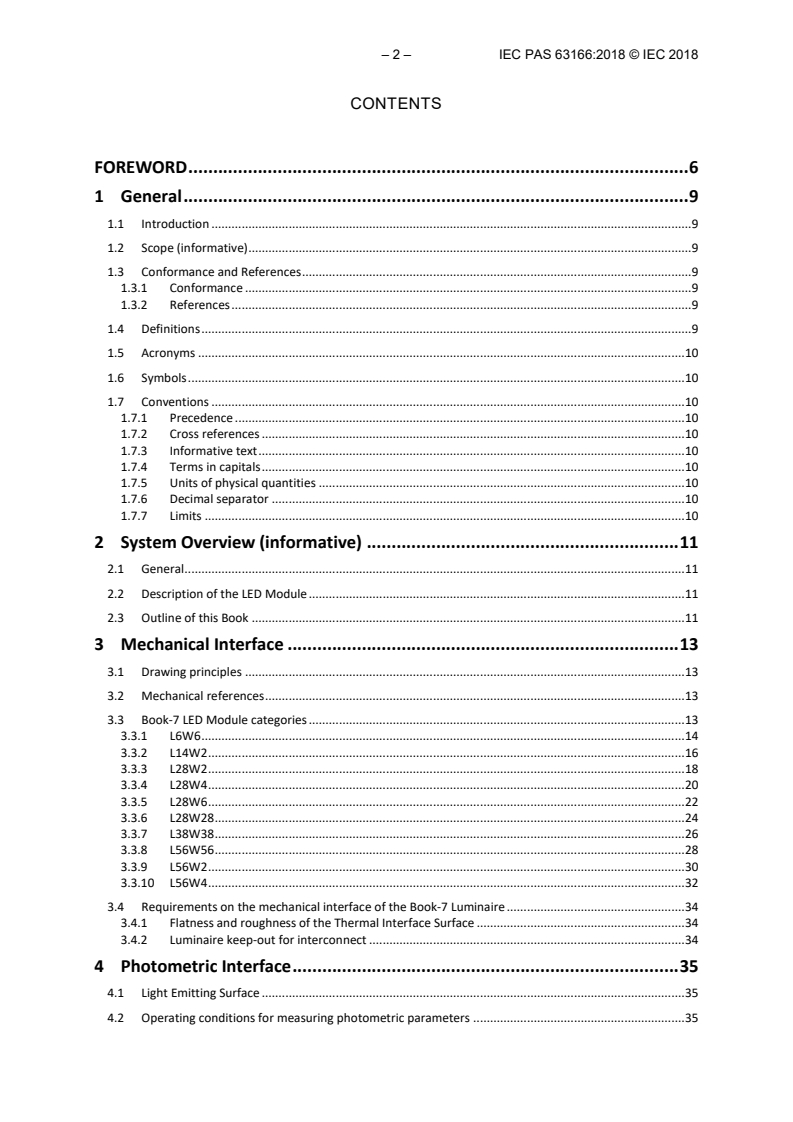
CONTENTS
FOREWORD . 6
1 General . 9
1.1 Introduction . 9
1.2 Scope (informative) . 9
1.3 Conformance and References . 9
1.3.1 Conformance . 9
1.3.2 References . 9
1.4 Definitions . 9
1.5 Acronyms . 10
1.6 Symbols . 10
1.7 Conventions . 10
1.7.1 Precedence . 10
1.7.2 Cross references . 10
1.7.3 Informative text . 10
1.7.4 Terms in capitals . 10
1.7.5 Units of physical quantities . 10
1.7.6 Decimal separator . 10
1.7.7 Limits . 10
2 System Overview (informative) . 11
2.1 General . 11
2.2 Description of the LED Module . 11
2.3 Outline of this Book . 11
3 Mechanical Interface . 13
3.1 Drawing principles . 13
3.2 Mechanical references . 13
3.3 Book-7 LED Module categories . 13
3.3.1 L6W6 . 14
3.3.2 L14W2 . 16
3.3.3 L28W2 . 18
3.3.4 L28W4 . 20
3.3.5 L28W6 . 22
3.3.6 L28W28 . 24
3.3.7 L38W38 . 26
3.3.8 L56W56 . 28
3.3.9 L56W2 . 30
3.3.10 L56W4 . 32
3.4 Requirements on the mechanical interface of the Book-7 Luminaire . 34
3.4.1 Flatness and roughness of the Thermal Interface Surface . 34
3.4.2 Luminaire keep-out for interconnect . 34
4 Photometric Interface . 35
4.1 Light Emitting Surface . 35
4.2 Operating conditions for measuring photometric parameters . 35
4.3 Luminous flux . 35
4.4 Luminous intensity distribution . 35
4.5 Luminance uniformity . 35
4.6 Correlated color temperature (CCT) . 36
4.7 Color rendering index (CRI) . 36
5 Electrical Interface . 37
5.1 Electrical interface to the ECG . 37
5.2 Electrical insulation . 37
5.3 Mechanical aspects of the electrical interface to the ECG . 37
6 Thermal Interface . 38
6.1 Background information (informative) . 38
6.2 General thermal requirements for Book-7 LED Modules . 38
6.3 Thermal headroom of Book-7 LED Modules . 38
7 Compliance test tools . 40
7.1 LED Module test tools . 40
7.1.1 Test Fixture PETF (photometric and electrical) . 40
7.1.2 Test Fixture THTF (Thermal Headroom) . 40
8 LED Module Compliance Tests . 44
8.1 LED Module mechanical interface tests . 44
8.1.1 Test of the mechanical interface of the LED Module . 44
8.2 LED Module photometric interface tests . 44
8.2.1 Test of Luminous Flux . 44
8.2.2 Test of correlated color temperature (CCT) . 45
8.2.3 Test of color rendering index (CRI) . 45
8.2.4 Test on luminance uniformity data . 45
8.3 LED Module thermal interface tests . 46
8.3.1 Test of thermal headroom of the LED Module . 46
8.4 LED Module electrical interface tests . 46
8.5 LED Module Product Data Set test . 46
9 Luminaire compliance tests . 47
9.1 Luminaire mechanical interface tests . 47
9.1.1 Test on the mechanical interface of the Luminaire for mounting the LED Module(s) . 47
9.2 Luminaire Product Data Set test . 47
Annex A Product Data Set requirements . 49
A.1 LED Module Product Data Set . 49
A.2 Luminaire Product Data Set . 49
Annex B Measurements on Luminance uniformity (informative) . 50
B.1 Test equipment . 50
B.2 Test conditions . 50
B.3 Test procedure . 51
– 4 – IEC PAS 63166:2018 © IEC 2018
Annex C Guidelines for mechanical interface test (informative) . 52
Annex D History of Changes . 54
1 General . 56
1.1 Introduction . 56
1.2 Scope . 56
1.3 Conformance and references . 56
1.3.1 Conformance . 56
1.3.2 Normative references . 56
1.3.3 Informative references . 57
1.4 Common definitions . 57
1.5 Common acronyms . 59
1.6 Common symbols . 59
1.7 Common conventions . 60
1.7.1 Cross references . 60
1.7.2 Informative text . 60
1.7.3 Terms in capitals. 60
1.7.4 Units of physical quantities . 60
1.7.5 Decimal separator . 60
2 Overview of Zhaga (informative) . 61
2.1 About Zhaga . 61
2.2 Zhaga building blocks and interfaces . 61
2.3 Compatibility and Interchangeability . 63
2.4 Product Data Set . 63
2.5 Compliance testing . 63
2.5.1 Certification . 64
2.5.2 Market surveillance . 64
2.6 Compatibility check . 64
2.7 Zhaga product certification . 65
3 Mechanical interface . 66
3.1 Drawing principles . 66
3.2 Mechanical interface between Separate ECG and Luminaire. . 66
3.3 Thermal expansion . 66
4 Photometric interface . 67
4.1 Light Emitting Surface . 67
4.1.1 LES categories . 67
4.2 Operating conditions for measuring photometric parameters . 68
4.3 Luminous flux . 69
4.4 Luminous intensity distribution . 69
4.4.1 Beam angle and beam angle categories . 70
4.5 Luminance uniformity . 70
4.6 Correlated color temperature (CCT) . 70
4.7 Color rendering index (CRI) . 71
4.8 Luminaire Optics (informative) . 71
5 Electrical interface . 72
5.1 Electrical insulation (informative) . 72
6 Thermal interface . 73
6.1 Background information (informative) . 73
6.2 Generic thermal interface model . 73
6.2.1 General case . 73
6.2.2 Test Fixture TPTF . 75
6.2.3 Rated Operating Temperature and safety (informative) . 75
6.2.4 Thermal overload protected LED Light Engine (Informative) . 75
6.2.5 Ambient Temperature . 76
6.2.6 Luminaires with multiple LLEs or multiple LED Modules . 76
6.2.7 Thermal compatibility check . 76
6.2.8 Thermal uniformity . 77
6.2.9 Thermal Interface Material . 78
6.2.10 Surface planarity and roughness . 78
6.2.11 Aging of LED Light Engine or LED Module (informative) . 78
6.2.12 Influence of the Electronic Control Gear on the thermal interface (informative) . 78
6.2.13 Ambient Temperature and thermal resistance (𝑹th). . 79
7 Control interface . 80
Annex A Compliance tests . 81
A.0 LED Module compliance tests . 81
A.0.1 LED Module mechanical interface test . 81
A.0.2 LED Module photometric interface tests . 81
A.0.3 LED Module thermal interface tests . 83
A.0.4 LED Module electrical interface tests . 84
A.0.5 LED Module Product Data Set test . 84
A.1 LLE compliance tests . 85
A.1.1 LLE mechanical interface tests . 85
A.1.2 LLE photometric interface tests . 85
A.1.3 LLE thermal interface tests . 88
A.1.4 LLE electrical interface tests . 93
A.1.5 LLE control interface tests . 93
A.1.6 LLE Product Data Set test . 93
A.2 Luminaire compliance tests . 93
A.2.1 Luminaire mechanical interface tests . 93
A.2.2 Luminaire photometric interface tests . 94
A.2.3 Luminaire thermal interface tests . 94
A.2.4 Luminaire electrical interface tests . 94
A.2.5 Luminaire control interface tests . 95
A.2.6 Luminaire Product Data Set test . 95
Annex B History of changes . 96
– 6 – IEC PAS 63166:2018 © IEC 2018
INTERNATIONAL ELECTROTECHNICAL COMMISSION
____________
ZHAGA INTERFACE SPECIFICATION BOOK 1 AND BOOK 7
FOREWORD
1) The International Electrotechnical Commission (IEC) is a worldwide organization for standardization comprising
all national electrotechnical committees (IEC National Committees). The object of IEC is to promote
international co-operation on all questions concerning standardization in the electrical and electronic fields. To
this end and in addition to other activities, IEC publishes International Standards, Technical Specifications,
Technical Reports, Publicly Available Specifications (PAS) and Guides (hereafter referred to as “IEC
Publication(s)”). Their preparation is entrusted to technical committees; any IEC National Committee interested
in the subject dealt with may participate in this preparatory work. International, governmental and non-
governmental organizations liaising with the IEC also participate in this preparation. IEC collaborates closely
with the International Organization for Standardization (ISO) in accordance with conditions determined by
agreement between the two organizations.
2) The formal decisions or agreements of IEC on technical matters express, as nearly as possible, an international
consensus of opinion on the relevant subjects since each technical committee has representation from all
interested IEC National Committees.
3) IEC Publications have the form of recommendations for international use and are accepted by IEC National
Committees in that sense. While all reasonable efforts are made to ensure that the technical content of IEC
Publications is accurate, IEC cannot be held responsible for the way in which they are used or for any
misinterpretation by any end user.
4) In order to promote international uniformity, IEC National Committees undertake to apply IEC Publications
transparently to the maximum extent possible in their national and regional publications. Any divergence
between any IEC Publication and the corresponding national or regional publication shall be clearly indicated in
the latter.
5) IEC itself does not provide any attestation of conformity. Independent certification bodies provide conformity
assessment services and, in some areas, access to IEC marks of conformity. IEC is not responsible for any
services carried out by independent certification bodies.
6) All users should ensure that they have the latest edition of this publication.
7) No liability shall attach to IEC or its directors, employees, servants or agents including individual experts and
members of its technical committees and IEC National Committees for any personal injury, property damage or
other damage of any nature whatsoever, whether direct or indirect, or for costs (including legal fees) and
expenses arising out of the publication, use of, or reliance upon, this IEC Publication or any other IEC
Publications.
8) Attention is drawn to the Normative references cited in this publication. Use of the referenced publications is
indispensable for the correct application of this publication.
9) Attention is drawn to the possibility that some of the elements of this IEC Publication may be the subject of
patent rights. IEC shall not be held responsible for identifying any or all such patent rights.
A PAS is a technical specification not fulfilling the requirements for a standard, but made
available to the public.
IEC PAS 63166 has been processed by subcommittee 34A: Lamps, of IEC technical
committee 34: Lamps and related equipment.
This PAS is a reproduction of Zhaga Books 1 and 7 with no changes introduced.
The document layout, terms and definitions, etc. within this PAS therefore do not follow the
normal IEC drafting rules that would be applied for an International Standard.
Subdivision 1 comprises Zhaga Book 7 – Rectangular LED Module with undefined LES.
Subdivision 2 comprises Zhaga Book 1 – Overview and common information, which is
essential to the interpretation of Zhaga Book 7 (and future Zhaga books).
The future intention is for the content of this PAS to be incorporated within one or more
International Standards and at this time any conflict with IEC Directives and drafting rules will
be addressed.
The text of this PAS is based on the This PAS was approved for
following document: publication by the P-members of the
committee concerned as indicated in
the following document
Draft PAS Report on voting
34A/2048/PAS 34A/2054/RVDPAS
Following publication of this PAS, the technical committee or subcommittee concerned may
transform it into an International Standard.
This PAS shall remain valid for an initial maximum period of 2 years starting from the
publication date. The validity may be extended for a single period up to a maximum of 2 years,
at the end of which it shall be published as another type of normative document, or shall be
withdrawn.
IMPORTANT – The 'colour inside' logo on the cover page of this publication indicates that it
contains colours which are considered to be useful for the correct understanding of its
contents. Users should therefore print this document using a colour printer.
– 8 – IEC PAS 63166:2018 © IEC 2018
ZHAGA INTERFACE SPECIFICATION BOOK 1 AND BOOK 7
Subdivision 1
Zhaga Interface Specification Book 7
Rectangular LED Module with undefined LES
Summary (informative)
Background
The Zhaga Consortium is a global lighting-industry organization that aims to standardize LED light engines and
associated components such as LED modules, holders and electronic control gear (LED drivers).
Zhaga has created a set of interface specifications, known as Books. Each Book defines an LED light engine
and/or associated components by means of the mechanical, photometric, electrical, thermal, and control
interfaces of the product to its environment. This makes such products interchangeable in the sense that it is
easy to replace one product with another, even if they have been made by different manufacturers.
Contents
This book 7 defines several LED modules. Each LED module has a rectangular shape and the only restriction to
the light emitting surface is that no light is emitted in the direction of the reference plane of the LED module.
This book must be read together with book 1, which is included as Subdivision 2 of this document.
Intended Use
The Book-7 LED module can be mounted in a luminaire, for example by means of screws. Book-7 LED modules
are intended to be replaced by professionals only.
1 General
1.1 Introduction
The Zhaga Consortium is a global organization that aims to standardize LED Light Engines and
associated components. A LED Light Engine is a light source for general lighting that is based on
solid state technology, and typically consists of one or more LEDs combined with an Electronic Control
Gear. Examples of associated components are LED Modules, Electronic Control Gears, and Holders.
Zhaga has created a set of interface specifications, known as Books defining interfaces between LED
Light Engines, associated components and Luminaires.
Book 1 is a special Book in the sense that it provides common information, which is relevant to all
other Books in the series. In addition, Book 1 defines requirements and compliance tests, which are
applicable across multiple Zhaga books. Such Books refer to those requirements and compliance
tests as applicable.
1.2 Scope (informative)
This Book 7 defines LED Modules, which can be fixed in a Luminaire. This document defines:
• Ten categories of the rectangular shaped LED Modules.
• Luminaires that provide the appropriate environment for the Book-7 LED Module(s).
Book 7 LED Modules are intended to be installed and replaced by Luminaire manufacturers only.
Book 1 is included as Subdivision 2 of this document.
1.3 Conformance and References
1.3.1 Conformance
All provisions in the Zhaga interface Specification are mandatory, unless specifically indicated as
recommended, optional or informative. Verbal expressions of provisions in the Zhaga Interface
Specification follow the rules provided in Annex H of ISO/IEC Directives, Part 2:2011. For clarity, the
word “shall” indicates a requirement that is to be followed strictly in order to conform to the Zhaga
Interface Specification, and from which no deviation is permitted. The word “should” indicates that
among several possibilities one is recommended as particularly suitable, without mentioning or
excluding others, or that a certain course of action is preferred but not necessarily required, or that (in
the negative form) a certain possibility or course of action is deprecated but not prohibited. The word
“may” indicates a course of action permissible within the limits of the Zhaga Interface Specification.
The word “can” indicates a possibility or capability, whether material, physical or causal.
1.3.2 References
For references that are not listed in this section, see [Book 1]. For undated references, the most recently
published edition applies.
[Book 1] Zhaga Interface Specification, Book 1: Overview and Common Information.
Book 1 is included as Subdivision 2 of this document.
[ISO/IEC 15948] Information technology – Computer graphics and image processing – Portable
Network Graphics (PNG): Functional specification.
[IEC 60598-1] Luminaires – Part 1: General requirements and tests
[LEDset-Inf] LEDset1 Information Interface Specification, Edition 1.2, November, 2016 available
from md-sig.org.
[LEDset-Pow] LEDset Power Interface Specification, Edition 1.1, November, 2016 available from
md-sig.org.
1.4 Definitions
This section defines terms that have a specific meaning in the context of this Book 7. Terms that have
a specific meaning across all Zhaga Books are defined in [Book 1].
Book-7 LED Module LED Module according to the specifications in this book.
– 10 – IEC PAS 63166:2018 © IEC 2018
Uniformity Test Diffuser Diffuser plate that is used for measuring luminance uniformity.
LED Module Demarcation The mechanical boundary between a LED Module and its environment consisting of
a Luminaire and interconnect.
1.5 Acronyms
This section defines acronyms that have a specific meaning in the context of this Book 7. Acronyms
that have a specific meaning across all Zhaga Books are defined in [Book 1].
UTD Uniformity Test Diffuser
1.6 Symbols
This section defines symbols that have a specific meaning in the context of this Book 7. Symbols that
have a specific meaning across all Zhaga Books defined in [Book 1].
𝑑 Distance between the mounting plate and the UTD (unit: mm).
UTD
𝑡 Temperature at a specific point on the LED Module (unit: °C).
p
𝑡 Value of the temperature 𝑡 at normal operating conditions (see section 8.3.1; unit:
p,normal p
°C).
𝑡 Value of the temperature 𝑡 at which the Rated LED Module values are specified
p,rated p
(unit: °C).
𝑡 =𝑡 −𝑡 (unit: °C).
p,headroom p,rated p,normal
1.7 Conventions
This section defines the notations and conventions used in the Zhaga Interface Specifications.
1.7.1 Precedence
In the case of any perceived discrepancy between the definitions provided in Part 1 of this document,
Interface Definition and the definitions provided in Part 2 of this document, Compliance Testing, the
definitions provided in Part 2 take precedence over the definitions provided in Part 1.
1.7.2 Cross references
Unless indicated otherwise, cross references to sections include the sub sections contained therein.
1.7.3 Informative text
Informative text is set in italics, unless the whole section is marked as informative.
1.7.4 Terms in capitals
Terms that have a specific meaning in the context of this Book 7 are capitalized. See section 1.4.
1.7.5 Units of physical quantities
Physical quantities are expressed in units of the International System of Units. All lengths that omit an
explicit unit indication are in millimeters.
1.7.6 Decimal separator
The decimal separator is a comma.
1.7.7 Limits
Values that are indicated as typical, as well as values between parentheses, are informative.
2 System Overview (informative)
2.1 General
General information with respect to the Zhaga Interface Specifications and certification of products that
comply with this Book 7 can be found in [Book 1], section 2.
2.2 Description of the LED Module
This Book 7 defines several categories of LED Modules. These LED Modules are intended to be
mounted in a Luminaire. Figure 2-1 illustrates an example of an LED Module-Luminaire combination.
In this example the Luminaire holds two LED Modules. In practice, a Luminaire may hold any number
of LED Modules.
Optional Luminaire Optics
LED Module LED Module
Luminaire
Figure 2-1: Example a Luminaire with two LED Modules
The Luminaire typically features Luminaire Optics which shape the light output of the LED Module(s).
The photometric interface of the Book-7 LED Module is specified in such a way that using suitable
Luminaire Optics, similar Luminaire performance is to be expected in typical applications using
different LED Modules with the same luminance uniformity. The specification has been carefully
evaluated to yield as much as possible “similar” performance without restricting the LED technology or
the inner structure of the LED Module.
2.3 Outline of this Book
This Book 7 consists of two parts:
Part 1, Interface Definition, defines the LED Module-Luminaire interface in terms of the four sub
interfaces:
• The mechanical interface (section 3).
• The photometric interface (section 4).
• The electrical interface (section 5).
• The thermal interface (section 6).
Part 2, Compliance Tests, defines:
• Specific tools, which are used for testing compliance of a LED Module or a Luminaire (section 7).
• The LED Module tests (section 8).
• The Luminaire tests (section 9).
The Annexes to this Book 7 provide the following additional information:
• Requirements on the information that shall be part of the Product Data Set (Annex A).
• Measurement of Luminance uniformity (Annex B)
• Guidelines for mechanical interface test (Annex C)
• History of changes (Annex D)
– 12 – IEC PAS 63166:2018 © IEC 2018
Part 1: Interface Definition
3 Mechanical Interface
3.1 Drawing principles
For the purpose of this section, the provisions in [Book 1] - section 3.1, apply.
3.2 Mechanical references
The reference plane and the reference point of a LED Module, including (optional) TIM are defined in
Figure 3-1. Dimensions are specified relative to either the reference point or the reference plane
unless indicated otherwise. Moreover, dimensions are specified to include the thickness of the TIM (if
present).
Cross section A-A
Z-axis
LED Module
TIM (optional)
reference point
reference plane
A A
X-axis
Y-axis
Figure 3-1: Positions of the reference point and the reference plane of the LED Module.
3.3 Book-7 LED Module categories
This Book 7 specifies a number of LED Module categories that are identified by a designation. In the
following sub sections, the LED Module Demarcations of these Book-7 LED Module categories are
specified.
No part of a LED Module shall cross the outline boundaries of the corresponding LED Module
Demarcation. And no part of a Luminaire shall cross the outline boundaries of the corresponding LED
Module Demarcation.
Unless stated otherwise, all holes shall be available and for each hole at least 25% of the
circumference of the hole shall be present in the LED Module.
In case the LED Module is applied in combination with a Thermal Interface Material, this material is
defined to be part of the LED module. Thus the total height of the Module + TIM shall not exceed the
maximum height H.
Additionally, for the purpose of this section, the provisions in [Book 1] - section 3.3, apply.
__________
Note that the LED Module demarcations not only define restrictions for the LED Module but also for the Luminaire.
– 14 – IEC PAS 63166:2018 © IEC 2018
3.3.1 L6W6
The LED Modul
...