

IEC TS 62538:2008
(Main)Categorization of optical devices
General Information
- Abstract
IEC/TS 62538:2008(E) which is a technical specification, applies to optical devices (i.e. elements, components, assemblies, sub-assemblies or modules) of interest to TC86 and its subcommittee. It provides the definitions of the three main categories of optical devices (i.e. dynamic, active and passive) together with other related definitions. It also gives a general procedure to identify the category of any optical devices.
- Status
- Published
- Publication Date
- 07-Oct-2008
- Technical Committee
- TC 86 - Fibre optics
- Current Stage
- PPUB - Publication issued
- Start Date
- 08-Oct-2008
- Completion Date
- 31-Jan-2009
Overview
IEC TS 62538:2008 - "Categorization of optical devices" is a Technical Specification published by the International Electrotechnical Commission (IEC) and prepared by TC86 (Fibre optics). The document defines a consistent taxonomy for optical devices (elements, components, assemblies, sub‑assemblies and modules) of interest to TC86 and its subcommittees. It establishes the three main categories - optical dynamic, optical active and optical passive devices - and provides a general, ranked procedure to identify the appropriate category for any optical device.
Key topics
- Definitions and scope
- Clear definitions for: optical element, optical component, optical assembly, optical sub‑assembly and optical module.
- Distinction that optical systems/subsystems (IEC 61281‑1) are outside this TS.
- Three main device categories
- Optical dynamic device: devices that monitor and dynamically control optical signal characteristics via electronic controls (e.g., controlling paths, intensity, polarization, dispersion). Typical control/response times: from a few microseconds to tens of seconds.
- Optical active device: devices that generate or detect optical power, convert electronic ↔ optical signals, provide optical amplification/regeneration (2R/3R), or perform wavelength (frequency) conversion.
- Optical passive device: devices that do not require external power for operation (except possibly to stabilize characteristics). Passive devices may include monitoring photodiodes without changing the device’s passive classification.
- Categorization procedure
- A simple 3‑step ranking: if primarily dynamic → dynamic; else if primarily active → active; else → passive. Annex A provides the categorization criteria and Annex B maps device examples to TC86 working groups.
- Notes on standards interaction
- Some definitions supersede analogous terms in IEC 61931; the TS is subject to review for possible conversion into an International Standard.
Applications and users
IEC TS 62538:2008 is practical for:
- Manufacturers and designers of optical elements, components and modules for consistent product classification.
- Standards committees and TC86 working groups for allocation of standardization tasks.
- Test laboratories and quality assurance teams for defining test scopes and reporting categories.
- Procurement, regulatory and compliance teams who need unambiguous device category definitions for contracts and conformity assessments.
- System architects who require clarity on whether a device is considered dynamic, active or passive for system integration and maintenance planning.
Related standards
- IEC 61931 (analogous definitions partly superseded)
- IEC 61281‑1 (definitions of systems/subsystems - outside scope)
- Prepared by IEC TC86 (Fibre optics); consult the IEC online catalogue for updates and corrigenda.
Keywords: IEC TS 62538:2008, categorization of optical devices, optical dynamic device, optical active device, optical passive device, TC86, fibre optics, optical component, optical module.
Relations
- Effective Date
- 10-Feb-2026
- Effective Date
- 10-Feb-2026
- Referred By
EN IEC 62343-1:2019 - Dynamic modules - Part 1: Performance standards - General conditions - Effective Date
- 10-Feb-2026
- Effective Date
- 10-Feb-2026
- Effective Date
- 10-Feb-2026
Get Certified
Connect with accredited certification bodies for this standard

ANCE
Mexican certification and testing association.

Intertek Slovenia
Intertek testing, inspection, and certification services in Slovenia.

LNE (Laboratoire National de Métrologie et d'Essais)
French national laboratory for metrology and testing.
Sponsored listings
Frequently Asked Questions
IEC TS 62538:2008 is a technical specification published by the International Electrotechnical Commission (IEC). Its full title is "Categorization of optical devices". This standard covers: IEC/TS 62538:2008(E) which is a technical specification, applies to optical devices (i.e. elements, components, assemblies, sub-assemblies or modules) of interest to TC86 and its subcommittee. It provides the definitions of the three main categories of optical devices (i.e. dynamic, active and passive) together with other related definitions. It also gives a general procedure to identify the category of any optical devices.
IEC/TS 62538:2008(E) which is a technical specification, applies to optical devices (i.e. elements, components, assemblies, sub-assemblies or modules) of interest to TC86 and its subcommittee. It provides the definitions of the three main categories of optical devices (i.e. dynamic, active and passive) together with other related definitions. It also gives a general procedure to identify the category of any optical devices.
IEC TS 62538:2008 is classified under the following ICS (International Classification for Standards) categories: 33.180.01 - Fibre optic systems in general. The ICS classification helps identify the subject area and facilitates finding related standards.
IEC TS 62538:2008 has the following relationships with other standards: It is inter standard links to EN IEC 62343-5-2:2018, EN 62077:2010, EN IEC 62343-1:2019, EN 61291-2:2016, EN IEC 61291-2:2023. Understanding these relationships helps ensure you are using the most current and applicable version of the standard.
IEC TS 62538:2008 is available in PDF format for immediate download after purchase. The document can be added to your cart and obtained through the secure checkout process. Digital delivery ensures instant access to the complete standard document.
Standards Content (Sample)
IEC/TS 62538
Edition 1.0 2008-10
TECHNICAL
SPECIFICATION
Categorization of optical devices
IEC/TS 62538:2008(E)
All rights reserved. Unless otherwise specified, no part of this publication may be reproduced or utilized in any form or by
any means, electronic or mechanical, including photocopying and microfilm, without permission in writing from either IEC or
IEC's member National Committee in the country of the requester.
If you have any questions about IEC copyright or have an enquiry about obtaining additional rights to this publication,
please contact the address below or your local IEC member National Committee for further information.
Droits de reproduction réservés. Sauf indication contraire, aucune partie de cette publication ne peut être reproduite
ni utilisée sous quelque forme que ce soit et par aucun procédé, électronique ou mécanique, y compris la photocopie
et les microfilms, sans l'accord écrit de la CEI ou du Comité national de la CEI du pays du demandeur.
Si vous avez des questions sur le copyright de la CEI ou si vous désirez obtenir des droits supplémentaires sur cette
publication, utilisez les coordonnées ci-après ou contactez le Comité national de la CEI de votre pays de résidence.
IEC Central Office
3, rue de Varembé
CH-1211 Geneva 20
Switzerland
Email: inmail@iec.ch
Web: www.iec.ch
About IEC publications
The technical content of IEC publications is kept under constant review by the IEC. Please make sure that you have the
latest edition, a corrigenda or an amendment might have been published.
ƒ Catalogue of IEC publications: www.iec.ch/searchpub
The IEC on-line Catalogue enables you to search by a variety of criteria (reference number, text, technical committee,…).
It also gives information on projects, withdrawn and replaced publications.
ƒ IEC Just Published: www.iec.ch/online_news/justpub
Stay up to date on all new IEC publications. Just Published details twice a month all new publications released. Available
on-line and also by email.
ƒ Electropedia: www.electropedia.org
The world's leading online dictionary of electronic and electrical terms containing more than 20 000 terms and definitions
in English and French, with equivalent terms in additional languages. Also known as the International Electrotechnical
Vocabulary online.
ƒ Customer Service Centre: www.iec.ch/webstore/custserv
If you wish to give us your feedback on this publication or need further assistance, please visit the Customer Service
Centre FAQ or contact us:
Email: csc@iec.ch
Tel.: +41 22 919 02 11
Fax: +41 22 919 03 00
IEC/TS 62538
Edition 1.0 2008-10
TECHNICAL
SPECIFICATION
Categorization of optical devices
INTERNATIONAL
ELECTROTECHNICAL
COMMISSION
PRICE CODE
M
ICS 33.180.01 ISBN 978-2-88910-757-5
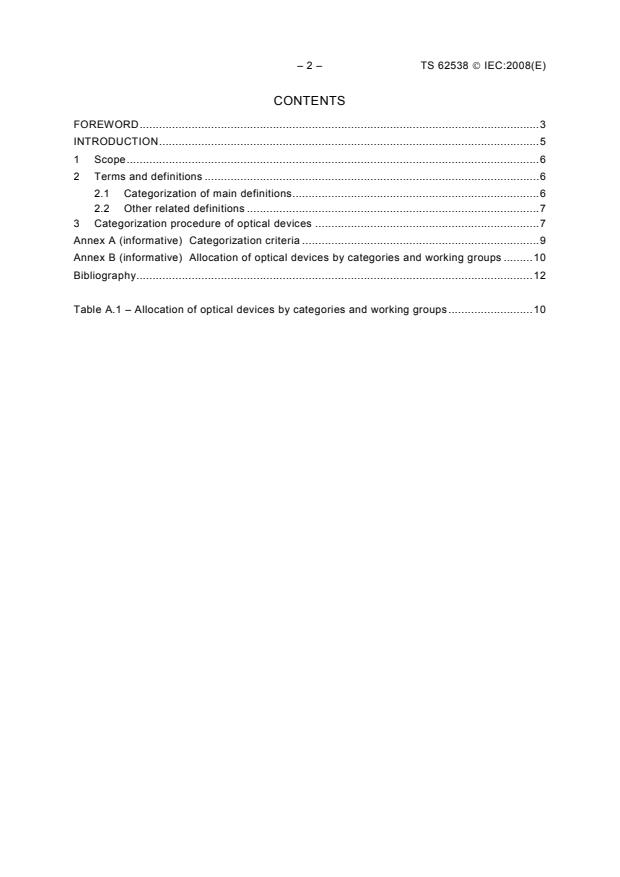
– 2 – TS 62538 © IEC:2008(E)
CONTENTS
FOREWORD.3
INTRODUCTION.5
1 Scope.6
2 Terms and definitions .6
2.1 Categorization of main definitions.6
2.2 Other related definitions .7
3 Categorization procedure of optical devices .7
Annex A (informative) Categorization criteria .9
Annex B (informative) Allocation of optical devices by categories and working groups .10
Bibliography.12
Table A.1 – Allocation of optical devices by categories and working groups.10
TS 62538 © IEC:2008(E) – 3 –
INTERNATIONAL ELECTROTECHNICAL COMMISSION
____________
CATEGORIZATION OF OPTICAL DEVICES
FOREWORD
1) The International Electrotechnical Commission (IEC) is a worldwide organization for standardization comprising
all national electrotechnical committees (IEC National Committees). The object of IEC is to promote
international co-operation on all questions concerning standardization in the electrical and electronic fields. To
this end and in addition to other activities, IEC publishes International Standards, Technical Specifications,
Technical Reports, Publicly Available Specifications (PAS) and Guides (hereafter referred to as “IEC
Publication(s)”). Their preparation is entrusted to technical committees; any IEC National Committee interested
in the subject dealt with may participate in this preparatory work. International, governmental and non-
governmental organizations liaising with the IEC also participate in this preparation. IEC collaborates closely
with the International Organization for Standardization (ISO) in accordance with conditions determined by
agreement between the two organizations.
2) The formal decisions or agreements of IEC on technical matters express, as nearly as possible, an international
consensus of opinion on the relevant subjects since each technical committee has representation from all
interested IEC National Committees.
3) IEC Publications have the form of recommendations for international use and are accepted by IEC National
Committees in that sense. While all reasonable efforts are made to ensure that the technical content of IEC
Publications is accurate, IEC cannot be held responsible for the way in which they are used or for any
misinterpretation by any end user.
4) In order to promote international uniformity, IEC National Committees undertake to apply IEC Publications
transparently to the maximum extent possible in their national and regional publications. Any divergence
between any IEC Publication and the corresponding national or regional publication shall be clearly indicated in
the latter.
5) IEC provides no marking procedure to indicate its approval and cannot be rendered responsible for any
equipment declared to be in conformity with an IEC Publication.
6) All users should ensure that they have the latest edition of this publication.
7) No liability shall attach to IEC or its directors, employees, servants or agents including individual experts and
members of its technical committees and IEC National Committees for any personal injury, property damage or
other damage of any nature whatsoever, whether direct or indirect, or for costs (including legal fees) and
expenses arising out of the publication, use of, or reliance upon, this IEC Publication or any other IEC
Publications.
8) Attention is drawn to the Normative references cited in this publication. Use of the referenced publications is
indispensable for the correct application of this publication.
9) Attention is drawn to the possibility that some of the elements of this IEC Publication may be the subject of
patent rights. IEC shall not be held responsible for identifying any or all such patent rights.
The main task of IEC technical committees is to prepare International Standards. In
exceptional circumstances, a technical committee may propose the publication of a technical
specification when
• The required support cannot be obtained for the publication of an International Standard,
despite repeated efforts, or
• The subject is still under technical development or where, for any other reason, there is
the future but no immediate possibility of an agreement on an International
Standard.Technical specifications are subject to review within three years of publication to
decide whether they can be transformed into International Standards.
Technical specifications are subject to review within three years of publication to decide
whether they can be transformed into International Standards.
IEC/TS 62538, which is a technical specification, has been prepared by IEC technical
committee 86: Fibre optics.
– 4 – TS 62538 © IEC:2008(E)
The text of this technical specification is based on the following documents:
Enquiry draft Report on voting
86/282/DTS 86/308/RVC
Full information on the voting for the approval of this technical specification can be found in
the report on voting indicated in the above table.
This publication has been drafted in accordance with the ISO/IEC Directives, Part 2.
The committee has decided that the contents of this publication will remain unchanged until
the maintenance result date indicated on the IEC web site under "http://webstore.iec.ch" in
the data related to the specific publication. At this date, the publication will be
• transformed into an International standard,
• reconfirmed,
• withdrawn,
• replaced by a revised edition, or
• amended.
A bilingual version of this publication may be issued at a later date.
TS 62538 © IEC:2008(E) – 5 –
INTRODUCTION
IEC/TS 62538, which is a technical specification, is based on the conclusions of the
coordinating group on categorization, approved by TC86 in 2005 and 2006, with the aim to
allocate the various optical devices among the appropriate working groups. It contains
fundamental definitions of broad validity and the procedure to categorize any optical devices.
– 6 – TS 62538 © IEC:2008(E)
CATEGORIZATION OF OPTICAL DEVICES
1 Scope
IEC/TS 62438, which is a technical specification, applies to optical devices (i.e. elements,
components, assemblies, sub-assemblies or modules) of interest to TC86 and its
subcommittee. It provides the definitions of the three main categories of optical devices (i.e.
dynamic, active and passive) together with other related definitions. It also gives a general
procedure to identify the category of any optical devices.
2 Terms and definitions
For the purposes of this document, the following terms and definitions apply.
NOTE 1 The definitions given in 2.1 are determined for the three main categories of optical devices: “optical
dynamic devices,” “optical active devices” and “optical passive devices.” O
...