

IEC 62368-1:2014
(Main)Audio/video, information and communication technology equipment - Part 1: Safety requirements
General Information
- Abstract
IEC 62368-1:2014 deals with the safety of electrical and electronic equipment within the field of audio, video, information and communication technology, and business and office machines with a rated voltage not exceeding 600 V. This standard does not include requirements for performance or functional characteristics of equipment. Examples of equipment within the scope of this standard are given in Annex A. A rated voltage of 600 V is considered to include equipment rated at 400/690 V. This part of IEC 62368 is also applicable to: components and subassemblies intended for incorporation in this equipment. Such components and subassemblies need not comply with every requirement of the standard, provided that the complete equipment, incorporating such components and subassemblies, does comply; external power supply units intended to supply other equipment within the scope of this part of IEC 62368 and accessories intended to be used with equipment within the scope of this part of IEC 62368. This part of IEC 62368 does not apply to power supply systems which are not an integral part of the equipment, such as motor-generator sets, battery backup systems and distribution transformers. This part of IEC 62328 specifies safeguards for ordinary persons, instructed persons, and skilled persons. Additional requirements may apply for equipment that is clearly designed or intended for use by children or specifically attractive to children. This second edition cancels and replaces the first edition published in 2010. It constitutes a technical revision. This edition includes the following significant technical changes with respect to the previous edition:
- addition of requirements for LEDs;
- new requirements for wall and ceiling mounting means;
- addition of acoustic shock requirements for personal music players;
- revision of the battery requirements, including new requirements for coin/button cell batteries and revision of the burn requirements. Key words: Audio/Video, Safeguards, Information, Communication The contents of the corrigenda of February 2015 and November 2015 have been included in this copy.
- Status
- Published
- Publication Date
- 25-Feb-2014
- Technical Committee
- TC 108 - Safety of electronic equipment within the field of audio/video, information technology and communication technology
- Drafting Committee
- WG HBSDT - TC 108/WG HBSDT
- Current Stage
- DELPUB - Deleted Publication
- Start Date
- 04-Oct-2018
- Completion Date
- 28-Aug-2026
Overview
IEC 62368-1:2014 is an international standard developed by the International Electrotechnical Commission (IEC) that specifies safety requirements for audio/video, information, and communication technology equipment. This standard applies to electrical and electronic devices, including business and office machines, with a rated voltage not exceeding 600 V. Its primary focus is on safety, excluding performance or functional characteristics, ensuring protection against electrical shock, fire, mechanical injury, thermal hazards, and exposure to hazardous substances.
The standard embraces a product safety systems approach, addressing safeguards for ordinary users, instructed persons, and skilled personnel. It includes safety principles for components, subassemblies, external power supplies, and applicable accessories. Notably, IEC 62368-1:2014 replaces the earlier 2010 edition and introduces updated safety requirements such as safeguards for LEDs, wall and ceiling mounting, acoustic shock protection in personal music players, and revised battery safety regulations.
Key Topics
Scope and Applicability
Covers electrical equipment related to audio, video, information, and communication technology with rated voltages up to 600 V, including components and power supply units integrated into such equipment.Safety Principles and Models
Establishes safety objectives based on preventing pain and injury from hazards including electrical shock, fire, mechanical harm, thermal burns, hazardous substances, and radiation.Energy Source Classification
Defines categories for energy sources (Class 1, 2, and 3) and their associated safety limits to guide the design of safeguards.Hierarchical Safeguards
Introduces multiple levels of protection including equipment safeguards, installation safeguards, personal safeguards, and behavioral safeguards depending on user expertise and environment.Specific Hazard Protections
- Electrical shock and burn prevention through insulation, clearances, and creepage distances.
- Fire prevention by controlling potential ignition sources and flammability of materials.
- Protection from mechanical injury by safe construction and enclosure design.
- Safety requirements for batteries, including coin/button cell batteries and guidance on lithium battery safety.
- Acoustic shock protection especially in personal music players.
Mounting and Installation Requirements
New requirements for safely mounting equipment on walls and ceilings to prevent hazards.Testing and Compliance
Specifies tests and compliance criteria ensuring consistent application of safety measures.
Applications
IEC 62368-1:2014 serves as the fundamental safety framework for manufacturers, designers, and testers of a wide range of audio, video, information, and communication technology equipment, including:
- Consumer electronics such as TVs, audio players, and personal music devices.
- Office and business machines including printers, computers, and communication devices.
- External power supply units and accessories intended for use with covered equipment.
- Components and subassemblies incorporated into larger systems.
- Equipment intended for professional, general, or limited user groups including children’s devices with special safeguards.
By following IEC 62368-1:2014 standards, manufacturers ensure that their products meet global safety requirements, reducing risk of injury or damage during normal or fault conditions, thus improving market acceptance and regulatory compliance.
Related Standards
- IEC 60950-1 – Safety of Information Technology Equipment (predecessor with a focus on IT, largely replaced by IEC 62368-1)
- IEC 60065 – Audio, Video and Similar Electronic Apparatus - Safety Requirements (older standard replaced by IEC 62368-1)
- IEC 62368-2 – Audio/video, information and communication technology equipment – Part 2: Hazard-based safety engineering
- IEC 62133 – Safety requirements for portable sealed secondary cells and batteries, related to battery safety in IEC 62368-1
- UL 62368-1 – US counterpart harmonized with IEC 62368-1 for product safety verification in North America
Understanding and implementing IEC 62368-1:2014 is essential for maintaining the safety integrity of modern audio/video and information communication technology devices, ensuring reduced hazards and compliance with rigorous international safety regulations.
Relations
- Effective Date
- 05-Sep-2023
- Effective Date
- 05-Sep-2023
- Effective Date
- 05-Sep-2023
- Effective Date
- 05-Sep-2023
- Effective Date
- 05-Sep-2023
Get Certified
Connect with accredited certification bodies for this standard

BSI Group
BSI (British Standards Institution) is the business standards company that helps organizations make excellence a habit.

IMQ S.p.A. (Certification)
Italian electrical product certification.

SLG Prüf- und Zertifizierungs GmbH
German testing and certification body.
Sponsored listings
Frequently Asked Questions
IEC 62368-1:2014 is a standard published by the International Electrotechnical Commission (IEC). Its full title is "Audio/video, information and communication technology equipment - Part 1: Safety requirements". This standard covers: IEC 62368-1:2014 deals with the safety of electrical and electronic equipment within the field of audio, video, information and communication technology, and business and office machines with a rated voltage not exceeding 600 V. This standard does not include requirements for performance or functional characteristics of equipment. Examples of equipment within the scope of this standard are given in Annex A. A rated voltage of 600 V is considered to include equipment rated at 400/690 V. This part of IEC 62368 is also applicable to: components and subassemblies intended for incorporation in this equipment. Such components and subassemblies need not comply with every requirement of the standard, provided that the complete equipment, incorporating such components and subassemblies, does comply; external power supply units intended to supply other equipment within the scope of this part of IEC 62368 and accessories intended to be used with equipment within the scope of this part of IEC 62368. This part of IEC 62368 does not apply to power supply systems which are not an integral part of the equipment, such as motor-generator sets, battery backup systems and distribution transformers. This part of IEC 62328 specifies safeguards for ordinary persons, instructed persons, and skilled persons. Additional requirements may apply for equipment that is clearly designed or intended for use by children or specifically attractive to children. This second edition cancels and replaces the first edition published in 2010. It constitutes a technical revision. This edition includes the following significant technical changes with respect to the previous edition: - addition of requirements for LEDs; - new requirements for wall and ceiling mounting means; - addition of acoustic shock requirements for personal music players; - revision of the battery requirements, including new requirements for coin/button cell batteries and revision of the burn requirements. Key words: Audio/Video, Safeguards, Information, Communication The contents of the corrigenda of February 2015 and November 2015 have been included in this copy.
IEC 62368-1:2014 deals with the safety of electrical and electronic equipment within the field of audio, video, information and communication technology, and business and office machines with a rated voltage not exceeding 600 V. This standard does not include requirements for performance or functional characteristics of equipment. Examples of equipment within the scope of this standard are given in Annex A. A rated voltage of 600 V is considered to include equipment rated at 400/690 V. This part of IEC 62368 is also applicable to: components and subassemblies intended for incorporation in this equipment. Such components and subassemblies need not comply with every requirement of the standard, provided that the complete equipment, incorporating such components and subassemblies, does comply; external power supply units intended to supply other equipment within the scope of this part of IEC 62368 and accessories intended to be used with equipment within the scope of this part of IEC 62368. This part of IEC 62368 does not apply to power supply systems which are not an integral part of the equipment, such as motor-generator sets, battery backup systems and distribution transformers. This part of IEC 62328 specifies safeguards for ordinary persons, instructed persons, and skilled persons. Additional requirements may apply for equipment that is clearly designed or intended for use by children or specifically attractive to children. This second edition cancels and replaces the first edition published in 2010. It constitutes a technical revision. This edition includes the following significant technical changes with respect to the previous edition: - addition of requirements for LEDs; - new requirements for wall and ceiling mounting means; - addition of acoustic shock requirements for personal music players; - revision of the battery requirements, including new requirements for coin/button cell batteries and revision of the burn requirements. Key words: Audio/Video, Safeguards, Information, Communication The contents of the corrigenda of February 2015 and November 2015 have been included in this copy.
IEC 62368-1:2014 is classified under the following ICS (International Classification for Standards) categories: 29.080.10 - Insulators; 29.240.20 - Power transmission and distribution lines; 33.160.01 - Audio, video and audiovisual systems in general; 35.020 - Information technology (IT) in general. The ICS classification helps identify the subject area and facilitates finding related standards.
IEC 62368-1:2014 has the following relationships with other standards: It is inter standard links to IEC 62368-1:2014/COR1:2015, IEC 62368-1:2014/COR2:2015, IEC 62368-1:2010/COR1:2010, IEC 62368-1:2018, IEC 62368-1:2010. Understanding these relationships helps ensure you are using the most current and applicable version of the standard.
IEC 62368-1:2014 is available in PDF format for immediate download after purchase. The document can be added to your cart and obtained through the secure checkout process. Digital delivery ensures instant access to the complete standard document.
Standards Content (Sample)
IEC 62368-1 ®
Edition 2.0 2014-02
INTERNATIONAL
STANDARD
NORME
INTERNATIONALE
colour
inside
Audio/video, information and communication technology equipment –
Part 1: Safety requirements
Équipements des technologies de l'audio/vidéo, de l'information et de la
communication –
Partie 1: Exigences de sécurité
All rights reserved. Unless otherwise specified, no part of this publication may be reproduced or utilized in any form
or by any means, electronic or mechanical, including photocopying and microfilm, without permission in writing from
either IEC or IEC's member National Committee in the country of the requester. If you have any questions about IEC
copyright or have an enquiry about obtaining additional rights to this publication, please contact the address below or
your local IEC member National Committee for further information.
Droits de reproduction réservés. Sauf indication contraire, aucune partie de cette publication ne peut être reproduite
ni utilisée sous quelque forme que ce soit et par aucun procédé, électronique ou mécanique, y compris la photocopie
et les microfilms, sans l'accord écrit de l'IEC ou du Comité national de l'IEC du pays du demandeur. Si vous avez des
questions sur le copyright de l'IEC ou si vous désirez obtenir des droits supplémentaires sur cette publication, utilisez
les coordonnées ci-après ou contactez le Comité national de l'IEC de votre pays de résidence.
IEC Central Office Tel.: +41 22 919 02 11
3, rue de Varembé Fax: +41 22 919 03 00
CH-1211 Geneva 20 info@iec.ch
Switzerland www.iec.ch
About the IEC
The International Electrotechnical Commission (IEC) is the leading global organization that prepares and publishes
International Standards for all electrical, electronic and related technologies.
About IEC publications
The technical content of IEC publications is kept under constant review by the IEC. Please make sure that you have the
latest edition, a corrigenda or an amendment might have been published.
IEC Catalogue - webstore.iec.ch/catalogue Electropedia - www.electropedia.org
The stand-alone application for consulting the entire The world's leading online dictionary of electronic and
bibliographical information on IEC International Standards, electrical terms containing more than 30 000 terms and
Technical Specifications, Technical Reports and other definitions in English and French, with equivalent terms in 14
documents. Available for PC, Mac OS, Android Tablets and additional languages. Also known as the International
iPad. Electrotechnical Vocabulary (IEV) online.
IEC publications search - www.iec.ch/searchpub IEC Glossary - std.iec.ch/glossary
The advanced search enables to find IEC publications by a More than 55 000 electrotechnical terminology entries in
variety of criteria (reference number, text, technical English and French extracted from the Terms and Definitions
committee,…). It also gives information on projects, replaced clause of IEC publications issued since 2002. Some entries
and withdrawn publications. have been collected from earlier publications of IEC TC 37,
77, 86 and CISPR.
IEC Just Published - webstore.iec.ch/justpublished
Stay up to date on all new IEC publications. Just Published IEC Customer Service Centre - webstore.iec.ch/csc
details all new publications released. Available online and If you wish to give us your feedback on this publication or
also once a month by email. need further assistance, please contact the Customer Service
Centre: csc@iec.ch.
A propos de l'IEC
La Commission Electrotechnique Internationale (IEC) est la première organisation mondiale qui élabore et publie des
Normes internationales pour tout ce qui a trait à l'électricité, à l'électronique et aux technologies apparentées.
A propos des publications IEC
Le contenu technique des publications IEC est constamment revu. Veuillez vous assurer que vous possédez l’édition la
plus récente, un corrigendum ou amendement peut avoir été publié.
Catalogue IEC - webstore.iec.ch/catalogue Electropedia - www.electropedia.org
Application autonome pour consulter tous les renseignements
Le premier dictionnaire en ligne de termes électroniques et
bibliographiques sur les Normes internationales,
électriques. Il contient plus de 30 000 termes et définitions en
Spécifications techniques, Rapports techniques et autres
anglais et en français, ainsi que les termes équivalents dans
documents de l'IEC. Disponible pour PC, Mac OS, tablettes
14 langues additionnelles. Egalement appelé Vocabulaire
Android et iPad.
Electrotechnique International (IEV) en ligne.
Recherche de publications IEC - www.iec.ch/searchpub
Glossaire IEC - std.iec.ch/glossary
Plus de 55 000 entrées terminologiques électrotechniques, en
La recherche avancée permet de trouver des publications IEC
en utilisant différents critères (numéro de référence, texte, anglais et en français, extraites des articles Termes et
comité d’études,…). Elle donne aussi des informations sur les Définitions des publications IEC parues depuis 2002. Plus
projets et les publications remplacées ou retirées. certaines entrées antérieures extraites des publications des
CE 37, 77, 86 et CISPR de l'IEC.
IEC Just Published - webstore.iec.ch/justpublished
Service Clients - webstore.iec.ch/csc
Restez informé sur les nouvelles publications IEC. Just
Published détaille les nouvelles publications parues. Si vous désirez nous donner des commentaires sur cette
Disponible en ligne et aussi une fois par mois par email. publication ou si vous avez des questions contactez-nous:
csc@iec.ch.
IEC 62368-1 ®
Edition 2.0 2014-02
INTERNATIONAL
STANDARD
NORME
INTERNATIONALE
colour
inside
Audio/video, information and communication technology equipment –
Part 1: Safety requirements
Équipements des technologies de l'audio/vidéo, de l'information et de la
communication –
Partie 1: Exigences de sécurité
INTERNATIONAL
ELECTROTECHNICAL
COMMISSION
COMMISSION
ELECTROTECHNIQUE
PRICE CODE
INTERNATIONALE
CODE PRIX XH
ICS 33.160.01, 35.020 ISBN 978-2-8322-1405-3
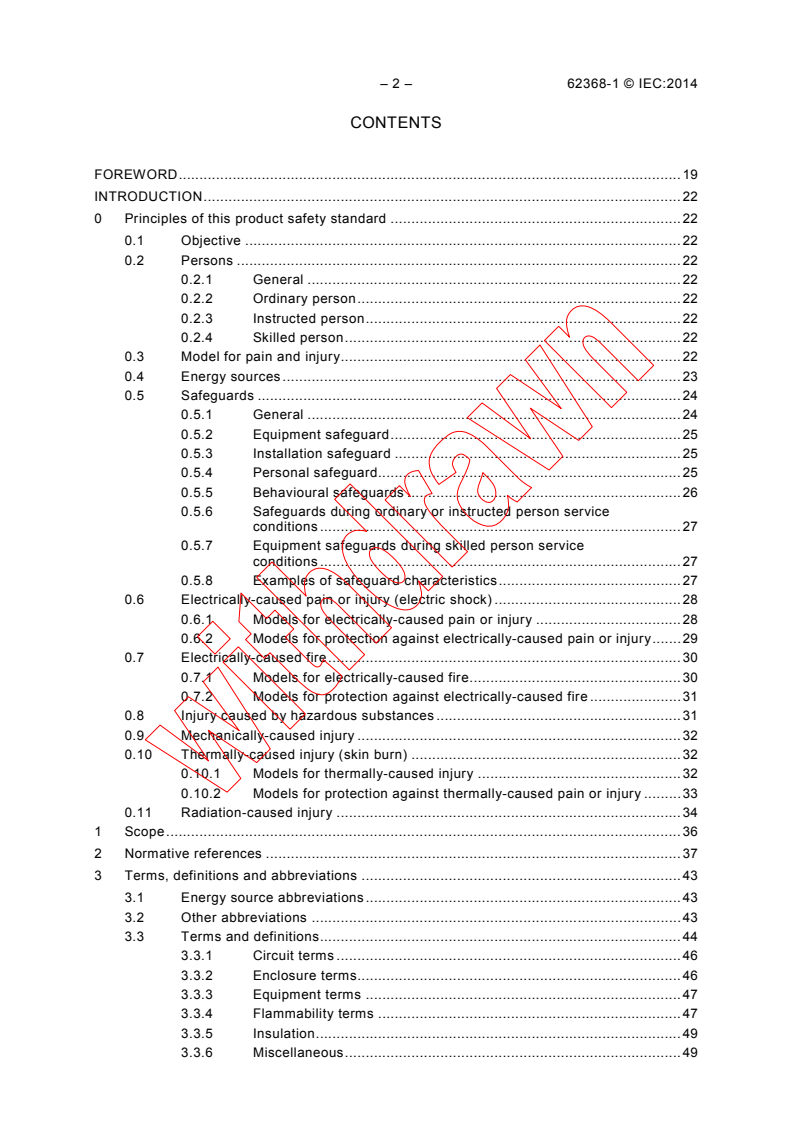
– 2 – 62368-1 © IEC:2014
CONTENTS
FOREWORD . 19
INTRODUCTION . 22
0 Principles of this product safety standard . 22
0.1 Objective . 22
0.2 Persons . 22
0.2.1 General . 22
0.2.2 Ordinary person . 22
0.2.3 Instructed person . 22
0.2.4 Skilled person . 22
0.3 Model for pain and injury . 22
0.4 Energy sources . 23
0.5 Safeguards . 24
0.5.1 General . 24
0.5.2 Equipment safeguard . 25
0.5.3 Installation safeguard . 25
0.5.4 Personal safeguard. 25
0.5.5 Behavioural safeguards . 26
0.5.6 Safeguards during ordinary or instructed person service
conditions . 27
0.5.7 Equipment safeguards during skilled person service
conditions . 27
0.5.8 Examples of safeguard characteristics . 27
0.6 Electrically-caused pain or injury (electric shock) . 28
0.6.1 Models for electrically-caused pain or injury . 28
0.6.2 Models for protection against electrically-caused pain or injury . 29
0.7 Electrically-caused fire . 30
0.7.1 Models for electrically-caused fire . 30
0.7.2 Models for protection against electrically-caused fire . 31
0.8 Injury caused by hazardous substances . 31
0.9 Mechanically-caused injury . 32
0.10 Thermally-caused injury (skin burn) . 32
0.10.1 Models for thermally-caused injury . 32
0.10.2 Models for protection against thermally-caused pain or injury . 33
0.11 Radiation-caused injury . 34
1 Scope . 36
2 Normative references . 37
3 Terms, definitions and abbreviations . 43
3.1 Energy source abbreviations . 43
3.2 Other abbreviations . 43
3.3 Terms and definitions . 44
3.3.1 Circuit terms . 46
3.3.2 Enclosure terms . 46
3.3.3 Equipment terms . 47
3.3.4 Flammability terms . 47
3.3.5 Insulation . 49
3.3.6 Miscellaneous . 49
62368-1 © IEC:2014 – 3 –
3.3.7 Operating and fault conditions . 51
3.3.8 Persons . 52
3.3.9 Potential ignition sources . 52
3.3.10 Ratings . 53
3.3.11 Safeguards . 53
3.3.12 Spacings . 55
3.3.13 Temperature controls . 55
3.3.14 Voltages and currents . 55
3.3.15 Classes of equipment with respect to protection from electric
shock . 56
3.3.16 Chemical terms . 57
3.3.17 Batteries . 57
4 General requirements . 59
4.1 General . 59
4.1.1 Application of requirements and acceptance of materials,
components and subassemblies . 59
4.1.2 Use of components . 59
4.1.3 Equipment design and construction . 59
4.1.4 Equipment installation . 60
4.1.5 Constructions and components not specifically covered . 60
4.1.6 Orientation during transport and use . 60
4.1.7 Choice of criteria . 60
4.1.8 Conductive liquids . 60
4.1.9 Electrical measuring instruments . 60
4.1.10 Temperature measurements . 60
4.1.11 Steady state conditions . 61
4.1.12 Hierarchy of safeguards . 61
4.1.13 Examples mentioned in the standard . 61
4.1.14 Tests on parts or samples separate from the end-product . 61
4.1.15 Markings and instructions . 61
4.2 Energy source classifications . 61
4.2.1 Class 1 energy source . 61
4.2.2 Class 2 energy source . 62
4.2.3 Class 3 energy source . 62
4.2.4 Energy source classification by declaration . 62
4.3 Protection against energy sources . 62
4.3.1 General . 62
4.3.2 Safeguards for protection of an ordinary person . 62
4.3.3 Safeguards for protection of an instructed person . 64
4.3.4 Safeguards for protection of a skilled person . 64
4.3.5 Safeguards in a restricted access area . 65
4.4 Safeguards . 66
4.4.1 Equivalent materials or components . 66
4.4.2 Composition of a safeguard . 66
4.4.3 Accessible parts of a safeguard . 66
4.4.4 Safeguard robustness . 66
4.5 Explosion . 68
4.5.1 General . 68
4.5.2 Requirements . 68
– 4 – 62368-1 © IEC:2014
4.6 Fixing of conductors . 69
4.6.1 Requirements . 69
4.6.2 Compliance criteria . 69
4.7 Equipment for direct insertion into mains socket-outlets . 69
4.7.1 General . 69
4.7.2 Requirements . 69
4.7.3 Compliance criteria . 70
4.8 Products containing lithium coin / button cell batteries . 70
4.8.1 General . 70
4.8.2 Instructional safeguard . 70
4.8.3 Construction . 70
4.8.4 Tests . 71
4.8.5 Compliance criteria . 71
4.9 Likelihood of fire or shock due to entry of conductive objects . 72
5 Electrically-caused injury . 72
5.1 General . 72
5.2 Classification and limits of electrical energy sources . 73
5.2.1 Electrical energy source classifications . 73
5.2.2 Electrical energy source ES1 and ES2 limits . 73
5.3 Protection against electrical energy sources . 79
5.3.1 General . 79
5.3.2 Accessibility to electrical energy sources and safeguards . 79
5.4 Insulation materials and requirements . 81
5.4.1 General . 81
5.4.2 Clearances . 87
5.4.3 Creepage distances . 97
5.4.4 Solid insulation . 101
5.4.5 Antenna terminal insulation. 110
5.4.6 Insulation of internal wire as a part of a supplementary
safeguard . 111
5.4.7 Tests for semiconductor components and for cemented joints . 111
5.4.8 Humidity conditioning . 111
5.4.9 Electric strength test . 112
5.4.10 Safeguards against transient voltages from external circuits . 115
5.4.11 Separation between external circuits and earth . 117
5.5 Components as safeguards . 118
5.5.1 General . 118
5.5.2 Capacitors and RC units . 118
5.5.3 Transformers . 120
5.5.4 Optocouplers . 120
5.5.5 Relays . 120
5.5.6 Resistors . 120
5.5.7 SPDs . 120
5.5.8 Insulation between the mains and an external circuit
consisting of a coaxial cable . 121
5.6 Protective conductor . 121
5.6.1 General . 121
5.6.2 Requirements for protective conductors . 121
5.6.3 Requirements for protective earthing conductors . 122
62368-1 © IEC:2014 – 5 –
5.6.4 Requirements for protective bonding conductors . 123
5.6.5 Terminals for protective conductors . 125
5.6.6 Resistance of the protective bonding system . 126
5.6.7 Reliable earthing . 128
5.7 Prospective touch voltage, touch current and protective conductor current. 128
5.7.1 General . 128
5.7.2 Measuring devices and networks . 128
5.7.3 Equipment set-up, supply connections and earth connections . 128
5.7.4 Earthed accessible conductive parts . 129
5.7.5 Protective conductor current . 129
5.7.6 Prospective touch voltage and touch current due to external
circuits . 130
5.7.7 Summation of touch currents from external circuits . 131
6 Electrically-caused fire . 133
6.1 General . 133
6.2 Classification of power sources (PS) and potential ignition sources (PIS) . 133
6.2.1 General . 133
6.2.2 Power source circuit classifications . 133
6.2.3 Classification of potential ignition sources . 136
6.3 Safeguards against fire under normal operating conditions and abnormal
operating conditions . 137
6.3.1 Requirements . 137
6.3.2 Compliance criteria . 138
6.4 Safeguards against fire under single fault conditions. 138
6.4.1 General . 138
6.4.2 Reduction of the likelihood of ignition under single fault
conditions in PS1 circuits . 138
6.4.3 Reduction of the likelihood of ignition under single fault
conditions in PS2 circuits and PS3 circuits . 138
6.4.4 Control of fire spread in PS1 circuits . 140
6.4.5 Control of fire spread in PS2 circuits . 140
6.4.6 Control of fire spread in a PS3 circuit . 141
6.4.7 Separation of combustible materials from a PIS . 142
6.4.8 Fire enclosures and fire barriers . 144
6.5 Internal and external wiring . 149
6.5.1 Requirements . 149
6.5.2 Compliance criteria . 149
6.5.3 Requirements for interconnection to building wiring. . 149
6.5.4 Compliance criteria . 150
6.6 Safeguards against fire due to the connection of additional equipment. 150
7 Injury caused by hazardous substances . 150
7.1 General . 150
7.2 Reduction of exposure to hazardous substances. 150
7.3 Ozone exposure . 150
7.4 Use of personal safeguards (PPE) . 150
7.5 Use of instructional safeguards and instructions . 151
7.6 Batteries and their protection circuits . 151
8 Mechanically-caused injury . 151
8.1 General . 151
– 6 – 62368-1 © IEC:2014
8.2 Mechanical energy source classifications . 151
8.2.1 General classification . 151
8.2.2 MS1 . 153
8.2.3 MS2 . 153
8.2.4 MS3 . 153
8.3 Safeguards against mechanical energy sources . 153
8.4 Safeguards against parts with sharp edges and corners . 153
8.4.1 Requirements . 153
8.4.2 Compliance criteria . 154
8.5 Safeguards against moving parts . 154
8.5.1 Requirements . 154
8.5.2 Instructional safeguard requirements . 154
8.5.3 Compliance criteria . 155
8.5.4 Special categories of equipment comprising moving parts . 155
8.5.5 High pressure lamps . 157
8.6 Stability of equipment . 158
8.6.1 Requirements . 158
8.6.2 Static stability . 159
8.6.3 Relocation stability test . 160
8.6.4 Glass slide test . 160
8.6.5 Horizontal force test and compliance criteria. 161
8.7 Equipment mounted to a wall or ceiling . 161
8.7.1 Requirements . 161
8.7.2 Test methods . 161
8.7.3 Compliance criteria . 163
8.8 Handle strength . 163
8.8.1 General . 163
8.8.2 Test method and compliance criteria . 163
8.9 Wheels or casters attachment requirements . 163
8.9.1 General . 163
8.9.2 Test method . 164
8.10 Carts, stands, and similar carriers . 164
8.10.1 General . 164
8.10.2 Marking and instructions . 164
8.10.3 Cart, stand or carrier loading test and compliance criteria . 165
8.10.4 Cart, stand or carrier impact test. 165
8.10.5 Mechanical stability . 165
8.10.6 Thermoplastic temperature stability . 166
8.11 Mounting means for rack mounted equipment . 166
8.11.1 General . 166
8.11.2 Requirements . 166
8.11.3 Mechanical strength test . 167
8.11.4 Mechanical strength test, 250 N, including end stops . 167
8.11.5 Compliance criteria . 167
8.12 Telescoping or rod antennas . 167
9 Thermal burn injury . 168
9.1 General . 168
9.2 Thermal energy source classifications . 168
9.2.1 General . 168
62368-1 © IEC:2014 – 7 –
9.2.2 TS1 . 168
9.2.3 TS2 . 168
9.2.4 TS3 . 168
9.2.5 Test method and compliance criteria . 168
9.2.6 Touch temperature levels . 169
9.3 Safeguards against thermal energy sources . 170
9.4 Requirements for safeguards . 170
9.4.1 Equipment safeguard . 170
9.4.2 Instructional safeguard . 170
10 Radiation . 170
10.1 General . 170
10.2 Radiation energy source classifications . 170
10.2.1 General classification . 170
10.2.2 RS1 . 172
10.2.3 RS2 . 172
10.2.4 RS3 . 172
10.3 Safeguards against laser radiation . 172
10.3.1 Requirements . 172
10.3.2 Compliance criteria . 172
10.4 Safeguards against visible, infra-red, and ultra-violet radiation . 173
10.4.1 General . 173
10.4.2 Instructional safeguard . 173
10.4.3 Compliance criteria . 174
10.5 Safeguards against x-radiation . 174
10.5.1 Requirements . 174
10.5.2 Compliance criteria . 174
10.5.3 Test method . 174
10.6 Safeguards against acoustic energy sources . 175
10.6.1 General . 175
10.6.2 Classification . 176
10.6.3 Measurement methods . 176
10.6.4 Protection of persons . 177
10.6.5 Requirements for listening devices (headphones, earphones,
etc.) . 177
Annex A (informative) Examples of equipment within the scope of this standard . 179
Annex B (normative) Normal operating condition tests, abnormal operating condition
tests and single fault condition tests . 180
B.1 General . 180
B.1.1 Introduction . 180
B.1.2 Test applicability . 180
B.1.3 Type of test . 180
B.1.4 Test samples . 180
B.1.5 Compliance by inspection of relevant data . 180
B.1.6 Temperature measurement conditions . 180
B.2 Normal operating conditions . 181
B.2.1 General . 181
B.2.2 Supply frequency . 181
B.2.3 Supply voltage . 181
B.2.4 Normal operating voltages . 182
– 8 – 62368-1 © IEC:2014
B.2.5 Input test . 182
B.2.6 Operating temperature measurement conditions . 183
B.2.7 Battery charging and discharging under normal operating
conditions . 183
B.3 Simulated abnormal operating conditions . 184
B.3.1 General . 184
B.3.2 Covering of ventilation openings . 184
B.3.3 DC mains polarity test . 185
B.3.4 Setting of voltage selector . 185
B.3.5 Maximum load at output terminals . 185
B.3.6 Reverse battery polarity . 185
B.3.7 Audio amplifier abnormal operating conditions . 185
B.3.8 Compliance criteria during and after abnormal operating
conditions . 185
B.4 Simulated single fault conditions . 185
B.4.1 General . 185
B.4.2 Temperature controlling device . 186
B.4.3 Motor tests . 186
B.4.4 Functional insulation . 186
B.4.5 Short-circuit and interruption of electrodes in tubes and
semiconductors . 187
B.4.6 Short-circuit or disconnection of passive components . 187
B.4.7 Continuous operation of components . 187
B.4.8 Compliance criteria during and after single fault conditions . 188
B.4.9 Battery charging and discharging under single fault conditions . 188
Annex C (normative) UV radiation . 189
C.1 Protection of materials in equipment from UV radiation . 189
C.1.1 General . 189
C.1.2 Requirements . 189
C.1.3 Test method and compliance criteria . 189
C.2 UV light conditioning test . 190
C.2.1 Test apparatus . 190
C.2.2 Mounting of test samples . 190
C.2.3 Carbon-arc light-exposure test . 190
C.2.4 Xenon-arc light-exposure test . 190
Annex D (normative) Test generators . 191
D.1 Impulse test generators . 191
D.2 Antenna interface test generator . 192
D.3 Electronic pulse generator . 192
Annex E (normative) Test conditions for equipment containing audio amplifiers . 193
E.1 Audio amplifier normal operating conditions . 193
E.2 Audio amplifier abnormal operating conditions . 194
Annex F (normative) Equipment markings, instructions, and instructional safeguards . 195
F.1 General . 195
F.2 Letter symbols and graphical symbols . 195
F.2.1 Letter symbols . 195
F.2.2 Graphical symbols . 195
F.2.3 Compliance criteria . 195
F.3 Equipment markings . 195
62368-1 © IEC:2014 – 9 –
F.3.1 Equipment marking locations . 195
F.3.2 Equipment identification markings . 196
F.3.3 Equipment rating markings . 196
F.3.4 Voltage setting device . 198
F.3.5 Markings on terminals and operating devices. 198
F.3.6 Equipment markings related to equipment classification . 199
F.3.7 Equipment IP rating marking . 200
F.3.8 External power supply output marking . 200
F.3.9 Durability, legibility and permanence of markings . 201
F.3.10 Test for the permanence of markings . 201
F.4 Instructions . 201
F.5 Instructional safeguards . 202
Annex G (normative) Components . 205
G.1 Switches . 205
G.1.1 General . 205
G.1.2 Requirements . 205
G.1.3 Test method and compliance criteria . 206
G.2 Relays . 206
G.2.1 Requirements . 206
G.2.2 Overload test . 207
G.2.3 Relay controlling connectors supplying power to other
equipment. 207
G.2.4 Test method and compliance criteria . 207
G.3 Protective devices
...