

IEC 61326-2-6:2025
(Main)Electrical equipment for measurement, control and laboratory use - EMC requirements - Part 2-6: Particular requirements - In vitro diagnostic (IVD) medical electrical equipment
General Information
- Abstract
IEC 61326-2-6:2025 applies to the BASIC SAFETY and ESSENTIAL PERFORMANCE of IN VITRO DIAGNOSTIC MEDICAL ELECTRICAL EQUIPMENT (IVD MEE). This part of IEC 61326 applies to the BASIC SAFETY and ESSENTIAL PERFORMANCE of IVD MEE in the presence of electromagnetic disturbances and to electromagnetic disturbances emitted by IVD MEE.
BASIC SAFETY with regard to electromagnetic disturbances is applicable to all IVD MEE.
NOTE 1 Performance with respect to electromagnetic disturbances other than ESSENTIAL PERFORMANCE is the subject of IEC 61326-1:2020
NOTE 2 IT equipment can be a part of an IVD MEE, if it is required to maintain BASIC SAFETY or ESSENTIAL PERFORMANCE.
This edition includes the following significant technical changes with respect to the previous edition:
- Update of the document with respect to test levels and documentation.
- Status
- Published
- Publication Date
- 17-Jun-2025
- Technical Committee
- SC 65A - System aspects
- Drafting Committee
- WG 4 - TC 65/SC 65A/WG 4
- Current Stage
- PPUB - Publication issued
- Start Date
- 18-Jun-2025
- Completion Date
- 18-Jul-2025
Buy Documents
IEC 61326-2-6:2025 - Electrical equipment for measurement, control and laboratory use - EMC requirements - Part 2-6: Particular requirements - In vitro diagnostic (IVD) medical electrical equipment Released:6/18/2025
Overview
IEC 61326-2-6:2025 establishes essential electromagnetic compatibility (EMC) requirements for in vitro diagnostic medical electrical equipment (IVD MEE). Developed by the International Electrotechnical Commission (IEC), this standard focuses on ensuring the basic safety and essential performance of IVD MEE when subjected to electromagnetic disturbances and addresses how such equipment may emit electromagnetic interference.
IVD MEE includes instruments and apparatus used for examining specimens derived from the human body, aiding in disease diagnosis, monitoring, or treatment decisions. Compliance with this standard is critical for manufacturers, regulatory authorities, laboratories, and healthcare facilities seeking reliable operation of diagnostic equipment under electromagnetic influences.
Key Topics
BASIC SAFETY and ESSENTIAL PERFORMANCE:
The standard mandates that manufacturers identify and mitigate unacceptable risks arising from electromagnetic disturbances, directly addressing the safety and performance necessary for the intended diagnostic functions of IVD medical electrical equipment.EMC Risk Management:
IEC 61326-2-6:2025 requires manufacturers to integrate EMC risk management in line with ISO 14971. The EMC risk management file must document hazard identification, risk controls, and test configurations to maintain both safety and essential performance.Test Plans and Report Documentation:
Manufacturers must establish detailed EMC test plans reflecting intended use scenarios, operational modes, and system configurations most likely to create unacceptable risks. Test results and methodology are to be thoroughly documented.Immunity and Emission Requirements:
Specific immunity test levels and procedures are provided for both professional healthcare facility and home healthcare environments, ensuring reliable equipment performance amid common sources of electromagnetic interference such as wireless devices, RFID, security systems, and power-line disturbances.Updates in the 2025 Edition:
The latest edition includes revised test levels and enhanced documentation requirements, reflecting current practices and ensuring alignment with evolving electromagnetic environments and regulatory needs.
Applications
Manufacturers of IVD Equipment:
Use IEC 61326-2-6:2025 to design, test, and document product compliance regarding EMC. This underpins safer products, accelerates market access, and streamlines regulatory submissions for global healthcare markets.Test Laboratories:
Reference the standard’s detailed test plan guidance and reporting structure to provide consistent, recognized EMC testing services for IVD MEE.Healthcare Providers and Laboratories:
Assurance that diagnostic results are reliable, free from interference that could compromise patient safety or lead to misdiagnosis, particularly when devices are used in environments with varying electromagnetic profiles.Regulatory and Certification Bodies:
Employ IEC 61326-2-6:2025 as a harmonized baseline for assessment of in vitro diagnostic medical electrical equipment, supporting regulatory frameworks and international market acceptance.
Related Standards
- IEC 61326-1:2020 - General EMC requirements for measurement, control and laboratory equipment. IEC 61326-2-6 builds upon and modifies specific clauses relevant to IVD equipment.
- IEC 61010 (series) - General safety requirements for electrical equipment for measurement, control, and laboratory use.
- ISO 14971:2019 - Medical devices - Application of risk management to medical devices; a key reference for EMC risk analysis.
- IEC 60601-1-11:2015 - Requirements for medical electrical equipment and systems used in home healthcare environments.
Adhering to IEC 61326-2-6:2025 promotes safety, reliability, and regulatory acceptance of in vitro diagnostic medical electrical equipment amidst today’s complex electromagnetic environments. Manufacturers, laboratories, and healthcare facilities are encouraged to reference and implement this standard to ensure the highest levels of EMC compliance.
Relations
- Effective Date
- 05-Sep-2023
Buy Documents
IEC 61326-2-6:2025 - Electrical equipment for measurement, control and laboratory use - EMC requirements - Part 2-6: Particular requirements - In vitro diagnostic (IVD) medical electrical equipment Released:6/18/2025
Get Certified
Connect with accredited certification bodies for this standard

DVS-ZERT GmbH
German welding certification society.

ANCE
Mexican certification and testing association.
BSMI (Bureau of Standards, Metrology and Inspection)
Taiwan's standards and inspection authority.
Sponsored listings
Frequently Asked Questions
IEC 61326-2-6:2025 is a standard published by the International Electrotechnical Commission (IEC). Its full title is "Electrical equipment for measurement, control and laboratory use - EMC requirements - Part 2-6: Particular requirements - In vitro diagnostic (IVD) medical electrical equipment". This standard covers: IEC 61326-2-6:2025 applies to the BASIC SAFETY and ESSENTIAL PERFORMANCE of IN VITRO DIAGNOSTIC MEDICAL ELECTRICAL EQUIPMENT (IVD MEE). This part of IEC 61326 applies to the BASIC SAFETY and ESSENTIAL PERFORMANCE of IVD MEE in the presence of electromagnetic disturbances and to electromagnetic disturbances emitted by IVD MEE. BASIC SAFETY with regard to electromagnetic disturbances is applicable to all IVD MEE. NOTE 1 Performance with respect to electromagnetic disturbances other than ESSENTIAL PERFORMANCE is the subject of IEC 61326-1:2020 NOTE 2 IT equipment can be a part of an IVD MEE, if it is required to maintain BASIC SAFETY or ESSENTIAL PERFORMANCE. This edition includes the following significant technical changes with respect to the previous edition: - Update of the document with respect to test levels and documentation.
IEC 61326-2-6:2025 applies to the BASIC SAFETY and ESSENTIAL PERFORMANCE of IN VITRO DIAGNOSTIC MEDICAL ELECTRICAL EQUIPMENT (IVD MEE). This part of IEC 61326 applies to the BASIC SAFETY and ESSENTIAL PERFORMANCE of IVD MEE in the presence of electromagnetic disturbances and to electromagnetic disturbances emitted by IVD MEE. BASIC SAFETY with regard to electromagnetic disturbances is applicable to all IVD MEE. NOTE 1 Performance with respect to electromagnetic disturbances other than ESSENTIAL PERFORMANCE is the subject of IEC 61326-1:2020 NOTE 2 IT equipment can be a part of an IVD MEE, if it is required to maintain BASIC SAFETY or ESSENTIAL PERFORMANCE. This edition includes the following significant technical changes with respect to the previous edition: - Update of the document with respect to test levels and documentation.
IEC 61326-2-6:2025 is classified under the following ICS (International Classification for Standards) categories: 17.220.20 - Measurement of electrical and magnetic quantities; 25.040.40 - Industrial process measurement and control; 33.100.20 - Immunity. The ICS classification helps identify the subject area and facilitates finding related standards.
IEC 61326-2-6:2025 has the following relationships with other standards: It is inter standard links to IEC 61326-2-6:2020. Understanding these relationships helps ensure you are using the most current and applicable version of the standard.
IEC 61326-2-6:2025 is available in PDF format for immediate download after purchase. The document can be added to your cart and obtained through the secure checkout process. Digital delivery ensures instant access to the complete standard document.
Standards Content (Sample)
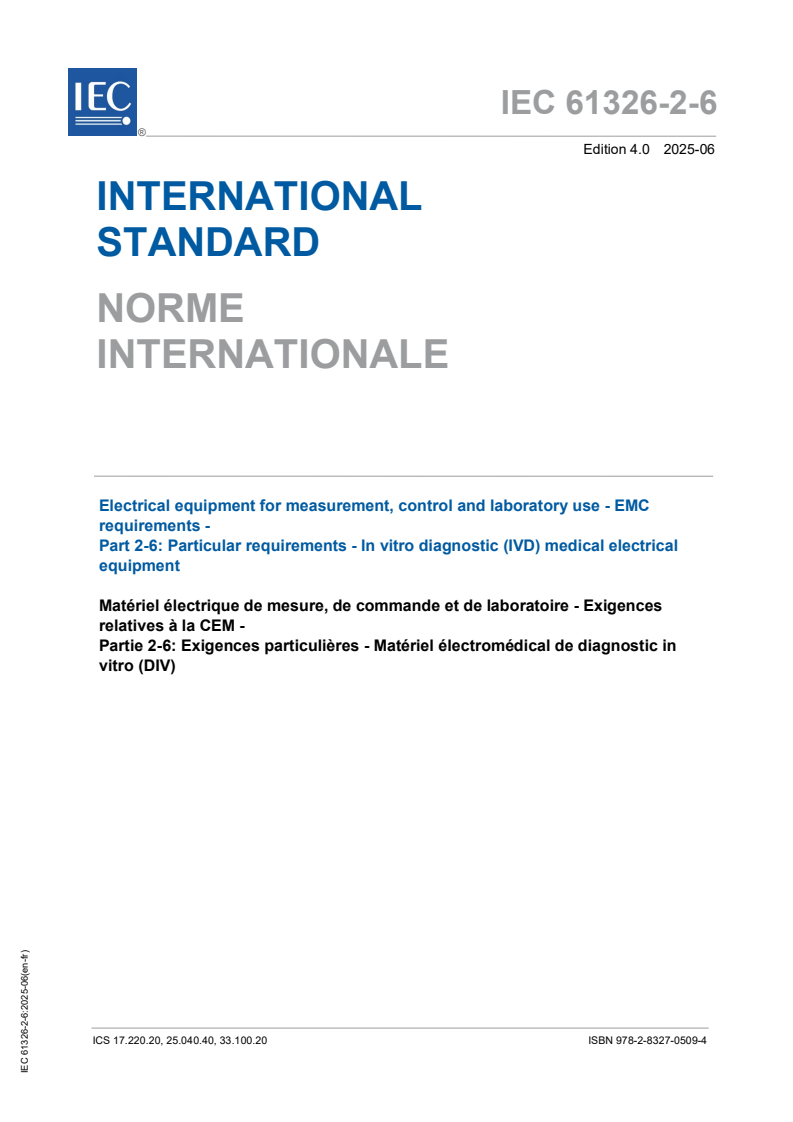
IEC 61326-2-6 ®
Edition 4.0 2025-06
INTERNATIONAL
STANDARD
NORME
INTERNATIONALE
Electrical equipment for measurement, control and laboratory use - EMC
requirements -
Part 2-6: Particular requirements - In vitro diagnostic (IVD) medical electrical
equipment
Matériel électrique de mesure, de commande et de laboratoire - Exigences
relatives à la CEM -
Partie 2-6: Exigences particulières - Matériel électromédical de diagnostic in
vitro (DIV)
ICS 17.220.20, 25.040.40, 33.100.20 ISBN 978-2-8327-0509-4
All rights reserved. Unless otherwise specified, no part of this publication may be reproduced or utilized in any form or
by any means, electronic or mechanical, including photocopying and microfilm, without permission in writing from either
IEC or IEC's member National Committee in the country of the requester. If you have any questions about IEC copyright
or have an enquiry about obtaining additional rights to this publication, please contact the address below or your local
IEC member National Committee for further information.
Droits de reproduction réservés. Sauf indication contraire, aucune partie de cette publication ne peut être reproduite ni
utilisée sous quelque forme que ce soit et par aucun procédé, électronique ou mécanique, y compris la photocopie et
les microfilms, sans l'accord écrit de l'IEC ou du Comité national de l'IEC du pays du demandeur. Si vous avez des
questions sur le copyright de l'IEC ou si vous désirez obtenir des droits supplémentaires sur cette publication, utilisez
les coordonnées ci-après ou contactez le Comité national de l'IEC de votre pays de résidence.
IEC Secretariat Tel.: +41 22 919 02 11
3, rue de Varembé info@iec.ch
CH-1211 Geneva 20 www.iec.ch
Switzerland
About the IEC
The International Electrotechnical Commission (IEC) is the leading global organization that prepares and publishes
International Standards for all electrical, electronic and related technologies.
About IEC publications
The technical content of IEC publications is kept under constant review by the IEC. Please make sure that you have the
latest edition, a corrigendum or an amendment might have been published.
IEC publications search - IEC Products & Services Portal - products.iec.ch
webstore.iec.ch/advsearchform Discover our powerful search engine and read freely all the
The advanced search enables to find IEC publications by a publications previews, graphical symbols and the glossary.
variety of criteria (reference number, text, technical With a subscription you will always have access to up to date
committee, …). It also gives information on projects, content tailored to your needs.
replaced and withdrawn publications.
Electropedia - www.electropedia.org
IEC Just Published - webstore.iec.ch/justpublished The world's leading online dictionary on electrotechnology,
Stay up to date on all new IEC publications. Just Published containing more than 22 500 terminological entries in English
details all new publications released. Available online and and French, with equivalent terms in 25 additional languages.
once a month by email. Also known as the International Electrotechnical Vocabulary
(IEV) online.
IEC Customer Service Centre - webstore.iec.ch/csc
If you wish to give us your feedback on this publication or
need further assistance, please contact the Customer
Service Centre: sales@iec.ch.
A propos de l'IEC
La Commission Electrotechnique Internationale (IEC) est la première organisation mondiale qui élabore et publie des
Normes internationales pour tout ce qui a trait à l'électricité, à l'électronique et aux technologies apparentées.
A propos des publications IEC
Le contenu technique des publications IEC est constamment revu. Veuillez vous assurer que vous possédez l’édition la
plus récente, un corrigendum ou amendement peut avoir été publié.
Recherche de publications IEC - IEC Products & Services Portal - products.iec.ch
webstore.iec.ch/advsearchform Découvrez notre puissant moteur de recherche et consultez
La recherche avancée permet de trouver des publications gratuitement tous les aperçus des publications, symboles
IEC en utilisant différents critères (numéro de référence, graphiques et le glossaire. Avec un abonnement, vous aurez
texte, comité d’études, …). Elle donne aussi des toujours accès à un contenu à jour adapté à vos besoins.
informations sur les projets et les publications remplacées
ou retirées. Electropedia - www.electropedia.org
Le premier dictionnaire d'électrotechnologie en ligne au
IEC Just Published - webstore.iec.ch/justpublished monde, avec plus de 22 500 articles terminologiques en
Restez informé sur les nouvelles publications IEC. Just anglais et en français, ainsi que les termes équivalents
Published détaille les nouvelles publications parues. dans 25 langues additionnelles. Egalement appelé
Disponible en ligne et une fois par mois par email. Vocabulaire Electrotechnique International (IEV) en ligne.
Service Clients - webstore.iec.ch/csc
Si vous désirez nous donner des commentaires sur cette
publication ou si vous avez des questions contactez-
nous: sales@iec.ch.
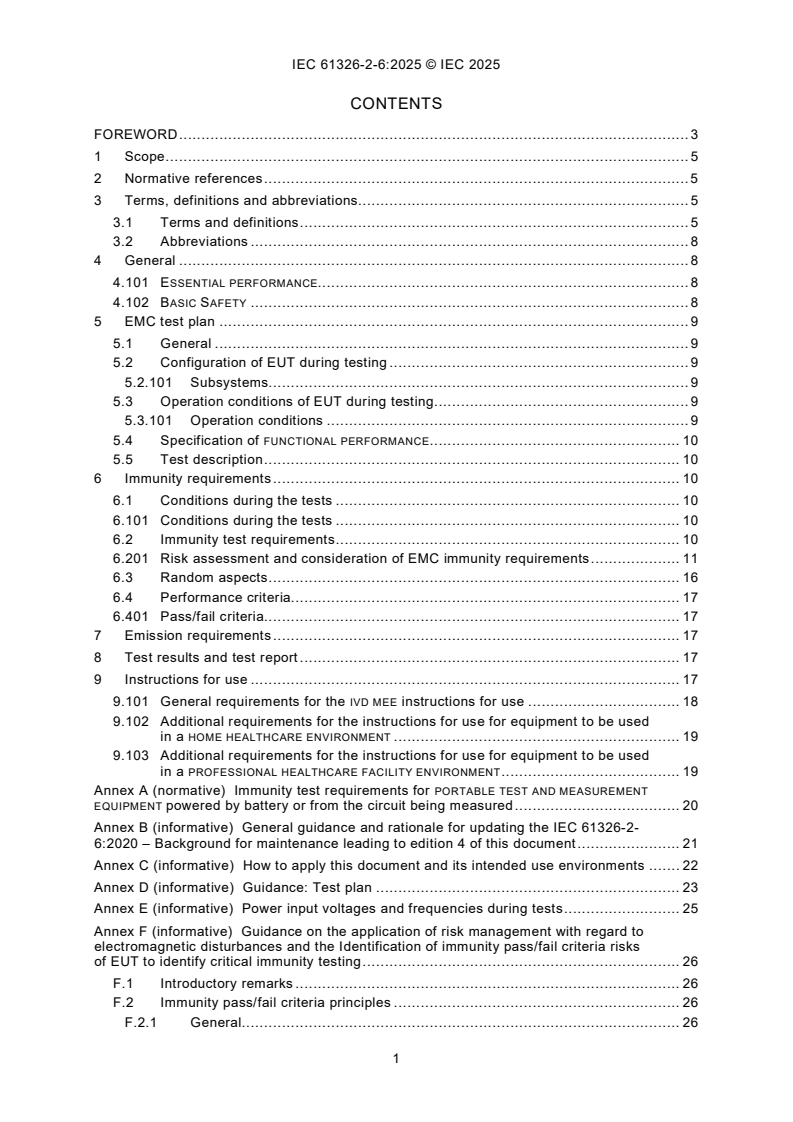
CONTENTS
FOREWORD . 3
1 Scope . 5
2 Normative references . 5
3 Terms, definitions and abbreviations . 5
3.1 Terms and definitions . 5
3.2 Abbreviations . 8
4 General . 8
4.101 ESSENTIAL PERFORMANCE. 8
4.102 BASIC SAFETY . 8
5 EMC test plan . 9
5.1 General . 9
5.2 Configuration of EUT during testing . 9
5.2.101 Subsystems. 9
5.3 Operation conditions of EUT during testing . 9
5.3.101 Operation conditions . 9
5.4 Specification of FUNCTIONAL PERFORMANCE . 10
5.5 Test description . 10
6 Immunity requirements . 10
6.1 Conditions during the tests . 10
6.101 Conditions during the tests . 10
6.2 Immunity test requirements . 10
6.201 Risk assessment and consideration of EMC immunity requirements . 11
6.3 Random aspects . 16
6.4 Performance criteria. 17
6.401 Pass/fail criteria. 17
7 Emission requirements . 17
8 Test results and test report . 17
9 Instructions for use . 17
9.101 General requirements for the IVD MEE instructions for use . 18
9.102 Additional requirements for the instructions for use for equipment to be used
in a HOME HEALTHCARE ENVIRONMENT . 19
9.103 Additional requirements for the instructions for use for equipment to be used
in a PROFESSIONAL HEALTHCARE FACILITY ENVIRONMENT . 19
Annex A (normative) Immunity test requirements for PORTABLE TEST AND MEASUREMENT
powered by battery or from the circuit being measured . 20
EQUIPMENT
Annex B (informative) General guidance and rationale for updating the IEC 61326-2-
6:2020 – Background for maintenance leading to edition 4 of this document . 21
Annex C (informative) How to apply this document and its intended use environments . 22
Annex D (informative) Guidance: Test plan . 23
Annex E (informative) Power input voltages and frequencies during tests . 25
Annex F (informative) Guidance on the application of risk management with regard to
electromagnetic disturbances and the Identification of immunity pass/fail criteria risks
of EUT to identify critical immunity testing . 26
F.1 Introductory remarks . 26
F.2 Immunity pass/fail criteria principles . 26
F.2.1 General. 26
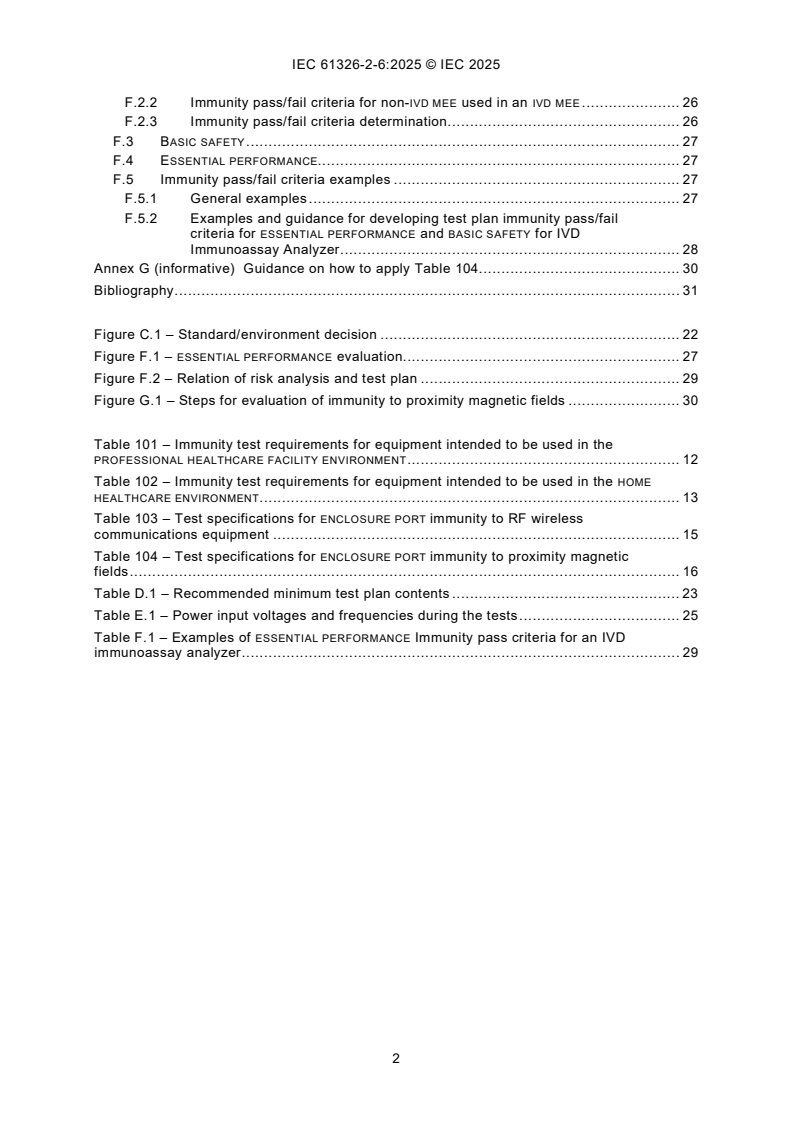
F.2.2 Immunity pass/fail criteria for non-IVD MEE used in an IVD MEE . 26
F.2.3 Immunity pass/fail criteria determination . 26
F.3 BASIC SAFETY . 27
F.4 ESSENTIAL PERFORMANCE. 27
F.5 Immunity pass/fail criteria examples . 27
F.5.1 General examples . 27
F.5.2 Examples and guidance for developing test plan immunity pass/fail
criteria for ESSENTIAL PERFORMANCE and BASIC SAFETY for IVD
Immunoassay Analyzer . 28
Annex G (informative) Guidance on how to apply Table 104 . 30
Bibliography . 31
Figure C.1 – Standard/environment decision . 22
Figure F.1 – ESSENTIAL PERFORMANCE evaluation. 27
Figure F.2 – Relation of risk analysis and test plan . 29
Figure G.1 – Steps for evaluation of immunity to proximity magnetic fields . 30
Table 101 – Immunity test requirements for equipment intended to be used in the
PROFESSIONAL HEALTHCARE FACILITY ENVIRONMENT . 12
Table 102 – Immunity test requirements for equipment intended to be used in the HOME
HEALTHCARE ENVIRONMENT . 13
Table 103 – Test specifications for ENCLOSURE PORT immunity to RF wireless
communications equipment . 15
Table 104 – Test specifications for ENCLOSURE PORT immunity to proximity magnetic
fields . 16
Table D.1 – Recommended minimum test plan contents . 23
Table E.1 – Power input voltages and frequencies during the tests . 25
Table F.1 – Examples of ESSENTIAL PERFORMANCE Immunity pass criteria for an IVD
immunoassay analyzer . 29
INTERNATIONAL ELECTROTECHNICAL COMMISSION
____________
Electrical equipment for measurement, control and laboratory use -
EMC requirements - Part 2-6: Particular requirements -
In vitro diagnostic (IVD) medical electrical equipment
FOREWORD
1) The International Electrotechnical Commission (IEC) is a worldwide organization for standardization comprising
all national electrotechnical committees (IEC National Committees). The object of IEC is to promote international
co-operation on all questions concerning standardization in the electrical and electronic fields. To this end and
in addition to other activities, IEC publishes International Standards, Technical Specifications, Technical Reports,
Publicly Available Specifications (PAS) and Guides (hereafter referred to as "IEC Publication(s)"). Their
preparation is entrusted to technical committees; any IEC National Committee interested in the subject dealt with
may participate in this preparatory work. International, governmental and non-governmental organizations liaising
with the IEC also participate in this preparation. IEC collaborates closely with the International Organization for
Standardization (ISO) in accordance with conditions determined by agreement between the two organizations.
2) The formal decisions or agreements of IEC on technical matters express, as nearly as possible, an international
consensus of opinion on the relevant subjects since each technical committee has representation from all
interested IEC National Committees.
3) IEC Publications have the form of recommendations for international use and are accepted by IEC National
Committees in that sense. While all reasonable efforts are made to ensure that the technical content of IEC
Publications is accurate, IEC cannot be held responsible for the way in which they are used or for any
misinterpretation by any end user.
4) In order to promote international uniformity, IEC National Committees undertake to apply IEC Publications
transparently to the maximum extent possible in their national and regional publications. Any divergence between
any IEC Publication and the corresponding national or regional publication shall be clearly indicated in the latter.
5) IEC itself does not provide any attestation of conformity. Independent certification bodies provide conformity
assessment services and, in some areas, access to IEC marks of conformity. IEC is not responsible for any
services carried out by independent certification bodies.
6) All users should ensure that they have the latest edition of this publication.
7) No liability shall attach to IEC or its directors, employees, servants or agents including individual experts and
members of its technical committees and IEC National Committees for any personal injury, property damage or
other damage of any nature whatsoever, whether direct or indirect, or for costs (including legal fees) and
expenses arising out of the publication, use of, or reliance upon, this IEC Publication or any other IEC
Publications.
8) Attention is drawn to the Normative references cited in this publication. Use of the referenced publications is
indispensable for the correct application of this publication.
9) IEC draws attention to the possibility that the implementation of this document may involve the use of (a)
patent(s). IEC takes no position concerning the evidence, validity or applicability of any claimed patent rights in
respect thereof. As of the date of publication of this document, IEC had not received notice of (a) patent(s), which
may be required to implement this document. However, implementers are cautioned that this may not represent
the latest information, which may be obtained from the patent database available at https://patents.iec.ch. IEC
shall not be held responsible for identifying any or all such patent rights.
IEC 61326-2-6 has been prepared by subcommittee 65A: System aspects, of IEC technical
committee 65: Industrial-process measurement, control and automation. It is an International
Standard.
This fourth edition cancels and replaces the third edition published in 2020. This edition
constitutes a technical revision.
This edition includes the following significant technical changes with respect to the previous
edition:
– Update of the document with respect to test levels and documentation.
The text of this International Standard is based on the following documents:
Draft Report on voting
65A/1174/FDIS 65A/1180/RVD
Full information on the voting for its approval can be found in the report on voting indicated in
the above table.
The language used for the development of this International Standard is English.
This document was drafted in accordance with ISO/IEC Directives, Part 2, and developed in
accordance with ISO/IEC Directives, Part 1 and ISO/IEC Directives, IEC Supplement, available
at www.iec.ch/members_experts/refdocs. The main document types developed by IEC are
described in greater detail at www.iec.ch/publications.
In this document the following print types are used:
Terms used throughout this document which have been defined in Clause 3 of this document
and of IEC 61326-1:2020 are printed in SMALL CAPITALS.
This part of IEC 61326 is to be used in conjunction with IEC 61326-1:2020 and follows the same
numbering of clauses, subclauses, tables and figures.
If an IEC 61326-2-6 report is available, the report of IEC 61326-1 is integrated.
When a particular subclause of IEC 61326-1 is not mentioned in this part, that subclause applies
as far as is reasonable. When this standard states "addition", "modification" or "replacement",
the relevant text in IEC 61326-1 is to be adapted accordingly.
NOTE The following numbering system is used:
– subclauses, tables and figures that are numbered starting from 101 are additional to those in IEC 61326-1;
– unless notes are in a new subclause or involve notes in IEC 61326-1, they are numbered starting from 101
including those in a replaced clause or subclause;
– additional annexes are lettered AA, BB, etc.
A list of all parts of the IEC 61326 series, under the general title Electrical equipment for
measurement, control and laboratory use – EMC requirements, can be found on the IEC website.
The committee has decided that the contents of this document will remain unchanged until the
stability date indicated on the IEC website under webstore.iec.ch in the data related to the
specific document. At this date, the document will be
• reconfirmed,
• withdrawn, or
• revised.
1 Scope
This International Standard applies to the BASIC SAFETY and ESSENTIAL PERFORMANCE of IN VITRO
DIAGNOSTIC MEDICAL ELECTRICAL EQUIPMENT (IVD MEE). This part of IEC 61326 applies to the BASIC
SAFETY and ESSENTIAL PERFORMANCE of IVD MEE in the presence of electromagnetic disturbances
and to electromagnetic disturbances emitted by IVD MEE.
BASIC SAFETY with regard to electromagnetic disturbances is applicable to all IVD MEE.
NOTE 1 Performance with respect to electromagnetic disturbances other than ESSENTIAL PERFORMANCE is the
subject of IEC 61326-1:2020
NOTE 2 IT equipment can be a part of an IVD MEE, if it is required to maintain BASIC SAFETY or ESSENTIAL
PERFORMANCE.
2 Normative references
The following documents are referred to in the text in such a way that some or all of their content
constitutes requirements of this document. For dated references, only the edition cited applies.
For undated references, the latest edition of the referenced document (including any
amendments) applies.
Clause 2 of IEC 61326-1:2020 applies, except as follows:
Addition:
IEC 61010 (all parts), Safety requirements for electrical equipment for measurement, control,
and laboratory use
IEC 61326-1:2020, Electrical equipment for measurement, control and laboratory use – EMC
requirements – Part 1: General requirements
ISO 14971:2019, Medical devices – Application of risk management to medical devices
3 Terms, definitions and abbreviations
For the purposes of this document, the terms and definitions given in IEC 61326-1 apply, except
as follows.
3.1 Terms and definitions
For the purposes of this document, the following terms and definitions apply.
ISO and IEC maintain terminology databases for use in standardization at the following
addresses:
• IEC Electropedia: available at https://www.electropedia.org/
• ISO Online browsing platform: available at https://www.iso.org/obp
Addition:
3.101
in vitro diagnostic medical electrical equipment
IVD MEE
instruments and apparatus intended for use in the examination of specimens intended for
diagnosis of disease or other conditions, including a determination of the state of health, in
order to cure, mitigate, treat, or prevent disease
Note 1 to entry: IVD MEE includes all items/parts, which are needed to perform ESSENTIAL PERFORMANCE and/or BASIC
SAFETY of the IVD MEE.
Note 2 to entry: Such instruments or apparatus are intended for use in the collection, preparation, and examination
of specimens taken from the human body without direct or wired PATIENT connection with the device.
Note 3 to entry: IVD: In vitro diagnostic.
Note 4 to entry: PATIENT can receive results and either can self-interpret it or a health care professional needs to
translate the result.
Note 5 to entry: MD/MEE: medical device / medical electrical equipment (defined and used in the IEC 60601 series).
3.102
professional healthcare facility environment
environment where professional healthcare is administered
Note 1 to entry: Locations include hospitals, diagnostic laboratories, blood banks, blood donation centers, physician
offices, intensive care units, surgical centers, emergency rooms, surgery rooms, clinics, PATIENT rooms, dental
offices, limited care facilities, drugstores with trained operator, and first-aid rooms.
Note 2 to entry: Such instruments can use wireless communications technology for various purposes such as
tracking system components and transferring data.
PROFESSIONAL HEALTHCARE FACILITY ENVIRONMENT are
Note 3 to entry: Most environments and locations in the
considered to have well-characterized and fixed EM sources. However, wireless (mobile) communication devices are
widely used by healthcare professionals in providing efficient PATIENT care. For this reason, it is more difficult to
control the environment for proximity electromagnetic disturbances. Examples of electromagnetic sources that could
be used or located close to IVD MEE are:
– radio frequency-identification systems (RFID);
– wireless local area networks (WLAN);
– handheld mobile radios (e.g. TETRA, two-way radio);
– paging systems;
– electromagnetic security systems such as anti-theft electronic article surveillance (EAS) systems or metal
detectors;
– other wireless devices (including consumer devices).
Note 4 to entry: IVD MEE, when used in ambulances, or any ground vehicle or aircraft, can require a higher level of
immunity than in the PROFESSIONAL HEALTHCARE FACILITY ENVIRONMENT.
3.103
home healthcare environment
dwelling place in which a PATIENT lives or other places where PATIENTS are present, excluding
PROFESSIONAL HEALTHCARE FACILITY ENVIRONMENTS where operators with medical training are
continually available when PATIENTS are present
EXAMPLES In a car, bus, train, boat, or plane, in a wheelchair or walking outdoors.
Note 1 to entry: Other places where a PATIENT is present include the outdoor environment, while working and in
vehicles.
SOURCE: IEC 60601-1-11:2015, 3.1
3.104
analyte
component represented in the name of a measurable quantity
EXAMPLE In "the type of quantity "mass of protein in 24-hour urine", "protein" is the ANALYTE. In "amount of
substance of glucose in plasma", "glucose" is the ANALYTE. In both cases, the long phrase represents the measured.
SOURCE: ISO 18113-1:2022, 3.1.4
3.105
basic safety
freedom from unacceptable risk directly caused by physical hazards when IVD MEE is used
3.106
essential performance
performance of a diagnostic function, other than that related to BASIC SAFETY, where loss or
DEGRADATION beyond the limits specified in the user documentation results in unacceptable risk
Note 1 to entry: The term “diagnostic” in this context includes testing performed to diagnose or to monitor a medical
condition; the results are used to determine the treatment of PATIENTS.
Note 2 to entry: ESSENTIAL PERFORMANCE is most easily understood by considering whether its absence or
DEGRADATION would result in unacceptable risk.
3.107
manufacturer
natural or legal person with responsibility for the design, manufacture, packaging, assembling,
adapting, or labelling of IVD MEE, regardless of whether these operations are performed by that
person or on his behalf by another person(s)
3.108
patient
living being (person or animal) undergoing a medical, surgical or dental procedure
Note 1 to entry: A PATIENT can be an operator.
3.109
normal condition
condition in which all means for protection against hazards are intact
3.110
single fault condition
condition of IVD MEE in which one means for reducing a risk is defective or one fault is present
Note 1 to entry: The context of risk is inclusive of hazards related to BASIC SAFETY and diagnostic function
DEGRADATION or loss related to ESSENTIAL PERFORMANCE.
Note 2 to entry: For the testing outlined within this document, BASIC SAFETY and ESSENTIAL PERFORMANCE will be
monitored for being maintained, in which a failure can result from a SINGLE FAULT CONDITION induced by sensitivity to
electromagnetic disturbances. Refer to 6.201 for guidance.
3.111
EMC risk management file
documentation containing a risk analysis, including documentation specific for electromagnetic
disturbances
Note 1 to entry: The context of risk is inclusive of hazards related to BASIC SAFETY and diagnostic function
DEGRADATION or loss related to ESSENTIAL PERFORMANCE.
Note 2 to entry: ISO 14971 has to be used to evaluate risk of the IVD MEE.
3.2 Abbreviations
Subclause 3.2 of IEC 61326-1:2020 applies.
4 General
Clause 4 of IEC 61326-1:2020 applies, except as follows:
Modify the last paragraph of the clause to:
The MANUFACTURER shall perform type testing where TYPE TEST is required.
4.101 ESSENTIAL PERFORMANCE
During risk analysis, the MANUFACTURER shall identify the performance of the diagnostic
function(s) of the IVD MEE, other than that related to BASIC SAFETY, that is necessary to achieve
its intended use or that could affect the safety of the IVD MEE were it lost or degraded.
To identify ESSENTIAL PERFORMANCE the MANUFACTURER shall:
1) identify performance of diagnostic function(s), other than that related to BASIC SAFETY,
that is necessary to achieve its intended use or that could affect safety;
2) specify performance limits between fully functional and total loss of the identified
diagnostic function(s) performance;
3) evaluate the risk from the loss or DEGRADATION beyond the specified limits of the fully
functional diagnostic function performance. If the resulting risk is unacceptable, then the
identified diagnostic function performance constitutes an ESSENTIAL PERFORMANCE of the
IVD MEE.
NOTE 1 ESSENTIAL PERFORMANCE can have multiple aspects.
NOTE 2 Following the principles of risk management, the MANUFACTURER verifies the effectiveness of each risk
control measure. This can involve demonstrating that the risk control measure will operate in the presence of the
conditions that result in the loss or DEGRADATION of the identified performance.
ESSENTIAL PERFORMANCES to guide the
NOTE 3 Each particular standard in the IEC 61010 series can list potential
MANUFACTURER to identify particular ESSENTIAL PERFORMANCE in accordance with 4.101.
Compliance is checked by inspection of the EMC RISK MANAGEMENT FILE provided by the
MANUFACTURER.
NOTE 4 This particular standard requires the MANUFACTURER to perform a number of activities with regard to
electromagnetic DISTURBANCES during the design and realization of their IVD MEE and to document them in the EMC
RISK MANAGEMENT FILE. However, EMC test laboratories cannot be expected to perform or document these activities.
4.102 BASIC SAFETY
During risk analysis, the MANUFACTURER shall identify that the IVD MEE is free from unacceptable
risk directly caused by physical hazards.
The MANUFACTURER shall evaluate the risk resulting from loss or DEGRADATION of the general
safety functions derived from Clauses 4 to 17 (all tests) of the IEC 61010-2-101:2018 or other
functions that could affect the safe use of the IVD MEE. If the resulting risk is unacceptable
without the implementation of risk controls, then the identified function contributes to BASIC
SAFETY of the IVD MEE.
NOTE 1 More guidance can be found under 6.201.
The MANUFACTURER shall implement risk control measures to reduce the risk resulting from loss
or DEGRADATION of the identified performance to an acceptable level.
Compliance to BASIC SAFETY is checked by inspection according to the required ENVIRONMENT
as determined by the MANUFACTURER through risk analysis within the EMC RISK MANAGEMENT FILE.
IVD MEE shall be tested under NORMAL CONDITION. IVD MEE shall be monitored for SINGLE FAULT
CONDITION.
NOTE 2 The MANUFACTURER identifies the risk control measures related to general safety that are sensitive to
electromagnetic disturbance and specify the methods used to verify the effectiveness of the risk control measures.
This can include any assessment made to determine whether verification is needed.
NOTE 3 Each particular standard in the IEC 61010 series can guide the MANUFACTURER to identify particular BASIC
SAFETY hazards in accordance with 4.102.
5 EMC test plan
5.1 General
Subclause 5.1 of IEC 61326-1:2020 applies.
NOTE Also consider Annex D.
5.2 Configuration of EUT during testing
Subclause 5.2 of IEC 61326-1:2020 applies, except as follows:
Replace 5.2.1 paragraph 1 with:
Measurement, control and LABORATORY equipment often consists of systems with no fixed
configuration. The kind, number and installation of different subassemblies within the equipment
can vary from system to system. The IVD MEE shall be tested in configurations representative of
its intended use, which are most likely to result in unacceptable risk, as determined by risk
analysis, experience, engineering analysis, or pretesting. This shall be documented in the test
plan and the EMC RISK MANAGEMENT FILE accordingly.
IVD MEE that uses IT equipment or similar to maintain BASIC SAFETY or ESSENTIAL PERFORMANCE,
shall include these IT equipment during tests in this document.
5.2.101 Subsystems
Compliance with the requirements of this document can be demonstrated by testing each
subsystem of an IVD MEE, provided that the normal operating conditions are simulated. The risk
management process shall be used to determine whether subsystem testing is allowed. Any
simulator used instead of actual equipment shall properly represent the electrical and, if
necessary, the mechanical characteristics of the interface, especially with respect to RF signals
and impedances, as well as cable configuration types.
5.3 Operation conditions of EUT during testing
Subclause 5.3 of IEC 61326-1:2020 applies, except as follows:
Addition:
5.3.101 Operation conditions
The device shall be set to conditions specified in the user documentation in accordance with
the intended use.
During immunity testing, the BASIC SAFETY and ESSENTIAL PERFORMANCE shall be tested using
the modes and settings (e.g. gain) that are most likely to result in an unacceptable risk, as
determined by the MANUFACTURER. When different input power modes are available while
operating the equipment (e.g. a.c. options, battery-operated, battery charging), the
MANUFACTURER shall specify for each mode of operation, the most severe condition in
accordance with the product risk analysis, and complete appropriate testing. This shall be
determined using risk analysis, experience, engineering analysis or pretesting. The standby
mode should be considered for inclusion in immunity testing in accordance with risk analysis.
The operating modes selected for testing should be documented in the test plan and shall be
documented in the test report.
Compliance of the relevant operating mode is checked by inspection of the EMC RISK
MANAGEMENT FILE and the test report.
If the IVD MEE is not rated for continuous duty, a duty cycle may be selected that is appropriate
for the IVD MEE under test and documented in the test report.
5.4 Specification of FUNCTIONAL PERFORMANCE
Subclause 5.4 of IEC 61326-1:2020 applies, except as follows:
Addition:
For IVD'S MEE, for immunity tests, the ESSENTIAL PERFORMANCE for each operating mode and test
shall be specified, where possible, as quantitative values, as well as for non-operational states
such as 'standby' or 'battery charging', when an unintended change of state could occur through
electromagnetic disturbances. If quantitative values are not available, the ESSENTIAL
PERFORMANCE should be described in the test plan by other metrics, with supporting scientific
rationale and risk management.
5.5 Test description
Subclause 5.5 of IEC 61326-1:2020 applies.
NOTE See Annex D for guidance on the recommended content of a test plan.
6 Immunity requirements
6.1 Conditions during the tests
Subclause 6.1 of IEC 61326-1:2020 is replaced as follows:
6.101 Conditions during the tests
The configuration and modes of operation during the tests shall be included in the test plan and
test report.
Tests should be applied to the relevant PORTS in accordance with Table 101, Table 102,
Table 103 and Table 104 of this document, as applicable.
The tests shall be carried out one at a time in accordance with the basic EMC standards. If
additional methods are required, the method and rationale shall be documented in the test
report.
6.2 Immunity test requirements
Subclause 6.2 of IEC 61326-1:2020 and its title are replaced as follows:
6.201 Risk assessment and consideration of EMC immunity requirements
IVD MEE is not intended for use in a CONTROLLED ELECTROMAGNETIC ENVIRONMENT. Consequently,
this document provides immunity test levels for unprotected environments normally found in the
home, public places or professional healthcare facilities.
Exposure to emissions from electromagnetic sources can lead to malfunctions in nearby IVD
MEE. Different types of IVD MEE have different levels of risk of malfunction. IVD MEE is not
intended to directly sustain or support life or resuscitate PATIENTS, so a malfunction would not
directly cause death or serious injury of a PATIENT. However, IVD MEE malfunctions can result in
an incorrect diagnostic test result, which can lead to an incorrect therapeutic decision (e.g.,
misdiagnosis). For some ANALYTES and in some circumstances, an incorrect result could result
in serious harm to the PATIENT. In case of a larger IVD MEE, electromagnetic disturbances can
also cause malfunctions that pose a direct threat to the operator, for example through
unexpected mechanical movements. The MANUFACTURER shall perform risk management
according to ISO 14971:2019 for guidance in assessing risk associated with hazards.
Compliance is checked by inspection of the EMC RISK MANAGEMENT FILE and adding this EMC RISK
MANAGEMENT FILE to the EMC report.
NOTE 1 As a rule, results from IVD MEE are checked for plausibility by medical personnel or followed-up by decisions
of a healthcare professional. IVD MEE for self-testing by lay users is always provided with advice on action to be taken
in case of indeterminate results. The IVD MEE documentation can urge users to contact their medical practitioner
before making any decision of medical relevance.
When a MANUFACTURER knows from experience, published data, or representative
measurements that the environment of intended use has unique characteristics that would alter
electromagnetic disturbance levels that form the basis of immunity test levels specified in
Table 101, Table 102, Table 103 and Table 104, the MANUFACTURER shall take this into
consideration in the risk management process.
For equipment intended to be used in a PROFESSIONAL HEALTHCARE FACILITY ENVIRONMENT, the
immunity requirements of Table 101, Table 103 and Table 104 shall be applied (more
information can be found in Annex B, Annex C, Annex E and in Annex F).
Table 101 – Immunity test requirements for equipment intended to be used in the
PROFESSIONAL HEALTHCARE FACILITY ENVIRONMENT
PORT Phenomenon Basic standard Test value
ENCLOSURE Electrostatic IEC 61000-4-2 ± 8 kV contact discharge
discharge ± 2 kV, ± 4 kV, ± 8 kV, ± 15 kV air discharge
Electromagnetic field IEC 61000-4-3 3 V/m (80 MHz to 6 GHz)
80 % AM at 1 kHz
Power frequency IEC 61000-4-8 30 A/m (50 Hz or 60 Hz)
g
magnetic field
AC power Burst IEC 61000-4-4 ± 2 kV (100 kHz repetition frequency)
(including
Surge IEC 61000-4-5 ± 0,5 kV, ± 1 kV line-to-line
protective earth)
± 0,5 kV, ± 1 kV, ± 2 kV line-to-ground
Conducted RF IEC 61000-4-6 3 V (150 kHz to 80 MHz)
6 V in ISM bands between
d
150 kHz and 80 MHz
80 % AM at 1 kHz
Voltage dip IEC 61000-4-11 0 % U during 0,5 cycles
T
e)
At 0°, 45°, 90°, 135°, 180°, 225°, 270° and 315°
0 % U during 1 cycle
T
a
70 % U during 25/30 cycles
T
At 0°
a
Short interruptions IEC 61000-4-11
0 % U during 250/300 cycles
T
c, f
Burst IEC 61000-4-4 ± 2 kV (100 kHz repetition frequency)
DC power
Surge IEC 61000-4-5 ± 0,5 kV, ± 1 kV line-to-line
(including
protective earth) ± 0,5 kV, ± 1 kV, ± 2 kV line-to-ground
Conducted RF IEC 61000-4-6 3 V (150 kHz to 80 MHz)
6 V in ISM bands between
d
150 kHz and 80 MHz
80 % AM at 1 kHz
f
I/O signal/control IEC 61000-4-4 ± 1 kV (100 kHz repetition frequency)
Burst
b
IEC 61000-4-5 ± 2 kV line-to-ground
(including Surge
functional earth)
h
IEC 61000-4-6 3 V (150 kHz to 80 MHz)
Conducted RF
6 V in ISM bands between
d
150 kHz and 80 MHz
80 % AM at 1 kHz
f
I/O signal/control IEC 61000-4-4 ± 1 kV (100 kHz repetition frequency)
Burst
b
IEC 61000-4-5 ± 0,5 kV line-to-line
(connected directly Surge
± 2 kV line-to-ground
to mains supply)
h
IEC 61000-4-6 3 V (150 kHz to 80 MHz)
Conducted RF
d
6 V in ISM bands between
150 kHz and 80 MHz
80 % AM at 1 kHz
NOTE The basic standard test levels are equal to IEC 60601-1-2:2014/AMD1:2020.
a
For example, "25/30 cycles" means "25 cycles for 50 Hz test" or "30 cycles for 60 Hz test".
b
Only in the case of LONG-DISTANCE LINES.
c
DC POWER PORTS intended to be connected to a low voltage DC supply (≤ 60 V), where secondary circuits
(isolated from the AC mains supply) are not subject to transient over voltages (i.e. reliably-grounded, capacitive-
filtered DC secondary circuits) shall be regarded as I/O signal/control PORTS.
d
The ISM (industrial, scientific and medical) bands between 150 kHz and 80 MHZ are 6,765 MHZ to 6,795 MHZ;
13,553 MHZ to 13,567 MHZ; 26,957 MHZ to 27,283 MHZ; and 40,66 MHZ to 40,70 MHZ.
e
At some phase angles, applying this test to IVD MEE with transformer mains power input could cause an
overcurrent protection device to open. This can occur due to magnetic flux saturation of the transformer core
after the voltage dip. If this occurs, the IVD MEE or IVD system shall provide BASIC SAFETY during and after the
test.
f
The test is applicable to PORTS intended to be connected permanently to cables longer than 3 m.
g
Applies only to IVD MEE with magnetically sensitive components or circuitry.
h
I/O signal/control lines whose maximum length is less than 1 m are excluded.
For equipment intended to be used in a HOME HEALTHCARE ENVIRONMENT, the immunity
requirements of Table 102, Table 103, and Table 104 shall be applied.
Table 102 – Immunity test requirements for equipment intended
to be used in the HOME HEALTHCARE ENVIRONMENT
Port Phenomenon Basic standard Test value
ENCLOSURE Electrostatic discharge IEC 61000-4-2 ±8 kV contact discharge
±2 kV, ±4 kV, ±8 kV, ±15 kV air discharge
Electromagnetic field IEC 61000-4-3 10 V/m (80 MHz to 6 GHz)
80 % AM at 1 kHz
Power frequency IEC 61000-4-8 30 A/m (50 Hz or 60 Hz)
g
magnetic field
AC power Voltage dip IEC 61000-4-11 0 % U during 0,5 cycles
T
e)
At 0°, 45°, 90°, 135°, 180°, 225°, 270° and 315°
0 % U during 1 cycle
T
a)
70 % U during 25/30 cycles
T
At 0°
a)
Short interruptions IEC 61000-4-11
0 % U during 250/300 cycles
T
Burst IEC 61000-4-4 ± 2 kV (100 kHz repetition frequency)
Surge IEC 61000-4-5 ± 0.5 kV, ± 1 kV line-to-line
± 0,5 kV, ± 1 kV, ± 2 kV line-to-ground
Conducted RF IEC 61000-4-6 3 V (150 kHz to 80 MHz)
6 V in ISM and amateur radio bands in the
d
frequency range 150 kHz to 80 MHz
80 % AM at 1 kHz
c, f
Burst IEC 61000-4-4 ± 2 kV (100 kHz repetition frequency)
DC power
Surge IEC 61000-4-5 ± 0,5 kV, ± 1 kV line-to-line
(including
± 0,5 kV, ±1 kV, ±2 kV line-to-ground
protective earth)
Conducted RF IEC 61000-4-6 3 V (150 kHz to 80 MHz)
6 V in ISM and amateur radio bands between and
radio amateur bands in the frequency range
d
150 kHz to 80 MHz
80 % AM at 1 kHz
Port Phenomenon Basic standard Test value
f
I/O signal/control IEC 61000-4-4 ± 1 kV (100 kHz repetition frequency)
Burst
(including
b
IEC 61000-4-5 ± 2 kV line-to-ground
Surge
functional earth)
h
IEC 61000-4-6 3 V (150 kHz to 80 MHz)
Conducted RF
6 V in ISM and amateur radio bands between and
radio amateur bands in the frequency range
d
150 kHz to 80 MHz
80 % AM at 1 kHz
f
I/O signal/control IEC 61000-4-4 ± 2kV (100 kHz repetition frequency)
Burst
(connected
b
IEC 61000-4-5 ± 1 kV line-to-line
Surge
directly
± 2 kV line-to-ground
to mains supply)
h
IEC 61000-4-6 3 V (150 kHz to 80 MHz)
Conducted RF
6 V in ISM and amateur radio bands between and
radio amateur bands in the frequency range
d
150 kHz to 80 MHz
80 % AM at 1 kHz
NOTE This basic standards test levels are equal to IEC 60601-1-2:2014/AMD1:2020.
a
For example, "25/30 cycles" means "25 cycles for 50 Hz test" or "3
...