

IEC 61547:2009
(Main)Equipment for general lighting purposes - EMC immunity requirements
General Information
- Abstract
IEC 61547:2009 for electromagnetic immunity requirements applies to lighting equipment which is within the scope of IEC Technical Committee 34, such as lamps, auxiliaries and luminaires, intended either for connecting to a low voltage electricity supply or for battery operation. Excluded from the scope of this standard is equipment for which the immunity requirements are formulated in other IEC or CISPR standards. The main reason for this revision is to update the dates of the references to the basic standards which also required some editorial changes in the tables. The contents of the corrigendum of April 2010 and Interpretation Sheet 1 of June 2013 have been included in this copy.
- Status
- Published
- Publication Date
- 24-Jun-2009
- Technical Committee
- TC 34 - Lighting
- Current Stage
- DELPUB - Deleted Publication
- Start Date
- 26-Mar-2020
- Completion Date
- 30-Nov-2017
Overview
IEC 61547:2009 is an International Electrotechnical Commission (IEC) standard that specifies electromagnetic compatibility (EMC) immunity requirements for equipment used in general lighting applications. This standard targets lighting devices such as lamps, auxiliaries, and luminaires designed for connection either to low voltage electricity supplies or battery operation. It provides a unified approach to ensure lighting equipment maintains reliable operation when exposed to electromagnetic disturbances, enhancing performance and safety.
This 2009 edition is the second revision and updates references to basic EMC standards, includes editorial improvements, and integrates corrigenda and interpretation sheets for enhanced clarity and applicability. The scope specifically excludes lighting equipment covered by other IEC or CISPR standards, such as those for transport vehicles or multimedia devices, ensuring focused coverage of standard lighting products.
Key Topics
EMC Immunity Requirements: Establishes test levels and performance criteria to evaluate lighting equipment’s resistance to electromagnetic disturbances, such as electrostatic discharges, radio-frequency electromagnetic fields, power frequency magnetic fields, fast transients, and voltage fluctuations.
Applicable Equipment: Covers lamps, auxiliaries, and luminaires under IEC Technical Committee 34, both connected to low voltage mains and battery-powered devices.
Exclusions: Explicitly excludes lighting equipment governed by other standards, such as vehicle lighting, entertainment lighting control, and integrated lighting in multimedia or office equipment.
Test Methods and Conditions: Defines standardized test procedures including specific test levels for different ports (e.g., enclosure, signal/control, power input) and conditions during testing, such as operating voltage levels and dimmed light output settings.
Performance Criteria and Assessment: Specifies criteria that equipment must meet during and after EMC testing to ensure operational integrity, covering visible malfunctioning, degradation, or loss of function.
Dimmable Lighting Interpretation: Clarifies testing levels for dimmable equipment where typical test dim levels (50% ±10%) are not achievable, recommending testing at the nearest dim level to 50%, favoring a lower level if equidistant.
Applications
General Lighting Equipment: Ensures that lamps, electronic ballasts, luminaires, and independent auxiliaries meet stringent EMC immunity standards to operate reliably in typical residential, commercial, and industrial environments.
Battery-Operated Lighting Devices: Ensures portable lighting maintains immunity against electromagnetic interference, enhancing safety and usability in mobile lighting solutions.
Manufacturing and Compliance Testing: Provides a foundation for manufacturers and testing laboratories to assess and certify lighting products against recognized EMC immunity benchmarks, facilitating market acceptance and regulatory compliance.
Design and Development: Guides product designers and engineers in integrating EMC immunity considerations in lighting equipment, improving product robustness and reducing lifecycle failures caused by electromagnetic disturbances.
Emergency and Specialized Lighting: Incorporates enhanced immunity requirements for emergency luminaires in high-risk areas, aligning with IEC 60598-2-22 to ensure critical lighting reliability.
Related Standards
IEC Technical Committee 34 Series: Covers various standards related to lamps and lighting equipment performance and safety.
IEC 60598-2-22: Specific requirements for emergency luminaires, complementing immunity standards provided by IEC 61547.
CISPR Standards: Address EMC requirements for equipment excluded from IEC 61547 scope, such as lighting in vehicles and entertainment lighting control.
General EMC Standards: Referenced within IEC 61547 for fundamental EMC test methods, including electrostatic discharge, radiated immunity, and surge testing procedures.
Keywords: IEC 61547, EMC immunity requirements, lighting equipment standards, general lighting, lamps, luminaires, auxiliaries, electromagnetic compatibility, EMC testing, dimmable lighting, IEC standards, EMC immunity for lighting devices, battery-operated lighting, emergency luminaires, IEC Technical Committee 34.
Relations
- Effective Date
- 05-Sep-2023
- Effective Date
- 05-Sep-2023
- Effective Date
- 05-Sep-2023
- Effective Date
- 05-Sep-2023
Get Certified
Connect with accredited certification bodies for this standard

IMQ S.p.A. (Certification)
Italian electrical product certification.

SLG Prüf- und Zertifizierungs GmbH
German testing and certification body.

UL Solutions
Global safety science company with testing, inspection and certification.
Sponsored listings
Frequently Asked Questions
IEC 61547:2009 is a standard published by the International Electrotechnical Commission (IEC). Its full title is "Equipment for general lighting purposes - EMC immunity requirements". This standard covers: IEC 61547:2009 for electromagnetic immunity requirements applies to lighting equipment which is within the scope of IEC Technical Committee 34, such as lamps, auxiliaries and luminaires, intended either for connecting to a low voltage electricity supply or for battery operation. Excluded from the scope of this standard is equipment for which the immunity requirements are formulated in other IEC or CISPR standards. The main reason for this revision is to update the dates of the references to the basic standards which also required some editorial changes in the tables. The contents of the corrigendum of April 2010 and Interpretation Sheet 1 of June 2013 have been included in this copy.
IEC 61547:2009 for electromagnetic immunity requirements applies to lighting equipment which is within the scope of IEC Technical Committee 34, such as lamps, auxiliaries and luminaires, intended either for connecting to a low voltage electricity supply or for battery operation. Excluded from the scope of this standard is equipment for which the immunity requirements are formulated in other IEC or CISPR standards. The main reason for this revision is to update the dates of the references to the basic standards which also required some editorial changes in the tables. The contents of the corrigendum of April 2010 and Interpretation Sheet 1 of June 2013 have been included in this copy.
IEC 61547:2009 is classified under the following ICS (International Classification for Standards) categories: 29.020 - Electrical engineering in general; 29.140.01 - Lamps in general; 33.100.10 - Emission. The ICS classification helps identify the subject area and facilitates finding related standards.
IEC 61547:2009 has the following relationships with other standards: It is inter standard links to IEC 61547:2009/COR1:2010, IEC 61547:2009/ISH1:2013, IEC 61547:1995/AMD1:2000, IEC 61547:2020. Understanding these relationships helps ensure you are using the most current and applicable version of the standard.
IEC 61547:2009 is available in PDF format for immediate download after purchase. The document can be added to your cart and obtained through the secure checkout process. Digital delivery ensures instant access to the complete standard document.
Standards Content (Sample)
IEC 61547 ®
Edition 2.0 2009-06
INTERNATIONAL
STANDARD
NORME
INTERNATIONALE
Equipment for general lighting purposes – EMC immunity requirements
Équipements pour l'éclairage à usage général – Exigences concernant
l’immunité CEM
All rights reserved. Unless otherwise specified, no part of this publication may be reproduced or utilized in any form or by
any means, electronic or mechanical, including photocopying and microfilm, without permission in writing from either IEC or
IEC's member National Committee in the country of the requester.
If you have any questions about IEC copyright or have an enquiry about obtaining additional rights to this publication,
please contact the address below or your local IEC member National Committee for further information.
Droits de reproduction réservés. Sauf indication contraire, aucune partie de cette publication ne peut être reproduite
ni utilisée sous quelque forme que ce soit et par aucun procédé, électronique ou mécanique, y compris la photocopie
et les microfilms, sans l'accord écrit de la CEI ou du Comité national de la CEI du pays du demandeur.
Si vous avez des questions sur le copyright de la CEI ou si vous désirez obtenir des droits supplémentaires sur cette
publication, utilisez les coordonnées ci-après ou contactez le Comité national de la CEI de votre pays de résidence.
IEC Central Office
3, rue de Varembé
CH-1211 Geneva 20
Switzerland
Email: inmail@iec.ch
Web: www.iec.ch
About the IEC
The International Electrotechnical Commission (IEC) is the leading global organization that prepares and publishes
International Standards for all electrical, electronic and related technologies.
About IEC publications
The technical content of IEC publications is kept under constant review by the IEC. Please make sure that you have the
latest edition, a corrigenda or an amendment might have been published.
ƒ Catalogue of IEC publications: www.iec.ch/searchpub
The IEC on-line Catalogue enables you to search by a variety of criteria (reference number, text, technical committee,…).
It also gives information on projects, withdrawn and replaced publications.
ƒ IEC Just Published: www.iec.ch/online_news/justpub
Stay up to date on all new IEC publications. Just Published details twice a month all new publications released. Available
on-line and also by email.
ƒ Electropedia: www.electropedia.org
The world's leading online dictionary of electronic and electrical terms containing more than 20 000 terms and definitions
in English and French, with equivalent terms in additional languages. Also known as the International Electrotechnical
Vocabulary online.
ƒ Customer Service Centre: www.iec.ch/webstore/custserv
If you wish to give us your feedback on this publication or need further assistance, please visit the Customer Service
Centre FAQ or contact us:
Email: csc@iec.ch
Tel.: +41 22 919 02 11
Fax: +41 22 919 03 00
A propos de la CEI
La Commission Electrotechnique Internationale (CEI) est la première organisation mondiale qui élabore et publie des
normes internationales pour tout ce qui a trait à l'électricité, à l'électronique et aux technologies apparentées.
A propos des publications CEI
Le contenu technique des publications de la CEI est constamment revu. Veuillez vous assurer que vous possédez
l’édition la plus récente, un corrigendum ou amendement peut avoir été publié.
ƒ Catalogue des publications de la CEI: www.iec.ch/searchpub/cur_fut-f.htm
Le Catalogue en-ligne de la CEI vous permet d’effectuer des recherches en utilisant différents critères (numéro de référence,
texte, comité d’études,…). Il donne aussi des informations sur les projets et les publications retirées ou remplacées.
ƒ Just Published CEI: www.iec.ch/online_news/justpub
Restez informé sur les nouvelles publications de la CEI. Just Published détaille deux fois par mois les nouvelles
publications parues. Disponible en-ligne et aussi par email.
ƒ Electropedia: www.electropedia.org
Le premier dictionnaire en ligne au monde de termes électroniques et électriques. Il contient plus de 20 000 termes et
définitions en anglais et en français, ainsi que les termes équivalents dans les langues additionnelles. Egalement appelé
Vocabulaire Electrotechnique International en ligne.
ƒ Service Clients: www.iec.ch/webstore/custserv/custserv_entry-f.htm
Si vous désirez nous donner des commentaires sur cette publication ou si vous avez des questions, visitez le FAQ du
Service clients ou contactez-nous:
Email: csc@iec.ch
Tél.: +41 22 919 02 11
Fax: +41 22 919 03 00
IEC 61547 ®
Edition 2.0 2009-06
INTERNATIONAL
STANDARD
NORME
INTERNATIONALE
Equipment for general lighting purposes – EMC immunity requirements
Équipements pour l'éclairage à usage général – Exigences concernant
l’immunité CEM
INTERNATIONAL
ELECTROTECHNICAL
COMMISSION
COMMISSION
ELECTROTECHNIQUE
PRICE CODE
INTERNATIONALE
P
CODE PRIX
ICS 29.020; 29.140; 33.100.10 ISBN 978-2-88910-534-2
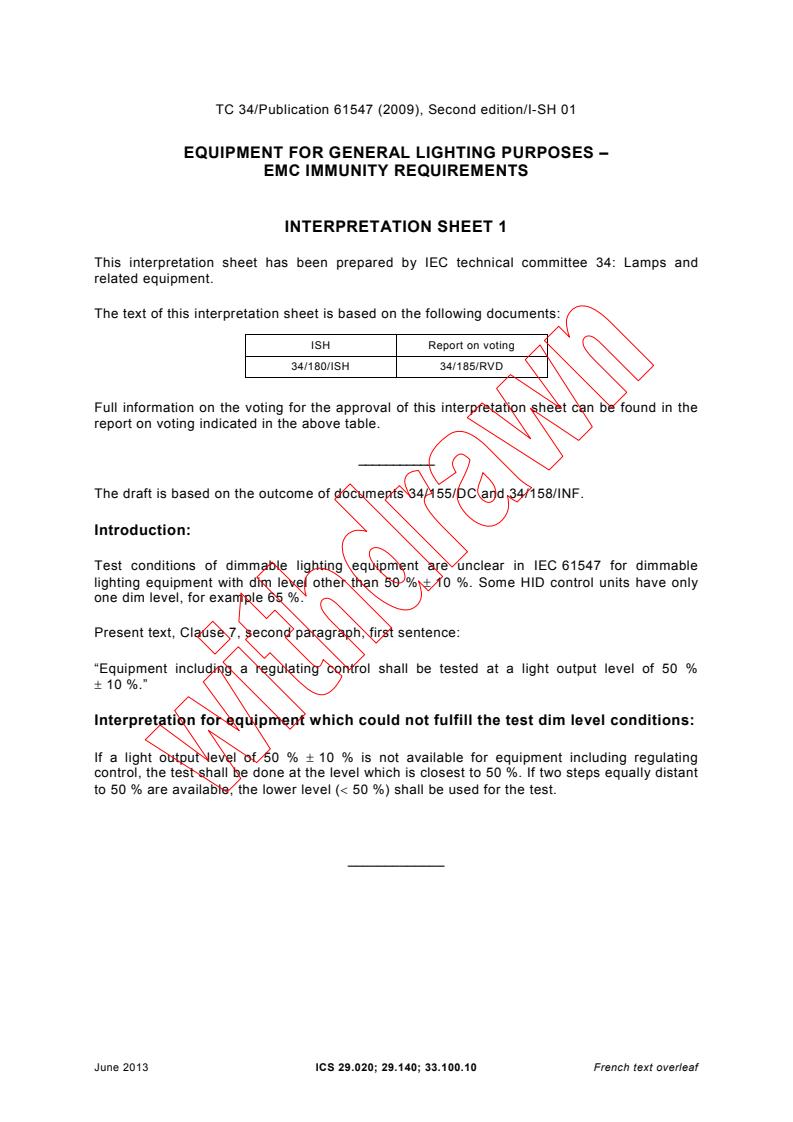
TC 34/Publication 61547 (2009), Second edition/I-SH 01
EQUIPMENT FOR GENERAL LIGHTING PURPOSES –
EMC IMMUNITY REQUIREMENTS
INTERPRETATION SHEET 1
This interpretation sheet has been prepared by IEC technical committee 34: Lamps and
related equipment.
The text of this interpretation sheet is based on the following documents:
ISH Report on voting
34/180/ISH 34/185/RVD
Full information on the voting for the approval of this interpretation sheet can be found in the
report on voting indicated in the above table.
___________
The draft is based on the outcome of documents 34/155/DC and 34/158/INF.
Introduction:
Test conditions of dimmable lighting equipment are unclear in IEC 61547 for dimmable
lighting equipment with dim level other than 50 % ± 10 %. Some HID control units have only
one dim level, for example 65 %.
Present text, Clause 7, second paragraph, first sentence:
“Equipment including a regulating control shall be tested at a light output level of 50 %
± 10 %.”
Interpretation for equipment which could not fulfill the test dim level conditions:
If a light output level of 50 % ± 10 % is not available for equipment including regulating
control, the test shall be done at the level which is closest to 50 %. If two steps equally distant
to 50 % are available, the lower level (< 50 %) shall be used for the test.
_____________
June 2013 ICS 29.020; 29.140; 33.100.10 French text overleaf
– 2 – 61547 © IEC:2009
CONTENTS
FOREWORD.4
1 Scope.6
2 Normative references .6
3 Terms and definitions .7
4 Performance criteria .8
5 Test specifications.9
5.1 General .9
5.2 Electrostatic discharges .9
5.3 Radio-frequency electromagnetic fields .10
5.4 Power frequency magnetic fields .10
5.5 Fast transients .10
5.6 Injected currents (radio-frequency common mode) .11
5.7 Surges .12
5.8 Voltage dips and short interruptions .12
5.9 Voltage fluctuations.13
6 Application of test specifications.13
6.1 General .13
6.2 Non-electronic lighting equipment.13
6.3 Electronic lighting equipment.13
6.3.1 General .13
6.3.2 Self-ballasted lamps .13
6.3.3 Independent auxiliaries.14
6.3.4 Luminaires.14
7 Conditions during testing .14
8 Assessment of conformity.15
Figure 1 – Examples of ports .8
Table 1 – Electrostatic discharges – Test levels at enclosure port.10
Table 2 – Radio-frequency electromagnetic fields – Test levels at enclosure port .10
Table 3 – Power frequency magnetic fields – Test levels at enclosure port .10
Table 4 – Fast transients – Test levels at ports for signal and control lines .10
Table 5 – Fast transients – Test levels at input and output d.c. power ports.11
Table 6 – Fast transients – Test levels at input and output a.c. power ports.11
Table 7 – Radio-frequency common mode – Test levels at ports for signal and control
lines.11
Table 8 – Radio-frequency common mode – Test levels at input and output d.c. power
ports .11
Table 9 – Radio-frequency common mode – Test levels at input and output a.c. power
ports .12
Table 10 – Surges – Test levels at input a.c. power ports .12
Table 11 – Voltage dips – Test levels at input a.c. power ports .12
Table 12 – Voltage short interruptions – Test levels at input a.c. power ports .13
Table 13 – Application of tests for self-ballasted lamps.13
61547 © IEC:2009 – 3 –
Table 14 – Application of tests for independent auxiliaries .14
Table 15 – Application of tests for luminaires.14
– 4 – 61547 © IEC:2009
INTERNATIONAL ELECTROTECHNICAL COMMISSION
____________
EQUIPMENT FOR GENERAL LIGHTING PURPOSES –
EMC IMMUNITY REQUIREMENTS
FOREWORD
1) The International Electrotechnical Commission (IEC) is a worldwide organization for standardization comprising
all national electrotechnical committees (IEC National Committees). The object of IEC is to promote
international co-operation on all questions concerning standardization in the electrical and electronic fields. To
this end and in addition to other activities, IEC publishes International Standards, Technical Specifications,
Technical Reports, Publicly Available Specifications (PAS) and Guides (hereafter referred to as “IEC
Publication(s)”). Their preparation is entrusted to technical committees; any IEC National Committee interested
in the subject dealt with may participate in this preparatory work. International, governmental and non-
governmental organizations liaising with the IEC also participate in this preparation. IEC collaborates closely
with the International Organization for Standardization (ISO) in accordance with conditions determined by
agreement between the two organizations.
2) The formal decisions or agreements of IEC on technical matters express, as nearly as possible, an international
consensus of opinion on the relevant subjects since each technical committee has representation from all
interested IEC National Committees.
3) IEC Publications have the form of recommendations for international use and are accepted by IEC National
Committees in that sense. While all reasonable efforts are made to ensure that the technical content of IEC
Publications is accurate, IEC cannot be held responsible for the way in which they are used or for any
misinterpretation by any end user.
4) In order to promote international uniformity, IEC National Committees undertake to apply IEC Publications
transparently to the maximum extent possible in their national and regional publications. Any divergence
between any IEC Publication and the corresponding national or regional publication shall be clearly indicated in
the latter.
5) IEC itself does not provide any attestation of conformity. Independent certification bodies provide conformity
assessment services and, in some areas, access to IEC marks of conformity. IEC is not responsible for any
services carried out by independent certification bodies.
6) All users should ensure that they have the latest edition of this publication.
7) No liability shall attach to IEC or its directors, employees, servants or agents including individual experts and
members of its technical committees and IEC National Committees for any personal injury, property damage or
other damage of any nature whatsoever, whether direct or indirect, or for costs (including legal fees) and
expenses arising out of the publication, use of, or reliance upon, this IEC Publication or any other IEC
Publications.
8) Attention is drawn to the normative references cited in this publication. Use of the referenced publications is
indispensable for the correct application of this publication.
9) Attention is drawn to the possibility that some of the elements of this IEC Publication may be the subject of
patent rights. IEC shall not be held responsible for identifying any or all such patent rights.
International Standard IEC 61547 has been prepared by IEC technical committee 34: Lamps
and related equipment.
This second edition cancels and replaces the first edition, published in 1995, and its
Amendment 1 (2000). It constitutes a technical revision
The main reason for this revision is to update the dates of the references to the basic
standards which also required some editorial changes in the tables. Other changes are:
1 Scope: clearly excludes multimedia equipment with lamps (e.g. TV);
3.2 Enclosure port: removal of the ”earth port” in Figure 1 as in the generic EMC
standards; the note below Figure 1 in the first edition relates to a requirement and
moved to the main text under 5.1 General;
5.6 Injected currents: update of the names of the example CDN’s;
5.7 Surges: test only at the peak of the mains voltage by deleting the requirement to test
at zero crossings;
61547 © IEC:2009 – 5 –
5.8 Voltage dips and interruptions: clarifying that the voltage level changes at the zero
crossing;
6.3.2 Independent auxiliaries: Table 14 has been simplified because most independent
auxiliaries have identical performance criteria;
6.3.3 Luminaires: Table 15 has been simplified because most luminaires have identical
performance criteria; correcting the error in the injected current column by changing
the B into A for luminaires with electronic ballast for discharge lamps; additionally, the
requirements for emergency luminaires operating in high risk task areas are updated
to meet the levels specified in IEC 60598-2-22;
7 Conditions during testing: the ”under consideration” for the operating conditions for
starting devices has been deleted; the supply voltage and frequency during the test
are clearly stated; shortening the immunity test for equipment incorporating a
regulating control by testing at one light output level (50 % ± 10 %) instead of testing
at three light output levels which are difficult to adjust and do not provide extra
protection.
The text of this standard is based on the following documents:
FDIS Report on voting
34/127/FDIS 34/130/RVD
Full information on the voting for the approval of this standard can be found in the report on
voting indicated in the above table.
This publication has been drafted in accordance with the ISO/IEC Directives, Part 2.
This standard is to be read in conjunction with the relevant basic and/or product standard(s).
The committee has decided that the contents of this publication will remain unchanged until
the maintenance result date indicated on the IEC web site under "http://webstore.iec.ch" in
the data related to the specific publication. At this date, the publication will be
• reconfirmed,
• withdrawn,
• replaced by a revised edition, or
• amended.
The contents of the corrigendum of April 2010 and Interpretation sheet 1 of June 2013 have
been included in this copy.
– 6 – 61547 © IEC:2009
EQUIPMENT FOR GENERAL LIGHTING PURPOSES –
EMC IMMUNITY REQUIREMENTS
1 Scope
This International Standard for electromagnetic immunity requirements applies to lighting
equipment which is within the scope of IEC technical committee 34, such as lamps, auxiliaries
and luminaires, intended either for connecting to a low voltage electricity supply or for battery
operation.
Excluded from the scope of this standard is equipment for which the immunity requirements
are formulated in other IEC or CISPR standards such as:
– lighting equipment for use in transport vehicles;
– entertainment lighting control equipment for professional purposes;
– lighting devices built into other equipment such as:
• scale illumination or indicators;
• photocopiers;
• slide and overhead projectors;
• multimedia equipment.
However, in multi-function equipment where the lighting part operates independently from
other parts, the electromagnetic immunity requirements of this standard apply to the lighting
part.
The requirements of this standard are based on the requirements for domestic, commercial
and light-industrial environments as given in IEC 61000-6-1, but modified to lighting
engineering practice.
It can be expected that lighting equipment complying with the requirements of this standard
will operate satisfactorily in other environments. In some special cases, measures have to be
taken to provide higher immunity. It is impracticable to deal with all these possibilities. Such
requirements may be established by contractual agreement between supplier and purchaser.
2 Normative references
The following referenced documents are indispensable for the application of this document.
For dated references, only the edition cited applies. For undated references, the latest edition
of the referenced document (including any amendments) applies.
IEC 60050-161, International Electrotechnical Vocabulary – Chapter 161: Electromagnetic
Compatibility
IEC 60050-845, International Electrotechnical Vocabulary – Chapter 845: Lighting
IEC 60598-1:2008, Luminaires – Part 1: General requirements and tests
IEC 60598-2-22, Luminaires – Part 2-22: Particular requirements – Luminaires for emergency
lighting
61547 © IEC:2009 – 7 –
IEC 61000-4-2:2008, Electromagnetic compatibility (EMC) – Part 4-2: Testing and
measurement techniques – Electrostatic discharge immunity test
IEC 61000-4-3:2006, Electromagnetic compatibility (EMC) – Part 4-3: Testing and
measurement techniques – Radiated, radio frequency, electromagnetic field immunity test
Amendment 1 (2007)
IEC 61000-4-4:2004, Electromagnetic compatibility (EMC) – Part 4-4: Testing and
measurement techniques – Electrical fast transient/burst immunity tests
IEC 61000-4-5:2005, Electromagnetic compatibility (EMC) – Part 4-5: Testing and
measurement techniques – Surge immunity test
IEC 61000-4-6:2008, Electromagnetic compatibility (EMC) – Part 4-6: Testing and
measurement techniques – Immunity to conducted disturbances, induced by radio-frequency
fields
IEC 61000-4-8:1993, Electromagnetic compatibility (EMC) – Part 4: Testing and measurement
techniques – Section 8: Power frequency magnetic field immunity test
Amendment 1 (2000)
IEC 61000-4-11:2004, Electromagnetic compatibility (EMC) – Part 4-11: Testing and
measurement techniques – Voltage dips, short interruptions and voltage variations immunity
tests
IEC 61000-6-1:2005, Electromagnetic compatibility (EMC) – Part 6-1: Generic standards –
Immunity for residential, commercial and light-industrial environments
3 Terms and definitions
For the purposes of this document, the terms and definitions of IEC 60050(161) and
IEC 60050(845) apply, together with the following.
3.1
port
particular electrical interface of the specified equipment with the external electromagnetic
environment
3.2
enclosure port
the physical boundary of the equipment through which electromagnetic fields may radiate or
penetrate (see Figure 1)
___________
There exists a consolidated edition 3.1 (2008) that comprises IEC 61000-4-3 and its Amendment 1.
)
There exists a consolidated edition 1.1 (2001) that comprises IEC 61000-4-8 and its Amendment 1.
– 8 – 61547 © IEC:2009
Enclosure port
AC power port
Signal/control port
Lighting
equipment
DC power port
IEC 999/09
NOTE AC/DC power port may include the protective earth conductor.
Figure 1 – Examples of ports
4 Performance criteria
4.1 A functional description of performance criteria, during or as a consequence of the
immunity testing, shall be provided by the manufacturer and noted in the test report.
The performance of lighting equipment shall be assessed by monitoring:
– the luminous intensity of the Iuminaire or of the lamp(s);
– the functioning of the control in the case of equipment which includes a regulating control
or concerns the regulating control itself;
– the functioning of the starting device, if any.
4.2 The performance criteria given hereafter apply to lighting equipment.
a) Performance criterion A
During the test, no change of the Iuminous intensity shall be observed and the regulating
control, if any, shall operate during the test as intended.
b) Performance criterion B
During the test, the Iuminous intensity may change to any value. After the test, the Iuminous
intensity shall be restored to its initial value within 1 min. Regulating controls need not
function during the test, but after the test, the mode of the control shall be the same as before
the test provided that during the test no mode changing commands were given.
c) Performance criterion C
During and after the test, any change of the luminous intensity is allowed and the lamp(s) may
be extinguished. After the test, within 30 min, all functions shall return to normal, if necessary
by temporary interruption of the mains supply and/or operating the regulating control.
Additional requirement for lighting equipment incorporating a starting device: After the test,
the lighting equipment is switched off. After half an hour, it is switched on again. The lighting
equipment shall start and operate as intended.
4.3 A change of luminous intensity may be checked by visual observation but, in case of
doubt, the following applies.
The luminous intensity of a luminaire or of the lamp(s) shall be measured by means of a
illuminance (lux) meter which is positioned in an axis perpendicular to the main plane of the
61547 © IEC:2009 – 9 –
luminaire or lamp(s), in its centre and at a distance for proper operation of the lux meter. The
luminous intensity shall be deemed to be unchanged if the measured intensities do not
deviate by more than 15 %.
Care shall be taken to ensure the ambient light level does not influence the measurement
results.
Precautions to achieve reproducible results given in the relevant lamp performance standards
shall be observed.
4.4 The effects of electromagnetic phenomena (as described in this standard) upon the life
of the equipment under test are excluded from this standard.
5 Test specifications
5.1 General
Immunity requirements for equipment defined within the scope concern:
– electrostatic discharges;
– continuous and transient disturbances;
– radiated and conducted disturbances;
– mains supply-related disturbances.
They are given in Subclauses 5.2 to 5.9 on a port by port basis.
Tests are applied to the relevant ports of the equipment as indicated in the respective
subclauses. For the purposes of this standard, d.c. power ports for supplying regulating
controls are considered to be signal ports. Tests shall be conducted in a well-defined and
reproducible manner. Tests shall be carried out as single tests in sequence. The sequence of
testing is optional.
It may be determined from consideration of the electrical characteristics and usage of
particular equipment that some of the tests are inappropriate and therefore unnecessary. In
such cases it is required that the decision not to test be recorded in the test report.
The description of the test, the test generator, the test methods and the test set-up are given
in the basic standards, which are referred to in the relevant subclauses.
Test levels are generally based on level 2 values as recommended in the basic standards.
5.2 Electrostatic discharges
These tests are carried out according to IEC 61000-4-2, with test levels as given in Table 1 of
this standard. Contact discharge is the preferred test method. Twenty discharges (10 with
positive and 10 with negative polarity) shall be applied on each accessible metallic part of the
enclosure (terminals are excluded). Air discharges shall be used where contact discharges
cannot be applied. Discharges shall be applied on the horizontal or vertical coupling planes,
as specified in IEC 61000-4-2.
NOTE "Accessible" means accessible under normal operating conditions including user maintenance.
– 10 – 61547 © IEC:2009
Table 1 – Electrostatic discharges – Test levels at enclosure port
Characteristics Test levels
Air discharge
±8 kV
Contact discharge
±4 kV
5.3 Radio-frequency electromagnetic fields
These tests are carried out according to IEC 61000-4-3, with test levels as given in Table 2 of
this standard.
Table 2 – Radio-frequency electromagnetic fields – Test levels at enclosure port
Characteristics Test levels
Frequency range 80 MHz to 1 000 MHz
Test level 3 V/m (unmodulated)
Modulation 1 kHz, 80 % AM, sine wave
5.4 Power frequency magnetic fields
These tests are carried out according to IEC 61000-4-8, with test levels as given in Table 3 of
this standard and need only to be applied to equipment containing components susceptible to
magnetic fields, such as Hall elements or magnetic field sensors. In case of mains-operated
devices, the test frequency shall be locked to the mains frequency.
Table 3 – Power frequency magnetic fields – Test levels at enclosure port
Characteristics Test levels
Field frequency 50/60 Hz
Test level 3 A/m
5.5 Fast transients
These tests are carried out according to IEC 61000-4-4, with test levels as given in Tables 4
to 6 of this standard. Fast transients are carried out with a minimum duration of 2 min with a
positive polarity and a minimum of 2 min with a negative polarity.
Table 4 – Fast transients – Test levels at ports for signal and control lines
Characteristics Test levels
Test level
±0,5 kV (peak)
Rise time/hold time 5/50 ns
Repetition frequency 5 kHz
NOTE 1 Only applicable to ports interfacing with cables whose total length,
according to the manufacturer's specification, may exceed 3 m.
NOTE 2 Change of state commands are not applied during the test.
61547 © IEC:2009 – 11 –
Table 5 – Fast transients – Test levels at input and output d.c. power ports
Characteristics Test levels
Test level
±0,5 kV (peak)
Rise time/hold time 5/50 ns
Repetition frequency 5 kHz
NOTE Not applicable to equipment not connected to the mains while in use.
Table 6 – Fast transients – Test levels at input and output a.c. power ports
Characteristics Test levels
Test level
±1 kV (peak)
Rise time/hold time 5/50 ns
Repetition frequency 5 kHz
5.6 Injected currents (radio-frequency common mode)
These tests are carried out according to IEC 61000-4-6, with test levels as given in Tables 7
to 9 of this standard. Example coupling and decoupling devices are:
AC mains: CDN – Mn
Screened signal cables: CDN – Sn
Unscreened signal cables: CDN – AFn / CDN – Tn
Table 7 – Radio-frequency common mode –
Test levels at ports for signal and control lines
Characteristics Test levels
Frequency range 0,15 MHz to 80 MHz
Test level 3 V r.m.s. (unmodulated)
Modulation 1 kHz, 80 % AM, sine wave
Source impedance
150 Ω
NOTE Only applicable to ports interfacing with cables whose total length,
according to the manufacturer's specification, may exceed 3 m.
Table 8 – Radio-frequency common mode –
Test levels at input and output d.c. power ports
Characteristics Test levels
Frequency range 0,15 MHz to 80 MHz
Test level 3 V r.m.s. (unmodulated)
Modulation 1 kHz, 80 % AM, sine wave
Source impedance 150 Ω
NOTE Only applicable to equipment that is connected to the mains while in use.
– 12 – 61547 © IEC:2009
Table 9 – Radio-frequency common mode –
Test levels at input and output a.c. power ports
Characteristics Test levels
Frequency range 0,15 MHz to 80 MHz
Test level 3 V r.m.s. (unmodulated)
Modulation 1 kHz, 80 % AM, sine wave
Source impedance 150 Ω
NOTE Only applicable to ports interfacing with cables whose total length,
according to the manufacturer's specification, may exceed 3 m.
5.7 Surges
These tests are carried out according to IEC 61000-4-5, with test levels as given in Table 10
of this standard. Pulses shall be applied to the a.c. voltage wave as follows; five positive
polarity pulses at the 90º phase angle, five negative polarity pulses at the 270º phase angle.
Two test levels are given for different types of lighting equipment.
Table 10 – Surges – Test levels at input a.c. power ports
Test levels
Device
Luminaires and
Characteristics
independent auxiliaries
Self-ballasted lamps
and semi-luminaires
Input power
≤25 W >25 W
Wave-shape data 1,2/50 μs 1,2/50 μs 1,2/50 μs
Test levels line to line
±0,5 kV ±0,5 kV ±1,0 kV
line to ground
±1,0 kV ±1,0 kV ±2,0 kV
NOTE In addition to the specified test level, all lower test levels as detailed in IEC 61000-4-5 should
also be satisfied.
5.8 Voltage dips and short interruptions
These tests are carried out according to IEC 61000-4-11, with test levels as given in Tables
11 and 12 of this standard. Changes to the voltage level shall occur at a zero crossing point in
the a.c. voltage waveform.
Table 11 – Voltage dips – Test levels at input a.c. power ports
Characteristics Test levels
Test voltage level 70 %
Number of periods 10
61547 © IEC:2009 – 13 –
Table 12 – Voltage short interruptions – Test levels at input a.c. power ports
Characteristics Test levels
Test voltage level 0 %
Number of periods 0,5
5.9 Voltage fluctuations
Tests regarding voltage fluctuations are part of equipment product standards.
6 Application of test specifications
6.1 General
The test requirements apply to the following lighting equipment:
– self-ballasted lamps and semi-luminaires;
– independent auxiliaries;
– Iuminaires or equivalent appliances.
Immunity requirements do not apply to lamps other than self-ballasted lamps, nor to
auxiliaries incorporated in luminaires, in self-ballasted lamps or in semi-Iuminaires. However,
if separate tests have proven that built-in auxiliaries such as ballasts or convertors comply
with the requirements set for independent auxiliaries, the luminaire is deemed to comply and
need not be tested.
6.2 Non-electronic lighting equipment
Lighting equipment, with the exception of emergency lighting luminaires, in which the light
source is mains frequency or battery-operated and which does not contain any active
electronic component, is deemed to fulfil the immunity requirements without testing.
6.3 Electronic lighting equipment
6.3.1 General
For lighting equipment containing active electronic components which, for example, convert or
regulate the operating voltage and/or the frequency of the light source, the requirements are
given in Subclauses 6.3.2 to 6.3.4.
6.3.2 Self-ballasted lamps
Electronic self-ballasted lamps shall be tested in accordance with Clause 5 and comply with
the performance criteria of Table 13.
Table 13 – Application of tests for self-ballasted lamps
Test (subclause) and performance criterion
5.8 5.8
5.2 5.3 5.4 5.5 5.6 5.7
Table 11 Table 12
Self-ballasted lamps B A A B A C C B
– 14 – 61547 © IEC:2009
6.3.3 Independent auxiliaries
Those auxiliaries which are independent as defined in their relevant product standard shall be
tested in accordance with Clause 5 and comply with the performance criteria of Table 14.
Table 14 – Application of tests for independent auxiliaries
Test (subclause) and performance criterion
5.8 5.8
5.2 5.3 5.4 5.5 5.6 5.7
Table 11 Table 12
a
Independent electronic auxiliary B A A B A C C B
a
For ballasts where the lamp is not able to restart within 1 min, due to the physical constraints of the lamp,
performance criterion C applies.
6.3.4 Luminaires
Luminaires shall be tested in accordance with Clause 5 and comply with the performance
criteria of Table 15.
Table 15 – Application of tests for luminaires
Test (subclause) and performance criterion
5.8 5.8
5.2 5.3 5.4 5.5 5.6 5.7
Table 11 Table 12
Luminaire including active
a
B A A B A C C B
electronic components
Luminaire for emergency
b b b d d
c B A A B A B
lighting
a
For luminaires where the lamp is not able to restart within 1 min, due to the physical constraints of the lamp,
performance criterion C applies.
b
For emergency luminaires designed to operate in high-risk task areas, after the test, the luminous intensity
shall be restored to its initial value within 0,5 s.
c
Luminaires for emergency lighting shall be tested in both the normal and emergency mode of operation.
d
These tests do not apply as they are covered by the test in IEC 60598-2-22.
7 Conditions during testing
The test shall be applied while the equipment is operated as intended under the normal
operating conditions as laid down in the relevant product standard at stabilized Iuminous
(radiant) flux and at normal laboratory conditions. Testing is only required at one combination
of supply voltage and frequency, as specified by the manufacturer.
Equipment including a regulating control shall be tested at a light output level of 50 % ± 10 %.
The lamp load of the equipment under test shall be the maximum allowed.
Luminaires and independent auxiliaries shall be tested with lamps for which they are
intended. Where equipment can operate with lamps of different wattages, lamps of maximum
wattage shall be applied. Lamps shall be test lamps as described in Annex B of IEC 60598-1.
For independent auxiliaries, the length of the cables between device and lamp shall be 3 m
unless the manufacturer prescribes another length.
61547 © IEC:2009 – 15 –
The configuration and mode of operation during the tests shall be precisely noted in the test
report.
8 Assessment of conformity
Equipment manufactured in series shall be verified by performing type-testing on one
representative model, or on one series-produced equipment. The manufacturer or supplier
shall ensure by means of his quality control system that the tested model or equipment is
representative of the series-produced equipment.
All equipment not produced in series shall be tested on an individual basis.
______________
CE 34/Publication 61547 (2009), Deuxième édition/I-SH 01
ÉQUIPEMENTS POUR L'ÉCLAIRAGE À USAGE GÉNÉRAL –
EXIGENCES CONCERNANT L'IMMUNITÉ CEM
FEUILLE D'INTERPRÉTATION 1
Cette feuille d’interprétation a été établie par le comité d'études 34 de la CEI: Lampes et
équipements associés.
Le texte de cette feuille d’interprétation est issue des documents suivants:
ISH Rapport de vote
34/180/FDIS 34/185/RVD
Le rapport de vote indiqué dans le tableau ci-dessus donne toute information sur le vote ayant
abouti à l'approbation de cette feuille d’interprétation.
___________
Introduction:
Les conditions d'essai des appareils d'éclairage à gradation ne sont pas bien définies dans la
CEI 61547 pour les appareils d'éclairage à gradation avec un niveau d'éclairage autre que
50 % ± 10 %. Certaines unités de contrôle HID ont seulement un niveau faible, par exemple
65 %.
Dans le présent document, Article 7, deuxième alinéa, première phrase:
“Les équipements intégrant une commande de régulation doivent être soumis aux essais à un
niveau de flux lumineux de 50 % ± 10 %."
Interprétation de l'équipement qui ne pouvait pas remplir les conditions d’essai
de niveau d’obscurité:
Si un niveau de sortie de lumière de 50 % ± 10 % n’est pas disponible pour l'équipement qui
comprend un contrôle de régulation, l'essai doit être effectué au niveau le plus proche de
50 %. Si deux étapes sont à équidistance de 50 %, le niveau inférieur (< 50 %) doit être
utilisé pour le test.
_____________
Juin 2013 ICS 29.020; 29.140; 33.100.10 Texte anglais au verso
– 16 – 61547 © CEI:2009
SOMMAIRE
AVANT-PROPOS.18
1 Domaine d’application .20
2 Références normatives.20
3 Termes et définitions .21
4 Critères d'aptitude à la fonction .22
5 Spécifications d’essai .23
5.1 Généralités.23
5.2 Décharges électrostatiques .23
5.3 Champs électromagnétiques à fréquence radioélectrique .24
5.4 Champs magnétiques à la fréquence du réseau .24
5.5 Transitoires rapides.24
5.6 Courants injectés (fréquence radioélectrique en mode commun) .25
5.7 Ondes de choc .26
5.8 Creux de tension et coupures brèves .27
5.9 Fluctuations de tension .27
6 Application des spécifications d’essais .28
6.1 Généralités.28
6.2 Equipement d’éclairage non électronique .28
6.3 Equipement d’éclairage électronique .28
6.3.1 Généralités.28
6.3.2 Lampes à ballast incorporé.28
6.3.3 Accessoires indépendants .28
6.3.4 Luminaires.29
7 Conditions pendant les essais .29
8 Evaluation de la conformité .30
Figure 1 – Exemples d'accès .22
Tableau 1 – Décharges électrostatiques – Niveaux d'essai sur l'accès par I'enveloppe.24
Tableau 2 – Champs électromagnétiques à fréquence radioélectrique – Niveaux
d'essai sur l'accès par I'enveloppe.24
Tableau 3 – Champs magnétiques à la fréquence du réseau – Niveaux d'essai sur
l'accès par I'enveloppe .24
Tableau 4 – Transitoires rapides – Niveaux d’essai sur les accès pour les lignes de
signalisation et de commande.25
Tableau 5 – Transitoires rapides – Niveaux d’essai sur l’accès d’entrée et de sortie de
puissance en courant continu.25
Tableau 6 – Transitoires rapides – Niveaux d’essai sur l’accès d’entrée et de sortie de
puissance en courant alternatif .25
Tableau 7 – Fréquence radioélectrique en mode commun – Niveaux d’essai sur les
accès pour les lignes de signalisation et de commande .26
Tableau 8 – Fréquence radioélectrique en mode commun – Niveaux d’essai sur l’accès
d’entrée et de sortie de puissance en courant continu.26
Tabl
...