

IEC 61231:2010
(Main)International lamp coding system (ILCOS)
General Information
- Abstract
IEC 61231:2010 gives the rules for the international lamp coding system and covers all lamp categories, excluding vehicle lamps. Coding for the main lamp types is specified and, for the others, will follow by amendments to this standard as appropriate. This first edition cancels and replaces the second edition of IEC 61231, published as a technical specification. It constitutes a technical revision, of which the main changes are indicated below: - introduction of LED modules (Subclause 5.8).
- Status
- Published
- Publication Date
- 26-Jun-2013
- Technical Committee
- SC 34A - Electric light sources
- Drafting Committee
- WG 6 - TC 34/SC 34A/WG 6
- Current Stage
- PPUB - Publication issued
- Start Date
- 14-Jan-2010
- Completion Date
- 15-Apr-2010
Buy Documents
IEC 61231:2010 - International lamp coding system (ILCOS) Released:1/14/2010
IEC 61231:2010+AMD1:2013 CSV - International lamp coding system (ILCOS) Released:6/27/2013
Overview
IEC 61231:2010, titled International Lamp Coding System (ILCOS), is an international standard published by the International Electrotechnical Commission (IEC). This standard establishes the rules for a unified global lamp coding system covering a broad range of lamp categories, excluding vehicle lamps. Its main objective is to standardize lamp identification and categorization, fostering clear communication and interoperability across manufacturers, distributors, and end users worldwide.
The standard replaces older regional and national coding schemes, allowing for easier cross-referencing and accurate lamp replacement. A significant update in this 2010 edition includes the introduction of LED modules, reflecting advancements in lighting technologies.
Key Topics
Scope
IEC 61231 specifies codes for all main lamp categories except vehicle lamps, ensuring comprehensive coverage of incandescent, halogen, fluorescent, sodium vapor, mercury vapor, metal halide, LED lamps, and special lamps.Code Structure
The ILCOS code comprises two main parts:- Letter section: Identifies the lamp category and subtype. For example, "I" for incandescent lamps, "H" for tungsten halogen, and "D" for LED modules.
- Figure section: Contains numerical blocks detailing specific lamp parameters such as wattage, voltage, lamp cap type, and dimensions.
Code Length and Flexibility
The code length varies depending on application needs. It can be shortened by removing trailing details while preserving critical identification elements at the front, maintaining adaptability for catalogues and technical documentation.Implementation of LED Modules
The standard has been amended to include special provisions for LED lamps, addressing the latest lighting trends and supporting interoperability for these increasingly prevalent light sources.Exclusions
Vehicle lamps are excluded as their coding remains under national or regional regulations.
Applications
International Trade and Manufacturing
The standardized coding system facilitates global trade by ensuring consistent lamp identification, reducing errors and confusion in manufacturing, distribution, and resale.Lamp Compatibility and Replacement
ILCOS coding helps users identify compatible replacement lamps quickly, considering critical features such as wattage, voltage, and dimensions.Standardization in Catalogues and Technical Literature
Manufacturers and distributors can adopt ILCOS as complementary marking in brochures and product labelling, improving clarity for consumers and technical professionals alike.Support for New Technologies
By including LED modules and allowing future amendments for emerging lamp types, the standard remains relevant amidst evolving lighting technologies.Cross-referencing with International Standards
ILCOS is designed to bridge manufacturer data and international standards, promoting harmonization in technical documentation and product specifications.
Related Standards
- IEC 60357 – Tungsten halogen lamps (non-vehicle), performance specifications
- IEC 60432-1 & IEC 60432-2 – Safety specifications for incandescent and tungsten halogen lamps
- IEC 60838-2-2 – Connectors for LED modules
- IEC 61167 – Metal halide lamps specifications
- IEC/TR 60887 – Glass bulb designation system
- IEC/TR 62732 – Three-digit code system for color rendering and correlated color temperature
- CIE Publication 29.2 – Guide on interior lighting
Benefits of IEC 61231:2010
- Promotes clarity and universal understanding of lamp types across industries
- Improves product compatibility and interchangeability for end users
- Enables manufacturers to streamline product coding and marketing
- Supports ongoing innovation with provisions for LED and other new lamp technologies
- Provides a foundation for global standardization reducing reliance on fragmented national codes
By adopting IEC 61231:2010, stakeholders in the lighting industry can ensure enhanced communication, improved product tracking, and increased consumer confidence in lamp specifications, fostering a more efficient and interoperable global market for lighting solutions.
Relations
- Effective Date
- 05-Sep-2023
- Effective Date
- 05-Sep-2023
Buy Documents
IEC 61231:2010 - International lamp coding system (ILCOS) Released:1/14/2010
IEC 61231:2010+AMD1:2013 CSV - International lamp coding system (ILCOS) Released:6/27/2013
Get Certified
Connect with accredited certification bodies for this standard

IMQ S.p.A. (Certification)
Italian electrical product certification.

SLG Prüf- und Zertifizierungs GmbH
German testing and certification body.

UL Solutions
Global safety science company with testing, inspection and certification.
Sponsored listings
Frequently Asked Questions
IEC 61231:2010 is a standard published by the International Electrotechnical Commission (IEC). Its full title is "International lamp coding system (ILCOS)". This standard covers: IEC 61231:2010 gives the rules for the international lamp coding system and covers all lamp categories, excluding vehicle lamps. Coding for the main lamp types is specified and, for the others, will follow by amendments to this standard as appropriate. This first edition cancels and replaces the second edition of IEC 61231, published as a technical specification. It constitutes a technical revision, of which the main changes are indicated below: - introduction of LED modules (Subclause 5.8).
IEC 61231:2010 gives the rules for the international lamp coding system and covers all lamp categories, excluding vehicle lamps. Coding for the main lamp types is specified and, for the others, will follow by amendments to this standard as appropriate. This first edition cancels and replaces the second edition of IEC 61231, published as a technical specification. It constitutes a technical revision, of which the main changes are indicated below: - introduction of LED modules (Subclause 5.8).
IEC 61231:2010 is classified under the following ICS (International Classification for Standards) categories: 29.140.01 - Lamps in general; 33.060.30 - Radio relay and fixed satellite communications systems. The ICS classification helps identify the subject area and facilitates finding related standards.
IEC 61231:2010 has the following relationships with other standards: It is inter standard links to IEC TS 61231:1999, IEC 61231:2010/AMD1:2013. Understanding these relationships helps ensure you are using the most current and applicable version of the standard.
IEC 61231:2010 is available in PDF format for immediate download after purchase. The document can be added to your cart and obtained through the secure checkout process. Digital delivery ensures instant access to the complete standard document.
Standards Content (Sample)
IEC 61231 ®
Edition 1.0 2010-01
INTERNATIONAL
STANDARD
NORME
INTERNATIONALE
International lamp coding system (ILCOS)
Système international de codification des lampes (ILCOS)
All rights reserved. Unless otherwise specified, no part of this publication may be reproduced or utilized in any form or by
any means, electronic or mechanical, including photocopying and microfilm, without permission in writing from either IEC or
IEC's member National Committee in the country of the requester.
If you have any questions about IEC copyright or have an enquiry about obtaining additional rights to this publication,
please contact the address below or your local IEC member National Committee for further information.
Droits de reproduction réservés. Sauf indication contraire, aucune partie de cette publication ne peut être reproduite
ni utilisée sous quelque forme que ce soit et par aucun procédé, électronique ou mécanique, y compris la photocopie
et les microfilms, sans l'accord écrit de la CEI ou du Comité national de la CEI du pays du demandeur.
Si vous avez des questions sur le copyright de la CEI ou si vous désirez obtenir des droits supplémentaires sur cette
publication, utilisez les coordonnées ci-après ou contactez le Comité national de la CEI de votre pays de résidence.
IEC Central Office
3, rue de Varembé
CH-1211 Geneva 20
Switzerland
Email: inmail@iec.ch
Web: www.iec.ch
About the IEC
The International Electrotechnical Commission (IEC) is the leading global organization that prepares and publishes
International Standards for all electrical, electronic and related technologies.
About IEC publications
The technical content of IEC publications is kept under constant review by the IEC. Please make sure that you have the
latest edition, a corrigenda or an amendment might have been published.
ƒ Catalogue of IEC publications: www.iec.ch/searchpub
The IEC on-line Catalogue enables you to search by a variety of criteria (reference number, text, technical committee,…).
It also gives information on projects, withdrawn and replaced publications.
ƒ IEC Just Published: www.iec.ch/online_news/justpub
Stay up to date on all new IEC publications. Just Published details twice a month all new publications released. Available
on-line and also by email.
ƒ Electropedia: www.electropedia.org
The world's leading online dictionary of electronic and electrical terms containing more than 20 000 terms and definitions
in English and French, with equivalent terms in additional languages. Also known as the International Electrotechnical
Vocabulary online.
ƒ Customer Service Centre: www.iec.ch/webstore/custserv
If you wish to give us your feedback on this publication or need further assistance, please visit the Customer Service
Centre FAQ or contact us:
Email: csc@iec.ch
Tel.: +41 22 919 02 11
Fax: +41 22 919 03 00
A propos de la CEI
La Commission Electrotechnique Internationale (CEI) est la première organisation mondiale qui élabore et publie des
normes internationales pour tout ce qui a trait à l'électricité, à l'électronique et aux technologies apparentées.
A propos des publications CEI
Le contenu technique des publications de la CEI est constamment revu. Veuillez vous assurer que vous possédez
l’édition la plus récente, un corrigendum ou amendement peut avoir été publié.
ƒ Catalogue des publications de la CEI: www.iec.ch/searchpub/cur_fut-f.htm
Le Catalogue en-ligne de la CEI vous permet d’effectuer des recherches en utilisant différents critères (numéro de référence,
texte, comité d’études,…). Il donne aussi des informations sur les projets et les publications retirées ou remplacées.
ƒ Just Published CEI: www.iec.ch/online_news/justpub
Restez informé sur les nouvelles publications de la CEI. Just Published détaille deux fois par mois les nouvelles
publications parues. Disponible en-ligne et aussi par email.
ƒ Electropedia: www.electropedia.org
Le premier dictionnaire en ligne au monde de termes électroniques et électriques. Il contient plus de 20 000 termes et
définitions en anglais et en français, ainsi que les termes équivalents dans les langues additionnelles. Egalement appelé
Vocabulaire Electrotechnique International en ligne.
ƒ Service Clients: www.iec.ch/webstore/custserv/custserv_entry-f.htm
Si vous désirez nous donner des commentaires sur cette publication ou si vous avez des questions, visitez le FAQ du
Service clients ou contactez-nous:
Email: csc@iec.ch
Tél.: +41 22 919 02 11
Fax: +41 22 919 03 00
IEC 61231 ®
Edition 1.0 2010-01
INTERNATIONAL
STANDARD
NORME
INTERNATIONALE
International lamp coding system (ILCOS)
Système international de codification des lampes (ILCOS)
INTERNATIONAL
ELECTROTECHNICAL
COMMISSION
COMMISSION
ELECTROTECHNIQUE
PRICE CODE
INTERNATIONALE
T
CODE PRIX
ICS 29.140 ISBN 978-2-88910-449-9
– 2 – 61231 © IEC:2010
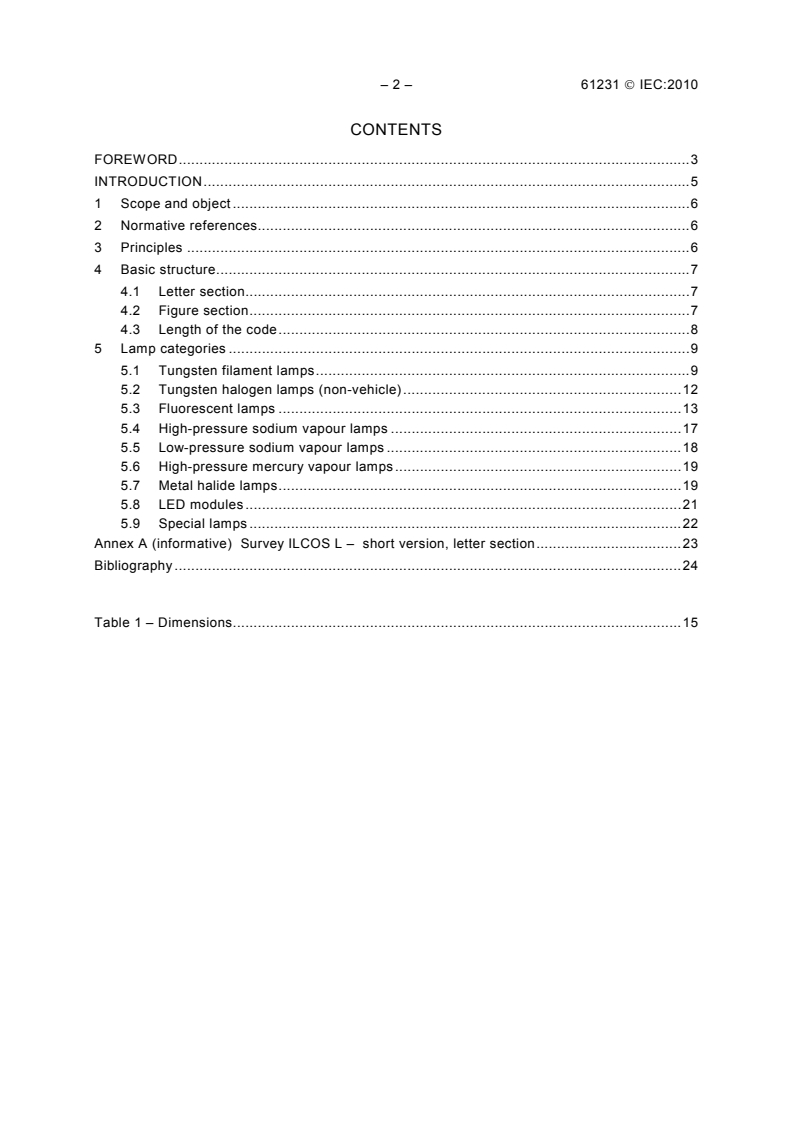
CONTENTS
FOREWORD.3
INTRODUCTION.5
1 Scope and object .6
2 Normative references.6
3 Principles .6
4 Basic structure.7
4.1 Letter section.7
4.2 Figure section.7
4.3 Length of the code.8
5 Lamp categories .9
5.1 Tungsten filament lamps.9
5.2 Tungsten halogen lamps (non-vehicle).12
5.3 Fluorescent lamps .13
5.4 High-pressure sodium vapour lamps .17
5.5 Low-pressure sodium vapour lamps .18
5.6 High-pressure mercury vapour lamps.19
5.7 Metal halide lamps.19
5.8 LED modules.21
5.9 Special lamps .22
Annex A (informative) Survey ILCOS L – short version, letter section.23
Bibliography .24
Table 1 – Dimensions.15
61231 © IEC:2010 – 3 –
INTERNATIONAL ELECTROTECHNICAL COMMISSION
____________
INTERNATIONAL LAMP CODING SYSTEM (ILCOS)
FOREWORD
1) The International Electrotechnical Commission (IEC) is a worldwide organization for standardization comprising
all national electrotechnical committees (IEC National Committees). The object of IEC is to promote
international co-operation on all questions concerning standardization in the electrical and electronic fields. To
this end and in addition to other activities, IEC publishes International Standards, Technical Specifications,
Technical Reports, Publicly Available Specifications (PAS) and Guides (hereafter referred to as “IEC
Publication(s)”). Their preparation is entrusted to technical committees; any IEC National Committee interested
in the subject dealt with may participate in this preparatory work. International, governmental and non-
governmental organizations liaising with the IEC also participate in this preparation. IEC collaborates closely
with the International Organization for Standardization (ISO) in accordance with conditions determined by
agreement between the two organizations.
2) The formal decisions or agreements of IEC on technical matters express, as nearly as possible, an international
consensus of opinion on the relevant subjects since each technical committee has representation from all
interested IEC National Committees.
3) IEC Publications have the form of recommendations for international use and are accepted by IEC National
Committees in that sense. While all reasonable efforts are made to ensure that the technical content of IEC
Publications is accurate, IEC cannot be held responsible for the way in which they are used or for any
misinterpretation by any end user.
4) In order to promote international uniformity, IEC National Committees undertake to apply IEC Publications
transparently to the maximum extent possible in their national and regional publications. Any divergence
between any IEC Publication and the corresponding national or regional publication shall be clearly indicated in
the latter.
5) IEC itself does not provide any attestation of conformity. Independent certification bodies provide conformity
assessment services and, in some areas, access to IEC marks of conformity. IEC is not responsible for any
services carried out by independent certification bodies.
6) All users should ensure that they have the latest edition of this publication.
7) No liability shall attach to IEC or its directors, employees, servants or agents including individual experts and
members of its technical committees and IEC National Committees for any personal injury, property damage or
other damage of any nature whatsoever, whether direct or indirect, or for costs (including legal fees) and
expenses arising out of the publication, use of, or reliance upon, this IEC Publication or any other IEC
Publications.
8) Attention is drawn to the Normative references cited in this publication. Use of the referenced publications is
indispensable for the correct application of this publication.
9) Attention is drawn to the possibility that some of the elements of this IEC Publication may be the subject of
patent rights. IEC shall not be held responsible for identifying any or all such patent rights.
International Standard IEC 61231 has been prepared by subcommittee 34A: Lamps, of IEC
technical committee 34: Lamps and related equipment.
This first edition cancels and replaces the second edition of IEC 61231, published as a
technical specification. It constitutes a technical revision, of which the main changes are
indicated below:
– introduction of LED modules (Subclause 5.8).
The text of this standard is based on the following documents:
CDV Report on voting
34A/1345/CDV 34A/1374/RVC
Full information on the voting for the approval of this standard can be found in the report on
voting indicated in the above table.
This publication has been drafted in accordance with the ISO/IEC Directives, Part 2.
– 4 – 61231 © IEC:2010
The committee has decided that the contents of this publication will remain unchanged until the
maintenance result date indicated on the IEC web site under "http://webstore.iec.ch" in the data
related to the specific publication. At this date, the publication will be
• reconfirmed,
• withdrawn,
• replaced by a revised edition, or
• amended.
61231 © IEC:2010 – 5 –
INTRODUCTION
The lamp industry strives continuously to meet customers' needs. Its innovative power has led
to a tremendous variety of different light sources. To enable customers and experts to find their
way within the diversity of products, a general system for the coding of lamps has been
developed.
The code does not replace specific markings used by individual manufacturers on their lamps
or in their catalogues, but it is promoted for cross-referencing purposes and, in due course, to
replace national and regional lamp coding systems which already exist.
NOTE The code does not give all the technical characteristics necessary to specify a lamp fully. For this the
relevant lamp standard and/or the manufacturer’s literature have to be consulted.
– 6 – 61231 © IEC:2010
INTERNATIONAL LAMP CODING SYSTEM (ILCOS)
1 Scope and object
This International Standard gives the rules for the international lamp coding system and covers
all lamp categories, excluding vehicle lamps. Coding for the main lamp types is specified and,
for the others, will follow by amendments to this standard as appropriate.
The object of the international lamp coding system is
– to improve communication about the different types of lamps;
– to help in discussions concerning interchangeability and compatibility of products;
– to create a closer relationship between international standards and manufacturers’ literature
(for example the code could be given in future in the relevant parts of a standard);
– to enable correct replacements of lamps;
– to be used as a complementary marking on the luminaire;
– to replace national and regional coding systems.
2 Normative references
The following referenced documents are indispensable for the application of this document. For
dated references, only the edition cited applies. For undated references, the latest edition of
the referenced document (including any amendments) applies.
IEC 60357, Tungsten halogen lamps (non-vehicle) – Performance specifications
IEC 60432-1, Incandescent lamps – Safety specifications – Part 1: Tungsten filament lamps for
domestic and similar general lighting purposes
IEC 60432-2, Incandescent lamps – Safety specifications – Part 2: Tungsten halogen lamps for
domestic and similar general lighting purposes
IEC 60838-2-2, Miscellaneous lampholders – Part 2-2: Particular requirements – Connectors
for LED-modules
IEC/TR 60887, Glass bulb designation system for lamps
IEC 61167, Metal halide lamps
CIE publication 29.2, Guide on interior lighting
3 Principles
The international lamp coding system has been developed on the basis of the following
principles.
– It should be manufacturer-independent concerning its content and its wording.
– A relationship between the coding system and international standards should be
established.
61231 © IEC:2010 – 7 –
– It should be internationally acceptable. It is recognized that other systems with national and
regional importance exist and that the change to an international code should be seen as a
long-term process.
– The length of the code should be as short as possible and as long as necessary. Therefore,
it should be possible to use the code in different lengths depending on the different
purposes.
– In view of the technical diversity of the different lamp categories, it would not be practical to
define the code for all types in the same way; the code depends therefore in its composition
on the technical needs of the different lamp categories.
– The code should not replace manufacturer-specific marking on the lamp or in the
catalogues, but should be used for cross-references in lamp and luminaire literature.
– The allocation of codes is based on interchangeability and compatibility.
An additional usage of the code on the lamp package should be envisaged for the future.
4 Basic structure
The complete lamp code ILCOS consists of a letter section and a figure section.
4.1 Letter section
The first letter of the letter section designates the lamp category as follows:
I Tungsten filament lamps
H Tungsten halogen lamps (non-vehicle)
F Fluorescent lamps
S High-pressure sodium lamps
L Low-pressure sodium lamps
Q High-pressure mercury lamps
M Metal halide lamps
D LED modules
X Special lamps
NOTE Vehicle lamps, including their coding, are covered by national and/or regional legislation.
The next letters within the letter section give further details as outlined in the description of the
different lamp categories. The letter section is separated from the rest by a hyphen.
4.2 Figure section
The figure section consists of several blocks mainly containing figures. Each block, separated
by hyphens, contains characteristic values of lamps such as
– wattage;
– voltage;
– lamp cap;
– dimensional values.
As a hyphen is used to separate the blocks, it cannot be applied within a block. As a
consequence, the sign of equality = is used instead of the hyphen, for example within the cap
designation.
The sequence and the specific content of the blocks is determined for each lamp category and
described in 5.1 to 5.8.
– 8 – 61231 © IEC:2010
4.3 Length of the code
4.3.1 General
The code can be used in different lengths depending on the purpose. In catalogues and
leaflets, specialities, for example special applications, can be indicated with an asterisk (*) in
the place where the difference occurs or at the end of the code and explained in a separate
remark, also indicated with an asterisk (*).
The code can be shortened by deleting parts from the end, not by deleting intermediate parts.
In general, if ‘standard’ types are concerned, the dimension block can be omitted. Intermediate
parts may be omitted, providing the separating signs such as hyphens (–) and slashes (/) are
given.
NOTE These shortening rules do not apply to the extended short version ILCOS LE.
4.3.2 Short version: ILCOS L
The short version consists of the letter section or a part of it and is called ILCOS L. It can be
used for the general classification of lamps. A survey of ILCOS L is given in Annex A.
4.3.3 Extended short version: ILCOS LE
The extended short version, where applicable, consists of the first part of the letter section
(ILCOS L) immediately followed (without spaces) by the relevant dimensions.
4.3.4 Standard version: ILCOS D
The standard version gives the complete designation and consists of the letter section and (a
part of) the figure section. The use of ILCOS D should enable the customer to find the correct
lamp type, for example in the case of lamp replacement from a different manufacturer. It can
be used for the purpose of marking luminaires, when suitable also in an abbreviated form.
61231 © IEC:2010 – 9 –
5 Lamp categories
For information about relevant lamp standards and lamp-related standards, see the IEC
publications prepared by IEC technical committee 34.
5.1 Tungsten filament lamps
5.1.1 ILCOS L for tungsten filament lamps
The ILCOS L code is built up as follows:
Tungsten filament lamps
Non-reflector lamps Reflector lamps
IA IB IN
Large lamps Compact bulb lamps Other non-reflector lamps
(bulb diameter usually (bulb diameter usually (lamps outside the scope
of IEC 60432-1)
> 45 mm) ≤ 45 mm)
Pear-shaped, mushroom or Candle, round bulb or lamps
lamps with other shapes with other shapes intended
intended for use in the same for use in the same luminaire
luminaire
After the first two letters IA, IB and IN the shape of the bulb follows, indicated as specified in
IEC 60887.
The main bulb shape types are
A pear-shaped
--
B candle (bulged)
--
C conical
--
G globular
--
M mushroom
--
P round bulb
--
S pigmy (straight-sided)
--
T tubular
--
An example with a modifier is
BA candle with angular tip
--
– 10 – 61231 © IEC:2010
For reflector lamps:
Reflector lamps
IR
IRR IRA IRP IPAR IPARD
R bulb reflector Pear-shaped Round bulb bowl Normal PAR Dichroic PAR
lamps bowl mirror mirror lamps bulb reflector bulb reflector
lamps lamps lamps
If it is necessary to indicate the finish or the colour of a lamp, or the specific kind of reflector or
other technical details, this can be done after a slash as follows:
/C clear
/F frosted, frosted equivalently coated
/W white
/R red
/B blue
/G green
/Y yellow
/V violet
/P pink
/A amber
/O orange
/S silver
/X gold
/N neodymium
/D decorative filament design
A second letter may be added for the following purposes:
/ P to indicate pastel shades
-
/ F to indicate a window
-
/
T to indicate transparent colours
-
Further technical details can be given after a second slash:
//AX axial filament
//TR transversal filament
//RS rough service lamps
//LT limited surface temperature
//RT rough service with limited surface temperature
61231 © IEC:2010 – 11 –
Examples
IAA/F Frosted pear-shaped lamps
IAM Mushroom lamps
IAT/W White-coated tubular lamps intended for use in the same luminaire
as pear-shaped lamps
IBBA/C Clear candle lamps with angular tip
IBP/R Red round bulb lamps
IAG Globular lamps, intended for use in the same luminaire as pear-shaped lamps
IBT/W White-coated tubular lamps, intended for use in the same luminaire
as round bulb lamps IBP
IBC Conical lamps, intended for use in the same luminaire as round bulb lamps IBP
IRA/S Pear-shaped bowl mirror lamp with silver reflector
5.1.2 ILCOS LE for tungsten filament lamps
ILCOS LE consists of the first part of ILCOS L up to and including the shape indication followed
by the number giving the nominal diameter of the lamp.
Examples
IAA60 Pear-shaped lamp with 60 mm nominal bulb diameter
IBP45 Round bulb lamp with 45 mm nominal bulb diameter
IAG80 Globular lamp with 80 mm nominal bulb diameter
5.1.3 ILCOS D for tungsten filament lamps
ILCOS D consists of the following blocks:
ILCOS L-wattage-rated voltage-lamp cap-dimensions
– Wattage: For miniature and/or glow lamps, the lamp current can be indicated in place of
the wattage. In that case, the lamp current value shall be immediately followed by a capital
A.
– Rated voltage: In case of a voltage range, two numbers are given separated by a slash.
– For airfield lamps the lamp voltage may be replaced by the lamp current value immediately
followed by a capital A.
– Dimensions: This block consists normally only of the number giving the nominal diameter.
For tubular lamps the maximum overall length can be added after a slash. For reflector
lamps, the beam angle can be added after a slash. In case of a non-symmetrical beam, two
numbers separated by a slash may be given, the first describing the horizontal and the
second the vertical beam angle.
Examples
IAA/C-40-220/230-E27-60 Clear pear-shaped lamp, 40 W, 220-230 V, cap E27, nominal
diameter 60 mm
IBB/W-40---35 White candle lamp, 40 W, nominal diameter 35 mm, rest not
specified
IRR-60-240-B22d-125/30 R bulb reflector lamp, 60 W, 240 V, cap B22d, type R125,
beam angle 30°
– 12 – 61231 © IEC:2010
5.2 Tungsten halogen lamps (non-vehicle)
5.2.1 ILCOS L for tungsten halogen lamps
The first two letters will be
HS Single-ended halogen lamps
HD Double-ended halogen lamps
HR Dichroic reflector halogen lamps
HM Metal reflector halogen lamps
HA Halogen lamps with aluminized glass reflector
HP Single-ended halogen lamps with proximity reflector
Third letter to indicate the field of application of the lamp:
P Projection including overhead projection and micro-film/-fiche lamps
--
S Photo/Studio/Theatre/Video
--
A Airfield
--
T Traffic signal
--
G General purpose (floodlight lamps are considered as general purpose)
--
A fourth letter can be used to indicate self-shielded lamps. Self-shielded lamps are lamps
designed to be suitable for use in open luminaires. Examples of self-shielded lamps are ELV
lamps with integral outer envelope, low-pressure tungsten halogen lamps and mains voltage
lamps which conform to IEC 60432-2 (for further information, see IEC 60357).
S Self-shielded halogen lamp
---
The bulb shape can be indicated after the third or fourth letter as described for tungsten
filament lamps.
If it is necessary to indicate the bulb finish, special colours or other technical details, this can
be done after one or two slashes as described for tungsten filament lamps (see 5.1.1).
Further technical details can be given after a second slash:
//UB UV reduction
//IB IR utilization
//S Short neck
Examples
HSGST Single-ended general purpose halogen lamps, self-shielded, tubular shaped
HDG Double-ended floodlight halogen lamps
HRG Dichroic reflector general purpose halogen lamps
HMGS Metal reflector general purpose halogen lamps, self-shielded
5.2.2 ILCOS LE for tungsten halogen lamps
ILCOS LE consists of ILCOS L up to the first slash immediately followed by the dimension
block as described in 5.2.3.
Examples
HRGS51 General purpose dichroic reflector lamp, self-shielded,
with a reflector diameter of 51 mm
61231 © IEC:2010 – 13 –
HMGS37 General purpose metal reflector lamp, self-shielded,
with a reflector diameter of 37 mm
5.2.3 ILCOS D for tungsten halogen lamps
ILCOS D consists of the following blocks:
ILCOS L-wattage-rated voltage-lamp cap-dimensions
– Wattage: In the case of a two-filament lamp, the wattage of each filament is given
combined by a (+) sign.
Where needed for further distinction, this block can be extended by a slash to give
information concerning the colour temperature in the following way. The colour temperature
of the lamp is divided by 100 and the number obtained is rounded to an integer.
– Rated voltage: In case of a voltage range, two numbers are given separated by a slash.
For airfield lamps, the lamp voltage may be replaced by the lamp current value immediately
followed by a capital A.
– Dimensions: The content of this block depends on the specific characteristics of the
different halogen lamp types. Nominal values are given, except for the bulb diameter of
single-ended lamps. It can contain one value and, if needed for further discrimination,
a second one after a slash as follows:
ILCOS L Dimensions (nominal)
HS – Bulb diameter (max.)/light centre length
HD – Contact to contact length Z
nom
HR – Diameter of reflector/beam angle
HM – Diameter of reflector/beam angle
HA – Diameter of reflector/beam angle
HP – Light centre length
Examples
HSG-20-12-G4-22 Single-ended general purpose halogen lamp, 20 W, 12 V, G4
base, light centre length 22 mm
HDS-800-220/230-R7s-74,9 Double-ended photo/studio halogen lamp, 800 W, 220-230 V,
R7s cap, contact-to-contact length 74,9 mm
HRGS-50-12-GX5.3-51/30 Dichroic reflector general purpose halogen lamp, self-
shielded, 50 W, 12 V, base GX5.3, diameter 51 mm, beam
angle 30°
5.3 Fluorescent lamps
5.3.1 ILCOS L for fluorescent lamps
The first two letters will be
FD Double-capped lamps
FS Single-capped lamps
FB Self-ballasted lamps
Additional information can be indicated by a third letter as follows:
FDR Double-capped lamps with internal reflector
FDU Double-capped lamps, U-shaped
– 14 – 61231 © IEC:2010
FSD Single-capped lamps, dual shaped
FSQ Single-capped lamps, quad shaped
FSS Single-capped lamps, square shaped
FSM Single-capped lamps, multi-limbed
FSC Single-capped lamps, circular shaped
FSG Single-capped lamps, globular
For FD and FS lamps a last letter can be added to indicate:
H For high frequency ballasts only
--
I Induction type lamp
--
For FB lamps the shape can be indicated as described for tungsten filament lamps (see 5.1.1).
A last letter can be added to indicate:
H Integral HF type ballast
---
I Integral induction type ballast
---
Colours or other bulb finishes can be indicated after a slash, as described for tungsten filament
lamps (see 5.1.1).
Further technical details can be given after a second slash as follows:
//L For use in low ambient temperatures
//H For use in high ambient temperatures
//P Photocell integrated
//PL Photocell integrated and for use in low ambient temperatures
//PH Photocell integrated and for use in high ambient temperatures
5.3.2 ILCOS LE for fluorescent lamps
ILCOS LE consists of ILCOS L (up to the first slash) immediately followed by the relevant
dimensions.
Examples
FD26 Double-capped lamp with nominal tube diameter 26 mm
FD38/1200 Double-capped lamp with nominal tube diameter 38 mm and nominal tube
length 1 200 mm (hence 40 W).
FD/1200 Double-capped lamp with nominal tube length 1 200 mm (36 W or 40 W)
5.3.3 ILCOS D for fluorescent lamps
ILCOS D consists of the following blocks:
ILCOS L-wattage-starting details (note)-lamp cap-dimensions
NOTE For self-ballasted lamps, the rated voltage is given instead of the starting details; if necessary, extended
after a slash by the rated frequency.
– Wattage: The block specifying wattage can be extended by a slash to give information
concerning the colour temperature and after another slash concerning the colour-rendering
properties in the following way.
The colour temperature of the lamp is divided by 100 and the number obtained is rounded
to an integer.
61231 © IEC:2010 – 15 –
The colour-rendering properties are indicated by one of the following CIE (see CIE publi-
cation 29.2) colour-rendering groups:
1A for R ≥ 90;
a
1B for R = 80-89;
a
2A for R = 70-79;
a
2B for R = 60-69;
a
3 for R = 40-59;
a
4 for R = 20-39.
a
– Starting details: The starting details for FD and FS lamps are given as follows:
- - No starting details for induction type
-I- Internal starter
-E- External starter, preheated
-L/ - Starterless
-LC/ - Starterless, low starting voltage with conductive strip or layer
- /P/ - Preheated
-
-/N- Non-preheated
-
- / /H- Cathodes of high resistance (only for starterless)
- -
- / /L- Cathodes of low resistance (only for starterless)
- -
The information concerning the starting details can be abbreviated, where appropriate;
however, this shall be done only from the right to the left. For example, the information
concerning cathodes of high or low resistance is only relevant for starterless operation;
therefore this part can be omitted for lamps with starters.
– Dimensions: This block gives information with regard to the nominal (for FD) or maximum
(for FS and FB) values of cross-section and length of the lamp. If the cross-section is
round, two values are given, which are separated by a slash, the first value indicating the
diameter of the cross-section. If the cross-section is rectangular, the dimensional part
consists of three values, separated by slashes, the first two values describing the cross-
section and the last one the length.
For the main lamp group FD the dimension block is only used for dimensions which are not
indicated in Table 1.
Table 1 – Dimensions
Diameter Nominal length Wattage
16 150 4
225 6
300 8
525 13
26/38 600 18/20, 16HF
1 200 36/40, 32HF
1 500 58/65, 50HF
– 16 – 61231 © IEC:2010
Examples
FD-36-E-G13 Double-capped fluorescent lamp, 36 W, external starter,
preheated, (European "switch start" version), cap G13,
diameter 26 mm, length 1 200 mm
abbreviated: FD-36-E (usually with diameter 26 mm)
FD-36/30/1B-E-G13 Same lamp as above, but with indication of colour
properties, colour temperature 3 000 K, colour-rendering
group 1B (R =80-89)
a
abbreviated: FD-36/30/1B
FD-40-L/P/L-G13 Double-capped fluorescent lamp, 40 W, starterless, pre-
heated, low cathode resistance, (North American "rapid
start" version), cap G13, diameter 38 mm, length 1 200 mm
abbreviated: FD-40-L/P (usually with diameter 38 mm)
FSC-40-L/P/L-G10q-32/406 Circular fluorescent lamp, 40 W, starterless, preheated,
low-cathode resistance, cap G10q, tube diameter 32 mm,
lamp diameter 406 mm
abbreviated: FSC-40-L
FD-40-L/N-Fa8 Double-capped fluorescent lamp, 40 W, starterless, non-
preheated, ("instant start" version), cap Fa8, diameter
38 mm, length 1 200 mm
abbreviated: FD-40-L/N (usually with diameter 38 mm)
FSD-7-I-G23-28/13/115 Single-capped fluorescent lamp, dual shaped, 7 W, internal
starter, cap G23, cross-section 28 mm × 13 mm, length
115 mm
abbreviated: FSD-7-I
FSQ-18-E-G24q=2-28/28/140 Single-capped fluorescent lamp, quad shaped, 18 W,
external starter, cap G24q-2, cross-section 28 mm × 28 mm,
length 140 mm
abbreviated: FSQ-18-E
FBT-18-230-E27-73/150 Self-ballasted fluorescent lamp, tubular, 18 W, rated
voltage 230 V, cap E27, diameter 73 mm, length 150 mm
abbreviated: FBT-18
FBGH-11-230/240-E27-112/178 Self-ballasted fluorescent lamp, globular shape, integral HF
type ballast, 11 W, rated voltage 230-240 V, cap E27,
diameter 112 mm, length 178 mm
abbreviated: FBGH-11
FSGI-55--K Single-capped fluorescent lamp, globular shape, induction
type, 55 W, cable connector
FBRI-23-230/240-E27-82/127 Self-ballasted fluorescent reflector lamp, integral induction
type ballast, 23 W, rated voltage 230-240 V, cap E27,
diameter 82 mm, length 127 mm
61231 © IEC:2010 – 17 –
5.4 High-pressure sodium vapour lamps
5.4.1 ILCOS L for high-pressure sodium lamps
5.4.1.1 Normal version
The first two letters will be
ST Single-ended tubular clear lamps
SE Single-ended lamps with elliptical bulb, diffuse coating
SC Single-ended lamps with elliptical bulb, clear
SD Double-ended clear lamps
SR Lamps of reflector version
5.4.1.2 Lamps for use in high-pressure mercury equipment
The first three letters will be: S_Q
SEQ Lamps with elliptical bulb, diffuse coating, for high-pressure mercury equipment
5.4.1.3 Colour improved lamp
The first three letters will be: S_M (M: Medium colour rendering)
STM Tubular clear lamps, colour improved
5.4.1.4 Lamp with high colour rendering
The first three letters will be: S_H (H: High colour rendering)
STH Tubular clear lamps with high colour rendering
Further technical details can be given after a slash as follows:
/T Twin arc tube
/E Special electronic operation
/F Frosted bulb finish (tubular lamps)
5.4.2 ILCOS LE for high-pressure sodium lamps
Not applicable for high-pressure sodium lamps.
5.4.3 ILCOS D for high-pressure sodium lamps
ILCOS D consists of the following blocks:
ILCOS L-wattage-lamp voltage range-lamp cap-dimensions
– Lamp voltage range: The lamp voltage range is indicated by the letter L, H or E:
L for lamp voltage range < 70 V
H for lamp voltage range of 70 V-180 V
E for lamp voltage range > 180 V
If necessary for further distinction, the lamp voltage can be given after the letter L, H or E
as a number, for example L52.
The lamp voltage range block can be extended by a slash to give further information
concerning the starting device:
/E Lamps with external starting device
/I Lamps with internal starting device
– 18 – 61231 © IEC:2010
/S Lamps with external starting device and increased starting voltage (usually not used
for replacement types)
– Dimensions: This block consists of two values separated by a slash representing the
maximum bulb diameter and the maximum lamp length. For reflector lamps, the beam
angle can be added after a slash.
Examples
ST-150-H/E-E40-53/211 High-pressure sodium lamp, tubular clear, 150 W, voltage
range 70 V-180 V, external starting device, cap E40, maximum
diameter 53 mm, maximum overall length 211 mm
abbreviated: ST-150 (usually with external starting device, and with the dimensions
as given)
SEM-150-H/E-E40-91/227 High-pressure sodium lamp, elliptical diffuse coated bulb,
colour improved, 150 W, voltage range 70 V-180 V, external
starting device, cap E40, maximum diameter 91 mm, maximum
overall length 227 mm
abbreviated: SEM-150
SEQ-210-H-E40-91/227 High-pressure sodium lamp, elliptical diffuse coated bulb, for
use in high-pressure mercury equipment, 210 W, voltage range
70 V-180 V, cap E40, maximum diameter 91 mm, maximum
overall length 227 mm
abbreviated: SEQ-210
5.5 Low-pressure sodium vapour lamps
5.5.1 ILCOS L for low-pressure sodium lamps
The first letters will be
LS Lamps, single-capped (with U-shaped arc tube)
LSE Lamps, single-capped, of the E type
5.5.2 ILCOS LE for low-pressure sodium lamps
Not applicable for low-pressure sodium lamps.
5.5.3 ILCOS D for low-pressure sodium lamps
ILCOS D consists of the following blocks:
ILCOS L-wattage(note)-lamp cap-dimensions
NOTE For lamps of the E-type the wattage is replaced by the lamp designation consisting of E plus a number.
– Dimensions: This block contains the maximum bulb diameter and the maximum overall
length, separated by a slash.
It can be extended to give information regarding a limitation in the operating position as
described for metal halide lamps (see 5.7.3).
Examples
LS-90-BY22d-68/528 Low-pressure sodium lamp, U-shaped arc tube, 90 W, cap
BY22d, maximum bulb diameter 68 mm, maximum overall
length 528 mm
abbreviated: LS-90
61231 © IEC:2010 – 19 –
LSE-E131-BY22d-68/1120 Low-pressure sodium lamp, E-type, designation E131, cap
BY22d, maximum bulb diameter 68 mm, maximum overall
length 1 120 mm
abbreviated: LSE-E131
5.6 High-pressure mercury vapour lamps
5.6.1 ILCOS L for high-pressure mercury lamps
The first letters will be
QT Tubular clear lamps
QE Lamps with elliptical bulb, diffuse coating
QC Lamps with elliptical bulb, clear
QR Lamps of reflector version
QB Blended lamps (self-ballasted)
QBR Blended lamps (self-ballasted) with reflector
NOTE In some countries it is necessary to identify lamps as "regular" or "fail-safe design" (lamp is extinguished
when the outer bulb is broken). This can be included in the code by extending the block ILCOS L by a slash
followed by the letter R for regular lamps or T for the fail-safe design.
5.6.2 ILCOS LE for high-pressure mercury lamps
Not applicable for high-pressure mercury lamps.
5.6.3 ILCOS D for high-pressure mercury lamps
ILCOS D consists of the following blocks:
ILCOS L-wattage-lamp voltage range(note)-lamp cap-dimensions
NOTE For blended lamps (self-ballasted), the rated voltage is given instead of the lamp voltage range.
– Wattage: The wattage block can be extended to give information concerning the colour
temperature and colour-rendering properties as described for fluorescent lamps (see 5.3.3).
– Lamp voltage range: The lamp voltage range is indicated as described for high-pressure
sodium lamps (see 5.4.3).
– Dimensions: This block contains the maximum bulb diameter and the maximum overall
length, separated by a slash. For reflector lamps, the beam angle can be added after a slash.
Examples
QE-125-H-E27-76/178 High-pressure mercury lamp, elliptical bulb, diffuse coated,
125 W, voltage range 70 V-180 V, cap E27, maximum bulb
diameter 76 mm, maximum overall length 178 mm
abbreviated: QE-125
QE-700-E-E40-152/357 High-pressure mercury lamp, elliptical diffuse coated bulb,
700 W, voltage range > 180 V, cap E40, maximum bulb
diameter 152 mm, maximum overall length 357 mm
abbreviated: QE-700-E
5.7 Metal halide lamps
5.7.1 ILCOS L for metal halide lamps
The first letters will be
– 20 – 61231 © IEC:2010
MT Single-ended tubular clear lamps
ME Single-ended lamps with elliptical or BT bulb, diffuse coating
MC Single-ended lamps with elliptical or BT bulb, clear
MD Double-ended lamps with clear outer bulb
MN Double-ended lamps without outer bulb
MR Reflector lamps
A third letter can be used to indicate self-shielded lamps, i.e. lamps designed to be suitable for
use in open luminaires:
S Self-shielded lamps
--
Further technical details can be given after a slash:
/UB UV reduction
5.7.2 ILCOS LE for metal halide lamps
Not applicable for metal halide lamps.
5.7.3 ILCOS D for metal halide lamps
For types standardized according to IEC 61167, ILCOS D consists of the following blocks:
ILCOS L-wattage-lamp voltage range-lamp cap-dimensions
– Wattage: The wattage block can be extended to give information concerning the colour
temperature and colour-rendering properties as described for fluorescent lamps (see 5.3.3).
– Lamp voltage range: The lamp voltage range is indicated as described for high-pressure
sodium lamps (see 5.4.3).
– Dimensions: The dimensional block contains the maximum bulb diameter and the
maximum overall length, separated by a slash. For double-ended lamps, the nominal
contact-to-contact length Z is given instead of the maximum overall length. For reflector
nom
lamps, the beam angle can be added after a slash.
This block can be extended to give information regarding a limitation in the operating position
in the following way:
/H horizontal operating position
/V vertical operating position
NOTE Detailed information on the operating position is under consideration.
For non-standardized types, the coding is under consideration.
Examples
MT-70/30/1B-H-G12-26/76 Metal halide lamp, tubular clear, 70 W, T 3 000 K,
c
R 80-89, voltage range 70 V-180 V, cap G12,
a
maximum bulb diameter 26 mm, maximum length
76 mm
abbreviated: MT-70
MD-150/42/1B-H-RX7s=24-25/132/H Metal halide lamp, double-ended with clear outer
bulb, 150 W, T 4 200 K, R 80-89, voltage range
c a
70 V-180 V, cap RX7s-24, maximum bulb diameter
25 mm, nominal contact-to-contact length Z 132
nom
mm, horizontal operating position
61231 © IEC:2010 – 21 –
abbreviated: MD-150
5.8 LED modules
5.8.1 ILCOS L for LED modules
The first letters will be
DS LED modules, separate ballast
DB self-ballasted LED modules
DR retrofit LED lamp, self-ballasted
A third letter can be used to indicate the form:
DSL and DBL linear
DSR and DBR round
DSH and DBH hexagonal
DSS and DBS square
DR_ same as for the lamp which is replaced
5.8.2 ILCOS LE for LED modules
Not applicable for LED modules.
5.8.3 ILCOS D for LED modules
ILCOS D consists of the following blocks:
ILCOS L wattage lamp voltage range lamp cap dimensions
– Wattage: The wattage block can be extended to give information concerning the colour
temperature and colour-rendering properties as described for fluorescent lamps (see 5.3.3).
– LED module voltage range:
S V
≤ 25
L V
≤ 50
H V
≤ 250
E V
> 250
NOTE For LED modules and LED lamps, the range of SELV is of interest and is expressed with letter "S“.
– LED module cap:
For ILCOS L types DS: No caps. For connectors (to other modules, to the control gear
and to the luminaire) see IEC 60838-2-2.
For ILCOS L types DB: No caps. For connectors (to the luminaire) see
IEC 60838-2-2.
For ILCOS L types DR: Caps as in the standards for self-ballasted LED lamps*
* to be developed for > 50 V (IEC 62560 to be published) and ≤ 50 V
– Dimensions:
For ILCOS L types DS and DB: under consideration
For ILCOS L types DR: same as for the lamp which is replaced
– 22 – 61231 © IEC:2010
5.9 Special lamps
The first letter will be X.
The following letters are
X High-pressure xenon lamps
-
IR IR emitters
-
UV UV emitters
-
For IR and UV emitters ILCOS L consists of the prefix XIR or XUV immediately followed after a
slash by the ILCOS L information as given for similar non IR or UV lamps, for example XIR/HD,
XUV/FDR.
Further coding details are under consideration.
For technical details about special lamps, refer to the manufacturer’s specification.
-
...
IEC 61231 ®
Edition 1.1 2013-06
CONSOLIDATED VERSION
INTERNATIONAL
STANDARD
NORME
INTERNATIONALE
colour
inside
International lamp coding system (ILCOS)
Système international de codification des lampes (ILCOS)
All rights reserved. Unless otherwise specified, no part of this publication may be reproduced or utilized in any form
or by any means, electronic or mechanical, including photocopying and microfilm, without permission in writing from
either IEC or IEC's member National Committee in the country of the requester.
If you have any questions about IEC copyright or have an enquiry about obtaining additional rights to this publication,
please contact the address below or your local IEC member National Committee for further information.
Droits de reproduction réservés. Sauf indication contraire, aucune partie de cette publication ne peut être reproduite ni
utilisée sous quelque forme que ce soit et par aucun procédé, électronique ou mécanique, y compris la photocopie et les
microfilms, sans l'accord écrit de la CEI ou du Comité national de la CEI du pays du demandeur.
Si vous avez des questions sur le copyright de la CEI ou si vous désirez obtenir des droits supplémentaires sur cette
publication, utilisez les coordonnées ci-après ou contactez le Comité national de la CEI de votre pays de résidence.
IEC Central Office Tel.: +41 22 919 02 11
3, rue de Varembé Fax: +41 22 919 03 00
CH-1211 Geneva 20 info@iec.ch
Switzerland www.iec.ch
About the IEC
The International Electrotechnical Commission (IEC) is the leading global organization that prepares and publishes
International Standards for all electrical, electronic and related technologies.
About IEC publications
The technical content of IEC publications is kept under constant review by the IEC. Please make sure that you have the
latest edition, a corrigenda or an amendment might have been published.
Useful links:
IEC publications search - www.iec.ch/searchpub Electropedia - www.electropedia.org
The advanced search enables you to find IEC publications The world's leading online dictionary of electronic and
by a variety of criteria (reference number, text, technical electrical terms containing more than 30 000 terms and
committee,…). definitions in English and French, with equivalent terms in
It also gives information on projects, replaced and additional languages. Also known as the International
withdrawn publications. Electrotechnical Vocabulary (IEV) on-line.
IEC Just Published - webstore.iec.ch/justpublished Customer Service Centre - webstore.iec.ch/csc
Stay up to date on all new IEC publications. Just Published If you wish to give us your feedback on this publication
details all new publications released. Available on-line and or need further assistance, please contact the
also once a month by email. Customer Service Centre: csc@iec.ch.
A propos de la CEI
La Commission Electrotechnique Internationale (CEI) est la première organisation mondiale qui élabore et publie des
Normes internationales pour tout ce qui a trait à l'électricité, à l'électronique et aux technologies apparentées.
A propos des publications CEI
Le contenu technique des publications de la CEI est constamment revu. Veuillez vous assurer que vous possédez
l’édition la plus récente, un corrigendum ou amendement peut avoir été publié.
Liens utiles:
Recherche de publications CEI - www.iec.ch/searchpub Electropedia - www.electropedia.org
La recherche avancée vous permet de trouver des Le premier dictionnaire en ligne au monde de termes
publications CEI en utilisant différents critères (numéro de électroniques et électriques. Il contient plus de 30 000
référence, texte, comité d’études,…). termes et définitions en anglais et en français, ainsi que
Elle donne aussi des informations sur les projets et les les termes équivalents dans les langues additionnelles.
publications remplacées ou retirées. Egalement appelé Vocabulaire Electrotechnique
International (VEI) en ligne.
Just Published CEI - webstore.iec.ch/justpublished
Service Clients - webstore.iec.ch/csc
Restez informé sur les nouvelles publications de la CEI.
Just Published détaille les nouvelles publications parues. Si vous désirez nous donner des commentaires sur
Disponible en ligne et aussi une fois par mois par email. cette publication ou si vous avez des questions
contactez-nous: csc@iec.ch.
IEC 61231 ®
Edition 1.1 2013-06
CONSOLIDATED VERSION
INTERNATIONAL
STANDARD
NORME
INTERNATIONALE
colour
inside
International lamp coding system (ILCOS)
Système international de codification des lampes (ILCOS)
INTERNATIONAL
ELECTROTECHNICAL
COMMISSION
COMMISSION
ELECTROTECHNIQUE
INTERNATIONALE
ICS 29.140 ISBN 978-2-8322-0905-9
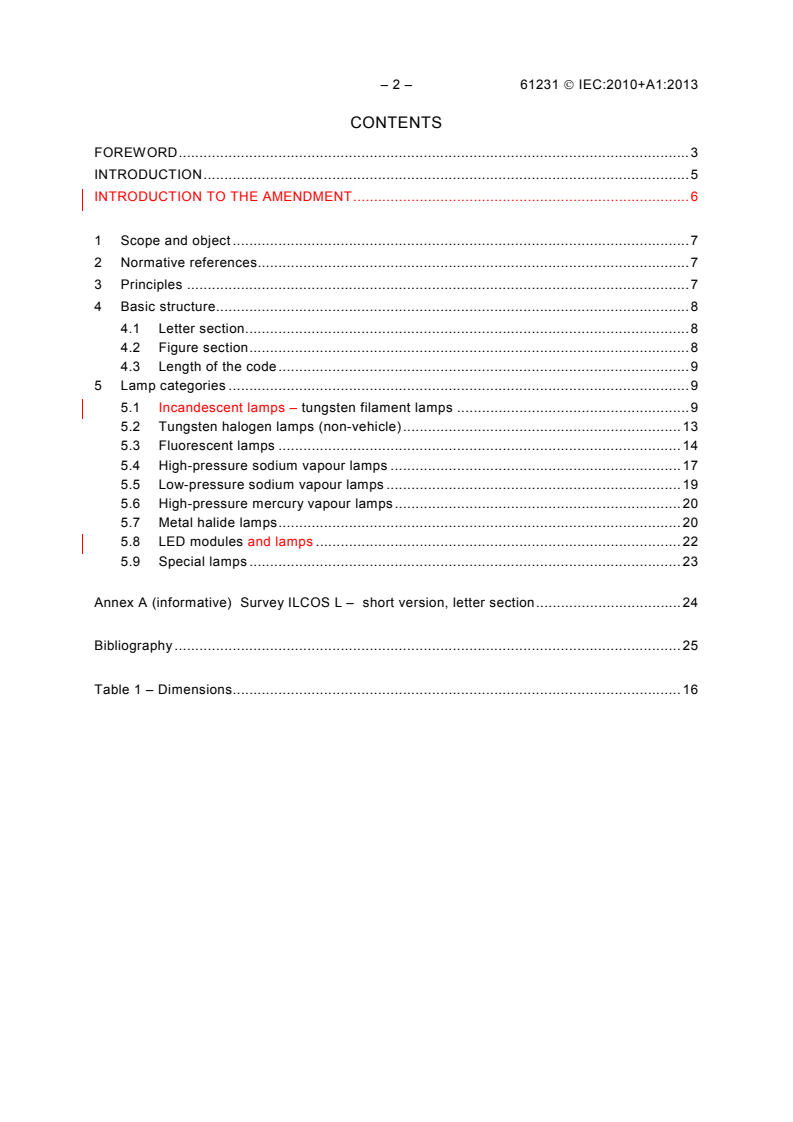
– 2 – 61231 IEC:2010+A1:2013
CONTENTS
FOREWORD . 3
INTRODUCTION . 5
INTRODUCTION TO THE AMENDMENT . 6
1 Scope and object . 7
2 Normative references. 7
3 Principles . 7
4 Basic structure . 8
4.1 Letter section . 8
4.2 Figure section . 8
4.3 Length of the code . 9
5 Lamp categories . 9
5.1 Incandescent lamps – tungsten filament lamps . 9
5.2 Tungsten halogen lamps (non-vehicle) . 13
5.3 Fluorescent lamps . 14
5.4 High-pressure sodium vapour lamps . 17
5.5 Low-pressure sodium vapour lamps . 19
5.6 High-pressure mercury vapour lamps . 20
5.7 Metal halide lamps . 20
5.8 LED modules and lamps . 22
5.9 Special lamps . 23
Annex A (informative) Survey ILCOS L – short version, letter section . 24
Bibliography . 25
Table 1 – Dimensions . 16
61231 IEC:2010+A1:2013 – 3 –
INTERNATIONAL ELECTROTECHNICAL COMMISSION
____________
INTERNATIONAL LAMP CODING SYSTEM (ILCOS)
FOREWORD
1) The International Electrotechnical Commission (IEC) is a worldwide organization for standardization comprising
all national electrotechnical committees (IEC National Committees). The object of IEC is to promote
international co-operation on all questions concerning standardization in the electrical and electronic fields. To
this end and in addition to other activities, IEC publishes International Standards, Technical Specifications,
Technical Reports, Publicly Available Specifications (PAS) and Guides (hereafter referred to as “IEC
Publication(s)”). Their preparation is entrusted to technical committees; any IEC National Committee interested
in the subject dealt with may participate in this preparatory work. International, governmental and non-
governmental organizations liaising with the IEC also participate in this preparation. IEC collaborates closely
with the International Organization for Standardization (ISO) in accordance with conditions determined by
agreement between the two organizations.
2) The formal decisions or agreements of IEC on technical matters express, as nearly as possible, an international
consensus of opinion on the relevant subjects since each technical committee has representation from all
interested IEC National Committees.
3) IEC Publications have the form of recommendations for international use and are accepted by IEC National
Committees in that sense. While all reasonable efforts are made to ensure that the technical content of IEC
Publications is accurate, IEC cannot be held responsible for the way in which they are used or for any
misinterpretation by any end user.
4) In order to promote international uniformity, IEC National Committees undertake to apply IEC Publications
transparently to the maximum extent possible in their national and regional publications. Any divergence
between any IEC Publication and the corresponding national or regional publication shall be clearly indicated in
the latter.
5) IEC itself does not provide any attestation of conformity. Independent certification bodies provide conformity
assessment services and, in some areas, access to IEC marks of conformity. IEC is not responsible for any
services carried out by independent certification bodies.
6) All users should ensure that they have the latest edition of this publication.
7) No liability shall attach to IEC or its directors, employees, servants or agents including individual experts and
members of its technical committees and IEC National Committees for any personal injury, property damage or
other damage of any nature whatsoever, whether direct or indirect, or for costs (including legal fees) and
expenses arising out of the publication, use of, or reliance upon, this IEC Publication or any other IEC
Publications.
8) Attention is drawn to the Normative references cited in this publication. Use of the referenced publications is
indispensable for the correct application of this publication.
9) Attention is drawn to the possibility that some of the elements of this IEC Publication may be the subject of
patent rights. IEC shall not be held responsible for identifying any or all such patent rights.
This consolidated version of the official IEC Standard and its amendment has been prepared
for user convenience.
IEC 61231 edition 1.1 contains the first edition (2010) [documents 34A/1345/CDV and 34A/1374/
RVC] and its amendment 1 (2013) [documents 34A/1663/FDIS and 34A/1680/RVD].
A vertical line in the margin shows where the base publication has been modified by
amendment 1. Additions and deletions are displayed in red, with deletions being struck
through.
– 4 – 61231 IEC:2010+A1:2013
International Standard IEC 61231 has been prepared by subcommittee 34A: Lamps, of IEC
technical committee 34: Lamps and related equipment.
This publication has been drafted in accordance with the ISO/IEC Directives, Part 2.
The committee has decided that the contents of this base publication and its amendment will
remain unchanged until the maintenance result date indicated on the IEC web site under
"http://webstore.iec.ch" in the data related to the specific publication. At this date, the
publication will be
• reconfirmed,
• withdrawn,
• replaced by a revised edition, or
• amended.
IMPORTANT – The “colour inside” logo on the cover page of this publication indicates
that it contains colours which are considered to be useful for the correct understanding
of its contents. Users should therefore print this publication using a colour printer.
61231 IEC:2010+A1:2013 – 5 –
INTRODUCTION
The lamp industry strives continuously to meet customers' needs. Its innovative power has led
to a tremendous variety of different light sources. To enable customers and experts to find their
way within the diversity of products, a general system for the coding of lamps has been
developed.
The code does not replace specific markings used by individual manufacturers on their lamps
or in their catalogues, but it is promoted for cross-referencing purposes and, in due course, to
replace national and regional lamp coding systems which already exist.
NOTE The code does not give all the technical characteristics necessary to specify a lamp fully. For this the
relevant lamp standard and/or the manufacturer’s literature have to be consulted.
– 6 – 61231 IEC:2010+A1:2013
INTRODUCTION TO THE AMENDMENT
This proposal serves:
a) the implementation of the low frequency square wave operation in ILCOS (International
Lamp Coding System):
ILCOS L – wattage – lamp voltage range/starting device/current wave form and frequency –
lamp cap – dimensions
b) the implementation of lamps for use in high-pressure mercury equipment under 5.7.1.2. In
order to distinguish this, other lamps are listed as normal lamps under 5.7.1.1.
c) further editorial changes as being presented with PRESCO(RTK)198 and agreed by
PRESCO.
61231 IEC:2010+A1:2013 – 7 –
INTERNATIONAL LAMP CODING SYSTEM (ILCOS)
1 Scope and object
This International Standard gives the rules for the international lamp coding system and covers
all lamp categories, excluding vehicle lamps. Coding for the main lamp types is specified and,
for the others, will follow by amendments to this standard as appropriate.
The object of the international lamp coding system is
– to improve communication about the different types of lamps;
– to help in discussions concerning interchangeability and compatibility of products;
– to create a closer relationship between international standards and manufacturers’ literature
(for example the code could be given in future in the relevant parts of a standard);
– to enable correct replacements of lamps;
– to be used as a complementary marking on the luminaire;
– to replace national and regional coding systems.
2 Normative references
The following referenced documents are indispensable for the application of this document. For
dated references, only the edition cited applies. For undated references, the latest edition of
the referenced document (including any amendments) applies.
IEC 60357, Tungsten halogen lamps (non-vehicle) – Performance specifications
IEC 60432-1, Incandescent lamps – Safety specifications – Part 1: Tungsten filament lamps for
domestic and similar general lighting purposes
IEC 60432-2, Incandescent lamps – Safety specifications – Part 2: Tungsten halogen lamps for
domestic and similar general lighting purposes
IEC 60838-2-2, Miscellaneous lampholders – Part 2-2: Particular requirements – Connectors
for LED-modules
IEC/TR 60887, Glass bulb designation system for lamps
IEC 61167, Metal halide lamps
CIE publication 29.2, Guide on interior lighting
IEC/TR 62732, Three-digit code for designation of colour rendering and correlated colour
temperature
3 Principles
The international lamp coding system has been developed on the basis of the following
principles.
– It should be manufacturer-independent concerning its content and its wording.
– 8 – 61231 IEC:2010+A1:2013
– A relationship between the coding system and international standards should be
established.
– It should be internationally acceptable. It is recognized that other systems with national and
regional importance exist and that the change to an international code should be seen as a
long-term process.
– The length of the code should be as short as possible and as long as necessary. Therefore,
it should be possible to use the code in different lengths depending on the different
purposes.
– In view of the technical diversity of the different lamp categories, it would not be practical to
define the code for all types in the same way; the code depends therefore in its composition
on the technical needs of the different lamp categories.
– The code should not replace manufacturer-specific marking on the lamp or in the
catalogues, but should be used for cross-references in lamp and luminaire literature.
– The allocation of codes is based on interchangeability and compatibility.
An additional usage of the code on the lamp package should be envisaged for the future.
4 Basic structure
The complete lamp code ILCOS consists of a letter section and a figure section.
4.1 Letter section
The first letter of the letter section designates the lamp category as follows:
I Incandescent lamps – tungsten filament lamps
H Tungsten halogen lamps (non-vehicle)
F Fluorescent lamps
S High-pressure sodium vapour lamps
L Low-pressure sodium vapour lamps
Q High-pressure mercury vapour lamps
M Metal halide lamps
D LED modules and lamps
X Special lamps
NOTE Vehicle lamps, including their coding, are covered by national and/or regional legislation.
The next letters within the letter section give further details as outlined in the description of the
different lamp categories. The letter section is separated from the rest by a hyphen.
4.2 Figure section
The figure section consists of several blocks mainly containing figures. Each block, separated
by hyphens, contains characteristic values of lamps such as
– wattage;
– voltage;
– lamp cap;
– dimensional values.
As a hyphen is used to separate the blocks, it cannot be applied within a block. As a
consequence, the sign of equality = is used instead of the hyphen, for example within the cap
designation.
61231 IEC:2010+A1:2013 – 9 –
The sequence and the specific content of the blocks is determined for each lamp category and
described in 5.1 to 5.89.
4.3 Length of the code
4.3.1 General
The code can be used in different lengths depending on the purpose. In catalogues and
leaflets, specialities, for example special applications, can be indicated with an asterisk (*) in
the place where the difference occurs or at the end of the code and explained in a separate
remark, also indicated with an asterisk (*).
The code can be shortened by deleting parts from the end, not by deleting intermediate parts.
In general, if ‘standard’ types are concerned, the dimension block can be omitted. Intermediate
parts may be omitted, providing the separating signs such as hyphens (–) and slashes (/) are
given.
NOTE These shortening rules do not apply to the extended short version ILCOS LE.
4.3.2 Short version: ILCOS L
The short version consists of the letter section or a part of it and is called ILCOS L. It can be
used for the general classification of lamps. A survey of ILCOS L is given in Annex A.
4.3.3 Extended short version: ILCOS LE
The extended short version, where applicable, consists of the first part of the letter section
(ILCOS L) immediately followed (without spaces) by the relevant dimensions.
4.3.4 Standard version: ILCOS D
The standard version gives the complete designation and consists of the letter section and (a
part of) the figure section. The use of ILCOS D should enable the customer to find the correct
lamp type, for example in the case of lamp replacement from a different manufacturer. It can
be used for the purpose of marking luminaires, when suitable also in an abbreviated form.
5 Lamp categories
For information about relevant lamp standards and lamp-related standards, see the IEC
publications prepared by IEC technical committee 34.
5.1 Incandescent lamps – tungsten filament lamps
5.1.1 ILCOS L for incandescent lamps – tungsten filament lamps
The ILCOS L code is built up as follows:
– 10 – 61231 IEC:2010+A1:2013
Incandescent lamps – tungsten filament lamps
Non-reflector lamps Reflector lamps
IA IB IN
Large lamps Compact bulb lamps Other non-reflector lamps
(bulb diameter usually (bulb diameter usually (lamps outside the scope
of IEC 60432-1)
> 45 mm) ≤ 45 mm)
Pear-shaped, mushroom or Candle, round bulb or lamps
lamps with other shapes with other shapes intended
intended for use in the same for use in the same luminaire
luminaire
After the first two letters IA, IB and IN the shape of the bulb follows, indicated as specified in
IEC 60887.
The main bulb shape types are
A pear-shaped
--
B candle (bulged) (candle)
--
C conical
--
G globular
--
M mushroom
--
P round bulb
--
S pigmy (straight-sided)
--
T tubular
--
An Some examples with a modifiers is are:
BA bulged (candle) with angular tip
--
BF bulged (candle) with flutes twisted
--
61231 IEC:2010+A1:2013 – 11 –
For reflector lamps:
Reflector lamps
IR
IRR IRA IRP IPAR IPARD
R bulb reflector Pear-shaped Round bulb bowl Normal PAR Dichroic PAR
lamps bowl mirror mirror lamps bulb reflector bulb reflector
lamps lamps lamps
If it is necessary to indicate the finish or the colour of a lamp, or the specific kind of reflector or
other technical details, this can be done after a slash as follows:
/C clear
/F frosted, frosted equivalently coated
/W white
/R red
/B blue
/G green
/Y yellow
/V violet
/P pink
/A amber
/O orange
/S silver
/X gold
/N neodymium
/D decorative filament design
A second letter may be added for the following purposes:
/ P to indicate pastel shades
-
/ F to indicate a window
-
/
T to indicate transparent colours
-
Further technical details can be given after a second slash:
//AX axial filament
//TR transversal filament
//RS rough service lamps
//LT limited surface temperature
//RT rough service with limited surface temperature
Examples
IAA/F Frosted pear-shaped lamps
IAM Mushroom lamps
– 12 – 61231 IEC:2010+A1:2013
IAT/W White-coated tubular lamps intended for use in the same luminaire
as pear-shaped lamps
IBBA/C Bulged clear (candle) lamps with angular tip
IBP/R Red round bulb lamps
IAG Globular lamps, intended for use in the same luminaire as pear-shaped lamps
IBT/W White-coated tubular lamps, intended for use in the same luminaire
as round bulb lamps IBP
IBC Conical lamps, intended for use in the same luminaire as round bulb lamps IBP
IRA/S Pear-shaped bowl mirror lamp with silver reflector
5.1.2 ILCOS LE for incandescent lamps – tungsten filament lamps
ILCOS LE consists of the first part of ILCOS L up to and including the shape indication followed
by the number giving the nominal diameter of the lamp.
Examples
IAA60 Pear-shaped lamp with 60 mm nominal bulb diameter
IBP45 Round bulb lamp with 45 mm nominal bulb diameter
IAG80 Globular lamp with 80 mm nominal bulb diameter
5.1.3 ILCOS D for incandescent lamps – tungsten filament lamps
ILCOS D consists of the following blocks:
ILCOS L-wattage-rated voltage-lamp cap-dimensions
– Wattage: For miniature and/or glow lamps, the lamp current can be indicated in place of
the wattage. In that case, the lamp current value shall be immediately followed by a capital
A.
– Rated voltage: In case of a voltage range, two numbers are given separated by a slash.
– For airfield lamps the lamp voltage may be replaced by the lamp current value immediately
followed by a capital A.
– Dimensions: This block consists normally only of the number giving the nominal diameter.
For tubular lamps the maximum overall length can be added after a slash. For reflector
lamps, the beam angle can be added after a slash. In case of a non-symmetrical beam, two
numbers separated by a slash may be given, the first describing the horizontal and the
second the vertical beam angle.
Examples
IAA/C-40-220/230-E27-60 Clear pear-shaped lamp, 40 W, 220-230 V, cap E27, nominal
diameter 60 mm
IBB/W-40---35 White bulged (candle) lamp, 40 W, nominal diameter 35 mm,
rest not specified
IRR-60-240-B22d-125/30 R bulb reflector lamp, 60 W, 240 V, cap B22d, type R125,
beam angle 30°
61231 IEC:2010+A1:2013 – 13 –
5.2 Tungsten halogen lamps (non-vehicle)
5.2.1 ILCOS L for tungsten halogen lamps
The first two letters will be
HS Single-ended halogen lamps
HD Double-ended halogen lamps
HR Dichroic reflector halogen lamps
HM Metal reflector halogen lamps
HA Halogen lamps with aluminized glass reflector
HP Single-ended halogen lamps with proximity reflector
Third letter to indicate the field of application of the lamp:
P Projection including overhead projection and micro-film/-fiche lamps
--
S Photo/Studio/Theatre/Video
--
A Airfield
--
T Traffic signal
--
G General purpose (floodlight lamps are considered as general purpose)
--
A fourth letter can be used to indicate self-shielded lamps. Self-shielded lamps are lamps
designed to be suitable for use in open luminaires. Examples of self-shielded lamps are ELV
lamps with integral outer envelope, low-pressure tungsten halogen lamps and mains voltage
lamps which conform to IEC 60432-2 (for further information, see IEC 60357).
S Self-shielded halogen lamp
---
The bulb shape can be indicated after the third or fourth letter as described for incandescent
lamps – tungsten filament lamps.
If it is necessary to indicate the bulb finish, special colours or other technical details, this can
be done after one or two slashes as described for incandescent lamps – tungsten filament
lamps (see 5.1.1).
Further technical details can be given after a second slash:
//UB UV reduction
//IB IR utilization
//S Short neck
Examples
HSGST Single-ended general purpose halogen lamps, self-shielded, tubular shaped
HDG Double-ended floodlight general purpose halogen lamps
HRG Dichroic reflector general purpose halogen lamps
HMGS Metal reflector general purpose halogen lamps, self-shielded
5.2.2 ILCOS LE for tungsten halogen lamps
ILCOS LE consists of ILCOS L up to the first slash immediately followed by the dimension
block as described in 5.2.3.
– 14 – 61231 IEC:2010+A1:2013
Examples
HRGS51 General purpose dichroic reflector lamp, self-shielded,
with a reflector diameter of 51 mm
HMGS37 General purpose metal reflector lamp, self-shielded,
with a reflector diameter of 37 mm
5.2.3 ILCOS D for tungsten halogen lamps
ILCOS D consists of the following blocks:
ILCOS L-wattage-rated voltage-lamp cap-dimensions
– Wattage: In the case of a two-filament lamp, the wattage of each filament is given
combined by a (+) sign.
Where needed for further distinction, this block can be extended by a slash to give
information concerning the colour temperature in the following way. The colour temperature
of the lamp is divided by 100 and the number obtained is rounded to an integer.
– Rated voltage: In case of a voltage range, two numbers are given separated by a slash.
For airfield lamps, the lamp voltage may be replaced by the lamp current value immediately
followed by a capital A.
– Dimensions: The content of this block depends on the specific characteristics of the
different halogen lamp types. Nominal values are given, except for the bulb diameter of
single-ended lamps. It can contain one value and, if needed for further discrimination,
a second one after a slash as follows:
ILCOS L Dimensions (nominal)
– Bulb diameter (max.)/light centre length
HS
HD – Contact to contact length Z
nom
– Diameter of reflector/beam angle
HR
HM – Diameter of reflector/beam angle
HA – Diameter of reflector/beam angle
HP – Light centre length
Examples
HSG-20-12-G4-22 Single-ended general purpose halogen lamp, 20 W, 12 V, G4
base, light centre length 22 mm
HDS-800-220/230-R7s-74,9 Double-ended photo/studio halogen lamp, 800 W, 220-230 V,
R7s cap, contact-to-contact length 74,9 mm
HRGS-50-12-GX5.3-51/30 Dichroic reflector general purpose halogen lamp, self-
shielded, 50 W, 12 V, base GX5.3, diameter 51 mm, beam
angle 30°
5.3 Fluorescent lamps
5.3.1 ILCOS L for fluorescent lamps
The first two letters will be
FD Double-capped lamps
FS Single-capped lamps
FB Self-ballasted lamps
Additional information can be indicated by a third letter as follows:
61231 IEC:2010+A1:2013 – 15 –
FDR Double-capped lamps with internal reflector
FDU Double-capped lamps, U-shaped
FSD Single-capped lamps, dual shaped
FSQ Single-capped lamps, quad shaped
FSS Single-capped lamps, square shaped
FSM Single-capped lamps, multi-limbed
FSC Single-capped lamps, circular shaped
FSG Single-capped lamps, globular
For FD and FS lamps a last letter can be added to indicate:
H For high frequency ballasts only
--
I Induction type lamp
--
For FB lamps the shape can be indicated as described for incandescent lamps – tungsten
filament lamps (see 5.1.1). A last letter can be added to indicate:
H Integral HF type ballast
---
I Integral induction type ballast
---
Colours or other bulb finishes can be indicated after a slash, as described for incandescent
lamps – tungsten filament lamps (see 5.1.1).
Further technical details can be given after a second double slash as follows:
//L For use in low ambient temperatures
//H For use in high ambient temperatures
//P Photocell integrated
//PL Photocell integrated and for use in low ambient temperatures
//PH Photocell integrated and for use in high ambient temperatures
5.3.2 ILCOS LE for fluorescent lamps
ILCOS LE consists of ILCOS L (up to the first slash) immediately followed by the relevant
dimensions.
Examples
FD26 Double-capped lamp with nominal tube diameter 26 mm
FD38/1200 Double-capped lamp with nominal tube diameter 38 mm and nominal tube
length 1 200 mm (hence 40 W).
FD/1200 Double-capped lamp with nominal tube length 1 200 mm (36 W or 40 W)
5.3.3 ILCOS D for fluorescent lamps
ILCOS D consists of the following blocks:
ILCOS L-wattage-starting details (note)-lamp cap-dimensions
NOTE For self-ballasted lamps, the rated voltage is given instead of the starting details; if necessary, extended
after a slash by the rated frequency.
– Wattage: The block specifying wattage can be extended by a slash to give information
concerning the colour rending index and colour temperature and after another slash
– 16 – 61231 IEC:2010+A1:2013
concerning the colour-rendering properties in the following way as described in
IEC/TR 62732.
The colour temperature of the lamp is divided by 100 and the number obtained is rounded
to an integer.
The colour-rendering properties are indicated by one of the following CIE (see CIE publi-
cation 29.2) colour-rendering groups:
1A for R ≥ 90;
a
1B for R = 80-89;
a
2A for R = 70-79;
a
2B for R = 60-69;
a
3 for R = 40-59;
a
4 for R = 20-39.
a
– Starting details: The starting details for FD and FS lamps are given as follows:
- - No starting details for induction type
-I- Internal starter
-E- External starter, preheated
-L/ - Starterless
-LC/ - Starterless, low starting voltage with conductive strip or layer
- /P/ - Preheated
-
- /N- Non-preheated
-
- / /H- Cathodes of high resistance (only for starterless)
- -
- / /L- Cathodes of low resistance (only for starterless)
- -
The information concerning the starting details can be abbreviated, where appropriate;
however, this shall be done only from the right to the left. For example, the information
concerning cathodes of high or low resistance is only relevant for starterless operation;
therefore this part can be omitted for lamps with starters.
– Dimensions: This block gives information with regard to the nominal (for FD) or maximum
(for FS and FB) values of cross-section and length of the lamp. If the cross-section is
round, two values are given, which are separated by a slash, the first value indicating the
diameter of the cross-section. If the cross-section is rectangular, the dimensional part
consists of three values, separated by slashes, the first two values describing the cross-
section and the last one the length.
For the main lamp group FD the dimension block is only used for dimensions which are not
indicated in Table 1.
Table 1 – Dimensions
Diameter Nominal length Wattage
16 150 4
225 6
300 8
525 13
26/38 600 18/20, 16HF
1 200 36/40, 32HF
1 500 58/65, 50HF
61231 IEC:2010+A1:2013 – 17 –
Examples
FD-36-E-G13 Double-capped fluorescent lamp, 36 W, external starter,
preheated, (European "switch start" version), cap G13,
diameter 26 mm, length 1 200 mm
abbreviated: FD-36-E (usually with diameter 26 mm)
FD-36/830/1B-E-G13 Same lamp as above, but with indication of colour
properties, colour temperature 3 000 K, colour rendering
group 1B (R =80-89) (Ra) = 80-89
a
abbreviated: FD-36/830/1B
FD-40-L/P/L-G13 Double-capped fluorescent lamp, 40 W, starterless, pre-
heated, low cathode resistance, (North American "rapid
start" version), cap G13, diameter 38 mm, length 1 200 mm
abbreviated: FD-40-L/P (usually with diameter 38 mm)
FSC-40-L/P/L-G10q-32/406 Circular fluorescent lamp, 40 W, starterless, preheated,
low-cathode resistance, cap G10q, tube diameter 32 mm,
lamp diameter 406 mm
abbreviated: FSC-40-L
FD-40-L/N-Fa8 Double-capped fluorescent lamp, 40 W, starterless, non-
preheated, ("instant start" version), cap Fa8, diameter
38 mm, length 1 200 mm
abbreviated: FD-40-L/N (usually with diameter 38 mm)
FSD-7-I-G23-28/13/115 Single-capped fluorescent lamp, dual shaped, 7 W, internal
starter, cap G23, cross-section 28 mm × 13 mm, length
115 mm
abbreviated: FSD-7-I
FSQ-18-E-G24q=2-28/28/140 Single-capped fluorescent lamp, quad shaped, 18 W,
external starter, cap G24q-2, cross-section 28 mm × 28 mm,
length 140 mm
abbreviated: FSQ-18-E
FBT-18-230-E27-73/150 Self-ballasted fluorescent lamp, tubular, 18 W, rated
voltage 230 V, cap E27, diameter 73 mm, length 150 mm
abbreviated: FBT-18
FBGH-11-230/240-E27-112/178 Self-ballasted fluorescent lamp, globular shape, integral HF
type ballast, 11 W, rated voltage 230-240 V, cap E27,
diameter 112 mm, length 178 mm
abbreviated: FBGH-11
FSGI-55--K Single-capped fluorescent lamp, globular shape, induction
type, 55 W, cable connector
FBRI-23-230/240-E27-82/127 Self-ballasted fluorescent reflector lamp, integral induction
type ballast, 23 W, rated voltage 230-240 V, cap E27,
diameter 82 mm, length 127 mm
5.4 High-pressure sodium vapour lamps
5.4.1 ILCOS L for high-pressure sodium vapour lamps
5.4.1.1 Normal version
The first two letters will be
– 18 – 61231 IEC:2010+A1:2013
ST Single-ended tubular clear lamps
SE Single-ended lamps with elliptical bulb, diffuse coating
SC Single-ended lamps with elliptical bulb, clear
SD Double-ended clear lamps
SR Lamps of reflector version
5.4.1.2 Lamps for use in high-pressure mercury equipment
The first three letters will be: S_Q
SEQ Lamps with elliptical bulb, diffuse coating, for high-pressure mercury equipment
5.4.1.3 Colour improved lamp
The first three letters will be: S_M (M: Medium colour rendering)
STM Tubular clear lamps, colour improved
5.4.1.4 Lamp with high colour rendering
The first three letters will be: S_H (H: High colour rendering)
STH Tubular clear lamps with high colour rendering
Further technical details can be given after a slash as follows:
/T Twin arc tube
/E Special electronic operation
/F Frosted bulb finish (tubular lamps)
5.4.2 ILCOS LE for high-pressure sodium vapour lamps
Not applicable for high-pressure sodium vapour lamps.
5.4.3 ILCOS D for high-pressure sodium vapour lamps
ILCOS D consists of the following blocks:
ILCOS L-wattage-lamp voltage range-lamp cap-dimensions
– Lamp voltage range: The lamp voltage range is indicated by the letter L, H or E:
L for lamp voltage range < 70 V
H for lamp voltage range of 70 V-180 V
E for lamp voltage range > 180 V
If necessary for further distinction, the lamp voltage can be given after the letter L, H or E
as a number, for example L52.
The lamp voltage range block can be extended by a slash to give further information
concerning the starting device:
/E Lamps with external starting device
/I Lamps with internal starting device
/S Lamps with external starting device and increased starting voltage (usually not used
for replacement types)
61231 IEC:2010+A1:2013 – 19 –
– Dimensions: This block consists of two values separated by a slash representing the
maximum bulb diameter and the maximum lamp length. For reflector lamps, the beam
angle can be added after a slash.
Examples
ST-150-H/E-E40-53/211 High-pressure sodium vapour lamp, tubular clear, 150 W,
voltage range 70 V-180 V, external starting device, cap E40,
maximum diameter 53 mm, maximum overall length 211 mm
abbreviated: ST-150 (usually with external starting device, and with the dimensions
as given)
SEM-150-H/E-E40-91/227 High-pressure sodium vapour lamp, elliptical diffuse coated
bulb, colour improved, 150 W, voltage range 70 V-180 V,
external starting device, cap E40, maximum diameter 91 mm,
maximum overall length 227 mm
abbreviated: SEM-150
SEQ-210-H-E40-91/227 High-pressure sodium vapour lamp, elliptical diffuse coated
bulb, for use in high-pressure mercury equipment, 210 W,
voltage range 70 V-180 V, cap E40, maximum diameter 91 mm,
maximum overall length 227 mm
abbreviated: SEQ-210
5.5 Low-pressure sodium vapour lamps
5.5.1 ILCOS L for low-pressure sodium vapour lamps
The first letters will be
LS Lamps, single-capped (with U-shaped arc tube)
LSE Lamps, single-capped, of the E type
5.5.2 ILCOS LE for low-pressure sodium vapour lamps
Not applicable for low-pressure sodium vapour lamps.
5.5.3 ILCOS D for low-pressure sodium vapour lamps
ILCOS D consists of the following blocks:
ILCOS L-wattage (note)-lamp cap-dimensions
NOTE For lamps of the E-type the wattage is replaced by the lamp designation consisting of E plus a number.
– Dimensions: This block contains the maximum bulb diameter and the maximum overall
length, separated by a slash.
It can be extended to give information regarding a limitation in the operating position as
described for metal halide lamps (see 5.7.3).
Examples
LS-90-BY22d-68/528 Low-pressure sodium vapour lamp, U-shaped arc tube, 90 W,
cap BY22d, maximum bulb diameter 68 mm, maximum overall
length 528 mm
abbreviated: LS-90
LSE-E131-BY22d-68/1120 Low-pressure sodium vapour lamp, E-type, designation E131,
cap BY22d, maximum bulb diameter 68 mm, maximum overall
length 1 120 mm
abbreviated: LSE-E131
– 20 – 61231 IEC:2010+A1:2013
5.6 High-pressure mercury vapour lamps
5.6.1 ILCOS L for high-pressure mercury vapour lamps
The first letters will be
QT Tubular clear lamps
QE Lamps with elliptical bulb, diffuse coating
QC Lamps with elliptical bulb, clear
QR Lamps of reflector version
QB Blended lamps (self-ballasted)
QBR Blended lamps (self-ballasted) with reflector
NOTE In some countries it is necessary to identify lamps as "regular" or "fail-safe design" (lamp is extinguished
when the outer bulb is broken). This can be included in the code by extending the block ILCOS L by a slash
followed by the letter R for regular lamps or T for the fail-safe design.
5.6.2 ILCOS LE for high-pressure mercury vapour lamps
Not applicable for high-pressure mercury vapour lamps.
5.6.3 ILCOS D for high-pressure mercury vapour lamps
ILCOS D consists of the following blocks:
ILCOS L-wattage-lamp voltage range (note)-lamp cap-dimensions
NOTE For blended lamps (self-ballasted), the rated voltage is given instead of the lamp voltage range.
– Wattage: The wattage block can be extended to give information concerning the colour
temperature and colour-rendering properties as described for fluorescent lamps (see 5.3.3).
– Lamp voltage range: The lamp voltage range is indicated as described for high-pressure
sodium vapour lamps (see 5.4.3).
– Dimensions: This block contains the maximum bulb diameter and the maximum overall
length, separated by a slash. For reflector lamps, the beam angle can be added after a slash.
Examples
QE-125-H-E27-76/178 High-pressure mercury vapour lamp, elliptical bulb, diffuse
coated, 125 W, voltage range 70 V-180 V, cap E27, maximum
bulb diameter 76 mm, maximum overall length 178 mm
abbreviated: QE-125
QE-700-E-E40-152/357 High-pressure mercury vapour lamp, elliptical diffuse coated
bulb, 700 W, voltage range > 180 V, cap E40, maximum bulb
diameter 152 mm, maximum overall length 357 mm
abbreviated: QE-700-E
5.7 Metal halide lamps
5.7.1 ILCOS L for metal halide lamps
5.7.1.1 Normal version
The first letters will be
MT Single-ended tubular clear lamps
ME Single-ended lamps with elliptical or BT bulb, diffuse coating
61231 IEC:2010+A1:2013 – 21 –
MC Single-ended lamps with elliptical or BT bulb, clear
MD Double-ended lamps with clear outer bulb
MN Double-ended lamps without outer bulb
MR Reflector lamps
5.7.1.2 Lamps for use in high-pressure mercury vapour lamp equipment
The first three letters will be: M_Q
MEQ Lamps with elliptical or BT bulb, diffuse coating, for high-pressure mercury vapour lamp
equipment
5.7.1.3 Further extension
A third or fourth letter can be used to indicate self-shielded lamps, i.e. lamps designed to be
suitable for use in open luminaires:
S Self-shielded lamps
--
Further technical details can be given after a slash:
/UB UV reduction
/F Frosted bulb finish (tubular lamps, double-ended lamps)
5.7.2 ILCOS LE for metal halide lamps
Not applicable for metal halide lamps.
5.7.3 ILCOS D for metal halide lamps
For types standardized according to IEC 61167, ILCOS D consists of the following blocks:
ILCOS L-wattage-lamp voltage range-lamp cap-dimensions
– Wattage: The wattage block can be extended to give information concerning the colour
temperature and colour-rendering properties as described for fluorescent lamps (see 5.3.3).
– Lamp voltage range: The lamp voltage range is indicated as described for high-pressure
sodium vapour lamps (see 5.4.3). After a slash the starting devices can be stated:
/E Lamp with external starting device
/I Lamp with internal starting device
A further slash can be inserted after which information on the wave form and frequency of the
operating current can be introduced:
/S (or nothing) sine wave 50 Hz or 60 Hz
/L low frequency square wave 70 Hz to 400 Hz
/H any wave form greater than 400 Hz
If more than one operating mode is possible, the letters shall be combined. Example:
/SL The metal halide lamp can be operated at 50/60 Hz sine wave and at low
frequency.
– Dimensions: The dimensional block contains the maximum bulb diameter and the
maximum overall length, separated by a slash. For double-ended lamps, the nominal
contact-to-contact length Z is given instead of the maximum overall len
...