

IEC TS 62565-4-2:2018
(Main)Nanomanufacturing - Material specifications - Part 4-2: Luminescent nanomaterials - Detail specification for general lighting and display applications
General Information
- Abstract
IEC TS 62565-4-2:2018 specifies the essential general and optical requirements of monodisperse luminescent nanomaterials used in general lighting and display products to enable their reliable mass production and quality control during the manufacturing process. This document does not address mixtures or agglomerations of luminescent nanomaterials.
In addition, this document enables the customer to specify requirements in a standardized manner and to verify through standardized methods that the luminescent nanomaterial meets the required properties.
- Status
- Published
- Publication Date
- 23-May-2018
- Technical Committee
- TC 113 - Nanotechnology for electrotechnical products and systems
- Drafting Committee
- PT 62565-4-2 - TC 113/PT 62565-4-2
- Current Stage
- PPUB - Publication issued
- Start Date
- 24-May-2018
- Completion Date
- 11-Jun-2018
Buy Documents
IEC TS 62565-4-2:2018 - Nanomanufacturing - Material specifications - Part 4-2: Luminescent nanomaterials - Detail specification for general lighting and display applications Released:5/24/2018
Overview
IEC TS 62565-4-2:2018 - Nanomanufacturing – Material specifications – Part 4-2: Luminescent nanomaterials - provides a standardized format for specifying, reporting and verifying the essential general and optical requirements of monodisperse luminescent nanomaterials used in general lighting and display applications. The Technical Specification focuses on enabling reliable mass production and quality control of materials such as semiconductor quantum dots and inorganic nanophosphors. It does not cover mixtures or agglomerates of luminescent nanomaterials.
Key topics and requirements
- Scope and purpose: Defines the essential material and optical attributes needed for lighting and display use, and how customers can specify them reproducibly.
- Measurement standards: References methods and measurement standards required to validate properties (see normative references).
- General requirements: Guidance on procurement data, traceability (e.g., date of manufacture), and reporting format for material deliveries.
- Key control characterization:
- Physical and chemical characteristics: particle monodispersity, composition, concentration/mass of dispersion, and other supply-related parameters.
- Optical characteristics: emission spectrum (including peak wavelength and FWHM), absorption behaviour, photoluminescence quantum efficiency and colour specification (CIE coordinates, illuminant/observer).
- Test and analysis overview: A summary of test methods and analytical techniques used for quality control and verification during manufacturing.
- Documentation format: Tables and formats for presenting general information, characteristic requirements and test results to support standardized procurement and QC.
Practical applications
- Specification and acceptance criteria for quantum dots, quantum rods, and nanophosphors used in:
- LED-based general lighting (lamps, luminaires)
- Backlights for displays and TVs (LCD/LED hybrid designs)
- Colour-conversion layers and films in display manufacturing
- Enables manufacturers and integrators to ensure consistent colour, high photoluminescence efficiency, and batch-to-batch reproducibility for mass production.
- Supports test laboratories in developing standardized verification protocols for optical and physical metrics.
Who uses this standard
- Nanomaterial manufacturers and suppliers (quantum dot producers, nanophosphor makers)
- LED and display module manufacturers, optical engineers, and product integrators
- Quality assurance teams and test laboratories performing materials verification
- Procurement specialists who require standardized specification formats
Related standards
- IEC 62607-3-1 - Quantum efficiency measurement for luminescent nanomaterials
- IEC TS 62607-3-2 - Determination of mass of quantum dot dispersion
- Other parts of the IEC 62565 nanomanufacturing material specifications series
This Technical Specification is essential for stakeholders aiming to apply standardized, reproducible requirements and test methods to luminescent nanomaterials for lighting and display sectors. Keywords: IEC TS 62565-4-2, luminescent nanomaterials, nanomanufacturing, quantum dots, nanophosphors, general lighting, display applications, material specifications, photoluminescence, quantum efficiency, quality control.
Buy Documents
IEC TS 62565-4-2:2018 - Nanomanufacturing - Material specifications - Part 4-2: Luminescent nanomaterials - Detail specification for general lighting and display applications Released:5/24/2018
Frequently Asked Questions
IEC TS 62565-4-2:2018 is a technical specification published by the International Electrotechnical Commission (IEC). Its full title is "Nanomanufacturing - Material specifications - Part 4-2: Luminescent nanomaterials - Detail specification for general lighting and display applications". This standard covers: IEC TS 62565-4-2:2018 specifies the essential general and optical requirements of monodisperse luminescent nanomaterials used in general lighting and display products to enable their reliable mass production and quality control during the manufacturing process. This document does not address mixtures or agglomerations of luminescent nanomaterials. In addition, this document enables the customer to specify requirements in a standardized manner and to verify through standardized methods that the luminescent nanomaterial meets the required properties.
IEC TS 62565-4-2:2018 specifies the essential general and optical requirements of monodisperse luminescent nanomaterials used in general lighting and display products to enable their reliable mass production and quality control during the manufacturing process. This document does not address mixtures or agglomerations of luminescent nanomaterials. In addition, this document enables the customer to specify requirements in a standardized manner and to verify through standardized methods that the luminescent nanomaterial meets the required properties.
IEC TS 62565-4-2:2018 is classified under the following ICS (International Classification for Standards) categories: 07.030 - Physics. Chemistry; 07.120 - Nanotechnologies. The ICS classification helps identify the subject area and facilitates finding related standards.
IEC TS 62565-4-2:2018 is available in PDF format for immediate download after purchase. The document can be added to your cart and obtained through the secure checkout process. Digital delivery ensures instant access to the complete standard document.
Standards Content (Sample)
IEC TS 62565-4-2 ®
Edition 1.0 2018-05
TECHNICAL
SPECIFICATION
Nanomanufacturing – Material specifications –
Part 4-2: Luminescent nanomaterials – Detail specification for general lighting
and display applications
All rights reserved. Unless otherwise specified, no part of this publication may be reproduced or utilized in any form
or by any means, electronic or mechanical, including photocopying and microfilm, without permission in writing from
either IEC or IEC's member National Committee in the country of the requester. If you have any questions about IEC
copyright or have an enquiry about obtaining additional rights to this publication, please contact the address below or
your local IEC member National Committee for further information.
IEC Central Office Tel.: +41 22 919 02 11
3, rue de Varembé info@iec.ch
CH-1211 Geneva 20 www.iec.ch
Switzerland
About the IEC
The International Electrotechnical Commission (IEC) is the leading global organization that prepares and publishes
International Standards for all electrical, electronic and related technologies.
About IEC publications
The technical content of IEC publications is kept under constant review by the IEC. Please make sure that you have the
latest edition, a corrigenda or an amendment might have been published.
IEC Catalogue - webstore.iec.ch/catalogue Electropedia - www.electropedia.org
The stand-alone application for consulting the entire The world's leading online dictionary of electronic and
bibliographical information on IEC International Standards, electrical terms containing 21 000 terms and definitions in
Technical Specifications, Technical Reports and other English and French, with equivalent terms in 16 additional
documents. Available for PC, Mac OS, Android Tablets and languages. Also known as the International Electrotechnical
iPad. Vocabulary (IEV) online.
IEC publications search - webstore.iec.ch/advsearchform IEC Glossary - std.iec.ch/glossary
The advanced search enables to find IEC publications by a 67 000 electrotechnical terminology entries in English and
variety of criteria (reference number, text, technical French extracted from the Terms and Definitions clause of
committee,…). It also gives information on projects, replaced IEC publications issued since 2002. Some entries have been
and withdrawn publications. collected from earlier publications of IEC TC 37, 77, 86 and
CISPR.
IEC Just Published - webstore.iec.ch/justpublished
Stay up to date on all new IEC publications. Just Published IEC Customer Service Centre - webstore.iec.ch/csc
details all new publications released. Available online and If you wish to give us your feedback on this publication or
also once a month by email. need further assistance, please contact the Customer Service
Centre: sales@iec.ch.
IEC TS 62565-4-2 ®
Edition 1.0 2018-05
TECHNICAL
SPECIFICATION
Nanomanufacturing – Material specifications –
Part 4-2: Luminescent nanomaterials – Detail specification for general lighting
and display applications
INTERNATIONAL
ELECTROTECHNICAL
COMMISSION
ICS 07.030; 07.120 ISBN 978-2-8322-5742-5
– 2 – IEC TS 62565-4-2:2018 © IEC 2018
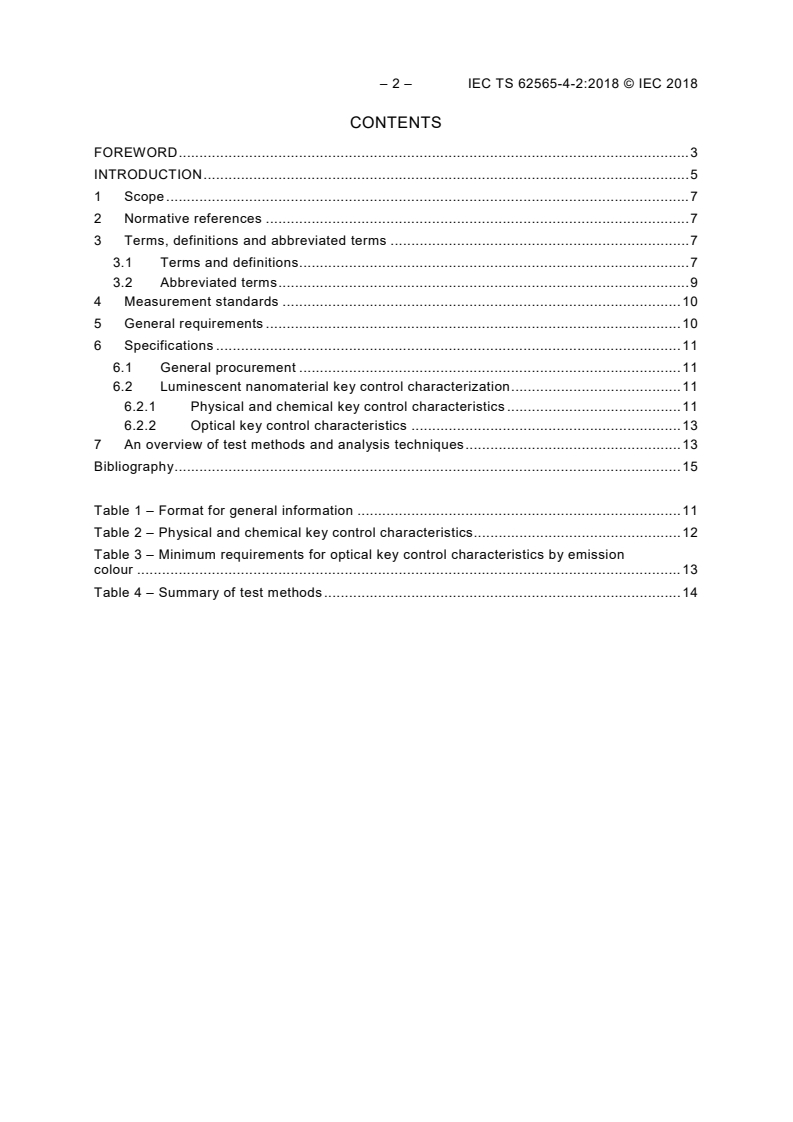
CONTENTS
FOREWORD . 3
INTRODUCTION . 5
1 Scope . 7
2 Normative references . 7
3 Terms, definitions and abbreviated terms . 7
3.1 Terms and definitions . 7
3.2 Abbreviated terms . 9
4 Measurement standards . 10
5 General requirements . 10
6 Specifications . 11
6.1 General procurement . 11
6.2 Luminescent nanomaterial key control characterization . 11
6.2.1 Physical and chemical key control characteristics . 11
6.2.2 Optical key control characteristics . 13
7 An overview of test methods and analysis techniques . 13
Bibliography . 15
Table 1 – Format for general information . 11
Table 2 – Physical and chemical key control characteristics. 12
Table 3 – Minimum requirements for optical key control characteristics by emission
colour . 13
Table 4 – Summary of test methods . 14
INTERNATIONAL ELECTROTECHNICAL COMMISSION
____________
NANOMANUFACTURING –
MATERIAL SPECIFICATIONS –
Part 4-2: Luminescent nanomaterials –
Detail specification for general lighting and display applications
FOREWORD
1) The International Electrotechnical Commission (IEC) is a worldwide organization for standardization comprising
all national electrotechnical committees (IEC National Committees). The object of IEC is to promote
international co-operation on all questions concerning standardization in the electrical and electronic fields. To
this end and in addition to other activities, IEC publishes International Standards, Technical Specifications,
Technical Reports, Publicly Available Specifications (PAS) and Guides (hereafter referred to as “IEC
Publication(s)”). Their preparation is entrusted to technical committees; any IEC National Committee interested
in the subject dealt with may participate in this preparatory work. International, governmental and non-
governmental organizations liaising with the IEC also participate in this preparation. IEC collaborates closely
with the International Organization for Standardization (ISO) in accordance with conditions determined by
agreement between the two organizations.
2) The formal decisions or agreements of IEC on technical matters express, as nearly as possible, an international
consensus of opinion on the relevant subjects since each technical committee has representation from all
interested IEC National Committees.
3) IEC Publications have the form of recommendations for international use and are accepted by IEC National
Committees in that sense. While all reasonable efforts are made to ensure that the technical content of IEC
Publications is accurate, IEC cannot be held responsible for the way in which they are used or for any
misinterpretation by any end user.
4) In order to promote international uniformity, IEC National Committees undertake to apply IEC Publications
transparently to the maximum extent possible in their national and regional publications. Any divergence
between any IEC Publication and the corresponding national or regional publication shall be clearly indicated in
the latter.
5) IEC itself does not provide any attestation of conformity. Independent certification bodies provide conformity
assessment services and, in some areas, access to IEC marks of conformity. IEC is not responsible for any
services carried out by independent certification bodies.
6) All users should ensure that they have the latest edition of this publication.
7) No liability shall attach to IEC or its directors, employees, servants or agents including individual experts and
members of its technical committees and IEC National Committees for any personal injury, property damage or
other damage of any nature whatsoever, whether direct or indirect, or for costs (including legal fees) and
expenses arising out of the publication, use of, or reliance upon, this IEC Publication or any other IEC
Publications.
8) Attention is drawn to the Normative references cited in this publication. Use of the referenced publications is
indispensable for the correct application of this publication.
9) Attention is drawn to the possibility that some of the elements of this IEC Publication may be the subject of
patent rights. IEC shall not be held responsible for identifying any or all such patent rights.
The main task of IEC technical committees is to prepare International Standards. In
exceptional circumstances, a technical committee may propose the publication of a Technical
Specification when
• the required support cannot be obtained for the publication of an International Standard,
despite repeated efforts, or
• the subject is still under technical development or where, for any other reason, there is the
future but no immediate possibility of an agreement on an International Standard.
Technical Specifications are subject to review within three years of publication to decide
whether they can be transformed into International Standards.
IEC TS 62565-4-2 has been prepared by IEC technical committee 113: Nanotechnology for
electrotechnical products and systems.
– 4 – IEC TS 62565-4-2:2018 © IEC 2018
The text of this Technical Specification is based on the following documents:
Enquiry draft Report on voting
113/361/DTS 113/417/RVDTS
Full information on the voting for the approval of this technical specification can be found in
the report on voting indicated in the above table.
This document has been drafted in accordance with the ISO/IEC Directives, Part 2.
A list of all parts in the IEC 62565 series, published under the general title
Nanomanufacturing – Material specifications, can be found on the IEC website.
The committee has decided that the contents of this publication will remain unchanged until
the stability date indicated on the IEC website under "http://webstore.iec.ch" in the data
related to the specific publication. At this date, the publication will be
• transformed into an International standard,
• reconfirmed,
• withdrawn,
• replaced by a revised edition, or
• amended.
A bilingual version of this publication may be issued at a later date.
INTRODUCTION
Lighting devices and displays are transitioning from incandescent illumination sources based
on heated filaments to solid-state lighting (SSL) sources. In devices such as lamps and
luminaires used for general illumination, light emitting diodes (LED) form SSL sources that
provide light, and a wide variety of lighting colours are commercially available. In display
products such as liquid crystal devices, white backlights are used in conjunction with colour
filters to provide red, green and blue colours, and these backlights are also increasingly
leveraging breakthroughs in LED technologies to increase the colour gamut. There are
several key drivers for this change including increased energy efficiency, increased product
lifetime, flexibility in colours produced and good colour rendering properties. For example,
solid-state lighting (SSL) sources can achieve luminous efficacies that are significantly higher
than conventional incandescent lamps. Since approximately 20 % of the world’s electricity
consumption is attributed to providing illumination, the impact of such a large gain in luminous
efficacy provided by changing to SSL technologies is significant. Likewise, SSL backlights
consume less energy than other backlight technologies, which is especially important in
battery powered portable electronics.
The structures of SSL sources used for general lighting and display backlights often are
similar. In a common structure, these devices consist of a blue LED and at least one
photoluminescent material to provide one or more additional wavelengths. When energized,
some photons emitted by the LEDs are absorbed by the luminescent material and produce
secondary photons of different wavelengths through the process of photoluminescence (PL).
The light produced by the SSL source is a mixture of the emissions from the blue LED and the
photoluminescent material. A variety of luminescent materials can be used in these
applications including phosphors and luminescent nanomaterials.
Luminescent nanomaterials are comprised of semiconductor nanocrystals like spherical
quantum dots and elongated quantum rods and inorganic nanophosphors. Semiconductor
nanocrystals with sizes typically below 10 nm show size-tunable optical properties (size-
dependent band gap and hence, size-dependent onset of absorption and spectral position of
the emission band or emission colour) and electrochemical properties (size-dependent
energetic positions of the valence and conduction band and hence, redox potentials of the
charge carriers) due to particle size-dependent quantum confinement effects. Particularly
favourable are their broad absorption bands (increasing absorption for all wavelengths shorter
than the onset of absorption), their narrow emission bands, (often revealing a symmetric
shape), their high photoluminescence quantum yields, and excellent photostability.
Light-emitting phosphors can also be used for lighting and display applications and in some
instances phosphors with particle diameters less than 100 nm (i.e. nanoparticles) can be
used. Such inorganic materials (also termed nanophosphors) include materials such as
YAG:Ce. These nanophosphors are characterized by broad absorption bands, broad emission
bands, good photoluminescence quantum efficiency, and a high photostability. The spectral
position of the absorption and emission of inorganic nanophosphors is not affected by size,
but the scattering properties will have a size dependence. However, the enhanced surface-to-
volume ratio with decreasing particle size can favour luminescence quenching at surface
defects, thereby affecting the photoluminescence quantum efficiency and PL decay behaviour
and rendering both properties size-dependent.
Other nanomaterials like dye-doped or -labelled polymer nanoparticles, inorganic particles or
hybrid organic–inorganic nanoparticles are commonly not used for such applications and are
beyond the scope of this document.
– 6 – IEC TS 62565-4-2:2018 © IEC 2018
Generally, luminescent nanomaterials used
...