

IEC 63002:2025
(Main)Interoperability specifications and communication method for external power supplies used with computing and consumer electronics devices
General Information
- Abstract
IEC 63002:2025 defines common charging interoperability guidelines for power sources (external power supplies (EPSs) and other Sources) used with computing and consumer electronics devices that implement IEC 62680‑1‑3 (USB Type-C® Cable and Connector Specification). This document defines normative requirements for an EPS to ensure interoperability; in particular, it specifies the data communicated from a power source to a device and certain safety elements of the EPS, cable, and device. While the requirements focus of this document is on the EPS and the behaviour at its USB Type-C connector interface, it is also important to comprehend cable assembly and device capabilities and behaviours in order to assure end-to-end charging interoperability. This document does not apply to all design aspects of an EPS. This document does not specify regulatory compliance requirements for aspects such as product safety, EMC, or energy efficiency. This document provides recommendations for the behaviour of a device when used with a power source compliant with this document. It specifies the minimum hardware specification for an EPS implementing IEC 62680‑1‑3. This document also specifies the data objects used by a charging system utilizing IEC 62680‑1‑2 to understand the identity, design and performance characteristics, and operating status of an external power supply. IEC 62680‑1‑2 focuses on power delivery applications ranging to 240 W for a variety of computing and consumer electronics devices including notebook computers, tablets, smartphones, small form-factor desktops, monitor displays and other multimedia devices. This document relies on established mechanical and electrical specifications, and communication protocols specified by IEC 62680‑1‑2 and IEC 62680‑1‑3. These specifications support methods for establishing the best performing interoperability between untested combinations of EPS and devices with the aim of improving consumer satisfaction. Information describing the USB charging interoperability model, overview of USB Type-C and USB Power Delivery specifications, and factors for charging performance are also provided to support implementation of this document. This third edition cancels and replaces the second edition published in 2021. This edition constitutes a technical revision.
This edition includes the following significant technical changes with respect to the previous edition:
a) power range is increased to 240 W;
b) AVS mode is introduced;
c) Annex A updates issues of arbitrary combinations of AC adapter and device;
d) Annex B describes new safeguards for EPR mode;
e) Annex C and Annex D are updated.
- Status
- Published
- Publication Date
- 16-Jun-2025
- Technical Committee
- TA 18 - Multimedia home systems and applications for end-user networks
- Drafting Committee
- MT 63002 - TC 100/TA 18/MT 63002
- Current Stage
- PPUB - Publication issued
- Start Date
- 17-Jun-2025
- Completion Date
- 02-Jul-2025
Buy Documents
REDLINE IEC 63002:2025 RLV - Interoperability specifications and communication method for external power supplies used with computing and consumer electronics devices/17/2025


IEC 63002:2025 - Interoperability specifications and communication method for external power supplies used with computing and consumer electronics devices Released:6/17/2025
Overview
IEC 63002:2025 is the latest international standard published by the International Electrotechnical Commission (IEC) that defines interoperability specifications and communication methods for external power supplies (EPSs) used with computing and consumer electronics devices. This third edition revises and extends prior releases, increasing the supported power range to 240 W and introducing new operational modes such as AVS (Adaptive Voltage Scaling). The standard focuses on ensuring robust, safe, and interoperable charging behavior for devices and EPSs that utilize USB Type-C® connectors and USB Power Delivery (USB PD) communication as specified in IEC 62680‑1‑2 and IEC 62680‑1‑3.
By establishing normative requirements for EPS hardware, communication protocols, and safety features, IEC 63002:2025 targets improved end-to-end interoperability, allowing consumers to use external power supplies confidently across a wide range of devices including notebooks, tablets, smartphones, small desktops, monitors, and other multimedia electronics.
Key Topics
USB Type-C and USB Power Delivery Integration
The standard builds upon USB Type-C® Cable and Connector Specification (IEC 62680-1-3) and the USB PD protocol (IEC 62680‑1‑2) to define power negotiation, communication, and data exchange between EPSs and devices.Hardware and Safety Requirements
Specifies minimum hardware characteristics for EPSs including AC input properties, environmental robustness, positive identification of the power source model, and protective mechanisms to ensure safe operation.Communication and Data Objects
Defines the data objects that convey the identity, design, performance characteristics, and operating status of the power supply to the connected device, enabling intelligent power management and optimal performance.Enhanced Power and Modes
Supports increased power delivery up to 240 W and introduces Adaptive Voltage Scaling (AVS) mode to optimize charging performance and efficiency across diverse device types.Interoperability Challenges and Safeguards
Addresses compatibility issues arising from arbitrary combinations of devices and power sources, with annexes describing safeguards, error handling, and examples of use cases to ensure consistent user experience.
Applications
IEC 63002:2025 applies broadly to the design, manufacture, and testing of external power supplies used with modern computing and consumer electronics devices. Key applications include:
Consumer Electronics Charging
Facilitates universal, safe, and efficient charging of smartphones, tablets, and wearables via USB Type-C power sources.Computing Devices
Ensures interoperability for notebook computers, small form-factor desktops, and other high-power computing devices requiring USB PD charging up to 240 W.Multimedia Peripherals
Supports devices such as monitors and audio-visual equipment that utilize USB PD for power delivery and control.Power Banks and Portable Chargers
Provides specification guidance for power sources integrated into mobile power banks that support USB PD protocols.Industrial and Home Appliances
Clarifies compatibility considerations for USB Type-C external supplies used in smart home devices and small appliances, including tools and fans.
By adhering to this standard, manufacturers can deliver EPSs and devices that interoperate seamlessly, reduce consumer confusion, and improve overall product safety and performance.
Related Standards
IEC 62680-1-2: USB Power Delivery (USB PD)
Defines the protocol and communication framework for negotiating power contracts between EPS and devices, supporting up to 240 W power delivery.IEC 62680-1-3: USB Type-C Cable and Connector Specification
Specifies the mechanical and electrical characteristics of USB Type-C connectors and cables, ensuring compatibility and power capacity declaration.Regional Regulatory Standards for EPSs
While IEC 63002:2025 does not specify product safety, EMC, or energy efficiency regulations, it complements regional regulatory compliance frameworks such as those in the EU, US, and Asia that govern external power supplies.USB Implementers Forum (USB-IF) Compliance Program
Supports certification and testing programs that validate compliance with USB charging interoperability requirements consistent with IEC 63002:2025.
Adherence to IEC 63002:2025 empowers device manufacturers, power supply designers, and system integrators to achieve matched performance, safety, and interoperability in external power supplies for the growing USB Type-C and USB PD ecosystem. This ensures consumers benefit from trusted, efficient charging solutions across a wide array of electronic devices.
Relations
- Effective Date
- 05-Sep-2023
Buy Documents
REDLINE IEC 63002:2025 RLV - Interoperability specifications and communication method for external power supplies used with computing and consumer electronics devices/17/2025
IEC 63002:2025 - Interoperability specifications and communication method for external power supplies used with computing and consumer electronics devices Released:6/17/2025
Get Certified
Connect with accredited certification bodies for this standard

BSI Group
BSI (British Standards Institution) is the business standards company that helps organizations make excellence a habit.

NYCE
Mexican standards and certification body.
Sponsored listings
Frequently Asked Questions
IEC 63002:2025 is a standard published by the International Electrotechnical Commission (IEC). Its full title is "Interoperability specifications and communication method for external power supplies used with computing and consumer electronics devices". This standard covers: IEC 63002:2025 defines common charging interoperability guidelines for power sources (external power supplies (EPSs) and other Sources) used with computing and consumer electronics devices that implement IEC 62680‑1‑3 (USB Type-C® Cable and Connector Specification). This document defines normative requirements for an EPS to ensure interoperability; in particular, it specifies the data communicated from a power source to a device and certain safety elements of the EPS, cable, and device. While the requirements focus of this document is on the EPS and the behaviour at its USB Type-C connector interface, it is also important to comprehend cable assembly and device capabilities and behaviours in order to assure end-to-end charging interoperability. This document does not apply to all design aspects of an EPS. This document does not specify regulatory compliance requirements for aspects such as product safety, EMC, or energy efficiency. This document provides recommendations for the behaviour of a device when used with a power source compliant with this document. It specifies the minimum hardware specification for an EPS implementing IEC 62680‑1‑3. This document also specifies the data objects used by a charging system utilizing IEC 62680‑1‑2 to understand the identity, design and performance characteristics, and operating status of an external power supply. IEC 62680‑1‑2 focuses on power delivery applications ranging to 240 W for a variety of computing and consumer electronics devices including notebook computers, tablets, smartphones, small form-factor desktops, monitor displays and other multimedia devices. This document relies on established mechanical and electrical specifications, and communication protocols specified by IEC 62680‑1‑2 and IEC 62680‑1‑3. These specifications support methods for establishing the best performing interoperability between untested combinations of EPS and devices with the aim of improving consumer satisfaction. Information describing the USB charging interoperability model, overview of USB Type-C and USB Power Delivery specifications, and factors for charging performance are also provided to support implementation of this document. This third edition cancels and replaces the second edition published in 2021. This edition constitutes a technical revision. This edition includes the following significant technical changes with respect to the previous edition: a) power range is increased to 240 W; b) AVS mode is introduced; c) Annex A updates issues of arbitrary combinations of AC adapter and device; d) Annex B describes new safeguards for EPR mode; e) Annex C and Annex D are updated.
IEC 63002:2025 defines common charging interoperability guidelines for power sources (external power supplies (EPSs) and other Sources) used with computing and consumer electronics devices that implement IEC 62680‑1‑3 (USB Type-C® Cable and Connector Specification). This document defines normative requirements for an EPS to ensure interoperability; in particular, it specifies the data communicated from a power source to a device and certain safety elements of the EPS, cable, and device. While the requirements focus of this document is on the EPS and the behaviour at its USB Type-C connector interface, it is also important to comprehend cable assembly and device capabilities and behaviours in order to assure end-to-end charging interoperability. This document does not apply to all design aspects of an EPS. This document does not specify regulatory compliance requirements for aspects such as product safety, EMC, or energy efficiency. This document provides recommendations for the behaviour of a device when used with a power source compliant with this document. It specifies the minimum hardware specification for an EPS implementing IEC 62680‑1‑3. This document also specifies the data objects used by a charging system utilizing IEC 62680‑1‑2 to understand the identity, design and performance characteristics, and operating status of an external power supply. IEC 62680‑1‑2 focuses on power delivery applications ranging to 240 W for a variety of computing and consumer electronics devices including notebook computers, tablets, smartphones, small form-factor desktops, monitor displays and other multimedia devices. This document relies on established mechanical and electrical specifications, and communication protocols specified by IEC 62680‑1‑2 and IEC 62680‑1‑3. These specifications support methods for establishing the best performing interoperability between untested combinations of EPS and devices with the aim of improving consumer satisfaction. Information describing the USB charging interoperability model, overview of USB Type-C and USB Power Delivery specifications, and factors for charging performance are also provided to support implementation of this document. This third edition cancels and replaces the second edition published in 2021. This edition constitutes a technical revision. This edition includes the following significant technical changes with respect to the previous edition: a) power range is increased to 240 W; b) AVS mode is introduced; c) Annex A updates issues of arbitrary combinations of AC adapter and device; d) Annex B describes new safeguards for EPR mode; e) Annex C and Annex D are updated.
IEC 63002:2025 is classified under the following ICS (International Classification for Standards) categories: 31.020 - Electronic components in general; 35.200 - Interface and interconnection equipment. The ICS classification helps identify the subject area and facilitates finding related standards.
IEC 63002:2025 has the following relationships with other standards: It is inter standard links to IEC 63002:2021. Understanding these relationships helps ensure you are using the most current and applicable version of the standard.
IEC 63002:2025 is available in PDF format for immediate download after purchase. The document can be added to your cart and obtained through the secure checkout process. Digital delivery ensures instant access to the complete standard document.
Standards Content (Sample)
IEC 63002 ®
Edition 3.0 2025-06
REDLINE VERSION
INTERNATIONAL
STANDARD
Interoperability specifications and communication method for external power
supplies used with computing and consumer electronics devices
ICS 31.020, 35.200 ISBN 978-2-8327-0517-9
All rights reserved. Unless otherwise specified, no part of this publication may be reproduced or utilized in any form or
by any means, electronic or mechanical, including photocopying and microfilm, without permission in writing from either
IEC or IEC's member National Committee in the country of the requester. If you have any questions about IEC copyright
or have an enquiry about obtaining additional rights to this publication, please contact the address below or your local
IEC member National Committee for further information.
IEC Secretariat Tel.: +41 22 919 02 11
3, rue de Varembé info@iec.ch
CH-1211 Geneva 20 www.iec.ch
Switzerland
About the IEC
The International Electrotechnical Commission (IEC) is the leading global organization that prepares and publishes
International Standards for all electrical, electronic and related technologies.
About IEC publications
The technical content of IEC publications is kept under constant review by the IEC. Please make sure that you have the
latest edition, a corrigendum or an amendment might have been published.
IEC publications search - IEC Products & Services Portal - products.iec.ch
webstore.iec.ch/advsearchform Discover our powerful search engine and read freely all the
The advanced search enables to find IEC publications by a publications previews, graphical symbols and the glossary.
variety of criteria (reference number, text, technical With a subscription you will always have access to up to date
committee, …). It also gives information on projects, content tailored to your needs.
replaced and withdrawn publications.
Electropedia - www.electropedia.org
The world's leading online dictionary on electrotechnology,
IEC Just Published - webstore.iec.ch/justpublished
Stay up to date on all new IEC publications. Just Published containing more than 22 500 terminological entries in English
details all new publications released. Available online and and French, with equivalent terms in 25 additional languages.
once a month by email. Also known as the International Electrotechnical Vocabulary
(IEV) online.
IEC Customer Service Centre - webstore.iec.ch/csc
If you wish to give us your feedback on this publication or
need further assistance, please contact the Customer
Service Centre: sales@iec.ch.
– 2 – IEC 63002:2025 RLV © IEC 2025
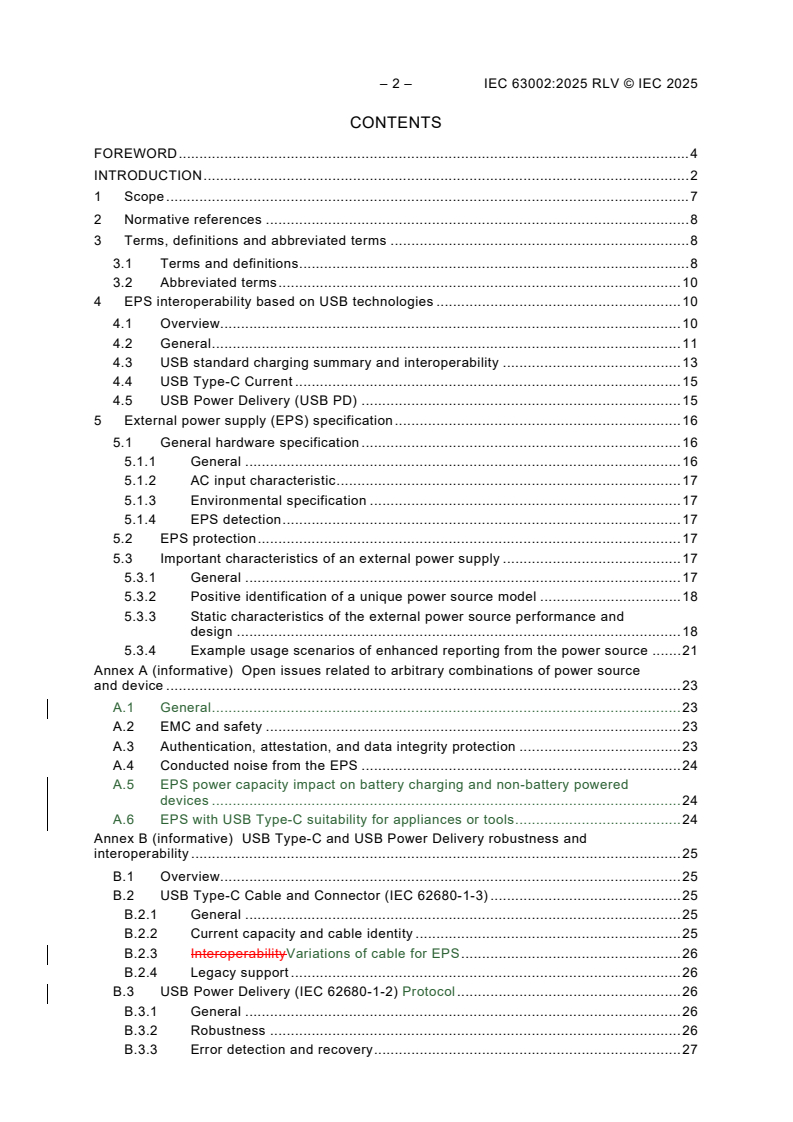
CONTENTS
FOREWORD . 4
INTRODUCTION . 2
1 Scope . 7
2 Normative references . 8
3 Terms, definitions and abbreviated terms . 8
3.1 Terms and definitions . 8
3.2 Abbreviated terms . 10
4 EPS interoperability based on USB technologies . 10
4.1 Overview. 10
4.2 General . 11
4.3 USB standard charging summary and interoperability . 13
4.4 USB Type-C Current . 15
4.5 USB Power Delivery (USB PD) . 15
5 External power supply (EPS) specification . 16
5.1 General hardware specification . 16
5.1.1 General . 16
5.1.2 AC input characteristic . 17
5.1.3 Environmental specification . 17
5.1.4 EPS detection . 17
5.2 EPS protection . 17
5.3 Important characteristics of an external power supply . 17
5.3.1 General . 17
5.3.2 Positive identification of a unique power source model . 18
5.3.3 Static characteristics of the external power source performance and
design . 18
5.3.4 Example usage scenarios of enhanced reporting from the power source . 21
Annex A (informative) Open issues related to arbitrary combinations of power source
and device . 23
A.1 General . 23
A.2 EMC and safety . 23
A.3 Authentication, attestation, and data integrity protection . 23
A.4 Conducted noise from the EPS . 24
A.5 EPS power capacity impact on battery charging and non-battery powered
devices . 24
A.6 EPS with USB Type-C suitability for appliances or tools . 24
Annex B (informative) USB Type-C and USB Power Delivery robustness and
interoperability . 25
B.1 Overview. 25
B.2 USB Type-C Cable and Connector (IEC 62680-1-3) . 25
B.2.1 General . 25
B.2.2 Current capacity and cable identity . 25
B.2.3 InteroperabilityVariations of cable for EPS . 26
B.2.4 Legacy support . 26
B.3 USB Power Delivery (IEC 62680-1-2) Protocol . 26
B.3.1 General . 26
B.3.2 Robustness . 26
B.3.3 Error detection and recovery . 27
B.3.4 Additional safeguards for EPR operation . 27
B.3.5 Nonstandard protocol over USB Type-C . 28
B.4 High current operation . 28
B.4.1 Fast battery charging use case . 28
B.4.2 Computing performance use case . 28
Annex C (informative) USB charging profiles and device charging performance . 30
C.1 Overview. 30
C.2 USB Type-C and USB PD power capabilities model . 30
C.3 Battery charging performance and AVS. 31
C.4 Fixed Supply charging versus PPS charging .
C.4 Continuous power and "Flash" battery charging . 35
Annex D (informative) Common charging interoperability use cases . 36
D.1 General . 36
D.2 Examples of device use cases . 36
D.2.1 General . 36
D.2.2 Smartphone . 36
D.2.3 Higher power computing devices (tablets, notebook computers, etc.) . 36
D.2.4 Other consumer electronics devices (smart watches, electric drills,
portable fans, etc.). 37
D.3 Examples of consumer use cases . 37
D.3.1 General . 37
D.3.2 Power Bank . 38
Annex E (informative) Conformance and market considerations . 39
E.1 General . 39
E.2 Summary of reported items and test references . 39
E.3 USB-IF Compliance Program . 40
E.4 General regulatory compliance for a power source . 41
E.5 Other considerations for system testing . 42
E.6 After-market firmware updates to power source . 42
Bibliography . 43
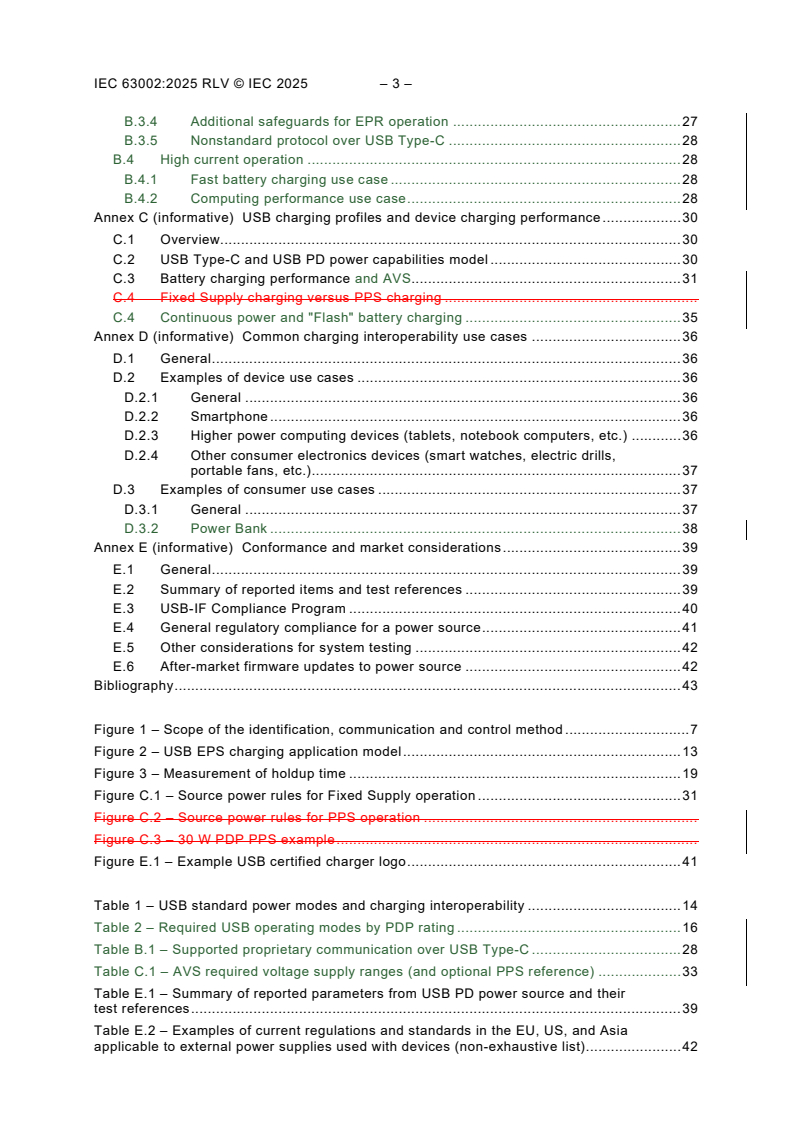
Figure 1 – Scope of the identification, communication and control method . 7
Figure 2 – USB EPS charging application model . 13
Figure 3 – Measurement of holdup time . 19
Figure C.1 – Source power rules for Fixed Supply operation . 31
Figure C.2 – Source power rules for PPS operation .
Figure C.3 – 30 W PDP PPS example .
Figure E.1 – Example USB certified charger logo . 41
Table 1 – USB standard power modes and charging interoperability . 14
Table 2 – Required USB operating modes by PDP rating . 16
Table B.1 – Supported proprietary communication over USB Type-C . 28
Table C.1 – AVS required voltage supply ranges (and optional PPS reference) . 33
Table E.1 – Summary of reported parameters from USB PD power source and their
test references . 39
Table E.2 – Examples of current regulations and standards in the EU, US, and Asia
applicable to external power supplies used with devices (non-exhaustive list) . 42
– 4 – IEC 63002:2025 RLV © IEC 2025
INTERNATIONAL ELECTROTECHNICAL COMMISSION
____________
INTEROPERABILITY SPECIFICATIONS AND COMMUNICATION METHOD
FOR EXTERNAL POWER SUPPLIES USED WITH COMPUTING AND
CONSUMER ELECTRONICS DEVICES
FOREWORD
1) The International Electrotechnical Commission (IEC) is a worldwide organization for standardization comprising
all national electrotechnical committees (IEC National Committees). The object of IEC is to promote international
co-operation on all questions concerning standardization in the electrical and electronic fields. To this end and
in addition to other activities, IEC publishes International Standards, Technical Specifications, Technical Reports,
Publicly Available Specifications (PAS) and Guides (hereafter referred to as "IEC Publication(s)"). Their
preparation is entrusted to technical committees; any IEC National Committee interested in the subject dealt with
may participate in this preparatory work. International, governmental and non-governmental organizations liaising
with the IEC also participate in this preparation. IEC collaborates closely with the International Organization for
Standardization (ISO) in accordance with conditions determined by agreement between the two organizations.
2) The formal decisions or agreements of IEC on technical matters express, as nearly as possible, an international
consensus of opinion on the relevant subjects since each technical committee has representation from all
interested IEC National Committees.
3) IEC Publications have the form of recommendations for international use and are accepted by IEC National
Committees in that sense. While all reasonable efforts are made to ensure that the technical content of IEC
Publications is accurate, IEC cannot be held responsible for the way in which they are used or for any
misinterpretation by any end user.
4) In order to promote international uniformity, IEC National Committees undertake to apply IEC Publications
transparently to the maximum extent possible in their national and regional publications. Any divergence between
any IEC Publication and the corresponding national or regional publication shall be clearly indicated in the latter.
5) IEC itself does not provide any attestation of conformity. Independent certification bodies provide conformity
assessment services and, in some areas, access to IEC marks of conformity. IEC is not responsible for any
services carried out by independent certification bodies.
6) All users should ensure that they have the latest edition of this publication.
7) No liability shall attach to IEC or its directors, employees, servants or agents including individual experts and
members of its technical committees and IEC National Committees for any personal injury, property damage or
other damage of any nature whatsoever, whether direct or indirect, or for costs (including legal fees) and
expenses arising out of the publication, use of, or reliance upon, this IEC Publication or any other IEC
Publications.
8) Attention is drawn to the Normative references cited in this publication. Use of the referenced publications is
indispensable for the correct application of this publication.
9) IEC draws attention to the possibility that the implementation of this document may involve the use of (a)
patent(s). IEC takes no position concerning the evidence, validity or applicability of any claimed patent rights in
respect thereof. As of the date of publication of this document, IEC had not received notice of (a) patent(s), which
may be required to implement this document. However, implementers are cautioned that this may not represent
the latest information, which may be obtained from the patent database available at https://patents.iec.ch. IEC
shall not be held responsible for identifying any or all such patent rights.
This redline version of the official IEC Standard allows the user to identify the changes
made to the previous edition IEC 63002:2021. A vertical bar appears in the margin
wherever a change has been made. Additions are in green text, deletions are in
strikethrough red text.
IEC 63002 has been prepared by technical area 18: Multimedia home systems and applications
for end-user networks, of IEC technical committee 100: Audio, video and multimedia systems
and equipment. It is an International Standard.
This third edition cancels and replaces the second edition published in 2021. This edition
constitutes a technical revision.
This edition includes the following significant technical changes with respect to the previous
edition:
a) power range is increased to 240 W;
b) AVS mode is introduced;
c) Annex A updates issues of arbitrary combinations of AC adapter and device;
d) Annex B describes new safeguards for EPR mode;
e) Annex C and Annex D are updated.
The text of this International Standard is based on the following documents:
Draft Report on voting
100/4193/CDV 100/4272/RVC
Full information on the voting for its approval can be found in the report on voting indicated in
the above table.
The language used for the development of this International Standard is English.
This document was drafted in accordance with ISO/IEC Directives, Part 2, and developed in
accordance with ISO/IEC Directives, Part 1 and ISO/IEC Directives, IEC Supplement, available
at www.iec.ch/members_experts/refdocs. The main document types developed by IEC are
described in greater detail at www.iec.ch/publications.
The committee has decided that the contents of this document will remain unchanged until the
stability date indicated on the IEC website under webstore.iec.ch in the data related to the
specific document. At this date, the document will be
• reconfirmed,
• withdrawn, or
• revised.
– 6 – IEC 63002:2025 RLV © IEC 2025
INTRODUCTION
The objective of this document is to enable common charging interoperability of external power
supplies (EPSs) used with the increasing variety of computing and consumer electronics
®1
devices that implement IEC 62680-1-3 (USB Type-C Cable and Connector Specification) and
IEC 62680-1-2 (USB Power Delivery). Broad market adoption of this document is expected to
make a significant contribution to the global goals of consumer convenience and re-usability of
power supplies by expanding common charging interoperability across different product
categories while preserving backwards compatibility with the installed base of billions of
IEC 62680 compliant devices worldwide.
This document specifies the minimum technical requirements for interoperability and includes
recommendations for EPS functionality when used with computing and electronics devices. The
approach taken by this document, focused on enabling common charging interoperability, can
allow manufacturers to innovate in aspects such as technical design, system performance, and
energy efficiency. Furthermore, common charging interoperability enables manufacturers to
design specific EPSs that match the requirements of target devices (functionality, cost, etc.)
and use cases, while at the same time enables consumers to use the EPS for charging other
IEC 62680 USB compliant devices, across various product types.
IEC 62680-1-3 adoption is well underway in global markets for a wide range of devices using
as much as 100 240 W, including notebook computers, tablets, smartphones, small form-factor
desktop computers, and other consumer electronics devices. This document enables the
reporting of the identity and power characteristics of power sources (EPSs and other Sources)
supported by IEC 62680-1-3 (USB Type-C) and specifies interoperability guidelines when using
IEC 62680-1-2 (USB Power Delivery). The method for identification of a specific power source
can enable equipment manufacturers to ensure compliant operation using these specifications
and promotes data communication that can be used by the device to predict and mitigate
interoperability concerns when an unfamiliar or incompatible EPS is connected to the device.
EPS power delivery applications can in the future extend beyond 100 W given updates to
IEC 62680 that appropriately address the needs of higher-power products in the computing and
consumer device market.
This document also provides important information regarding consumer safety, system
reliability as well as relevant global standards and regulatory compliance.
Other international and regional standards, and government policies for "universal" or "common
power adapters" that reference this document are expected to take into account open technical
and regulatory compliance issues that are associated with untested or arbitrary combinations
of EPSs and devices such as those identified in Annex A. As well as, the limitations and issues
with approaches to define "common chargers" in meeting market needs should be considered
compared with the benefits of this document's approach with focus on enabling common
charging interoperability. For clarity, this document focuses on interoperability specifications in
order to support global industry in developing safe, convenient innovative, environmentally
conscious, and end-to-end interoperable charging solutions that meet regulatory compliance
and market requirements and evolving market needs.
___________
USB4™® and USB Type-C® are trademarks of the Universal Serial Bus Implementers Forum (USB-IF). This
information is given for the convenience of users of this document and does not constitute an endorsement by
IEC.
INTEROPERABILITY SPECIFICATIONS AND COMMUNICATION METHOD
FOR EXTERNAL POWER SUPPLIES USED WITH COMPUTING AND
CONSUMER ELECTRONICS DEVICES
1 Scope
This document defines common charging interoperability guidelines for power sources (external
power supplies (EPSs) and other Sources) used with computing and consumer electronics ®
devices that implement IEC 62680-1-3 (USB Type-C Cable and Connector Specification).
This document defines normative requirements for an EPS to ensure interoperability; in
particular, it specifies the data communicated from a power source to a device (Figure 1) and
certain safety elements of the EPS, cable, and device. While the requirements focus of this
document is on the EPS and the behaviour at its USB Type-C connector interface, it is also
important to comprehend cable assembly and device capabilities and behaviours in order to
assure end-to-end charging interoperability. This document does not apply to all design aspects
of an EPS. This document does not specify regulatory compliance requirements for aspects
such as product safety, EMC, or energy efficiency.
Figure 1 – Scope of the identification, communication and control method
This document provides recommendations for the behaviour of a device when used with a power
source compliant with this document. It specifies the minimum hardware specification for an
EPS implementing IEC 62680-1-3. This document also specifies the data objects used by a
charging system utilizing IEC 62680-1-2 to understand the identity, design and performance
characteristics, and operating status of an external power supply. IEC 62680-1-2 focuses on
power delivery applications ranging to 100 240 W for a variety of computing and consumer
electronics devices including notebook computers, tablets, smartphones, small form-factor
desktops, monitor displays and other multimedia devices.
This document relies on established mechanical and electrical specifications, and
communication protocols specified by IEC 62680-1-2 and IEC 62680-1-3. These specifications
support methods for establishing the best performing interoperability between untested
combinations of EPS and devices with the aim of improving consumer satisfaction.
Information describing the USB charging interoperability model, overview of USB Type-C and
USB Power Delivery specifications, and factors for charging performance are also provided to
support implementation of this document.
– 8 – IEC 63002:2025 RLV © IEC 2025
2 Normative references
The following documents are referred to in the text in such a way that some or all of their content
constitutes requirements of this document. For dated references, only the edition cited applies.
For undated references, the latest edition of the referenced document (including any
amendments) applies.
IEC 60950-1, Information technology equipment – Safety – Part 1: General requirements
IEC 60990, Methods of measurement of touch current and protective conductor current
62368-1:20182023, Audio/video, information and communication technology equipment –
IEC
Part 1: Safety requirements
IEC 62680-1-1, Universal serial bus interfaces for data and power – Part 1-1: Common
components – USB Battery Charging Specification, Revision 1.2
IEC 62680-1-2:2021, Universal Serial Bus interfaces for data and power – Part 1-2: Common
components – USB Power Delivery specification
62680-1-3:2024, Universal serial bus interfaces for data and power – Part 1-3: Common
IEC
components – USB Type-C® cable and connector specification
3 Terms, definitions and abbreviated terms
3.1 Terms and definitions
For the purposes of this document, the following terms and definitions apply.
ISO and IEC maintain terminology databases for use in standardization at the following
addresses:
• IEC Electropedia: available at https://www.electropedia.org/
• ISO Online browsing platform: available at https://www.iso.org/obp
3.1.1
VID
vendor identification
unique 16-bit unsigned value assigned by the USB-IF to a given vendor
3.1.2
Source
power supply
power source
device designed to comply with IEC 62680-1-2 that supplies power over V
BUS
EXAMPLE An EPS, a USB connector on a PC, laptop computer, vehicle, AC outlet, docking station, or battery pack,
or EPS.
3.1.3
Sink
power sink
device designed to comply with IEC 62680-1-2 that receives and consumes power over V
BUS
EXAMPLE A computing device.
Note 1 to entry: Sometimes referred to as the device.
3.1.4
charging
charge
transfer of power over USB connector and cable
Note 1 to entry: "battery charging" is a specific use by a Sink that is enabled by "charging".
3.1.5
external power supply
EPS
power source contained in a separate physical enclosure external to the device casing and
designed to convert mains power supply to lower DC voltage(s) for the purpose of powering the
device
EXAMPLE A charging block or a power adapter.
3.1.6
Programmable Power Supply
PPS
optional capability in IEC 62680-1-2 where a device (Sink) can adaptively adjust the SPR EPS
(Source) output voltage in small increments and set maximum current within its advertised
range
Note 1 to entry: In IEC 62680-1-2, an EPS that supports PPS is called a "Fast Charger".
3.1.7
Fixed Supply
power source whose output voltage is regulated at certain voltages
Note 1 to entry: Standardized voltages in IEC 62680-1-2:2021 are 5 V, 9 V, 15 V and 20 V for SPR and 28 V, 36 V,
and 48 V for EPR.
3.1.8
USB PD power
PDP
nominal power capacity of the charger defined by IEC 62680-1-2 for use to indicate to
consumers
Note 1 to entry: The PDP rating is indicated both on the USB charger certification logo and within the USB PD
Source capabilities advertisement to the Sink. For any given PDP rating, the minimum capabilities in terms of
supported voltages and currents are deterministic, as defined in IEC 62680-1-2.
3.1.9
charging cable
cable used between the EPS and device to be charged
Note 1 to entry: The cable connection to the EPS is a USB Type-C plug in accordance with IEC 62680-1-3. The
cable connection to the device can be either a USB Type-C plug, a legacy USB plug (e.g. USB Micro-B in accordance
with IEC 62680-2-2), or a non-USB device-specific connection (either permanent or detachable). Charging cables
can be application-specific to enable interoperability between the USB Type-C-based EPS defined by this document
and both existing and future devices and including devices that are not able to accommodate USB Type-C receptacles,
e.g. smart watches.
3.1.10
captive cable
permanently attached cable
cable that has a USB Type-C plug on one end and is either hard-wired into a device on the
other end or has a device-specific plug on the other end
Note 1 to entry: When a device-specific plug is used on one end, the cable can be detachable in a physical sense
but is considered "functionally captive" to the device given it does not use a USB-defined connector on the device
end but otherwise functions as a USB device. This definition has remained the USB definition since it was originally
specified in IEC 62680-2-1 (USB 2.0).
– 10 – IEC 63002:2025 RLV © IEC 2025
3.1.11
standard power range
SPR
USB power source limited to 20 V and 100 W or less
3.1.12
extended power range
EPR
USB power source up to 48 V and 240 W
3.1.13
Adjustable Voltage Supply
AVS
optional capability in IEC 62680-1-2 where a device (Sink) can adaptively vary the Source
output voltage in small increments within its advertised range
3.2 Abbreviated terms
AC alternating current
AVS Adjustable Voltage Supply
CC configuration channel
CRC cyclic redundancy check
DC direct current
EMC electromagnetic compatibility
EMI electromagnetic interference
EPR Extended Power Range
EPS external power supply
IoC contracted operating current
LPS limited power source
OEM original equipment manufacturer
OVP overvoltage protection
PDO power data object
PFC power factor correction
PDP USB PD Power
PID product identification
PPS Programmable Power Supply
SPR Standard Power Range
VAC volts alternating current
USB universal serial bus
USB PD universal serial bus power delivery
USB-IF Universal Serial Bus Implementers Forum
VDM Vendor Defined Message
VID vendor identification
4 EPS interoperability based on USB technologies
4.1 Overview
This Clause 4 describes the USB common charging interoperability model and provides a
summary of the USB Type-C and USB Power Delivery technologies specified in IEC 62680‑1‑3
and IEC 62680-1-2, respectively.
4.2 General
Since its introduction over 20 years ago, USB charging technology has consistently provided
5 V DC (up to 7,5 W) power and relied on a over the common USB Standard-A connector on
the power source. When used with defined legacy cables and adapters, USB Type-C-based
power sources, including those that source higher voltages, remain electrically and
mechanically interoperable with previous generation USB devices, while enabling new
capabilities for devices that have evolved to align with these new capabilities. This technology
has continuously evolved to support higher charging power, increased capabilities, and
simplified charging interoperability, while maintaining backwards and forwards interoperability,
resulting in a growing ecosystem of devices and use cases that are adopting USB charging
technology.
With the USB Type-C technology, base charging capacity is increased up to 15 W over the USB
Type-C connector. When used with defined legacy cables and adapters, USB Type-C-based
power sources, remain electrically and functionally interoperable with previous generations of
USB devices, while enabling new capabilities for USB Type-C supported devices.
USB Power Delivery (USB PD) software technology has enabled a rapid evolution of charging
models and an increasing scope of products using the USB Type-C connector. Both power
capability and support of new charging models have evolved with each generation of USB PD
protocols: First as the USB Type-C connector has evolved from fixed voltage to standardized
voltages and 100 W Standard Power Range (SPR) capabilities, then to 240 W Extended Power
Range (EPR), and then to the Adjustable Voltage Supply (AVS) protocol. Each generation is
deliberately distinct while maintaining strict reliability and interoperability. It is anticipated that
the trend for higher power capable EPS is to implement EPR with AVS protocol as these
capabilities simplify charging interoperability with different devices, improve user experience,
and reduce design complexity for more devices to support USB charging.
Figure 2 illustrates the USB EPS charging application model consisting of the EPS (Source)
with a USB Type-C receptacle, the device to be charged (Sink) and the charging cable
connecting the device to the EPS. This model also enables compatibility with devices that are
based on legacy USB connectors, have a permanently attached cable, or use a cable that is
device specific. Several usage examples demonstrating end-to-end charging interoperability
based on this comprehensive model are presented in Annex D.
– 12 – IEC 63002:2025 RLV © IEC 2025
Figure 2 – USB EPS charging application model
In Figure 2, the last two devices illustrated align with the USB definition of a captive cable
assembly – supporting these device usage configurations enables USB to support charging
interoperability across a wider variety of applications that implement a non-USB standard
receptacle or connector for any number of usage or design reasons but otherwise function as
USB devices. Examples of these applications include a smartphone device that has a non-USB
receptacle (such as a wireless charger) and, or a USB power bank that incorporates a
permanently attached cable for user convenience.
This charging model for USB Type-C is fundamentally the same as the previous generation
USB charging model consisting of an EPS with a USB Standard-A receptacle which is the basis
for charging interoperability specified in IEC 62684 [1] . This USB Standard-A EPS model will
continue to be supported even with new devices which are based on USB Type-C receptacles
since USB-defined transition cables and adapters are readily available to enable basic charging
interoperability.
4.3 USB standard charging summary and interoperability
Table 1 summarizes the standard charging modes defined by USB specifications, including the
applicable USB connectors for each of the defined power modes.
___________
Numbers in square brackets refer to the Bibliography.
– 14 – IEC 63002:2025 RLV © IEC 2025
While the USB Type-C connector is functionally compatible with all existing USB power options,
the older USB Standard-A and USB Micro-B cannot support advanced USB Type-C dedicated
power modes – these power modes are indicated in the lower portion row 6 of Table 1. As read
down the rows of Table 1, each subsequent power mode is required to support backward-
compatibility with all of the power modes above it – in this way, USB-defined interoperability
given that an
between newer power sources is readily assured with older power sinks
appropriate cable or adapter is used (as indicated in the Interoperability column and the table
notes).
Table 1 – USB standard power modes and charging interoperability
IEC specification Power Applicable Voltage Current Interoperability
mode receptacle
connectors
a
IEC 62680-2-1 [2] USB Standard-A 5 V 0,5 A Forward compatibility
USB 2.0
(Source) supported using USB
IEC 62680-2-2 [3]
Standard-A to USB
b
USB Micro-B
Type-C cables or USB
IEC 62680-2-3 [4]
(Sink)
Micro-B to USB Type-C
adapters.
USB Type-C
(Source or Sink)
Backward compatibility
supported using USB
IEC 62680-3-1 [5] USB 3.0, USB Standard-A 5 V 0,9 A
Type-C to USB Micro-B
USB 3.1, (Source)
cables.
a
USB 3.2
b
USB Micro-B
(Sink)
USB Type-C
(Source or Sink)
IEC 62684 [1] USB BC 1.2 USB Standard-A 5 V Up to 1,5 A
(Source)
c
USB Micro-B
(Sink)
USB Type-C
(Source or Sink)
IEC 62680-1-3 USB Type-C USB Type-C 5 V 1,5 A Functionally compatible
Current at (Source or Sink) with USB BC 1.2
3 A
1,5 A or compatible Sinks up to
3,0 A 1,5 A.
Backward compatibility
in BC 1.2 mode
supported using USB
Type-C to USB Micro-B
cables.
IEC 62680-1-2 USB Power USB Type-C Configurable Configurable
USB4™ ® uses USB PD
d
Delivery (Source or Sink) up from 9 V to
up to 5 A as its power mode.
(USB PD) 20 V
AVS protocol (allowing
SPR mode
configuration of any
USB Power Configurable
voltage from 9 V to
d
Delivery maximum rated voltage)
up to 48 V
(USB PD) is required for all EPS
EPR mode
rated 28 W and higher.
a
These specifications do not explicitly define charging support requirements. When USB data ports also support
charging, the current capabilities of these ports are typically based on what is defined for a USB port operating
in its high power configured state, i.e. 500 mA for USB 2.0.
b
While less common, USB Standard-B and USB Mini-B are also applicable for a Sink.
c
While less common, USB Micro-AB is also applicable for a Sink.
d
Power transfer over 60 W (3 A) or 20 V requires use of an electronically marked 240 W (5 A, 48 V) cable if the
EPS is a detachable cable design.
Annex B provides further detail on the robustness and interoperability characteristics of USB
Type-C and USB Power Delivery solutions.
®
4.4 USB Type-C Current
The USB Type-C Current power mode is provides up to 15 W, based on a regulated 5 V power
source with up to 3 A operation. This power mode does not require USB PD capability and
instead uses a simple analogue method over the USB Type-C Configuration Channel (CC)
interface for a Source to advertise its available current to a Sink. A USB Type-C Source may
can advertise default USB Type-C Current (500 mA or 900 mA, based on the version of the
USB port and cable), USB Type-C Current at 1,5 A (7,5 W) or USB Type-C Current at 3 A (15 W).
An EPS shall indicate USB BC 1.2 compatibility on the port such that a device (Sink) that doesn't
recognize USB Type-C Current modes but is compatible with USB BC 1.2 can still draw 1,5 A.
4.5 USB Power Delivery (USB PD)
Power transfer at other more than 15 W, 5 V, or over 3 A shall comply with IEC 62680-1-2 (USB
Power Delivery). USB Power Delivery standardizes the discovery, configuration and functional
operation of more capable USB Type-C power sources and battery chargers. The USB PD
protocol, operating as a digital communication over the USB Type-C Configuration Channel (CC)
interface, enables a predictable, reliable user experience based on a common set of robust
mechanisms and communication exchanges between the USB Source and Sink. The
comprehensive set of power delivery methods supported by the USB PD protocol enables a
broad range of battery charging approaches and profiles that are specific to the design and
operation of the device being charged powered (the Sink) – this enables device designs to
evolve and innovate, even enjoying new capabilities with a different EPS, while the capabilities
of another USB PD-based charger EPS can remain a constant.
USB PD protocol is used to provide system control, error detection and handshaking. The four
required steps for enabling power delivery are:
1) Source offers its capabilities.
2) Sink requests from the offered capabilities.
3) Source accepts the request.
4) Source indicates that it is ready to provide power.
USB PD protocol can also be used for reporting the status (overcurrent protection,
overtemperature protection, overvoltage protection, etc.) of the Source.
The USB PD protocol specifies two principal modes of power transfer that can be implemented
by a USB PD Source.
– Fixed Supply operation: Provides a set of selectable fixed voltage and current combinations.
IEC 62680-1-2 defines voltages that include 5 V, 9 V, 15 V and 20 V. The Source can offer
as much as 5 A, depending on the cable current rating and selected voltage.
– Programmable Power Supply (PPS) operation: Provides granular control of voltage or a
maximum regulated source current limit. In PPS mode, the integrity of the connection is
continually monitored and absence of a handshake message between Source or Sink forces
the connection to lower safe power level. PPS places the burden of regulation in the Source
instead of in the Sink, allowing the Sink to better manage thermal rise during higher power
battery charging, which aids in lowering touch temperatures. Standard-defined voltage
ranges for PPS PDOs are nominally aligned with the defined Fixed Supply PDOs (5 V, 9 V,
15 V and 20 V) with a range minimum of 3,3 V and maximum of 5,9 V, 11 V, 16 V and 21 V,
respectively. The Source could offer as much as 5 A, depending on the cable current rating
and selected voltage.
By default, all USB Type-C EPS are required to output power over a USB connector as a Fixed
Supply capable of 5 V up to 1,5 A. USB Type-C EPS chargers can also support USB PD.
USB Type-C EPSs that implement USB PD fall into one of two defined categories: a USB
charger supporting only Fixed Supply operation, or a USB charger supporting both Fixed Supply
and PPS operation. For both categories, charger products are required to indicate a user-visible
USB PD Power (PDP) rating, which dictates the minimum set of available voltage and current
ranges that a charger supports. The PDP rating, for example, which is expressed in watts
– 16 – IEC 63002:2025 RLV © IEC 2025
ranging from 15 W to 100 W, eases user experience by matching chargers' capabilities with
device needs and also indicates expected charging performance. for any given PDP rating, the
capabilities associated with all lower PDP ratings are required in the charger in order to assure
safe downward compatibility with lower-power devices. See Annex C for more information.
The USB PD protocol recognizes two voltage regulation methods.
– Fixed Supply charging model: Provides a set of selectable fixed voltage and current
combinations. IEC 62680-1-2 requires voltages that include 5 V, 9 V, 15 V and 20 V in SPR
mode and 28 V, 36 V, and 48 V in EPR mode. The Source can offer as much as 5 A,
depending on the cable current rating.
– Adjustable charging models: Adjustable Voltage Supply (AVS) and Programmable Power
Supply (PPS) charging models enable fine control over voltage, providing the benefit of a
decrease of heating in the device for example to help facilitate faster battery charge. AVS
and PPS give the Sink precise control of voltage, or (in PPS only) a maximum regulated
source current limit, that may relieve the heat generation and thermal rise due to voltage
regulation.
USB PD EPS are required to indicate a user-visible U
...
IEC 63002 ®
Edition 3.0 2025-06
INTERNATIONAL
STANDARD
NORME
INTERNATIONALE
Interoperability specifications and communication method for external power
supplies used with computing and consumer electronics devices
Spécifications d'interopérabilité et méthode de communication pour les
alimentations externes utilisées avec les dispositifs informatiques et les
dispositifs électroniques grand public
ICS 31.020, 35.200 ISBN 978-2-8327-0461-5
All rights reserved. Unless otherwise specified, no part of this publication may be reproduced or utilized in any form or
by any means, electronic or mechanical, including photocopying and microfilm, without permission in writing from either
IEC or IEC's member National Committee in the country of the requester. If you have any questions about IEC copyright
or have an enquiry about obtaining additional rights to this publication, please contact the address below or your local
IEC member National Committee for further information.
Droits de reproduction réservés. Sauf indication contraire, aucune partie de cette publication ne peut être reproduite ni
utilisée sous quelque forme que ce soit et par aucun procédé, électronique ou mécanique, y compris la photocopie et
les microfilms, sans l'accord écrit de l'IEC ou du Comité national de l'IEC du pays du demandeur. Si vous avez des
questions sur le copyright de l'IEC ou si vous désirez obtenir des droits supplémentaires sur cette publication, utilisez
les coordonnées ci-après ou contactez le Comité national de l'IEC de votre pays de résidence.
IEC Secretariat Tel.: +41 22 919 02 11
3, rue de Varembé info@iec.ch
CH-1211 Geneva 20 www.iec.ch
Switzerland
About the IEC
The International Electrotechnical Commission (IEC) is the leading global organization that prepares and publishes
International Standards for all electrical, electronic and related technologies.
About IEC publications
The technical content of IEC publications is kept under constant review by the IEC. Please make sure that you have the
latest edition, a corrigendum or an amendment might have been published.
IEC publications search - IEC Products & Services Portal - products.iec.ch
webstore.iec.ch/advsearchform Discover our powerful search engine and read freely all the
The advanced search enables to find IEC publications by a publications previews, graphical symbols and the glossary.
variety of criteria (reference number, text, technical With a subscription you will always have access to up to date
committee, …). It also gives information on projects, content tailored to your needs.
replaced and withdrawn publications.
Electropedia - www.electropedia.org
IEC Just Published - webstore.iec.ch/justpublished The world's leading online dictionary on electrotechnology,
Stay up to date on all new IEC publications. Just Published containing more than 22 500 terminological entries in English
details all new publications released. Available online and and French, with equivalent terms in 25 additional languages.
once a month by email. Also known as the International Electrotechnical Vocabulary
(IEV) online.
IEC Customer Service Centre - webstore.iec.ch/csc
If you wish to give us your feedback on this publication or
need further assistance, please contact the Customer
Service Centre: sales@iec.ch.
A propos de l'IEC
La Commission Electrotechnique Internationale (IEC) est la première organisation mondiale qui élabore et publie des
Normes internationales pour tout ce qui a trait à l'électricité, à l'électronique et aux technologies apparentées.
A propos des publications IEC
Le contenu technique des publications IEC est constamment revu. Veuillez vous assurer que vous possédez l’édition la
plus récente, un corrigendum ou amendement peut avoir été publié.
Recherche de publications IEC - IEC Products & Services Portal - products.iec.ch
webstore.iec.ch/advsearchform Découvrez notre puissant moteur de recherche et consultez
La recherche avancée permet de trouver des publications gratuitement tous les aperçus des publications, symboles
IEC en utilisant différents critères (numéro de référence, graphiques et le glossaire. Avec un abonnement, vous aurez
texte, comité d’études, …). Elle donne aussi des toujours accès à un contenu à jour adapté à vos besoins.
informations sur les projets et les publications remplacées
ou retirées. Electropedia - www.electropedia.org
Le premier dictionnaire d'électrotechnologie en ligne au
IEC Just Published - webstore.iec.ch/justpublished monde, avec plus de 22 500 articles terminologiques en
Restez informé sur les nouvelles publications IEC. Just anglais et en français, ainsi que les termes équivalents
Published détaille les nouvelles publications parues. dans 25 langues additionnelles. Egalement appelé
Disponible en ligne et une fois par mois par email. Vocabulaire Electrotechnique International (IEV) en ligne.
Service Clients - webstore.iec.ch/csc
Si vous désirez nous donner des commentaires sur cette
publication ou si vous avez des questions contactez-
nous: sales@iec.ch.
– 2 – IEC 63002:2025 © IEC 2025
CONTENTS
FOREWORD . 4
INTRODUCTION . 6
1 Scope . 7
2 Normative references . 8
3 Terms, definitions and abbreviated terms . 8
3.1 Terms and definitions . 8
3.2 Abbreviated terms . 10
4 EPS interoperability based on USB technologies . 10
4.1 Overview. 10
4.2 General . 11
4.3 USB standard charging summary and interoperability . 12
4.4 USB Type-C Current . 14
4.5 USB Power Delivery (USB PD) . 14
5 External power supply (EPS) specification . 15
5.1 General hardware specification . 15
5.1.1 General . 15
5.1.2 AC input characteristic . 15
5.1.3 Environmental specification . 15
5.1.4 EPS detection . 15
5.2 EPS protection . 16
5.3 Important characteristics of an external power supply . 16
5.3.1 General . 16
5.3.2 Positive identification of a unique power source model . 16
5.3.3 Static characteristics of the external power source performance and
design . 17
5.3.4 Example usage scenarios of enhanced reporting from the power source . 19
Annex A (informative) Open issues related to arbitrary combinations of power source
and device . 22
A.1 General . 22
A.2 EMC and safety . 22
A.3 Authentication, attestation, and data integrity protection . 22
A.4 Conducted noise from the EPS . 23
A.5 EPS power capacity impact on battery charging and non-battery powered
devices . 23
A.6 EPS with USB Type-C suitability for appliances or tools . 23
Annex B (informative) USB Type-C and USB Power Delivery robustness and
interoperability . 24
B.1 Overview. 24
B.2 USB Type-C Cable and Connector (IEC 62680-1-3) . 24
B.2.1 General . 24
B.2.2 Current capacity and cable identity . 24
B.2.3 Variations of cable for EPS . 24
B.2.4 Legacy support . 25
B.3 USB Power Delivery (IEC 62680-1-2) Protocol . 25
B.3.1 General . 25
B.3.2 Robustness . 25
B.3.3 Error detection and recovery . 26
B.3.4 Additional safeguards for EPR operation . 26
B.3.5 Nonstandard protocol over USB Type-C . 26
B.4 High current operation . 27
B.4.1 Fast battery charging use case . 27
B.4.2 Computing performance use case . 27
Annex C (informative) USB charging profiles and device charging performance . 28
C.1 Overview. 28
C.2 USB Type-C and USB PD power capabilities model . 28
C.3 Battery charging performance and AVS. 30
C.4 Continuous power and "Flash" battery charging . 31
Annex D (informative) Common charging interoperability use cases . 32
D.1 General . 32
D.2 Examples of device use cases . 32
D.2.1 General . 32
D.2.2 Smartphone . 32
D.2.3 Higher power computing devices (tablets, notebook computers, etc.) . 32
D.2.4 Other consumer electronics devices (smart watches, electric drills,
portable fans, etc.). 33
D.3 Examples of consumer use cases . 33
D.3.1 General . 33
D.3.2 Power Bank . 34
Annex E (informative) Conformance and market considerations . 35
E.1 General . 35
E.2 Summary of reported items and test references . 35
E.3 USB-IF Compliance Program . 36
E.4 General regulatory compliance for a power source . 37
E.5 Other considerations for system testing . 38
E.6 After-market firmware updates to power source . 38
Bibliography . 39
Figure 1 – Scope of the identification, communication and control method . 7
Figure 2 – USB EPS charging application model . 12
Figure 3 – Measurement of holdup time . 18
Figure C.1 – Source power rules for Fixed Supply operation . 29
Figure E.1 – Example USB certified charger logo . 37
Table 1 – USB standard power modes and charging interoperability . 13
Table 2 – Required USB operating modes by PDP rating . 15
Table B.1 – Supported proprietary communication over USB Type-C . 27
Table C.1 – AVS required voltage supply ranges (and optional PPS reference) . 30
Table E.1 – Summary of reported parameters from USB PD power source and their
test references . 35
Table E.2 – Examples of current regulations and standards in the EU, US, and Asia
applicable to external power supplies used with devices (non-exhaustive list) . 37
– 4 – IEC 63002:2025 © IEC 2025
INTERNATIONAL ELECTROTECHNICAL COMMISSION
____________
INTEROPERABILITY SPECIFICATIONS AND COMMUNICATION METHOD
FOR EXTERNAL POWER SUPPLIES USED WITH COMPUTING AND
CONSUMER ELECTRONICS DEVICES
FOREWORD
1) The International Electrotechnical Commission (IEC) is a worldwide organization for standardization comprising
all national electrotechnical committees (IEC National Committees). The object of IEC is to promote international
co-operation on all questions concerning standardization in the electrical and electronic fields. To this end and
in addition to other activities, IEC publishes International Standards, Technical Specifications, Technical Reports,
Publicly Available Specifications (PAS) and Guides (hereafter referred to as "IEC Publication(s)"). Their
preparation is entrusted to technical committees; any IEC National Committee interested in the subject dealt with
may participate in this preparatory work. International, governmental and non-governmental organizations liaising
with the IEC also participate in this preparation. IEC collaborates closely with the International Organization for
Standardization (ISO) in accordance with conditions determined by agreement between the two organizations.
2) The formal decisions or agreements of IEC on technical matters express, as nearly as possible, an international
consensus of opinion on the relevant subjects since each technical committee has representation from all
interested IEC National Committees.
3) IEC Publications have the form of recommendations for international use and are accepted by IEC National
Committees in that sense. While all reasonable efforts are made to ensure that the technical content of IEC
Publications is accurate, IEC cannot be held responsible for the way in which they are used or for any
misinterpretation by any end user.
4) In order to promote international uniformity, IEC National Committees undertake to apply IEC Publications
transparently to the maximum extent possible in their national and regional publications. Any divergence between
any IEC Publication and the corresponding national or regional publication shall be clearly indicated in the latter.
5) IEC itself does not provide any attestation of conformity. Independent certification bodies provide conformity
assessment services and, in some areas, access to IEC marks of conformity. IEC is not responsible for any
services carried out by independent certification bodies.
6) All users should ensure that they have the latest edition of this publication.
7) No liability shall attach to IEC or its directors, employees, servants or agents including individual experts and
members of its technical committees and IEC National Committees for any personal injury, property damage or
other damage of any nature whatsoever, whether direct or indirect, or for costs (including legal fees) and
expenses arising out of the publication, use of, or reliance upon, this IEC Publication or any other IEC
Publications.
8) Attention is drawn to the Normative references cited in this publication. Use of the referenced publications is
indispensable for the correct application of this publication.
9) IEC draws attention to the possibility that the implementation of this document may involve the use of (a)
patent(s). IEC takes no position concerning the evidence, validity or applicability of any claimed patent rights in
respect thereof. As of the date of publication of this document, IEC had not received notice of (a) patent(s), which
may be required to implement this document. However, implementers are cautioned that this may not represent
the latest information, which may be obtained from the patent database available at https://patents.iec.ch. IEC
shall not be held responsible for identifying any or all such patent rights.
IEC 63002 has been prepared by technical area 18: Multimedia home systems and applications
for end-user networks, of IEC technical committee 100: Audio, video and multimedia systems
and equipment. It is an International Standard.
This third edition cancels and replaces the second edition published in 2021. This edition
constitutes a technical revision.
This edition includes the following significant technical changes with respect to the previous
edition:
a) power range is increased to 240 W;
b) AVS mode is introduced;
c) Annex A updates issues of arbitrary combinations of AC adapter and device;
d) Annex B describes new safeguards for EPR mode;
e) Annex C and Annex D are updated.
The text of this International Standard is based on the following documents:
Draft Report on voting
100/4193/CDV 100/4272/RVC
Full information on the voting for its approval can be found in the report on voting indicated in
the above table.
The language used for the development of this International Standard is English.
This document was drafted in accordance with ISO/IEC Directives, Part 2, and developed in
accordance with ISO/IEC Directives, Part 1 and ISO/IEC Directives, IEC Supplement, available
at www.iec.ch/members_experts/refdocs. The main document types developed by IEC are
described in greater detail at www.iec.ch/publications.
The committee has decided that the contents of this document will remain unchanged until the
stability date indicated on the IEC website under webstore.iec.ch in the data related to the
specific document. At this date, the document will be
• reconfirmed,
• withdrawn, or
• revised.
– 6 – IEC 63002:2025 © IEC 2025
INTRODUCTION
The objective of this document is to enable common charging interoperability of external power
supplies (EPSs) used with the increasing variety of computing and consumer electronics
®1
devices that implement IEC 62680-1-3 (USB Type-C Cable and Connector Specification) and
IEC 62680-1-2 (USB Power Delivery). Broad market adoption of this document is expected to
make a significant contribution to the global goals of consumer convenience and re-usability of
power supplies by expanding common charging interoperability across different product
categories while preserving backwards compatibility with the installed base of billions of
IEC 62680 compliant devices worldwide.
This document specifies the minimum technical requirements for interoperability and includes
recommendations for EPS functionality when used with computing and electronics devices. The
approach taken by this document, focused on enabling common charging interoperability, can
allow manufacturers to innovate in aspects such as technical design, system performance, and
energy efficiency. Furthermore, common charging interoperability enables manufacturers to
design specific EPSs that match the requirements of target devices (functionality, cost, etc.)
and use cases, while at the same time enables consumers to use the EPS for charging other
IEC 62680 USB compliant devices, across various product types.
IEC 62680-1-3 adoption is well underway in global markets for a wide range of devices using
as much as 240 W, including notebook computers, tablets, smartphones, small form-factor
desktop computers, and other consumer electronics devices. This document enables the
reporting of the identity and power characteristics of power sources (EPSs and other Sources)
supported by IEC 62680-1-3 (USB Type-C) and specifies interoperability guidelines when using
IEC 62680-1-2 (USB Power Delivery). The method for identification of a specific power source
can enable equipment manufacturers to ensure compliant operation using these specifications
and promotes data communication that can be used by the device to predict and mitigate
interoperability concerns when an unfamiliar or incompatible EPS is connected to the device.
This document also provides important information regarding consumer safety, system
reliability as well as relevant global standards and regulatory compliance.
Other international and regional standards, and government policies for "universal" or "common
power adapters" that reference this document are expected to take into account open technical
and regulatory compliance issues that are associated with untested or arbitrary combinations
of EPSs and devices such as those identified in Annex A. As well, the limitations and issues
with approaches to define "common chargers" should be considered compared with the benefits
of this document's approach with focus on enabling common charging interoperability. For
clarity, this document focuses on interoperability specifications in order to support global
industry in developing safe, innovative, environmentally conscious, and end-to-end
interoperable charging solutions that meet regulatory requirements and evolving market needs.
___________
USB4® and USB Type-C® are trademarks of the Universal Serial Bus Implementers Forum (USB-IF). This
information is given for the convenience of users of this document and does not constitute an endorsement by
IEC.
INTEROPERABILITY SPECIFICATIONS AND COMMUNICATION METHOD
FOR EXTERNAL POWER SUPPLIES USED WITH COMPUTING AND
CONSUMER ELECTRONICS DEVICES
1 Scope
This document defines common charging interoperability guidelines for power sources (external
power supplies (EPSs) and other Sources) used with computing and consumer electronics ®
devices that implement IEC 62680-1-3 (USB Type-C Cable and Connector Specification).
This document defines normative requirements for an EPS to ensure interoperability; in
particular, it specifies the data communicated from a power source to a device (Figure 1) and
certain safety elements of the EPS, cable, and device. While the requirements focus of this
document is on the EPS and the behaviour at its USB Type-C connector interface, it is also
important to comprehend cable assembly and device capabilities and behaviours in order to
assure end-to-end charging interoperability. This document does not apply to all design aspects
of an EPS. This document does not specify regulatory compliance requirements for aspects
such as product safety, EMC, or energy efficiency.
Figure 1 – Scope of the identification, communication and control method
This document provides recommendations for the behaviour of a device when used with a power
source compliant with this document. It specifies the minimum hardware specification for an
EPS implementing IEC 62680-1-3. This document also specifies the data objects used by a
charging system utilizing IEC 62680-1-2 to understand the identity, design and performance
characteristics, and operating status of an external power supply. IEC 62680-1-2 focuses on
power delivery applications ranging to 240 W for a variety of computing and consumer
electronics devices including notebook computers, tablets, smartphones, small form-factor
desktops, monitor displays and other multimedia devices.
This document relies on established mechanical and electrical specifications, and
communication protocols specified by IEC 62680-1-2 and IEC 62680-1-3. These specifications
support methods for establishing the best performing interoperability between untested
combinations of EPS and devices with the aim of improving consumer satisfaction.
Information describing the USB charging interoperability model, overview of USB Type-C and
USB Power Delivery specifications, and factors for charging performance are also provided to
support implementation of this document.
– 8 – IEC 63002:2025 © IEC 2025
2 Normative references
The following documents are referred to in the text in such a way that some or all of their content
constitutes requirements of this document. For dated references, only the edition cited applies.
For undated references, the latest edition of the referenced document (including any
amendments) applies.
IEC 60990, Methods of measurement of touch current and protective conductor current
IEC 62368-1:2023, Audio/video, information and communication technology equipment – Part 1:
Safety requirements
IEC 62680-1-2, Universal serial bus interfaces for data and power – Part 1-2: Common
components – USB Power Delivery specification
IEC 62680-1-3:2024, Universal serial bus interfaces for data and power – Part 1-3: Common
components – USB Type-C® cable and connector specification
3 Terms, definitions and abbreviated terms
3.1 Terms and definitions
For the purposes of this document, the following terms and definitions apply.
ISO and IEC maintain terminology databases for use in standardization at the following
addresses:
• IEC Electropedia: available at https://www.electropedia.org/
• ISO Online browsing platform: available at https://www.iso.org/obp
3.1.1
VID
vendor identification
unique 16-bit unsigned value assigned by the USB-IF to a given vendor
3.1.2
Source
power supply
power source
device designed to comply with IEC 62680-1-2 that supplies power over V
BUS
EXAMPLE An EPS, a USB connector on a PC, laptop computer, vehicle, AC outlet, docking station, or battery pack.
3.1.3
Sink
power sink
device designed to comply with IEC 62680-1-2 that receives and consumes power over V
BUS
EXAMPLE A computing device.
Note 1 to entry: Sometimes referred to as the device.
3.1.4
charging
charge
transfer of power over USB connector and cable
Note 1 to entry: "battery charging" is a specific use by a Sink that is enabled by "charging".
3.1.5
external power supply
EPS
power source contained in a separate physical enclosure external to the device casing and
designed to convert mains power supply to lower DC voltage(s) for the purpose of powering the
device
EXAMPLE A charging block or a power adapter.
3.1.6
Programmable Power Supply
PPS
optional capability in IEC 62680-1-2 where a device (Sink) can adaptively adjust the SPR EPS
(Source) output voltage in small increments and set maximum current within its advertised
range
Note 1 to entry: In IEC 62680-1-2, an EPS that supports PPS is called a "Fast Charger".
3.1.7
Fixed Supply
power source whose output voltage is regulated at certain voltages
Note 1 to entry: Standardized voltages in IEC 62680-1-2 are 5 V, 9 V, 15 V and 20 V for SPR and 28 V, 36 V, and
48 V for EPR.
3.1.8
USB PD power
PDP
nominal power capacity of the charger defined by IEC 62680-1-2 for use to indicate to
consumers
Note 1 to entry: The PDP rating is indicated both on the USB charger certification logo and within the USB PD
Source capabilities advertisement to the Sink. For any given PDP rating, the minimum capabilities in terms of
supported voltages and currents are deterministic, as defined in IEC 62680-1-2.
3.1.9
charging cable
cable used between the EPS and device to be charged
Note 1 to entry: The cable connection to the EPS is a USB Type-C plug in accordance with IEC 62680-1-3. The
cable connection to the device can be either a USB Type-C plug, a legacy USB plug (e.g. USB Micro-B in accordance
with IEC 62680-2-2), or a non-USB device-specific connection (either permanent or detachable). Charging cables
can be application-specific to enable interoperability between the USB Type-C-based EPS defined by this document
and both existing and future devices and including devices that are not able to accommodate USB Type-C receptacles,
e.g. smart watches.
3.1.10
captive cable
permanently attached cable
cable that has a USB Type-C plug on one end and is either hard-wired into a device on the
other end or has a device-specific plug on the other end
Note 1 to entry: When a device-specific plug is used on one end, the cable can be detachable in a physical sense
but is considered "functionally captive" to the device given it does not use a USB-defined connector on the device
end but otherwise functions as a USB device. This definition has remained the USB definition in IEC 62680-2-1
(USB 2.0).
3.1.11
standard power range
SPR
USB power source limited to 20 V and 100 W or less
– 10 – IEC 63002:2025 © IEC 2025
3.1.12
extended power range
EPR
USB power source up to 48 V and 240 W
3.1.13
Adjustable Voltage Supply
AVS
optional capability in IEC 62680-1-2 where a device (Sink) can adaptively vary the Source
output voltage in small increments within its advertised range
3.2 Abbreviated terms
AC alternating current
AVS Adjustable Voltage Supply
CC configuration channel
CRC cyclic redundancy check
DC direct current
EMC electromagnetic compatibility
EMI electromagnetic interference
EPR Extended Power Range
EPS external power supply
IoC contracted operating current
LPS limited power source
OEM original equipment manufacturer
OVP overvoltage protection
PDO power data object
PFC power factor correction
PDP USB PD Power
PID product identification
PPS Programmable Power Supply
SPR Standard Power Range
VAC volts alternating current
USB universal serial bus
USB PD universal serial bus power delivery
USB-IF Universal Serial Bus Implementers Forum
VDM Vendor Defined Message
VID vendor identification
4 EPS interoperability based on USB technologies
4.1 Overview
This Clause 4 describes the USB common charging interoperability model and provides a
summary of the USB Type-C and USB Power Delivery technologies specified in IEC 62680‑1‑3
and IEC 62680-1-2, respectively.
4.2 General
Since its introduction, USB charging technology has consistently provided 5 V DC (up to 7,5 W)
power over the common USB Standard-A connector on the power source. This technology has
continuously evolved to support higher charging power, increased capabilities, and simplified
charging interoperability, while maintaining backwards and forwards interoperability, resulting
in a growing ecosystem of devices and use cases that are adopting USB charging technology.
With the USB Type-C technology, base charging capacity is increased up to 15 W over the USB
Type-C connector. When used with defined legacy cables and adapters, USB Type-C-based
power sources, remain electrically and functionally interoperable with previous generations of
USB devices, while enabling new capabilities for USB Type-C supported devices.
USB Power Delivery (USB PD) software technology has enabled a rapid evolution of charging
models and an increasing scope of products using the USB Type-C connector. Both power
capability and support of new charging models have evolved with each generation of USB PD
protocols: First as the USB Type-C connector has evolved from fixed voltage to standardized
voltages and 100 W Standard Power Range (SPR) capabilities, then to 240 W Extended Power
Range (EPR), and then to the Adjustable Voltage Supply (AVS) protocol. Each generation is
deliberately distinct while maintaining strict reliability and interoperability. It is anticipated that
the trend for higher power capable EPS is to implement EPR with AVS protocol as these
capabilities simplify charging interoperability with different devices, improve user experience,
and reduce design complexity for more devices to support USB charging.
Figure 2 illustrates the USB EPS charging application model consisting of the EPS (Source)
with a USB Type-C receptacle, the device to be charged (Sink) and the charging cable
connecting the device to the EPS. This model also enables compatibility with devices that are
based on legacy USB connectors, have a permanently attached cable, or use a cable that is
device specific. Several usage examples demonstrating end-to-end charging interoperability
based on this comprehensive model are presented in Annex D.
– 12 – IEC 63002:2025 © IEC 2025
Figure 2 – USB EPS charging application model
In Figure 2, the last two devices illustrated align with the USB definition of a captive cable
assembly – supporting these device usage configurations enables USB to support charging
interoperability across a wider variety of applications that implement a non-USB standard
receptacle or connector for any number of usage or design reasons but otherwise function as
USB devices. Examples of these applications include a device that has a non-USB receptacle
(such as a wireless charger), or a USB power bank that incorporates a permanently attached
cable for user convenience.
This charging model for USB Type-C is fundamentally the same as the previous generation
USB charging model consisting of an EPS with a USB Standard-A receptacle which is the basis
for charging interoperability specified in IEC 62684 [1] . This USB Standard-A EPS model will
continue to be supported even with new devices which are based on USB Type-C receptacles
since USB-defined transition cables and adapters are readily available to enable charging
interoperability.
4.3 USB standard charging summary and interoperability
Table 1 summarizes the standard charging modes defined by USB specifications, including the
applicable USB connectors for each of the defined power modes.
___________
Numbers in square brackets refer to the Bibliography.
While the USB Type-C connector is functionally compatible with all existing USB power options,
the older USB Standard-A and USB Micro-B cannot support advanced USB Type-C dedicated
power modes – these power modes are indicated in row 6 of Table 1. As read down the rows
of Table 1, each subsequent power mode is required to support backward-compatibility with all
of the power modes above it – in this way, USB-defined interoperability between newer power
sources is readily assured with older power sinks.
Table 1 – USB standard power modes and charging interoperability
IEC specification Power Applicable Voltage Current Interoperability
mode receptacle
connectors
a
IEC 62680-2-1 [2] USB Standard-A 5 V 0,5 A Forward compatibility
USB 2.0
supported using USB
(Source)
IEC 62680-2-2 [3]
Standard-A to USB
b
USB Micro-B
Type-C cables or USB
IEC 62680-2-3 [4]
(Sink)
Micro-B to USB Type-C
adapters.
USB Type-C
(Source or Sink)
Backward compatibility
supported using USB
IEC 62680-3-1 [5] USB 3.0, USB Standard-A 5 V 0,9 A
Type-C to USB Micro-B
USB 3.1, (Source)
cables.
a
USB 3.2
b
USB Micro-B
(Sink)
USB Type-C
(Source or Sink)
IEC 62684 [1] USB BC 1.2 USB Standard-A 5 V Up to 1,5 A
(Source)
c
USB Micro-B
(Sink)
USB Type-C
(Source or Sink)
IEC 62680-1-3 USB Type-C USB Type-C 5 V 1,5 A Functionally compatible
Current at (Source or Sink) with USB BC 1.2
3 A
1,5 A or compatible Sinks up to
3,0 A 1,5 A.
Backward compatibility
in BC 1.2 mode
supported using USB
Type-C to USB Micro-B
cables.
IEC 62680-1-2 USB Power USB Type-C Configurable Configurable
USB4 ® uses USB PD
d
Delivery (Source or Sink) from 9 V to
up to 5 A as its power mode.
(USB PD) 20 V
AVS protocol (allowing
SPR mode
configuration of any
USB Power Configurable
voltage from 9 V to
d
Delivery
maximum rated voltage)
up to 48 V
(USB PD) is required for all EPS
EPR mode
rated 28 W and higher.
a
These specifications do not explicitly define charging support requirements. When USB data ports also support
charging, the current capabilities of these ports are typically based on what is defined for a USB port operating
in its high power configured state, i.e. 500 mA for USB 2.0.
b
While less common, USB Standard-B and USB Mini-B are also applicable for a Sink.
c
While less common, USB Micro-AB is also applicable for a Sink.
d
Power transfer over 60 W (3 A) or 20 V requires use of an electronically marked 240 W (5 A, 48 V) cable if the
EPS is a detachable cable design.
Annex B provides further detail on the robustness and interoperability characteristics of USB
Type-C and USB Power Delivery solutions.
– 14 – IEC 63002:2025 © IEC 2025
4.4 USB Type-C Current
The USB Type-C Current power mode provides up to 15 W, based on a regulated 5 V power
source with up to 3 A operation. This power mode does not require USB PD capability and
instead uses a simple analogue method over the USB Type-C Configuration Channel (CC)
interface for a Source to advertise its available current to a Sink. A USB Type-C Source can
advertise default USB Type-C Current (500 mA or 900 mA, based on the version of the USB
port and cable), USB Type-C Current at 1,5 A (7,5 W) or USB Type-C Current at 3 A (15 W).
4.5 USB Power Delivery (USB PD)
Power transfer at more than 15 W, 5 V, or 3 A shall comply with IEC 62680-1-2 (USB Power
Delivery). USB Power Delivery standardizes the discovery, configuration and functional
operation of more capable USB Type-C power sources and battery chargers. The USB PD
protocol, operating as a digital communication over the USB Type-C Configuration Channel (CC)
interface, enables a predictable, reliable user experience based on a common set of robust
mechanisms and communication exchanges between the USB Source and Sink. The
comprehensive set of power delivery methods supported by the USB PD protocol enables a
broad range of charging approaches and profiles that are specific to the design and operation
of the device being powered (the Sink) – this enables device designs to evolve and innovate,
even enjoying new capabilities with a different EPS, while the capabilities of another USB PD-
based EPS can remain a constant.
USB PD protocol is used to provide system control, error detection and handshaking. The four
required steps for enabling power delivery are:
1) Source offers its capabilities.
2) Sink requests from the offered capabilities.
3) Source accepts the request.
4) Source indicates that it is ready to provide power.
USB PD protocol can also be used for reporting the status (overcurrent protection,
overtemperature protection, overvoltage protection, etc.) of the Source.
The USB PD protocol recognizes two voltage regulation methods.
– Fixed Supply charging model: Provides a set of selectable fixed voltage and current
combinations. IEC 62680-1-2 requires voltages that include 5 V, 9 V, 15 V and 20 V in SPR
mode and 28 V, 36 V, and 48 V in EPR mode. The Source can offer as much as 5 A,
depending on the cable current rating.
– Adjustable charging models: Adjustable Voltage Supply (AVS) and Programmable Power
Supply (PPS) charging models enable fine control over voltage, providing the benefit of a
decrease of heating in the device for example to help facilitate faster battery charge. AVS
and PPS give the Sink precise control of voltage, or (in PPS only) a maximum regulated
source current limit, that may relieve the heat generation and thermal rise due to voltage
regulation.
USB PD EPS are required to indicate a user-visible USB PD Power (PDP) rating. The PDP
rating is expressed in watts ranging from 15 W to 240 W and eases the user experience by
matching the chargers' capabilities (voltage and USB PD capability) with the device needs. As
shown in Table 2, these capabilities are progressive with PDP rating—meaning that for any
given PDP rating, the capabilities associated with all lower PDP ratings are required in the
charger in order to assure safe downward compatibility with lower-power devices. See Annex C
for more information.
Table 2 – Required USB operating modes by PDP rating
PDP rating Shall incrementally have
Any PDP 5 V
More than 15 W USB PD
28 W or more Adjustable voltage supply (AVS)
More than 100 W EPR mode
As indicated in Table 2, interoperability between EPSs and devices is supported when different
USB PD charging modes are supported:
• All USB Type-C EPS with PDP rating of 15 W or below are only required to support 5 V.
USB PD support is optional and not required.
• EPS rated above 15 W PDP shall also employ USB PD and enable a 9 V fixed supply.
• EPS rated at 28 W or more shall support certain determined fixed voltages and also AVS.
The USB Type-C and USB Power Delivery specifications continue to evolve as data
performance and power needs increase over time, supporting new product designs and
technology innovations.
5 External power supply (EPS) specification
5.1 General hardware specification
5.1.1 General
An EPS compliant with this document shall provide power on at least one USB Type-C
receptacle compliant with IEC 62680-1-3. A power cable assembly, supplied with EPS
compliant with this document shall comply with IEC 62680
...