

ISO 23920:2020
(Main)Cigarettes — Determination of ammonia in cigarette mainstream smoke with an intense smoking regime using ion chromatography
General Information
- Abstract
This document specifies a method for the quantification of ammonia by ion chromatography in mainstream smoke using ISO 20778 smoking parameters. This method is applicable to an ammonia yield of about 10 µg/cigarette to 40 µg/cigarette. It is not applicable for the determination of ammonia in dark-air cured cigarettes.
- Status
- Published
- Publication Date
- 29-Jun-2020
- Technical Committee
- ISO/TC 126 - Tobacco and tobacco products
- Drafting Committee
- ISO/TC 126/WG 10 - Intense smoking regime
- Current Stage
- 9060 - Close of review
- Completion Date
- 02-Dec-2030
Buy Documents



ISO 23920:2020 - Cigarettes -- Determination of ammonia in cigarette mainstream smoke with an intense smoking regime using ion chromatography
ISO 23920:2020 - Cigarettes — Determination of ammonia in cigarette mainstream smoke with an intense smoking regime using ion chromatography/30/2020
Overview
ISO 23920:2020 specifies a laboratory method for the quantification of ammonia in cigarette mainstream smoke using ion chromatography under an intense machine smoking regime (ISO 20778 parameters). The method targets ammonia yields of about 10 µg/cigarette to 40 µg/cigarette and explicitly excludes testing of dark‑air cured cigarettes. The procedure is intended for routine analytical testing and product characterization, using external standard calibration and defined trapping systems to collect smoke constituents.
Key Topics and Requirements
- Scope & limits: Applicable to mainstream smoke ammonia in the stated yield range; not for dark‑air cured tobacco.
- Smoking regime: Uses the ISO 20778 intense smoking parameters and refers to ISO 20779 for particulate matter collection.
- Sampling / trapping systems: Two validated collection approaches:
- Trapping system 1 - glass fibre filter pad (GFP/CFP) followed by impinger traps containing dilute sulphuric acid.
- Trapping system 2 - impregnated GFP followed by an untreated GFP, extracted with dilute hydrochloric acid.
- Analytical technique: Ion chromatography with a conductivity detector and suppressor; employs a cation‑exchange analytical column and external calibration with ammonium standards.
- Reagents & preparation: Specifies analytical‑grade reagents (ammonium sulfate, sulphuric acid, hydrochloric acid, methanesulphonic acid, ethanol, deionized water) and precise eluent and standard preparation (e.g., MSA and sulphuric acid eluents).
- Instrumentation & apparatus: Routine analytical smoking machine, impinger setup, ion chromatography system, balances and standard labware.
- Quality & performance: Procedure includes calibration, calculations, and documented repeatability/reproducibility from interlaboratory studies (CORESTA basis). Safety warnings for hazardous materials and limits of machine smoking data are included.
Applications and Users
Who uses ISO 23920:2020:
- Tobacco testing laboratories performing emissions analysis and regulatory reporting.
- Product development teams assessing formulation or design impacts on ammonia yields.
- Regulatory bodies and conformity assessment organizations evaluating product characteristics.
- Research groups studying smoke chemistry under standardized intense smoking regimes.
Practical applications:
- Routine monitoring of ammonia in mainstream cigarette smoke for product characterization.
- Comparative testing across cigarette designs or blends (excluding dark‑air cured products).
- Generating standardized data for regulatory dossiers and scientific studies.
Note: Machine smoking regimes do not represent human exposure; results are intended for product characterization and regulatory use, not direct human risk or exposure quantification.
Related Standards
- ISO 20778 - Routine analytical cigarette‑smoking machine (intense regime)
- ISO 20779 - Generation and collection of total particulate matter (intense regime)
- ISO 3402 - Conditioning and testing atmosphere for tobacco
- ISO 8243 - Cigarettes - Sampling
Keywords: ISO 23920:2020, ammonia determination, cigarettes, ion chromatography, intense smoking regime, ISO 20778, mainstream smoke, trapping system, tobacco testing.
Relations
- Consolidated By
ISO 8028:2024 - Rubber and/or plastics hoses and hose assemblies for airless paint spraying — Specification - Effective Date
- 28-Jan-2023
Buy Documents
ISO 23920:2020 - Cigarettes -- Determination of ammonia in cigarette mainstream smoke with an intense smoking regime using ion chromatography
ISO 23920:2020 - Cigarettes — Determination of ammonia in cigarette mainstream smoke with an intense smoking regime using ion chromatography/30/2020
Get Certified
Connect with accredited certification bodies for this standard

Control Union Certifications
Global certification for agriculture and sustainability.

ECOCERT
Organic and sustainability certification.

FSC International
Forest Stewardship Council certification.
Sponsored listings
Frequently Asked Questions
ISO 23920:2020 is a standard published by the International Organization for Standardization (ISO). Its full title is "Cigarettes — Determination of ammonia in cigarette mainstream smoke with an intense smoking regime using ion chromatography". This standard covers: This document specifies a method for the quantification of ammonia by ion chromatography in mainstream smoke using ISO 20778 smoking parameters. This method is applicable to an ammonia yield of about 10 µg/cigarette to 40 µg/cigarette. It is not applicable for the determination of ammonia in dark-air cured cigarettes.
This document specifies a method for the quantification of ammonia by ion chromatography in mainstream smoke using ISO 20778 smoking parameters. This method is applicable to an ammonia yield of about 10 µg/cigarette to 40 µg/cigarette. It is not applicable for the determination of ammonia in dark-air cured cigarettes.
ISO 23920:2020 is classified under the following ICS (International Classification for Standards) categories: 65.160 - Tobacco, tobacco products and related equipment. The ICS classification helps identify the subject area and facilitates finding related standards.
ISO 23920:2020 has the following relationships with other standards: It is inter standard links to ISO 8028:2024. Understanding these relationships helps ensure you are using the most current and applicable version of the standard.
ISO 23920:2020 is available in PDF format for immediate download after purchase. The document can be added to your cart and obtained through the secure checkout process. Digital delivery ensures instant access to the complete standard document.
Standards Content (Sample)
INTERNATIONAL ISO
STANDARD 23920
First edition
2020-06
Cigarettes — Determination of
ammonia in cigarette mainstream
smoke with an intense smoking
regime using ion chromatography
Cigarettes — Dosage de l'ammoniac dans le courant principal
de la fumée de cigarette avec un régime de fumage intense par
chromatographie par échange d’ions
Reference number
©
ISO 2020
© ISO 2020
All rights reserved. Unless otherwise specified, or required in the context of its implementation, no part of this publication may
be reproduced or utilized otherwise in any form or by any means, electronic or mechanical, including photocopying, or posting
on the internet or an intranet, without prior written permission. Permission can be requested from either ISO at the address
below or ISO’s member body in the country of the requester.
ISO copyright office
CP 401 • Ch. de Blandonnet 8
CH-1214 Vernier, Geneva
Phone: +41 22 749 01 11
Email: copyright@iso.org
Website: www.iso.org
Published in Switzerland
ii © ISO 2020 – All rights reserved
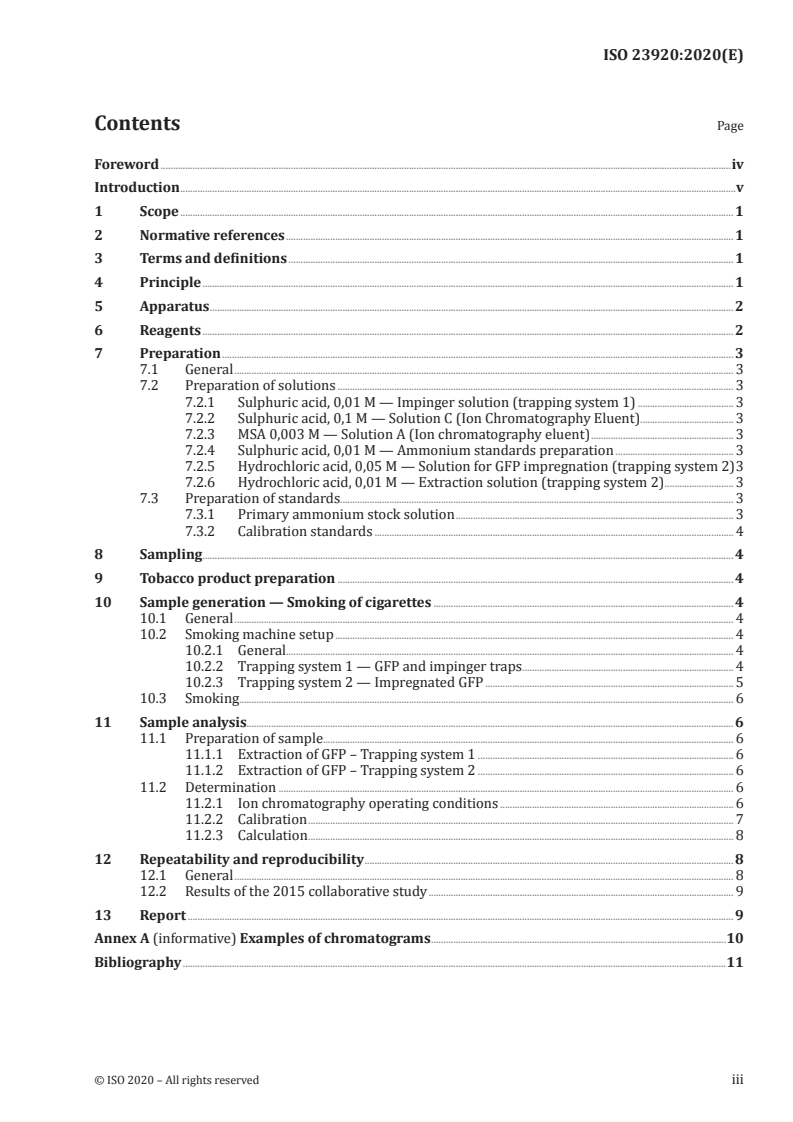
Contents Page
Foreword .iv
Introduction .v
1 Scope . 1
2 Normative references . 1
3 Terms and definitions . 1
4 Principle . 1
5 Apparatus . 2
6 Reagents . 2
7 Preparation . 3
7.1 General . 3
7.2 Preparation of solutions . 3
7.2.1 Sulphuric acid, 0,01 M — Impinger solution (trapping system 1) . 3
7.2.2 Sulphuric acid, 0,1 M — Solution C (Ion Chromatography Eluent). 3
7.2.3 MSA 0,003 M — Solution A (Ion chromatography eluent) . 3
7.2.4 Sulphuric acid, 0,01 M — Ammonium standards preparation . 3
7.2.5 Hydrochloric acid, 0,05 M — Solution for GFP impregnation (trapping system 2) 3
7.2.6 Hydrochloric acid, 0,01 M — Extraction solution (trapping system 2) . 3
7.3 Preparation of standards. 3
7.3.1 Primary ammonium stock solution . 3
7.3.2 Calibration standards . 4
8 Sampling . 4
9 Tobacco product preparation . 4
10 Sample generation — Smoking of cigarettes . 4
10.1 General . 4
10.2 Smoking machine setup . 4
10.2.1 General. 4
10.2.2 Trapping system 1 — GFP and impinger traps . 4
10.2.3 Trapping system 2 — Impregnated GFP . 5
10.3 Smoking . 6
11 Sample analysis . 6
11.1 Preparation of sample. 6
11.1.1 Extraction of GFP – Trapping system 1 . 6
11.1.2 Extraction of GFP – Trapping system 2 . 6
11.2 Determination . 6
11.2.1 Ion chromatography operating conditions . 6
11.2.2 Calibration . 7
11.2.3 Calculation . 8
12 Repeatability and reproducibility . 8
12.1 General . 8
12.2 Results of the 2015 collaborative study . 9
13 Report . 9
Annex A (informative) Examples of chromatograms .10
Bibliography .11
Foreword
ISO (the International Organization for Standardization) is a worldwide federation of national standards
bodies (ISO member bodies). The work of preparing International Standards is normally carried out
through ISO technical committees. Each member body interested in a subject for which a technical
committee has been established has the right to be represented on that committee. International
organizations, governmental and non-governmental, in liaison with ISO, also take part in the work.
ISO collaborates closely with the International Electrotechnical Commission (IEC) on all matters of
electrotechnical standardization.
The procedures used to develop this document and those intended for its further maintenance are
described in the ISO/IEC Directives, Part 1. In particular, the different approval criteria needed for the
different types of ISO documents should be noted. This document was drafted in accordance with the
editorial rules of the ISO/IEC Directives, Part 2 (see www .iso .org/ directives).
Attention is drawn to the possibility that some of the elements of this document may be the subject of
patent rights. ISO shall not be held responsible for identifying any or all such patent rights. Details of
any patent rights identified during the development of the document will be in the Introduction and/or
on the ISO list of patent declarations received (see www .iso .org/ patents).
Any trade name used in this document is information given for the convenience of users and does not
constitute an endorsement.
For an explanation of the voluntary nature of standards, the meaning of ISO specific terms and
expressions related to conformity assessment, as well as information about ISO's adherence to
the World Trade Organization (WTO) principles in the Technical Barriers to Trade (TBT), see
www .iso .org/ iso/ foreword .html.
This document was prepared by Technical Committee ISO/TC 126, Tobacco and tobacco products.
Any feedback or questions on this document should be directed to the user’s national standards body. A
complete listing of these bodies can be found at www .iso .org/ members .html.
iv © ISO 2020 – All rights reserved
Introduction
1) 2)
The CORESTA Smoke Analytes Sub-Group conducted a survey among its members and determined
that most laboratories used a method involving ion chromatography for the determination of ammonia
in cigarette mainstream smoke. Two alternative trapping systems were used, either with a combination
of glass fibre filter pad followed by impinger traps or with an impregnated GFP followed by a GFP.
[1]
A CORESTA recommended method (CRM) was written on the basis of the results obtained in an
interlaboratory study conducted in 2015 involving 18 laboratories and 8 samples using cigarettes
[2]
manufactured from a range of blend styles . The results demonstrated equivalency of the data
obtained by using both trapping systems. It was observed that the method is not applicable to dark-air
cured cigarettes.
This document is based upon the CRM 83 and includes statistical evaluations carried out according to
[3] [4]
ISO 5725-1 and ISO 5725-2 .
No machine smoking regime can represent all human smoking behaviour.
— It is recommended that cigarettes also be tested under conditions of a different intensity of machine
smoking than those specified in this document.
— Machine smoking testing is useful to characterize cigarette emissions for design and regulatory
purposes, but communication of machine measurements to smokers can result in misunderstandings
about exposure and risk across brands.
— Smoke emission data from machine measurements may be used as inputs for product hazard
assessment, but they are not intended to be nor are they valid as measures of human exposure or
risks. Communicating differences between products in machine measurements as differences in
exposure or risk is a misuse of testing using ISO standards.
1) Available at: www .coresta .org.
2) Until 2017, the sub-group was known as CORESTA Special Analytes Sub-Group.
INTERNATIONAL STANDARD ISO 23920:2020(E)
Cigarettes — Determination of ammonia in cigarette
mainstream smoke with an intense smoking regime using
ion chromatography
WARNING — The use of this document involves hazardous materials, operations and equipment.
This document does not purport to address all the safety problems associated with its use. It
is the responsibility of the user of this document to establish appropriate safety and health
practices and determine the applicability of any other restrictions prior to use.
1 Scope
This document specifies a method for the quantification of ammonia by ion chromatography in
mainstream smoke using ISO 20778 smoking parameters.
This method is applicable to an ammonia yield of about 10 µg/cigarette to 40 µg/cigarette. It is not
applicable for the determination of ammonia in dark-air cured cigarettes.
2 Normative references
The following documents are referred to in the text in such a way that some or all of their content
constitutes requirements of this document. For dated references, only the edition cited applies. For
undated references, the latest edition of the referenced document (including any amendments) applies.
ISO 3402, Tobacco and tobacco products — Atmosphere for conditioning and testing
ISO 8243, Cigarettes — Sampling
ISO 20778, Cigarettes — Routine analytical cigarette smoking machine — Definitions and standard
conditions with an intense smoking regime
ISO 20779, Cigarettes — Generation and collection of total particulate matter using a routine analytical
smoking machine with an intense smoking regime
3 Terms and definitions
No terms and definitions are listed in this document.
ISO and IEC maintain terminological databases for use in standardization at the following addresses:
— ISO Online browsing platform: available at https:// www .iso .org/ obp
— IEC Electropedia: available at http:// www .electropedia .org/
4 Principle
Ammonia is collected by passing the mainstream smoke of cigarettes with intense smoking regime
through either:
3)
a) a glass fibre filter pad as specified in ISO 20779 (e.g. Cambridge filter pad, CFP ) followed by
impinger traps containing dilute sulphuric acid (trapping system 1 in this document), or
3) Cambridge filter pad is an example of a suitable product available commercially. This information is given for
the convenience of users of this document and does not constitute an endorsement by ISO of this product.
b) an impregnated glass fibre filter pad followed by an untreated glass fibre filter pad (trapping
system 2 in this document).
The glass fibre filter pads are extracted either with the impinger solutions (trapping system 1)
or with dilute hydrochloric acid (trapping system 2). The obtained solutions are analysed by ion
chromatography using an external standard calibration.
5 Apparatus
The usual laboratory apparatus for use in preparation of samples, solutions and standards and, in
particular, the following.
5.1 Routine analytical cigarette-smoking machine, complying with the requirements of ISO 20778.
5.2 Impinger trapping system, capable of being connected in series.
5.3 Ion chromatography system, consisting of a
...
INTERNATIONAL ISO
STANDARD 23920
First edition
2020-06
Cigarettes — Determination of
ammonia in cigarette mainstream
smoke with an intense smoking
regime using ion chromatography
Cigarettes — Dosage de l'ammoniac dans le courant principal
de la fumée de cigarette avec un régime de fumage intense par
chromatographie par échange d’ions
Reference number
©
ISO 2020
© ISO 2020
All rights reserved. Unless otherwise specified, or required in the context of its implementation, no part of this publication may
be reproduced or utilized otherwise in any form or by any means, electronic or mechanical, including photocopying, or posting
on the internet or an intranet, without prior written permission. Permission can be requested from either ISO at the address
below or ISO’s member body in the country of the requester.
ISO copyright office
CP 401 • Ch. de Blandonnet 8
CH-1214 Vernier, Geneva
Phone: +41 22 749 01 11
Email: copyright@iso.org
Website: www.iso.org
Published in Switzerland
ii © ISO 2020 – All rights reserved
Contents Page
Foreword .iv
Introduction .v
1 Scope . 1
2 Normative references . 1
3 Terms and definitions . 1
4 Principle . 1
5 Apparatus . 2
6 Reagents . 2
7 Preparation . 3
7.1 General . 3
7.2 Preparation of solutions . 3
7.2.1 Sulphuric acid, 0,01 M — Impinger solution (trapping system 1) . 3
7.2.2 Sulphuric acid, 0,1 M — Solution C (Ion Chromatography Eluent). 3
7.2.3 MSA 0,003 M — Solution A (Ion chromatography eluent) . 3
7.2.4 Sulphuric acid, 0,01 M — Ammonium standards preparation . 3
7.2.5 Hydrochloric acid, 0,05 M — Solution for GFP impregnation (trapping system 2) 3
7.2.6 Hydrochloric acid, 0,01 M — Extraction solution (trapping system 2) . 3
7.3 Preparation of standards. 3
7.3.1 Primary ammonium stock solution . 3
7.3.2 Calibration standards . 4
8 Sampling . 4
9 Tobacco product preparation . 4
10 Sample generation — Smoking of cigarettes . 4
10.1 General . 4
10.2 Smoking machine setup . 4
10.2.1 General. 4
10.2.2 Trapping system 1 — GFP and impinger traps . 4
10.2.3 Trapping system 2 — Impregnated GFP . 5
10.3 Smoking . 6
11 Sample analysis . 6
11.1 Preparation of sample. 6
11.1.1 Extraction of GFP – Trapping system 1 . 6
11.1.2 Extraction of GFP – Trapping system 2 . 6
11.2 Determination . 6
11.2.1 Ion chromatography operating conditions . 6
11.2.2 Calibration . 7
11.2.3 Calculation . 8
12 Repeatability and reproducibility . 8
12.1 General . 8
12.2 Results of the 2015 collaborative study . 9
13 Report . 9
Annex A (informative) Examples of chromatograms .10
Bibliography .11
Foreword
ISO (the International Organization for Standardization) is a worldwide federation of national standards
bodies (ISO member bodies). The work of preparing International Standards is normally carried out
through ISO technical committees. Each member body interested in a subject for which a technical
committee has been established has the right to be represented on that committee. International
organizations, governmental and non-governmental, in liaison with ISO, also take part in the work.
ISO collaborates closely with the International Electrotechnical Commission (IEC) on all matters of
electrotechnical standardization.
The procedures used to develop this document and those intended for its further maintenance are
described in the ISO/IEC Directives, Part 1. In particular, the different approval criteria needed for the
different types of ISO documents should be noted. This document was drafted in accordance with the
editorial rules of the ISO/IEC Directives, Part 2 (see www .iso .org/ directives).
Attention is drawn to the possibility that some of the elements of this document may be the subject of
patent rights. ISO shall not be held responsible for identifying any or all such patent rights. Details of
any patent rights identified during the development of the document will be in the Introduction and/or
on the ISO list of patent declarations received (see www .iso .org/ patents).
Any trade name used in this document is information given for the convenience of users and does not
constitute an endorsement.
For an explanation of the voluntary nature of standards, the meaning of ISO specific terms and
expressions related to conformity assessment, as well as information about ISO's adherence to
the World Trade Organization (WTO) principles in the Technical Barriers to Trade (TBT), see
www .iso .org/ iso/ foreword .html.
This document was prepared by Technical Committee ISO/TC 126, Tobacco and tobacco products.
Any feedback or questions on this document should be directed to the user’s national standards body. A
complete listing of these bodies can be found at www .iso .org/ members .html.
iv © ISO 2020 – All rights reserved
Introduction
1) 2)
The CORESTA Smoke Analytes Sub-Group conducted a survey among its members and determined
that most laboratories used a method involving ion chromatography for the determination of ammonia
in cigarette mainstream smoke. Two alternative trapping systems were used, either with a combination
of glass fibre filter pad followed by impinger traps or with an impregnated GFP followed by a GFP.
[1]
A CORESTA recommended method (CRM) was written on the basis of the results obtained in an
interlaboratory study conducted in 2015 involving 18 laboratories and 8 samples using cigarettes
[2]
manufactured from a range of blend styles . The results demonstrated equivalency of the data
obtained by using both trapping systems. It was observed that the method is not applicable to dark-air
cured cigarettes.
This document is based upon the CRM 83 and includes statistical evaluations carried out according to
[3] [4]
ISO 5725-1 and ISO 5725-2 .
No machine smoking regime can represent all human smoking behaviour.
— It is recommended that cigarettes also be tested under conditions of a different intensity of machine
smoking than those specified in this document.
— Machine smoking testing is useful to characterize cigarette emissions for design and regulatory
purposes, but communication of machine measurements to smokers can result in misunderstandings
about exposure and risk across brands.
— Smoke emission data from machine measurements may be used as inputs for product hazard
assessment, but they are not intended to be nor are they valid as measures of human exposure or
risks. Communicating differences between products in machine measurements as differences in
exposure or risk is a misuse of testing using ISO standards.
1) Available at: www .coresta .org.
2) Until 2017, the sub-group was known as CORESTA Special Analytes Sub-Group.
INTERNATIONAL STANDARD ISO 23920:2020(E)
Cigarettes — Determination of ammonia in cigarette
mainstream smoke with an intense smoking regime using
ion chromatography
WARNING — The use of this document involves hazardous materials, operations and equipment.
This document does not purport to address all the safety problems associated with its use. It
is the responsibility of the user of this document to establish appropriate safety and health
practices and determine the applicability of any other restrictions prior to use.
1 Scope
This document specifies a method for the quantification of ammonia by ion chromatography in
mainstream smoke using ISO 20778 smoking parameters.
This method is applicable to an ammonia yield of about 10 µg/cigarette to 40 µg/cigarette. It is not
applicable for the determination of ammonia in dark-air cured cigarettes.
2 Normative references
The following documents are referred to in the text in such a way that some or all of their content
constitutes requirements of this document. For dated references, only the edition cited applies. For
undated references, the latest edition of the referenced document (including any amendments) applies.
ISO 3402, Tobacco and tobacco products — Atmosphere for conditioning and testing
ISO 8243, Cigarettes — Sampling
ISO 20778, Cigarettes — Routine analytical cigarette smoking machine — Definitions and standard
conditions with an intense smoking regime
ISO 20779, Cigarettes — Generation and collection of total particulate matter using a routine analytical
smoking machine with an intense smoking regime
3 Terms and definitions
No terms and definitions are listed in this document.
ISO and IEC maintain terminological databases for use in standardization at the following addresses:
— ISO Online browsing platform: available at https:// www .iso .org/ obp
— IEC Electropedia: available at http:// www .electropedia .org/
4 Principle
Ammonia is collected by passing the mainstream smoke of cigarettes with intense smoking regime
through either:
3)
a) a glass fibre filter pad as specified in ISO 20779 (e.g. Cambridge filter pad, CFP ) followed by
impinger traps containing dilute sulphuric acid (trapping system 1 in this document), or
3) Cambridge filter pad is an example of a suitable product available commercially. This information is given for
the convenience of users of this document and does not constitute an endorsement by ISO of this product.
b) an impregnated glass fibre filter pad followed by an untreated glass fibre filter pad (trapping
system 2 in this document).
The glass fibre filter pads are extracted either with the impinger solutions (trapping system 1)
or with dilute hydrochloric acid (trapping system 2). The obtained solutions are analysed by ion
chromatography using an external standard calibration.
5 Apparatus
The usual laboratory apparatus for use in preparation of samples, solutions and standards and, in
particular, the following.
5.1 Routine analytical cigarette-smoking machine, complying with the requirements of ISO 20778.
5.2 Impinger trapping system, capable of being connected in series.
5.3 Ion chromatography system, consisting of a
...