

ISO/FDIS 10318-2
(Main)Geosynthetics — Part 2: Symbols and pictograms
- Abstract
The intent of ISO 10318-2:2015 is to define property symbols, graphical symbols, and pictograms used in EN and ISO geosynthetics standards. Definitions of particular or specific symbols and pictograms terms not included in this this part of ISO 10318 can be found in the International Standards describing appropriate test methods.
- Status
- Not Published
- Technical Committee
- ISO/TC 221 - Geosynthetics
- Drafting Committee
- ISO/TC 221/WG 2 - Terminology, identification and sampling
- Current Stage
- 5020 - FDIS ballot initiated: 2 months. Proof sent to secretariat
- Start Date
- 20-Oct-2026
- Completion Date
- 20-Oct-2026
Buy Documents

ISO/FDIS 10318-2 - Geosynthetics — Part 2: Symbols and pictograms
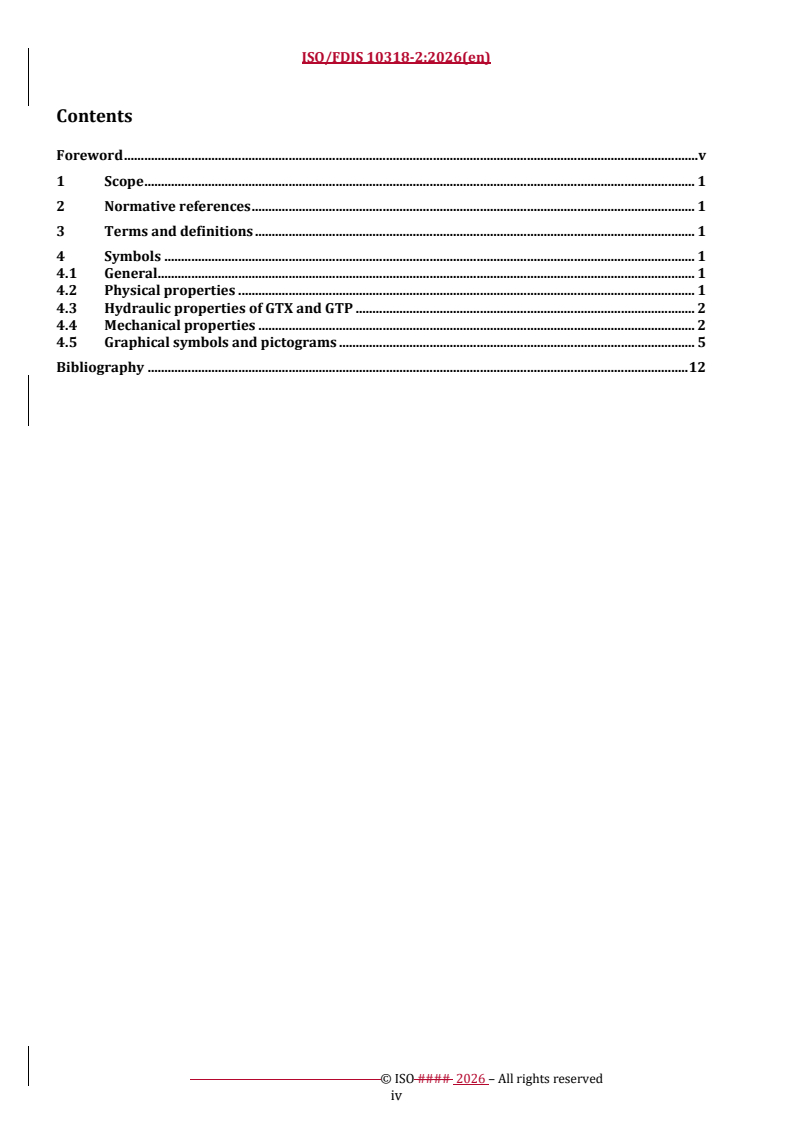
REDLINE ISO/FDIS 10318-2 - Geosynthetics — Part 2: Symbols and pictograms
ISO/FDIS 10318-2 is an ISO draft standard for geosynthetics. It specifies the property symbols, graphical symbols, and pictograms used in EN and ISO geosynthetics standards. In practice, it gives engineers, laboratories, and specifiers a common notation so technical documents use the same symbols for the same geosynthetic properties and products.
What does ISO/FDIS 10318-2 specify?
ISO/FDIS 10318-2 specifies symbols and pictograms for geosynthetics standards, not the test methods themselves. It does not define the detailed terms for individual symbols or pictogram meanings; those are found in the relevant standards, especially the vocabulary part of the ISO 10318 series.
ISO/FDIS 10318-2 is organized as follows:
- Clause 1 - Scope
- Clause 2 - Normative references
- Clause 3 - Terms and definitions
- Clause 4 - Symbols
- 4.1 General
- 4.2 Physical properties
- 4.3 Hydraulic properties of GTX and GTP
- 4.4 Mechanical properties
- 4.5 Graphical symbols and pictograms
- Bibliography
There are no normative references listed, and no terms and definitions are listed in Clause 3.
What are the key requirements of ISO/FDIS 10318-2?
ISO/FDIS 10318-2 is mainly a notation standard. Its key requirement is that each symbol has one unambiguous meaning and shall be used consistently in standards and technical documents.
4.1 General
Clause 4.1 sets the rule for the whole document: symbols are meant to give a consistent and internationally recognized notation system for geosynthetics. In practice, that means writers should use the same symbol for the same property every time, rather than creating local variants.
4.2 Physical properties
Table 1 standardizes symbols for basic physical properties such as thickness, width, length, and mass per unit area. This matters when describing products or comparing test data, because the same shorthand can be used across specifications and reports.
4.3 Hydraulic properties of GTX and GTP
Table 2 standardizes symbols for hydraulic properties of geotextiles (GTX) and geotextile-related products (GTP), including permeability normal to the plane, permittivity, transmissivity, velocity index, in-plane flow capacity, flux normal to the plane, and characteristic opening size. In practice, these symbols support drainage and filtration design by making flow-related data easier to read and compare.
4.4 Mechanical properties
Table 3 covers tensile characteristics such as yield stress, strength at a given strain, failure stress, maximum stress, tensile modulus, maximum joint seam strength, and joint or seam efficiency. This helps when documenting reinforcement performance and seam behavior.
Table 4 covers frictional characteristics, including friction angles and friction interaction coefficient between soil and GSY, or between GSY and GSY. This is important for interface design where sliding resistance matters.
Table 5 covers loading characteristics such as load at failure, maximum load, static puncture force, normal load in compressive creep, and shear load in direct shear. Table 6 adds the diameter of a hole obtained in the cone drop test. These symbols help keep test reporting precise and comparable.
4.5 Graphical symbols and pictograms
Tables 7 to 9 standardize graphical symbols and pictograms for product types, functions, and applications. In practice, these symbols let documents identify geosynthetic types and uses quickly without relying on long text labels.
What terms does ISO/FDIS 10318-2 define?
ISO/FDIS 10318-2 uses a small set of recurring terms and abbreviations that are central to its symbol tables:
- Geotextiles (GTX) - the product group named in the hydraulic-property tables.
- Geotextile-related products (GTP) - related products covered together with GTX for hydraulic notation.
- Permittivity (ψ) - the hydraulic symbol linked to flow through the plane of the product.
- Transmissivity (θ) - the hydraulic symbol linked to in-plane flow capacity.
- Geosynthetic barrier (GBR) - one of the graphical symbols listed for product types.
- Geocomposite (GCO) - a product type shown in the graphical-symbol table.
- Joint or seam efficiency (ξs) - a mechanical term used for joined or seamed products.
Who uses ISO/FDIS 10318-2?
ISO/FDIS 10318-2 is used by people who write, read, check, or apply geosynthetics standards and technical documents. That includes standards committees, test laboratories, manufacturers, designers, quality managers, and buyers.
It is especially relevant in work on separation, filtration, drainage, reinforcement, stabilization, surface erosion control, protection, and stress relief for asphalt interlayers. The application pictograms also point to common infrastructure and containment uses such as reservoirs and dams, canals, transportation infrastructure and roads, railways, tunnels and underground structures, coastal erosion control, secondary containment, and waterproofing of underground structures.
What changed in ISO/FDIS 10318-2 from the previous edition?
ISO/FDIS 10318-2 replaces ISO 10318-2:2015 and incorporates ISO 10318-2:2015/Amd 1:2018. The foreword says the document was technically revised, the nomenclature of the parts was changed, and a clarifying paragraph was added at the start of figures with descriptions of the tables.
Which standards are used with ISO/FDIS 10318-2?
ISO/FDIS 10318-2 lists no normative references. The bibliography cites ISO 10318-1, Geosynthetics - Part 1: Vocabulary, and the symbol tables refer to ISO 10318-1 for the underlying definitions of many symbols and properties.
What does the ISO/FDIS 10318-2 document contain?
ISO/FDIS 10318-2 contains one general symbol rule in Clause 4.1, then six symbol and pictogram tables covering physical, hydraulic, tensile, frictional, loading, and other characteristics. It also contains three tables of graphical symbols and pictograms for product types, functions, and applications.
The document is a notation reference for specifications, test reports, drawings, and other technical documents. It does not reproduce test methods or product requirements; it standardizes how those topics are named and shown.
Relations
- Consolidates
FprEN ISO 10318-2 - Geosynthetics - Part 2: Symbols and pictograms (ISO/FDIS 10318-2:2026) - Effective Date
- 12-Feb-2026
- Effective Date
- 11-Nov-2023
- Effective Date
- 28-Oct-2023
- Effective Date
- 28-Oct-2023
Buy Documents
ISO/FDIS 10318-2 - Geosynthetics — Part 2: Symbols and pictograms
REDLINE ISO/FDIS 10318-2 - Geosynthetics — Part 2: Symbols and pictograms
Get Certified
Connect with accredited certification bodies for this standard

Control Union Certifications
Global certification for agriculture and sustainability.

Hohenstein Institut
Textile testing and certification.

Bureau Veritas Bangladesh
Bureau Veritas certification services in Bangladesh.
Sponsored listings
Frequently Asked Questions
ISO/FDIS 10318-2 is a draft published by the International Organization for Standardization (ISO). Its full title is "Geosynthetics — Part 2: Symbols and pictograms". This standard covers: The intent of ISO 10318-2:2015 is to define property symbols, graphical symbols, and pictograms used in EN and ISO geosynthetics standards. Definitions of particular or specific symbols and pictograms terms not included in this this part of ISO 10318 can be found in the International Standards describing appropriate test methods.
The intent of ISO 10318-2:2015 is to define property symbols, graphical symbols, and pictograms used in EN and ISO geosynthetics standards. Definitions of particular or specific symbols and pictograms terms not included in this this part of ISO 10318 can be found in the International Standards describing appropriate test methods.
ISO/FDIS 10318-2 is classified under the following ICS (International Classification for Standards) categories: 01.080.99 - Other graphical symbols; 59.080.70 - Geotextiles. The ICS classification helps identify the subject area and facilitates finding related standards.
ISO/FDIS 10318-2 has the following relationships with other standards: It is inter standard links to FprEN ISO 10318-2, ISO/IEC TS 11179-30:2019, ISO 10318-2:2015/Amd 1:2018, ISO 10318-2:2015. Understanding these relationships helps ensure you are using the most current and applicable version of the standard.
ISO/FDIS 10318-2 is available in PDF format for immediate download after purchase. The document can be added to your cart and obtained through the secure checkout process. Digital delivery ensures instant access to the complete standard document.
Standards Content (Sample)
FINAL DRAFT
International
Standard
ISO/TC 221
Geosynthetics —
Secretariat: BSI
Part 2:
Voting begins on:
2026-10-20
Symbols and pictograms
Voting terminates on:
Géosynthétiques —
2026-12-01
Partie 2: Symboles et pictogrammes
RECIPIENTS OF THIS DRAFT ARE INVITED TO SUBMIT,
WITH THEIR COMMENTS, NOTIFICATION OF ANY
RELEVANT PATENT RIGHTS OF WHICH THEY ARE AWARE
AND TO PROVIDE SUPPOR TING DOCUMENTATION.
IN ADDITION TO THEIR EVALUATION AS
BEING ACCEPTABLE FOR INDUSTRIAL, TECHNO-
ISO/CEN PARALLEL PROCESSING LOGICAL, COMMERCIAL AND USER PURPOSES, DRAFT
INTERNATIONAL STANDARDS MAY ON OCCASION HAVE
TO BE CONSIDERED IN THE LIGHT OF THEIR POTENTIAL
TO BECOME STAN DARDS TO WHICH REFERENCE MAY BE
MADE IN NATIONAL REGULATIONS.
Reference number
FINAL DRAFT
International
Standard
ISO/TC 221
Geosynthetics —
Secretariat: BSI
Part 2:
Voting begins on:
Symbols and pictograms
Voting terminates on:
Géosynthétiques —
Partie 2: Symboles et pictogrammes
© ISO 2026
All rights reserved.
RECIPIENTS OF THIS DRAFT ARE INVITED TO SUBMIT,
WITH THEIR COMMENTS, NOTIFICATION OF ANY
This ISO publication is protected by copyright and is owned by ISO and/or its licensors.
RELEVANT PATENT RIGHTS OF WHICH THEY ARE AWARE
The content of this ISO publication is provided under licence, not sold. Use is subject to the applicable licence terms issued by ISO,
AND TO PROVIDE SUPPOR TING DOCUMENTATION.
an ISO member body, or an authorized third-party distributor.
IN ADDITION TO THEIR EVALUATION AS
BEING ACCEPTABLE FOR INDUSTRIAL, TECHNO-
Except as required for implementation or expressly permitted by a separate licence, no part of this ISO publication may be
ISO/CEN PARALLEL PROCESSING
LOGICAL, COMMERCIAL AND USER PURPOSES, DRAFT
reproduced, distributed, modified, used, or made available in any form or by any means – electronic or mechanical, including
INTERNATIONAL STANDARDS MAY ON OCCASION HAVE
photocopying, scanning, recording, or posting on internal or external digital platforms. TO BE CONSIDERED IN THE LIGHT OF THEIR POTENTIAL
TO BECOME STAN DARDS TO WHICH REFERENCE MAY BE
Any use beyond the scope of the granted rights is prohibited and may result in legal action.
MADE IN NATIONAL REGULATIONS.
ISO copyright office
CP 401 • CH-1214 Vernier, Geneva
Phone: +41 22 749 01 11
Email: copyright@iso.org
Website: www.iso.org
Published in Switzerland
Reference number
ii
Contents Page
Foreword .iv
1 Scope . 1
2 Normative references . 1
3 Terms and definitions . 1
4 Symbols . 1
4.1 General .1
4.2 Physical properties .1
4.3 Hydraulic properties of GTX and GTP .2
4.4 Mechanical properties .2
4.4.1 General .2
4.4.2 Tensile characteristics .2
4.4.3 Frictional characteristics .2
4.4.4 Loading characteristics .3
4.4.5 Other characteristics .3
4.5 Graphical symbols and pictograms .3
4.5.1 General .3
4.5.2 Functions .4
4.5.3 Applications .5
Bibliography . 8
iii
Foreword
ISO (the International Organization for Standardization) is a worldwide federation of national standards
bodies (ISO member bodies). The work of preparing International Standards is normally carried out through
ISO technical committees. Each member body interested in a subject for which a technical committee
has been established has the right to be represented on that committee. International organizations,
governmental and non-governmental, in liaison with ISO, also take part in the work. ISO collaborates closely
with the International Electrotechnical Commission (IEC) on all matters of electrotechnical standardization.
The procedures used to develop this document and those intended for its further maintenance are described
in the ISO/IEC Directives, Part 1. In particular, the different approval criteria needed for the different types
of ISO document should be noted. This document was drafted in accordance with the editorial rules of the
ISO/IEC Directives, Part 2 (see www.iso.org/directives).
ISO draws attention to the possibility that the implementation of this document may involve the use of (a)
patent(s). ISO takes no position concerning the evidence, validity or applicability of any claimed patent
rights in respect thereof. As of the date of publication of this document, ISO [had/had not] received notice of
(a) patent(s) which may be required to implement this document. However, implementers are cautioned that
this may not represent the latest information, which may be obtained from the patent dat
...
ISO/DISFDIS 10318-2:2025(en)
ISO /TC 221
Secretariat: BSI
Date: 2026-01-0510-06
Geosynthetics — —
Part 2:
Symbols and pictograms
TTTThhhhiiiis drs drs drs draaaaftfffttt i i i is s s s susususubbbbmmmmiiiitttttttteeeed d d d ttttoooo aaaa ppppaaaarrrraaaallellellellel l l l vvvvooootttteeee i i i innnn IIIISSSSOOOO,,,, CCCCEEEEN.N.N.N.
© Géosynthétiques —
Partie 2: Symboles et pictogrammes
FDIS stage
TThhiis drs draafftt i is s susubbmmiitttteed d ttoo aa ppaarraallellel l vvoottee i inn IISSOO,, CCEEN.N.
ISO/DISFDIS 10318-2:20252026(en)
All rights reserved. Unless otherwise specified,
This ISO publication is protected by copyright and is owned by ISO and/or its licensors.
The content of this ISO publication is provided under licence, not sold. Use is subject to the applicable licence terms issued
by ISO, an ISO member body, or an authorized third-party distributor.
Except as required in the context of its for implementation or expressly permitted by a separate licence, no part of this
ISO publication may be reproduced or utilized otherwise, distributed, modified, used, or made available in any form or
by any means, – electronic or mechanical, including photocopying, scanning, recording, or posting on internal or external
digital platforms.
Any use beyond the internet or an intranet, without prior written permission. Permission can be requested from either
ISO at the address below or ISO’s member body in the countryscope of the requestergranted rights is prohibited and may
result in legal action.
ISO copyright office
CP 401 • Ch. de Blandonnet 8
CH-1214 Vernier, Geneva
Phone: + 41 22 749 01 11
Fax: +41 22 749 09 47
Email: copyright@iso.org
Website: www.iso.org
Published in Switzerland
iii
Contents
Foreword . v
1 Scope . 1
2 Normative references . 1
3 Terms and definitions . 1
4 Symbols . 1
4.1 General . 1
4.2 Physical properties . 1
4.3 Hydraulic properties of GTX and GTP . 2
4.4 Mechanical properties . 2
4.5 Graphical symbols and pictograms . 5
Bibliography . 12
© ISO #### 2026 – All rights reserved
iv
ISO/DISFDIS 10318-2:20252026(en)
Foreword
ISO (the International Organization for Standardization) is a worldwide federation of national standards
bodies (ISO member bodies). The work of preparing International Standards is normally carried out through
ISO technical committees. Each member body interested in a subject for which a technical committee has been
established has the right to be represented on that committee. International organizations, governmental and
non-governmental, in liaison with ISO, also take part in the work. ISO collaborates closely with the
International Electrotechnical Commission (IEC) on all matters of electrotechnical standardization.
The procedures used to develop this document and those intended for its further maintenance are described
in the ISO/IEC Directives, Part 1. In particular, the different approval criteria needed for the different types of
ISO document should be noted. This document was drafted in accordance with the editorial rules of the
ISO/IEC Directives, Part 2 (see www.iso.org/directives).
ISO draws attention to the possibility that the implementation of this document may involve the use of (a)
patent(s). ISO takes no position concerning the evidence, validity or applicability of any claimed patent rights
in respect thereof. As of the date of publication of this document, ISO [had/had not] received notice of (a)
patent(s) which may be required to implement this document. However, implementers are cautioned that this
may not represent the latest information, which may be obtained from the patent database available at
www.iso.org/patents. ISO shall not be held responsible for identifying any or all such patent rights.
Any trade name used in this document is information given for the convenience of users and does not
constitute an endorsement.
For an explanation of the voluntary nature of standards, the meaning of ISO specific terms and expressions
related to conformity assessment, as well as information about ISO's adherence to the World Trade
Organization (WTO) principles in the Technical Barriers to Trade (TBT), see www.iso.org/iso/foreword.html.
This document was prepared by Technical Committee ISO/TC 221, Geosynthetics, in collaboration with the
European Committee for Standardization (CEN) Technical Committee CEN/TC 189, Geosynthetics, in
accordance with the Agreement on technical cooperation between ISO and CEN (Vienna Agreement).
This thirdsecond edition cancels and replaces the secondfirst edition (ISO 10318-2:2015), which has been
technically revised. It also incorporates the Amendment ISO 10318-2:2015/Amd 1:2018.
The main changes arechange is as follows:
— Nomenclatureaddition of the parts changed.
— — Paragraph at the start of Figures with a description of the tables was included for clarification and
following the ISO regulations.
A list of all parts in the ISO 10318 series can be found on the ISO website.
Any feedback or questions on this document should be directed to the user’s national standards body. A
complete listing of these bodies can be found at www.iso.org/members.html.
v
DRAFT International Standard ISO/DIS 10318-2:2025(en)
Geosynthetics — —
Part 2:
Symbols and pictograms
1 Scope
This document specifies property symbols, graphical symbols, and pictograms used in EN and ISO
geosynthetics standards.
Definitions of particular or specific symbols and p
...