

ISO 10655
(Main)Methods for analysis of lithium hexafluorophosphate — Determination of metal ions content by inductively coupled plasma optical emission spectrometry (ICP-OES)
- Abstract
This document specifies a method for the determination of metal ions content of lithium hexafluorophosphate (LiPF6) by inductively coupled plasma optical emission spectrometry (ICP-OES). The document is applicable to the determination of the content of aluminium (Al), calcium (Ca), cadmium (Cd), chromium (Cr), copper (Cu), iron (Fe), potassium(K), magnesium (Mg), sodium (Na), nickel (Ni) palladium(Pd) and zinc (Zn) in LiPF6. This method is suitable for the laboratory operation of LiPF6 producer, final user and independent test institute.
- Status
- Not Published
- Technical Committee
- ISO/TC 333 - Lithium
- Drafting Committee
- ISO/TC 333/WG 4 - Analysis for lithium electrolyte
- Current Stage
- 6000 - International Standard under publication - 60 Publication
- Start Date
- 17-Oct-2026
Buy Documents

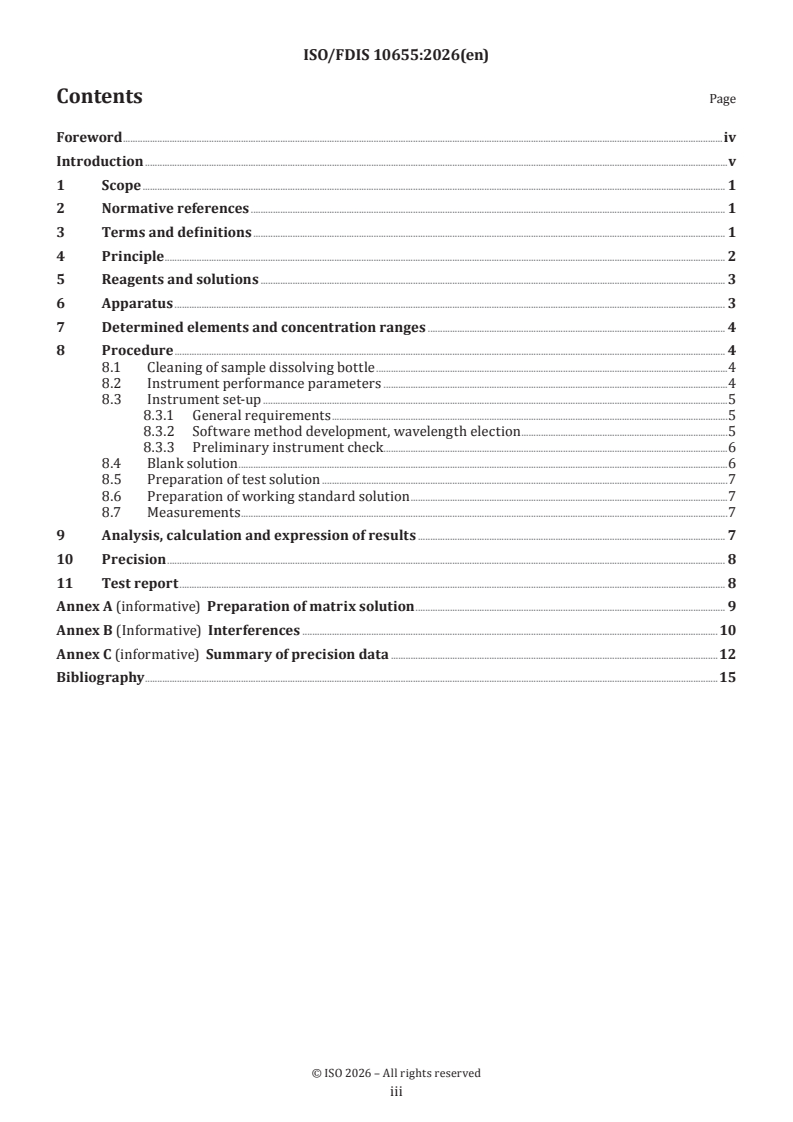

ISO/FDIS 10655 - Methods for analysis of lithium hexafluorophosphate — Determination of metal ions content by inductively coupled plasma optical emission spectrometry (ICP-OES)
REDLINE ISO/FDIS 10655 - Methods for analysis of lithium hexafluorophosphate — Determination of metal ions content by inductively coupled plasma optical emission spectrometry (ICP-OES)
ISO 10655 is an ISO standard for determining metal ion impurities in lithium hexafluorophosphate (LiPF6) by inductively coupled plasma optical emission spectrometry (ICP-OES). It specifies a laboratory method for aluminium (Al), calcium (Ca), cadmium (Cd), chromium (Cr), copper (Cu), iron (Fe), potassium (K), magnesium (Mg), sodium (Na), nickel (Ni), lead (Pb) and zinc (Zn) in LiPF6. The document is written for LiPF6 producers, final users and independent test institutes that need a common way to measure trace metals in this battery material.
What does ISO 10655 specify?
ISO 10655 specifies the scope, the ICP-OES principle, the reagents and apparatus, the measurement procedure, the calculation of results, precision information and the test report content. In practice, it is a complete laboratory method: it tells the user how to prepare the sample, how to calibrate the instrument and how to report the metal content in mg/kg.
The standard applies to impurity metal ions in LiPF6 when the mass concentration is below 10 mg/kg. It can also be used at higher concentrations if extra interferences are identified and corrected, with the user responsible for showing that the method is fit for purpose.
| Annex | What it covers |
|---|---|
| Annex A | Preparation of matrix solution for LiPF6 and other high-purity lithium salts |
| Annex B | Interferences, including spectral and non-spectral effects |
| Annex C | Summary of precision data from interlaboratory testing |
The document is organized into clauses on scope, normative references, terms and definitions, principle, reagents and solutions, apparatus, determined elements and ranges, procedure, analysis and calculation, precision, and test report.
What are the key requirements of ISO 10655?
ISO 10655 is built around matrix-matched ICP-OES measurement of dissolved LiPF6. The main practical points are sample cleanliness, correct calibration, control of interferences and clear result reporting.
Sample preparation and matrix matching
ISO 10655 requires the test sample to be prepared in an inert atmosphere, with about 2.5 g of sample weighed into a dissolving bottle and diluted with about 50 g of water by mass. The calibration solutions must be matrix matched, meaning the lithium concentration in the standards should be approximately the same as in the sample solution.
This matters because lithium concentration affects emission intensity. If the matrix is not matched, the calibration curve can shift and the measured metal content can be biased.
Reagents and equipment
ISO 10655 uses grade 1 water according to ISO 3696, high-purity nitric acid, single-element stock solutions, a mixed-element standard solution, argon of at least 99.995 % purity and an ICP-OES instrument with an appropriate sample introduction system. The standard recommends hydrofluoric acid-resistant nebulizers because HF can be generated during dissolution of LiPF6 and can damage glass parts.
This matters in practice because the wrong bottle material, nebulizer or gas quality can create contamination, damage the instrument or distort results. The document also calls for analytical balances accurate to 0.1 mg and plastic sample dissolving bottles made from suitable materials such as polyethylene, polypropylene or PTFE-based materials.
Cleaning and blank control
ISO 10655 requires sample dissolving bottles to be cleaned carefully before use, for example by soaking in 5 % nitric acid for at least 6 hours and then rinsing with water. The blank solution is the matrix solution.
This matters because trace-metal analysis is easily affected by carryover and contamination. A dirty bottle or a poor blank can produce false high results, especially at low mg/kg levels.
Calibration and instrument checks
ISO 10655 uses a working curve method. The instrument is set up according to the manufacturer’s instructions, the plasma is allowed to stabilize, and the operator checks wavelength choice, linearity, sensitivity, stability, detection limit, inter-element correction and rinse times. The standard gives recommended wavelengths and likely spectral interferences in a table.
This matters because ICP-OES performance depends on the chosen wavelength and the surrounding matrix. A wavelength with overlapping interferences can make one element look higher than it is.
Acceptance of measurement performance
ISO 10655 calls for daily checks of reproducibility and sensitivity, with replicate precision below an RSD of 2 %. During calibration, the linear regression should satisfy r ≥ 0.99. A calibration check solution should then give a recovery between 80 % and 110 %.
This gives the laboratory a simple pass-fail control on the run before reporting results. If those checks fail, the batch should be questioned before results are used for release, investigation or supplier acceptance.
Calculation and reporting
ISO 10655 expresses the result as mg/kg and calculates it from the measured concentration in the test solution, the blank and the sample mass. The report is based on two independent determinations under reproducibility conditions, and the final test report must identify the sample, the method reference, deviations, results to two decimal places, the test date, the laboratory and any unusual features.
That makes the result traceable and suitable for quality records, customer communication and dispute resolution.
What terms does ISO 10655 define?
ISO 10655 defines a small set of sampling and measurement terms used throughout the method.
- Laboratory sample - the sample prepared for sending to the laboratory and intended for inspection or testing.
- Test sample - the sample prepared from the laboratory sample from which test portions are taken.
- Test portion - the quantity actually taken from the test sample for the measurement.
- Sample solution - the solution prepared from the test sample by dissolution, extraction or digestion before further preparation.
- Standard solution - a solution of accurately known concentration used as the basis for calibration or comparison.
- Calibration solution - the solution used to calibrate the instrument, prepared from a stock solution or a certified standard.
- Determination - the full sequence from preparing the test sample solution through measurement and calculation of the result.
- Repeatability - closeness of agreement between results obtained in the same laboratory under short-interval conditions.
- Reproducibility - closeness of agreement between results obtained in different laboratories using the same method.
Who uses ISO 10655?
ISO 10655 is intended for LiPF6 producers, final users and independent test institutes. In practice, those users include laboratory analysts, quality control staff and technical buyers who need a common method for checking metal impurities in battery-grade LiPF6.
It is especially relevant where impurity metals can affect lithium-ion battery performance. The introduction links these impurities to product quality monitoring, so the standard is useful for incoming inspection, batch release testing, supplier control and dispute testing.
Which standards are used with ISO 10655?
ISO 10655 relies on several referenced standards and cited sources.
- ISO 3696 - provides the water specification used for analytical-grade water.
- ISO 11885:2007 - is cited for ICP-OES interference discussion and for recovery-related guidance.
- ISO 5725-2:2019 - is used for the calculation of the precision data summarized in Annex C.
- ISO 6206:1979 - is cited as the source for sampling terms such as laboratory sample, test sample and test portion.
- ISO 78-2:1999 - is cited as the source for the term standard solution.
- ISO 17294-1:2016 - is cited as a source for the term calibration solution.
- ISO 3534-2:2006 - is cited as the source for repeatability and reproducibility.
- ISO/TS 23031:2020 - is cited as a source for the term precision.
What does the ISO 10655 document contain?
ISO 10655 contains a working method for dissolving LiPF6, preparing matrix-matched calibration standards and measuring metal ions by ICP-OES. It also includes a table of determined elements and concentration ranges, and a recommended wavelength table with listed spectral interferences for method setup.
The document gives a practical sequence for bottle cleaning, instrument checks, sample preparation, blank preparation, working standard preparation and measurement. It then shows how to turn the measured signal into mg/kg, using the blank-corrected concentration and the sample mass.
Annex A gives example matrix-solution preparations for LiPF6 and other lithium salts. Annex B explains spectral, physical, excitation and chemical interferences and discusses ways to detect or correct them, including dilution, standard additions and internal standards. Annex C summarizes precision data from eight laboratories and four LiPF6 samples, which helps users judge how the method performed in interlaboratory testing.
Buy Documents
ISO/FDIS 10655 - Methods for analysis of lithium hexafluorophosphate — Determination of metal ions content by inductively coupled plasma optical emission spectrometry (ICP-OES)
REDLINE ISO/FDIS 10655 - Methods for analysis of lithium hexafluorophosphate — Determination of metal ions content by inductively coupled plasma optical emission spectrometry (ICP-OES)
Get Certified
Connect with accredited certification bodies for this standard

ECOCERT
Organic and sustainability certification.

Eurofins Food Testing Global
Global leader in food, environment, and pharmaceutical product testing.

Intertek Bangladesh
Intertek certification and testing services in Bangladesh.
Sponsored listings
Frequently Asked Questions
ISO 10655 is a draft published by the International Organization for Standardization (ISO). Its full title is "Methods for analysis of lithium hexafluorophosphate — Determination of metal ions content by inductively coupled plasma optical emission spectrometry (ICP-OES)". This standard covers: This document specifies a method for the determination of metal ions content of lithium hexafluorophosphate (LiPF6) by inductively coupled plasma optical emission spectrometry (ICP-OES). The document is applicable to the determination of the content of aluminium (Al), calcium (Ca), cadmium (Cd), chromium (Cr), copper (Cu), iron (Fe), potassium(K), magnesium (Mg), sodium (Na), nickel (Ni) palladium(Pd) and zinc (Zn) in LiPF6. This method is suitable for the laboratory operation of LiPF6 producer, final user and independent test institute.
This document specifies a method for the determination of metal ions content of lithium hexafluorophosphate (LiPF6) by inductively coupled plasma optical emission spectrometry (ICP-OES). The document is applicable to the determination of the content of aluminium (Al), calcium (Ca), cadmium (Cd), chromium (Cr), copper (Cu), iron (Fe), potassium(K), magnesium (Mg), sodium (Na), nickel (Ni) palladium(Pd) and zinc (Zn) in LiPF6. This method is suitable for the laboratory operation of LiPF6 producer, final user and independent test institute.
ISO 10655 is classified under the following ICS (International Classification for Standards) categories: 71.060.50 - Salts. The ICS classification helps identify the subject area and facilitates finding related standards.
ISO 10655 is available in PDF format for immediate download after purchase. The document can be added to your cart and obtained through the secure checkout process. Digital delivery ensures instant access to the complete standard document.
Standards Content (Sample)
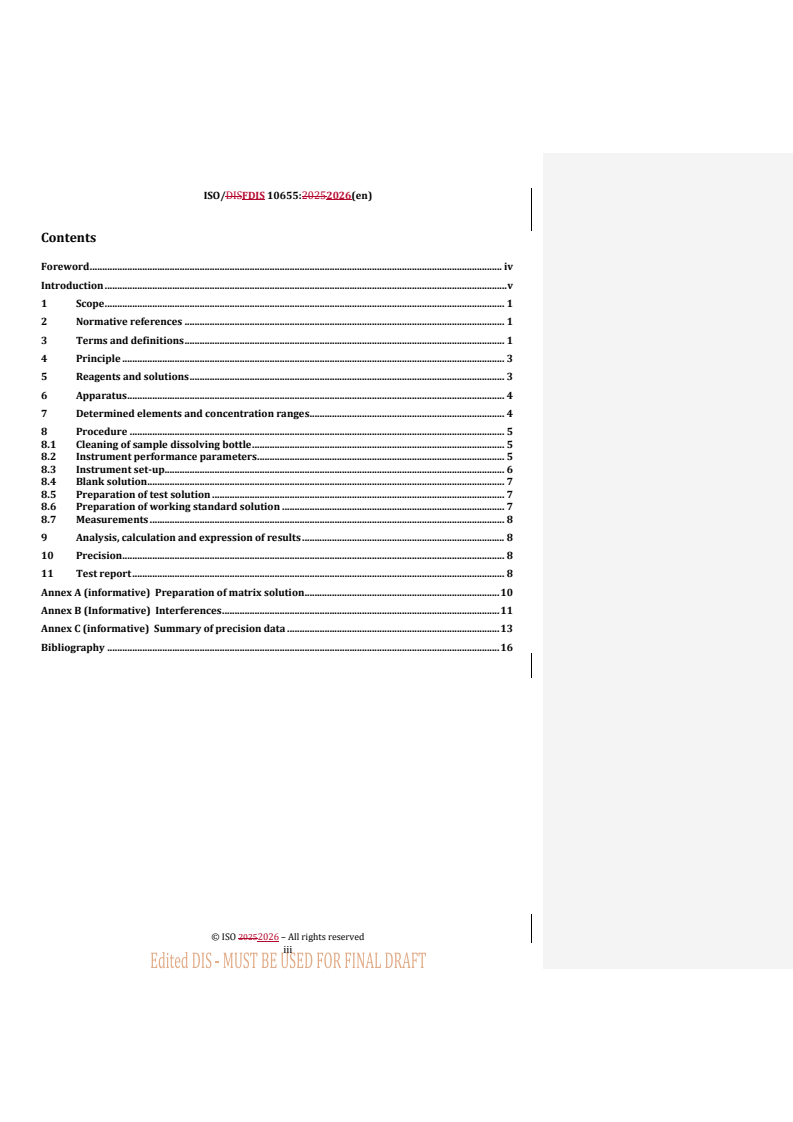
Contents
- Introduction
- 1 Scope
- 2 Normative references
- 3 Terms and definitions
- 3.1 laboratory sample
- 3.2 test sample
- 3.3 test portion
- 3.4 sample solution
- 3.5 standard solution
- 3.6 stock solution
- 3.7 calibration solution
- 3.8 determination
- 3.9 precision
- 3.10 reproducibility
- 3.11 repeatability
- 4 Principle
- 5 Reagents and solutions
- 5.2 Nitric acid washing solution (CAS Registry Number 7697-37-2), preparation of 5 % HNO from
- 6 Apparatus
- 7 Determined elements and concentration ranges
- 8 Procedure
- 8.1 Cleaning of sample dissolving bottle
- 8.2 Instrument performance parameters
- 8.3 Instrument set-up
- 8.4 Blank solution
- 8.5 Preparation of test solution
- 8.6 Preparation of working standard solution
- 8.7 Measurements
- 9 Analysis, calculation and expression of results
- 10 Precision
- 11 Test report
- Annex A
- Annex B
- Annex C
- Bibliography
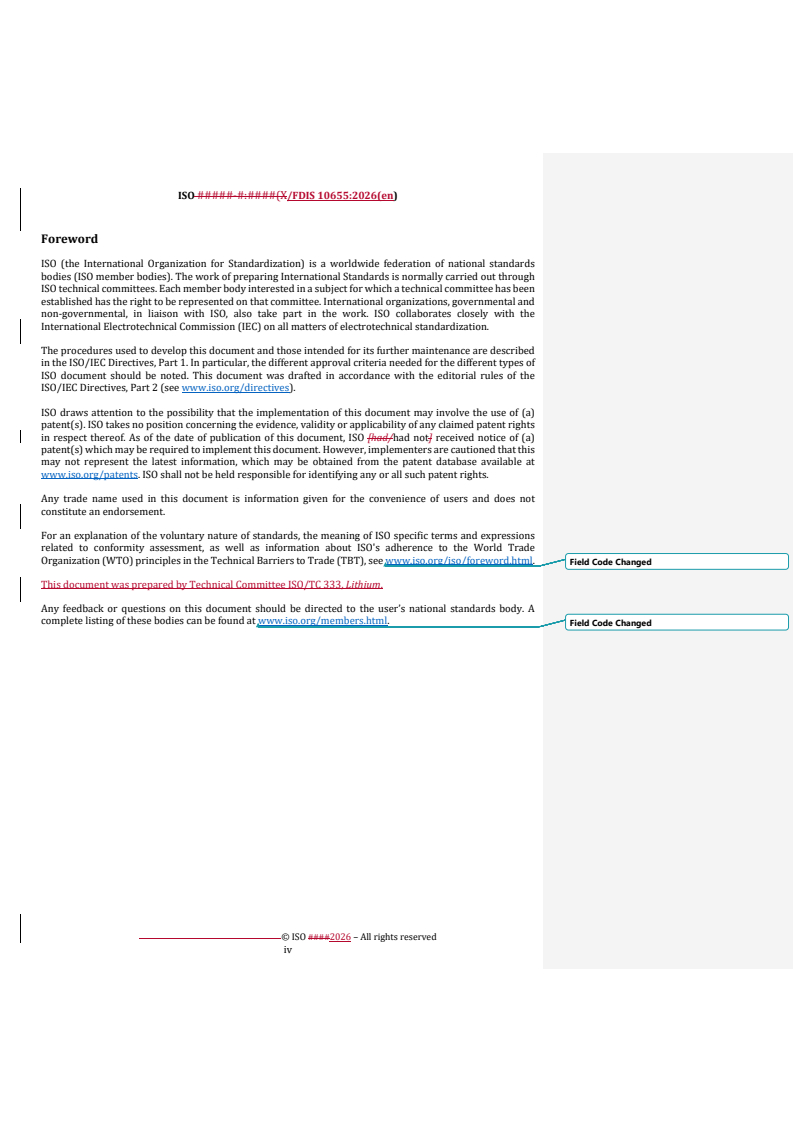
Introduction
Lithium hexafluorophosphate (LiPF ) is a white crystalline powder that dissolves easily in water,
decomposes rapidly, and generates white fumes when exposed to the air. It is mainly used as electrolyte lithium salt for lithium-ion battery and lithium-ion supercapacitor. As the metal impurity ions of LiPF ,
such as aluminium (Al), calcium (Ca), cadmium (Cd), chromium (Cr), copper(Cu), iron (Fe), potassium(K), magnesium (Mg), sodium (Na), nickel (Ni), lead(Pb), zinc (Zn) have a higher reduction potential than lithium ions, during charging the metal impurity ions will preferentially intercalate into the cathode surface, which will affect the forming and compactness of SEI film, reduce the reversible capacity of lithium-ion batteries and deteriorate the battery’s performance.
Therefore, the content of metal impurity ions in LiPF is an important index to monitor product quality.
The advantages of determination of LiPF metal ions by inductively coupled plasma optical emission
spectrometry (ICP-OES) are simple sample pre-treatment, high accuracy and low detection limit. When applying this document, it is necessary in each case, depending on the range to be tested, to determine if and to what extent additional conditions should be established.
FINAL DRAFT International Standard ISO/FDIS 10655:2026(en) Methods for analysis of lithium hexafluorophosphate — Determination of metal ions content by inductively coupled plasma optical emission spectrometry (ICP-OES) WARNING — The use of this document can involve hazardous materials, operations, and equipment. This document does not purport to address any safety problems associated with its use. It is the responsibility of the user of this document to establish appropriate safety and health practices and determine the applicability of regulatory limitations prior to use.
1 Scope
This document specifies the method for determining impurity metal ions in lithium hexafluorophosphate - specifically aluminum (Al), calcium (Ca), cadmium (Cd), chromium (Cr), copper (Cu), iron (Fe), potassium (K), magnesium (Mg), sodium (Na), nickel (Ni), lead (Pb), and zinc (Zn). This document applies when the mass concentration of these impurity metal ions in LiPF is below 10 mg/kg.
This document can apply to higher mass concentrations of impurity metallic ions in LiPF if it can be shown
that additionally occurring interferences are considered and corrected for carefully. It is the responsibility of the user to demonstrate the fitness for purpose.
This document is applicable for the other elements listed above provided the user has verified the applicability. Higher concentrations can be measured by adjusting the dilution ratio, provided that the calibration standards have been diluted in the same way.
2 Normative references
The following documents are referred to in the text in such a way that some or all of their content constitutes requirements of this document. For dated references, only the edition cited applies. For undated references, the latest edition of the referenced document (including any amendments) applies. ISO 3696, Water for analytical laboratory use — Specification and test methods
3 Terms and definitions
For the purposes of this document, the following terms and definitions apply. ISO and IEC maintain terminology databases for use in standardization at the following addresses:
- ISO Online browsing platform: available at https:// www .iso .org/ obp
- IEC Electropedia: available at https:// www .electropedia .org/
3.1 laboratory sample
sample as prepared for sending to the laboratory and intended for inspection or testing [SOURCE: ISO 6206:1979, 3.2.10]
3.2 test sample
sample prepared from the laboratory sample (3.1) and from which test portions (3.3) will be taken [SOURCE: ISO 6206:1979, 3.2.13]
ISO/FDIS 10655:2026(en)
3.3 test portion
quantity of material drawn from the test sample (3.2) (or from the laboratory sample (3.1) if both are the same) and on which the test or observation is actually carried out [SOURCE: ISO 6206:1979, 3.2.14]
3.4 sample solution
solution prepared from a test sample (3.2) by the process of dissolution, extraction or digestion according to appropriate specifications sample solution Note 1 to entry: A sample solution can need to be subjected to further operations, e.g., dilution and/or addition of an internal standard, in order to produce a test solution that is ready for analysis.
3.5 standard solution
solution of accurately known concentration of an element, an ion, a compound or a group derived from the substance used for its preparation [SOURCE: ISO 78-2:1999, 3.6]
3.6 stock solution
solution of accurately known analyte concentration(s), prepared from pure chemicals
3.7 calibration solution
solution used to calibrate the instrument, prepared from a stock solution (3.6) or a certified standard [SOURCE: ISO 17294-1:2016, 3.4]
3.8 determination
entire process from preparing the test sample (3.2) solution up to and including measurement and calculation of the result
3.9 precision
closeness of agreement between independent test results obtained under prescribed conditions [SOURCE: ISO/TS 23031:2020, 3.15]
3.10 reproducibility
precision (3.9) under conditions where test results are obtained with the same method on identical test items in different laboratories with different operators using different equipment [SOURCE: ISO 3534-2:2006, 3.3.10]
3.11 repeatability
precision under conditions where test results are obtained with the same method on identical test items in the same laboratory by the same operator using the same equipment within short intervals of time. [SOURCE: ISO 3534-2:2006, 3.3.5]
4 Principle
The determination is carried out by means of the analytical technique of optical emission spectroscopy with inductively coupled plasma (ICP-OES), which allows the detection and quantitative determination of most of the elements from the periodic table from samples in aqueous solution.
ISO/FDIS 10655:2026(en) In the ICP-OES technique, the continuous introduction of the liquid sample and a nebulization system forms an aerosol that is transported by Argon to the plasma torch, inductively coupled by radio frequency. In the plasma, due to the high temperatures generated, the analytes are atomized and ionized, generating the atomic emission spectra of characteristic lines. The spectra are scattered by the diffraction grating and the light-sensitive detector measures the spectral line intensities. The information is processed by the computer software system of the ICP-OES equipment.
In this document, dissolution of a test sample in water, and dilution of the solution to a known mass. Nebulization of the solution into an inductively coupled plasma and atomic emission spectrometer and measurement of the intensity of the emitted light from metal ions, simultaneously. The working curve method is used to determine the content of metal ions in LiPF samples by ICP-OES with
hydrofluoric acid-resistant nebulizers.
5 Reagents and solutions
5.1 Water, grade 1 water with conductivity (25 °C) less than 0,005 5 mS/m, in accordance with ISO 3696. ®1)
5.2 Nitric acid washing solution (CAS Registry Number 7697-37-2), preparation of 5 % HNO from
65 % HNO .
5.3 High-purity nitric acid (CAS RN 7697-37-2), 65 % min HNO .
5.4 Single element standard stock solution (Al, Ca, Cd, Cr, Cu, Fe, K, Mg, Na, Ni, Pb and Zn), 1 000 mg/l. Single element standard stock solutions specifying the acid used and the preparation technique are commercially available. Single-element standard stock solutions can be made from high purity metals. 5.5 Mixed-element standard solution, place 1 ml of each of the solutions prepared from Clause 5.4 into a sample dissolving bottle. Dilute with water (5.1) to 100 g and shake 15 times until uniform. 1 ml solution contains 0,01 mg metal ions, the concentration of the obtained solution is 10 μg / g (Al, Ca, Cd, Cr, Cu, Fe, K, Mg, Na, Ni, Pb and Zn). A 10 µg/ml certified mixed element standard solution can be purchased directly. 5.6 Matrix solution, because the lithium concentration has an influence on the intensities of the analyte intensities. The calibration solutions shall be matrix matched. To match this matrix any high purity Li-salt can be used. The lithium solution concentration in the calibration solution and in the sample should be approximately the same as the lithium matrix solution concentration. The lithium matrix solution can be made from high purity LiPF6, Li-nitrate or Li-carbonate (information on how to prepare the matrix solution is given in Annex A).
5.7 Argon gas (CAS RN 7440-37-1), purity ≥ 99,995 % (mass fraction).
6 Apparatus
6.1 Inductively coupled plasma optical emission spectrometry, the ICP optical emission spectrometer consists of a sample introduction system, the plasma (as an excitation/emission source), a plasma torch, an optical system, a detector and a computer system. The sample introduction system usually consists of a peristaltic pump for sample transport to the nebulizer, the nebulizer and a spray chamber. The most common nebulizers are the concentric nebulizer, the crossflow nebulizer and the V-groove nebulizer. They 2)
are made from glass, quartz, Teflon , ceramic or plastics. HF is generated during the dissolution of LiPF6, 1) CAS Registry Number® is a trademark of the American Chemical Society (ACS). This information is given for the convenience of users of this document and does not constitute an endorsement by ISO of the product named. Equivalent products may be used if they can be shown to lead to the same results. 2) Teflon is an example(s) of a suitable product available commercially. This information is given for the convenience of users of this document and does not constitute an endorsement by ISO of this product.
ISO/FDIS 10655:2026(en) which destroys nebulizer made of glass. Therefore, it is recommended to use hydrofluoric acid-resistant nebulizers.
...
Contents
- Introduction
- 1 Scope
- 2 Normative references
- 3 Terms and definitions
- 3.4 3.4 test
- 4 Principle
- 5 Reagents and solutions
- 6 Apparatus
- 7 Determined elements and concentration ranges
- 8 Procedure
- 8.1 Cleaning of sample dissolving bottle
- 8.2 Instrument performance parameters
- 8.3 Instrument set-up
- 8.4 Blank solution
- 8.5 Preparation of test solution
- 8.6 Preparation of working standard solution
- 8.7 Measurements
- 9 Analysis, calculation and expression of results
- 10 Precision
- 11 Test report
- Annex A
- Annex B
- Annex C
- Bibliography
Introduction
Lithium hexafluorophosphate (LiPF ) is a white crystalline powder that dissolves easily in water, decomposes
rapidly, and generates white fumes when exposed to the air. It is mainly used as electrolyte lithium salt for lithium-ion battery and lithium-ion supercapacitor. As the metal impurity ions of LiPF , such as aluminium
(Al), calcium (Ca), cadmium (Cd), chromium (Cr), copper(Cu), iron (Fe), potassium(K), magnesium (Mg), sodium (Na), nickel (Ni), lead(Pb), zinc (Zn) have a higher reduction potential than lithium ions, during charging the metal impurity ions will preferentially intercalate into the cathode surface, which will affect the forming and compactness of SEI film, reduce the reversible capacity of lithium-ion batteries and deteriorate the battery’s performance.
Therefore, the content of metal impurity ions in LiPF is an important index to monitor product quality. The
advantages of determination of LiPF metal ions by inductively coupled plasma optical emission spectrometry
(ICP-OES) are simple sample pre-treatment, high accuracy and low detection limit. When applying this document, it is necessary in each case, depending on the range to be tested, to determine if and to what extent additional conditions should be established.
DRAFT International Standard ISO/DIS 10655:2025(en)
Methods for analysis of lithium hexafluorophosphate - — Determination of metal ions content by Inductively Coupled Plasma Optical Emission Spectrometryinductively coupled plasma optical emission spectrometry (ICP-OES) WARNING— — The use of this document can involve hazardous materials, operations, and equipment. This document does not purport to address any safety problems associated with its use. It is the responsibility of the user of this document to establish appropriate safety and health practices and determine the applicability of regulatory limitations prior to use.
1 Scope
This document specifies the method for determining impurity metal ions in lithium hexafluorophosphate— - specifically aluminum (Al), calcium (Ca), cadmium (Cd), chromium (Cr), copper (Cu), iron (Fe), potassium (K), magnesium (Mg), sodium (Na), nickel (Ni), lead (Pb), and zinc (Zn). This document applies when the mass concentration of these impurity metal ions in LiPF₆LiPF is below 10 mg/kg.
This document can apply to higher mass concentrations of impurity metallic ions in LiPF6 if it can be shown that additionally occurring interferences are considered and corrected for carefully. It is up tothe responsibility of the user to demonstrate the fitness for purpose. This document is applicable for the other elements listed above, provided the user has verified the applicability. Higher concentrations can be measured by adjusting the dilution ratio, provided that the calibration standards have been diluted in the same way.
2 Normative references
The following documents are referred to in the text in such a way that some or all of their content constitutes requirements of this document. For dated references, only the edition cited applies. For undated references, the latest edition of the referenced document (including any amendments) applies. ISO 3696, Water for analytical laboratory use — Specification and test methods
3 Terms and definitions
For the purposes of this document, the following terms and definitions apply. ISO and IEC maintain terminology databases for use in standardization at the following addresses:
- — ISO Online browsing platform: available at https://www.iso.org/obp
- — IEC Electropedia: available at https://www.electropedia.org/
3.1 3.1 laboratory sample a sample as prepared for sending to the laboratory and intended for inspection or testing
ISO #####-#:####(X/FDIS 10655:2026(en) [SOURCE: ISO 6206:1979, 3.2.10] 3.2 3.2 test sample a sample prepared from the laboratory sample (3.1) and from which test portions (3.3(3.3)) will be taken [SOURCE: ISO 6206:1979, 3.2.13] 3.3 3.3 test portion quantity of material drawn from the test sample (3.2(3.2)) (or from the laboratory sample (3.1 (3.1)) if both are the same) and on which the test or observation is actually carried out [SOURCE: ISO 6206:1979, 3.2.14]
3.4 3.4 test
sample solution solution prepared from a test sample (3.2(3.2)) by the process of dissolution, extraction or digestion according to appropriate specifications sample solution Note 1 to entry: A sample solution maycan need to be subjected to further operations, e.g., dilution and/or addition of an internal standard, in order to produce a test solution that is ready for analysis. 3.43.5 3.5 standard solution solution of accurately known concentration of an element, an ion, a compound or a group derived from the substance used for its preparation [SOURCE: ISO 78-2:1999, 3.6] 3.53.6 3.6 stock solution solution of accurately known analyte concentration(s), prepared from pure chemicals 3.63.7 3.7 calibration solution solution used to calibrate the instrument, prepared from a stock solution (3.6(3.6)) or a certified standard [SOURCE: ISO 17294-1:2016, 3.4] 3.73.8 3.8 determination entire process from preparing the test sample (3.2) solution up to and including measurement and calculation of the result 3.83.9 3.9 precision closeness of agreement between independent test results obtained under prescribed conditions [SOURCE: ISO/TS 23031:2020, 3.15]
ISO/DISFDIS 10655:20252026(en) 3.93.10 3.10 reproducibility precision (3.9) under conditions where test results are obtained with the same method on identical test items in different laboratories with different operators using different equipment [SOURCE: ISO 3534-2:2006, 3.3.10] 3.103.11 3.11 repeatability precision under conditions where test results are obtained with the same method on identical test items in the same laboratory by the same operator using the same equipment within short intervals of time. [SOURCE: ISO 3534-2:2006, 3.3.5]
4 Principle
The determination is carried out by means of the analytical technique of optical emission spectroscopy with inductively coupled plasma (ICP-OES), which allows the detection and quantitative determination of most of the elements from the periodic table from samples in aqueous solution. In the ICP-OES technique, the continuous introduction of the liquid sample and a nebulization system forms an aerosol that is transported by Argon to the plasma torch, inductively coupled by radio frequency. In the plasma, due to the high temperatures generated, the analytes are atomized and ionized, generating the atomic emission spectra of characteristic lines. The spectra are scattered by the diffraction grating and the lightsensitive detector measures the spectral line intensities. The information is processed by the computer software system of the ICP-OES equipment.
In this document, dissolution of a test sample in water, and dilution of the solution to a known mass. Nebulization of the solution into an inductively coupled plasma and atomic emission spectrometer and measurement of the intensity of the emitted light from metal ions, simultaneously. The working curve method is used to determine the content of metal ions in LiPF samples by ICP-OES with
hydrofluoric acid-resistant nebulizers.
5 Reagents and solutions
5.1 5.1 Water, grade 1 water with conductivity (25 °C) less than 0,005 5 mS/m, in accordance with ISO 3696.
®11) 5.2 5.2 Nitric acid washing solution (CAS Registry Number 7697-37-2), Preparationpreparation of 5 % HNO from 65 % HNO .
3 3
5.3 5.3 High-purity nitric acid (CAS RN 7697-37-2), 65 % min HNO .
5.4 5.4 Single element standard stock solution (Al, Ca, Cd, Cr, Cu, Fe, K, Mg, Na, Ni, Pb and Zn), 1 000 mg/l. Single element standard stock solutions specifying the acid used and the preparation
CAS Registry Number® is a trademark of the American Chemical Society (ACS). This information is given for the convenience of users of this document and does not constitute an endorsement by ISO of the product named. Equivalent products may be used if they can be shown to lead to the same results. 1) CAS Registry Number® is a trademark of the American Chemical Society (ACS). This information is given for the convenience of users of this document and does not constitute an endorsement by ISO of the product named. Equivalent products may be used if they can be shown to lead to the same results.
ISO #####-#:####(X/FDIS 10655:2026(en) technique are commercially available. Single-element standard stock solutions can be made from high purity metals.
5.5 5.5 Mixed-element standard solution, place 1 ml of each of the solutions prepared from Clause 5.4Clause 5.4 into a sample dissolving bottle. Dilute with water (5.1(5.1)) to 100 g and shake 15 times until uniform. 1 ml solution contains 0,01 mg metal ions, the concentration of the obtained solution is 10 μg / g (Al, Ca, Cd, Cr, Cu, Fe, K, Mg, Na, Ni, Pb and Zn) .). A 10 µg/ml certified mixed element standard solution can be purchased directly.
5.6 5.6 Matrix solution, because the lithium concentration has an influence on the intensities of the analyte intensities. The calibration solutions shall be matrix matched. To match this matrix any high purity Li- salt can be used. The lithium solution concentration in the calibration solution and in the sample should be approximately the same as the lithium matrix solution concentration. The lithium matrix solution can be made from high purity LiPF6, Li-nitrate or Li-carbonate (information on how to prepare the matrix solution is given in Annex AAnnex A).).
5.7 5.7 Argon gas (CAS RN 7440-37-1), purity ≥ 99,995 % (mass fraction).
6 Apparatus
6.1 6.1 Inductively coupled plasma optical emission spectrometry, the ICP optical emission spectrometer consists of a sample introduction system, the plasma (as an excitation/emission source), a plasma torch, an optical system, a detector and a computer system. The sample introduction system usually consists of a peristaltic pump for sample transport to the nebulizer, the nebulizer and a spray chamber. The most common nebulizers are the concentric nebulizer, the crossflow nebulizer and the V-groove nebulizer. ®2) They are made from glass, quartz, Teflon, , ceramic or plastics. HF is generated during the dissolution of LiPF6, which destroys nebulizer made of glass. Therefore, it is recommended to use hydrofluoric acid-resistant nebulizers.
...