

ISO/FDIS 10655
(Main)Methods for analysis of lithium hexafluorophosphate — Determination of metal ions content by inductively coupled plasma optical emission spectrometry (ICP-OES)
- Abstract
This document specifies a method for the determination of metal ions content of lithium hexafluorophosphate (LiPF6) by inductively coupled plasma optical emission spectrometry (ICP-OES). The document is applicable to the determination of the content of aluminium (Al), calcium (Ca), cadmium (Cd), chromium (Cr), copper (Cu), iron (Fe), potassium(K), magnesium (Mg), sodium (Na), nickel (Ni) palladium(Pd) and zinc (Zn) in LiPF6. This method is suitable for the laboratory operation of LiPF6 producer, final user and independent test institute.
- Status
- Not Published
- Technical Committee
- ISO/TC 333 - Lithium
- Drafting Committee
- ISO/TC 333 - Lithium
- Current Stage
- 5020 - FDIS ballot initiated: 2 months. Proof sent to secretariat
- Start Date
- 21-Aug-2026
- Completion Date
- 21-Aug-2026
Buy Documents


ISO/FDIS 10655 - Methods for analysis of lithium hexafluorophosphate — Determination of metal ions content by inductively coupled plasma optical emission spectrometry (ICP-OES)
REDLINE ISO/FDIS 10655 - Methods for analysis of lithium hexafluorophosphate — Determination of metal ions content by inductively coupled plasma optical emission spectrometry (ICP-OES)
ISO/FDIS 10655 is an ISO International Standard for measuring metal ion impurities in lithium hexafluorophosphate (LiPF6) by inductively coupled plasma optical emission spectrometry (ICP-OES). It specifies a laboratory method for aluminium, calcium, cadmium, chromium, copper, iron, potassium, magnesium, sodium, nickel, lead and zinc in LiPF6, and it is written for LiPF6 producers, final users and independent test institutes.
What does ISO/FDIS 10655 specify?
ISO/FDIS 10655 specifies a method for determining metal ions in LiPF6 using ICP-OES. The document is organized into scope, references, terms, principle, reagents, apparatus, element ranges, procedure, calculation, precision, test report, and three informative annexes.
The method is intended for laboratory work on LiPF6 samples, including routine quality control and independent checking. It also allows higher concentrations if the user demonstrates that interferences are managed and the method remains fit for purpose.
| Annex | What it covers |
|---|---|
| Annex A | Preparation of matrix solution |
| Annex B | Interferences |
| Annex C | Summary of precision data |
What are the key requirements of ISO/FDIS 10655?
Clause 4, Principle - ISO/FDIS 10655 uses ICP-OES on a dissolved and diluted sample, then quantifies the emitted element-specific light with a working-curve approach. In practice, the analyst must prepare a clear solution, run it through an ICP-OES system, and convert the measured signal into concentration.
Clauses 5 and 6, Reagents, solutions and apparatus - ISO/FDIS 10655 calls for high-purity reagents, grade 1 water to ISO 3696, argon, analytical balances, and sample dissolving bottles made from suitable inert materials. This matters because trace metal analysis is highly sensitive to contamination and to contact with unsuitable vessels or nebulizers.
Clause 5 and Annex A, matrix matching - ISO/FDIS 10655 uses a matrix solution so the calibration solutions match the lithium background of the sample. That reduces matrix effects, which helps the calibration behave more like the actual LiPF6 sample.
Clause 7 and Table 1, element ranges - ISO/FDIS 10655 sets element-specific working ranges for the listed impurity metals. The practical point is that the laboratory should check whether the sample falls within range and adjust dilution when needed.
Clause 8, procedure and instrument setup - ISO/FDIS 10655 requires careful cleaning of sample dissolving bottles, instrument checks, wavelength selection, and control of rinse conditions and plasma stability. The document also points to recommended wavelengths and interfering elements in Table 2, so the user can choose channels with lower risk of spectral overlap.
Clause 8.4 to 8.7, blanks, standards and measurement - ISO/FDIS 10655 uses the matrix solution as the blank, prepares test and working standard solutions by mass, and checks calibration before reporting results. In practice, this means the analyst must keep the blank, standards and sample matrix closely aligned and confirm the calibration behaves acceptably before reading results.
Clause 9, calculation and expression of results - ISO/FDIS 10655 expresses the metal content as mg/kg after blank correction and calculation from the sample and diluted solution masses. The result is based on the arithmetic mean of two independent determinations under reproducibility conditions, which supports more defensible reporting.
Clauses 10 and 11, precision and reporting - ISO/FDIS 10655 provides precision information in Annex C and defines the minimum content of the test report. The report must identify the sample, the method used, deviations, results, date, laboratory and any unusual observations, which is important for traceability and comparison between labs.
What terms does ISO/FDIS 10655 define?
Inductively coupled plasma optical emission spectrometry (ICP-OES) - The analytical technique used here, in which an argon plasma excites the sample and the emitted light is measured for each element.
Laboratory sample - A sample prepared for sending to the laboratory and intended for inspection or testing.
Test sample - A sample prepared from the laboratory sample from which test portions are taken.
Test portion - The amount of material actually taken for the test or observation.
Sample solution - A solution prepared from the test sample by dissolution, extraction or digestion before further preparation or measurement.
Calibration solution - A solution used to calibrate the instrument, prepared from a stock solution or a certified standard.
Precision - The closeness of agreement between independent test results obtained under prescribed conditions.
Reproducibility - Precision under conditions where the same method is used on identical test items in different laboratories, with different operators and equipment.
Who uses ISO/FDIS 10655?
ISO/FDIS 10655 is used by LiPF6 producers, final users and independent test institutes. In practice, these are the laboratories and quality teams that check metal impurities in LiPF6 before release, during incoming inspection, or during dispute testing.
It is also relevant to analytical chemists and quality managers who need a shared method for comparing results between sites. Because LiPF6 is used as an electrolyte lithium salt in lithium-ion battery and lithium-ion supercapacitor applications, the standard supports impurity control in the supply chain for those materials.
Which standards are used with ISO/FDIS 10655?
- ISO 3696 - Supplies the water specification used for analytical work.
- ISO 6206 - Source for the sampling vocabulary used for laboratory sample, test sample and test portion.
- ISO 78-2 - Source for the definition of standard solution.
- ISO 17294-1 - Source for the definition of calibration solution.
- ISO/TS 23031 - Source for the definition of precision.
- ISO 3534-2 - Source for the definitions of repeatability and reproducibility.
- ISO 11885:2007 - Cited for guidance on interferences and calibration check recovery practice.
- ISO 5725-2:2019 - Used for the calculation framework behind the precision data in Annex C.
What does the ISO/FDIS 10655 document contain?
ISO/FDIS 10655 contains the full ICP-OES method, from sample dissolution through measurement and calculation. It includes reagent and apparatus lists, the element-specific working range table, and a wavelength and interference table for instrument setup.
The procedure section covers bottle cleaning, matrix preparation, blank preparation, working standard preparation, calibration, and measurement. Annex A gives matrix-solution preparation options, Annex B explains spectral and non-spectral interferences and ways to check them, and Annex C summarizes precision data for the listed elements.
Buy Documents
ISO/FDIS 10655 - Methods for analysis of lithium hexafluorophosphate — Determination of metal ions content by inductively coupled plasma optical emission spectrometry (ICP-OES)
REDLINE ISO/FDIS 10655 - Methods for analysis of lithium hexafluorophosphate — Determination of metal ions content by inductively coupled plasma optical emission spectrometry (ICP-OES)
Get Certified
Connect with accredited certification bodies for this standard

ECOCERT
Organic and sustainability certification.

Eurofins Food Testing Global
Global leader in food, environment, and pharmaceutical product testing.

Intertek Bangladesh
Intertek certification and testing services in Bangladesh.
Sponsored listings
Frequently Asked Questions
ISO/FDIS 10655 is a draft published by the International Organization for Standardization (ISO). Its full title is "Methods for analysis of lithium hexafluorophosphate — Determination of metal ions content by inductively coupled plasma optical emission spectrometry (ICP-OES)". This standard covers: This document specifies a method for the determination of metal ions content of lithium hexafluorophosphate (LiPF6) by inductively coupled plasma optical emission spectrometry (ICP-OES). The document is applicable to the determination of the content of aluminium (Al), calcium (Ca), cadmium (Cd), chromium (Cr), copper (Cu), iron (Fe), potassium(K), magnesium (Mg), sodium (Na), nickel (Ni) palladium(Pd) and zinc (Zn) in LiPF6. This method is suitable for the laboratory operation of LiPF6 producer, final user and independent test institute.
This document specifies a method for the determination of metal ions content of lithium hexafluorophosphate (LiPF6) by inductively coupled plasma optical emission spectrometry (ICP-OES). The document is applicable to the determination of the content of aluminium (Al), calcium (Ca), cadmium (Cd), chromium (Cr), copper (Cu), iron (Fe), potassium(K), magnesium (Mg), sodium (Na), nickel (Ni) palladium(Pd) and zinc (Zn) in LiPF6. This method is suitable for the laboratory operation of LiPF6 producer, final user and independent test institute.
ISO/FDIS 10655 is classified under the following ICS (International Classification for Standards) categories: 71.060.50 - Salts. The ICS classification helps identify the subject area and facilitates finding related standards.
ISO/FDIS 10655 is available in PDF format for immediate download after purchase. The document can be added to your cart and obtained through the secure checkout process. Digital delivery ensures instant access to the complete standard document.
Standards Content (Sample)
FINAL DRAFT
International
Standard
ISO/TC 333
Methods for analysis of lithium
Secretariat: SAC
hexafluorophosphate —
Voting begins on:
Determination of metal ions content
2026-08-21
by inductively coupled plasma
Voting terminates on:
optical emission spectrometry (ICP-
2026-10-16
OES)
RECIPIENTS OF THIS DRAFT ARE INVITED TO SUBMIT,
WITH THEIR COMMENTS, NOTIFICATION OF ANY
RELEVANT PATENT RIGHTS OF WHICH THEY ARE AWARE
AND TO PROVIDE SUPPOR TING DOCUMENTATION.
IN ADDITION TO THEIR EVALUATION AS
BEING ACCEPTABLE FOR INDUSTRIAL, TECHNO
LOGICAL, COMMERCIAL AND USER PURPOSES, DRAFT
INTERNATIONAL STANDARDS MAY ON OCCASION HAVE
TO BE CONSIDERED IN THE LIGHT OF THEIR POTENTIAL
TO BECOME STAN DARDS TO WHICH REFERENCE MAY BE
MADE IN NATIONAL REGULATIONS.
Reference number
FINAL DRAFT
International
Standard
ISO/TC 333
Methods for analysis of lithium
Secretariat: SAC
hexafluorophosphate —
Voting begins on:
Determination of metal ions content
by inductively coupled plasma
Voting terminates on:
optical emission spectrometry (ICP-
OES)
RECIPIENTS OF THIS DRAFT ARE INVITED TO SUBMIT,
WITH THEIR COMMENTS, NOTIFICATION OF ANY
RELEVANT PATENT RIGHTS OF WHICH THEY ARE AWARE
AND TO PROVIDE SUPPOR TING DOCUMENTATION.
© ISO 2026
IN ADDITION TO THEIR EVALUATION AS
All rights reserved. Unless otherwise specified, or required in the context of its implementation, no part of this publication may
BEING ACCEPTABLE FOR INDUSTRIAL, TECHNO
LOGICAL, COMMERCIAL AND USER PURPOSES, DRAFT
be reproduced or utilized otherwise in any form or by any means, electronic or mechanical, including photocopying, or posting on
INTERNATIONAL STANDARDS MAY ON OCCASION HAVE
the internet or an intranet, without prior written permission. Permission can be requested from either ISO at the address below
TO BE CONSIDERED IN THE LIGHT OF THEIR POTENTIAL
or ISO’s member body in the country of the requester.
TO BECOME STAN DARDS TO WHICH REFERENCE MAY BE
MADE IN NATIONAL REGULATIONS.
ISO copyright office
CP 401 • Ch. de Blandonnet 8
CH-1214 Vernier, Geneva
Phone: +41 22 749 01 11
Email: copyright@iso.org
Website: www.iso.org
Published in Switzerland Reference number
ii
ISO/FDIS 10655:2026(en)
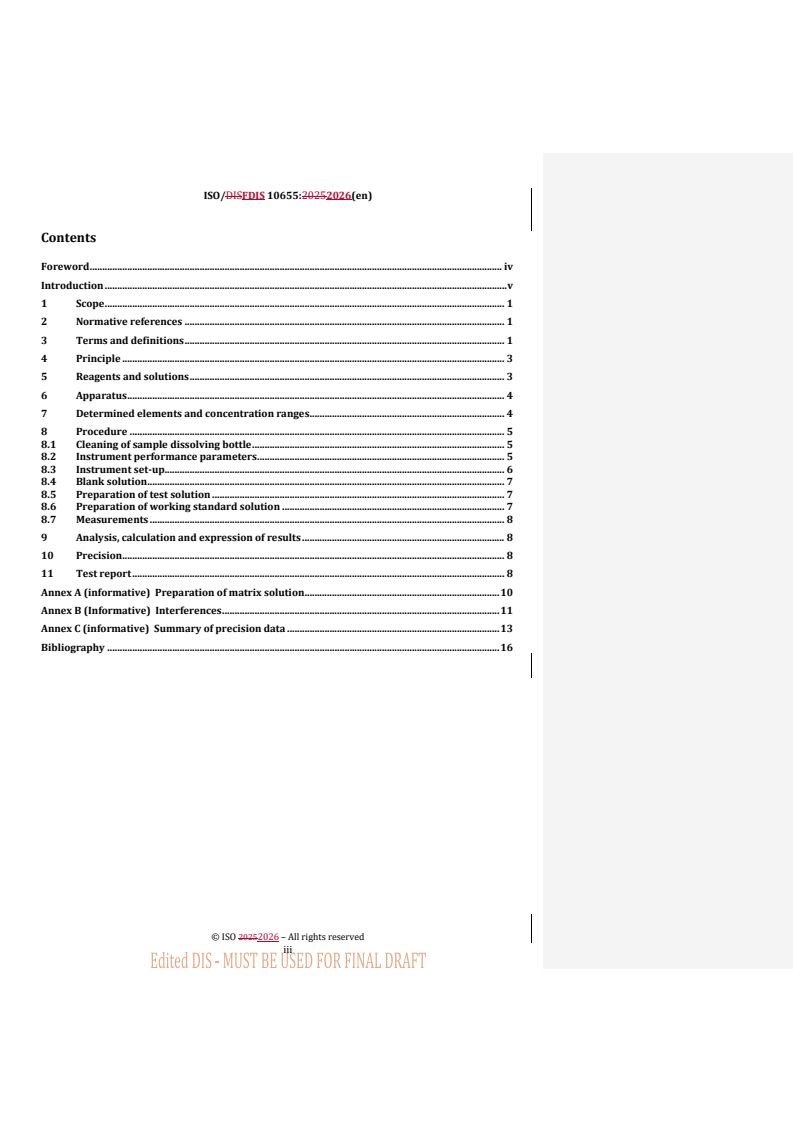
Contents Page
Foreword .iv
Introduction .v
1 Scope .1
2 Normative references .1
3 Terms and definitions .1
4 Principle .2
5 Reagents and solutions . 3
6 Apparatus . 3
7 Determined elements and concentration ranges . 4
8 Procedure . 4
8.1 Cleaning of sample dissolving bottle .4
8.2 Instrument performance parameters .4
8.3 Instrument set-up .5
8.3.1 General requirements .5
8.3.2 Software method development, wavelength election .5
8.3.3 Preliminary instrument check .6
8.4 Blank solution .6
8.5 Preparation of test solution .7
8.6 Preparation of working standard solution .7
8.7 Measurements . .7
9 Analysis, calculation and expression of results . 7
10 Precision . 8
11 Test report . 8
Annex A (informative) Preparation of matrix solution . 9
Annex B (Informative) Interferences .10
Annex C (informative) Summary of precision data .12
Bibliography .15
iii
ISO/FDIS 10655:2026(en)
Foreword
ISO (the International Organization for Standardization) is a worldwide federation of national standards
bodies (ISO member bodies). The work of preparing International Standards is normally carried out through
ISO technical committees. Each member body interested in a subject for which a technical committee
has been established has the right to be represented on that committee. International organizations,
governmental and non-governmental, in liaison with ISO, also take part in the work. ISO collaborates closely
with the International Electrotechnical Commission (IEC) on all matters of electrotechnical standardization.
The procedures used to develop this document and those intended for its further maintenance are described
in the ISO/IEC Directives, Part 1. In particular, the different approval criteria needed for the different types
of ISO document should be noted. This document was drafted in accordance with the editorial rules of the
ISO/IEC Directives, Part 2 (see www.iso.org/directives).
ISO draws attention to the possibility that the implementation of this document may involve the use of (a)
patent(s). ISO takes no position concerning the evidence, validity or applicability of any claimed patent
rights in respect thereof. As of the date of publication of this document, ISO had not received notice of (a)
patent(s) which may be required to implement this document. However, implementers are cautioned that
this may not represent the latest information, which may be obtained from the patent database available at
www.iso.org/patents. ISO shall not be held responsible for identifying any or all such patent rights.
Any trade name used in this document is information given for the convenience of users and does not
constitute an endorsement.
For an explanation of the voluntary nature of standards, the meaning of ISO specific terms and expressions
related to conformity assessment, as well as information about ISO's adherence to the World Trade
Organization (WTO) principles in the Technical Barriers to Trade (TBT), see www.iso.org/iso/foreword.html.
This document was prepared by Technical Committee ISO/TC 333, Lithium.
Any feedback or questions on this document should be directed to the user’s national standards body. A
complete listing of these bodies can be found at www.iso.org/members.html.
iv
ISO/FDIS 10655:2026(en)
Introduction
Lithium hexafluorophosphate (LiPF ) is a white crystalline powder that dissolves easily in water,
decomposes rapidly, and generates white fumes when exposed to the air. It is mainly used as electrolyte
lithium salt for lithium-ion battery and lithium-ion supercapacitor. As the metal impurity ions of LiPF ,
such as aluminium (Al), calcium (Ca), cadmium (Cd), chromium (Cr), copper(Cu), iron (Fe), potassium(K),
magnesium (Mg), sodium (Na), nickel (Ni), lead(Pb), zinc (Zn) have a higher reduction potential than lithium
ions, during charging the metal impurity ions will preferentially intercalate into the cathode surface, which
will affect the forming and compactness of SEI film, reduce the reversible capacity of lithium-ion batteries
and deteriorate the battery’s performance.
Therefore, the content of metal impurity ions in LiPF is an important index to monitor product quality.
The advantages of determination of LiPF metal ions by inductively coupled plasma optical emission
spectrometry (ICP-OES) are simple sample pre-treatment, high accuracy and low detection limit.
When applying this document, it is necessary in each case, depending on the range to be tested, to determine
if and to what extent additional conditions should be established.
v
FINAL DRAFT International Standard ISO/FDIS 10655:2026(en)
Methods for analysis of lithium hexafluorophosphate —
Determination of metal ions content by inductively coupled
plasma optical emission spectrometry (ICP-OES)
WARNING — The use of this document can involve hazardous materials, operations, and equipment.
This document does not purport to address any safety problems associated with its use. It is the
responsibility of the user of this document to establish appropriate safety and health practices and
determine the applicability of regulatory limitations prior to use.
1 Scope
This document specifies the method for determining impurity metal ions in lithium hexafluorophosphate
— specifically aluminum (Al), calcium (Ca), cadmium (Cd), chromium (Cr), copper (Cu), iron (Fe), potassium
(K), magnesium (Mg), sodium (Na), nickel (Ni), lead (Pb), and zinc (Zn). This document applies when the
mass concentration of these impurity metal ions in LiPF is below 10 mg/kg.
This document can apply to higher mass concentrations of impurity metallic ions in LiPF if it can be shown
that additionally occurring interferences are considered and corrected for carefully. It is the responsibility
of the user to demonstrate the fitness for purpose.
This document is applicable for the other elements listed above provided the user has verified the
applicability. Higher concentrations can be measured by adjusting the dilution ratio, provided that the
calibration standards have been diluted in the same way.
2 Normative references
The following documents are referred to in the text in such a way that some or all of their content constitutes
requirements of this document. For dated references, only the edition cited applies. For undated references,
the latest edition of the referenced document (including any amendments) applies.
ISO 3696, Water for analytical laboratory use — Specification and test methods
3 Terms and definitions
For the purposes of this document, the following terms and definitions apply.
ISO and IEC maintain terminology databases for use in standardization at the following addresses:
— ISO Online browsing platform: available at https:// www .iso .org/ obp
— IEC Electropedia: available at https:// www .electropedia .org/
3.1
laboratory sample
sample as prepared for sending to the laboratory and intended for inspection or testing
[SOURCE: ISO 6206:1979, 3.2.10]
3.2
test sample
sample prepared from the laboratory sample (3.1) and from which test portions (3.3) will be taken
[SOURCE: ISO 6206:1979, 3.2.13]
ISO/FDIS 10655:2026(en)
3.3
test portion
quantity of material drawn from the test sample (3.2) (or from the laboratory sample (3.1) if both are the
same) and on which the test or observation is actually carried out
[SOURCE: ISO 6206:1979, 3.2.14]
3.4
sample solution
solution prepared from a test sample (3.2) by the process of dissolution, extraction or digestion according to
appropriate specifications sample solution
Note 1 to entry: A sample solution can need to be subjected to further operations, e.g., dilution and/or addition of an
internal standard, in order to produce a test solution that is ready for analysis.
3.5
standard solution
solution of accurately known concentration of an element, an ion, a compound or a group derived from the
substance used for its preparation
[SOURCE: ISO 78-2:1999, 3.6]
3.6
stock solution
solution of accurately known analyte concentration(s), prepared from pure chemicals
3.7
calibration solution
solution used to calibrate the instrument, prepared from a stock solution (3.6) or a certified standard
[SOURCE: ISO 17294-1:2016, 3.4]
3.8
determination
entire process from preparing the test sample (3.2) solution up to and including measurement and calculation
of the result
3.9
precision
closeness of agreement between independent test results obtained under prescribed conditions
[SOURCE: ISO/TS 23031:2020, 3.15]
3.10
reproducibility
precision (3.9) under conditions where test results are obtained with the same method on identical test
items in different laboratories with different operators using different equipment
[SOURCE: ISO 3534-2:2006, 3.3.10]
3.11
repeatability
precision under conditions where test results are obtained with the same method on identical test items in
the same laboratory by the same operator using the same equipment within short intervals of time.
[SOURCE: ISO 3534-2:2006, 3.3.5]
4 Principle
The determination is carried out by means of the analytical technique of optical emission spectroscopy with
inductively coupled plasma (ICP-OES), which allows the detection and quantitative determination of most of
the elements from the periodic table from samples in aqueous solution.
ISO/FDIS 10655:2026(en)
In the ICP-OES technique, the continuous introduction of the liquid sample and a nebulization system forms
an aerosol that is transported by Argon to the plasma torch, inductively coupled by radio frequency. In the
plasma, due to the high temperatures generated, the analytes are atomized and ionized, generating the
atomic emission spectra of characteristic lines. The spectra are scattered by the diffraction grating and the
light-sensitive detector measures the spectral line intensities. The information is processed by the computer
software system of the ICP-OES equipment.
In this document, dissolution of a test sample in water, and dilution of the solution to a known mass.
Nebulization of the solution into an inductively coupled plasma and atomic emission spectrometer and
measurement of the intensity of the emitted light from metal ions, simultaneously.
The working curve method is used to determine the content of metal ions in LiPF samples by ICP-OES with
hydrofluoric acid-resistant nebulizers.
5 Reagents and solutions
5.1 Water, grade 1 water with conductivity (25 °C) less than 0,005 5 mS/m, in accordance with ISO 3696.
®1)
5.2 Nitric acid washing solution (CAS Registry Number 7697-37-2), preparation of 5 % HNO from
65 % HNO . ®
5.3 High-purity nitric acid (CAS RN 7697-37-2), 65 % min HNO .
5.4 Single element standard stock solution (Al, Ca, Cd, Cr, Cu, Fe, K, Mg, Na, Ni, Pb and Zn), 1 000 mg/l.
Single element standard stock solutions specifying the acid used and the preparation technique are
commercially available. Single-element standard stock solutions can be made from high purity metals.
5.5 Mixed-element standard solution, place 1 ml of each of the solutions prepared from Clause 5.4 into
a sample dissolving bottle. Dilute with water (5.1) to 100 g and shake 15 times until uniform. 1 ml solution
contains 0,01 mg metal ions, the concentration of the obtained solution is 10 μg / g (Al, Ca, Cd, Cr, Cu, Fe, K,
Mg, Na, Ni, Pb and Zn). A 10 µg/ml certified mixed element standard solution can be purchased directly.
5.6 Matrix solution, because the lithium concentration has an influence on the intensities of the analyte
intensities. The calibration solutions shall be matrix matched. To match this matrix any high purity Li-salt
can be used. The lithium solution concentration in the calibration solution and in the sample should be
approximately the same as the lithium matrix solution concentration. The lithium matrix solution can be
made from high purity LiPF6, Li-nitrate or Li-carbonate (information on how to prepare the matrix solution
is given in Annex A). ®
5.7 Argon gas (CAS RN 7440-37-1), purity ≥ 99,995 % (mass fraction).
6 Apparatus
6.1 Inductively coupled plasma optical emission spectrometry, the ICP optical emission spectrometer
consists of a sample introduction system, the plasma (as an excitation/emission source), a plasma torch,
an optical system, a detector and a computer system. The sample introduction system usually consists
of a peristaltic pump for sample transport to the nebulizer, the nebulizer and a spray chamber. The most
common nebulizers are the concentric nebulizer, the crossflow nebulizer and the V-groove nebulizer. They
2) ®
are made from glass, quartz, Teflon , ceramic or plastics. HF is generated during the dissolution of LiPF6,
1) CAS Registry Number® is a trademark of the American Chemical Society (ACS). This information is given for the
convenience of users of this document and does not constitute an endorsement by ISO of the product named. Equivalent
products may be used if they can be shown to lead to the same results.
2) Teflon is an example(s) of a suitable prod
...
ISO/DISFDIS 10655:2025(en)
ISO /TC 333/ WG 4
Secretariat: SAC
Date: 2026-01-2308-06
Methods for analysis of lithium hexafluorophosphate —
Determination of metal ions content by inductively coupled plasma
optical emission spectrometry (ICP-OES)
FDIS stage
ISO #####-#:####(X/FDIS 10655:2026(en)
All rights reserved. Unless otherwise specified, or required in the context of its implementation, no part of this publication
may be reproduced or utilized otherwise in any form or by any means, electronic or mechanical, including photocopying,
or posting on the internet or an intranet, without prior written permission. Permission can be requested from either ISO
at the address below or ISO’s member body in the country of the requester.
ISO copyright office
CP 401 • Ch. de Blandonnet 8
CH-1214 Vernier, Geneva
Phone: + 41 22 749 01 11
EmailE-mail: copyright@iso.org
Website: www.iso.org
Published in Switzerland
© ISO ####2026 – All rights reserved
ii
ISO/DISFDIS 10655:20252026(en)
Contents
Foreword . iv
Introduction . v
1 Scope . 1
2 Normative references . 1
3 Terms and definitions . 1
4 Principle . 3
5 Reagents and solutions . 3
6 Apparatus . 4
7 Determined elements and concentration ranges . 4
8 Procedure . 5
8.1 Cleaning of sample dissolving bottle . 5
8.2 Instrument performance parameters . 5
8.3 Instrument set-up . 6
8.4 Blank solution. 7
8.5 Preparation of test solution . 7
8.6 Preparation of working standard solution . 7
8.7 Measurements . 8
9 Analysis, calculation and expression of results . 8
10 Precision . 8
11 Test report . 8
Annex A (informative) Preparation of matrix solution . 10
Annex B (Informative) Interferences . 11
Annex C (informative) Summary of precision data . 13
Bibliography . 16
iii
ISO #####-#:####(X/FDIS 10655:2026(en)
Foreword
ISO (the International Organization for Standardization) is a worldwide federation of national standards
bodies (ISO member bodies). The work of preparing International Standards is normally carried out through
ISO technical committees. Each member body interested in a subject for which a technical committee has been
established has the right to be represented on that committee. International organizations, governmental and
non-governmental, in liaison with ISO, also take part in the work. ISO collaborates closely with the
International Electrotechnical Commission (IEC) on all matters of electrotechnical standardization.
The procedures used to develop this document and those intended for its further maintenance are described
in the ISO/IEC Directives, Part 1. In particular, the different approval criteria needed for the different types of
ISO document should be noted. This document was drafted in accordance with the editorial rules of the
ISO/IEC Directives, Part 2 (see www.iso.org/directives).
ISO draws attention to the possibility that the implementation of this document may involve the use of (a)
patent(s). ISO takes no position concerning the evidence, validity or applicability of any claimed patent rights
in respect thereof. As of the date of publication of this document, ISO [had/had not] received notice of (a)
patent(s) which may be required to implement this document. However, implementers are cautioned that this
may not represent the latest information, which may be obtained from the patent database available at
www.iso.org/patents. ISO shall not be held responsible for identifying any or all such patent rights.
Any trade name used in this document is information given for the convenience of users and does not
constitute an endorsement.
For an explanation of the voluntary nature of standards, the meaning of ISO specific terms and expressions
related to conformity assessment, as well as information about ISO's adherence to the World Trade
Organization (WTO) principles in the Technical Barriers to Trade (TBT), see www.iso.org/iso/foreword.html.
Field Code Changed
This document was prepared by Technical Committee ISO/TC 333, Lithium.
Any feedback or questions on this document should be directed to the user’s national standards body. A
complete listing of these bodies can be found at www.iso.org/members.html.
Field Code Changed
© ISO ####2026 – All rights reserved
iv
ISO/DISFDIS 10655:20252026(en)
Introduction
Lithium hexafluorophosphate (LiPF ) is a white crystalline powder that dissolves easily in water, decomposes
rapidly, and generates white fumes when exposed to the air. It is mainly used as electrolyte lithium salt for
lithium-ion battery and lithium-ion supercapacitor. As the metal impurity ions of LiPF , such as aluminium
(Al), calcium (Ca), cadmium (Cd), chromium (Cr), copper(Cu), iron (Fe), potassium(K), magnesium (Mg),
sodium (Na), nickel (Ni), lead(Pb), zinc (Zn) have a higher reduction potential than lithium ions, during
charging the metal impurity ions will preferentially intercalate into the cathode surface, which will affect the
forming and compactness of SEI film, reduce the reversible capacity of lithium-ion batteries and deteriorate
the battery’s performance.
Therefore, the content of metal impurity ions in LiPF is an important index to monitor product quality. The
advantages of determination of LiPF metal ions by inductively coupled plasma optical emission spectrometry
(ICP-OES) are simple sample pre-treatment, high accuracy and low detection limit.
When applying this document, it is necessary in each case, depending on the range to be tested, to determine
if and to what extent additional conditions should be established.
v
DRAFT International Standard ISO/DIS 10655:2025(en)
Methods for analysis of lithium hexafluorophosphate - —
Determination of metal ions content by Inductively Coupled Plasma
Optical Emission Spectrometryinductively coupled plasma optical
emission spectrometry (ICP-OES)
WARNING— — The use of this document can involve hazardous materials, operations, and equipment.
This document does not purport to address any safety problems associated with its use. It is the
responsibility of the user of this document to establish appropriate safety and health practices and
determine the applicability of regulatory limitations prior to use.
1 Scope
This document specifies the method for determining impurity metal ions in lithium hexafluorophosphate—
— specifically aluminum (Al), calcium (Ca), cadmium (Cd), chromium (Cr), copper (Cu), iron (Fe), potassium
(K), magnesium (Mg), sodium (Na), nickel (Ni), lead (Pb), and zinc (Zn). This document applies when the mass
concentration of these impurity metal ions in LiPF₆LiPF is below 10 mg/kg.
This document can apply to higher mass concentrations of impurity metallic ions in LiPF6 if it can be shown
that additionally occurring interferences are considered and corrected for carefully. It is up tothe
responsibility of the user to demonstrate the fitness for purpose.
This document is applicable for the other elements listed above, provided the user has verified the
applicability. Higher concentrations can be measured by adjusting the dilution ratio, provided that the
calibration standards have been diluted in the same way.
2 Normative references
The following documents are referred to in the text in such a way that some or all of their content constitutes
requirements of this document. For dated references, only the edition cited applies. For undated references,
the latest edition of the referenced document (including any amendments) applies.
ISO 3696, Water for analytical laboratory use — Specification and test methods
3 Terms and definitions
For the purposes of this document, the following terms and definitions apply.
ISO and IEC maintain terminology databases for use in standardization at the following addresses:
— — ISO Online browsing platform: available at https://www.iso.org/obp
— — IEC Electropedia: available at https://www.electropedia.org/
—
3.1 3.1
laboratory sample
a sample as prepared for sending to the laboratory and intended for inspection or testing
ISO #####-#:####(X/FDIS 10655:2026(en)
[SOURCE: ISO 6206:1979, 3.2.10]
3.2 3.2
test sample
a sample prepared from the laboratory sample (3.1) and from which test portions (3.3(3.3)) will be taken
[SOURCE: ISO 6206:1979, 3.2.13]
3.3 3.3
test portion
quantity of material drawn from the test sample (3.2(3.2)) (or from the laboratory sample (3.1 (3.1)) if both
are the same) and on which the test or observation is actually carried out
[SOURCE: ISO 6206:1979, 3.2.14]
3.4
3.4 test
sample solution
solution prepared from a test sample (3.2(3.2)) by the process of dissolution, extraction or digestion according
to appropriate specifications sample solution
Note 1 to entry: A sample solution maycan need to be subjected to further operations, e.g., dilution and/or addition of
an internal standard, in order to produce a test solution that is ready for analysis.
3.43.5 3.5
standard solution
solution of accurately known concentration of an element, an ion, a compound or a group derived from the
substance used for its preparation
[SOURCE: ISO 78-2:1999, 3.6]
3.53.6 3.6
stock solution
solution of accurately known analyte concentration(s), prepared from pure chemicals
3.63.7 3.7
calibration solution
solution used to calibrate the instrument, prepared from a stock solution (3.6(3.6)) or a certified standard
[SOURCE: ISO 17294-1:2016, 3.4]
3.73.8 3.8
determination
entire process from preparing the test sample (3.2) solution up to and including measurement and calculation
of the result
3.83.9 3.9
precision
closeness of agreement between independent test results obtained under prescribed conditions
[SOURCE: ISO/TS 23031:2020, 3.15]
© ISO ####2026 – All rights reserved
ISO/DISFDIS 10655:20252026(en)
3.93.10 3.10
reproducibility
precision (3.9) under conditions where test results are obtained with the same method on identical test items
in different laboratories with different operators using different equipment
[SOURCE: ISO 3534-2:2006, 3.3.10]
3.103.11 3.11
repeatability
precision under conditions where test results are obtained with the same method on identical test items in
the same laboratory by the same operator using the same equipment within short intervals of time.
[SOURCE: ISO 3534-2:2006, 3.3.5]
4 Principle
The determination is carried out by means of the analytical technique of optical emission spectroscopy with
inductively coupled plasma (ICP-OES), which allows the detection and quantitative determination of most of
the elements from the periodic table from samples in aqueous solution.
In the ICP-OES technique, the continuous introduction of the liquid sample and a nebulization system forms
an aerosol that is transported by Argon to the plasma torch, inductively coupled by radio frequency. In the
plasma, due to the high temperatures generated, the analytes are atomized and ionized, generating the atomic
emission spectra of characteristic lines. The spectra are scattered by the diffraction grating and the light-
sensitive detector measures the spectral line intensities. The information is processed by the computer
software system of the ICP-OES equipment.
In this document, dissolution of a test sample in water, and dilution of the solution to a known mass.
Nebulization of the solution into an inductively coupled plasma and atomic emission spectrometer and
measurement of the intensity of the emitted light from metal ions, simultaneously.
The working curve method is used to determine the content of metal ions in LiPF samples by ICP-OES with
hydrofluoric acid-resistant nebulizers.
5 Reagents and solutions
5.1 5.1 Water, grade 1 water with conductivity (25 °C) less than 0,005 5 mS/m, in accordance with
ISO 3696.
®11)
5.2 5.2 Nitric acid washing solution (CAS Registry Number 7697-37-2),
Preparationpreparation of 5 % HNO from 65 % HNO .
3 3 ®
5.3 5.3 High-purity nitric acid (CAS RN 7697-37-2), 65 % min HNO .
5.4 5.4 Single element standard stock solution (Al, Ca, Cd, Cr, Cu, Fe, K, Mg, Na, Ni, Pb and
Zn), 1 000 mg/l. Single element standard stock solutions specifying the acid used and the preparation
CAS Registry Number® is a trademark of the American Chemical Society (ACS). This information is given for the
convenience of users of this document and does not constitute an endorsement by ISO of the product named. Equivalent
products may be used if they can be shown to lead to the same results.
1)
CAS Registry Number® is a trademark of the American Chemical Society (ACS). This information is given for the
convenience of users of this document and does not constitute an endorsement by ISO of the product named. Equivalent
products may be used if they can be shown to lead to the same results.
ISO #####-#:####(X/FDIS 10655:2026(en)
technique are commercially available. Single-element standard stock solutions can be made from high purity
metals.
5.5 5.5 Mixed-element standard solution, place 1 ml of each of the solutions prepared from
Clause 5.4Clause 5.4 into a sample dissolving bottle. Dilute with water (5.1(5.1)) to 100 g and shake
15 times until uniform. 1 ml solution contains 0,01 mg metal ions, the concentration of the obtained solution
is 10 μg / g (Al, Ca, Cd, Cr, Cu, Fe, K, Mg, Na, Ni, Pb and Zn) .). A 10 µg/ml certified mixed element standard
solution can be purchased directly.
5.6 5.6 Matrix solution, because the lithium concentration has an influence on the intensities of the
analyte intensities. The calibration solutions shall be matrix matched. To match this matrix any high purity Li-
salt can be used. The lithium solution concentration in the calibration solution and in the sample should be
approximately the same as the lithium matrix solution concentration. The lithium matrix solution can be made
from high purity LiPF6, Li-nitrate or Li-carbonate (information on how to prepare the matrix solution is given
in Annex AAnnex A).). ®
5.7 5.7 Argon gas (CAS RN 7440-37-1), purity ≥ 99,995 % (mass fraction).
6 Apparatus
6.1 6.1 Inductively coupled plasma optical emission spectrometry, the ICP optical emission
spectrometer consists of a sample introduction system, the plasma (as an excitation/emission source), a
plasma torch, an optical system, a detector and a computer system. The sample introduction system usually
consists of a peristaltic pump for sample transport to the nebulizer, the nebulizer and a spray chamber. The
most common nebulizers are the concentric nebulizer, the crossflow nebulizer and the V-groove nebulizer.
®2)
They are made from glass, quartz, Teflon, , ceramic or plastics. HF is generated during the dissolution of
LiPF6, which destroys nebulizer made of glass. Therefore, it is recommended to use hydrofluoric acid-resistant
nebulizers.
NoteNOTE 1 The computerized registration of light intensities by several element lines is converted into
concentrations using appropriate software packages from the instrument manufacturers.
NoteNOTE 2 To run the ICP-OES with a large number of samples, an autosampler can be used.
Note 3 For higher salt tolerance, it is recommended to use an argon humidifier.
6.2 6.2 Analytical balances, electronic balance with tare compensation and accurate to 0,1 mg.
6.3 6.3 Sample dissolving bottle, 100 ml and 250 ml, preferably made of plastic. Vessels made of
polyethylene, polypropylene or polytetrafluoroethylene (HDPE or PFA, FEP) are suitable.
7 Determined elements and concentration ranges
The detection range of elements is shown in Table 1Table 1.
2)
Teflon is an example(s) of a suitable product available commercially. This information is given for the convenience of
users of this document and does not constitute an endorsement by ISO of this product.
© ISO ####2026 – All rights reserved
ISO/DISFDIS 10655:20252026(en)
Table 1 — The detection range of elements
The detection range of elements
Element
(mg/kg)
Al 0,005 to 10,00
Ca 0,000 1 to 10,00
Cd 0,002 to 10,00
Cr 0,003 to 10,00
Cu 0,004 to 10,00
Fe 0,002 to 10,00
Mg 0,001 to 10,00
Ni 0,005 to 10,00
Pb 0,02 to 10,00
Zn 0,003 to 10,00
K 0,04 to 10,00
Na 0,005 to 10,00
8 Procedure
WARNING — The use of this document can involve hazardous materials, operations, and equipment.
This document does not purport to address any safety
...