

ISO 15174:2012
(Main)Milk and milk products — Microbial coagulants — Determination of total milk-clotting activity
General Information
- Abstract
ISO 15174:2012 specifies a method for comparison of the total milk-clotting activity of a microbial coagulant sample with the milk-clotting activity of an international microbial coagulant reference standard on a standard milk substrate prepared with a calcium chloride solution of concentration 0,5 g/l (pH ~6,5).
- Status
- Published
- Publication Date
- 02-May-2012
- Technical Committee
- ISO/TC 34/SC 5 - Milk and milk products
- Drafting Committee
- ISO/TC 34/SC 5 - Milk and milk products
- Current Stage
- 9093 - International Standard confirmed
- Start Date
- 05-Oct-2023
- Completion Date
- 29-Aug-2026
Buy Documents
ISO 15174:2012 - Milk and milk products — Microbial coagulants — Determination of total milk-clotting activity Released:5/3/2012
ISO 15174:2012 - Lait et produits laitiers — Coagulants microbiens — Détermination de l'activité totale de coagulation du lait Released:5/3/2012
ISO 15174:2012 - Milk and milk products — Microbial coagulants — Determination of total milk-clotting activity Released:5/19/2014
Overview
ISO 15174:2012 - Milk and milk products - Microbial coagulants - Determination of total milk‑clotting activity defines an international, comparative method to measure the total milk‑clotting activity of microbial coagulants. The method compares a test sample against an international microbial coagulant reference standard (Rhizomucor miehei) using a defined standard milk substrate prepared with calcium chloride (0.5 g/l, pH ≈ 6.5). The principle is based on measuring the time to visible flocculation (clotting) under controlled chemical and physical conditions.
Key topics and technical requirements
- Scope and principle: Relative determination of milk‑clotting activity by comparing clotting times of test and reference solutions.
- Reference standard: R. miehei powder ampoules with labeled total milk‑clotting activity (set relative to an earlier rennet standard). Stored at −18 °C, protected from moisture and light.
- Substrate preparation: Standard milk substrate prepared with calcium chloride working solution (0.5 g/l; pH ~6.5).
- Critical reagents: Buffer pH 5.5 (sodium acetate/acetic acid), calcium chloride stock (500 g/l) and working solutions, low‑heat low‑fat spray‑dried milk powder.
- Apparatus and tolerances:
- Micropipette (0.5 ml delivery, high repeatability)
- One‑mark volumetric flasks and pipettes (class A)
- Calibrated thermometer (20–45 °C, ±0.1 °C), pH meter (0.01 pH), analytical balance (1 mg), stopwatch (1 s)
- Water bath at 32 °C ±1 °C with rotating spindle and lamp for visual observation (rotation ~2–4 r/min suggested)
- Sample handling: Procedures for liquid and powdered coagulants (mixing, temperature equilibration to 18–22 °C); sampling guidance referenced to ISO 707.
- Results and quality: Calculation and expression of activity relative to the reference; documented precision descriptors (interlaboratory, repeatability, reproducibility) and required test reporting.
Applications and users
ISO 15174:2012 is used where reproducible measurement of microbial milk‑clotting activity is needed:
- Dairy laboratories performing quality control and batch certification of microbial coagulants
- Cheese manufacturers for dose standardization and process control
- Enzyme producers and suppliers to label and certify product activity (comparability across batches)
- R&D groups evaluating enzyme performance, sensitivity to pH, calcium and temperature
- Regulatory and standards bodies concerned with analytical consistency in the dairy sector
Practical benefits include consistent dosing in cheese‑making, reliable supplier comparisons, and standardized enzyme potency evaluation.
Related standards
- ISO 11815 / IDF 157 - relative milk‑clotting activity test for bovine rennets (method alignment)
- ISO 15163 / IDF 110 - qualitative determination of microbial coagulants (annex referenced)
- ISO 707 / IDF 50 - sampling of liquid and powdered coagulants
Keywords: ISO 15174:2012, microbial coagulants, milk‑clotting activity, R. miehei, calcium chloride 0.5 g/l, standard milk substrate, cheese‑making, enzyme activity testing.
Relations
- Effective Date
- 10-Oct-2009
Buy Documents
ISO 15174:2012 - Milk and milk products — Microbial coagulants — Determination of total milk-clotting activity Released:5/3/2012
ISO 15174:2012 - Lait et produits laitiers — Coagulants microbiens — Détermination de l'activité totale de coagulation du lait Released:5/3/2012
ISO 15174:2012 - Milk and milk products — Microbial coagulants — Determination of total milk-clotting activity Released:5/19/2014
Get Certified
Connect with accredited certification bodies for this standard

BSI Group
BSI (British Standards Institution) is the business standards company that helps organizations make excellence a habit.

Bureau Veritas
Bureau Veritas is a world leader in laboratory testing, inspection and certification services.

DNV
DNV is an independent assurance and risk management provider.
Sponsored listings
Frequently Asked Questions
ISO 15174:2012 is a standard published by the International Organization for Standardization (ISO). Its full title is "Milk and milk products — Microbial coagulants — Determination of total milk-clotting activity". This standard covers: ISO 15174:2012 specifies a method for comparison of the total milk-clotting activity of a microbial coagulant sample with the milk-clotting activity of an international microbial coagulant reference standard on a standard milk substrate prepared with a calcium chloride solution of concentration 0,5 g/l (pH ~6,5).
ISO 15174:2012 specifies a method for comparison of the total milk-clotting activity of a microbial coagulant sample with the milk-clotting activity of an international microbial coagulant reference standard on a standard milk substrate prepared with a calcium chloride solution of concentration 0,5 g/l (pH ~6,5).
ISO 15174:2012 is classified under the following ICS (International Classification for Standards) categories: 07.100.30 - Food microbiology; 67.100.10 - Milk and processed milk products. The ICS classification helps identify the subject area and facilitates finding related standards.
ISO 15174:2012 has the following relationships with other standards: It is inter standard links to ISO 15174:2002. Understanding these relationships helps ensure you are using the most current and applicable version of the standard.
ISO 15174:2012 is available in PDF format for immediate download after purchase. The document can be added to your cart and obtained through the secure checkout process. Digital delivery ensures instant access to the complete standard document.
Standards Content (Sample)
INTERNATIONAL ISO
STANDARD 15174
IDF
Second edition
2012-05-15
Milk and milk products — Microbial
coagulants — Determination of total milk-
clotting activity
Lait et produits laitiers — Coagulants microbiens — Détermination de
l'activité totale de coagulation du lait
Reference numbers
IDF 176:2012(E)
©
ISO and IDF 2012
IDF 176:2012(E)
© ISO and IDF 2012
All rights reserved. Unless otherwise specified, no part of this publication may be reproduced or utilized in any form or by any means,
electronic or mechanical, including photocopying and microfilm, without permission in writing from either ISO or IDF at the respective
address below.
ISO copyright office International Dairy Federation
Case postale 56 CH-1211 Geneva 20 Silver Building Boulevard Auguste Reyers 70/B B-1030 Brussels
Tel. + 41 22 749 01 11 Tel. + 32 2 733 98 88
Fax + 41 22 749 09 47 Fax + 32 2 733 04 13
E-mail copyright@iso.org E-mail info@fil-idf.org
Web www.iso.org Web www.fil-idf.org
Published in Switzerland
ii © ISO and IDF 2012 – All rights reserved
IDF 176:2012(E)
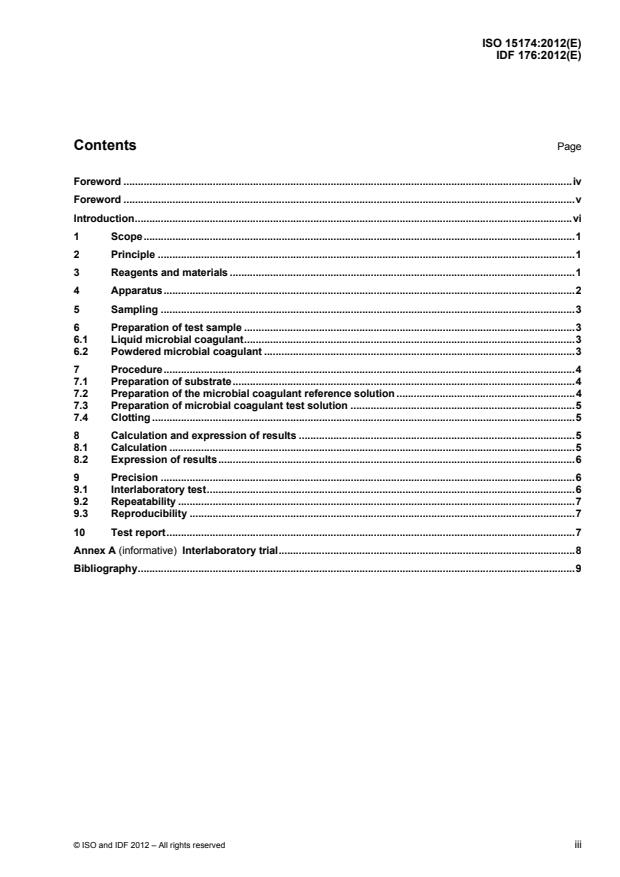
Contents Page
Foreword . iv
Foreword . v
Introduction . vi
1 Scope . 1
2 Principle . 1
3 Reagents and materials . 1
4 Apparatus . 2
5 Sampling . 3
6 Preparation of test sample . 3
6.1 Liquid microbial coagulant . 3
6.2 Powdered microbial coagulant . 3
7 Procedure . 4
7.1 Preparation of substrate . 4
7.2 Preparation of the microbial coagulant reference solution . 4
7.3 Preparation of microbial coagulant test solution . 5
7.4 Clotting . 5
8 Calculation and expression of results . 5
8.1 Calculation . 5
8.2 Expression of results . 6
9 Precision . 6
9.1 Interlaboratory test . 6
9.2 Repeatability . 7
9.3 Reproducibility . 7
10 Test report . 7
Annex A (informative) Interlaboratory trial . 8
Bibliography . 9
IDF 176:2012(E)
Foreword
ISO (the International Organization for Standardization) is a worldwide federation of national standards
bodies (ISO member bodies). The work of preparing International Standards is normally carried out through
ISO technical committees. Each member body interested in a subject for which a technical committee has
been established has the right to be represented on that committee. International organizations, governmental
and non-governmental, in liaison with ISO, also take part in the work. ISO collaborates closely with the
International Electrotechnical Commission (IEC) on all matters of electrotechnical standardization.
International Standards are drafted in accordance with the rules given in the ISO/IEC Directives, Part 2.
The main task of technical committees is to prepare International Standards. Draft International Standards
adopted by the technical committees are circulated to the member bodies for voting. Publication as an
International Standard requires approval by at least 75 % of the member bodies casting a vote.
Attention is drawn to the possibility that some of the elements of this International Standard may be the
subject of patent rights. IDF shall not be held responsible for identifying any or all such patent rights.
ISO 15174IDF 176 was prepared by Technical Committee ISO/TC 34, Food products, Subcommittee SC 5,
Milk and milk products and the International Dairy Federation (IDF). It is being published jointly by ISO and
IDF.
This second edition of ISO 15174IDF 176 cancels and replaces the first edition (ISO 15174IDF 176:2002),
which has been technically revised.
iv © ISO and IDF 2012 – All rights reserved
IDF 176:2012(E)
Foreword
IDF (the International Dairy Federation) is a non-profit organization representing the dairy sector worldwide.
IDF membership comprises National Committees in every member country as well as regional dairy
associations having signed a formal agreement on cooperation with IDF. All members of IDF have the right to
be represented at the IDF Standing Committees carrying out the technical work. IDF collaborates with ISO in
the development of standard methods of analysis and sampling for milk and milk products.
The main task of Standing Committees is to prepare International Standards. Draft International Standards
adopted by Standing Committees are circulated to the National Committees for endorsement prior to
publication as International Standards. Publication as an International Standard requires approval by at least
50 % of IDF National Committees casting a vote.
Attention is drawn to the possibility that some of the elements of this International Standard may be the
subject of patent rights. IDF shall not be held responsible for identifying any or all such patent rights.
ISO 15174IDF 176 was prepared by the International Dairy Federation (IDF) and Technical Committee
ISO/TC 34, Food products, Subcommittee SC 5, Milk and milk products. It is being published jointly by IDF
and ISO.
All work was carried out by the Joint ISO/IDF Project Group on Microbial coagulants of the Standing
Committee on Analytical methods for processing aids and indicators under the aegis of its project leader,
Mrs. M. Harboe (DK) and Prof. A. Andrén (SE).
This second edition of ISO 15174IDF 176 cancels and replaces the first edition (ISO 15174IDF 176:2002),
which has been technically revised.
IDF 176:2012(E)
Introduction
Microbial coagulants are derived from various microbial sources, the most common sources being
Rhizomucor miehei (EC 3.4.23.23), R. pusillus (EC 3.4.23.23) and Cryphonectria parasitica, formerly named
Endothia parasitica (EC 3.4.23.22).
Each of these enzymes has its own characteristics as far as milk-clotting activity and cheese-making
properties are concerned. These are differences in temperature sensitivity, pH sensitivity, sensitivity to
calcium ions, and effect on the rheology of the milk-gel formed.
For practical and economic reasons, therefore, it is very important to have an international method for
determination of the total milk-clotting activity of microbial coagulants relative to an international recognized
reference standard. Also for practical reasons, it was decided to use the R. miehei enzyme as a microbial
coagulant reference standard for all types of microbial coagulants.
The method is in accordance with the relative milk-clotting activity test for bovine rennets described in
ISO 11815IDF 157.
A qualitative determination of the microbial coagulants in a sample can be performed according to
[7]
ISO 15163IDF 110:— , Annex A. For mixtures of different clotting enzymes, no correct determination of the
total milk-clotting activity for the sample can be obtained.
vi © ISO and IDF 2012 – All rights reserved
INTERNATIONAL STANDARD
IDF 176:2012(E)
Milk and milk products — Microbial coagulants —
Determination of total milk-clotting activity
1 Scope
This International Standard specifies a method for comparison of the total milk-clotting activity of a microbial
coagulant sample with the milk-clotting activity of an international microbial coagulant reference standard on a
standard milk substrate prepared with a calcium chloride solution of concentration 0,5 g/l (pH ~6,5).
2 Principle
The time needed for a visible flocculation of a standard milk substrate prepared with a 0,5 g/l calcium chloride
solution (pH ~6,5) is determined. The clotting time of a microbial coagulant sample is compared under
identical chemical and physical conditions to that of the microbial coagulant reference standard with known
milk-clotting activity.
3 Reagents and materials
Unless otherwise specified, use only reagents of recognized analytical grade and distilled or demineralized
water or water of equivalent purity.
3.1 Buffer solution, pH 5,5. Add, using a pipette (4.1), 10,0 ml of 1 mol/l acetic acid (CH COOH) to 10,0 g
of sodium acetate trihydrate (CH COONa·3H O) and mix. Dilute with water to 1 000 ml. If necessary, adjust
3 2
the pH to 5,5 with 1 mol/l acetic acid or with 1 mol/l sodium acetate solution.
3.2 Calcium chloride stock solution, (CaCl ) 500 g/l. Calcium chloride solutions with the required
1)
accurate calcium chloride concentration of 500 g/l and the actual density stated are commercially available.
Store the solution according to the manufacturer's instructions.
Prior to use, bring the calcium chloride stock solution to room temperature (18 °C to 22 °C). Check the
concentration of the calcium chloride solution by titration with EDTA (ethylenediaminetetraacetic acid) every
year.
3.3 Calcium chloride working solution, (CaCl ) 0,5 g/l. Use the density of the calcium chloride stock
solution (3.2) to calculate the mass needed to get a final calcium chloride concentration of 0,5 g/l in the
working solution.
The mass of the solution should be equivalent to the addition of 2,00 ml of the stock solution with exact
concentration of (CaCl ) 500 g/l, in which case the solution mass is ~2,70 g.
Weighing of the calcium chloride stock solution (3.2) is recommended to be able to prepare the calcium
chloride working solution, as the viscous solution is difficult to pipette.
1) Chr. Hansen's A/S, Hvidovre, Denmark is an example of a suitable supplier. This information is given for the
convenience of users of this document and does not constitute an endorsement by ISO or IDF of this supplier.
IDF 176:2012(E)
Weigh, to the nearest 0,01 g, about 2,70 g of the calcium chloride stock solution (3.2) of exact known
concentration at room temperature (18 °C to 22 °C) in a 2 000 ml one-mark volumetric flask. Dilute with water
to the 2 000 ml mark and mix. The calcium chloride solution shall be freshly prepared on the day of its use.
NOTE Alternatively, an intermediate calcium chloride solution of 50 g/l can be prepared and further diluted before use.
3.4 Low-heat, low-fat spray-dried milk powders, of good renneting and bacteriological quality.
1),2)
NOTE Low-heat, low-fat spray-dried milk powders meeting the requirements are commercially available.
3.5 Microbial coagulant reference standard powder (Rhizomucor miehei), in glass ampoules. The
exact total milk-clotting activity is labelled on the ampoules.
Store the microbial coagulant reference standard powder in the dark at 18 °C, protected against moisture.
For short periods, e.g. during transport, the powder may be kept at ambient temperatures.
The microbial coagulant reference standard powder is a primary reference standard; a secondary liquid
standard may be made and used if it is assured that the same result is obtained.
The total milk-clotting activity of the international microbial coagulant reference standard powder (R. miehei) is
the amount of activity set relative to the first batch of international calf rennet reference standard powder,
[6]
which was defined to contain 1 000 IMCU/g (see ISO 11815IDF 157 ).
NOTE 1 The total milk-clotting activity is expressed as a percentage relative to the arithmetic mean of test results.
The total milk clotting activity of the microbial coagulant reference standard powder is labelled on the glass
ampoules and/or stated on the certificate provided. There is a requirement for future preparations of microbial
reference standards to be set relative to the previous batch of the microbial reference standard.
NOTE 2 The total proteolytic (milk-clotting) activity of the microbial coagulant reference standard powder is checked
3)
every second year by an alternative method, e.g. on a synthetic hexapeptide substrate of NIZO .
The international microbial coagulant reference standard powder is commercially available from DSM Food
4)
Specialties .
4 Apparatus
Usual laboratory equipment and, in particular, the following.
4.1 Micropipette or any other pipette, capable of delivering 0,5 ml in less than 1 s with a repeatability of
0,2 % or better.
[1]
4.2 One-mark pipettes, for delivering appropriate volumes, ISO 648 , class A.
Alternatively a dilutor (e.g. a Hamilton diluter) with the same precision may be used for diluting the coagulants.
For measuring substrate, a syringe or a dispenser delivering the appropriate amount with repeatability of
0,4 % may also be used.
2) Cecalait, Poligny, France, is an example of a suitable supplier. This information is given for the convenience of users
of this document Standard and does not constitute an endorsement by ISO or IDF of this supplier.
3) NIZO Food Research BV, Ede, Netherlands is an example of a suitable supplier. This information is given for the
convenience of the user of this document and does not constitute an endorsement by ISO or IDF of this supplier.
4) DSM Food Specialities, Dairy Ingredients Group, Delft, Netherlands is an example of a suitable supplier. This
information is given for the convenience of users of this document and does not constitute an endorsement by ISO or IDF
of this supplier.
2 © ISO and IDF 2012 – All rights reserved
IDF 176:2012(E)
[3]
4.3 One-mark volumetric flasks, of required capacities, ISO 1042 , class A.
4.4 Thermometer, calibrated, graduated between 20 °C and 45 °C, with a precision 0,1 °C.
4.5 pH meter, capable of being read to the nearest 0,01 pH unit.
4.6 Analytical balance, capable of being read to the nearest 1 mg.
4.7 Stopwatch, capable of being read to the nearest second.
4.8 Flasks or test-tubes, for milk-clotting testing, with suitable capacity (see 7.4).
4.9 Wat
...
NORME ISO
INTERNATIONALE 15174
FIL
Deuxième édition
2012-05-15
Lait et produits laitiers — Coagulants
microbiens — Détermination de l'activité
totale de coagulation du lait
Milk and milk products — Microbial coagulants — Determination of total
milk-clotting activity
Numéros de référence
FIL 176:2012(F)
©
ISO et FIL 2012
FIL 176:2012(F)
DOCUMENT PROTÉGÉ PAR COPYRIGHT
© ISO et FIL 2012
Droits de reproduction réservés. Sauf prescription différente, aucune partie de cette publication ne peut être reproduite ni utilisée sous
quelque forme que ce soit et par aucun procédé, électronique ou mécanique, y compris la photocopie et les microfilms, sans l'accord écrit
soit de l'ISO soit de la FIL, à l'une ou l'autre des adresses ci-après.
ISO copyright office Fédération Internationale du Lait
Case postale 56 CH-1211 Geneva 20 Silver Building Boulevard Auguste Reyers 70/B B-1030 Bruxelles
Tel. + 41 22 749 01 11 Tel. + 32 2 733 98 88
Fax + 41 22 749 09 47 Fax + 32 2 733 04 13
E-mail copyright@iso.org E-mail info@fil-idf.org
Web www.iso.org Web www.fil-idf.org
Publié en Suisse
ii © ISO et FIL 2012 – Tous droits réservés
FIL 176:2012(F)
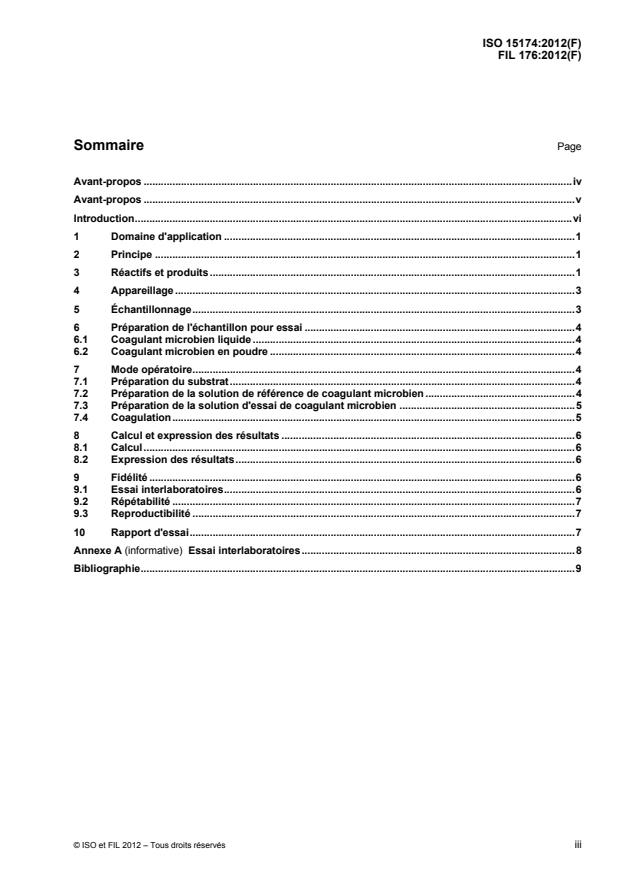
Sommaire Page
Avant-propos . iv
Avant-propos . v
Introduction . vi
1 Domaine d'application . 1
2 Principe . 1
3 Réactifs et produits . 1
4 Appareillage . 3
5 Échantillonnage . 3
6 Préparation de l'échantillon pour essai . 4
6.1 Coagulant microbien liquide . 4
6.2 Coagulant microbien en poudre . 4
7 Mode opératoire . 4
7.1 Préparation du substrat . 4
7.2 Préparation de la solution de référence de coagulant microbien . 4
7.3 Préparation de la solution d'essai de coagulant microbien . 5
7.4 Coagulation . 5
8 Calcul et expression des résultats . 6
8.1 Calcul . 6
8.2 Expression des résultats . 6
9 Fidélité . 6
9.1 Essai interlaboratoires . 6
9.2 Répétabilité . 7
9.3 Reproductibilité . 7
10 Rapport d'essai . 7
Annexe A (informative) Essai interlaboratoires . 8
Bibliographie . 9
© ISO et FIL 2012 – Tous droits réservés iii
FIL 176:2012(F)
Avant-propos
L'ISO (Organisation internationale de normalisation) est une fédération mondiale d'organismes nationaux
de normalisation (comités membres de l'ISO). L'élaboration des Normes internationales est en général
confiée aux comités techniques de l'ISO. Chaque comité membre intéressé par une étude a le droit de faire
partie du comité technique créé à cet effet. Les organisations internationales, gouvernementales et non
gouvernementales, en liaison avec l'ISO participent également aux travaux. L'ISO collabore étroitement avec
la Commission électrotechnique internationale (CEI) en ce qui concerne la normalisation électrotechnique.
Les Normes internationales sont rédigées conformément aux règles données dans les Directives ISO/CEI,
Partie 2.
La tâche principale des comités techniques est d'élaborer les Normes internationales. Les projets de Normes
internationales adoptés par les comités techniques sont soumis aux comités membres pour vote. Leur
publication comme Normes internationales requiert l'approbation de 75 % au moins des comités membres
votants.
L'attention est appelée sur le fait que certains des éléments du présent document peuvent faire l'objet de
droits de propriété intellectuelle ou de droits analogues. L'ISO ne saurait être tenue pour responsable de ne
pas avoir identifié de tels droits de propriété et averti de leur existence.
L'ISO 15174FIL 176 a été élaborée par le comité technique ISO/TC 34, Produits alimentaires, sous-comité
SC 5, Lait et produits laitiers, et la Fédération Internationale du Lait (FIL). Elle est publiée conjointement par
l'ISO et la FIL.
Cette deuxième édition de l'ISO 15174FIL 176 annule et remplace la première édition
(ISO 15174FIL 176:2002), dont elle constitue une révision technique.
iv © ISO et FIL 2012 – Tous droits réservés
FIL 176:2012(F)
Avant-propos
La FIL (Fédération Internationale du Lait) est une organisation sans but lucratif représentant le secteur
laitier mondial. Les membres de la FIL se composent des Comités Nationaux dans chaque pays membre et
des associations laitières régionales avec lesquelles la FIL a signé des accords de coopération. Tout membre
de la FIL a le droit de faire partie des Comités permanents de la FIL auxquels sont confiés les travaux
techniques. La FIL collabore avec l'ISO pour l'élaboration de méthodes normalisées d'analyse et
d'échantillonnage pour le lait et les produits laitiers.
La tâche principale des Comités permanents est d'élaborer les Normes internationales. Les projets de
Normes internationales adoptés par les Comités permanents sont soumis aux Comités Nationaux pour
approbation avant publication en tant que Norme internationale. La publication comme Norme internationale
requiert l'approbation de 50 % au moins des Comités Nationaux de la FIL votants.
L'attention est appelée sur le fait que certains des éléments du présent document peuvent faire l'objet de
droits de propriété intellectuelle ou de droits analogues. La FIL ne saurait être tenue pour responsable de ne
pas avoir identifié de tels droits de propriété et averti de leur existence.
L'ISO 15174FIL 176 a été élaborée par la Fédération Internationale du Lait (FIL) et le comité technique
ISO/TC 34, Produits alimentaires, sous-comité SC 5, Lait et produits laitiers. Elle est publiée conjointement
par la FIL et l'ISO.
L'ensemble des travaux a été confié au Groupe de projet mixte ISO-FIL sur les Coagulants microbiens du
Comité permanent chargé des Méthodes d'analyse pour les auxiliaires technologiques et indicateurs, sous la
conduite de ses chefs de projet, Mme M. Harboe (DK) et Prof. A. Andren (SE).
Cette deuxième édition de l'ISO 15174FIL 176 annule et remplace la première édition
(ISO 15174FIL 176:2002), dont elle constitue une révision technique.
© ISO et FIL 2012 – Tous droits réservés v
FIL 176:2012(F)
Introduction
Les coagulants microbiens proviennent de différentes sources microbiennes, dont les plus courantes sont le
Rhizomucor miehei (CE 3.4.23.23), le R. pusillus (CE 3.4.23.23) et la Cryphonectria parasitica, autrefois
appelée Endothia parasitica (CE 3.4.23.22).
Chacune de ces enzymes présente des caractéristiques spécifiques sous l'angle de son activité de
coagulation du lait et de ses propriétés lors de la fabrication du fromage. Il existe des différences de sensibilité
à la température, de sensibilité au pH, de sensibilité aux ions calcium et de l'effet sur la rhéologie du gel de
lait formé.
Pour des raisons pratiques et économiques, il est donc très important de définir une méthode internationale
de détermination de l'activité totale de coagulation du lait des coagulants microbiens par rapport à un étalon
de référence reconnu à l'échelle internationale. Également pour des raisons pratiques, il a été décidé d'utiliser
l'enzyme R. miehei comme étalon de référence pour tous les types de coagulants microbiens.
Cette méthode est conforme à l'essai d'activité de coagulation relative pour présures de veaux et coagulants
issus de bovins adultes décrit dans l'ISO 11815FIL 157.
Une détermination qualitative des coagulants microbiens présents dans un échantillon peut être réalisée
[7]
conformément à l'ISO 15613FIL 110:— , Annexe A. En présence de mélanges de différentes enzymes de
coagulation du lait, il est impossible de déterminer correctement l'activité totale de coagulation du lait pour
l'échantillon en question.
vi © ISO et FIL 2012 – Tous droits réservés
NORME INTERNATIONALE
FIL 176:2012(F)
Lait et produits laitiers — Coagulants microbiens —
Détermination de l'activité totale de coagulation du lait
1 Domaine d'application
La présente Norme internationale spécifie une méthode permettant de comparer l'activité totale de
coagulation du lait d'un échantillon de coagulant microbien à l'activité de coagulation du lait d'un étalon de
référence de coagulant microbien reconnu à l'échelle internationale, sur un substrat de lait étalon préparé
avec une solution de chlorure de calcium à une concentration de 0,5 g/l (pH 6,5).
2 Principe
Le temps requis pour observer visuellement l'apparition d'une floculation d'un substrat de lait étalon préparé
avec une solution de chlorure de calcium à 0,5 g/l (pH 6,5) est déterminé. Le temps de coagulation d'un
échantillon de coagulant microbien est comparé avec celui de l'étalon de référence de coagulant microbien
d'activité de coagulation du lait connue, dans les mêmes conditions chimiques et physiques.
3 Réactifs et produits
Sauf spécification contraire, utiliser uniquement des réactifs de qualité analytique reconnue et de l'eau distillée
ou déminéralisée ou de l'eau de pureté équivalente.
3.1 Solution tampon, pH 5,5. À l'aide d'une pipette (4.1), ajouter 10,0 ml d'acide acétique à 1 mol/l
(CH COOH) à 10,0 g d'acétate de sodium trihydraté (CH COONa, 3H O) et mélanger. Compléter à 1 000 ml
3 3 2
avec de l'eau. Au besoin, ajuster le pH à 5,5 avec de l'acide acétique à 1 mol/l ou une solution d'acétate de
sodium à 1 mol/l.
3.2 Solution mère de chlorure de calcium, (CaCl ) 500 g/l. Des solutions de chlorure de calcium à la
concentration en chlorure de calcium exacte requise de 500 g/l et avec l'indication de la masse volumique
1 )
effective sont disponibles dans le commerce . Conserver la solution conformément aux instructions du
fabricant.
Avant utilisation, porter la solution mère de chlorure de calcium à température ambiante (18 °C à 22 °C).
Vérifier tous les ans sa concentration par titrage à l'aide d'EDTA (acide éthylène diamine tétracétique).
3.3 Solution de travail de chlorure de calcium, (CaCl ) 0,5 g/l. Utiliser la masse volumique de la
solution mère de chlorure de calcium (3.2) pour calculer la masse nécessaire pour obtenir une concentration
finale en chlorure de calcium de 0,5 g/l dans la solution de travail.
Il convient que la masse de la solution soit équivalente à l'ajout de 2,00 ml de solution mère avec une
concentration exacte de (CaCl ) 500 g/l, auquel cas la masse de la solution est 2,70 g.
1) Chr. Hansen's A/S, Hvidovre, Danemark, est un exemple de fournisseur approprié. Cette information est donnée à
l'intention des utilisateurs du présent document et ne signifie nullement que l’ISO ou la FIL approuvent ou recommandent
l’emploi exclusif du fournisseur ainsi désigné.
© ISO et FIL 2012 – Tous droits réservés 1
FIL 176:2012(F)
Il est recommandé de peser la solution mère de chlorure de calcium (3.2) pour pouvoir préparer la solution de
travail, car la solution visqueuse est difficile à prélever avec une pipette.
Dans une fiole jaugée à un trait de 2 000 ml, peser à 0,01 g près, environ 2,70 g de solution mère de chlorure
de calcium (3.2) de concentration connue avec précision, à température ambiante (18 °C à 22 °C). Compléter
jusqu’au trait avec de l'eau et mélanger. La solution de chlorure de calcium doit être fraîchement préparée le
jour même de son utilisation.
NOTE En alternative, une solution intermédiaire de chlorure de calcium à 50 g/l peut être préparée et ensuite diluée
avant emploi.
3.4 Poudres de lait à faible teneur en matière grasse, séchées par atomisation à basse température,
présentant une bonne coagulation et une bonne qualité bactériologique.
NOTE Des poudres de lait à faible teneur en matière grasse, séchées par atomisation à basse température et
1) 2)
conformes à ces exigences sont disponibles dans le commerce.
3.5 Poudre étalon de référence de coagulant microbien (Rhizomucor miehei), contenue dans des
ampoules en verre. L'activité totale de coagulation du lait est indiquée sur les étiquettes des ampoules.
Conserver la poudre étalon de référence de coagulant microbien à une température de 18 °C, à l'abri de la
lumière et de l'humidité. Pour de courtes périodes, par exemple pendant le transport, la poudre peut être
conservée à température ambiante.
La poudre étalon de référence de coagulant microbien est un étalon de référence primaire; un étalon liquide
secondaire peut être réalisé et utilisé si l'obtention du même résultat est garantie.
L'activité totale de coagulation du lait de la poudre étalon de référence de coagulant microbien reconnue à
l'échelle internationale (R. miehei) est la quantité d'activité établie par rapport au premier lot de poudre étalon
de référence de présure de veau reconnue à l'échelle internationale, défini comme contenant 1 000 IMCU/g
[6]
(voir l'ISO 11815|FIL 157 ).
NOTE 1 L'activité totale de coagulation du lait est exprimée en pourcentage de la moyenne arithmétique des résultats
d'essai.
L'activité totale de coagulation du lait de la poudre étalon de référence de coagulant microbien figure sur les
ampoules en verre et/ou est indiquée sur le certificat fourni. Il est exigé que les futures préparations d'étalons
de référence microbiens soient définies par rapport aux lots antérieurs d'étalons de référence microbiens.
NOTE 2 L'activité protéolytique totale (coagulation du lait) de la poudre étalon de référence de coagulant microbien est
vérifiée tous les deux ans par une méthode alternative, par exemple sur un substrat à base d'hexapeptide synthétique du
3)
NIZO .
La poudre étalon de référence de coagulant microbien, reconnue à l'échelle internationale, est
4)
commercialement disponible auprès de DSM Food Specialities .
2) Cecalait, Poligny, France, est un exemple de fournisseur approprié. Cette information est donnée à l'intention des
utilisateurs du présent document et ne signifie nullement que l’ISO ou la FIL approuvent ou recommandent l’emploi
exclusif du fournisseur ainsi désigné.
3) NIZO Food Research BV, Ede, Pays-Bas, est un exemple de fournisseur approprié. Cette information est donnée à
l'intention des utilisateurs du présent document et ne signifie nullement que l’ISO ou la FIL approuvent ou recommandent
l’emploi exclusif du fournisseur ainsi désigné.
4) DSM Food Specialties, Dairy Ingredients Group, Delft, Pays-Bas, est un exemple de fournisseur approprié. Cette
information est donnée à l'intention des utilisateurs du présent document et ne signifie nullement que l’ISO ou la FIL
approuvent ou recommandent l’emploi exclusif du fournisseur ainsi désigné.
2 © ISO et FIL 2012 – Tous droits réservés
FIL 176:2012(F)
4 Appareillage
Matériel courant de laboratoire et, en particulier, ce qui suit.
4.1 Micropipette ou toute autre pipette, permettant l'écoulement de 0,5 ml en moins de 1 s avec une
répétabilité de 0,2 % ou mieux.
[1]
4.2 Pipettes à un trait, permettant une distribution des volumes appropriés, ISO 648 , classe A.
Un diluteur (par exemple un diluteur Hamilton) ayant la même précision peut également être utilisé pour
diluer les coagulants. Pour mesurer le substrat, une seringue ou un distributeur permettant la distribution de
la quantité appropriée, avec une répétabilité de 0,4 %, peut également être utilisé.
[3]
4.3 Fioles jaugées à un trait, avec les capacités requises, ISO 1042 , classe A.
4.4 Thermomètre, étalonné, gradué entre 20 °C et 45 °C, d'une précision de 0,1 °C.
4.5 pH-mètre, pouvant être lu à 0,01 unité pH près.
4.6 Balance analytique, pouvant être lue à 1 mg près.
4.7 Chronomètre, pouvant être lu à la seconde près.
4.8 Fioles ou tubes à essai, pour l'essai de coagulation du lait, d'une capacité appropriée (voir 7.4).
4.9 Bain-marie, pouvant être maintenu à une température de 32 °C 1 °C et à une
...
МЕЖДУНАРОДНЫЙ ISO
СТАНДАРТ 15174
IDF
Второе издание
2012-05-15
Молоко и молочные продукты.
Микробные коагулянты. Определение
общей молокосвертывающей
активности
Milk and milk products — Microbial coagulants — Determination of total
milk-clotting activity
Ответственность за подготовку русской версии несёт GOST R
(Российская Федерация) в соответствии со статьёй 18.1 Устава ISO
Ссылочные номера
IDF 176:2012(R)
©
ISO и IDF 2012
IDF 176:2012(R)
ДОКУМЕНТ ЗАЩИЩЕН АВТОРСКИМ ПРАВОМ
© ISO и IDF 2012
Все права сохраняются. Если не указано иное, никакую часть настоящей публикации нельзя копировать или использовать в
какой-либо форме или каким-либо электронным или механическим способом, включая фотокопии и микрофильмы, без
письменного согласия ISO или IDF, полученного по адресу, приведенному ниже.
ISO copyright office International Dairy Federation
Case postale 56 • CH-1211 Geneva 20 Silver Building • Boulevard Auguste Reyers 70/B • B-1030 Brussels
Tel. + 41 22 749 01 11 Tel. + 32 2 733 98 88
Fax + 41 22 749 09 47 Fax + 32 2 733 04 13
E-mail copyright@iso.org E-mail info@fil-idf.org
Web www.iso.org Web www.fil-idf.org
Опубликовано в Швейцарии
ii © ISO и IDF 2012 – Все права сохраняются
IDF 176:2012(R)
Содержание Страница
Предисловие .iv
Предисловие .v
Введение .vi
1 Область применения .1
2 Принцип.1
3 Реактивы и материалы.1
4 Аппаратура.2
5 Отбор проб.3
6 Приготовление пробы для испытания.3
6.1 Жидкий микробный коагулянт.3
6.2 Порошкообразный микробный коагулянт.4
7 Методика .4
7.1 Приготовление субстрата .4
7.2 Приготовление раствора эталона микробного коагулянта .4
7.3 Приготовление испытуемого раствора микробного коагулянта.5
7.4 Свертывание .5
8 Расчет и выражение результатов .5
8.1 Расчет .5
8.2 Выражение результатов .6
9 Прецизионность.6
9.1 Межлабораторное испытание.6
9.2 Повторяемость .7
9.3 Воспроизводимость .7
10 Протокол испытания.7
Приложение A (информативное) Межлабораторное испытание .8
Библиография.9
© ISO и IDF 2012 – Все права сохраняются iii
IDF 176:2012(R)
Предисловие
Международная организация по стандартизации (ISO) является всемирной федерацией
национальных организаций по стандартизации (комитетов-членов ISO). Разработка международных
стандартов обычно осуществляется техническими комитетами ISO. Каждый комитет-член ISO,
заинтересованный в деятельности, для которой был создан технический комитет, имеет право быть
представленным в этом комитете. Международные организации, правительственные и
неправительственные, имеющие связи с ISO, также принимают участие в работах. ISO
непосредственно сотрудничает с Международной электротехнической комиссией (IEC) по всем
вопросам электротехнической стандартизации.
Международные стандарты разрабатываются в соответствии с правилами, приведенными в
Директивах ISO/IEC, Часть 2.
Основная задача технических комитетов состоит в подготовке международных стандартов. Проекты
международных стандартов, одобренные техническими комитетами, рассылаются комитетам-членам
на голосование. Их опубликование в качестве международных стандартов требует одобрения, по
меньшей мере, 75 % комитетов-членов, принимающих участие в голосовании.
Следует иметь в виду, что некоторые элементы настоящего документа могут быть объектом патентных
прав. ISO не должен нести ответственность за идентификацию какого-либо одного или всех патентных
прав.
ISO 15174⎪IDF 176 разработан Техническим комитетом ISO/TC 34, Пищевые продукты, Подкомитетом
SC 5, Молоко и молочные продукты, и Международной федерацией по молочному животноводству
(IDF). Этот стандарт должен быть опубликован совместно ISO и IDF.
Настоящее второе издание ISO 15174⎪IDF 176 отменяет и заменяет первое издание
(ISO 15174⎪IDF 176:2002), которое было подвергнуто техническому пересмотру.
iv © ISO и IDF 2012 – Все права сохраняются
IDF 176:2012(R)
Предисловие
Международная федерация по молочному животноводству (IDF) является некоммерческой
организацией, представляющей всемирное молочное животноводство. Членами IDF являются
Национальные комитеты каждой страны-члена, а также региональные ассоциации по молочному
животноводству, которые имеют подписанное официальное соглашение о совместной деятельности с
IDF. Каждый член IDF имеет право быть представленным в Постоянных комитетах IDF,
осуществляющих техническую работу. IDF сотрудничает с ISO по вопросам разработки стандартных
методов анализа и отбора проб молока и молочных продуктов.
Основная задача Постоянных комитетов состоит в подготовке международных стандартов. Проекты
международных стандартов, принятые Постоянными комитетами, рассылаются Национальным
комитетам для утверждения до опубликования в качестве международных стандартов. Их
опубликование в качестве международных стандартов требует одобрения не менее 50 %
Национальных комитетов IDF, принимающих участие в голосовании.
Следует иметь в виду, что некоторые элементы настоящего документа могут быть объектом патентных
прав. IDF не должен нести ответственность за идентификацию какого-либо одного или всех патентных
прав.
ISO 15174⎪IDF 176 подготовлен Международной федерацией по молочному животноводству (IDF) и
Техническим комитетом ISO/TC 34, Пищевые продукты, Подкомитетом SC 5, Молоко и молочные
продукты. Этот стандарт должен быть опубликован совместно IDF и ISO.
Вся работа была проведена совместной ISO-IDF рабочей группой по Микробным коагулянтам
Постоянного комитета по Аналитическим методам определения технологических добавок и
индикаторов под руководством м-ра М. Харбое (Дания) и профессора А. Андрена (Швеция).
Настоящее второе издание ISO 15174⎪IDF 176 отменяет и заменяет первое издание
(ISO 15174⎪IDF 176:2002), которое было подвергнуто техническому пересмотру.
© ISO и IDF 2012 – Все права сохраняются v
IDF 176:2012(R)
Введение
Микробные коагулянты получают из различных микробиологических источников, наиболее
распространенными являются Rhizomucor miehei (EC 3.4.23.23), R. pusillus (EC 3.4.23.23) и
Cryphonectria parasitica, ранее называемый Endothia parasitica (EC 3.4.23.22).
Каждый их этих ферментов имеет свои собственные характеристики, что касается общей
молокосвертывающей активности и свойств, связанных с сыроделием. Существуют различия в
чувствительности к воздействию температуры, рН, ионов кальция, а также во влиянии на
реологические свойства образованного молочного геля.
Поэтому очень важно, исходя из практических и экономических соображений, иметь международный
метод определения общей молокосвертывающей активности микробных коагулянтов относительно
признанного на международном уровне исходного эталона. Также по практическим причинам было
решено использовать фермент R. miehei в качестве исходного эталона микробных коагулянтов для
всех типов этих коагулянтов.
Этот метод соответствует методу определения относительной молокосвертывающей активности
говяжьего сычужного фермента, описанного в ISO 11815⎪IDF 157.
Качественное определение микробных коагулянтов в пробе можно выполнять в соответствии с
[7]
ISO 15163⎪IDF 110:— , Приложение A. В случае смеси различных молокосвертывающих ферментов
невозможно осуществить правильное определение общей молокосвертывающей активности в пробе.
vi © ISO и IDF 2012 – Все права сохраняются
МЕЖДУНАРОДНЫЙ СТАНДАРТ
IDF 176:2012(R)
Молоко и молочные продукты. Микробные коагулянты.
Определение общей молокосвертывающей активности
1 Область применения
Настоящий международный стандарт устанавливает метод сравнения общей молокосвертывающей
активности пробы микробного коагулянта с молокосвертывающей активностью международного
исходного эталона микробного коагулянта в стандартном молочном субстрате, приготовленном с
использованием раствора хлорида кальция концентрацией 0,5 г/л (pH ~6,5).
2 Принцип
Определяют время, необходимое для видимого образования хлопьев в стандартном молочном
субстрате, приготовленном с использованием раствора хлорида кальция концентрацией 0,5 г/л
(pH ~6,5). Сравнивают при идентичных химических и физических условиях продолжительность его
свертывания пробой микробного коагулянта с продолжительностью свертывания исходным эталоном
микробного коагулянта с известной молокосвертывающей активностью.
3 Реактивы и материалы
Если не указано иначе, используют реактивы только признанного аналитического качества и
дистиллированную или деминерализованную воду либо воду эквивалентной чистоты.
3.1 Буферный раствор, pH 5,5. Добавляют с помощью пипетки (4.1) 10,0 мл раствора уксусной кислоты
концентрацией 1 моль/л (CH COOH) к 10,0 г тригидрата ацетата натрия (CH COONa·3H O) и
3 3 2
перемешивают. Разбавляют водой до 1 000 мл. При необходимости доводят pH до 5,5 с помощью
раствора уксусной кислоты концентрацией 1 моль/л или раствора ацетата натрия концентрацией 1 моль/л.
3.2 Основной раствор хлорида кальция, ρ(CaCl ) = 500 г/л. Растворы хлорида кальция требуемой
1)
точной концентрации 500 г/л и заявленной фактической плотности имеются в продаже. Хранят
раствор согласно инструкциям производителя.
Перед применением доводят основной раствор хлорида кальция до комнатной температуры
(18 °C – 22 °C). Проверяют концентрацию раствора хлорида кальция путем титрования раствором
EDTA (этилендиаминтетрауксусной кислоты) каждый год.
3.3 Рабочий раствор хлорида кальция, ρ(CaCl ) = 0,5 г/л. Используют плотность основного
раствора хлорида кальция (3.2) для расчета массы, необходимой для получения окончательной
концентрации хлорида кальция 0,5 г/л в рабочем растворе.
Масса раствора должна быть эквивалентна добавлению 2,00 мл основного раствора с точной
концентрацией ρ(CaCl ) = 500 г/л, в этом случае масса раствора составляет ~2,70 г.
Для приготовления рабочего раствора хлорида кальция рекомендуется взвешивание основного
раствора хлорида кальция (3.2), поскольку вязкий раствор трудно отбирать пипеткой.
1) Chr. Hansen's A/S, Hvidovre, Denmark является примером подходящего поставщика. Эта информация дается для
удобства пользователей данного документа и не означает одобрения этого поставщика со стороны ISO или IDF.
© ISO и IDF 2012 – Все права сохраняются 1
IDF 176:2012(R)
Взвешивают с точностью до 0,01 г приблизительно 2,70 г основного раствора хлорида кальция (3.2)
точно установленной концентрации при комнатной температуре (18 °C – 22 °C) в мерной колбе с одной
меткой вместимостью 2 000 мл. Разбавляют водой до метки 2 000 мл и перемешивают. Раствор
хлорида кальция должен быть свежеприготовленным в день его использования.
ПРИМЕЧАНИЕ Альтернативно можно приготовить промежуточный раствор хлорида кальция концентрацией
50 г/л и в дальнейшем разбавлять его перед использованием.
3.4 Сухое молоко низкотемпературного сгущения и распылительной сушки с пониженным
содержанием жира, с хорошим сычужным свертыванием и хорошего бактериологического качества.
ПРИМЕЧАНИЕ Соответствующее этим требованиям сухое молоко низкотемпературного сгущения и
1),2)
распылительной сушки с пониженным содержанием жира имеется в продаже.
3.5 Порошкообразный исходный эталон микробного коагулянта (Rhizomucor miehei), в
стеклянных ампулах. Точное значение общей молокосвертывающей активности маркируют на ампулах.
Хранят порошкообразный исходный эталон микробного коагулянта в темноте при температуре –18 °C
в защищенном от влаги месте. В течение коротких промежутков времени, например, при
транспортировке, порошок может храниться при температуре окружающей среды.
Порошкообразный исходный эталон микробного коагулянта является первичным исходным эталоном;
можно приготовить вторичный жидкий эталон и использовать его в том случае, если гарантируется
получение одинаковых результатов.
Общая молокосвертывающая активность международного порошкообразного исходного эталона
микробного коагулянта (R. miehei) — это величина активности, установленная относительно первой
партии международного порошкообразного исходного эталона сычужного фермента из желудка телят,
[6]
который, как было определено, содержит 1 000 IMCU/г (см. ISO 11815⎪IDF 157 ).
ПРИМЕЧАНИЕ 1 Общая молокосвертывающая активность выражается в процентах относительно
среднеарифметического значения результатов испытаний.
Общая молокосвертывающая активность порошкообразного исходного эталона микробного коагулянта
маркируется на стеклянных ампулах и/или заявляется в предусмотренном сертификате. Это
необходимо для будущих препаратов микробных исходных эталонов, активность которых должна быть
установлена относительно предыдущей партии микробного исходного эталона.
ПРИМЕЧАНИЕ 2 Общую протеолитическую (молокосвертывающую) активность порошкообразного исходного
эталона микробного коагулянта проверяют каждый второй год альтернативным методом, например, на
3)
синтетическом гексапептидном субстрате NIZO .
Международный порошкообразный исходный эталон микробного коагулянта доступен для
4)
приобретения в DSM Food Specialties .
4 Аппаратура
Обычная лабораторная аппаратура и, в частности, следующая.
4.1 Микропипетка или любая другая пипетка, способная подавать 0,5 мл не менее чем за 1 с при
повторяемости 0,2 % или выше.
2) Cecalait, Poligny, France является примером подходящего поставщика. Эта информация дается для удобства
пользователей данного документа и не означает одобрения этого поставщика со стороны ISO или IDF.
3) NIZO Food Research BV, Ede, Netherlands является примером подходящего поставщика. Эта информация дается
для удобства пользователей данного документа и не означает одобрения этого поставщика со стороны ISO или IDF.
4) DSM Food Specialities, Dairy Ingredients Group, Delft, Netherlands является примером подходящего поставщика.
Эта информация дается для удобства пользователей данного документа и не означает одобрения этого
поставщика со стороны ISO или IDF.
2 © ISO и IDF 2012 – Все права сохраняются
IDF 176:2012(R)
[1]
4.2 Пипетки с одной меткой, для подачи соответствующих объемов, ISO 648 , класс A.
Альтернативно для разбавления коагулянтов можно использовать разбавитель (например,
разбавитель Гамильтона) с такой же прецизионностью. Для измерения субстрата также можно
использовать шприц или дозатор, подающий соответствующее количество с повторяемостью 0,4 %.
[3]
4.3 Мерные колбы с одной меткой, требуемой вместимости, ISO 1042 , класс A.
4.4 Термометр, калиброванный, градуированный от 20 °C до 45 °C, с точностью до ±0,1 °C.
4.5 pH-метр, пригодный для считывания показаний с точностью до 0,01 единиц pH.
4.6 Аналитические весы, пригодные для считывания показаний с точностью до 1 мг.
4.7 Секундомер, пригодный для считывания показаний с точностью до секунды.
4.8 Колбы или пробирки, для испытания молока на свертывание соответствующей вместимости
(см. 7.4).
4.9 Водяная баня, способная поддерживать температуру 32 °C ± 1 °C, а также постоянную
...