

ISO 14250:2026
(Main)Steel — Metallographic characterization of duplex grain size and distributions
- Abstract
This document specifies a micrographic method of determining the duplex grain size including the area fraction, of rolled or forged steel products. Additionally, this document provides detailed description methods for each specific type of duplex grain size.
- Status
- Published
- Publication Date
- 16-Nov-2026
- Current Stage
- 6060 - International Standard published
- Start Date
- 17-Nov-2026
- Completion Date
- 17-Nov-2026

ISO 14250:2026 is an International Standard from ISO for the metallographic characterization of duplex grain size and distributions in rolled or forged steel products. It specifies a micrographic method for determining duplex grain size, including area fraction, and gives detailed methods for the main duplex grain size types, for use by laboratories, producers, and others who need to examine steel microstructures.
What does ISO 14250:2026 specify?
ISO 14250:2026 specifies how to identify, classify, measure, and report duplex grain size in rolled or forged steel products. It covers both random and topological duplex grain size, and it ties the measurements to the grain size methods in ISO 643 and the point counting method in ISO 9042.
The document is organized into clauses on scope, references, terms, abbreviations, principle, apparatus, sampling and preparation, procedure, and test report. It also includes two annexes, one normative and one informative.
| Annex | What it covers |
|---|---|
| Annex A | Chart for estimation of area fractions |
| Annex B | Classification procedure for grain size distributions |
What are the key requirements of ISO 14250:2026?
ISO 14250:2026 requires the examiner to decide whether the specimen shows random duplex grain size or topological duplex grain size, then apply the matching measurement route. This matters because the reporting format and the area-fraction method depend on the grain-size pattern.
Classification of duplex grain size
Clause 5 divides duplex grain size into two main categories: random duplex grain size and topological duplex grain size. Random duplex grain size includes individual coarse grains, wide range grains, and bimodal grains; topological duplex grain size includes cross-section variations, necklace grains, and grains in bands.
The classification thresholds are based on differences in ISO grain size numbers and on how much of the specimen area each population occupies. In practice, this tells the reader whether the microstructure is a mixed random distribution or a patterned one, which changes how the report is written and how the measurements are taken.
Sampling, surface preparation, and field selection
Clause 7 requires evaluation of the entire specimen surface when the method is used to characterize deviations from a single log-normal distribution and patterns of grain-size variation. The examined surface is prepared by polishing and etching so that grain boundaries are visible.
The plane of examination depends on product form: it is parallel to the direction of maximum deformation, except for bars and tubes where the examined surface is perpendicular to that direction. This matters because the observed duplex pattern can change with orientation.
Estimating area fractions
Clause 8.2 provides four ways to estimate area fractions: comparison with charts in Annex A, point counting using ISO 9042, planimetric measurement, and a direct measurement procedure for topological specimens with surface layers of differing grain size. The comparison and point-count methods are used differently for random and topological cases, and the report must state which method and parameters were used.
Determining grain size
Clause 8.3 uses ISO 643 methods to rate grain size, and it gives special treatment to ALA grains. For ALA grain size, the standard focuses on the largest coarse grain and allows diameter, planimetric, test-grid, and image-analysis methods, with the test-grid method acting as the referee procedure in disputes.
For non-ALA duplex conditions, the document uses the apparent grain size (AGS) of the relevant populations. For necklace grains, the fine ring is treated as the grain boundary of the coarse grains, and the coarse grains are then rated accordingly.
Reporting
Clause 8.4 and Clause 9 require reports to identify the duplex type, specimen orientation, method used, AGS index, area fraction, and the most suitable report format for the observed condition. In practice, this gives a standard way to compare results between laboratories and to link microstructure findings to product acceptance or investigation records.
What terms does ISO 14250:2026 define?
- Duplex grain size - a condition where the distribution of grain intercept lengths, diameters, or areas departs from a single lognormal distribution.
- Equivalent diameter - the diameter of a circle with the same area as the grain.
- Random duplex grain size - two or more significantly different grain sizes that are randomly distributed.
- Topological duplex grain size - two or more significantly different grain sizes that vary in a non-random, definable pattern.
- AGS - Apparent grain size, the grain-size rating used for the relevant grain populations.
- ALA - A condition for isolated coarse grains, reported with an ALA grain size index.
- BD - Banding, the topological condition where distinct grain sizes appear in bands.
Who uses ISO 14250:2026?
ISO 14250:2026 is used in steel metallography, especially by laboratories and technical staff examining rolled or forged steel products. It is useful for producers, testing organizations, and quality teams that need to classify duplex grain patterns, measure area fractions, and report grain size in a consistent way. It also supports product-standard writers who need a defined method for micrographic evaluation.
What changed in ISO 14250:2026 from the previous edition?
ISO 14250:2026 is the second edition and it cancels and replaces ISO 14250:2000. The stated changes are:
- added terms and definitions, principles, and procedure, with later clauses renumbered;
- clarified the method for determining grain size using ISO 643;
- modified all figures;
- clarified the planimetric procedure for estimating area fractions;
- clarified the determination of isolated coarse grain size;
- clarified the determination of apparent grain size other than ALA grains;
- clarified the characterization of duplex grain size and distributions;
- modified the charts in Annex A;
- added the classification procedure for grain size distributions in Annex B.
Which standards are used with ISO 14250:2026?
- ISO 643, Steels - Micrographic determination of the apparent grain size - supplies the grain-size rating methods used throughout the document, including rating chart, planimetric, and intercept methods.
- ISO 9042, Steels - Point counting method for statistically estimating the volume fraction of a constituent with a point grid - supplies the point-counting procedure used to estimate area fractions.
- ISO 643:2024, Annex E - is also referenced for intercept length measurement and statistical determination of grain-size distribution where detailed discrimination is needed.
What does the ISO 14250:2026 document contain?
ISO 14250:2026 contains Table 1 for abbreviated terms, Table 2 for the relationship between ALA grain size, diameter, and area, and Formula (1) and Formula (2) for point counting and ALA area calculation. It also includes photomicrograph figures for ALA, WR, BM, CS, NL, and BD conditions, plus a mixed-condition figure and a schematic test-grid figure.
Annex A provides a chart for estimating area fractions. Annex B provides a classification procedure for grain-size distributions, which helps the reader decide whether the specimen belongs to a random or topological duplex class before reporting results.
Relations
- Revises
ISO 14250:2000 - Steel — Metallographic characterization of duplex grain size and distributions - Effective Date
- 23-Dec-2023
Get Certified
Connect with accredited certification bodies for this standard

Element Materials Technology
Materials testing and product certification.

Inštitut za kovinske materiale in tehnologije
Institute of Metals and Technology. Materials testing, metallurgical analysis, NDT.
Sponsored listings
Frequently Asked Questions
ISO 14250:2026 is a standard published by the International Organization for Standardization (ISO). Its full title is "Steel — Metallographic characterization of duplex grain size and distributions". This standard covers: This document specifies a micrographic method of determining the duplex grain size including the area fraction, of rolled or forged steel products. Additionally, this document provides detailed description methods for each specific type of duplex grain size.
This document specifies a micrographic method of determining the duplex grain size including the area fraction, of rolled or forged steel products. Additionally, this document provides detailed description methods for each specific type of duplex grain size.
ISO 14250:2026 is classified under the following ICS (International Classification for Standards) categories: 77.080.20 - Steels. The ICS classification helps identify the subject area and facilitates finding related standards.
ISO 14250:2026 has the following relationships with other standards: It is inter standard links to ISO 14250:2000. Understanding these relationships helps ensure you are using the most current and applicable version of the standard.
ISO 14250:2026 is available in PDF format for immediate download after purchase. The document can be added to your cart and obtained through the secure checkout process. Digital delivery ensures instant access to the complete standard document.
Standards Content (Sample)
International
Standard
ISO 14250
Second edition
Steel — Metallographic
2026-11
characterization of duplex grain
size and distributions
Aciers — Caractérisation métallographique de la grosseur et de
la distribution de grain duplex
Reference number
© ISO 2026
All rights reserved.
This ISO publication is protected by copyright and is owned by ISO and/or its licensors.
The content of this ISO publication is provided under licence, not sold. Use is subject to the applicable licence terms issued by ISO,
an ISO member body, or an authorized third-party distributor.
Except as required for implementation or expressly permitted by a separate licence, no part of this ISO publication may be
reproduced, distributed, modified, used, or made available in any form or by any means – electronic or mechanical, including
photocopying, scanning, recording, or posting on internal or external digital platforms.
Any use beyond the scope of the granted rights is prohibited and may result in legal action.
ISO copyright office
CP 401 • CH-1214 Vernier, Geneva
Phone: +41 22 749 01 11
Email: copyright@iso.org
Website: www.iso.org
Published in Switzerland
ii
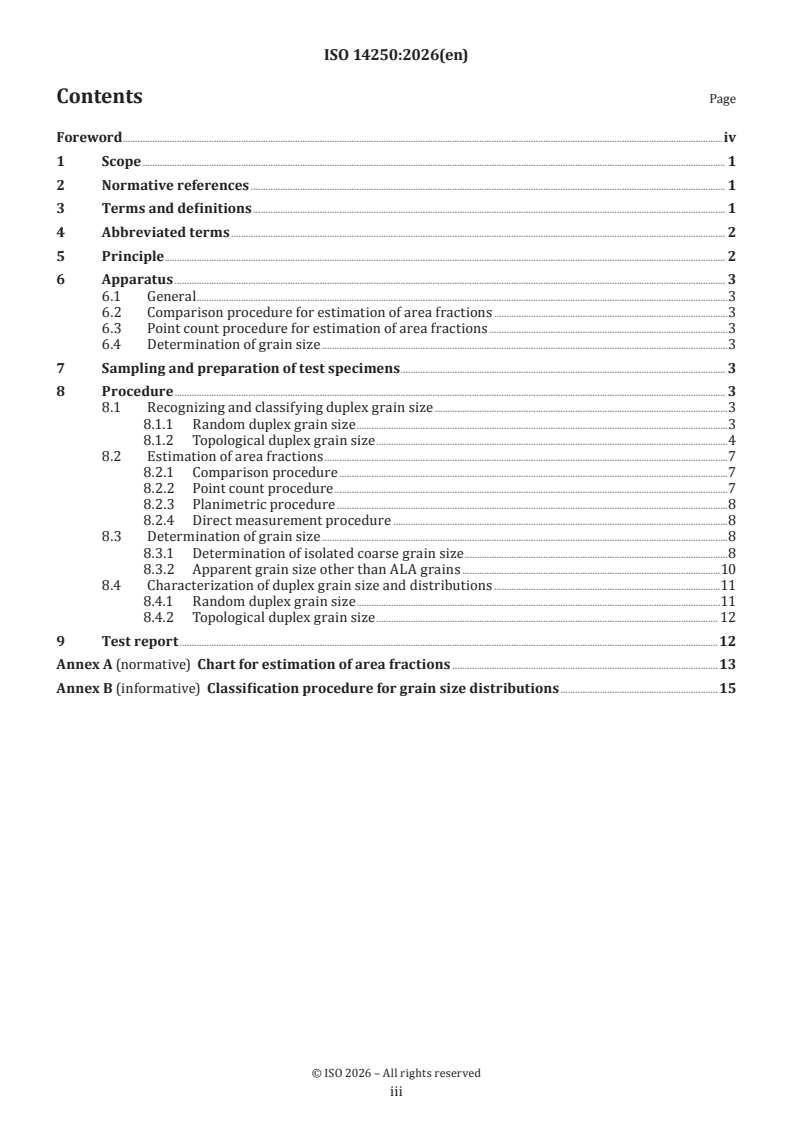
Contents Page
Foreword .iv
1 Scope . 1
2 Normative references . 1
3 Terms and definitions . 1
4 Abbreviated terms . 2
5 Principle . 2
6 Apparatus . 3
6.1 General .3
6.2 Comparison procedure for estimation of area fractions .3
6.3 Point count procedure for estimation of area fractions .3
6.4 Determination of grain size .3
7 Sampling and preparation of test specimens . 3
8 Procedure . 3
8.1 Recognizing and classifying duplex grain size .3
8.1.1 Random duplex grain size .3
8.1.2 Topological duplex grain size .4
8.2 Estimation of area fractions .7
8.2.1 Comparison procedure .7
8.2.2 Point count procedure .7
8.2.3 Planimetric procedure .8
8.2.4 Direct measurement procedure .8
8.3 Determination of grain size .8
8.3.1 Determination of isolated coarse grain size .8
8.3.2 Apparent grain size other than ALA grains .10
8.4 Characterization of duplex grain size and distributions .11
8.4.1 Random duplex grain size .11
8.4.2 Topological duplex grain size . 12
9 Test report .12
Annex A (normative) Chart for estimation of area fractions .13
Annex B (informative) Classification procedure for grain size distributions .15
iii
Foreword
ISO (the International Organization for Standardization) is a worldwide federation of national standards
bodies (ISO member bodies). The work of preparing International Standards is normally carried out through
ISO technical committees. Each member body interested in a subject for which a technical committee
has been established has the right to be represented on that committee. International organizations,
governmental and non-governmental, in liaison with ISO, also take part in the work. ISO collaborates closely
with the International Electrotechnical Commission (IEC) on all matters of electrotechnical standardization.
The procedures used to develop this document and those intended for its further maintenance are described
in the ISO/IEC Directives, Part 1. In particular, the different approval criteria needed for the different types
of ISO documents should be noted. This document was drafted in accordance with the editorial rules of the
ISO/IEC Directives, Part 2 (see www.iso.org/directives).
ISO draws attention to the possibility that the implementation of this document may involve the use of (a)
patent(s). ISO takes no position concerning the evidence, validity or applicability of any claimed patent
rights in respect thereof. As of the date of publication of this document, ISO had not received notice of (a)
patent(s) which may be required to implement this document. However, implementers are cautioned that
this may not represent the latest information, which may be obtained from the patent database available at
www.iso.org/patents. ISO shall not be held responsible for identifying any or all such patent rights.
Any trade name used in this document is information given for the convenience of users and does not
constitute an endorsement.
For an explanation of the voluntary nature of standards, the meaning of ISO specific terms and expressions
related to conformity assessment, as well as information about ISO's adherence to the World Trade
Organization (WTO) principles in the Technical Barriers to Trade (TBT), see www.iso.org/iso/foreword.html.
This document was prepared by Technical Committee ISO/TC 17, Steel, Subcommittee SC 7, Methods of testing
(other than mechanical tests and chemical analysis).
This second edition cancels and replaces the first edition (ISO 14250:2000), which has been technically
revised.
The main changes are as follows:
— adding terms and definitions (Clause 3), principles (Clause 5) and procedure (Clause 8), and renumbering
the subsequent clauses;
— clarifying the specific method for determining grain size using ISO 643;
— modifying all of the figures;
— clarifying the planimetric procedure of estimation of area fraction;
— clarifying the determination of isolated coarse grain size;
— clarifying the determination of apparent grain size other than ALA grains;
— clarifying the characterization of duplex grain size and distributions;
— modifying the charts for estimation of area fractions in Annex A;
— adding the classification procedure for grain size distributions in Annex B.
Any feedback or questions on this document should be directed to the user’s national standards body. A
complete listing of these bodies can be found at www.iso.org/members.html.
iv
International Standard ISO 14250:2026(en)
Steel — Metallographic characterization of duplex grain size
and distributions
1 Scope
This document specifies a micrographic method of determining the duplex grain size including the area
fraction, of rolled or forged steel products.
Additionally, this document provides detailed description methods for each specific type of duplex grain
size.
2 Normative references
The following documents are referred to in the text in such a way that some or all of their content constitutes
requirements of this document. For dated references, only the edition cited applies. For undated references,
the latest edition of the referenced document (including any amendments) applies.
ISO 643, Steels — Micrographic determination of the apparent grain size
ISO 9042, Steels — Point counting method for statistically estimating the volume fraction of a constituent with
a point grid
3 Terms and definitions
For the purposes of this document, the following terms and definitions apply.
ISO and IEC maintain terminology databases for use in standardization at the following addresses:
— ISO Online browsing platform: available at https:// www .iso .org/ obp
— IEC Electropedia: available at https:// www .electropedia .org/
3.1
duplex grain size
condition existent when the distribution of grain intercept lengths, diameters or areas deviates from a single
lognormal distribution
Note 1 to entry: Various types of duplex grain sizes are described in 8.1.
3.2
equivalent diameter
diameter of a circle with an area equivalent to that of the grain
Note 1 to entry: The area is calculated as the geometric mean of the long axis (the maximum chord length) and the
short axis (the maximum chord length perpendicular to the long axis), obtained by multiplying the two axes and
taking the square root of the product.
3.3
random duplex grain size
grains of two or more significantly different sizes that are randomly distributed
Note 1 to entry: See 5.1 for further explanations.
3.4
topological duplex grain size
grains of two or more significantly different sizes that vary in a non-random, definable pattern
Note 1 to entry: See 5.1 for further explanations.
4 Abbreviated terms
The abbreviated terms used are given in Table 1
Table 1 — Abbreviated terms
Abbreviated
Definition
term
ALA As large as
AGS Apparent grain size
BD Banding
BM Bimodal
CS Cross section
DG Duplex grain
L Longitudinal
NL Necklace
T Transverse
WR Wide range
G ALA grain size
ALA
G AGS grain size
5 Principle
5.1 Duplex grain size is classified into two main categories: random duplex grain size and topological
duplex grain size, each with specified subcategories. Random duplex grain size includes: Individual coarse
grains (ALA), Wide range grains (WR) and Bimodal grains (BM). Topological duplex grain size includes:
Cross-section variations of grains (CS), Necklace grains (NL) and Grains in bands (BD). This pattern may be
related to the shape of the product being examined or the factors influencing grain formation. The document
specifies methods for analysing the distribution type, rating the grain size, and estimating the area fractions
occupied by each distinct grain size type. See Figure B.1 in Annex B for the classification procedure for grain
size distribution.
5.2 This document outlines methods for identifying the presence of duplex grain size and characterizing
the features of specific types of duplex grain sizes. It includes procedures for estimating the area fractions
occupied by distinct grain sizes. The document establishes test methods for determining ALA grain size and
provides guidelines for applying ISO 643 to determine grain size in specific designated areas. Additionally,
it offers methods for reporting detailed and distinctive information for each type of duplex grain size.
Furthermore, the test methods provide a statistical procedure for determining the actual distribution of all
grain sizes present in a duplex grain size specimen.
5.3 The method may be applied to specimens or products containing grains of two or more significantly
different sizes, but distributes at random or in topologically varying patterns.
5.4 The total specimen surface shall be evaluated when the test method describes deviations from a
single, log-normal distribution of grain sizes and characterizes pattern of variations in grain size.
6 Apparatus
6.1 General
The apparatus used shall depend on the nature of the test method as described in 6.2 to 6.4.
6.2 Comparison procedure for estimation of area fractions
This procedure shall require the use of comparison charts presented in Annex A, Figure A.1 to improve the
accuracy of visual estimates of area fractions occupied by a distinct grain size. These comparison charts
show different area percentages of light grains among dark grains.
6.3 Point count procedure for estimation of area fractions
This procedure shall require the use of a test grid on a transparent overlay, or on a reticle, as specified in
ISO 9042.
6.4 Determination of grain size
The devices specified in ISO 643 shall be used. For specimens exhibiting different grain size distributions,
the test methods outlined in ISO 643 — such as the rating chart method, planimetric method, or intercept
method — shall be employed to rate the distinct grain sizes. Additionally, the intercept length method
described in ISO 643:2024, Annex E, may also be utilized for this purpose. When rating individual ALA
grains, the assessment shall be based on the equivalent diameter or the area of the maximum grain.
7 Sampling and preparation of test specimens
In order to characterize patterns of duplex grain size, the entire cross section of the specimen from the
product shall be evaluated. The examined surface shall be along the longitudinal direction in a plane parallel
to the direction of maximum product deformation except in the case of bars and tubes where the examined
surface shall be perpendicular to the direction of the maximum deformation. The number of test specimens
and their location shall be specified in the relevant product standard. When it is not the case, they are left at
the producer's discretion.
A flat surface of the test specimen shall be polished for micrographic examination and shall be etched for an
adequate period of time by means of the appropriate etching. The etch shall be such that all, or nearly all, of
the grain boundaries are visible.
8 Procedure
8.1 Recognizing and classifying duplex grain size
8.1.1 Random duplex grain size
8.1.1.1 General
A random duplex grain size is defined as any of the following.
8.1.1.2 Random coarse grains (ALA)
This is the presence of randomly distributed individual coarse grains, differing in size by three or more ISO
grain size numbers from the average size of the balance of the grains.
These individual coarse grains shall comprise 5 % or less of the area of the specimens. If they comprise more
than 5 % of that area, treat the specimen as described in 8.1.1.4.
An example of a photomicrograph of the ALA condition appears in Figure 1.
8.1.1.3 Wide range grains
This is the presence of an unusually wide range of grain sizes, randomly distributed, with the largest size
differing from the smallest size by five
...