

ISO/FDIS 16703
(Main)Environmental solid matrices — Determination of hydrocarbon content in the range of C10 to C40 by gas chromatography
- Abstract
ISO 16703:2004 specifies a method for the quantitative determination of the mineral oil (hydrocarbon) content in field-moist soil samples by gas chromatography. The method is applicable to mineral oil contents (mass fraction) between 100 mg/kg and 10 000 mg/kg soil, expressed as dry matter, and can be adapted to lower detection limits. ISO 16703:2004 is applicable to the determination of all hydrocarbons with a boiling range of 175 °C to 525 °C, n-alkanes from C10H22 to C40H82, isoalkanes, cycloalkanes, alkylbenzenes, alkylnaphthalenes and polycyclic aromatic compounds, provided that they are not absorbed on the specified column during the clean-up procedure. ISO 16703:2004 is not applicable to the quantitative determination of hydrocarbons 10 originating from gasolines. On the basis of the peak pattern of the gas chromatogram obtained, and of the boiling points of the individual n-alkanes listed in Annex B, the approximate boiling range of the mineral oil and some qualitative information on the composition of the contamination can be achieved.
- Status
- Not Published
- Technical Committee
- ISO/TC 190/SC 3 - Chemical and physical characterization
- Drafting Committee
- ISO/TC 190/SC 3/WG 6 - Organic analysis
- Current Stage
- 5000 - FDIS registered for formal approval
- Start Date
- 21-Sep-2026
- Completion Date
- 31-Mar-2026
Buy Documents
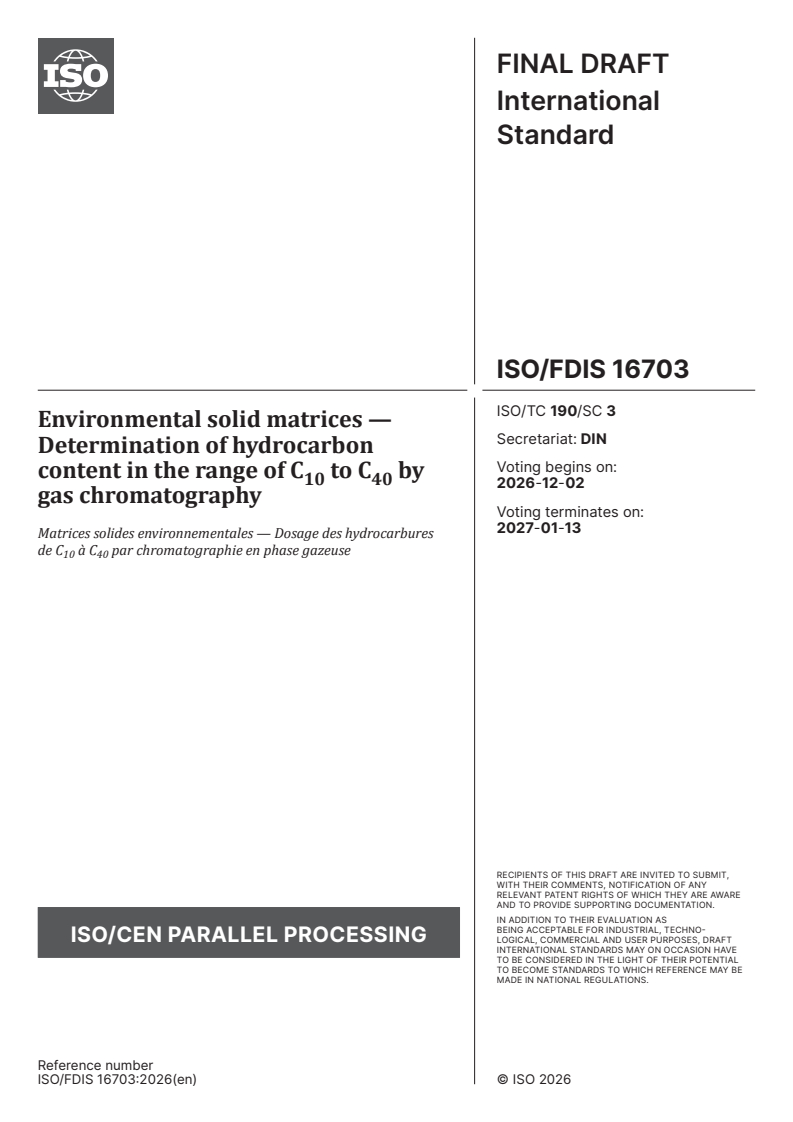

ISO/FDIS 16703 - Environmental solid matrices — Determination of hydrocarbon content in the range of C10 to C40 by gas chromatography

REDLINE ISO/FDIS 16703 - Environmental solid matrices — Determination of hydrocarbon content in the range of C10 to C40 by gas chromatography
Relations
- Effective Date
- 12-Feb-2026
- Effective Date
- 18-Nov-2023
- Effective Date
- 04-Nov-2023
Buy Documents
ISO/FDIS 16703 - Environmental solid matrices — Determination of hydrocarbon content in the range of C10 to C40 by gas chromatography
REDLINE ISO/FDIS 16703 - Environmental solid matrices — Determination of hydrocarbon content in the range of C10 to C40 by gas chromatography
Get Certified
Connect with accredited certification bodies for this standard

CIS Institut d.o.o.
Personal Protective Equipment (PPE) certification body. Notified Body NB-2890 for EU Regulation 2016/425 PPE.

Kiwa BDA Testing
Building and construction product certification.
Kmetijski inštitut Slovenije
Agricultural Institute of Slovenia. Soil testing, plant health, agricultural product analysis.
Sponsored listings
Frequently Asked Questions
ISO/FDIS 16703 is a draft published by the International Organization for Standardization (ISO). Its full title is "Environmental solid matrices — Determination of hydrocarbon content in the range of C10 to C40 by gas chromatography". This standard covers: ISO 16703:2004 specifies a method for the quantitative determination of the mineral oil (hydrocarbon) content in field-moist soil samples by gas chromatography. The method is applicable to mineral oil contents (mass fraction) between 100 mg/kg and 10 000 mg/kg soil, expressed as dry matter, and can be adapted to lower detection limits. ISO 16703:2004 is applicable to the determination of all hydrocarbons with a boiling range of 175 °C to 525 °C, n-alkanes from C10H22 to C40H82, isoalkanes, cycloalkanes, alkylbenzenes, alkylnaphthalenes and polycyclic aromatic compounds, provided that they are not absorbed on the specified column during the clean-up procedure. ISO 16703:2004 is not applicable to the quantitative determination of hydrocarbons 10 originating from gasolines. On the basis of the peak pattern of the gas chromatogram obtained, and of the boiling points of the individual n-alkanes listed in Annex B, the approximate boiling range of the mineral oil and some qualitative information on the composition of the contamination can be achieved.
ISO 16703:2004 specifies a method for the quantitative determination of the mineral oil (hydrocarbon) content in field-moist soil samples by gas chromatography. The method is applicable to mineral oil contents (mass fraction) between 100 mg/kg and 10 000 mg/kg soil, expressed as dry matter, and can be adapted to lower detection limits. ISO 16703:2004 is applicable to the determination of all hydrocarbons with a boiling range of 175 °C to 525 °C, n-alkanes from C10H22 to C40H82, isoalkanes, cycloalkanes, alkylbenzenes, alkylnaphthalenes and polycyclic aromatic compounds, provided that they are not absorbed on the specified column during the clean-up procedure. ISO 16703:2004 is not applicable to the quantitative determination of hydrocarbons 10 originating from gasolines. On the basis of the peak pattern of the gas chromatogram obtained, and of the boiling points of the individual n-alkanes listed in Annex B, the approximate boiling range of the mineral oil and some qualitative information on the composition of the contamination can be achieved.
ISO/FDIS 16703 is classified under the following ICS (International Classification for Standards) categories: 13.080.10 - Chemical characteristics of soils. The ICS classification helps identify the subject area and facilitates finding related standards.
ISO/FDIS 16703 has the following relationships with other standards: It is inter standard links to prEN ISO 16703, ISO/IEC 27035-1:2023, ISO 16703:2004. Understanding these relationships helps ensure you are using the most current and applicable version of the standard.
ISO/FDIS 16703 is available in PDF format for immediate download after purchase. The document can be added to your cart and obtained through the secure checkout process. Digital delivery ensures instant access to the complete standard document.
Standards Content (Sample)
FINAL DRAFT
International
Standard
ISO/TC 190/SC 3
Environmental solid matrices —
Secretariat: DIN
Determination of hydrocarbon
Voting begins on:
content in the range of C to C by
10 40
2026-12-02
gas chromatography
Voting terminates on:
2027-01-13
Matrices solides environnementales — Dosage des hydrocarbures
de C à C par chromatographie en phase gazeuse
10 40
RECIPIENTS OF THIS DRAFT ARE INVITED TO SUBMIT,
WITH THEIR COMMENTS, NOTIFICATION OF ANY
RELEVANT PATENT RIGHTS OF WHICH THEY ARE AWARE
AND TO PROVIDE SUPPOR TING DOCUMENTATION.
IN ADDITION TO THEIR EVALUATION AS
BEING ACCEPTABLE FOR INDUSTRIAL, TECHNO
ISO/CEN PARALLEL PROCESSING LOGICAL, COMMERCIAL AND USER PURPOSES, DRAFT
INTERNATIONAL STANDARDS MAY ON OCCASION HAVE
TO BE CONSIDERED IN THE LIGHT OF THEIR POTENTIAL
TO BECOME STAN DARDS TO WHICH REFERENCE MAY BE
MADE IN NATIONAL REGULATIONS.
Reference number
FINAL DRAFT
International
Standard
ISO/TC 190/SC 3
Environmental solid matrices —
Secretariat: DIN
Determination of hydrocarbon
Voting begins on:
content in the range of C to C by
10 40
gas chromatography
Voting terminates on:
Matrices solides environnementales — Dosage des hydrocarbures
de C à C par chromatographie en phase gazeuse
10 40
© ISO 2026
All rights reserved.
RECIPIENTS OF THIS DRAFT ARE INVITED TO SUBMIT,
WITH THEIR COMMENTS, NOTIFICATION OF ANY
This ISO publication is protected by copyright and is owned by ISO and/or its licensors.
RELEVANT PATENT RIGHTS OF WHICH THEY ARE AWARE
The content of this ISO publication is provided under licence, not sold. Use is subject to the applicable licence terms issued by ISO,
AND TO PROVIDE SUPPOR TING DOCUMENTATION.
an ISO member body, or an authorized third-party distributor.
IN ADDITION TO THEIR EVALUATION AS
BEING ACCEPTABLE FOR INDUSTRIAL, TECHNO
Except as required for implementation or expressly permitted by a separate licence, no part of this ISO publication may be
ISO/CEN PARALLEL PROCESSING
LOGICAL, COMMERCIAL AND USER PURPOSES, DRAFT
reproduced, distributed, modified, used, or made available in any form or by any means – electronic or mechanical, including
INTERNATIONAL STANDARDS MAY ON OCCASION HAVE
photocopying, scanning, recording, or posting on internal or external digital platforms. TO BE CONSIDERED IN THE LIGHT OF THEIR POTENTIAL
TO BECOME STAN DARDS TO WHICH REFERENCE MAY BE
Any use beyond the scope of the granted rights is prohibited and may result in legal action.
MADE IN NATIONAL REGULATIONS.
ISO copyright office
CP 401 • CH-1214 Vernier, Geneva
Phone: +41 22 749 01 11
Email: copyright@iso.org
Website: www.iso.org
Published in Switzerland
Reference number
ii
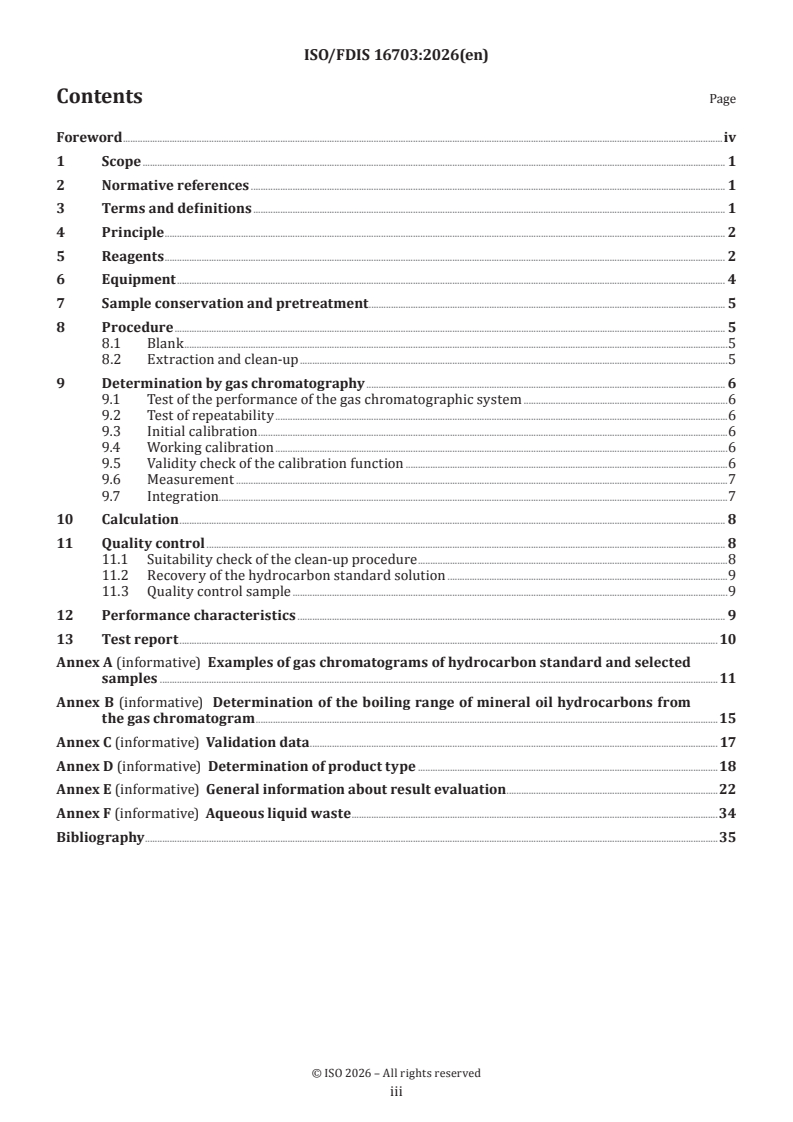
Contents Page
Foreword .iv
1 Scope . 1
2 Normative references . 1
3 Terms and definitions . 1
4 Principle . 2
5 Reagents . 2
6 Equipment . 4
7 Sample conservation and pretreatment . 5
8 Procedure . 5
8.1 Blank .5
8.2 Extraction and clean-up .5
9 Determination by gas chromatography . 6
9.1 Test of the performance of the gas chromatographic system .6
9.2 Test of repeatability .6
9.3 Initial calibration .6
9.4 Working calibration .6
9.5 Validity check of the calibration function .6
9.6 Measurement .7
9.7 Integration.7
10 Calculation . 8
11 Quality control . 8
11.1 Suitability check of the clean-up procedure .8
11.2 Recovery of the hydrocarbon standard solution .9
11.3 Quality control sample .9
12 Performance characteristics . 9
13 Test report . 10
Annex A (informative) Examples of gas chromatograms of hydrocarbon standard and selected
samples .11
Annex B (informative) Determination of the boiling range of mineral oil hydrocarbons from
the gas chromatogram .15
Annex C (informative) Validation data . 17
Annex D (informative) Determination of product type .18
Annex E (informative) General information about result evaluation .22
Annex F (informative) Aqueous liquid waste .34
Bibliography .35
iii
Foreword
ISO (the International Organization for Standardization) is a worldwide federation of national standards
bodies (ISO member bodies). The work of preparing International Standards is normally carried out through
ISO technical committees. Each member body interested in a subject for which a technical committee
has been established has the right to be represented on that committee. International organizations,
governmental and non-governmental, in liaison with ISO, also take part in the work. ISO collaborates closely
with the International Electrotechnical Commission (IEC) on all matters of electrotechnical standardization.
The procedures used to develop this document and those intended for its further maintenance are described
in the ISO/IEC Directives, Part 1. In particular, the different approval criteria needed for the different types
of ISO documents should be noted. This document was drafted in accordance with the editorial rules of the
ISO/IEC Directives, Part 2 (see www.iso.org/directives).
ISO draws attention to the possibility that the implementation of this document may involve the use of (a)
patent(s). ISO takes no position concerning the evidence, validity or applicability of any claimed patent
rights in respect thereof. As of the date of publication of this document, ISO had not received notice of (a)
patent(s) which may be required to implement this document. However, implementers are cautioned that
this may not represent the latest information, which may be obtained from the patent database available at
www.iso.org/patents. ISO shall not be held responsible for identifying any or all such patent rights.
Any trade name used in this document is information given for the convenience of users and does not
constitute an endorsement.
For an explanation of the voluntary nature of standards, the meaning of ISO specific terms and expressions
related to conformity assessment, as well as information about ISO’s adherence to the World Trade
Organization (WTO) principles in the Technical Barriers to Trade (TBT), see www.iso.org/iso/foreword.html.
This document was prepared by Technical Committee ISO/TC 190, Soil quality, Subcommittee SC 3, Chemical
and physical characterization, in collaboration with the European Committee for Standardization (CEN)
Technical Committee CEN/TC 444, Environmental characterization of solid matrices, in accordance with the
Agreement on technical cooperation between ISO and CEN (Vienna Agreement).
This second edition cancels and replaces the first edition (ISO 16703:2004), which has been technically
revised.
The main changes are as follows:
— expansion of the scope to include waste by merging with EN 14039;
— describing possibility of quantification of fractions in between n-C and n-C ;
10 40
— describing a way of determination of product specific patterns;
— more specific details regarding the integration and handling of graphical data are described;
— extension of Annex C to include additional examples of product types and typical patterns for determining
hydrocarbon content by gas chromatography.
Any feedback or questions on this document should be directed to the user’s national standards body. A
complete listing of these bodies can be found at www.iso.org/members.html.
iv
FINAL DRAFT International Standard ISO/FDIS 16703:2026(en)
Environmental solid matrices — Determination of
hydrocarbon content in the range of C to C by gas
10 40
chromatography
1 Scope
This document specifies a method for the quantitative determination of the mineral oil-based hydrocarbon
content (C to C ) in soil and waste samples by gas chromatography coupled with flame ionization
10 40
detection (GC-FID). This document is also applicable to sediment samples.
It is generally applicable to all solid waste, soil and contaminated materials with hydrocarbon contents
between 100 mg/kg and 10 000 mg/kg dry mass and can be adapted to lower limits of detection.
Using this document all hydrocarbons with a boiling range of approximately 175 °C to 525 °C, e.g. n-alkanes
from C H to C H , isoalkanes, cycloalkanes, alkyl benzenes, alkyl naphthalenes and polycyclic aromatic
10 22 40 82
1)
compounds are determined as hydrocarbons, provided they do not adsorb on the Florisil® column during
clean-up.
The document can also be applied to determine any fraction in the range n-C to n-C .
10 40
Volatile hydrocarbons cannot be quantitatively determined using this document. This can affect the
determination of some common hydrocarbon fuels, e.g. petrol.
NOTE 1 On the basis of the peak pattern of the gas chromatogram (see Annex D) and of the boiling points of the
individual n-alkanes listed in Annex B the approximate boiling range of the hydrocarbons and some qualitative
information on the nature of the hydrocarbons can be obtained.
NOTE 2 At the moment there is no sufficient information on how to handle organic liquid wastes (e.g. by-product of
a manufacturing process, oils and greases) for the analysis of hydrocarbons.
NOTE 3 Aqueous liquid waste samples can be analysed using ISO 9377-2 or the procedure specified in Annex F.
Plastic-containing samples are treated by a hexane-like extraction solvent without usage of acetone in order
to avoid overfindings (false-high content).
2 Normative references
The following documents are referred to in the text in such a way that some or all of their content constitutes
requirements of this document. For dated references, only the edition cited applies. For undated references,
the latest edition of the referenced document (including any amendments) applies.
ISO 8466-1, Water quality — Calibration and evaluation of analytical methods — Part 1: Linear calibration
function
3 Terms and definitions
For the purposes of this document, the following terms and definitions apply.
1) Florisil® is a trade mark of U.S. Silica Company and is an example of a suitable product available commercially. The
term Florisil® is used in the document, as this is the term commonly used by experts. This information is given for the
convenience of users of this document and does not constitute an endorsement by ISO of the product named.
ISO and IEC maintain terminology databases for use in standardization at the following addresses:
— ISO Online browsing platform: available at https:// www .iso .org/ obp
— IEC Electropedia: available at https:// www .electropedia .org/
3.1
hydrocarbon content
sum of compounds that are extractable with acetone/hexane-like solvent (2+1) from environmental solid
matrices, that do not adsorb on a specified single Florisil® column cleanup and can be chromatographed on
a non-polar capillary column with retention times between those of n-decane (C H ) and n-tetracontane
10 22
(C H ) utilizing gas chromatography coupled with flame ionization detection GC-FID
40 82
Note 1 to entry: Substances that comply with this definition are mainly non-polar long chain or branched aliphatic,
alicyclic, alkyl substituted aromatic or polycyclic aromatic compounds.
Note 2 to entry: This definition differs from that given by utilizing a gravimetric approach (e.g. EN 14345).
Note 3 to entry: Non-polar and weakly polar compounds (e.g. halogenated hydrocarbons) and high contents of more
polar compounds, e.g. animal and vegetable fats and oils, can exceed the adsorption capacity of the Florisil used and
will be included in the results.
4 Principle
A known amount of the homogenized sample is extracted by mechanical shaking or sonication with acetone/
hexane-like solvent. The organic phase is separated and washed twice with water. Polar compounds
are removed by adsorption on Florisil®. An aliquot of the purified extract is analysed by capillary gas
chromatography with flame ionization detection.
The total peak area between the retention time window standards n-decane and n-tetracontane is measured
and the amount of hydrocarbons in the sample is quantified against an external standard consisting of equal
amounts of two different types of mineral oil.
NOTE 1 Hexane-like solvent can be understood as n-heptane, or other non-polar solvent (e.g. n-hexane, iso-hexane,
petroleum ether, cyclohexane).
NOTE 2 If lower limits of qualifications are required, large-volume injection or concentration of the final extract
can be applied.
5 Reagents
All reagents shall be reagent grade and suitable for their specific purposes.
5.1 Acetone, (CH ) CO.
3 2
5.2 Hexane-like solvent such as n-Heptane, C H ; alternatively, other hexane-like solvents after proving
7 16
suitability (range of boiling point 60 °C to 100 °C).
5.3 Activated magnesium silicate (Florisil®) for preparation of clean-up column, particle size
150 µm to 250 µm (60 mesh to 100 mesh), heated for at least 16 h at 140 °C and stored in a desiccator over a
molecular sieve.
NOTE Commercially available cartridges containing activated magnesium silicate (Florisil®) and sodium sulfate
are also applicable.
5.4 Anhydrous sodium sulfate (Na SO ), heated for at least 2 h at 550 °C. Afterwards the sodium sulfate
2 4
should be stored under dry conditions (e.g. a desiccator).
5.5 Test solution of stearyl stearate (C H O ); n-octadecanoic acid octadecyl ester.
36 72 2
Dissolve e.g. (100 ± 1) mg of n-octadecanoic acid octadecyl ester in 100 ml hexane-like solvent (5.2) to yield
a concentration of 1 mg/ml. The solution is stable for 6 months when stored in a refrigerator between 1 °C
and 5 °C.
5.6 Retention-time window (RTW) standard solution, containing n-tetracontane and n-decane.
RTW standard solution is needed to define the quantification-range between C and C . Weigh e.g.
10 40
(30 ± 1) mg of n-tetracontane [5.13] and transfer it into a 1 l volumetric flask, dissolve completely in an
appropriate volume of hexane-like solvent (5.2), add e.g. 30 µl of n-decane (approximately 21 mg) [5.12], mix
well, fill up to volume with hexane-like solvent and homogenize. This solution shall be used for all dilution
steps of the hydrocarbon standard (5.7). The ration n-C to n-C should be kept as described above.
10 40
Store at room temperature.
NOTE n-Tetracontane is only moderately soluble in hexane-like solvent. Slightly warming up or sonicating can
help accelerating the dissolution processes.
5.7 Hydrocarbon standard solution for calibration.
Mix approximately equal masses of two different types of mineral oil. Weigh accurately this mixture and
dissolve in the RTW standard solution (5.6) to give a hydrocarbon mass concentration of approximately
8 g/l.
The first oil type should show separated peaks (e.g. a diesel fuel) in the gas chromatogram, as can be seen
in Figure A.1 (left part of the chromatogram). The second type should have a boiling range higher than the
first one, and should show a hump in the gas chromatogram, as can be seen in Figure A.1 (right part of the
chromatogram). A suitable oil of this type is for example a lubricating oil without any additives.
The calibration solutions can be prepared by diluting an aliquot of this standard solution with different
volumes of the RTW standard solution (5.6).
NOTE Commercially available columns can be used, if suitability has been proven and meets the criteria in 5.7.
5.8 Calibration control solution.
Prepare an independent control solution in accordance with (5.7) using a hydrocarbon concentration
approximately in the middle of the working range.
5.9 System-performance standard solution.
Prepare a mixture of equal amounts, on a mass basis, of the n-alkanes with even carbon numbers from C to
C , dissolved in hexan-like solvent (5.2), to give a concentration of approximately 50 mg/l of each n-alkane.
Store at room temperature.
This solution is used to verify the suitability of the gas chromatographic system for the resolution of
n-alkanes as well as for the detector response.
NOTE This solution is in addition used to give information of the retention times of the n-alkanes to characterize
the hydrocarbons in the samples (see Annex D).
5.10 Solution for definition of retention times.
For all fraction-based on even carbon numbers, the system-performance standard solution (5.9) can be
used for determination of retention times. If fractions are to be determined with odd carbon numbers (e.g.
> C -C ), a standard solution containing at least all relevant n-alkanes shall be applied.
10 25
5.11 Preparation of the clean-up column.
A plug of pre-washed glass wool or a PTFE frit is pushed down into the column (6.9). Then, successively 2 g
Florisil® (5.3) and 2 g sodium sulfate (5.4) are added. The column shall be prepared immediately before use
or stored in a dry environment (e.g. desiccator). In addition, commercially available columns can be used, if
suitability has been proven.
After proving suitability, a miniaturization of the cleanup can be applied, and the ratio used extract to
Florisil®/sodium sulfate shall remain the same (10:2:2; e.g. 5 ml with 1 g Florisil® and 1 g sodium sulfate).
5.12 n-decane; linear hydrocarbon n-C (CAS 124-18-5); used as retention-time marker in RTW (5.6)
5.13 n-tetradecane; linear hydrocarbon n-C (CAS 629-59-4); used as retention-time marker in RTW (5.6)
5.14 Water; should not cause high blank according to 8.1.
6 Equipment
6.1 Standard laboratory glassware, which shall be treated at high temperatures or rinsed with acetone
(5.1) and dried before use.
6.2 Devices for extraction, mechanical shaker (at least 120 r/min) or ultrasonic bath.
6.3 Gas chromatograph, equipped with a non-discriminating injector, a flame ionization detector (FID)
and a temperature programmable oven.
NOTE The use of a large-volume injection system can improve the limit of detection considerably.
6.4 Capillary column, fused silica column with suitable stationary phase and dimensions, e.g.
stationary phase: non-polar (e.g. immobilised 100 % dimethyl polysiloxane, 95 %-dimethyl-5 %-diphenyl
polysiloxane, modified siloxane polymer);
length: 2 m to 20 m;
internal diameter: 0,1 mm to 0,32 mm;
film thickness: 0,1 µm to 1,0 µm.
The column should give a base-line separation of the n-alkanes when the system performance standard
solution (5.9) is run. The use of a pre-column, e.g. wide-bore (0,53 mm internal diameter) deactivated fused
silica of at least 2 m of length is recommended. Thermally stable low bleed columns should be preferred.
6.5 Data system, capable of integrating the total peak area of the chromatogram, compensating for
column bleed and reintegrating after defining a new baseline.
6.6 Glass extraction vessel of volume at least 100 ml, with screw caps provided with a septum coated
with polytetrafluoroethylene (PTFE).
6.7 Glass tube, e.g. 25 ml, with ground glass stopper or screw caps incorporating a septum coated with
polytetrafluoroethylene (PTFE).
6.8 Separation funnel, at least 500 ml, with a ground glass stopper.
6.9 Chromatography column for clean-up, glass columns of about 10 mm internal diameter. Preferably,
the upper part of the column should be widened to use as solvent reservoir and the lower part should be
narrowed to form a tip.
Plastic columns can be used if they meet the requirements given in 8.2.
7 Sample conservation and pretreatment
Storage and pretreatment should be according to ISO 18512, if not otherwise specified.
Before analysis, the samples shall be homogenized. Sample treatment should be performed according to
ISO 14507 or other suitable standards.
Drying of the sample at maximum 40 °C can be applied, if losses of hydrocarbons can be neglected (e.g.
products HF, LO or BI according to Table D.1). If drying at 40 °C is not applicable due to high water content of
the sample, freeze drying is preferable.
8 Procedure
8.1 Blank
With each series of samples, carry out a blank determination according to 8.2 using all reagents in identical
amounts but without a sample. If blank values are unusually high (more than 50 % of the lowest value of
interest), every step in the procedure shall be checked to determine the cause of these high blanks.
8.2 Extraction and clean-up
Weigh an amount of approximately e.g. 20 g of the homogenized field-moist or pretreated sample into a glass
extraction vessel (6.6) and add e.g. 40 ml of acetone (5.1) with a precision of ± 1 ml. After briefly shaking
by hand, add e.g. 20 ml of the RTW standard solution (5.6) with a precision of ± 1 ml. Close the vessel and
extract the sample for 1 h using mechanical shaking or sonication (6.2). After settling of the solid material,
transfer as much as possible of the supernatant into e.g. a separatory funnel (6.8) or use alternative tools
to remove the extract as completely as possible (e.g. bottleneck). To remove the acetone, wash the organic
phase twice by shaking thoroughly with e.g. 100 ml of water each time. Collect the organic phase in a glass
tube (6.7). Add sufficient sodium sulfate so that no lumps are formed. Transfer e.g. 10 ml of the extract to a
clean-up column filled with Florisil® (5.3). In case of significant deviation to 10 ml, the amount of applied
Florisil® shall be adjusted so that the ratio of used extract to Florisil®/sodium sulfate remains the same
(10:2:2). Do not pre-wash the column with organic solvent. Collect the eluate. Transfer an aliquot of the
purified extract to a GC-vial and analyse by gas chromatography.
This method can be used if the sample contains up to 25 % water. If the water content of the sample is higher
than 25 %, this procedure is less effective and the amount of acetone shall be increased. The acetone: water
ratio should be at least 9:1.
Beside the mentioned default test portion of approximately 20 g and a solid/hexan-like solvent ratio of 1:1,
in special cases test portions of 5 g to 30 g can be used based on type of matrix and contamination of the
sample. For example:
— smaller test portions should be used if samples sorb the major portion of the extraction solvent added;
— the extract shall be diluted by utilizing the entire process in the case of high contamination;
— sample intake should be increased if high sensitivity is required.
Due to sample homogeneity, the application of less than 5 g to 10 g of sample material should be avoided.
In case of plastic containing samples, the utilization of acetone shall be avoided. In such cases the sample
shall be dried (chemically or at room temperature) and only treated by a hexane-like extraction solvent. For
inhomogeneous samples, the weight and solvent amount should be increased. In case of plastic-containing
samples, the recovery of hydrocarbons can be lower, but overfindings (false-high content) by extracted plastic
material are avoided by means of excluding the extraction step with acetone. A pre-dilution (1:5 to 1:20) of
such extract before clean-up can be meaningful in selected cases in order to reduce the concentration of
matrix components in the extract.
NOTE 1 Alternative extraction procedures e.g. pressurized liquid extraction (PLE) can be used provided they give
comparable extraction performances.
NOTE 2 To improve and accelerate phase separation, centrifugation can be applied provided that the necessary
safety precautions, especially with regard to inflammable solvents, are taken into account.
In case of sediments or other matrices potentially rich of plant materials, the standard procedure shall be
applied. The resulting biogenic hydrocarbons are in this case included to definition in 3.1.
IMPORTANT — It is very important that the Florisil is freshly prepared and active, and the extract
is free of acetone (less than 0,1 volume %), especially when the sample contains polycyclic aromatic
hydrocarbons (PAH) besides mineral oil based hydrocarbons.
9 Determination by gas chromatography
9.1 Test of the performance of the gas chromatographic system
Use a capillary column with one of the specified stationary phases (6.4) for gas chromatographic analysis.
Adjust the gas chromatograph (6.3) to provide a sufficient separation. The n-alkanes in the system-
performance standard solution (5.9) shall be baseline-separated. The relative response of the n-tetracontane
(C ) shall be at least 0,8, with respect to n-eicosane (C ).
40 20
For an example of gas chromatographic conditions, see Annex A.
9.2 Test of repeatability
Record a gas chromatogram of the column bleed by injection of an appropriate volume of hexane-like solvent
(5.2). Then inject the same volume of a suitable concentration of the calibration control solution (5.8) three
times and record the chromatogram for each injection. Integrate the chromatograms according to 9.7 and
calculate the mean of the measured peak areas and the corresponding standard deviation. The relative
standard deviation shall not be greater than 5 %.
9.3 Initial calibration
When the method is used for the first time and/or when the apparatus is changed, carry out a basic calibration
according to ISO 8466-1 including the determination of the limit of detection and limit of determination.
9.4 Working calibration
Perform an external working calibration by analysing a minimum of 3 dilutions of hydrocarbon standard
solution (5.7) which shall cover the working range. Calculate a calibration function by linear regression
analysis of the corrected peak areas. Use a chromatogram of a solution of the extraction solvent to correct
the peak area of the chromatograms of the hydrocarbon standard solutions for the column bleed. From the
calculated regression line, determine the actual sensitivity of the method. The calibration shall be checked
as described in (9.5).
9.5 Validity check of the calibration function
Check the validity of the calibration function within each batch of samples by analysis of one independent
control solution (5.8). This calibration check identifies problems of calibra
...
2026-06-02
ISO/TC 190/SC 3/WG 6
Secretariat: DIN
Date: 2026-11-17
Environmental solid matrices — Determination of hydrocarbon
content in the range of C C10 to C C40 by gas chromatography
10 40
Matrices solides environnementales — Matrices solides environnementales — Détermination de la teneur
enDosage des hydrocarbures dans la gamme C de C10 à C C40 par chromatographie en phase gazeuse
10 40
TTTTTTTTTThhhhhihhhhhiiiiiiiiis drs drs drs drs drs drs drs drs drs draaaaaaaaaafffffffffftttttttttt i i i i i i i i i is s s s s s s s s s ssususususususususuubbbbbbbbbbmmmmmmmmmmiiiiiiiiiitttttttttttttttttttteeeeeeeeeedd d d d d d d d d ttttttttttoooooooooo aaaaaaaaaa ppppppppppaaaaaaaaaarrrrrrrrrraaaaaaaaaallellellellellellellellellellel l l l l l l l l l vvvvvvvvvvooooooooootttttttttteeeeeeeeee i i i i i i i i i innnnnnnnnn IIIIIIIIIISSSSSSSSSSOOOOOOOOOO,,,,,,,,,, CCCCCCCCCCEEEEEEEEEEN.N.N.N.N.N.N.N.N.N.
ISO #####-#:####(X)
© FDIS stage
2 © ISO #### – All rights reserved
All rights reserved. Unless otherwise specified,
This ISO publication is protected by copyright and is owned by ISO and/or its licensors.
The content of this ISO publication is provided under licence, not sold. Use is subject to the applicable licence terms issued
by ISO, an ISO member body, or an authorized third-party distributor.
Except as required in the context of its for implementation or expressly permitted by a separate licence, no part of this
ISO publication may be reproduced or utilized otherwise, distributed, modified, used, or made available in any form or
by any means, – electronic or mechanical, including photocopying, scanning, recording, or posting on internal or external
digital platforms.
Any use beyond the internet or an intranet, without prior written permission. Permission can be requested from either
ISO at the address below or ISO’s member body in the countryscope of the requestergranted rights is prohibited and may
result in legal action.
ISO copyright office
CP 401 • Ch. de Blandonnet 8
CH-1214 Vernier, Geneva
Phone: + 41 22 749 01 11
Email: copyright@iso.org
Website: www.iso.org
Published in Switzerland
iii
ISO #####-#:####(X/FDIS 16703:2026(en)
Contents
Foreword . v
1 Scope . 1
2 Normative references . 1
3 Terms and definitions . 2
4 Principle . 2
5 Reagents . 2
6 Equipment . 4
7 Sample conservation and pretreatment . 5
8 Procedure . 5
8.1 Blank . 5
8.2 Extraction and clean-up . 5
9 Determination by gas chromatography . 6
9.1 Test of the performance of the gas chromatographic system . 6
9.2 Test of repeatability . 6
9.3 Initial calibration . 7
9.4 Working calibration . 7
9.5 Validity check of the calibration function . 7
9.6 Measurement . 7
9.7 Integration . 7
10 Calculation . 8
11 Quality control . 9
11.1 Suitability check of the clean-up procedure . 9
11.2 Recovery of the hydrocarbon standard solution . 9
11.3 Quality control sample . 10
12 Performance characteristics . 10
13 Test report . 10
Annex A (informative) Examples of gas chromatograms of hydrocarbon standard and selected
samples . 12
Annex B (informative) Determination of the boiling range of mineral oil hydrocarbons from the
gas chromatogram . 19
Annex C (informative) Validation data . 21
Annex D (informative) Determination of product type . 23
Annex E (informative) General information about result evaluation . 30
Annex F (informative) Aqueous liquid waste . 51
Bibliography . 52
© ISO #### 2026 – All rights reserved
iv
Foreword
ISO (the International Organization for Standardization) is a worldwide federation of national standards
bodies (ISO member bodies). The work of preparing International Standards is normally carried out through
ISO technical committees. Each member body interested in a subject for which a technical committee has been
established has the right to be represented on that committee. International organizations, governmental and
non-governmental, in liaison with ISO, also take part in the work. ISO collaborates closely with the
International Electrotechnical Commission (IEC) on all matters of electrotechnical standardization.
The procedures used to develop this document and those intended for its further maintenance are described
in the ISO/IEC Directives, Part 1. In particular, the different approval criteria needed for the different types of
ISO documents should be noted. This document was drafted in accordance with the editorial rules of the
ISO/IEC Directives, Part 2 (see www.iso.org/directives).
ISO draws attention to the possibility that the implementation of this document may involve the use of (a)
patent(s). ISO takes no position concerning the evidence, validity or applicability of any claimed patent rights
in respect thereof. As of the date of publication of this document, ISO [had/had not] received notice of (a)
patent(s) which may be required to implement this document. However, implementers are cautioned that this
may not represent the latest information, which may be obtained from the patent database available at
www.iso.org/patents. ISO shall not be held responsible for identifying any or all such patent rights.
Any trade name used in this document is information given for the convenience of users and does not
constitute an endorsement.
For an explanation of the voluntary nature of standards, the meaning of ISO specific terms and expressions
related to conformity assessment, as well as information about ISO'sISO’s adherence to the World Trade
Organization (WTO) principles in the Technical Barriers to Trade (TBT), see www.iso.org/iso/foreword.html.
This document was prepared by Technical Committee ISO/TC 190, Soil quality, Subcommittee SC 3, Chemical
and physical characterization, in collaboration with the European Committee for Standardization (CEN)
Technical Committee CEN/TC 444, Environmental characterization of solid matrices, in accordance with the
Agreement on technical cooperation between ISO and CEN (Vienna Agreement).
This second edition cancels and replaces the first edition (ISO 16703:2004), which has been technically
revised.
The main changes are as follows:
— Expansionexpansion of the scope to include waste by merging with EN 14039;
— Describingdescribing possibility of quantification of fractions in between n-C and n-C ;
10 40
— Describingdescribing a way of determination of product specific patterns;
— Moremore specific details regarding the integration and handling of graphical data are described;
— Extensionextension of Annex CAnnex C to include additional examples of product types and typical
patterns for determining hydrocarbon content by gas chromatography.
Any feedback or questions on this document should be directed to the user’s national standards body. A
complete listing of these bodies can be found at www.iso.org/members.html.
v
Environmental solid matrices — Determination of hydrocarbon
content in the range of C10 to C40 by gas chromatography
1 Scope
This document specifies a method for the quantitative determination of the mineral oil-based hydrocarbon
content (C to C ) in soil and waste samples by gas chromatography coupled with flame ionization detection
10 40
(GC - -FID). This document is also applicable to sediment samples.
It is generally applicable to all solid waste, soil and contaminated materials with hydrocarbon contents
between 100 - mg/kg and 10 ,000 mg/kg dry mass and can be adapted to lower limits of detection.
Using this document all hydrocarbons with a boiling range of approximately 175 °C to 525 °C, e.g. n--alkanes
from C H to C H , isoalkanes, cycloalkanes, alkyl benzenes, alkyl naphthalenes and polycyclic aromatic
10 22 40 82
11)
compounds are determined as hydrocarbons, provided they do not adsorb on the Florisil® column during
clean-up.
The document can also be applied to determine any fraction in-between the range n-C to n-C .
10 40
Volatile hydrocarbons cannot be quantitatively determined using this document. This can affect the
determination of some common hydrocarbon fuels, e.g. petrol.
NOTE 1 On the basis of the peak pattern of the gas chromatogram (see Annex DAnnex D)) and of the boiling points of
the individual n--alkanes listed in Annex BAnnex B the approximate boiling range of the hydrocarbons and some
qualitative information on the nature of the hydrocarbons can be obtained.
NOTE 2 At the moment there is no sufficient information on how to handle organic liquid wastes (e.g. by-product of a
manufacturing process, oils and greases) for the analysis of hydrocarbons.
NOTE 3 Aqueous liquid waste samples can be analysed using ISO 9377-2 [2] or the procedure specified in
Annex FAnnex E.
Plastic-containing samples are treated by a hexane-like extraction solvent without usage of acetone in order
to avoid overfindings (false-high content).
2 Normative references
The following documents are referred to in the text in such a way that some or all of their content constitutes
requirements of this document. For dated references, only the edition cited applies. For undated references,
the latest edition of the referenced document (including any amendments) applies.
ISO 8466--1, Water quality — Calibration and evaluation of analytical methods — Part 1: Linear calibration
function
Florisil® is a trade mark. The chemical specification is given in chapter 5.3. for better readability, the term Florisil® is
used in the document, as this is the term commonly used by experts. The ISO does not specify any preferences for a
corresponding supplier company.
1)
Florisil® is a trade mark of U.S. Silica Company and is an example of a suitable product available commercially. The
term Florisil® is used in the document, as this is the term commonly used by experts. This information is given for the
convenience of users of this document and does not constitute an endorsement by ISO of the product named.
3 Terms and definitions
For the purposes of this document, the following terms and definitions apply.
ISO and IEC maintain terminology databases for use in standardization at the following addresses:
— — ISO Online browsing platform: available at https://www.iso.org/obp
— — IEC Electropedia: available at https://www.electropedia.org/
3.1 3.1
hydrocarbon content
sum of compounds that are extractable with acetone/hexane-like solvent (2+1) from environmental solid
matrices, that do not adsorb on a specified single Florisil® column cleanup and can be chromatographed on a
non-polar capillary column with retention times between those of n-decane (C H ) and n-tetracontane
10 22
(C H ) utilizing a GC/FID.gas chromatography coupled with flame ionization detection GC-FID
40 82
Note 1 to entry: Substances that comply with this definition are mainly non-polar long chain or branched aliphatic,
alicyclic, alkyl substituted aromatic or polycyclic aromatic compounds.
Note 2 to entry: This definition differs from that given by utilizing a gravimetric approach (e.g. EN 14345 [8]).).
Note 3 to entry: Non-polar and weakly polar compounds (e.g. halogenated hydrocarbons) and high contents of more
polar compounds, e.g. animal and vegetable fats and oils, maycan exceed the adsorption capacity of the Florisil used and
will be included in the results.
4 Principle
A known amount of the homogenized sample is extracted by mechanical shaking or sonication with
acetone/hexane-like solvent. The organic phase is separated and washed twice with water. Polar compounds
are removed by adsorption on Florisil®. An aliquot of the purified extract is analysed by capillary gas
chromatography with flame ionization detection.
The total peak area between the retention time window standards n-decane and n-tetracontane is measured
and the amount of hydrocarbons in the sample is quantified against an external standard consisting of equal
amounts of two different types of mineral oil.
NOTE 1 Hexane-like solvent can be understood as n-heptane, or other non-polar solvent (e.g. n-hexane, iso-hexane,
petroleum ether, cyclohexane).
NOTE 2 If lower limits of qualifications are required, large-volume injection or concentration of the final extract can
be applied.
5 Reagents
All reagents shall be reagent grade and suitable for their specific purposes.
5.1 5.1 Acetone, (CH ) CO.
3 2
5.2 5.2 Hexane-like solvent such as n-Heptane, C H ; alternatively, other hexane-like solvents after
7 16
proving suitability (range of boiling point 60 °C- to 100 °C).
© ISO #### 2026 – All rights reserved
5.3 5.3 Activated magnesium silicate (Florisil®) for preparation of clean-up column, particle
size 150 µm to 250 µm (60 mesh to 100 mesh), heated for at least 16 h at 140 °C and stored in a desiccator
over a molecular sieve.
NOTE Commercially available cartridges containing activated magnesium silicate (Florisil®) and sodium sulfate are
also applicable.
5.4 5.4 Anhydrous sodium sulfate (Na SO ), heated for at least 2 h at 550 °C. Afterwards the sodium
2 4
sulfate should be stored under dry conditions (e.g. a desiccator).
5.5 5.5 Test solution of stearyl stearate (C H O ); n-octadecanoic acid octadecyl ester.
36 72 2
Dissolve e.g. (100 ± 1) mg of n-octadecanoic acid octadecyl ester in 100 ml hexane-like solvent (5.2(5.2)) to
yield a concentration of 1 mg/ml. The solution is stable for 6 months when stored in a refrigerator between
1 °C and 5 °C.
5.6 5.6 Retention-time window (RTW) standard solution, containing n-tetracontane and n-decane.
Retention-time window (RTW) standard solution is needed to define the quantification-range between C -
and C . Weigh e.g. (30 ± 1) mg of n-tetracontane5.13 [5.13] and transfer it into a 1 l volumetric flask, dissolve
completely in an appropriate volume of hexane-like solvent (5.2(5.2),), add e.g. 30 µl of n-decane
(approximately 21 mg)5.12) [5.12],, mix well, fill up to volume with hexane-like solvent and homogenize. This
solution shall be used for all dilution steps of the hydrocarbon standard (5.7(5.7).). The ration n-C to n-C
10 40
should be kept as described above.
Store at room temperature.
NOTE n-Tetracontane is only moderately soluble in hexane-like solvent. Slightly warming up or sonicating can help
accelerating the dissolution processes.
5.7 5.7 Hydrocarbon standard solution for calibration.
Mix approximately equal masses of two different types of mineral oil. Weigh accurately this mixture and
dissolve in the RTW standard solution (5.6(5.6)) to give a hydrocarbon mass concentration of
aboutapproximately 8 g/l.
The first oil type should show separated peaks (e.g. a diesel fuel) in the gas chromatogram, as can be seen in
Figure A.1Figure A.1 (left part of the chromatogram). The second type should have a boiling range higher than
the first one, and should show a hump in the gas chromatogram, as can be seen in Figure A.1Figure A.1 (right
part of the chromatogram). A suitable oil of this type is for example a lubricating oil without any additives.
The calibration solutions can be prepared by diluting an aliquot of this standard solution with different
volumes of the RTW standard solution (5.6(5.6).).
NOTE Commercially available columns can be used, if suitability has been proven and meets the criteria in 5.7made
above.
5.8 5.8 Calibration control solution.
Prepare an independent control solution in accordance with (5.7(5.7)) using a hydrocarbon concentration
approximately in the middle of the working range.
Florisil is an example of a suitable product available commercially. This information is given for the convenience of
users of this document and does not constitute an endorsement by ISO of this product.
5.9 5.9 System-performance standard solution.
Prepare a mixture of equal amounts, on a mass basis, of the n-alkanes with even carbon numbers from C to
C , dissolved in hexan-like solvent (5.2(5.2),), to give a concentration of aboutapproximately 50 mg/l of each
n-alkane. Store at room temperature.
This solution is used to verify the suitability of the gas chromatographic system for the resolution of n--alkanes
as well as for the detector response.
NOTE This solution is in addition used to give information of the retention times of the n-alkanes to characterize the
hydrocarbons in the samples (see Annex Dc.f. Annex D).).
5.10 5.10 Solution for definition of retention times.
For all fraction-based on even carbon numbers, the system-performance standard solution (5.9(5.9)) can be
used for determination of retention times. If fractions are to be determined with odd carbon numbers (e.g.
> C -C ), a standard solution containing at least all relevant n-alkanes have toshall be applied.
10 25
5.11 5.11 Preparation of the clean-up column.
A plug of pre-washed glass wool or a PTFE frit is pushed down into the column (6.9(6.9).). Then, successively
2 g Florisil® (5.3(5.3)) and 2 g sodium sulfate (5.4(5.4)) are added. The column shall be prepared immediately
before use or stored in a dry environment (e.g. desiccator). In addition, commercially available columns can
be used, if suitability has been proven.
After proving suitability, a miniaturization of the cleanup can be applied, and the ratio used extract to
Florisil®/sodium sulfate shall remain the same (10:2:2; e.g. 5 ml with 1 g Florisil® and 1 g sodium sulfate).
5.12 5.12 n-decane; linear hydrocarbon n-C (CAS 124-18-5); used as retention-time marker in RTW
(5.6(5.6))
5.13 5.13 n-tetradecane; linear hydrocarbon n-C (CAS 629-59-4); used as retention-time marker in RTW
(5.6(5.6))
5.14 5.14 waterWater; should not cause high blank according to 8.1(8.1).
6 Equipment
6.1 6.1 Standard laboratory glassware, which shall be treated at high temperatures or rinsed with
acetone (5.1(5.1)) and dried before use.
6.2 6.2 Devices for extraction, mechanical shaker (at least 120 rpmr/min) or ultrasonic bath.
6.3 6.3 Gas chromatograph, equipped with a non-discriminating injector, a flame ionization detector
(FID) and a temperature programmable oven.
NOTE The use of a large-volume injection system can improve the limit of detection considerably.
6.4 6.4 Capillary column, fused silica column with suitable stationary phase and dimensions, e.g.
stationary phase: non-polar (e.g. immobilised 100 % dimethyl polysiloxane, 95 %-dimethyl-5 %-diphenyl
polysiloxane, modified siloxane polymer, etc.););
length: 2 m to 20 m;
internal diameter: 0,1 mm to 0,32 mm;
© ISO #### 2026 – All rights reserved
film thickness: 0,1 µm to 1,0 µm.
The column should give a base-line separation of the n-alkanes when the system performance standard
solution (5.9(5.9)) is run. The use of a pre-column, e.g. wide-bore (0,53 mm internal diameter) deactivated
fused silica of at least 2 m of length is recommended. Thermally stable low bleed columns should be preferred.
6.5 6.5 Data system, capable of integrating the total peak area of the chromatogram, compensating
for column bleed and reintegrating after defining a new baseline.
6.6 6.6 Glass extraction vessel of volume at least 100 ml, with screw caps provided with a septum
coated with polytetrafluoroethylene (PTFE).
6.7 6.7 Glass tube, e.g. 25 ml, with ground glass stopper or screw caps incorporating a septum coated
with polytetrafluoroethylene (PTFE).
6.8 6.8 Separation funnel, at least 500 ml, with a ground glass stopper.
6.9 6.9 Chromatography column for clean-up, glass columns of about 10 mm internal diameter.
Preferably, the upper part of the column should be widened to use as solvent reservoir and the lower part
toshould be narrowed to form a tip.
Plastic columns can be used if they meet the requirements given in 8.28.1.
7 Sample conservation and pretreatment
Storage and pretreatment should be according to ISO 18512 [3],, if not otherwise specified.
Before analysis, the samples shall be homogenized. Sample treatment should be performed according to
ISO 14507[4] or other suitable standards.
Drying of the sample at max.maximum 40 °C can be applied, if losses of hydrocarbons can be neglected (e.g.
products HF, LO or BI according to Table D.1table D.1).). If drying at 40 °C is not applicable due to high water
content of the sample, freeze drying is preferable.
8 Procedure
8.1 Blank
With each series of samples, carry out a blank determination according to 8.28.2 using all reagents in identical
amounts but without a sample. If blank values are unusually high (more than 50 % of the lowest value of
interest), every step in the procedure shall be checked to determine the cause of these high blanks.
8.2 Extraction and clean-up
Weigh an amount of approximately e.g. 20 g of the homogenized field-moist or pretreated sample into a glass
extraction vessel (6.6(6.6)) and add e.g. 40 ml of acetone (5.1) with a precision of +/-± 1 ml (5.1). After briefly
shaking by hand, add e.g. 20 ml of the RTW -standard solution (5.6(5.6)) with a precision of +/-± 1 ml. Close
the vessel and extract the sample for 1 h using mechanical shaking or sonication (6.2(6.2).). After settling of
the solid material, transfer as much as possible of the supernatant into e.g. a separatory funnel (6.8(6.8)) or
use alternative tools to remove the extract as completely as possible (e.g. bottleneck). To remove the acetone,
wash the organic phase twice by shaking thoroughly with e.g. 100 ml of water each time. Collect the organic
phase in a glass tube (6.7(6.7).). Add sufficient sodium sulfate so that no lumps are formed. Transfer e.g. 10 ml
of the extract to a clean-up column filled with Florisil® (5.3(5.3).). In case of significant deviation to 10 ml, the
amount of applied Florisil® has toshall be adjusted in a way,so that the ratio of used extract to
Florisil®/sodium sulfate remains the same (10:2:2). Do not pre-wash the column with organic solvent. Collect
the eluate. Transfer an aliquot of the purified extract to a GC-vial and analyse by gas chromatography.
This method can be used if the sample contains up to 25 % water. If the water content of the sample is higher
than 25 %, this procedure is less effective and the amount of acetone shall be increased. The acetone:water
ratio should be at least 9:1.
Beside the mentioned default test portion of aboutapproximately 20 g and a solid / /hexan-like solvent ratio
of 1:1, in special cases test portions of 5 g to 30 g can be used based on type of matrix and contamination of
the sample. For example, :
— smaller test portions should be used if samples sorb the major portion of the extraction solvent added, ;
— the extract shall be diluted by utilizing the entire process in the case of high contamination and ;
— sample intake should be increased if high sensitivity is required.
Due to sample homogeneity, the application of less than 5- g to 10 g of sample material should be avoided.
In case of plastic containing samples, the utilization of acetone shall be avoided. In such cases the sample shall
be dryeddried (chemically or at room temperature) and only treated by a hexane-like extraction solvent. For
inhomogeneous samples, the weight and solvent amount should be increased. In case of plastic-containing
samples, the recovery of hydrocarbons can be lower, but overfindings (false-high content) by extracted plastic
material are avoided by means of excluding the extraction step with acetone. A pre-dilution (1:5 – to 1:20) of
such extract before clean-up can be meaningful in selected cases in order to reduce the concentration of matrix
components in the extract.
NOTE 1 Alternative extraction procedures e.g. pressurized liquid extraction (PLE) can be used provided they give
comparable extraction performances.
NOTE 2 To improve and accelerate phase separation, centrifugation can be applied provided that the necessary safety
precautions, especially with regard to inflammable solvents, are taken into account.
In case of sediments or other matrices potentially rich of plant materials, the standard procedure shall be
applied. The resulting biogenic hydrocarbons are in this case included to definition in 3.13.1.
IMPORTANT — It is very important that the Florisil is freshly prepared and active, and the extract is
free of acetone (less than 0,1 volume %), especially when the sample contains polycyclic aromatic
hydrocarbons (PAH) besides mineral oil based hydrocarbons.”.
9 Determination by gas chromatography
9.1 Test of the performance of the gas chromatographic system
Use a capillary column with one of the specified stationary phases (6.4(6.4)) for gas chromatographic analysis.
Adjust the gas chromatograph (6.3(6.3)) to provide a sufficiantsufficient separation. The n-alkanes in the
system-performance standard solution (5.9(5.9)) shall be baseline-separated. The relative response of the
n--tetracontane (C ) shall be at least 0,8, with respect to n-eicosane (C ).
40 20
For an example of gas chromatographic conditions, see Annex AAnnex A.
9.2 Test of repeatability
Record a gas chromatogram of the column bleed by injection of an appropriate volume of hexane-like solvent
(5.2.). Then inject the same volume of a suitable concentration of the calibration control solution (5.8(5.8))
three times and record the chromatogram for each injection. Integrate the chromatograms according to 9.79.7
© ISO #### 2026 – All rights reserved
and calculate the mean of the measured peak areas and the corresponding standard deviation. The relative
standard deviation shall not be greater than 5 %.
9.3 Initial calibration
When the method is used for the first time and/or when the apparatus is changed, carry out a basic calibration
according to ISO 8466--1 including the determination of the limit of detection and limit of determination.
9.4 Working calibration
Perform an external working calibration by analysing a minimum of 3 dilutions of hydrocarbon standard
solution (5.7(5.7)) which shall cover the working range. Calculate a calibration function by linear regression
analysis of the corrected peak areas. Use a chromatogram of a solution of the extraction solvent to correct the
peak area of the chromatograms of the hydrocarbon standard solutions for the column bleed. From the
calculated regression line, determine the actual sensitivity of the method. The calibration shall be checked as
described in (9.5(9.5).).
9.5 Validity check of the calibration function
Check the validity of the calibration function within each batch of samples by analysis of one independent
control solution (5.8(5.8).). This calibration check identifies problems of calibration before real samples are
run. Check whether the result is within ±10 % of the reference value of the control solution. If this is the case,
the actual calibration function is assumed to be valid. If not, perform a new calibration according to (9.4(9.4).).
NOTE It is good analytical practice to perform both a calibration check and analytical quality control using an
independent solution randomly placed during the analysis of the batch of samples. This independent solution can
perform both functions.
9.6 Measurement
Analyse the blank (8.1(8.1)) and the sample extracts (8.2(8.2),), calibration standards (5.7(5.7)) and
calibration control solutions (5.8(5.8)) under identical gas chromatographic conditions.
The extraction solvent shall be analysed in each sample batch. The resulting chromatogram is used to correct
chromatograms of blanks (8.1(8.1),), sample extracts (8.2(8.2),), calibration standards (5.7(5.7)) and
calibration control solutions (5.8(5.8)) for column bleed prior to integration.
9.7 Integration
Integrate the total area between the n-decane C and n-tetracontane C peaks of the chromatogram. Start
10 40
the integration at the retention time just after the end of the n-decane-peak at the signal level in front of the
solvent peak. End the integration of the total area at the retention time just before the beginning of the n-
tetracontane peak at the same signal level (see Annex AAnnex A).). Integrate n-tetracontane (C ) as a
separate peak for the recovery check. The recovery should be not less than 60 %.
In case of determination of fractions, the retention time of the range defining n-alkanes shall be taken from
the system-performance standard solution (5.9(5.9).). The integration starts after the end of the peak (as
defined for n-C for the entire index) of the lower n-alkane defining the fraction and ends after the end of the
higher n-alkane defining the fraction (e.g. >n-C -C ). In order to stay in the logic of the index, this definition
10 22
holds not true for all fractions ending up at n-C . In such cases the definition is equal to the definition of the
index. Due to the fact, that the response of the FID is nearly equal for all hydrocarbons in the entire range, the
calibration made for C -C can also be utilized for any fraction in-between.
10 40
The presence of peaks on the tail of the solvent peak with retention times less than that of n-decane indicates
that the sample contains low-boiling volatile hydrocarbons.
A non-horizontal baseline at the end of the chromatogram (retention time greater than that of
n--tetracontane), with a signal level greater than the bleed, indicates that the sample contains high-boiling
hydrocarbons with more than 40 carbon atoms. It should be ensured that these compounds elute completely
from the column, otherwise they can cause interferences with the subsequent sample analysis.
All chromatograms should be checked visually for correct integration. The start and stop times of the
integration should be visible on the chromatogram. Annex EAnnex E provides a detailed overview of how to
manage integration settings.
NOTE 1 The range of the carbon numbers of n-alkanes present in the sample is determined by comparing the gas
chromatogramchromatogram of the sample extract with that of the system-performance standard solution (5.9(5.9).).
The corresponding boiling range can be derived from Annex BAnnex B. A typing of the pattern can be applied by the
procedure described in Annex DAnnex D.
NOTE 2 The peak shape and signal intensity of n-tetracontane are sensitive to changes in the surface properties of the
injector and/or the pre-column due to contamination by sample constituents. Therefore, they can be used as an indication
of the need for replacing pre-column and/or liner.
10 Calculation
Calculate the mineral oil content of the soil sample using Formula (1)Formula (1) and
Formula (2)Formula (2): :
(1)
𝑉𝑉 100
h
𝑤𝑤 =𝜌𝜌⋅ ⋅𝑓𝑓⋅
h
𝑚𝑚 𝑤𝑤
s
(1)
where
𝐴𝐴 −𝑏𝑏
s
𝜌𝜌=
𝑎𝑎
(2)
and where
w is the hydrocarbon mass fraction of the soil sample, in milligrams per kilogram dry matter;
h
(mg/kg);
ρ is the hydrocarbon mass concentration of the extract calculated from the calibration function, in
milligrams per litre; (mg/l);
V is the volume of the sample extract, in millilitre; (ml);
h
f is the dilution factor (if applicable);
m is the mass of the sample taken for analysis, in grams; (g);
w is the dry matter content of the soil sample, expressed as a percentage (mass fraction), determined
s
according to e.g. ISO 11465[5];;
A is the integrated peak area of the sample extract, expressed in instrument-dependent units;
s
b is the intercept of the Y-axis, expressed in instrument-dependent units;
a is the slope of the calibration function, expressed in litres per milligram (l/mg).
Round the result to two significant figures.
© ISO #### 2026 – All rights reserved
If two or more phases are present in the sample, calculate the hydrocarbon content of the original sample in
accordance with the dry matter mass ratio of the phases.
NOTE 2 If required by national regulations, results can be expressed as mg/kg based on the original material.
11 Quality control
11.1 Suitability check of the clean-up procedure
The clean-up efficiency of each batch of Florisil® column packing shall be checked regularly by the following
procedure. The procedure shall also be applied in case of suitability test of commercially available columns.
Add 10 ml of the n-octadecanoic acid octadecyl ester solution (5.5(5.5)) to the clean-up column (6.9(6.9)) filled
with 2 g of Florisil® and 2 g of sodium sulfate, and collect the entire eluate. Analyse a portion of the resulting
solution by gas chromatography. Analyse a 1+19 dilution of the untreated n-octadecanoic acid octadecyl ester
test solution (5.5(5.5)) as reference. Determine the recovery of the n-octadecanoic acid octadecyl ester after
clean-up on the base of the peak area in respect to the untreated n-octadecanoic acid octadecyl ester using
Formula (3)[see Formula (3)].:
𝐴𝐴
foo
𝑅𝑅 = ×5
oo
𝐴𝐴
uoo
(3)
where
R is the recovery of n-octadecanoic acid octadecyl ester (1+19), as a percent (%);
oo
A is the peak area of n-octadecanoic acid octadecyl ester after clean-up on the Florisil® column, in
foo
instrument-dependent units;
A is the peak area of the (1+19) dilution of untreated n-octadecanoic acid octadecyl ester, in
uoo
instrument-dependent units.
R is the recovery of n-octadecanoic acid octadecyl ester (1+19), as a percent (%);
oo
A is the peak area of n-octadecanoic acid octadecyl ester after clean-up on the Florisil® column,
foo
in instrument-dependent units;
A is the peak area of the (1+19) dilution of untreated n-octadecanoic acid octadecyl ester, in
uoo
instrument-dependent units.
The recovery shall not exceed 5 %. If the recovery of n-octadecanoic acid octadecyl ester acid is above 5 %,
activate the Florisil® according to (5.3(5.3)) and repeat the test.
11.2 Recovery of the hydrocarbon standard solution
The recovery of the hydrocarbon standard solution shall be checked with each batch of Florisil®. The
procedure shall also be applied in case of suitability test of commercially available columns. Recovery shall be
checked by the following procedure:.
Add 10 ml of the hydrocarbon standard solution (5.7(5.7)) to the clean-up column (6.9(6.9)) filled with 2,0 g
of Florisil® and 2 g of sodium sulfate and collect the entire eluate. Analyse a portion of the purified solution
by gas chromatography. Analyse the untreated hydrocarbon standard solution as reference. Determine the
recovery of the hydrocarbons on the base of the peak area of the purified and untreated standard solutions
using Formula (4)Formula (4)::
𝐴𝐴
fHC
𝑅𝑅 = ×100
HC
𝐴𝐴
uHC
(4)
where
R is the recovery of the hydrocarbon standard;
HC
A is the peak area of the hydrocarbon standard after clean-up on the Florisil® column, in instrument-
fHC
dependent units;
A is the peak area of untreated hydrocarbon standard, in instrument-dependent units.
uHC
R is the recovery of the hydrocarbon standard;
HC
A is the peak area of the hydrocarbon standard after clean-up on the Florisil® column, in
fHC
instrument-dependent units;
A is the peak area of untreated hydrocarbon standard, in instrument-dependent units.
uHC
The recovery shall be more than 80 %. If the recovery is less than 80 %, activate the Florisil® as described in
5.3clause 5.3. If the repeated test again shows that the criterion is not met, try another batch of Florisil®.
11.3 Quality control sample
For analytical quality control, use the calibration control solution placed every 10- to 20 samples, but at a
minimum at the beginning and at the end of the batch, and document the results, e.g. in a control chart.
Additionally, suitable certified reference materials or internal laboratory control samples (e.g. waste sample
of known hydrocarbon content or samples which have been analysed several times in a laboratory so that
their approximate hydrocarbon content can be assumed as known) should be analysed in regular intervals.
Typically, a relative standard deviation of ±20 % can be achieved for this kind of quality control over the entire
procedure.
12 Performance characteristics
The performance characteristics of the method as determined by interlaboratory studies are given in
Annex CAnnex C.
13 Test report
The test report shall contain at least the following information:
a) a) a reference to this document, i.e. ISO 16703:2026;:—;
b) b) a reference to the method used for extraction (shaking or sonication or other);
c) c) a complete identification of the sample;
d) d) the results of the determination, as described below;
e) e) any details not specified in this document or which are optional, as well as any other factor that
might have affected the results;
f) f) any deviation from the procedure.;
g) g) the date of the test.
© ISO #### 2026 – All rights reserved
The value determined according to Clause 10clause 10 should be reported in mg/kg dry mass rounded to 2
significant digits in the report.
EXAMPLE
EXAMPLE 53 000 mg/kg
EXAMPLE 1 100 mg/kg
EXAMPLE 220 mg/kg
Annex A
(informative)
Examples of gas chromatograms of hydrocarbon standard and selected
samples
Figure A.1Figure A.1 shows the gas chromatogram of the calibration mixture of mineral oil consisting of equal
parts of a diesel fuel and a lubricating oil. Figure A.2Figure A.2 shows the gas chromatogram of the “column
bleed” after injection of n-heptane, and Figure A.3. Figure A.3 shows the integrated gas chromatogram of the
calibration mixture of mineral oil corrected for the “column bleed”. The total peak area between n-decane
(C ) and n-tetracontane (C ) used for quantification is indicated as hatched area.
10 40
Figures A.4Figures A.4 and A.5A.5 show integrated gas chromatograms corrected for the “column bleed” of
low and highly contaminated soil samples, respectively.
Figure A.6Figure A.6 shows a chromatogram of a system-performance standard solution.
In addition, Annex EAnnex E gives a more specific overview about the criteria to be established for a correct
evaluation of the data.
The gas chromatograms were recorded under the following conditions:
Injection technique: on-column
Injection volume: 1 µl to 3 µl
Column type: Wall-coated open tubular (WCOT) fused silica column
Column length: 12 m
Internal diameter: 0,32 mm
Liquid phase: BPX-5
Film thickness: 1,0 µm
Pre-column: deactivated fused silica capillary, 2 m x× 0,53 mm
Carrier gas: helium
Pressure: 100 kPa
Detector: flame ionization detector
Detector temperature: 360 °C
Temperature program: 80 °C for 1 min;
20 °C/min to 360 °C;
360 °C for 15 min
© ISO #### 2026 – All rights reserved
Key
1 n-decane
2 n-tetracontane
1 n-decane
2 n-tetracontane
Figure A.1 A.1 — Gas chromatogram of the calibration mixture consisting of equal parts of diesel fuel
and lubricating oil
Figure A.2 — Gas chromatogram of the “column bleed”
© ISO ###
...