

ISO 17779
(Main)Brazing — Specification and qualification of brazing procedures for metallic materials
- Abstract
This document specifies requirements for the specification and qualification of brazing procedures for brazing of metallic materials. This document specifies requirements for brazing of the test piece, testing of the test specimen, essential variables and their range of qualification, acceptance criteria, brazing procedure qualification record (BPQR) and brazing procedure specification (BPS). This document gives general provisions on quality requirements for brazing (see Annex A). This document does not cover testing of residual stresses, corrosion resistance and impact properties. This document applies to the following brazing processes according to ISO 857-2 and ISO 4063:2009 with local and global heating: — 911 Infrared brazing; — 912 Flame brazing, torch brazing; — 913 Laser beam brazing; — 914 Electron beam brazing; — 916 Induction brazing; — 918 Resistance brazing; — 919 Diffusion brazing; — 921 Furnace brazing; — 922 Vacuum brazing; — 923 Dip-bath brazing; — 924 Salt-bath brazing; — 925 Flux bath brazing; — 926 Immersion brazing; — 972 Arc weld brazing. The principles of this document can be applied to other brazing processes and brazing of materials not listed.
- Status
- Not Published
- Technical Committee
- ISO/TC 44/SC 11 - Qualification requirements for welding and allied processes personnel
- Drafting Committee
- ISO/TC 44/SC 11/WG 3 - Brazing qualification
- Current Stage
- 6000 - International Standard under publication
- Start Date
- 18-Sep-2026
- Completion Date
- 10-Oct-2026
Buy Documents
ISO/PRF 17779 - Brazing — Specification and qualification of brazing procedures for metallic materials
REDLINE ISO/PRF 17779 - Brazing — Specification and qualification of brazing procedures for metallic materials
ISO 17779 is an International Organization for Standardization (ISO) document for brazing of metallic materials. It specifies how to prepare, test, qualify, record and specify brazing procedures so a manufacturer can prove that a brazing method is repeatable in production. The document is aimed at manufacturers, examiners, examining bodies, and anyone who needs to qualify and control brazing procedures.
What does ISO 17779 specify?
ISO 17779 specifies the requirements for specification and qualification of brazing procedures for metallic materials. It covers the brazing test piece, testing of the test specimen, essential variables and their qualification ranges, acceptance criteria, the brazing procedure qualification record (BPQR), and the brazing procedure specification (BPS).
ISO 17779 applies to brazing processes with local and global heating, including infrared, flame or torch, laser beam, electron beam, induction, resistance, diffusion, furnace, vacuum, dip-bath, salt-bath, flux bath, immersion and arc weld brazing. It does not cover testing of residual stresses, corrosion resistance or impact properties. It also excludes brazing for aerospace applications covered by ISO 11745.
The document is organized as follows:
- Clauses 1-3: scope, normative references, terms and definitions
- Clause 4: preliminary brazing procedure specification (pBPS)
- Clause 5: brazing procedure test
- Clause 6: test piece
- Clause 7: examination and testing
- Clause 8: essential variables and range of qualification
- Clause 9: brazing procedure qualification record (BPQR)
- Clause 10: brazing procedure specification (BPS)
| Annex | What it covers |
|---|---|
| Annex A | Quality requirements for brazing |
| Annex B | Example BPS form |
| Annex C | Examples of test pieces |
| Annex D | Example BPQR form |
| Annex E | Material grouping system |
| Annex ZA | Relationship to EU Directive 2014/68/EU |
What are the key requirements of ISO 17779?
ISO 17779 sets out a qualification route that starts with a written preliminary brazing procedure specification (pBPS), continues through brazing and testing of representative test pieces, and ends with a qualified BPQR and BPS. In practice, the standard is about proving that a specific brazing procedure can be repeated with controlled results.
Procedure planning and test pieces
Clause 4 requires a pBPS before qualification work starts. Clause 6 says the test piece must represent the intended production joint, use the proposed joint design, and be brazed under general production-like conditions.
If no application standard fixes the specimen shape and size, the contracting parties agree them. Annex C gives example test pieces, including lap joints, butt joints, socket-type joints and T-joints. This matters because the test piece has to be large enough for all required examinations and any retesting.
Testing and acceptance
Clause 7 requires testing in accordance with the joint type and Table 1. Visual testing is required on all test pieces, and the standard ties the work to EN 12797 for destructive tests and EN 12799 for non-destructive examination.
The test programme depends on the joint type:
- T-joints: metallographic examination and bend testing
- Lap joints: metallographic examination and shear or peel testing
- Butt joints: metallographic examination and tensile or bend testing
Acceptance is based on ISO 18279:2023. A brazing procedure is qualified when imperfections meet quality level B, except that excess braze metal uses quality level C, and no imperfection may pass through the joint length. For a reader, this is the pass/fail rule for qualification.
Re-testing and witness
Clause 7 also sets the re-testing rules. If visual or non-destructive testing fails, one further test piece is brazed and tested. If destructive testing fails only because of braze imperfections, two additional specimens are tested for each failed specimen. Clause 6.3 requires brazing and testing to be witnessed by an examiner or an examining body. That makes the qualification traceable and independently checked.
Essential variables and qualification range
Clause 8 defines what changes require re-qualification. Each qualification test qualifies only one brazing process, and changes beyond the stated range require a new brazing procedure test.
Important variables include:
- brazing process
- product type
- type of joint
- branch connection angle
- parent material group(s)
- filler metal, flux and brazing filler application
- dimensions
- filler metal flow direction
- post-braze heat treatment
- technical and quality control conditions
For example, the same process family is not enough if the process changes, furnace atmosphere type changes, or the fuel gas/flame type changes. Table 2 and Table 3 define which product types and joint types can be covered. Annex E groups parent materials by M-number so one qualification can cover materials within the same group. This matters because it limits how far a qualification can be stretched to other products or materials.
Qualification records and procedure instructions
Clause 9 says the BPQR must capture the test results, including re-tests, the relevant BPS items, and any rejectable features. It must be signed and dated by the examiner or examining body when the procedure qualifies.
Clause 10 says the BPS is the work instruction for production brazing. It has to identify the manufacturer, the procedure, the parent materials, joint design, process, filler metal, flux, gas, temperature, atmosphere, cleaning, heat treatment and degree of mechanization. In practice, the BPS is the document the brazer or brazing operator follows on the shop floor.
Annex A adds contract-level quality items that parties should agree in advance, including acceptance criteria, retesting rules, test specimens, consumables, testing extent and documentation.
What terms does ISO 17779 define?
- Brazing - a joining process that uses filler metal with a liquidus temperature above 450 °C.
- Brazing procedure specification (BPS) - a qualified document that gives the required brazing variables to support repeatable production brazing.
- Preliminary brazing procedure specification (pBPS) - the unqualified draft version of the brazing procedure variables used before qualification.
- Brazing procedure qualification record (BPQR) - the record of all data gathered during brazing procedure qualification.
- Test piece - the brazed assembly made for testing.
- Test specimen - a part or portion cut from the test piece for destructive testing.
- Examiner - a person appointed to verify conformance with the applicable standard.
- Examining body - an organization appointed to verify conformance with the applicable standard.
Who uses ISO 17779?
ISO 17779 is used by manufacturers and brazing workshops that need to qualify a brazing procedure before production. It is also used by quality managers, contract reviewers and buyers when they need to agree the test route, acceptance criteria and documentation for brazed joints.
Examiners and examining bodies use ISO 17779 to witness the tests, review the results and sign the BPQR. In the pressure equipment field, Annex ZA shows how the standard can support the essential requirements of EU Directive 2014/68/EU for permanent joining.
What changed in ISO 17779 from the previous edition?
ISO 17779 is the second edition and it replaces ISO 17779:2021. The foreword states that the revision is technical.
The changes listed in the document are:
- requirements were clarified overall
- the introduction was revised to match ISO/DIS 15614-1
- the reference to Annex A was moved from the scope to Clause 7.5
- the reference to ISO 857-2 was deleted from the scope
- the sentence saying the principles could be applied to other brazing processes and materials was removed
- normative references in Clause 2 were updated
- Clause 3.4 was revised to avoid a circular definition
- some technically equivalent standards are no longer permitted in Clauses 7.2, 7.3 and 7.4.2-7.4.5
- the footnotes in Table 4 were revised for clarity
- equivalent technical condition standards are no longer permitted in Clause 8.7
- ISO 11745 was added to the bibliography
Which standards are used with ISO 17779?
| Standard | What it contributes |
|---|---|
| ISO 4063:2023 | Process nomenclature and reference numbers for brazing processes |
| ISO 18279:2023 | Imperfection assessment and acceptance levels for brazed joints |
| EN 12797 | Destructive tests of brazed joints |
| EN 12799 | Non-destructive examination of brazed joints |
| ISO 857-2 | Vocabulary for soldering and brazing processes and related terms |
| ISO 13585 | Qualification testing of brazers and brazing operators |
| ISO 17672 | Classification of brazing filler metals |
| ISO 18496 | Classification and technical delivery conditions for brazing fluxes |
| ISO/TR 25901-1 | General welding and allied process terms |
| ISO 11745 | Aerospace brazing qualification standard, named as the aerospace boundary in the scope |
What does the ISO 17779 document contain?
ISO 17779 contains the full qualification route for brazing procedures, from pBPS through test pieces, inspection and testing, to BPQR and BPS. It includes test and acceptance tables, plus the essential-variable rules that define when requalification is needed.
Annex B and Annex D provide example formats for the BPS and BPQR, which is useful for drafting consistent shop and quality records. Annex C shows example joint configurations for test pieces, and Annex E gives the material grouping system used to reduce the number of qualifications. Annex ZA maps the standard to EU pressure equipment requirements.
Relations
- Effective Date
- 12-Feb-2026
- Effective Date
- 08-Nov-2025
- Effective Date
- 07-Jun-2025
Buy Documents
ISO/PRF 17779 - Brazing — Specification and qualification of brazing procedures for metallic materials
REDLINE ISO/PRF 17779 - Brazing — Specification and qualification of brazing procedures for metallic materials
Get Certified
Connect with accredited certification bodies for this standard

DVS-ZERT GmbH
German welding certification society.
CARES (UK Certification Authority for Reinforcing Steels)
UK certification for reinforcing steels and construction.
EWF/IIW (European/International Welding Federation)
International welding personnel certification.
Sponsored listings
Frequently Asked Questions
ISO 17779 is a draft published by the International Organization for Standardization (ISO). Its full title is "Brazing — Specification and qualification of brazing procedures for metallic materials". This standard covers: This document specifies requirements for the specification and qualification of brazing procedures for brazing of metallic materials. This document specifies requirements for brazing of the test piece, testing of the test specimen, essential variables and their range of qualification, acceptance criteria, brazing procedure qualification record (BPQR) and brazing procedure specification (BPS). This document gives general provisions on quality requirements for brazing (see Annex A). This document does not cover testing of residual stresses, corrosion resistance and impact properties. This document applies to the following brazing processes according to ISO 857-2 and ISO 4063:2009 with local and global heating: — 911 Infrared brazing; — 912 Flame brazing, torch brazing; — 913 Laser beam brazing; — 914 Electron beam brazing; — 916 Induction brazing; — 918 Resistance brazing; — 919 Diffusion brazing; — 921 Furnace brazing; — 922 Vacuum brazing; — 923 Dip-bath brazing; — 924 Salt-bath brazing; — 925 Flux bath brazing; — 926 Immersion brazing; — 972 Arc weld brazing. The principles of this document can be applied to other brazing processes and brazing of materials not listed.
This document specifies requirements for the specification and qualification of brazing procedures for brazing of metallic materials. This document specifies requirements for brazing of the test piece, testing of the test specimen, essential variables and their range of qualification, acceptance criteria, brazing procedure qualification record (BPQR) and brazing procedure specification (BPS). This document gives general provisions on quality requirements for brazing (see Annex A). This document does not cover testing of residual stresses, corrosion resistance and impact properties. This document applies to the following brazing processes according to ISO 857-2 and ISO 4063:2009 with local and global heating: — 911 Infrared brazing; — 912 Flame brazing, torch brazing; — 913 Laser beam brazing; — 914 Electron beam brazing; — 916 Induction brazing; — 918 Resistance brazing; — 919 Diffusion brazing; — 921 Furnace brazing; — 922 Vacuum brazing; — 923 Dip-bath brazing; — 924 Salt-bath brazing; — 925 Flux bath brazing; — 926 Immersion brazing; — 972 Arc weld brazing. The principles of this document can be applied to other brazing processes and brazing of materials not listed.
ISO 17779 is classified under the following ICS (International Classification for Standards) categories: 25.160.01 - Welding, brazing and soldering in general. The ICS classification helps identify the subject area and facilitates finding related standards.
ISO 17779 has the following relationships with other standards: It is inter standard links to prEN ISO 17779, ISO 21219-7:2024, ISO 17779:2021. Understanding these relationships helps ensure you are using the most current and applicable version of the standard.
ISO 17779 is available in PDF format for immediate download after purchase. The document can be added to your cart and obtained through the secure checkout process. Digital delivery ensures instant access to the complete standard document.
Standards Content (Sample)
International
Standard
Second edition
Brazing — Specification and
qualification of brazing procedures
for metallic materials
Brasage fort — Descriptif et qualification d'un mode opératoire
de brasage fort pour les matériaux métalliques
PROOF/ÉPREUVE
Reference number
© ISO 2026
All rights reserved. Unless otherwise specified, or required in the context of its implementation, no part of this publication may
be reproduced or utilized otherwise in any form or by any means, electronic or mechanical, including photocopying, or posting on
the internet or an intranet, without prior written permission. Permission can be requested from either ISO at the address below
or ISO’s member body in the country of the requester.
ISO copyright office
CP 401 • Ch. de Blandonnet 8
CH-1214 Vernier, Geneva
Phone: +41 22 749 01 11
Email: copyright@iso.org
Website: www.iso.org
Published in Switzerland
PROOF/ÉPREUVE
ii
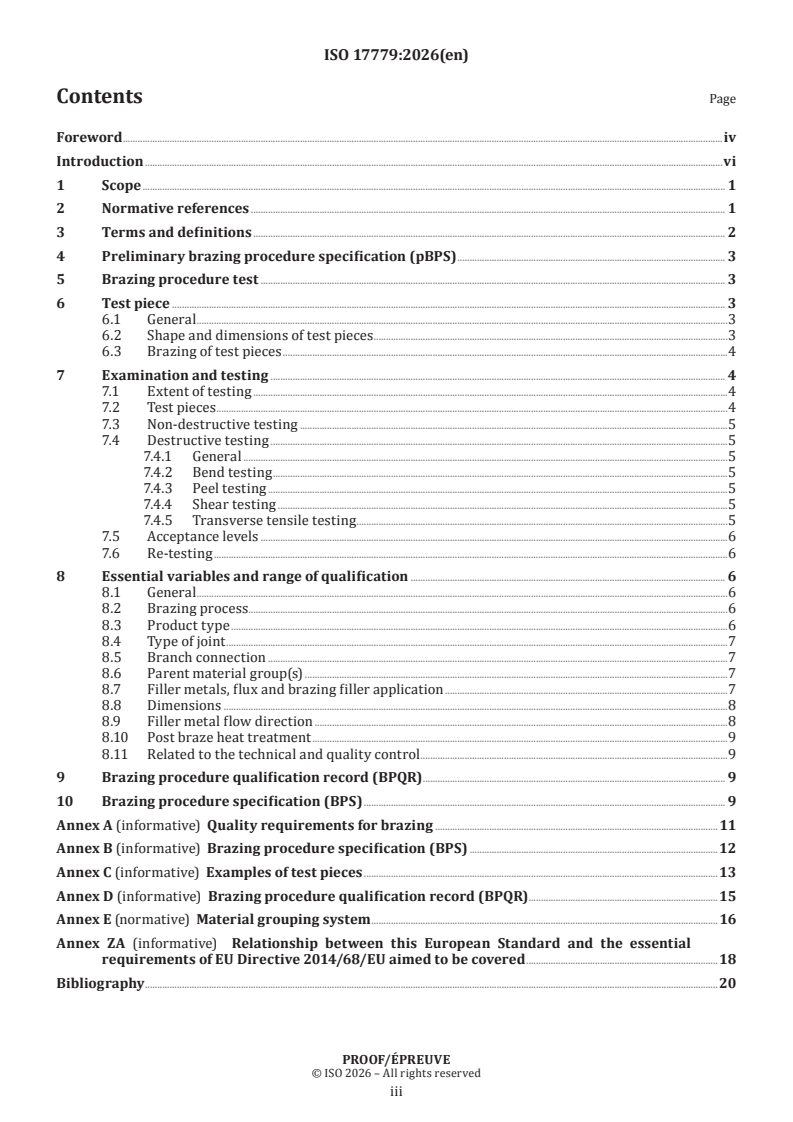
Contents Page
Foreword .iv
Introduction .vi
1 Scope . 1
2 Normative references . 1
3 Terms and definitions . 2
4 Preliminary brazing procedure specification (pBPS) . 3
5 Brazing procedure test . 3
6 Test piece . 3
6.1 General .3
6.2 Shape and dimensions of test pieces .3
6.3 Brazing of test pieces .4
7 Examination and testing . 4
7.1 Extent of testing .4
7.2 Test pieces . .4
7.3 Non-destructive testing .5
7.4 Destructive testing .5
7.4.1 General .5
7.4.2 Bend testing .5
7.4.3 Peel testing .5
7.4.4 Shear testing .5
7.4.5 Transverse tensile testing .5
7.5 Acceptance levels .6
7.6 Re-testing .6
8 Essential variables and range of qualification . 6
8.1 General .6
8.2 Brazing process.6
8.3 Product type .6
8.4 Type of joint .7
8.5 Branch connection .7
8.6 Parent material group(s) .7
8.7 Filler metals, flux and brazing filler application .7
8.8 Dimensions .8
8.9 Filler metal flow direction .8
8.10 Post braze heat treatment .9
8.11 Related to the technical and quality control .9
9 Brazing procedure qualification record (BPQR) . 9
10 Brazing procedure specification (BPS) . 9
Annex A (informative) Quality requirements for brazing .11
Annex B (informative) Brazing procedure specification (BPS) .12
Annex C (informative) Examples of test pieces .13
Annex D (informative) Brazing procedure qualification record (BPQR) .15
Annex E (normative) Material grouping system .16
Annex ZA (informative) Relationship between this European Standard and the essential
requirements of EU Directive 2014/68/EU aimed to be covered .18
Bibliography .20
PROOF/ÉPREUVE
iii
Foreword
ISO (the International Organization for Standardization) is a worldwide federation of national standards
bodies (ISO member bodies). The work of preparing International Standards is normally carried out through
ISO technical committees. Each member body interested in a subject for which a technical committee
has been established has the right to be represented on that committee. International organizations,
governmental and non-governmental, in liaison with ISO, also take part in the work. ISO collaborates closely
with the International Electrotechnical Commission (IEC) on all matters of electrotechnical standardization.
The procedures used to develop this document and those intended for its further maintenance are described
in the ISO/IEC Directives, Part 1. In particular, the different approval criteria needed for the different types
of ISO document should be noted. This document was drafted in accordance with the editorial rules of the
ISO/IEC Directives, Part 2 (see www.iso.org/directives).
ISO draws attention to the possibility that the implementation of this document may involve the use of (a)
patent(s). ISO takes no position concerning the evidence, validity or applicability of any claimed patent
rights in respect thereof. As of the date of publication of this document, ISO had not received notice of (a)
patent(s) which may be required to implement this document. However, implementers are cautioned that
this may not represent the latest information, which may be obtained from the patent database available at
www.iso.org/patents. ISO shall not be held responsible for identifying any or all such patent rights.
Any trade name used in this document is information given for the convenience of users and does not
constitute an endorsement.
For an explanation of the voluntary nature of standards, the meaning of ISO specific terms and expressions
related to conformity assessment, as well as information about ISO's adherence to the World Trade
Organization (WTO) principles in the Technical Barriers to Trade (TBT), see www.iso.org/iso/foreword.html.
This document was prepared by Technical Committee ISO/TC 44, Welding and allied processes, Subcommittee
SC 11, Qualification requirements for welding and allied processes personnel, in collaboration with the European
Committee for Standardization (CEN) Technical Committee CEN/TC 121, Welding and allied processes, in
accordance with the Agreement on technical cooperation between ISO and CEN (Vienna Agreement).
This second edition cancels and replaces the first edition (ISO 17779:2021), which has been technically
revised.
The main changes are as follows:
— in general, all requirements have been clarified by use of suitable revisions;
— introduction has been revised to match text used in ISO/DIS 15614-1;
— reference to Annex A has been moved from the scope to 7.5;
— reference to ISO 857-2 has been deleted from the scope;
— scope revised by removing the statement: “The principles of this document can be applied to other
brazing processes and brazing of materials not listed";
— normative references in Clause 2 have been updated;
— in 7.2, 7.3, 7.4.2, 7.4.3, 7.4.4 and 7.4.5, the use of technically equivalent standards is no longer permitted
— in Table 4, the footnotes have been revised for clarity;
— in 8.7, the use of other standards that provide equivalent technical conditions is no longer permitted;
— ISO 11745 has been added to a new bibliography.
Any feedback or questions on this document should be directed to the user’s
national standards body. A complete listing of these bodies can be found at
PROOF/ÉPREUVE
iv
www.iso.org/members.html. Official interpretations of ISO/TC 44 documents, where they exist, are
available from this page: https://committee.iso.org/sites/tc44/home/interpretation.html.
PROOF/ÉPREUVE
v
Introduction
The purpose of this document is to provide a general set of rules for brazing procedure qualification
independent of product or application.
All new brazing procedure qualification tests are intended to be performed in accordance with this
document. Specification and qualification of brazing procedures that were made in accordance with previous
editions of this document may be used for any application for which the current edition is specified. In this
case, the ranges of qualification of previous editions remain applicable.
Where additional tests need to be carried out to make the qualification technically equivalent, it is only
necessary to perform the additional tests on a test piece which should be made in accordance with this
document.
PROOF/ÉPREUVE
vi
International Standard ISO 17779:2026(en)
Brazing — Specification and qualification of brazing
procedures for metallic materials
1 Scope
This document specifies requirements for the specification and qualification of brazing procedures for
brazing of metallic materials.
This document specifies requirements for brazing of the test piece, testing of the test specimen, essential
variables and their range of qualification, acceptance criteria, brazing procedure qualification record
(BPQR) and brazing procedure specification (BPS).
This document does not cover testing of residual stresses, corrosion resistance and impact properties.
This document applies to the following brazing processes according to ISO 4063:2023 with local and global
heating:
— 911 Infrared brazing;
— 912 Flame brazing, torch brazing;
— 913 Laser beam brazing;
— 914 Electron beam brazing;
— 916 Induction brazing;
— 918 Resistance brazing;
— 919 Diffusion brazing;
— 921 Furnace brazing;
— 922 Vacuum brazing;
— 923 Dip-bath brazing;
— 924 Salt-bath brazing;
— 925 Flux bath brazing;
— 926 Immersion brazing;
— 972 Arc weld brazing.
This document does not apply to brazing for aerospace applications covered by ISO 11745.
2 Normative references
The following documents are referred to in the text in such a way that some or all of their content constitutes
requirements of this document. For dated references, only the edition cited applies. For undated references,
the latest edition of the referenced document (including any amendments) applies.
ISO 4063:2023, Welding, brazing, soldering and cutting — Nomenclature of processes and reference numbers
ISO 18279:2023, Brazing — Imperfections in brazed joints
PROOF/ÉPREUVE
EN 12797, Brazing — Destructive tests of brazed joints
EN 12799, Brazing — Non-destructive examination of brazed joints
ISO 857-2, Welding and allied processes — Vocabulary — Part 2: Soldering and brazing processes and related
terms
ISO 13585, Brazing — Qualification testing of brazers and brazing operators
ISO 17672, Brazing — Filler metals
ISO 18496, Brazing — Fluxes for brazing — Classification and technical delivery conditions
ISO/TR 25901-1, Welding and allied processes — Vocabulary — Part 1: General terms
3 Terms and definitions
For the purposes of this document, the terms and definitions given in ISO 857-2, ISO/TR 25901-1 and the
following apply.
ISO and IEC maintain terminology databases for use in standardization at the following addresses:
— ISO Online browsing platform: available at https:// www .iso .org/ obp
— IEC Electropedia: available at https:// www .electropedia .org/
3.1
brazing
joining process using filler metal with a liquidus temperature above 450 °C
[SOURCE: ISO 857-2:2005, 3.1.2.]
3.2
brazing procedure specification
BPS
document that has been qualified and provides the required variables of the brazing procedure to ensure
repeatability during production brazing
3.3
preliminary brazing procedure specification
pBPS
document containing the required variables of the brazing procedure which is not yet qualified
3.4
brazing procedure qualification record
BPQR
record comprising all necessary data from qualification of a brazing procedure
3.5
manufacturer
workshop or site or both which is (are) under the same technical and quality management
3.6
examiner
person who has been appointed to verify conformance with the applicable standard
Note 1 to entry: In certain cases, an external independent examiner can be required.
[SOURCE: ISO/TR 25901-1:2016, 2.5.29, modified — compliance has been changed to conformance.]
PROOF/ÉPREUVE
3.7
examining body
organization that has been appointed to verify conformance with the applicable standard
Note 1 to entry: In certain cases, an external independent examining body can be required.
[SOURCE: ISO/TR 25901-1:2016, 2.5.30, modified — compliance has been changed to conformance.]
3.8
filler metal
added metal applied to brazed joints
Note 1 to entry: Filler metal can be in the form of wire, inserts, powder, pastes, foil, etc.
3.9
flux
non-metallic material which, when molten, promotes wetting by removing existing oxide or other detrimental
films from the surfaces to be joined and prevents their re-formation during the joining operation
[SOURCE: ISO 857-2:2005, 3.2.2]
3.10
test piece
brazed assembly which is used for testing purposes
3.11
test specimen
part or portion cut from the test piece in order to perform specified destructive testing
[SOURCE: ISO/TR 25901-1:2016, 2.2.1.6]
4 Preliminary brazing procedure specification (pBPS)
A preliminary brazing procedure specification shall be prepared. An example pBPS form is shown in
Annex B.
5 Brazing procedure test
The brazing and testing of test pieces shall be in accordance with Clause 6 and Clause 7.
A brazer or brazing operator who undertakes the brazing procedure test satisfactorily in accordance with
this document shall be considered qualified for the appropriate range of qualification in accordance with
ISO 13585, provided that the relevant testing requirements are met.
6 Test piece
6.1 General
The test piece or pieces shall be brazed using a type of joint design proposed in the pBPS and be representative
for the intended production.
6.2 Shape and dimensions of test pieces
If not specified in an application standard, the shape and dimension of the test piece shall be agreed by the
contracting parties.
The test piece is typically a basic lap or butt joint in sheet material or a sleeve joint in tube.
NOTE Examples of applicable joint configurations are given in Annex C.
PROOF/ÉPREUVE
The size of the test piece shall be sufficient to allow all required tests to be carried out. Additional test pieces
may be prepared in order to allow for additional tests and/or for re-testing specimens.
6.3 Brazing of test pieces
Preparation and brazing of test pieces shall be carried out in accordance with the pBPS, and under the
general conditions of brazing in production, which they shall represent.
Brazing and testing of the test pieces shall be witnessed by an examiner or an examining body.
7 Examination and testing
7.1 Extent of testing
As a minimum, testing shall be carried out in accordance with Table 1, EN 12797 and EN 12799.
Table 1 — Examination and testing of the test pieces
Test piece Type of test Extent of testing
Visual, and 100 %
a
T-joint Metallographic, or 2 sections
b
Bend 2 specimens
Visual, and 100 %
a
Metallographic, and 2 sections
Lap joint
Shear, or 2 specimens
Peel 2 specimens
Visual, and 100 %
a
Metallographic, and 2 sections
Butt joint
Tensile, or 2 specimens
b
Bend 2 specimens
a
Macro sections. If additional micro sections are required, they shall be specified.
b
One first surface and one second surface test.
NOTE For specific service, material or manufacturing conditions, more comprehensive testing than is specified
by this document can be needed to gain more information and to avoid repeating the brazing procedure test at a later
date to obtain additional test data.
Consequently, an application standard can specify additional tests, e.g.:
— longitudinal tensile test;
— volumetric testing (RT or UT);
— corrosion tests;
— chemical analysis;
— cruciform test.
7.2 Test pieces
The shape of the test pieces shall be compatible with non-destructive testing in accordance with 7.3.
The dimensions of the test pieces shall be compatible with destructive testing in accordance with 7.4.
PROOF/ÉPREUVE
7.3 Non-destructive testing
The extent of non-destructive testing shall be in accordance with 7.1 and Table 1 and be carried out on
the test pieces prior to cutting of the test specimens. Visual testing shall be performed in accordance with
EN 12799. Radiographic testing, where specified, shall also be carried out in accordance with EN 12799.
7.4 Destructive testing
7.4.1 Gene
...
ISO/FDISPRF 17779:2026(en)
ISO/TC 44/SC 11
Secretariat: ANSI
Second edition
Date: 2026-06-10-1608-19
Brazing — Specification and qualification of brazing procedures for
metallic materials
Brasage fort — Descriptif et qualification d'un mode opératoire de brasage fort pour les matériaux métalliques
PROOF
ThiThis drs drafaft is t is submitted tsubmitted too a a p parallel arallel vovote in ISOte in ISO, CE, CEN.N.
ISO/DISPRF 17779:20252026(en)
All rights reserved. Unless otherwise specified, or required in the context of its implementation, no part of this publication
may be reproduced or utilized otherwise in any form or by any means, electronic or mechanical, including photocopying,
or posting on the internet or an intranet, without prior written permission. Permission can be requested from either ISO
at the address below or ISO’s member body in the country of the requester.
ISO copyright office
CP 401 • Ch. de Blandonnet 8
CH-1214 Vernier, Geneva
Phone: + 41 22 749 01 11
E-mail: copyright@iso.org
Website: www.iso.org
Published in Switzerland
ii
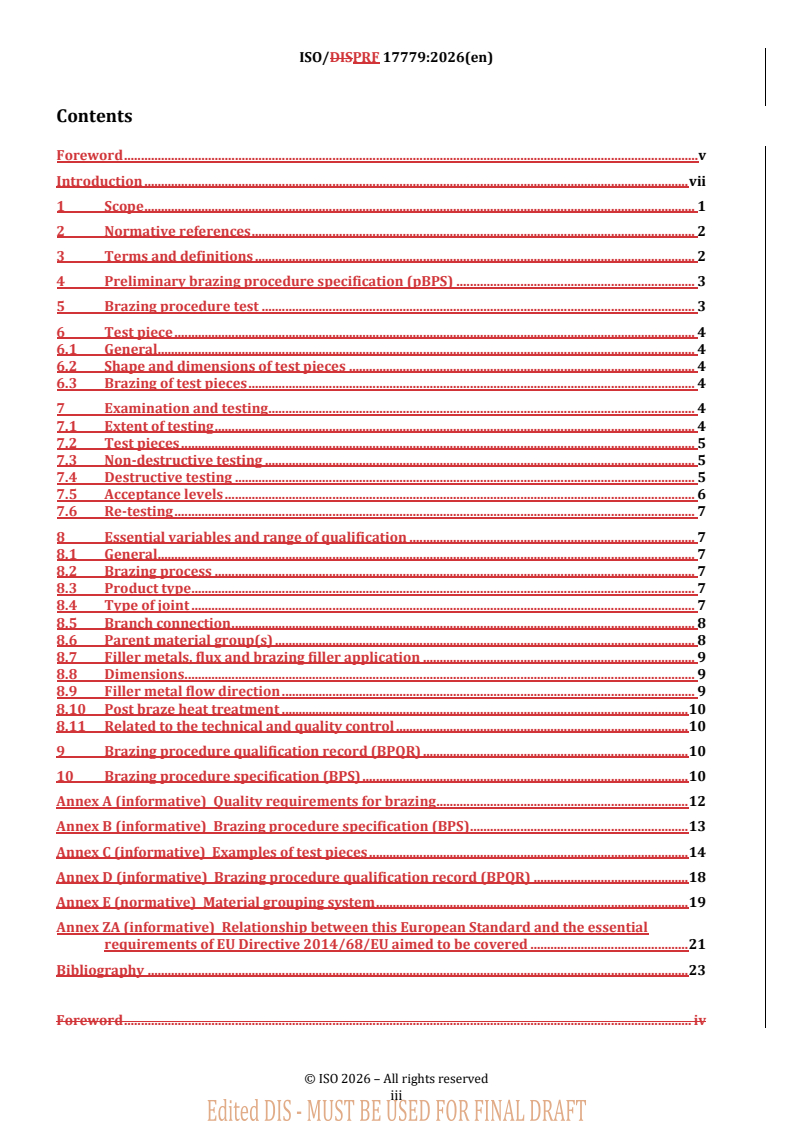
ISO/DISPRF 17779:2026(en)
Contents
Foreword . v
Introduction . vii
1 Scope . 1
2 Normative references . 2
3 Terms and definitions . 2
4 Preliminary brazing procedure specification (pBPS) . 3
5 Brazing procedure test . 3
6 Test piece . 4
6.1 General . 4
6.2 Shape and dimensions of test pieces . 4
6.3 Brazing of test pieces . 4
7 Examination and testing . 4
7.1 Extent of testing . 4
7.2 Test pieces . 5
7.3 Non-destructive testing . 5
7.4 Destructive testing . 5
7.5 Acceptance levels . 6
7.6 Re-testing . 7
8 Essential variables and range of qualification . 7
8.1 General . 7
8.2 Brazing process . 7
8.3 Product type . 7
8.4 Type of joint . 7
8.5 Branch connection . 8
8.6 Parent material group(s) . 8
8.7 Filler metals, flux and brazing filler application . 9
8.8 Dimensions . 9
8.9 Filler metal flow direction . 9
8.10 Post braze heat treatment . 10
8.11 Related to the technical and quality control . 10
9 Brazing procedure qualification record (BPQR) . 10
10 Brazing procedure specification (BPS) . 10
Annex A (informative) Quality requirements for brazing . 12
Annex B (informative) Brazing procedure specification (BPS) . 13
Annex C (informative) Examples of test pieces . 14
Annex D (informative) Brazing procedure qualification record (BPQR) . 18
Annex E (normative) Material grouping system . 19
Annex ZA (informative) Relationship between this European Standard and the essential
requirements of EU Directive 2014/68/EU aimed to be covered . 21
Bibliography . 23
Foreword . iv
iii
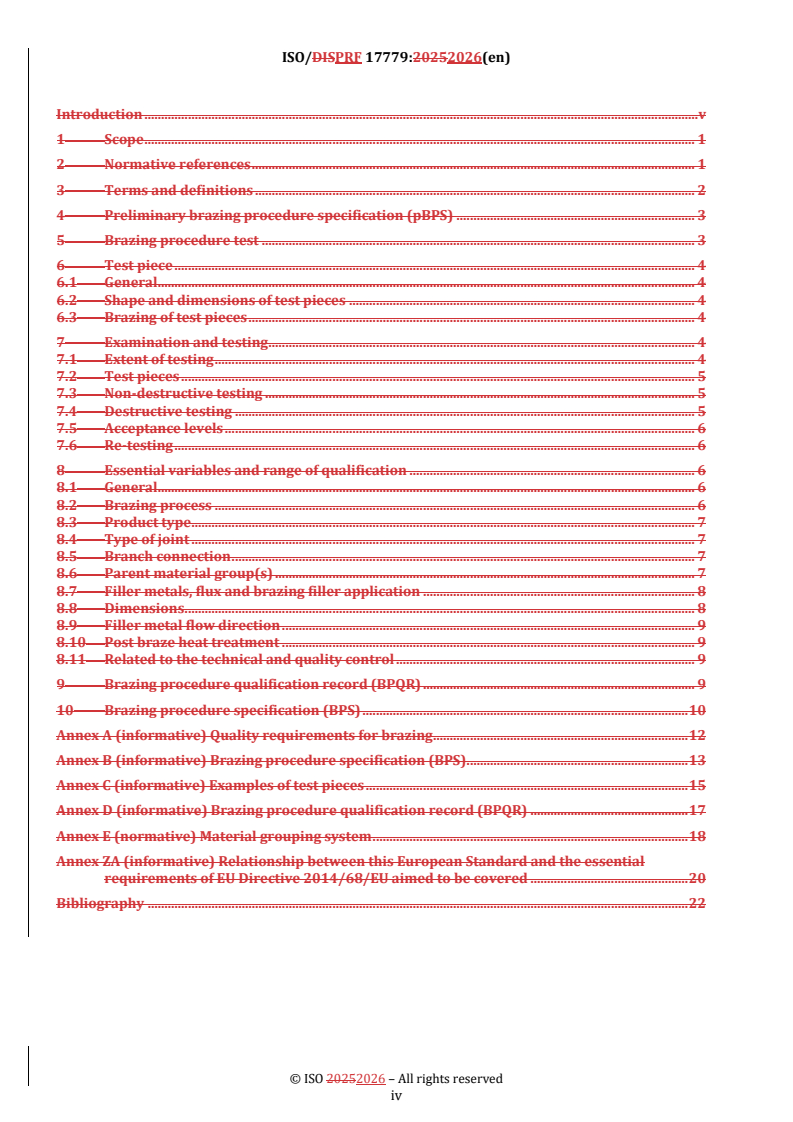
ISO/DISPRF 17779:20252026(en)
Introduction . v
1 Scope . 1
2 Normative references . 1
3 Terms and definitions . 2
4 Preliminary brazing procedure specification (pBPS) . 3
5 Brazing procedure test . 3
6 Test piece . 4
6.1 General . 4
6.2 Shape and dimensions of test pieces . 4
6.3 Brazing of test pieces . 4
7 Examination and testing . 4
7.1 Extent of testing . 4
7.2 Test pieces . 5
7.3 Non-destructive testing . 5
7.4 Destructive testing . 5
7.5 Acceptance levels . 6
7.6 Re-testing . 6
8 Essential variables and range of qualification . 6
8.1 General . 6
8.2 Brazing process . 6
8.3 Product type . 7
8.4 Type of joint . 7
8.5 Branch connection . 7
8.6 Parent material group(s) . 7
8.7 Filler metals, flux and brazing filler application . 8
8.8 Dimensions . 8
8.9 Filler metal flow direction . 9
8.10 Post braze heat treatment . 9
8.11 Related to the technical and quality control . 9
9 Brazing procedure qualification record (BPQR) . 9
10 Brazing procedure specification (BPS) . 10
Annex A (informative) Quality requirements for brazing. 12
Annex B (informative) Brazing procedure specification (BPS). 13
Annex C (informative) Examples of test pieces . 15
Annex D (informative) Brazing procedure qualification record (BPQR) . 17
Annex E (normative) Material grouping system . 18
Annex ZA (informative) Relationship between this European Standard and the essential
requirements of EU Directive 2014/68/EU aimed to be covered . 20
Bibliography . 22
iv
ISO/DISPRF 17779:2026(en)
Foreword
ISO (the International Organization for Standardization) is a worldwide federation of national standards
bodies (ISO member bodies). The work of preparing International Standards is normally carried out through
ISO technical committees. Each member body interested in a subject for which a technical committee has been
established has the right to be represented on that committee. International organizations, governmental and
non-governmental, in liaison with ISO, also take part in the work. ISO collaborates closely with the
International Electrotechnical Commission (IEC) on all matters of electrotechnical standardization.
The procedures used to develop this document and those intended for its further maintenance are described
in the ISO/IEC Directives, Part 1. In particular, the different approval criteria needed for the different types of
ISO document should be noted. This document was drafted in accordance with the editorial rules of the
ISO/IEC Directives, Part 2 (see www.iso.org/directives).
ISO draws attention to the possibility that the implementation of this document may involve the use of (a)
patent(s). ISO takes no position concerning the evidence, validity or applicability of any claimed patent rights
in respect thereof. As of the date of publication of this document, ISO had not received notice of (a) patent(s)
which may be required to implement this document. However, implementers are cautioned that this may not
represent the latest information, which may be obtained from the patent database available at
www.iso.org/patents.www.iso.org/patents. ISO shall not be held responsible for identifying any or all such
patent rights.
Any trade name used in this document is information given for the convenience of users and does not
constitute an endorsement.
For an explanation of the voluntary nature of standards, the meaning of ISO specific terms and expressions
related to conformity assessment, as well as information about ISO's adherence to the World Trade
Organization (WTO) principles in the Technical Barriers to Trade (TBT), see
www.iso.org/iso/foreword.htmlwww.iso.org/iso/foreword.html.
This document was prepared by Technical Committee ISO/TC 44, Welding and allied processes, Subcommittee
SC 11, Qualification requirements for welding and allied processes personnel, in collaboration with the European
Committee for Standardization (CEN) Technical Committee CEN/TC 121, Welding and allied processes, in
accordance with the Agreement on technical cooperation between ISO and CEN (Vienna Agreement).
This second edition cancels and replaces the first edition (ISO 17779:2021), which has been technically
revised.
The main changes are as follows:
— Inin general, all requirements have been clarified by use of suitable revisions;
— The introduction has been revised to match text used in ISO/DIS 15614-1;
— reference to Annex AAnnex A has been moved from the scope to 7.57.5;
— reference to ISO 857-2 has been deleted from the scope;
— the last but one sentence of the scope has been deletedscope revised by removing the statement: “The
principles of this document can be applied to other brazing processes and brazing of materials not listed.";
— Normativenormative references in Clause 22 have been updated;
— 3.4 was revised so as not to be a circular definition
v
ISO/DISPRF 17779:20252026(en)
— In 7.2, 7.3, 7.4.2, 7.4.3, 7.4.4in 7.2, 7.3, 7.4.2, 7.4.3, 7.4.4 and 7.4.5,7.4.5, the use of technically equivalent
standards is no longer permitted
— In Table 4,in Table 4 , the footnotes have been revised for clarity;
— In 8.7,in 8.7, the use of other standards that provide equivalent technical conditions is no longer permitted;
— ISO 11745 has been added toato a new bibliography.
Any feedback or questions on this document should be directed to the user’s national standards body. A
complete listing of these bodies can be found at www.iso.org/members.html.
Official interpretations of ISO/TC 44 documents, where they exist, are available from this page:
https://committee.iso.org/sites/tc44/home/interpretation.htmlhttps://committee.iso.org/sites/tc44/hom
e/interpretation.html.
vi
ISO/DISPRF 17779:2026(en)
Introduction
The purpose of this document is to provide a general set of rules for brazing procedure qualification
independent of product or application.
All new brazing procedure qualification tests are intended to be performed in accordance with this document.
Specification and qualification of brazing procedures that were made in accordance with previous editions of
this document may be used for any application for which the current edition is specified. In this case, the
ranges of qualification of previous editions remain applicable.
Where additional tests need to be carried out to make the qualification technically equivalent, it is only
necessary to perform the additional tests on a test piece which should be made in accordance with this
document.
vii
DRAFT International Standard ISO/DIS 17779:2026(en)
Brazing — Specification and qualification of brazing procedures for
metallic materials
1 Scope
This document specifies requirements for the specification and qualification of brazing procedures for brazing
of metallic materials.
This document specifies requirements for brazing of the test piece, testing of the test specimen, essential
variables and their range of qualification, acceptance criteria, brazing procedure qualification record (BPQR)
and brazing procedure specification (BPS).
This document does not cover testing of residual stresses, corrosion resistance and impact properties.
This document applies to the following brazing processes according to ISO 4063:2023 with local and global
heating:
— — 911 Infrared brazing;
— — 912 Flame brazing, torch brazing;
— — 913 Laser beam brazing;
— — 914 Electron beam brazing;
— — 916 Induction brazing;
— — 918 Resistance brazing;
— — 919 Diffusion brazing;
— — 921 Furnace brazing;
— — 922 Vacuum brazing;
— — 923 Dip-bath brazing;
— — 924 Salt-bath brazing;
— — 925 Flux bath brazing;
— — 926 Immersion brazing;
— — 972 Arc weld brazing.
This document does not apply to brazing for aerospace applications covered by ISO 11745.
ISO/DISPRF 17779:20252026(en)
2 Normative references
The following documents are referred to in the text in such a way that some or all of their content constitutes
requirements of this document. For dated references, only the edition cited applies. For undated references,
the latest edition of the referenced document (including any amendments) applies.
ISO 4063:2023, Welding, brazing, soldering and cutting — Nomenclature of processes and reference numbers
ISO 18279:2023, Brazing — Imperfections in brazed joints
EN 12797, Brazing — Destructive tests of brazed joints
EN 12799, Brazing — Non-destructive examination of brazed joints
ISO 857--2, Welding and allied processes — Vocabulary — Part 2: Soldering and brazing processes and related
terms
ISO 13585, Brazing — Qualification testing of brazers and brazing operators
ISO 17672, Brazing — Filler metals
ISO 18496, Brazing — Fluxes for brazing — Classification and technical delivery conditions
ISO/TR 25901--1, Welding and allied processes — Vocabulary — Part 1: General terms
3 Terms and definitions
For the purposes of this document, the terms and definitions given in ISO 857-2, ISO/TR 25901-1 and the
following apply.
ISO and IEC maintain terminology databases for use in standardization at the following addresses:
— — ISO Online browsing platform: available at https://www.iso.org/obp
— — IEC Electropedia: available at https://www.electropedia.org/https://www.electropedia.org/
3.1 3.1
brazing
joining process using filler metal with a liquidus temperature above 450 °C
[SOURCE: ISO 857-2:2005, 3.1.2.]
3.2 3.2
brazing procedure specification
BPS
document that has been qualified and provides the required variables of the brazing procedure to ensure
repeatability during production brazing
3.3 3.3
preliminary brazing procedure specification
pBPS
document containing the required variables of the brazing procedure which is not yet qualified
ISO/DISPRF 17779:2026(en)
3.4 3.4
brazing procedure qualification record
BPQR
record comprising all necessary data from qualification of a brazing procedure
3.5 3.5
manufacturer
workshop or site or both which is (are) under the same technical and quality management
3.6 3.6
examiner
person who has been appointed to verify conformance with the applicable standard
Note 1 to entry: In certain cases, an external independent examiner can be required.
[SOURCE: ISO/TR 25901-1:2016, 2.5.29, modified –— compliance has been changed to conformance].]
3.7 3.7
examining body
organization that has been appointed to verify conformance with the applicable standard
Note 1 to entry: In certain cases, an external independent examining body can be required.
[SOURCE: ISO/TR 25901-1:2016, 2.5.30, modified –— compliance has been changed to conformance].]
3.8 3.8
filler metal
added metal applied to brazed joints
Note 1 to entry: Filler metal can be in the form of wire, inserts, powder, pastes, foil, etc.
3.9 3.9
flux
non-metallic material which, when molten, promotes wetting by removing existing oxide or other detrimental
films from the surfaces to be joined and prevents their re-formation during the joining operation
[SOURCE: ISO 857-2:2005, 3.2.2]
3.10 3.10
test piece
brazed assembly which is used for testing purposes
3.11 3.11
test specimen
part or portion cut from the test piece in order to perform specified destructive testing
[SOURCE: ISO/TR 25901-1:2016, 2.2.1.6]
4 Preliminary brazing procedure specification (pBPS)
A preliminary brazing procedure specification shall be prepared. An example pBPS form is shown in
Annex B.Annex B.
5 Brazing procedure test
The brazing and testing of test pieces shall be in accordance with Clause 66 and Clause 7.7.
© ISO 2026 – All rights reserved
ISO/DISPRF 17779:20252026(en)
A brazer or brazing operator who undertakes the brazing procedure test satisfactorily in accordance with this
document shall be considered qualified for the appropriate range of qualification in accordance with
ISO 13585, provided that the relevant testing requirements are met.
6 Test piece
6.1 General
The test piece or pieces shall be brazed using a type of joint design proposed in the pBPS and be representative
for the intended production.
6.2 Shape and dimensions of test pieces
If not specified in an application standard, the shape and dimension of the test piece shall be agreed by the
contracting parties.
The test piece is typically a basic lap or butt joint in sheet material or a sleeve joint in tube.
NOTE Examples of applicable joint configurations are given in Annex C.Annex C.
The size of the test piece shall be sufficient to allow all required tests to be carried out. Additional test pieces
may be prepared in order to allow for additional tests and/or for re-testing specimens.
6.3 Brazing of test pieces
Preparation and brazing of test pieces shall be carried out in accordance with the pBPS, and under the general
conditions of brazing in production, which they shall represent.
Brazing and testing of the test pieces shall be witnessed by an examiner or an examining body.
7 Examination and testing
7.1 Extent of testing
As a minimum, testing shall be carried out in accordance with Table 1,Table 1 , EN 12797 and EN 12799.
Table 1 — Examination and testing of the test pieces
Test piece Type of test Extent of testing
Visual, and 100 %
a
T-joint Metallographic, or 2 sections
b
Bend 2 specimens
Visual, and 100
...