

ISO 6149-3:2006
(Main)Connections for hydraulic fluid power and general use — Ports and stud ends with ISO 261 metric threads and O-ring sealing — Part 3: Dimensions, design, test methods and requirements for light-duty (L series) stud ends
General Information
- Abstract
ISO 6149-3:2006 specifies dimensions, performance requirements and test procedures for metric adjustable and non-adjustable light-duty (L series) stud ends and O-rings. Stud ends in accordance with ISO 6149-3:2006 may be used at working pressures up to 40 MPa (400 bar) for non-adjustable stud ends and 31,5 MPa (315 bar) for adjustable stud ends. The permissible working pressure depends upon the stud end size, materials, design, working conditions, application, etc.
- Status
- Published
- Publication Date
- 15-Feb-2006
- Technical Committee
- ISO/TC 131/SC 4 - Connectors and similar products and components
- Drafting Committee
- ISO/TC 131/SC 4/WG 1 - Ports and connector stud ends
- Current Stage
- 9093 - International Standard confirmed
- Start Date
- 22-May-2026
- Completion Date
- 29-Aug-2026
Buy Documents
ISO 6149-3:2006 - Connections for hydraulic fluid power and general use — Ports and stud ends with ISO 261 metric threads and O-ring sealing — Part 3: Dimensions, design, test methods and requirements for light-duty (L series) stud ends Released:2/16/2006
ISO 6149-3:2006 - Raccordements pour transmissions hydrauliques et applications générales — Orifices et éléments mâles a filetage métrique ISO 261 et joint torique — Partie 3: Dimensions, conception, méthodes d'essai et exigences des éléments mâles de série légere (série L) Released:2/16/2006
Overview - ISO 6149-3:2006 (stud ends, L series)
ISO 6149-3:2006 specifies the dimensions, design, test methods and requirements for light‑duty (L series) stud ends and matching O‑rings used in hydraulic fluid power and general‑use applications. It covers metric stud ends with ISO 261 metric threads and O‑ring sealing, for thread sizes from M8 up to M60, and defines performance limits, identification, and designation rules for adjustable and non‑adjustable stud ends.
Key topics and technical requirements
- Threading and dimensions: Stud ends conform to ISO 261 metric threads with specified dimensions and hex tolerances (product grade C) referenced to ISO 965‑1 and detailed in the standard’s figures and tables.
- Stud end types: Distinguishes adjustable (orientation via locknut) and non‑adjustable (straight) stud ends with identification machined features.
- Working pressures and test pressures:
- Non‑adjustable stud ends: up to 40 MPa (400 bar) (size dependent).
- Adjustable stud ends: up to 31.5 MPa (315 bar) (size dependent).
- Burst and impulse (cyclic endurance) pressures are specified per thread size (see Table 2).
- Pressure ratings were established using connectors of low carbon steel; actual permissible pressure depends on size, material and application.
- O‑rings: Dimensions and material guidance: default O‑ring material for petroleum‑based hydraulic fluids is NBR (nitrile), hardness 90 ± 5 IRHD, meeting ISO 3601‑3 quality criteria.
- Performance testing: Burst and cyclic endurance (impulse) tests performed in accordance with ISO 19879. Manufacturers are required to verify rated performance by testing; conformance to dimensional data alone does not guarantee performance.
- Washer and locknut requirements: Flatness, fit, and maximum nut torque to move adjustable washers are specified (Table 3).
- Marking and designation: Clear designation format (e.g., “Stud end ISO 6149‑3 - M18 × 1,5”) and identification features for metric stud ends are defined.
Practical applications
- Hydraulic system connectors on tubes, pipes, hoses and hose fittings where metric threads with O‑ring sealing are needed.
- Typical use in mobile and industrial hydraulics, fluid power equipment, valves, manifolds and diagnostic ports.
- Useful where compact, light‑duty connections are required and pressure/size limits match the application.
Who should use this standard
- Hydraulic system designers and engineers specifying connectors and ports.
- Manufacturers of connectors, fittings and O‑rings for hydraulic equipment.
- Quality assurance and test laboratories performing burst and impulse tests.
- Procurement and compliance teams ensuring components meet international requirements.
Related standards
- ISO 6149 (Parts 1, 2, 4) - series for ports and stud ends (heavy‑duty S series is Part 2).
- ISO 19879 - test methods for hydraulic fluid power connections.
- ISO 3601‑3 - O‑ring quality acceptance criteria.
- ISO 261 / ISO 965‑1 - metric thread definitions and tolerances.
Using ISO 6149‑3:2006 helps ensure consistent dimensions, reliable O‑ring sealing and validated pressure performance for light‑duty hydraulic stud ends.
Relations
- Effective Date
- 25-Aug-2026
- Effective Date
- 25-Aug-2026
- Effective Date
- 25-Aug-2026
- Effective Date
- 25-Aug-2026
- Effective Date
- 25-Aug-2026
- Effective Date
- 25-Aug-2026
- Effective Date
- 03-Jun-2026
- Effective Date
- 11-Mar-2026
- Effective Date
- 06-Jun-2022
- Effective Date
- 15-Apr-2008
Buy Documents
ISO 6149-3:2006 - Connections for hydraulic fluid power and general use — Ports and stud ends with ISO 261 metric threads and O-ring sealing — Part 3: Dimensions, design, test methods and requirements for light-duty (L series) stud ends Released:2/16/2006
ISO 6149-3:2006 - Raccordements pour transmissions hydrauliques et applications générales — Orifices et éléments mâles a filetage métrique ISO 261 et joint torique — Partie 3: Dimensions, conception, méthodes d'essai et exigences des éléments mâles de série légere (série L) Released:2/16/2006
Get Certified
Connect with accredited certification bodies for this standard

Institut za varilstvo d.o.o. (Welding Institute)
Slovenia's leading welding institute since 1952. ISO 3834, EN 1090, pressure equipment certification, NDT personnel, welder qualification. Only IIW Au
Sponsored listings
Frequently Asked Questions
ISO 6149-3:2006 is a standard published by the International Organization for Standardization (ISO). Its full title is "Connections for hydraulic fluid power and general use — Ports and stud ends with ISO 261 metric threads and O-ring sealing — Part 3: Dimensions, design, test methods and requirements for light-duty (L series) stud ends". This standard covers: ISO 6149-3:2006 specifies dimensions, performance requirements and test procedures for metric adjustable and non-adjustable light-duty (L series) stud ends and O-rings. Stud ends in accordance with ISO 6149-3:2006 may be used at working pressures up to 40 MPa (400 bar) for non-adjustable stud ends and 31,5 MPa (315 bar) for adjustable stud ends. The permissible working pressure depends upon the stud end size, materials, design, working conditions, application, etc.
ISO 6149-3:2006 specifies dimensions, performance requirements and test procedures for metric adjustable and non-adjustable light-duty (L series) stud ends and O-rings. Stud ends in accordance with ISO 6149-3:2006 may be used at working pressures up to 40 MPa (400 bar) for non-adjustable stud ends and 31,5 MPa (315 bar) for adjustable stud ends. The permissible working pressure depends upon the stud end size, materials, design, working conditions, application, etc.
ISO 6149-3:2006 is classified under the following ICS (International Classification for Standards) categories: 23.100.40 - Piping and couplings. The ICS classification helps identify the subject area and facilitates finding related standards.
ISO 6149-3:2006 has the following relationships with other standards: It is inter standard links to EN ISO 6149-1:2022, EN ISO 8434-1:2018, EN ISO 4413:2010, EN ISO 6149-1:2019, EN ISO 23553-1:2014, EN ISO 8434-1:2007, EN ISO 6149-1:2007, EN 12514:2020, ISO 14113:2013, ISO 6149-3:1993. Understanding these relationships helps ensure you are using the most current and applicable version of the standard.
ISO 6149-3:2006 is available in PDF format for immediate download after purchase. The document can be added to your cart and obtained through the secure checkout process. Digital delivery ensures instant access to the complete standard document.
Standards Content (Sample)
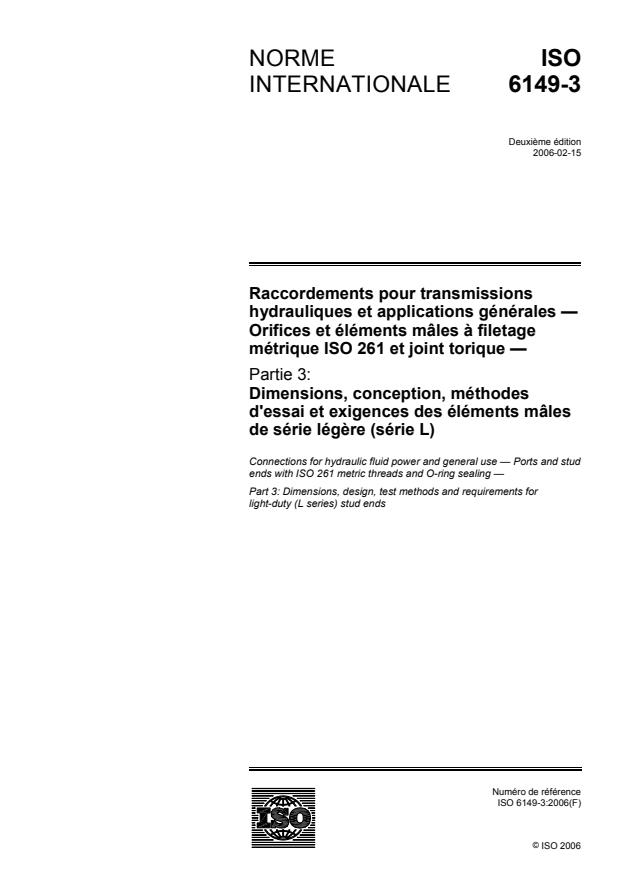
INTERNATIONAL ISO
STANDARD 6149-3
Second edition
2006-02-15
Connections for hydraulic fluid power
and general use — Ports and stud ends
with ISO 261 metric threads and O-ring
sealing —
Part 3:
Dimensions, design, test methods and
requirements for light-duty (L series) stud
ends
Raccordements pour transmissions hydrauliques et applications
générales — Orifices et éléments mâles à filetage métrique ISO 261 et
joint torique —
Partie 3: Dimensions, conception, méthodes d'essai et exigences des
éléments mâles de série légère (série L)
Reference number
©
ISO 2006
PDF disclaimer
This PDF file may contain embedded typefaces. In accordance with Adobe's licensing policy, this file may be printed or viewed but
shall not be edited unless the typefaces which are embedded are licensed to and installed on the computer performing the editing. In
downloading this file, parties accept therein the responsibility of not infringing Adobe's licensing policy. The ISO Central Secretariat
accepts no liability in this area.
Adobe is a trademark of Adobe Systems Incorporated.
Details of the software products used to create this PDF file can be found in the General Info relative to the file; the PDF-creation
parameters were optimized for printing. Every care has been taken to ensure that the file is suitable for use by ISO member bodies. In
the unlikely event that a problem relating to it is found, please inform the Central Secretariat at the address given below.
© ISO 2006
All rights reserved. Unless otherwise specified, no part of this publication may be reproduced or utilized in any form or by any means,
electronic or mechanical, including photocopying and microfilm, without permission in writing from either ISO at the address below or
ISO's member body in the country of the requester.
ISO copyright office
Case postale 56 • CH-1211 Geneva 20
Tel. + 41 22 749 01 11
Fax + 41 22 749 09 47
E-mail copyright@iso.org
Web www.iso.org
Published in Switzerland
ii © ISO 2006 – All rights reserved
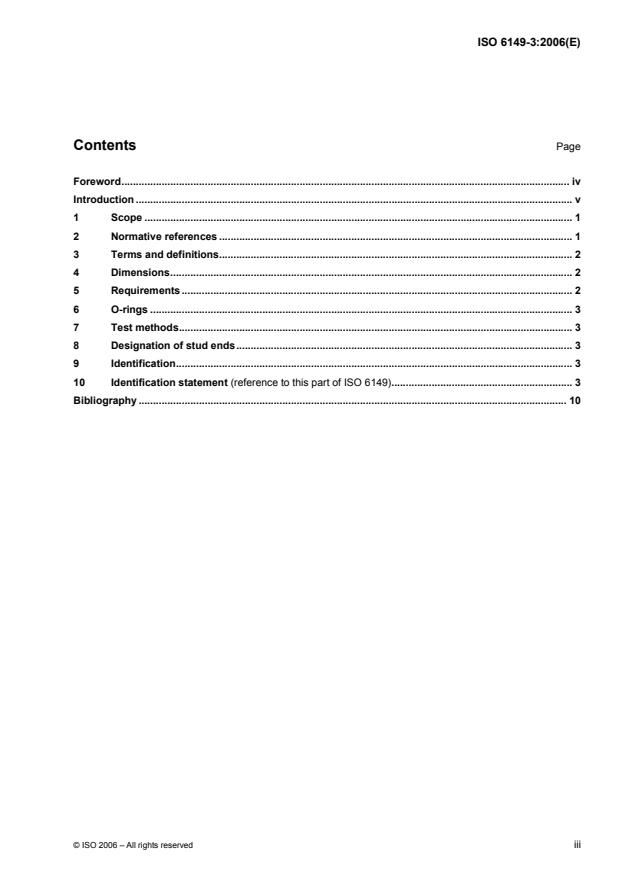
Contents Page
Foreword. iv
Introduction . v
1 Scope . 1
2 Normative references . 1
3 Terms and definitions. 2
4 Dimensions. 2
5 Requirements . 2
6 O-rings . 3
7 Test methods. 3
8 Designation of stud ends. 3
9 Identification. 3
10 Identification statement (reference to this part of ISO 6149). 3
Bibliography . 10
Foreword
ISO (the International Organization for Standardization) is a worldwide federation of national standards bodies
(ISO member bodies). The work of preparing International Standards is normally carried out through ISO
technical committees. Each member body interested in a subject for which a technical committee has been
established has the right to be represented on that committee. International organizations, governmental and
non-governmental, in liaison with ISO, also take part in the work. ISO collaborates closely with the
International Electrotechnical Commission (IEC) on all matters of electrotechnical standardization.
International Standards are drafted in accordance with the rules given in the ISO/IEC Directives, Part 2.
The main task of technical committees is to prepare International Standards. Draft International Standards
adopted by the technical committees are circulated to the member bodies for voting. Publication as an
International Standard requires approval by at least 75 % of the member bodies casting a vote.
Attention is drawn to the possibility that some of the elements of this document may be the subject of patent
rights. ISO shall not be held responsible for identifying any or all such patent rights.
ISO 6149-3 was prepared by Technical Committee ISO/TC 131, Fluid power systems, Subcommittee SC 4,
Connectors and similar products and components.
This second edition cancels and replaces the first edition (ISO 6149-3:1993), which has been technically
revised.
ISO 6149 consists of the following parts, under the general title Connections for hydraulic fluid power and
general use — Ports and stud ends with ISO 261 metric threads and O-ring sealing:
— Part 1: Ports with truncated housing for O-ring seal
— Part 2: Dimensions, design, test methods and requirements for heavy-duty (S series) stud ends
— Part 3: Dimensions, design, test methods and requirements for light-duty (L series) stud ends
— Part 4: Dimensions, design, test methods and requirements of external and internal hexport plugs
iv © ISO 2006 – All rights reserved
Introduction
In hydraulic fluid power systems, power is transmitted and controlled through a liquid under pressure within an
enclosed circuit. In general applications, a fluid (liquid or gas) may be conveyed under pressure.
Components are connected through their threaded ports by stud ends on fluid conductor connectors to tubes
and pipes or to hose connectors and hoses.
For threaded ports and stud ends specified in new designs in hydraulic fluid power applications,
ISO/TC 131/SC 4 recommends that the ISO 6149 series be used because these International Standards
specify ports and stud ends with metric threads and O-ring sealing and because the subcommittee would like
to help users by recommending one preferred system. ISO/TC 131/SC 4 further recommends that threaded
ports and stud ends in accordance with the ISO 1179 series, ISO 9974 series and ISO 11926 series not be
used for new designs in hydraulic fluid power applications; these International Standards will be maintained
because they specify ports and stud ends that are currently used in hydraulic systems worldwide.
INTERNATIONAL STANDARD ISO 6149-3:2006(E)
Connections for hydraulic fluid power and general use — Ports
and stud ends with ISO 261 metric threads and O-ring
sealing —
Part 3:
Dimensions, design, test methods and requirements
for light-duty (L series) stud ends
1 Scope
This part of ISO 6149 specifies dimensions, performance requirements and test procedures for metric
adjustable and non-adjustable light-duty (L series) stud ends and O-rings.
Stud ends in accordance with this part of ISO 6149 may be used at working pressures up to 40 MPa
1)
[400 bar ] for non-adjustable stud ends and 31,5 MPa (315 bar) for adjustable stud ends. The permissible
working pressure depends upon the stud end size, materials, design, working conditions, application, etc.
Conformance to the dimensional information in this part of ISO 6149 does not guarantee rated performance.
Each manufacturer should perform testing according to the specification contained in this part of ISO 6149 to
assure that components comply with the performance ratings.
NOTE 1 A significant number of tests have been conducted to confirm the performance requirements of connection
ends made from carbon steel.
NOTE 2 This part of ISO 6149 applies to connectors detailed in ISO 8434-1 and ISO 8434-2 (see ISO 12151-4 for
related hose fitting specification).
NOTE 3 The Introduction of this part of ISO 6149 gives recommendations for ports and stud ends to be used for new
designs in hydraulic fluid power applications.
2 Normative references
The following referenced documents are indispensable for the application of this document. For dated
references, only the edition cited applies. For undated references, the latest edition of the referenced
document (including any amendments) applies.
ISO 48, Rubber, vulcanized or thermoplastic — Determination of hardness (hardness between 10 IRHD and
100 IRHD)
ISO 261, ISO general purpose metric screw threads — General plan
ISO 965-1, ISO general purpose metric screw threads — Tolerances — Part 1: Principles and basic data
ISO 3601-3:2005, Fluid power systems — O-rings — Part 3: Quality acceptance criteria
ISO 4759-1, Tolerances for fasteners — Part 1: Bolts, screws, studs and nuts — Product grades A, B and C
5 2
1) 1 bar = 0,1 MPa = 10 Pa; 1 MPa = 1 N/mm .
2)
ISO 5598 , Fluid power systems and components — Vocabulary
ISO 6149-2, Connections for hydraulic fluid power and general use — Ports and stud ends with ISO 261
metric threads and O-ring sealing — Part 2: Dimensions, design, test methods and requirements for
heavy-duty (S series) stud ends
ISO 19879, Metallic tube connections for fluid power and general use — Test methods for hydraulic fluid
power connections
3 Terms and definitions
For the purposes of this part of ISO 6149, the terms and definitions given in ISO 5598 and the following apply.
3.1
adjustable stud end
stud end connector that allows for connector orientation through final tightening of the locknut to complete the
connection
NOTE This type of stud end is typically used on shaped connectors (e.g. tees, crosses and elbows).
3.2
non-adjustable stud end
stud end connector that does not require specific orientation before final tightening of the connection, because
it is only used on straight connectors
4 Dimensions
Light-duty (L series) stud ends shall conform to the dimensions given in Figures 1 and 2 and given in Table 1.
Hex tolerances across flats shall be in accordance with ISO 4759-1, product grade C.
5 Requirements
5.1 Working pressure
Light-duty (L series) stud ends made of low carbon steel shall be designed for use at the working pressures
given in Table 2.
5.2 Performance
Light-duty (L series) stud ends made of low carbon steel shall meet or exceed the burst and impulse
pressures given in Table 2, when submitted to burst and cyclic endurance (impulse) tests conducted in
accordance with Clause 7 and assembled using the torques in Table 5.
5.3 Flatness and fit of adjustable stud end washers
The washer shall be clinched to the stud end with a tight slip fit to an interference fit. The slip fit shall be tight
enough so that the washer cannot be shaken loose to cause it to drop from its uppermo
...
NORME ISO
INTERNATIONALE 6149-3
Deuxième édition
2006-02-15
Raccordements pour transmissions
hydrauliques et applications générales —
Orifices et éléments mâles à filetage
métrique ISO 261 et joint torique —
Partie 3:
Dimensions, conception, méthodes
d'essai et exigences des éléments mâles
de série légère (série L)
Connections for hydraulic fluid power and general use — Ports and stud
ends with ISO 261 metric threads and O-ring sealing —
Part 3: Dimensions, design, test methods and requirements for
light-duty (L series) stud ends
Numéro de référence
©
ISO 2006
PDF – Exonération de responsabilité
Le présent fichier PDF peut contenir des polices de caractères intégrées. Conformément aux conditions de licence d'Adobe, ce fichier
peut être imprimé ou visualisé, mais ne doit pas être modifié à moins que l'ordinateur employé à cet effet ne bénéficie d'une licence
autorisant l'utilisation de ces polices et que celles-ci y soient installées. Lors du téléchargement de ce fichier, les parties concernées
acceptent de fait la responsabilité de ne pas enfreindre les conditions de licence d'Adobe. Le Secrétariat central de l'ISO décline toute
responsabilité en la matière.
Adobe est une marque déposée d'Adobe Systems Incorporated.
Les détails relatifs aux produits logiciels utilisés pour la création du présent fichier PDF sont disponibles dans la rubrique General Info
du fichier; les paramètres de création PDF ont été optimisés pour l'impression. Toutes les mesures ont été prises pour garantir
l'exploitation de ce fichier par les comités membres de l'ISO. Dans le cas peu probable où surviendrait un problème d'utilisation,
veuillez en informer le Secrétariat central à l'adresse donnée ci-dessous.
© ISO 2006
Droits de reproduction réservés. Sauf prescription différente, aucune partie de cette publication ne peut être reproduite ni utilisée sous
quelque forme que ce soit et par aucun procédé, électronique ou mécanique, y compris la photocopie et les microfilms, sans l'accord écrit
de l'ISO à l'adresse ci-après ou du comité membre de l'ISO dans le pays du demandeur.
ISO copyright office
Case postale 56 • CH-1211 Geneva 20
Tel. + 41 22 749 01 11
Fax. + 41 22 749 09 47
E-mail copyright@iso.org
Web www.iso.org
Publié en Suisse
ii © ISO 2006 – Tous droits réservés
Sommaire Page
Avant-propos. iv
Introduction . v
1 Domaine d'application. 1
2 Références normatives . 1
3 Termes et définitions. 2
4 Dimensions. 2
5 Exigences . 2
6 Joints toriques . 3
7 Méthodes d'essai . 3
8 Désignation des éléments mâles . 3
9 Identification. 3
10 Phrase d'identification (Référence à la présente partie de l'ISO 6149) . 4
Bibliographie . 11
Avant-propos
L'ISO (Organisation internationale de normalisation) est une fédération mondiale d'organismes nationaux de
normalisation (comités membres de l'ISO). L'élaboration des Normes internationales est en général confiée
aux comités techniques de l'ISO. Chaque comité membre intéressé par une étude a le droit de faire partie du
comité technique créé à cet effet. Les organisations internationales, gouvernementales et non
gouvernementales, en liaison avec l'ISO participent également aux travaux. L'ISO collabore étroitement avec
la Commission électrotechnique internationale (CEI) en ce qui concerne la normalisation électrotechnique.
Les Normes internationales sont rédigées conformément aux règles données dans les Directives ISO/CEI,
Partie 2.
La tâche principale des comités techniques est d'élaborer les Normes internationales. Les projets de Normes
internationales adoptés par les comités techniques sont soumis aux comités membres pour vote. Leur
publication comme Normes internationales requiert l'approbation de 75 % au moins des comités membres
votants.
L'attention est appelée sur le fait que certains des éléments du présent document peuvent faire l'objet de
droits de propriété intellectuelle ou de droits analogues. L'ISO ne saurait être tenue pour responsable de ne
pas avoir identifié de tels droits de propriété et averti de leur existence.
L'ISO 6149-3 a été élaborée par le comité technique ISO/TC 131, Transmissions hydrauliques et
pneumatiques, sous-comité SC 4, Raccords, produits similaires et leurs composants.
Cette deuxième édition annule et remplace la première édition (ISO 6149-3:1993), dont elle constitue une
révision technique.
L'ISO 6149 comprend les parties suivantes, présentées sous le titre général Raccordements pour
transmissions hydrauliques et applications générales — Orifices et éléments mâles à filetage métrique
ISO 261 et joint torique:
— Partie 1: Orifices à joint torique dans un logement tronconique
— Partie 2: Dimensions, conception, méthodes d'essai et exigences des éléments mâles de série lourde
(série S)
— Partie 3: Dimensions, conception, méthodes d'essai et exigences des éléments mâles de série légère
(série L)
— Partie 4: Dimensions, conception, méthodes d'essai et exigences des bouchons d'orifices à six pans
internes et à six pans externes
iv © ISO 2006 – Tous droits réservés
Introduction
Dans les transmissions hydrauliques, la puissance est transmise et commandée par l'intermédiaire d'un
liquide sous pression circulant en circuit fermé. Dans les applications générales, un fluide (liquide ou gaz)
peut être transporté sous pression.
Les composants sont reliés entre eux au niveau de leurs orifices filetés par des raccords aux tubes et aux
tuyauteries ou aux tuyaux flexibles.
Pour les orifices et les éléments mâles filetés pour de nouvelles conceptions dans des applications de
transmissions hydrauliques, l'ISO/TC 131/SC 4 recommande que la série ISO 6149 soit utilisée d'une part
parce que ces Normes internationales spécifient des orifices et des éléments mâles avec filetage métrique et
étanchéité par joint torique et, d'autre part, parce que le sous-comité souhaiterait aider les utilisateurs en leur
recommandant un système préférentiel. L'ISO/TC 131/SC 4 recommande, en outre, que les orifices et les
éléments mâles filetés selon les séries ISO 1179, ISO 9974 et ISO 11926 ne soient pas utilisés pour de
nouvelles conceptions dans des applications de transmissions hydrauliques; ces Normes internationales
seront maintenues parce qu'elles spécifient des orifices et des éléments mâles qui actuellement sont utilisés
dans des systèmes hydrauliques dans le monde entier.
NORME INTERNATIONALE ISO 6149-3:2006(F)
Raccordements pour transmissions hydrauliques et
applications générales — Orifices et éléments mâles à filetage
métrique ISO 261 et joint torique —
Partie 3:
Dimensions, conception, méthodes d'essai et exigences des
éléments mâles de série légère (série L)
1 Domaine d'application
La présente partie de l'ISO 6149 spécifie les dimensions, les performances et les méthodes d'essai des
éléments mâles métriques orientables ou non orientables de série légère (série L) et de leurs joints toriques.
Les éléments mâles conformes à la présente partie de l'ISO 6149 peuvent être utilisés jusqu'à des pressions
1)
de travail de 40 MPa [400 bar ] pour les éléments mâles non orientables et de 31,5 MPa (315 bar) pour les
éléments mâles orientables. La pression de travail admissible dépend de la taille de l'élément mâle, des
matériaux, de la conception, des conditions de travail, de l'utilisation, etc.
La conformité aux spécifications dimensionnelles de la présente partie de l'ISO 6149 ne garantit pas les
performances nominales. Il convient à chaque fabricant de procéder à des essais suivant les spécifications
normalisées pour vérifier que les organes conformes à la présente partie de l'ISO 6149 présentent les
caractéristiques nominales de fonctionnement.
NOTE 1 De nombreux essais ont été effectués pour confirmer les performances requises des extrémités de
raccordement en acier au carbone.
NOTE 2 Les éléments mâles spécifiés dans la présente partie de l'ISO 6149 sont utilisés sur les connecteurs définis
dans l'ISO 8434-1 et dans l'ISO 8434-2. Voir l'ISO 12151-4 pour la spécification des flexibles de raccordement qui utilisent
les éléments mâles spécifiés dans la présente partie de l'ISO 6149.
NOTE 3 L'Introduction de la présente partie de l'ISO 6149 donne des recommandations pour les orifices et les
éléments mâles à utiliser pour de nouvelles conceptions dans des applications de transmissions hydrauliques.
2 Références normatives
Les documents de référence suivants sont indispensables pour l'application du présent document. Pour les
références datées, seule l'édition citée s'applique. Pour les références non datées, la dernière édition du
document de référence s'applique (y compris les éventuels amendements).
ISO 48, Caoutchouc vulcanisé ou thermoplastique — Détermination de la dureté (dureté comprise entre
10 DIDC et 100 DIDC)
ISO 261, Filetages métriques ISO pour usages généraux — Vue d'ensemble
ISO 965-1, Filetages métriques ISO pour usages généraux — Tolérances — Partie 1: Principes et données
fondamentales
5 2
1) 1 bar = 0,1 MPa = 10 Pa; 1 MPa = 1 N/mm .
ISO 3601-3:2005, Transmissions hydrauliques et pneumatiques — Joints toriques — Partie 3: Critères de
qualité
ISO 4759-1, Tolérances des éléments de fixation — Partie 1: Vis, goujons et écrous — Grades A, B et C
2)
ISO 5598 , Transmissions hydrauliques et pneumatiques — Vocabulaire
ISO 6149-2, Raccordements pour transmissions hydrauliques et applications générales — Orifices et
éléments mâles à filetage métrique ISO 261 et joint torique — Partie 2: Dimensions, conception, méthodes
d'essai et exigences des éléments mâles de série lourde (série S)
ISO 19879, Raccords de tubes métalliques pour transmissions hydrauliques et pneumatiques et applications
générales — Méthodes d'essai pour raccords pour transmissions hydrauliques
3 Termes et définitions
Pour les besoins de la présente partie de l'ISO 6149, les termes et définitions donnés dans l'ISO 5598 et les
suivants s'appliquent.
3.1
élément mâle orientable
embout fileté permettant d'orienter le raccord par un dernier serrage du contre-écrou assurant le
raccordement
NOTE Ce type d'élément mâle est généralement utilisé sur les raccords façonnés (par exemple tés, croix et coudes).
3.2
élément mâle non orientable
embout fileté n'exigeant pas une orientation particulière avant le dernier serrage du raccordement, parce qu'il
n'est utilisé que sur les raccords droits
4 Dimensions
Les éléments mâles de série légère (série L) doivent avoir des dimensions conformes à celles données aux
Figures 1 et 2 et dans le Tableau 1. Les tolérances des cotes surplats doivent être conformes à
l'ISO 4759-1:2000, grade C.
5 Exigences
5.1 Pression d'utilisation
Les éléments mâles de série légère (série L) en acier à bas carbone doivent être conçus pour fonctionner aux
pressions d'utilisation données dans le Tableau 2.
5.2 Performances
Les éléments mâles de série légère (série L) en acier à bas carbone doivent supporter au minimum les
pressions de rupture et d'impulsion données dans le Tableau 2, appliquées lors des essais de rupture et
d'endurance cyclique (impulsion) réalisés conformément à l'Article 7, et être assemblés en appliquant les
couples donnés dans le Tableau 5.
2) À publier. (Révision de l'ISO 5598:1985)
2 © ISO 2006 – Tous droits réservés
5.3 Planéité et ajustement de la rondelle d'élément mâle orientable
La rondelle doit être assujettie à l'embout fileté par un ajustement glissant à serré. L'ajustement gl
...