

ISO/TR 18568:2021
(Main)Packaging and the environment — Marking for material identification
General Information
- Abstract
This document shows some examples of markings (words, numbers or symbols) for the identification of packaging materials. This document is applicable to all types of packaging in order to enable the identification of the materials used.
- Status
- Published
- Publication Date
- 08-Apr-2021
- Technical Committee
- ISO/TC 122/SC 4 - Packaging and the environment
- Drafting Committee
- ISO/TC 122/SC 4 - Packaging and the environment
- Current Stage
- 6060 - International Standard published
- Start Date
- 09-Apr-2021
- Completion Date
- 09-Apr-2021
Buy Documents


ISO/TR 18568:2021 - Packaging and the environment -- Marking for material identification
ISO/TR 18568:2021 - Packaging and the environment — Marking for material identification/9/2021
Overview
ISO/TR 18568:2021 - Packaging and the environment - Marking for material identification (Technical Report, 1st edition, April 2021) provides examples of markings for packaging material identification (words, numbers and symbols). The report is applicable to all types of packaging and is intended to support efficient collection, sorting, recycling and recovery by enabling clear identification of materials used in packaging.
Key topics
- Scope and purpose: Illustrative markings to help identify packaging materials across jurisdictions to aid recycling and waste-management systems.
- Markings by material: Example marks for major packaging materials including paper, aluminium, glass, plastics, steel, wood and others (see Clause 4.1 and Tables 1–6).
- Plastics coding: Annex A provides numbers and abbreviations of commonly used plastics/polymers for packaging (useful for plastic recycling codes).
- Markings related to collection and sorting: Examples of non-material marks that indicate collection routes, recyclability or specific waste-management schemes (Table 7).
- Regional examples and issuing bodies: Illustrative references to schemes and legal frameworks used in different regions (e.g., European Decision 1997/129/EC, ASTM D7611 in the USA, China’s GB/T18455‑2010, and national recycling laws referenced for Japan and Korea).
- Recommendations: High-level guidance on use and implementation (Clause 5) and context on limitations where advanced mechanical sorting is in place.
Practical applications
Who uses ISO/TR 18568:2021 and why:
- Packaging designers and brand owners - to select clear material-identification markings that support downstream recycling.
- Recyclers and waste operators - to interpret markings and improve manual/semimanual sorting processes where automatic separation is limited.
- Regulatory bodies and compliance teams - to align labeling policies with international examples and national legislation.
- Standards bodies and policy makers - to harmonize markings or develop national schemes informed by multi‑region examples.
- Supply chain and sustainability teams - to improve packaging circularity by consistent material identification.
Benefits:
- Facilitates correct sorting and higher-quality recycling streams.
- Reduces contamination in material recovery when markings are clear and standardized.
- Acts as a reference for harmonizing marks across markets.
Related standards
- ISO 21067‑1 and ISO 21067‑2 (vocabulary referenced in the report)
- Regional and technical references cited in the report (Decision 1997/129/EC, EN/TR 14311, ASTM D7611/D7611M, GB/T18455‑2010)
ISO/TR 18568:2021 is a practical, illustrative resource for improving packaging material identification, supporting recycling policy, and informing label design and waste‑management practice.
Buy Documents
ISO/TR 18568:2021 - Packaging and the environment -- Marking for material identification
ISO/TR 18568:2021 - Packaging and the environment — Marking for material identification/9/2021
Get Certified
Connect with accredited certification bodies for this standard

BSI Group
BSI (British Standards Institution) is the business standards company that helps organizations make excellence a habit.

Bureau Veritas
Bureau Veritas is a world leader in laboratory testing, inspection and certification services.

DNV
DNV is an independent assurance and risk management provider.
Sponsored listings
Frequently Asked Questions
ISO/TR 18568:2021 is a technical report published by the International Organization for Standardization (ISO). Its full title is "Packaging and the environment — Marking for material identification". This standard covers: This document shows some examples of markings (words, numbers or symbols) for the identification of packaging materials. This document is applicable to all types of packaging in order to enable the identification of the materials used.
This document shows some examples of markings (words, numbers or symbols) for the identification of packaging materials. This document is applicable to all types of packaging in order to enable the identification of the materials used.
ISO/TR 18568:2021 is classified under the following ICS (International Classification for Standards) categories: 13.020.01 - Environment and environmental protection in general; 55.020 - Packaging and distribution of goods in general. The ICS classification helps identify the subject area and facilitates finding related standards.
ISO/TR 18568:2021 is available in PDF format for immediate download after purchase. The document can be added to your cart and obtained through the secure checkout process. Digital delivery ensures instant access to the complete standard document.
Standards Content (Sample)
TECHNICAL ISO/TR
REPORT 18568
First edition
2021-04
Packaging and the environment —
Marking for material identification
Emballage et environnement — Marquage pour l'identification des
matériaux
Reference number
©
ISO 2021
© ISO 2021
All rights reserved. Unless otherwise specified, or required in the context of its implementation, no part of this publication may
be reproduced or utilized otherwise in any form or by any means, electronic or mechanical, including photocopying, or posting
on the internet or an intranet, without prior written permission. Permission can be requested from either ISO at the address
below or ISO’s member body in the country of the requester.
ISO copyright office
CP 401 • Ch. de Blandonnet 8
CH-1214 Vernier, Geneva
Phone: +41 22 749 01 11
Email: copyright@iso.org
Website: www.iso.org
Published in Switzerland
ii © ISO 2021 – All rights reserved
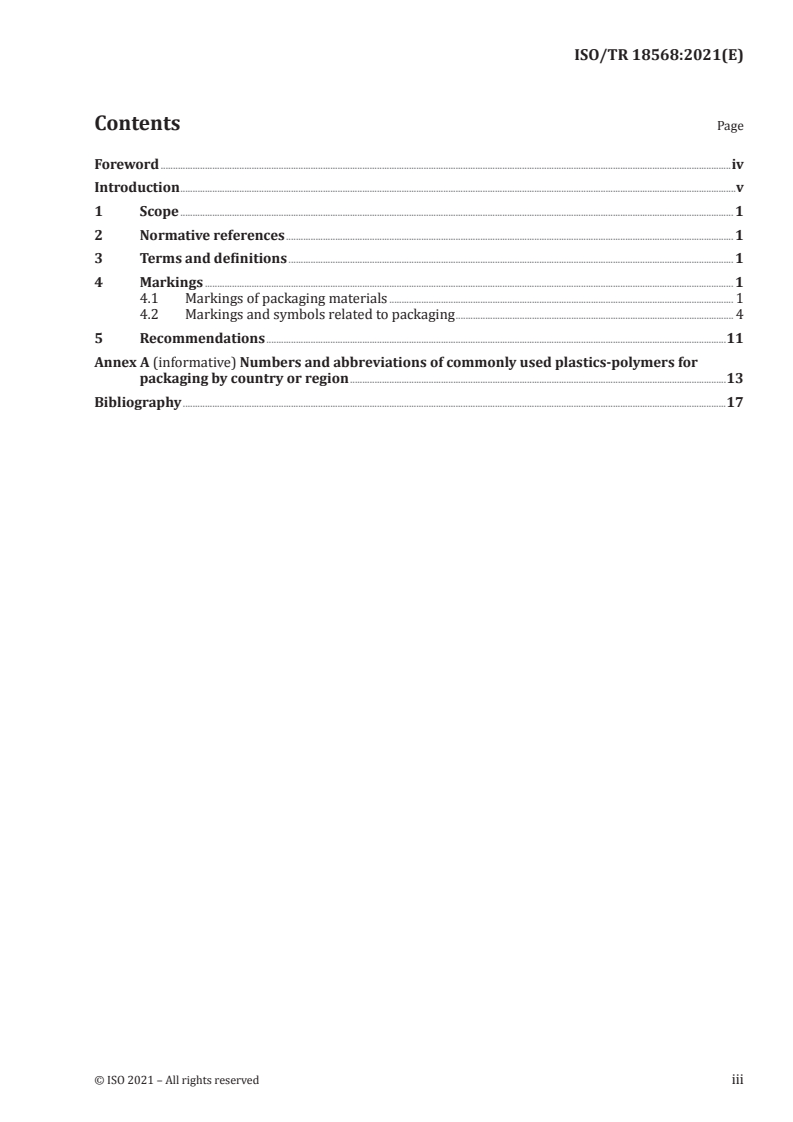
Contents Page
Foreword .iv
Introduction .v
1 Scope . 1
2 Normative references . 1
3 Terms and definitions . 1
4 Markings . 1
4.1 Markings of packaging materials . 1
4.2 Markings and symbols related to packaging . 4
5 Recommendations .11
Annex A (informative) Numbers and abbreviations of commonly used plastics-polymers for
packaging by country or region .13
Bibliography .17
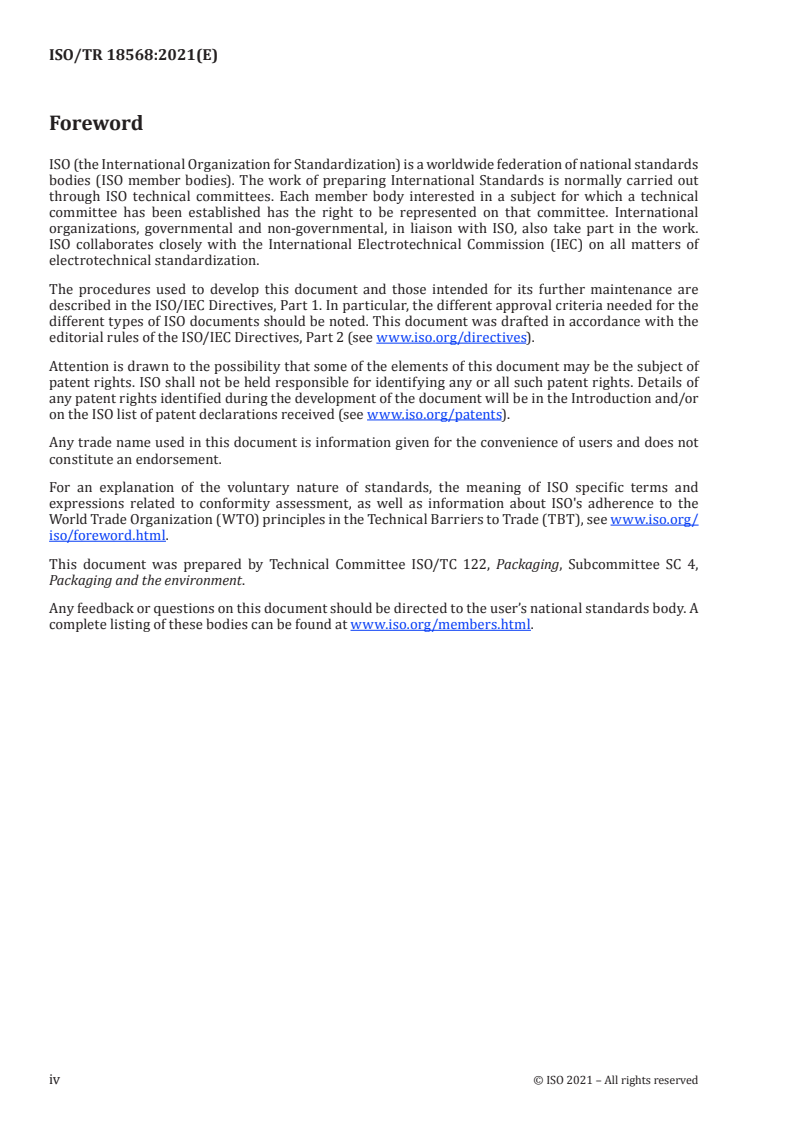
Foreword
ISO (the International Organization for Standardization) is a worldwide federation of national standards
bodies (ISO member bodies). The work of preparing International Standards is normally carried out
through ISO technical committees. Each member body interested in a subject for which a technical
committee has been established has the right to be represented on that committee. International
organizations, governmental and non-governmental, in liaison with ISO, also take part in the work.
ISO collaborates closely with the International Electrotechnical Commission (IEC) on all matters of
electrotechnical standardization.
The procedures used to develop this document and those intended for its further maintenance are
described in the ISO/IEC Directives, Part 1. In particular, the different approval criteria needed for the
different types of ISO documents should be noted. This document was drafted in accordance with the
editorial rules of the ISO/IEC Directives, Part 2 (see www .iso .org/ directives).
Attention is drawn to the possibility that some of the elements of this document may be the subject of
patent rights. ISO shall not be held responsible for identifying any or all such patent rights. Details of
any patent rights identified during the development of the document will be in the Introduction and/or
on the ISO list of patent declarations received (see www .iso .org/ patents).
Any trade name used in this document is information given for the convenience of users and does not
constitute an endorsement.
For an explanation of the voluntary nature of standards, the meaning of ISO specific terms and
expressions related to conformity assessment, as well as information about ISO's adherence to the
World Trade Organization (WTO) principles in the Technical Barriers to Trade (TBT), see www .iso .org/
iso/ foreword .html.
This document was prepared by Technical Committee ISO/TC 122, Packaging, Subcommittee SC 4,
Packaging and the environment.
Any feedback or questions on this document should be directed to the user’s national standards body. A
complete listing of these bodies can be found at www .iso .org/ members .html.
iv © ISO 2021 – All rights reserved
Introduction
The purpose of this document is to specify a number of markings used to identify packaging materials,
with the aim to support the efficient collection, sorting, recycling and recovery after use. The collection
and sorting of used packaging is a prerequisite for a successful recycling and recovery process.
Although several countries and regions have established marking systems for material identification,
the absence of such systems in other countries and regions has created difficulties for individuals and
organizations to properly identify packaging materials. Waste operators lacking sufficient means of
mechanical sorting face problems in properly separating the used packaging materials, when specified
identification markings are lacking. Moreover, packaging material markings are not always linked to
collection symbols for packaging, which depend on the relevant packaging waste management systems.
The usefulness of markings for packaging materials is limited in countries and regions with established
collection and sorting schemes, where the latest technologies are used to separate the packaging
materials fractions.
This document contains a number of identification markings with their sorting and recycling systems
which are successfully used in some countries and regions.
TECHNICAL REPORT ISO/TR 18568:2021(E)
Packaging and the environment — Marking for material
identification
1 Scope
This document shows some examples of markings (words, numbers or symbols) for the identification
of packaging materials. This document is applicable to all types of packaging in order to enable the
identification of the materials used.
2 Normative references
The following documents are referred to in the text in such a way that some or all of their content
constitutes requirements of this document. For dated references, only the edition cited applies. For
undated references, the latest edition of the referenced document (including any amendments) applies.
ISO 21067-1, Packaging — Vocabulary — Part 1: General terms
ISO 21067-2, Packaging — Vocabulary — Part 2: Packaging and the environment terms
3 Terms and definitions
For the purposes of this document, the terms and definitions given in ISO 21067-1 and ISO 21067-2 apply.
ISO and IEC maintain terminological databases for use in standardization at the following addresses:
— ISO Online browsing platform: available at https:// www .iso .org/ obp
— IEC Electropedia: available at http:// www .electropedia .org/
4 Markings
4.1 Markings of packaging materials
Tables 1 to 6 outline some of the most commonly used markings of packaging materials categorized by
country and/or region. Where necessary, a short explanation is given about the meaning and purpose
of the markings outlined below.
Table 1 — Markings for paper as packaging material by country/region
Material Country/ Marking Application, Issuing organization
region purpose and
Information source
meaning
China Applicable Indication: voluntary
to all paper
SAC, GB/T18455-2010
packaging
Paper
Europe PAP22 (paper) Applicable Indication: voluntary
to packaging
PAP 21 (fibreboard) Decision 1997/129/EC,
and material
but the marking is man-
PAP 20 (corrugated) identification
datory when packaging
meaning
material identification
is adopted
Table 2 — Markings for aluminium as packaging material by country/region
Material Country/ Marking Application, purpose Issuing organization
region and meaning
Information source
China Applicable to all alu- Indication: voluntary
minium packaging
SAC, GB/T18455-2010
Europe ALU 41 Applicable to packag- Indication: voluntary
ing and material identi-
Decision 1997/129/EC but
fication meaning
Aluminium
the marking is mandatory
when packaging material
identification is adopted
Applicable to packag- Indication: voluntary
ing and material identi-
EN/TR 14311
fication meaning
Table 3 — Markings for glass as packaging material by country/region
Material Country/ Marking Application, purpose Issuing organization
region and meaning
Information source
Europe GL70 (colourless) Applicable to packag- Indication: voluntary
ing and material iden-
GL71 (green) Decision 1997/129/EC but the
tification meaning
Glass
marking is mandatory when
GL72 (brown)
packaging material identifica-
tion is adopted
2 © ISO 2021 – All rights reserved
Table 4 — Markings for plastics as packaging material by country/region (including numbers
and abbreviations of commonly used plastics-polymers for packaging)
Material Country/ Marking Application, purpose Issuing organization
region and meaning
Information source
China Applicable to plastic Indication: voluntary
packaging.
SAC, GB/T18455-2010
This an example of the
symbol.
See Annex A for the
numbers and abbrevia-
tions of commonly used
plastics-polymers for
packaging
HDPE2 Applicable to packaging Indication: voluntary
and material identifica-
Decision 1997/129/EC but
tion meaning.
the marking is mandatory
See Annex A for the when packaging material
numbers and abbrevia- identification is adopted
tions of commonly used
plastics-polymers for
packaging
Applicable to plastic Indication: voluntary
Plastics Europe
packaging and material
EN/TR 14311
identification meaning
This an example of
symbol.
See Annex A for the
numbers and abbrevia-
tions of commonly used
plastics-polymers for
packaging
USA Applicable to plastic Indication: voluntary
packaging.
ASTM,
This an example of the
ASTM D7611/D7611M
symbol.
-2013e1, but mandatory
See Annex A for the when material identification
numbers and abbrevia- is adopted by state legisla-
tions of commonly used tion in the USA
plastics-polymers for
packaging
Table 5 — Markings for steel as packaging material by country/region
Material Country/region Marking Application, Issuing organization
purpose and
Information source
meaning
China Applicable to steel Indication: voluntary
packaging.
SAC, GB/T18455-2010
FE40 Applicable to Indication: voluntary,
packaging and
Decision 1997/129/EC but
material identifi-
the marking is mandatory
cation meaning
when packaging material
identification is adopted
Steel
Applicable to Indication: voluntary,
packaging and
EN/TR 14311
material identifi-
Europe
cation meaning
Table 6 — Markings for other packaging materials by country/region
Issue organisation
Country / Application, purpose
Material Marking
region and meaning
Information source
Applicable to packag- Indication: voluntary
ing and material iden-
FOR 50 Decision 1997/129/EC but
tification meaning
Wood Europe
the marking is mandatory
FOR 51 (cork)
when packaging material
identification is adopted
Ceramics Not designated Not designated Not designated Not designated
4.2 Markings and symbols related to packaging
Table 7 shows examples of markings and symbols related to packaging without a material identification
purpose. Such markings often point to a specific collection and sorting instruction or refer to a specific
packaging waste management system in place. Others can refer to the recyclability of the packaging or
packaging material concerned.
4 © ISO 2021 – All rights reserved
Table 7 — Markings and symbols related to packaging materials and/or products without a
clear material identification purpose
Application, Issuing organization
Country
Material Marking
purpose and meaning
/Region
Information source
Containers/packaging Law for Promotion of
Effective Utilization of
Paper box, paper bag, wrap-
Resources
ping paper, paper container
for liquid, paper cup, other Recycling:
than next column corru- Containers and Packag-
gated cardboard and Paper ing Recycling Law
carton for milk, beverage,
alcohol, etc., with no alu-
minium layer.
Paper
Paper made packaging com-
ponent
Corrugated cardboard box Indication: voluntary
Japan
Cardboard Recycling
Council
Recycling: voluntary
Paper carton for milk, bev- Indication: voluntary
erages, alcohol, etc., with no
The Beverage Paper Con-
aluminium layer
Paper
tainer Recycling Council
Recycling: voluntary
Paper carton
Applicable to all carton and Act on the promotion
paper packaging with some of saving and recycling
exceptions listed in Article of resources, Article 14
6 of Directive on Separate (Separate Discharge
discharge Mark Mark)
Carton
Korea
Paper
Table 7 (continued)
Application, Issuing organization
Country
Material Marking
purpose and meaning
/Region
Information source
Aluminium cans for bev- Law for Promotion of
erages such as soft drinks, Effective Utilization of
alcohol drinks, lactic drinks Resources
Recycli
...
TECHNICAL ISO/TR
REPORT 18568
First edition
2021-04
Packaging and the environment —
Marking for material identification
Emballage et environnement — Marquage pour l'identification des
matériaux
Reference number
©
ISO 2021
© ISO 2021
All rights reserved. Unless otherwise specified, or required in the context of its implementation, no part of this publication may
be reproduced or utilized otherwise in any form or by any means, electronic or mechanical, including photocopying, or posting
on the internet or an intranet, without prior written permission. Permission can be requested from either ISO at the address
below or ISO’s member body in the country of the requester.
ISO copyright office
CP 401 • Ch. de Blandonnet 8
CH-1214 Vernier, Geneva
Phone: +41 22 749 01 11
Email: copyright@iso.org
Website: www.iso.org
Published in Switzerland
ii © ISO 2021 – All rights reserved
Contents Page
Foreword .iv
Introduction .v
1 Scope . 1
2 Normative references . 1
3 Terms and definitions . 1
4 Markings . 1
4.1 Markings of packaging materials . 1
4.2 Markings and symbols related to packaging . 4
5 Recommendations .11
Annex A (informative) Numbers and abbreviations of commonly used plastics-polymers for
packaging by country or region .13
Bibliography .17
Foreword
ISO (the International Organization for Standardization) is a worldwide federation of national standards
bodies (ISO member bodies). The work of preparing International Standards is normally carried out
through ISO technical committees. Each member body interested in a subject for which a technical
committee has been established has the right to be represented on that committee. International
organizations, governmental and non-governmental, in liaison with ISO, also take part in the work.
ISO collaborates closely with the International Electrotechnical Commission (IEC) on all matters of
electrotechnical standardization.
The procedures used to develop this document and those intended for its further maintenance are
described in the ISO/IEC Directives, Part 1. In particular, the different approval criteria needed for the
different types of ISO documents should be noted. This document was drafted in accordance with the
editorial rules of the ISO/IEC Directives, Part 2 (see www .iso .org/ directives).
Attention is drawn to the possibility that some of the elements of this document may be the subject of
patent rights. ISO shall not be held responsible for identifying any or all such patent rights. Details of
any patent rights identified during the development of the document will be in the Introduction and/or
on the ISO list of patent declarations received (see www .iso .org/ patents).
Any trade name used in this document is information given for the convenience of users and does not
constitute an endorsement.
For an explanation of the voluntary nature of standards, the meaning of ISO specific terms and
expressions related to conformity assessment, as well as information about ISO's adherence to the
World Trade Organization (WTO) principles in the Technical Barriers to Trade (TBT), see www .iso .org/
iso/ foreword .html.
This document was prepared by Technical Committee ISO/TC 122, Packaging, Subcommittee SC 4,
Packaging and the environment.
Any feedback or questions on this document should be directed to the user’s national standards body. A
complete listing of these bodies can be found at www .iso .org/ members .html.
iv © ISO 2021 – All rights reserved
Introduction
The purpose of this document is to specify a number of markings used to identify packaging materials,
with the aim to support the efficient collection, sorting, recycling and recovery after use. The collection
and sorting of used packaging is a prerequisite for a successful recycling and recovery process.
Although several countries and regions have established marking systems for material identification,
the absence of such systems in other countries and regions has created difficulties for individuals and
organizations to properly identify packaging materials. Waste operators lacking sufficient means of
mechanical sorting face problems in properly separating the used packaging materials, when specified
identification markings are lacking. Moreover, packaging material markings are not always linked to
collection symbols for packaging, which depend on the relevant packaging waste management systems.
The usefulness of markings for packaging materials is limited in countries and regions with established
collection and sorting schemes, where the latest technologies are used to separate the packaging
materials fractions.
This document contains a number of identification markings with their sorting and recycling systems
which are successfully used in some countries and regions.
TECHNICAL REPORT ISO/TR 18568:2021(E)
Packaging and the environment — Marking for material
identification
1 Scope
This document shows some examples of markings (words, numbers or symbols) for the identification
of packaging materials. This document is applicable to all types of packaging in order to enable the
identification of the materials used.
2 Normative references
The following documents are referred to in the text in such a way that some or all of their content
constitutes requirements of this document. For dated references, only the edition cited applies. For
undated references, the latest edition of the referenced document (including any amendments) applies.
ISO 21067-1, Packaging — Vocabulary — Part 1: General terms
ISO 21067-2, Packaging — Vocabulary — Part 2: Packaging and the environment terms
3 Terms and definitions
For the purposes of this document, the terms and definitions given in ISO 21067-1 and ISO 21067-2 apply.
ISO and IEC maintain terminological databases for use in standardization at the following addresses:
— ISO Online browsing platform: available at https:// www .iso .org/ obp
— IEC Electropedia: available at http:// www .electropedia .org/
4 Markings
4.1 Markings of packaging materials
Tables 1 to 6 outline some of the most commonly used markings of packaging materials categorized by
country and/or region. Where necessary, a short explanation is given about the meaning and purpose
of the markings outlined below.
Table 1 — Markings for paper as packaging material by country/region
Material Country/ Marking Application, Issuing organization
region purpose and
Information source
meaning
China Applicable Indication: voluntary
to all paper
SAC, GB/T18455-2010
packaging
Paper
Europe PAP22 (paper) Applicable Indication: voluntary
to packaging
PAP 21 (fibreboard) Decision 1997/129/EC,
and material
but the marking is man-
PAP 20 (corrugated) identification
datory when packaging
meaning
material identification
is adopted
Table 2 — Markings for aluminium as packaging material by country/region
Material Country/ Marking Application, purpose Issuing organization
region and meaning
Information source
China Applicable to all alu- Indication: voluntary
minium packaging
SAC, GB/T18455-2010
Europe ALU 41 Applicable to packag- Indication: voluntary
ing and material identi-
Decision 1997/129/EC but
fication meaning
Aluminium
the marking is mandatory
when packaging material
identification is adopted
Applicable to packag- Indication: voluntary
ing and material identi-
EN/TR 14311
fication meaning
Table 3 — Markings for glass as packaging material by country/region
Material Country/ Marking Application, purpose Issuing organization
region and meaning
Information source
Europe GL70 (colourless) Applicable to packag- Indication: voluntary
ing and material iden-
GL71 (green) Decision 1997/129/EC but the
tification meaning
Glass
marking is mandatory when
GL72 (brown)
packaging material identifica-
tion is adopted
2 © ISO 2021 – All rights reserved
Table 4 — Markings for plastics as packaging material by country/region (including numbers
and abbreviations of commonly used plastics-polymers for packaging)
Material Country/ Marking Application, purpose Issuing organization
region and meaning
Information source
China Applicable to plastic Indication: voluntary
packaging.
SAC, GB/T18455-2010
This an example of the
symbol.
See Annex A for the
numbers and abbrevia-
tions of commonly used
plastics-polymers for
packaging
HDPE2 Applicable to packaging Indication: voluntary
and material identifica-
Decision 1997/129/EC but
tion meaning.
the marking is mandatory
See Annex A for the when packaging material
numbers and abbrevia- identification is adopted
tions of commonly used
plastics-polymers for
packaging
Applicable to plastic Indication: voluntary
Plastics Europe
packaging and material
EN/TR 14311
identification meaning
This an example of
symbol.
See Annex A for the
numbers and abbrevia-
tions of commonly used
plastics-polymers for
packaging
USA Applicable to plastic Indication: voluntary
packaging.
ASTM,
This an example of the
ASTM D7611/D7611M
symbol.
-2013e1, but mandatory
See Annex A for the when material identification
numbers and abbrevia- is adopted by state legisla-
tions of commonly used tion in the USA
plastics-polymers for
packaging
Table 5 — Markings for steel as packaging material by country/region
Material Country/region Marking Application, Issuing organization
purpose and
Information source
meaning
China Applicable to steel Indication: voluntary
packaging.
SAC, GB/T18455-2010
FE40 Applicable to Indication: voluntary,
packaging and
Decision 1997/129/EC but
material identifi-
the marking is mandatory
cation meaning
when packaging material
identification is adopted
Steel
Applicable to Indication: voluntary,
packaging and
EN/TR 14311
material identifi-
Europe
cation meaning
Table 6 — Markings for other packaging materials by country/region
Issue organisation
Country / Application, purpose
Material Marking
region and meaning
Information source
Applicable to packag- Indication: voluntary
ing and material iden-
FOR 50 Decision 1997/129/EC but
tification meaning
Wood Europe
the marking is mandatory
FOR 51 (cork)
when packaging material
identification is adopted
Ceramics Not designated Not designated Not designated Not designated
4.2 Markings and symbols related to packaging
Table 7 shows examples of markings and symbols related to packaging without a material identification
purpose. Such markings often point to a specific collection and sorting instruction or refer to a specific
packaging waste management system in place. Others can refer to the recyclability of the packaging or
packaging material concerned.
4 © ISO 2021 – All rights reserved
Table 7 — Markings and symbols related to packaging materials and/or products without a
clear material identification purpose
Application, Issuing organization
Country
Material Marking
purpose and meaning
/Region
Information source
Containers/packaging Law for Promotion of
Effective Utilization of
Paper box, paper bag, wrap-
Resources
ping paper, paper container
for liquid, paper cup, other Recycling:
than next column corru- Containers and Packag-
gated cardboard and Paper ing Recycling Law
carton for milk, beverage,
alcohol, etc., with no alu-
minium layer.
Paper
Paper made packaging com-
ponent
Corrugated cardboard box Indication: voluntary
Japan
Cardboard Recycling
Council
Recycling: voluntary
Paper carton for milk, bev- Indication: voluntary
erages, alcohol, etc., with no
The Beverage Paper Con-
aluminium layer
Paper
tainer Recycling Council
Recycling: voluntary
Paper carton
Applicable to all carton and Act on the promotion
paper packaging with some of saving and recycling
exceptions listed in Article of resources, Article 14
6 of Directive on Separate (Separate Discharge
discharge Mark Mark)
Carton
Korea
Paper
Table 7 (continued)
Application, Issuing organization
Country
Material Marking
purpose and meaning
/Region
Information source
Aluminium cans for bev- Law for Promotion of
erages such as soft drinks, Effective Utilization of
alcohol drinks, lactic drinks Resources
Recycli
...