

ISO 14554-1:2013
(Main)Quality requirements for welding — Resistance welding of metallic materials — Part 1: Comprehensive quality requirements
General Information
- Abstract
ISO 14554-1:2013 specifies requirements for the demonstration of the capability of a manufacturer or a sub-contractor to produce welded constructions, fulfilling specified quality requirements, in one or more of the following: a) a contract between involved parties; b) an application standard; c) a regulatory requirement. The requirements contained within ISO 14554-1:2013 can be adopted in full or can be selectively deleted by the manufacturer if not applicable to the construction concerned. They provide a flexible framework for the control of welding by providing specific requirements for: 1) Case 1 ? resistance welding in contracts which require the manufacturer or sub-contractor to have a quality system in accordance with ISO 9001; 2) Case 2 ? resistance welding in contracts which require the manufacturer or sub-contractor to have a quality system other than ISO 9001; 3) Case 3 ? resistance welding as guidance to a manufacturer or sub-contractor developing a quality system; 4) Case 4 ? references in application standards which use resistance welding as part of their requirements or in a contract between relevant parties, although it is more appropriate for ISO 14554‑2 to be used in such cases. ISO 14554-1:2013: i) is independent of the type of welded construction to be manufactured; ii) defines quality requirements for welding both in production plants and on site; iii) provides guidance for describing the capability of a manufacturer to produce welded constructions to meet specified requirements; iv) can also be used as a basis for assessing the manufacturer in respect to his welding capability. For general guidelines for selection and use, see ISO 3834‑1, while being aware that only comprehensive and elementary quality requirements are specified for resistance welding. An annex gives a summary comparison of specific quality requirements for resistance welding in ISO 14554-1:2013 and ISO 14554‑2.
- Status
- Published
- Publication Date
- 09-Dec-2013
- Technical Committee
- ISO/TC 44/SC 6 - Resistance welding and allied mechanical joining
- Drafting Committee
- ISO/TC 44/SC 6/WG 3 - Quality management and testing
- Current Stage
- 9093 - International Standard confirmed
- Start Date
- 19-Mar-2024
- Completion Date
- 29-Aug-2026
Buy Documents



ISO 14554-1:2013 - Quality requirements for welding -- Resistance welding of metallic materials

ISO 14554-1:2013 - Quality requirements for welding — Resistance welding of metallic materials — Part 1: Comprehensive quality requirements/10/2013

ISO 14554-1:2013 - Exigences de qualité en soudage -- Soudage par résistance des matériaux métalliques
ISO 14554-1:2013 - Exigences de qualité en soudage — Soudage par résistance des matériaux métalliques — Partie 1: Exigences de qualité complète/10/2013

ISO 14554-1:2013 - Quality requirements for welding — Resistance welding of metallic materials — Part 1: Comprehensive quality requirements/23/2015
Overview
ISO 14554-1:2013 - Quality requirements for welding - Resistance welding of metallic materials - Part 1: Comprehensive quality requirements - defines a flexible, comprehensive framework for demonstrating a manufacturer’s or sub‑contractor’s capability to produce resistance‑welded constructions that meet specified quality requirements. It applies to welding in production plants and on site, is independent of the type of welded construction, and may be adopted in full or selectively adjusted to the contract or application standard.
ISO 14554-1:2013 supports four application cases:
- Case 1: where the supplier has an ISO 9001 quality system
- Case 2: where a different quality system is used
- Case 3: guidance for developing a quality system
- Case 4: references in application standards or contracts (note: ISO 14554-2 is often more appropriate here)
For selection and general guidance see ISO 3834‑1.
Key topics and requirements
The standard specifies practical quality controls and requirements across the welding lifecycle, including:
- Contract and design review (Clause 4): verification of contractual, inspection and documentation requirements before production.
- Sub‑contracting (Clause 5): requirements for passing on specifications and control of outsourced work.
- Welding personnel (Clause 6): qualification and approval of operators, setters and welding coordinators.
- Equipment (Clause 8): production and testing facilities, approval, installation and maintenance of resistance welding equipment.
- Welding activities (Clause 9): production planning, welding procedure specifications (WPS), procedure approval, work instructions and documentation.
- Electrodes and auxiliaries (Clause 10): batch testing, marking and control of electrodes.
- Inspection, testing and examination (Clause 13): pre‑weld, during‑production and post‑weld inspections, and inspection status.
- Heat treatment & storage (Clauses 11–12): handling of parent metals and any required heat treatments.
- Non‑conformance and corrective action (Clause 14), Calibration (15), Identification & traceability (16), Quality records (17).
- Annex A: summary comparison of quality requirements between ISO 14554‑1 and ISO 14554‑2.
Practical applications and users
ISO 14554-1:2013 is used to:
- Demonstrate supplier capability for contracts, regulatory compliance or application standards.
- Develop or assess a manufacturer’s welding quality system for resistance welding.
- Establish WPS, inspection plans, equipment maintenance and personnel qualification programs.
- Support procurement, supplier audits and independent inspection activities.
Typical users:
- Manufacturers and sub‑contractors performing resistance welding
- Quality managers and welding coordinators
- Welding engineers, NDT/inspection personnel and procurement teams
- Certification bodies and regulatory assessors
Related standards
- ISO 14554‑2 (Elementary quality requirements) - for simpler applications
- ISO 3834‑1 - guidance for selecting appropriate levels of welding quality requirements
Use ISO 14554-1:2013 when you need a comprehensive, contract‑aligned framework to control resistance welding quality, demonstrate capability, and support supplier assessment and compliance.
Relations
- Effective Date
- 12-Feb-2026
- Effective Date
- 06-Jun-2022
- Effective Date
- 28-Jan-2012
Buy Documents
ISO 14554-1:2013 - Quality requirements for welding -- Resistance welding of metallic materials
ISO 14554-1:2013 - Quality requirements for welding — Resistance welding of metallic materials — Part 1: Comprehensive quality requirements/10/2013
ISO 14554-1:2013 - Exigences de qualité en soudage -- Soudage par résistance des matériaux métalliques
ISO 14554-1:2013 - Exigences de qualité en soudage — Soudage par résistance des matériaux métalliques — Partie 1: Exigences de qualité complète/10/2013
ISO 14554-1:2013 - Quality requirements for welding — Resistance welding of metallic materials — Part 1: Comprehensive quality requirements/23/2015
Get Certified
Connect with accredited certification bodies for this standard

DVS-ZERT GmbH
German welding certification society.
CARES (UK Certification Authority for Reinforcing Steels)
UK certification for reinforcing steels and construction.
EWF/IIW (European/International Welding Federation)
International welding personnel certification.
Sponsored listings
Frequently Asked Questions
ISO 14554-1:2013 is a standard published by the International Organization for Standardization (ISO). Its full title is "Quality requirements for welding — Resistance welding of metallic materials — Part 1: Comprehensive quality requirements". This standard covers: ISO 14554-1:2013 specifies requirements for the demonstration of the capability of a manufacturer or a sub-contractor to produce welded constructions, fulfilling specified quality requirements, in one or more of the following: a) a contract between involved parties; b) an application standard; c) a regulatory requirement. The requirements contained within ISO 14554-1:2013 can be adopted in full or can be selectively deleted by the manufacturer if not applicable to the construction concerned. They provide a flexible framework for the control of welding by providing specific requirements for: 1) Case 1 ? resistance welding in contracts which require the manufacturer or sub-contractor to have a quality system in accordance with ISO 9001; 2) Case 2 ? resistance welding in contracts which require the manufacturer or sub-contractor to have a quality system other than ISO 9001; 3) Case 3 ? resistance welding as guidance to a manufacturer or sub-contractor developing a quality system; 4) Case 4 ? references in application standards which use resistance welding as part of their requirements or in a contract between relevant parties, although it is more appropriate for ISO 14554‑2 to be used in such cases. ISO 14554-1:2013: i) is independent of the type of welded construction to be manufactured; ii) defines quality requirements for welding both in production plants and on site; iii) provides guidance for describing the capability of a manufacturer to produce welded constructions to meet specified requirements; iv) can also be used as a basis for assessing the manufacturer in respect to his welding capability. For general guidelines for selection and use, see ISO 3834‑1, while being aware that only comprehensive and elementary quality requirements are specified for resistance welding. An annex gives a summary comparison of specific quality requirements for resistance welding in ISO 14554-1:2013 and ISO 14554‑2.
ISO 14554-1:2013 specifies requirements for the demonstration of the capability of a manufacturer or a sub-contractor to produce welded constructions, fulfilling specified quality requirements, in one or more of the following: a) a contract between involved parties; b) an application standard; c) a regulatory requirement. The requirements contained within ISO 14554-1:2013 can be adopted in full or can be selectively deleted by the manufacturer if not applicable to the construction concerned. They provide a flexible framework for the control of welding by providing specific requirements for: 1) Case 1 ? resistance welding in contracts which require the manufacturer or sub-contractor to have a quality system in accordance with ISO 9001; 2) Case 2 ? resistance welding in contracts which require the manufacturer or sub-contractor to have a quality system other than ISO 9001; 3) Case 3 ? resistance welding as guidance to a manufacturer or sub-contractor developing a quality system; 4) Case 4 ? references in application standards which use resistance welding as part of their requirements or in a contract between relevant parties, although it is more appropriate for ISO 14554‑2 to be used in such cases. ISO 14554-1:2013: i) is independent of the type of welded construction to be manufactured; ii) defines quality requirements for welding both in production plants and on site; iii) provides guidance for describing the capability of a manufacturer to produce welded constructions to meet specified requirements; iv) can also be used as a basis for assessing the manufacturer in respect to his welding capability. For general guidelines for selection and use, see ISO 3834‑1, while being aware that only comprehensive and elementary quality requirements are specified for resistance welding. An annex gives a summary comparison of specific quality requirements for resistance welding in ISO 14554-1:2013 and ISO 14554‑2.
ISO 14554-1:2013 is classified under the following ICS (International Classification for Standards) categories: 25.160.01 - Welding, brazing and soldering in general. The ICS classification helps identify the subject area and facilitates finding related standards.
ISO 14554-1:2013 has the following relationships with other standards: It is inter standard links to EN ISO 14554-1:2013, ISO 16932:2007, ISO 14554-1:2000. Understanding these relationships helps ensure you are using the most current and applicable version of the standard.
ISO 14554-1:2013 is available in PDF format for immediate download after purchase. The document can be added to your cart and obtained through the secure checkout process. Digital delivery ensures instant access to the complete standard document.
Standards Content (Sample)
INTERNATIONAL ISO
STANDARD 14554-1
Second edition
2013-12-15
Quality requirements for welding —
Resistance welding of metallic
materials —
Part 1:
Comprehensive quality requirements
Exigences de qualité en soudage — Soudage par résistance des
matériaux métalliques —
Partie 1: Exigences de qualité complète
Reference number
©
ISO 2013
© ISO 2013
All rights reserved. Unless otherwise specified, no part of this publication may be reproduced or utilized otherwise in any form
or by any means, electronic or mechanical, including photocopying, or posting on the internet or an intranet, without prior
written permission. Permission can be requested from either ISO at the address below or ISO’s member body in the country of
the requester.
ISO copyright office
Case postale 56 • CH-1211 Geneva 20
Tel. + 41 22 749 01 11
Fax + 41 22 749 09 47
E-mail copyright@iso.org
Web www.iso.org
Published in Switzerland
ii © ISO 2013 – All rights reserved
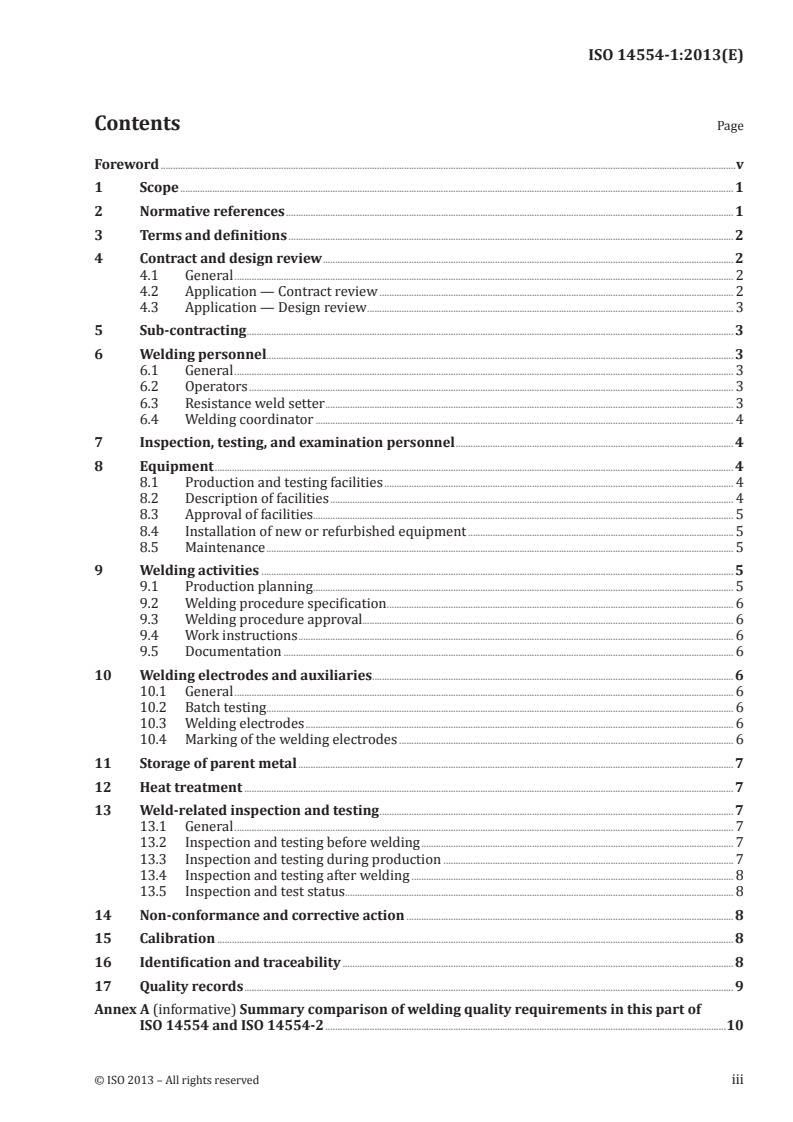
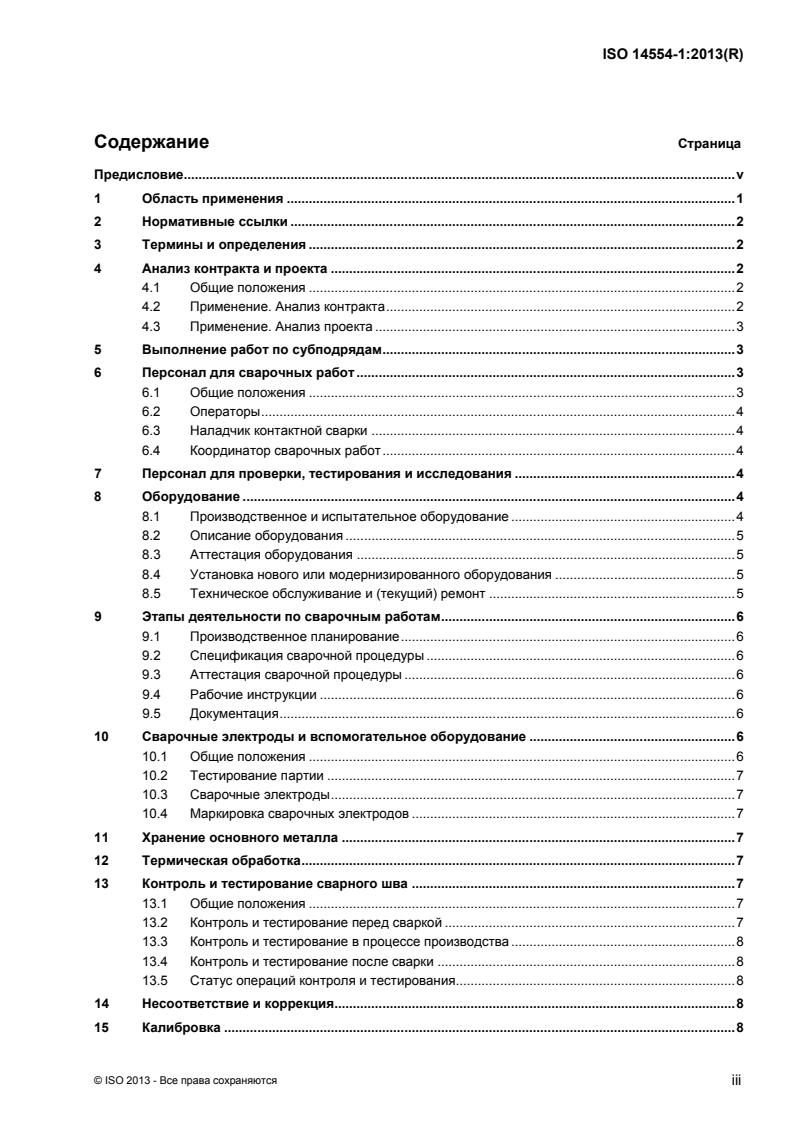
Contents Page
Foreword .v
1 Scope . 1
2 Normative references . 1
3 Terms and definitions . 2
4 Contract and design review . 2
4.1 General . 2
4.2 Application — Contract review . 2
4.3 Application — Design review . 3
5 Sub-contracting . 3
6 Welding personnel. 3
6.1 General . 3
6.2 Operators . 3
6.3 Resistance weld setter . 3
6.4 Welding coordinator . 4
7 Inspection, testing, and examination personnel . 4
8 Equipment . 4
8.1 Production and testing facilities . 4
8.2 Description of facilities . 4
8.3 Approval of facilities . . 5
8.4 Installation of new or refurbished equipment . 5
8.5 Maintenance . 5
9 Welding activities . 5
9.1 Production planning . 5
9.2 Welding procedure specification . 6
9.3 Welding procedure approval. 6
9.4 Work instructions . 6
9.5 Documentation . 6
10 Welding electrodes and auxiliaries. 6
10.1 General . 6
10.2 Batch testing . 6
10.3 Welding electrodes . 6
10.4 Marking of the welding electrodes . 6
11 Storage of parent metal . 7
12 Heat treatment . 7
13 Weld-related inspection and testing . 7
13.1 General . 7
13.2 Inspection and testing before welding . 7
13.3 Inspection and testing during production . 7
13.4 Inspection and testing after welding . 8
13.5 Inspection and test status . 8
14 Non-conformance and corrective action . 8
15 Calibration . 8
16 Identification and traceability . 8
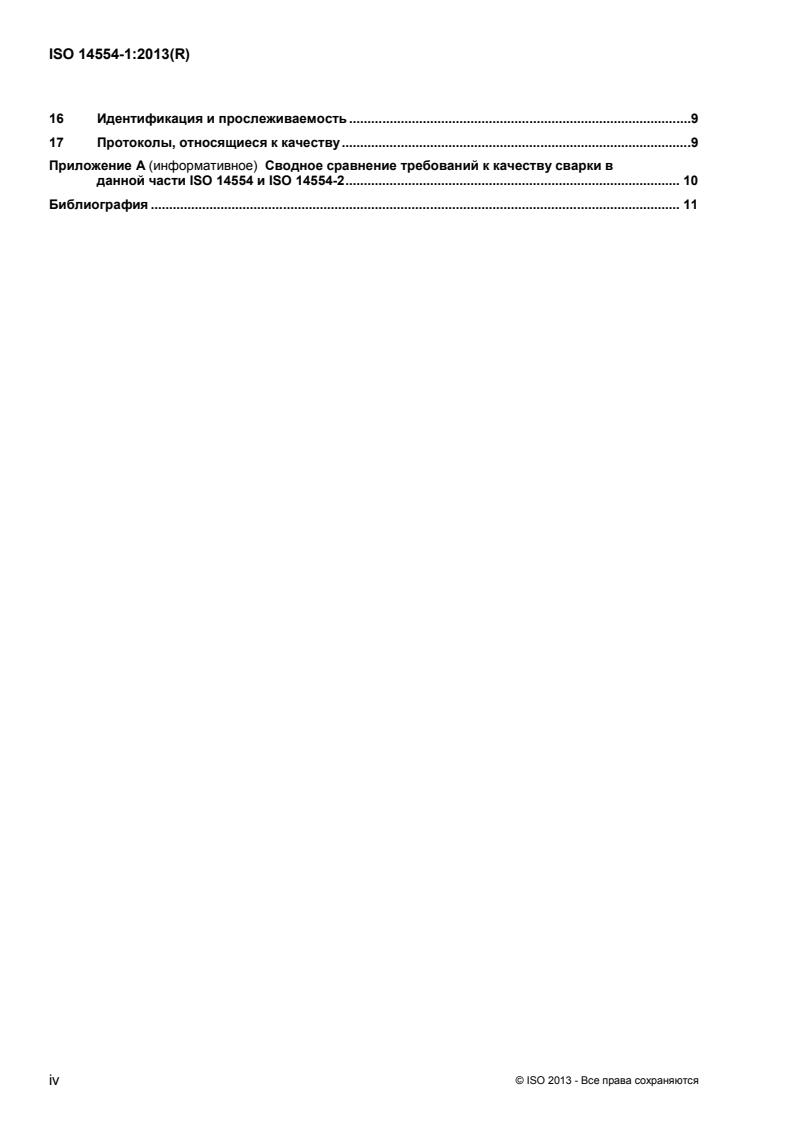
17 Quality records . 9
Annex A (informative) Summary comparison of welding quality requirements in this part of
ISO 14554 and ISO 14554-2 .10
Bibliography .11
iv © ISO 2013 – All rights reserved
Foreword
ISO (the International Organization for Standardization) is a worldwide federation of national standards
bodies (ISO member bodies). The work of preparing International Standards is normally carried out
through ISO technical committees. Each member body interested in a subject for which a technical
committee has been established has the right to be represented on that committee. International
organizations, governmental and non-governmental, in liaison with ISO, also take part in the work.
ISO collaborates closely with the International Electrotechnical Commission (IEC) on all matters of
electrotechnical standardization.
The procedures used to develop this document and those intended for its further maintenance are
described in the ISO/IEC Directives, Part 1. In particular the different approval criteria needed for the
different types of ISO documents should be noted. This document was drafted in accordance with the
editorial rules of the ISO/IEC Directives, Part 2. www.iso.org/directives
Attention is drawn to the possibility that some of the elements of this document may be the subject of
patent rights. ISO shall not be held responsible for identifying any or all such patent rights. Details of any
patent rights identified during the development of the document will be in the Introduction and/or on
the ISO list of patent declarations received. www.iso.org/patents
Any trade name used in this document is information given for the convenience of users and does not
constitute an endorsement.
For an explanation on the meaning of ISO specific terms and expressions related to conformity
assessment, as well as information about ISO’s adherence to the WTO principles in the Technical
Barriers to Trade (TBT) see the following URL: http://www.iso.org/iso/home/standards_development/
resources-for-technical-work/foreword.htm
The committee responsible for this document is ISO/TC 44, Welding and allied processes, Subcommittee
SC 6, Resistance welding and allied mechanical joining.
This second edition cancels and replaces the first edition (ISO 14551-1:2000), of which it constitutes a
minor revision.
ISO 14554 consists of the following parts, under the general title Quality requirements for welding —
Resistance welding of metallic materials:
— Part 1: Comprehensive quality requirements
— Part 2: Elementary quality requirements
Requests for official interpretations of any aspect of this part of ISO 14554 should be directed to the
Secretariat of ISO/TC 44/SC 6 via your national standards body. A complete listing of these bodies can
be found at www.iso.org.
INTERNATIONAL STANDARD ISO 14554-1:2013(E)
Quality requirements for welding — Resistance welding of
metallic materials —
Part 1:
Comprehensive quality requirements
1 Scope
This part of ISO 14554 specifies requirements for the demonstration of the capability of a manufacturer
or a sub-contractor to produce welded constructions, fulfilling specified quality requirements, in one or
more of the following:
— a contract between involved parties;
— an application standard;
— a regulatory requirement.
The requirements contained within this part of ISO 14554 can be adopted in full or can be selectively
deleted by the manufacturer if not applicable to the construction concerned. They provide a flexible
framework for the control of welding by providing specific requirements for:
— Case 1 — resistance welding in contracts which require the manufacturer or sub-contractor to have
[4]
a quality system in accordance with ISO 9001;
— Case 2 — resistance welding in contracts which require the manufacturer or sub-contractor to have
[4]
a quality system other than ISO 9001;
— Case 3 — resistance welding as guidance to a manufacturer or sub-contractor developing a
quality system;
— Case 4 — references in application standards which use resistance welding as part of their
requirements or in a contract between relevant parties, although it is more appropriate for
ISO 14554-2 to be used in such cases.
This part of ISO 14554:
— is independent of the type of welded construction to be manufactured;
— defines quality requirements for welding both in production plants and on site;
— provides guidance for describing the capability of a manufacturer to produce welded constructions
to meet specified requirements;
— can also be used as a basis for assessing the manufacturer in respect to his welding capability.
For general guidelines for selection and use, see ISO 3834-1, while being aware that only comprehensive
and elementary quality requirements are specified for resistance welding. Annex A gives a summary
comparison of specific quality requirements for resistance welding in this part of ISO 14554 and ISO 14554-2.
2 Normative references
The following documents, in whole or in part, are normatively referenced in this document and are
indispensable for its application. For dated references, only the edition cited applies. For undated
references, the latest edition of the referenced document (including any amendments) applies.
ISO 3834-1, Quality requirements for fusion welding of metallic materials — Part 1: Criteria for the selection
of the appropriate level of quality requirements
3 Terms and definitions
For the purposes of this document, the terms and definitions given in ISO 3834-1 apply.
4 Contract and design review
4.1 General
The manufacturer shall review the contractual requirements and the design data provided by the
purchaser or in-house data for construction designed by the manufacturer. This is to ensure that all
information necessary to carry out the fabrication operations is available prior to the commencement
of the work. The manufacturer shall affirm his capability to meet all welding contract requirements and
ensure adequate planning of all quality-related activities.
Contract review is performed by the manufacturer to verify that: the contract is within his capability to
carry out; sufficient resources are available to achieve delivery schedules; and documentation is clear
and unambiguous. The manufacturer should ensure any variations between the contract and previous
tender documentation are identified and the purchaser notified of any programme, cost or engineering
changes that may result.
The items in 4.2 are typically considered at or before the time of the contract review. The items in 4.3
usually form part of the design review and should be taken into account during the contract review if
the design is not carried out by the manufacturer. It shall be ensured that all relevant information has
been supplied by the purchaser.
When a contract does not exist, e.g. items made for stock, the manufacturer is required to take into
consideration the requirements of 4.2 while carrying out its design review (see 4.3).
4.2 Application — Contract review
Contractual requirements to be considered should include:
a) the application standard to be used, together with any supplementary requirements;
b) inspection and testing;
c) the specification of welding procedures, destructive and non-destructive examination procedures
and heat treatment procedures;
d) the approach to be used for welding procedure approval;
e) the approval of personnel;
f) heat treatment (for details, see Clause 12);
g) selection, identification and/or traceability, e.g. for materials, welding equipment, welders and
welds (see Clause 16);
h) quality control arrangements, including any involvement of an independent inspection body;
i) other welding requirements, e.g. surface condition of the sheets, coatings, fit up of the parts;
j) environmental conditions, e.g. main voltage cond
...
INTERNATIONAL ISO
STANDARD 14554-1
Second edition
2013-12-15
Quality requirements for welding —
Resistance welding of metallic
materials —
Part 1:
Comprehensive quality requirements
Exigences de qualité en soudage — Soudage par résistance des
matériaux métalliques —
Partie 1: Exigences de qualité complète
Reference number
©
ISO 2013
© ISO 2013
All rights reserved. Unless otherwise specified, no part of this publication may be reproduced or utilized otherwise in any form
or by any means, electronic or mechanical, including photocopying, or posting on the internet or an intranet, without prior
written permission. Permission can be requested from either ISO at the address below or ISO’s member body in the country of
the requester.
ISO copyright office
Case postale 56 • CH-1211 Geneva 20
Tel. + 41 22 749 01 11
Fax + 41 22 749 09 47
E-mail copyright@iso.org
Web www.iso.org
Published in Switzerland
ii © ISO 2013 – All rights reserved
Contents Page
Foreword .v
1 Scope . 1
2 Normative references . 1
3 Terms and definitions . 2
4 Contract and design review . 2
4.1 General . 2
4.2 Application — Contract review . 2
4.3 Application — Design review . 3
5 Sub-contracting . 3
6 Welding personnel. 3
6.1 General . 3
6.2 Operators . 3
6.3 Resistance weld setter . 3
6.4 Welding coordinator . 4
7 Inspection, testing, and examination personnel . 4
8 Equipment . 4
8.1 Production and testing facilities . 4
8.2 Description of facilities . 4
8.3 Approval of facilities . . 5
8.4 Installation of new or refurbished equipment . 5
8.5 Maintenance . 5
9 Welding activities . 5
9.1 Production planning . 5
9.2 Welding procedure specification . 6
9.3 Welding procedure approval. 6
9.4 Work instructions . 6
9.5 Documentation . 6
10 Welding electrodes and auxiliaries. 6
10.1 General . 6
10.2 Batch testing . 6
10.3 Welding electrodes . 6
10.4 Marking of the welding electrodes . 6
11 Storage of parent metal . 7
12 Heat treatment . 7
13 Weld-related inspection and testing . 7
13.1 General . 7
13.2 Inspection and testing before welding . 7
13.3 Inspection and testing during production . 7
13.4 Inspection and testing after welding . 8
13.5 Inspection and test status . 8
14 Non-conformance and corrective action . 8
15 Calibration . 8
16 Identification and traceability . 8
17 Quality records . 9
Annex A (informative) Summary comparison of welding quality requirements in this part of
ISO 14554 and ISO 14554-2 .10
Bibliography .11
iv © ISO 2013 – All rights reserved
Foreword
ISO (the International Organization for Standardization) is a worldwide federation of national standards
bodies (ISO member bodies). The work of preparing International Standards is normally carried out
through ISO technical committees. Each member body interested in a subject for which a technical
committee has been established has the right to be represented on that committee. International
organizations, governmental and non-governmental, in liaison with ISO, also take part in the work.
ISO collaborates closely with the International Electrotechnical Commission (IEC) on all matters of
electrotechnical standardization.
The procedures used to develop this document and those intended for its further maintenance are
described in the ISO/IEC Directives, Part 1. In particular the different approval criteria needed for the
different types of ISO documents should be noted. This document was drafted in accordance with the
editorial rules of the ISO/IEC Directives, Part 2. www.iso.org/directives
Attention is drawn to the possibility that some of the elements of this document may be the subject of
patent rights. ISO shall not be held responsible for identifying any or all such patent rights. Details of any
patent rights identified during the development of the document will be in the Introduction and/or on
the ISO list of patent declarations received. www.iso.org/patents
Any trade name used in this document is information given for the convenience of users and does not
constitute an endorsement.
For an explanation on the meaning of ISO specific terms and expressions related to conformity
assessment, as well as information about ISO’s adherence to the WTO principles in the Technical
Barriers to Trade (TBT) see the following URL: http://www.iso.org/iso/home/standards_development/
resources-for-technical-work/foreword.htm
The committee responsible for this document is ISO/TC 44, Welding and allied processes, Subcommittee
SC 6, Resistance welding and allied mechanical joining.
This second edition cancels and replaces the first edition (ISO 14551-1:2000), of which it constitutes a
minor revision.
ISO 14554 consists of the following parts, under the general title Quality requirements for welding —
Resistance welding of metallic materials:
— Part 1: Comprehensive quality requirements
— Part 2: Elementary quality requirements
Requests for official interpretations of any aspect of this part of ISO 14554 should be directed to the
Secretariat of ISO/TC 44/SC 6 via your national standards body. A complete listing of these bodies can
be found at www.iso.org.
INTERNATIONAL STANDARD ISO 14554-1:2013(E)
Quality requirements for welding — Resistance welding of
metallic materials —
Part 1:
Comprehensive quality requirements
1 Scope
This part of ISO 14554 specifies requirements for the demonstration of the capability of a manufacturer
or a sub-contractor to produce welded constructions, fulfilling specified quality requirements, in one or
more of the following:
— a contract between involved parties;
— an application standard;
— a regulatory requirement.
The requirements contained within this part of ISO 14554 can be adopted in full or can be selectively
deleted by the manufacturer if not applicable to the construction concerned. They provide a flexible
framework for the control of welding by providing specific requirements for:
— Case 1 — resistance welding in contracts which require the manufacturer or sub-contractor to have
[4]
a quality system in accordance with ISO 9001;
— Case 2 — resistance welding in contracts which require the manufacturer or sub-contractor to have
[4]
a quality system other than ISO 9001;
— Case 3 — resistance welding as guidance to a manufacturer or sub-contractor developing a
quality system;
— Case 4 — references in application standards which use resistance welding as part of their
requirements or in a contract between relevant parties, although it is more appropriate for
ISO 14554-2 to be used in such cases.
This part of ISO 14554:
— is independent of the type of welded construction to be manufactured;
— defines quality requirements for welding both in production plants and on site;
— provides guidance for describing the capability of a manufacturer to produce welded constructions
to meet specified requirements;
— can also be used as a basis for assessing the manufacturer in respect to his welding capability.
For general guidelines for selection and use, see ISO 3834-1, while being aware that only comprehensive
and elementary quality requirements are specified for resistance welding. Annex A gives a summary
comparison of specific quality requirements for resistance welding in this part of ISO 14554 and ISO 14554-2.
2 Normative references
The following documents, in whole or in part, are normatively referenced in this document and are
indispensable for its application. For dated references, only the edition cited applies. For undated
references, the latest edition of the referenced document (including any amendments) applies.
ISO 3834-1, Quality requirements for fusion welding of metallic materials — Part 1: Criteria for the selection
of the appropriate level of quality requirements
3 Terms and definitions
For the purposes of this document, the terms and definitions given in ISO 3834-1 apply.
4 Contract and design review
4.1 General
The manufacturer shall review the contractual requirements and the design data provided by the
purchaser or in-house data for construction designed by the manufacturer. This is to ensure that all
information necessary to carry out the fabrication operations is available prior to the commencement
of the work. The manufacturer shall affirm his capability to meet all welding contract requirements and
ensure adequate planning of all quality-related activities.
Contract review is performed by the manufacturer to verify that: the contract is within his capability to
carry out; sufficient resources are available to achieve delivery schedules; and documentation is clear
and unambiguous. The manufacturer should ensure any variations between the contract and previous
tender documentation are identified and the purchaser notified of any programme, cost or engineering
changes that may result.
The items in 4.2 are typically considered at or before the time of the contract review. The items in 4.3
usually form part of the design review and should be taken into account during the contract review if
the design is not carried out by the manufacturer. It shall be ensured that all relevant information has
been supplied by the purchaser.
When a contract does not exist, e.g. items made for stock, the manufacturer is required to take into
consideration the requirements of 4.2 while carrying out its design review (see 4.3).
4.2 Application — Contract review
Contractual requirements to be considered should include:
a) the application standard to be used, together with any supplementary requirements;
b) inspection and testing;
c) the specification of welding procedures, destructive and non-destructive examination procedures
and heat treatment procedures;
d) the approach to be used for welding procedure approval;
e) the approval of personnel;
f) heat treatment (for details, see Clause 12);
g) selection, identification and/or traceability, e.g. for materials, welding equipment, welders and
welds (see Clause 16);
h) quality control arrangements, including any involvement of an independent inspection body;
i) other welding requirements, e.g. surface condition of the sheets, coatings, fit up of the parts;
j) environmental conditions, e.g. main voltage cond
...
NORME ISO
INTERNATIONALE 14554-1
Deuxième édition
2013-12-15
Exigences de qualité en soudage —
Soudage par résistance des matériaux
métalliques —
Partie 1:
Exigences de qualité complète
Quality requirements for welding — Resistance welding of metallic
materials —
Part 1: Comprehensive quality requirements
Numéro de référence
©
ISO 2013
DOCUMENT PROTÉGÉ PAR COPYRIGHT
© ISO 2013
Droits de reproduction réservés. Sauf indication contraire, aucune partie de cette publication ne peut être reproduite ni utilisée
sous quelque forme que ce soit et par aucun procédé, électronique ou mécanique, y compris la photocopie, l’affichage sur
l’internet ou sur un Intranet, sans autorisation écrite préalable. Les demandes d’autorisation peuvent être adressées à l’ISO à
l’adresse ci-après ou au comité membre de l’ISO dans le pays du demandeur.
ISO copyright office
Case postale 56 • CH-1211 Geneva 20
Tel. + 41 22 749 01 11
Fax + 41 22 749 09 47
E-mail copyright@iso.org
Web www.iso.org
Publié en Suisse
ii © ISO 2013 – Tous droits réservés
Sommaire Page
Avant-propos .v
1 Domaine d’application . 1
2 Références normatives . 2
3 Termes et définitions . 2
4 Revue de contrat et du dossier de conception . 2
4.1 Généralités . 2
4.2 Application — Revue de contrat . 2
4.3 Application — Revue du dossier de conception . 3
5 Sous-traitance . 3
6 Personnel en soudage . 4
6.1 Généralités . 4
6.2 Opérateurs . 4
6.3 Régleur sur machine de soudage par résistance . 4
6.4 Coordonnateur en soudage . 4
7 Personnel chargé des contrôles, essais et examens . 4
8 Matériels . 4
8.1 Matériels de production et d’essai . 4
8.2 Description des installations . 5
8.3 Qualification du matériel . . 5
8.4 Installation de matériel neuf ou de matériel révisé . 5
8.5 Entretien . 5
9 Activités de soudage. 6
9.1 Planification de la production . 6
9.2 Descriptif du mode opératoire de soudage (DMOS) . 6
9.3 Qualification du mode opératoire de soudage . 6
9.4 Instructions de travail . 6
9.5 Documentation . 6
10 Électrodes et accessoires pour le soudage . 7
10.1 Généralités . 7
10.2 Contrôle par lots . 7
10.3 Electrodes de soudage . 7
10.4 Identification des électrodes de soudage . 7
11 Stockage des matériaux de base. 7
12 Traitement thermique . 7
13 Contrôles, essais et examens liés au soudage . 7
13.1 Généralités . 7
13.2 Contrôles, essais et examens avant le soudage . 8
13.3 Contrôles, essais et examens en cours de fabrication . 8
13.4 Contrôles, essais et examens après soudage . 8
13.5 État des contrôles, essais. 8
14 Non-conformités et mesures correctives . 9
15 Étalonnage . 9
16 Identification et traçabilité. 9
17 Enregistrements relatifs à la qualité . 9
Annexe A (informative) Résumé comparatif des exigences de qualité en soudage selonla présente
partie de l’ISO 14554 et l’ISO 14554-2 .11
Bibliographie .12
iv © ISO 2013 – Tous droits réservés
Avant-propos
L’ISO (Organisation internationale de normalisation) est une fédération mondiale d’organismes
nationaux de normalisation (comités membres de l’ISO). L’élaboration des Normes internationales est
en général confiée aux comités techniques de l’ISO. Chaque comité membre intéressé par une étude
a le droit de faire partie du comité technique créé à cet effet. Les organisations internationales,
gouvernementales et non gouvernementales, en liaison avec l’ISO participent également aux travaux.
L’ISO collabore étroitement avec la Commission électrotechnique internationale (CEI) en ce qui concerne
la normalisation électrotechnique.
Les procédures utilisées pour élaborer le présent document et celles destinées à sa mise à jour sont
décrites dans les Directives ISO/CEI, Partie 1. Il convient, en particulier de prendre note des différents
critères d’approbation requis pour les différents types de documents ISO. Le présent document a été
rédigé conformément aux règles de rédaction données dans les Directives ISO/CEI, Partie 2, www.iso.
org/directives.
L’attention est appelée sur le fait que certains des éléments du présent document peuvent faire l’objet de
droits de propriété intellectuelle ou de droits analogues. L’ISO ne saurait être tenue pour responsable
de ne pas avoir identifié de tels droits de propriété et averti de leur existence. Les détails concernant les
références aux droits de propriété intellectuelle ou autres droits analogues identifiés lors de l’élaboration
du document sont indiqués dans l’Introduction et/ou sur la liste ISO des déclarations de brevets reçues,
www.iso.org/patents.
Les éventuelles appellations commerciales utilisées dans le présent document sont données pour
information à l’intention des utilisateurs et ne constituent pas une approbation ou une recommandation.
Pour une explication de la signification des termes et expressions spécifiques de l’ISO liés à l’évaluation
de la conformité, aussi bien que pour des informations au-sujet de l’adhésion de l’ISO aux principes
de l’OMC concernant les obstacles techniques au commerce (OTC) voir le lien suivant: Foreword -
Supplementary information
Le comité chargé de l’élaboration du présent document est l’ISO/TC 44, Soudage et techniques connexes,
sous-comité SC 6, Soudage par résistance et assemblage mécanique allié.
Cette deuxième édition annule et remplace la première édition (ISO 14554-1:2000), qui a fait l’objet
d’une révision technique.
L’ISO 14554 comprend les parties suivantes, présentées sous le titre général Exigences de qualité en
soudage — Soudage par résistance des matériaux métalliques:
— Partie 1: Exigences de qualité complète
— Partie 2: Exigences de qualité élémentaire
Il convient que des demandes d’interprétations officielles de tout aspect de la présente partie de
l’ISO 14554 soient envoyées au Secrétariat de l’ISO/TC 44/SC 6 via votre organisme de normalisation
nationale. Une liste complète des ces organismes peut être obtenue sur www.iso.org.
NORME INTERNATIONALE ISO 14554-1:2013(F)
Exigences de qualité en soudage — Soudage par résistance
des matériaux métalliques —
Partie 1:
Exigences de qualité complète
1 Domaine d’application
La présente partie de l’ISO 14554 spécifie des exigences concernant la démonstration de la capacité d’un
constructeur, d’un fabricant ou d’un sous-traitant à produire des structures soudées en répondant aux
exigences de qualité stipulées dans un ou plusieurs des documents suivants:
— un contrat conclu entre les parties intéressées;
— une norme d’application;
— des exigences de caractère réglementaire.
Les exigences énoncées dans la présente partie de l’ISO 14554 peuvent être adoptées dans leur ensemble,
ou bien certaines d’entre elles peuvent être supprimées par le constructeur ou le fabricant, si elles ne
s’appliquent pas à la construction considérée. Elles fournissent un cadre souple pour le contrôle du
soudage dans les cas suivants:
— Premier cas — fournir des exigences spécifiques pour le soudage par résistance dans les contrats qui
exigent que le constructeur, le fabricant ou le sous-traitant dispose d’un système qualité conforme
[4]
à l’ISO 9001;
— Deuxième cas — fournir des exigences spécifiques pour le soudage par résistance dans les contrats
qui exigent que le constructeur, le fabricant ou le sous-traitant dispose d’un système qualité autre
[4]
que celui de l’ISO 9001.
— Troisième cas — fournir des exigences spécifiques pour le soudage par résistance en tant que guide
à l’intention d’un constructeur, d’un fabricant ou d’un sous-traitant élaborant un système qualité.
— Quatrième cas — fournir des exigences spécifiques pour références dans les normes d’application
qui utilisent le soudage par résistance comme partie de leurs exigences ou dans un contrat entre les
parties concernées. Il est parfois plus approprié d’utiliser l’ISO 14554-2 dans de tels cas.
La présente partie de l’ISO 14554
— est indépendante du type de construction soudée dont la fabrication est envisagée,
— définit les exigences de qualité pour le soudage, aussi bien dans les usines de production que sur site,
— fournit des orientations pour décrire l’aptitude d’un constructeur ou d’un fabricant à produire des
structures soudées de la qualité requise, et
— peut également servir de base pour l’évaluation du constructeur ou du fabricant, en ce qui concerne
ses capacités en soudage.
Voir l’ISO 3834-1 pour la sélection et l’utilisation des lignes directrices, et en considérant que pour le
soudage par résistance, seules des exigences de qualité complète et élémentaire sont définies. L’Annexe A
donne un résumé comparatif des exigences de qualité en soudage selon la présente partie de l’ISO 14554
et l’ISO 14554-2.
2 Références normatives
Les documents suivants, en totalité ou en partie, sont référencés de manière normative dans le présent
document et sont indispensables pour son application. Pour les références datées, seule l’édition citée
s’applique. Pour les références non datées, la dernière édition du document de référence s’applique (y
compris les éventuels amendements).
ISO 3834-1, Exigences de qualité en soudage par fusion des matériaux métalliques — Partie 1: Critères pour
la sélection du niveau approprié d’exigences de qualité
3 Termes et définitions
Pour les besoins du présent document, les termes et définitions donnés dans l’ISO 3834-1 s’appliquent.
4 Revue de contrat et du dossier de conception
4.1 Généralités
Le constructeur ou le fabricant doit passer en revue les exigences contractuelles et les données du
dossier de conception fournies par l’acheteur, ou les données existant au sein de son entreprise pour la
construction conçue par le constructeur ou le fabricant. Cette revue est destinée à s’assurer que tous les
renseignements nécessaires à l’accomplissement des opérations de fabrication sont disponibles avant le
commencement des travaux. Le constructeur ou le fabricant doit confirmer sa capacité de satisfaire à
toutes les exigences contractuelles visant le soudage, et doit assurer une bonne planification de toutes
activités relatives à la qualité.
La revue de contrat est faite par le constructeur ou le fabricant afin de vérifier qu’il est apte à accomplir
le contrat, qu’il dispose de moyens suffisants pour assurer les livraisons conformément au calendrier, et
que la documentation est claire et sans ambiguïté. Il est recommandé que le constructeur ou le fabricant
s’assure que d’éventuelles variations entre le contrat et la documentation préalable de l’appel d’offres ont
été identifiées et que l’acheteur a été prévenu de toute modification de programme, de coût ou technique
qui en résulterait.
Les éléments contenus en 4.2 sont examinés typiquement à l’occasion de la revue de contrat ou avant
celle-ci. Les éléments contenus en 4.3 font normalement partie de la revue du dossier de conception. Il
est recommandé de les prendre en compte pendant la revue de contrat si la conception n’est pas réalisée
par le constructeur ou le fabricant. On doit s’assurer que toutes les informations pertinentes ont été
fournies par l’acheteur.
Lorsqu’aucun contrat n’existe, par exemple lorsque des pièces sont fabriquées pour constituer le stock,
le constructeur ou le fabricant doit prendre en considération les spécifications de 4.2 au moment de la
revue de conception (voir 4.3).
4.2 Application — Revue de contrat
Parmi les exigences contractuelles qu’il est recommandé de prendre en considération, on peut citer:
a) la norme d’application à utiliser, ainsi que les exigences complémentaires éventuelles;
b) les contrôles et les essais;
c) la spécification des modes opératoires de soudage, d’essai destructif et de contrôle non-destructif et
de traitement thermique;
d) la démarche à suivre pour la qualification du mode opératoire de soudage;
e) la qualification du personnel;
f) les traitements thermiques (pour plus d’informations, voir Article 12);
2 © ISO 2013 – Tous droits réservés
g) le choix, l’identification et/ou la traçabilité, par exemple pour les matériaux, le matériel de soudage,
les soudeurs et les soudures (voir Article 16);
h) les dispositions de maîtrise de la qualité, y compris toute intervention d’un organisme de
contrôle indépendant;
i) toutes autres exigences relatives au soudage, par exemple état de surface des tôles minces,
revêtements, accostage des pièces;
j) les conditions d’environnement, par exemple la tension du réseau, une température ambiante très
[1]
élevée ou très basse, une humidité importante (voir ISO 669 );
k) la sous-traitance;
l) le traitement des non-conformités.
4.3 Application — Revue du dossier de conception
Parmi les exigences relatives à la conception qu’il est recommandé de prendre en considération, on peut citer:
a) le procédé de soudage ou les variables du procédé de soudage;
b) le matériel de soudage ou les électrodes de soudage;
c) l’utilisation de méthodes spéciales, par exemple le soudage avec contre-électrodes, le soudage avec
gaz de protection ou fluides de protection, le soudage avec électrode intermédiaire;
d) la localisation, l’accessibilité et la séquence à respecter pour toutes les soudures;
e) la finition et la configuration de la soudure, par exemple empreinte excessive de l’électrode ou, en
soudage par écrasement, épaisseur excessive de la soudure;
f) la spécification du métal (ou des métaux) de base et les caractéristiques des joints soudés;
g) les soudures à réaliser dans les ateliers de production ou sur site;
h) les dimensions initiales et finales des éléments soudés, et toute préparation spéciale de la surface
ou des bords;
i) les exigences relatives à la qualité et à l’acceptation des soudures;
j) autres exigences spécifiques, par exemple finition de surface, traitement thermique, adhésif, mastic,
enduit primaire.
5 Sous-traitance
Lorsqu’un constructeur ou un fabricant a l’intention
...
NORME ISO
INTERNATIONALE 14554-1
Deuxième édition
2013-12-15
Exigences de qualité en soudage —
Soudage par résistance des matériaux
métalliques —
Partie 1:
Exigences de qualité complète
Quality requirements for welding — Resistance welding of metallic
materials —
Part 1: Comprehensive quality requirements
Numéro de référence
©
ISO 2013
DOCUMENT PROTÉGÉ PAR COPYRIGHT
© ISO 2013
Droits de reproduction réservés. Sauf indication contraire, aucune partie de cette publication ne peut être reproduite ni utilisée
sous quelque forme que ce soit et par aucun procédé, électronique ou mécanique, y compris la photocopie, l’affichage sur
l’internet ou sur un Intranet, sans autorisation écrite préalable. Les demandes d’autorisation peuvent être adressées à l’ISO à
l’adresse ci-après ou au comité membre de l’ISO dans le pays du demandeur.
ISO copyright office
Case postale 56 • CH-1211 Geneva 20
Tel. + 41 22 749 01 11
Fax + 41 22 749 09 47
E-mail copyright@iso.org
Web www.iso.org
Publié en Suisse
ii © ISO 2013 – Tous droits réservés
Sommaire Page
Avant-propos .v
1 Domaine d’application . 1
2 Références normatives . 2
3 Termes et définitions . 2
4 Revue de contrat et du dossier de conception . 2
4.1 Généralités . 2
4.2 Application — Revue de contrat . 2
4.3 Application — Revue du dossier de conception . 3
5 Sous-traitance . 3
6 Personnel en soudage . 4
6.1 Généralités . 4
6.2 Opérateurs . 4
6.3 Régleur sur machine de soudage par résistance . 4
6.4 Coordonnateur en soudage . 4
7 Personnel chargé des contrôles, essais et examens . 4
8 Matériels . 4
8.1 Matériels de production et d’essai . 4
8.2 Description des installations . 5
8.3 Qualification du matériel . . 5
8.4 Installation de matériel neuf ou de matériel révisé . 5
8.5 Entretien . 5
9 Activités de soudage. 6
9.1 Planification de la production . 6
9.2 Descriptif du mode opératoire de soudage (DMOS) . 6
9.3 Qualification du mode opératoire de soudage . 6
9.4 Instructions de travail . 6
9.5 Documentation . 6
10 Électrodes et accessoires pour le soudage . 7
10.1 Généralités . 7
10.2 Contrôle par lots . 7
10.3 Electrodes de soudage . 7
10.4 Identification des électrodes de soudage . 7
11 Stockage des matériaux de base. 7
12 Traitement thermique . 7
13 Contrôles, essais et examens liés au soudage . 7
13.1 Généralités . 7
13.2 Contrôles, essais et examens avant le soudage . 8
13.3 Contrôles, essais et examens en cours de fabrication . 8
13.4 Contrôles, essais et examens après soudage . 8
13.5 État des contrôles, essais. 8
14 Non-conformités et mesures correctives . 9
15 Étalonnage . 9
16 Identification et traçabilité. 9
17 Enregistrements relatifs à la qualité . 9
Annexe A (informative) Résumé comparatif des exigences de qualité en soudage selonla présente
partie de l’ISO 14554 et l’ISO 14554-2 .11
Bibliographie .12
iv © ISO 2013 – Tous droits réservés
Avant-propos
L’ISO (Organisation internationale de normalisation) est une fédération mondiale d’organismes
nationaux de normalisation (comités membres de l’ISO). L’élaboration des Normes internationales est
en général confiée aux comités techniques de l’ISO. Chaque comité membre intéressé par une étude
a le droit de faire partie du comité technique créé à cet effet. Les organisations internationales,
gouvernementales et non gouvernementales, en liaison avec l’ISO participent également aux travaux.
L’ISO collabore étroitement avec la Commission électrotechnique internationale (CEI) en ce qui concerne
la normalisation électrotechnique.
Les procédures utilisées pour élaborer le présent document et celles destinées à sa mise à jour sont
décrites dans les Directives ISO/CEI, Partie 1. Il convient, en particulier de prendre note des différents
critères d’approbation requis pour les différents types de documents ISO. Le présent document a été
rédigé conformément aux règles de rédaction données dans les Directives ISO/CEI, Partie 2, www.iso.
org/directives.
L’attention est appelée sur le fait que certains des éléments du présent document peuvent faire l’objet de
droits de propriété intellectuelle ou de droits analogues. L’ISO ne saurait être tenue pour responsable
de ne pas avoir identifié de tels droits de propriété et averti de leur existence. Les détails concernant les
références aux droits de propriété intellectuelle ou autres droits analogues identifiés lors de l’élaboration
du document sont indiqués dans l’Introduction et/ou sur la liste ISO des déclarations de brevets reçues,
www.iso.org/patents.
Les éventuelles appellations commerciales utilisées dans le présent document sont données pour
information à l’intention des utilisateurs et ne constituent pas une approbation ou une recommandation.
Pour une explication de la signification des termes et expressions spécifiques de l’ISO liés à l’évaluation
de la conformité, aussi bien que pour des informations au-sujet de l’adhésion de l’ISO aux principes
de l’OMC concernant les obstacles techniques au commerce (OTC) voir le lien suivant: Foreword -
Supplementary information
Le comité chargé de l’élaboration du présent document est l’ISO/TC 44, Soudage et techniques connexes,
sous-comité SC 6, Soudage par résistance et assemblage mécanique allié.
Cette deuxième édition annule et remplace la première édition (ISO 14554-1:2000), qui a fait l’objet
d’une révision technique.
L’ISO 14554 comprend les parties suivantes, présentées sous le titre général Exigences de qualité en
soudage — Soudage par résistance des matériaux métalliques:
— Partie 1: Exigences de qualité complète
— Partie 2: Exigences de qualité élémentaire
Il convient que des demandes d’interprétations officielles de tout aspect de la présente partie de
l’ISO 14554 soient envoyées au Secrétariat de l’ISO/TC 44/SC 6 via votre organisme de normalisation
nationale. Une liste complète des ces organismes peut être obtenue sur www.iso.org.
NORME INTERNATIONALE ISO 14554-1:2013(F)
Exigences de qualité en soudage — Soudage par résistance
des matériaux métalliques —
Partie 1:
Exigences de qualité complète
1 Domaine d’application
La présente partie de l’ISO 14554 spécifie des exigences concernant la démonstration de la capacité d’un
constructeur, d’un fabricant ou d’un sous-traitant à produire des structures soudées en répondant aux
exigences de qualité stipulées dans un ou plusieurs des documents suivants:
— un contrat conclu entre les parties intéressées;
— une norme d’application;
— des exigences de caractère réglementaire.
Les exigences énoncées dans la présente partie de l’ISO 14554 peuvent être adoptées dans leur ensemble,
ou bien certaines d’entre elles peuvent être supprimées par le constructeur ou le fabricant, si elles ne
s’appliquent pas à la construction considérée. Elles fournissent un cadre souple pour le contrôle du
soudage dans les cas suivants:
— Premier cas — fournir des exigences spécifiques pour le soudage par résistance dans les contrats qui
exigent que le constructeur, le fabricant ou le sous-traitant dispose d’un système qualité conforme
[4]
à l’ISO 9001;
— Deuxième cas — fournir des exigences spécifiques pour le soudage par résistance dans les contrats
qui exigent que le constructeur, le fabricant ou le sous-traitant dispose d’un système qualité autre
[4]
que celui de l’ISO 9001.
— Troisième cas — fournir des exigences spécifiques pour le soudage par résistance en tant que guide
à l’intention d’un constructeur, d’un fabricant ou d’un sous-traitant élaborant un système qualité.
— Quatrième cas — fournir des exigences spécifiques pour références dans les normes d’application
qui utilisent le soudage par résistance comme partie de leurs exigences ou dans un contrat entre les
parties concernées. Il est parfois plus approprié d’utiliser l’ISO 14554-2 dans de tels cas.
La présente partie de l’ISO 14554
— est indépendante du type de construction soudée dont la fabrication est envisagée,
— définit les exigences de qualité pour le soudage, aussi bien dans les usines de production que sur site,
— fournit des orientations pour décrire l’aptitude d’un constructeur ou d’un fabricant à produire des
structures soudées de la qualité requise, et
— peut également servir de base pour l’évaluation du constructeur ou du fabricant, en ce qui concerne
ses capacités en soudage.
Voir l’ISO 3834-1 pour la sélection et l’utilisation des lignes directrices, et en considérant que pour le
soudage par résistance, seules des exigences de qualité complète et élémentaire sont définies. L’Annexe A
donne un résumé comparatif des exigences de qualité en soudage selon la présente partie de l’ISO 14554
et l’ISO 14554-2.
2 Références normatives
Les documents suivants, en totalité ou en partie, sont référencés de manière normative dans le présent
document et sont indispensables pour son application. Pour les références datées, seule l’édition citée
s’applique. Pour les références non datées, la dernière édition du document de référence s’applique (y
compris les éventuels amendements).
ISO 3834-1, Exigences de qualité en soudage par fusion des matériaux métalliques — Partie 1: Critères pour
la sélection du niveau approprié d’exigences de qualité
3 Termes et définitions
Pour les besoins du présent document, les termes et définitions donnés dans l’ISO 3834-1 s’appliquent.
4 Revue de contrat et du dossier de conception
4.1 Généralités
Le constructeur ou le fabricant doit passer en revue les exigences contractuelles et les données du
dossier de conception fournies par l’acheteur, ou les données existant au sein de son entreprise pour la
construction conçue par le constructeur ou le fabricant. Cette revue est destinée à s’assurer que tous les
renseignements nécessaires à l’accomplissement des opérations de fabrication sont disponibles avant le
commencement des travaux. Le constructeur ou le fabricant doit confirmer sa capacité de satisfaire à
toutes les exigences contractuelles visant le soudage, et doit assurer une bonne planification de toutes
activités relatives à la qualité.
La revue de contrat est faite par le constructeur ou le fabricant afin de vérifier qu’il est apte à accomplir
le contrat, qu’il dispose de moyens suffisants pour assurer les livraisons conformément au calendrier, et
que la documentation est claire et sans ambiguïté. Il est recommandé que le constructeur ou le fabricant
s’assure que d’éventuelles variations entre le contrat et la documentation préalable de l’appel d’offres ont
été identifiées et que l’acheteur a été prévenu de toute modification de programme, de coût ou technique
qui en résulterait.
Les éléments contenus en 4.2 sont examinés typiquement à l’occasion de la revue de contrat ou avant
celle-ci. Les éléments contenus en 4.3 font normalement partie de la revue du dossier de conception. Il
est recommandé de les prendre en compte pendant la revue de contrat si la conception n’est pas réalisée
par le constructeur ou le fabricant. On doit s’assurer que toutes les informations pertinentes ont été
fournies par l’acheteur.
Lorsqu’aucun contrat n’existe, par exemple lorsque des pièces sont fabriquées pour constituer le stock,
le constructeur ou le fabricant doit prendre en considération les spécifications de 4.2 au moment de la
revue de conception (voir 4.3).
4.2 Application — Revue de contrat
Parmi les exigences contractuelles qu’il est recommandé de prendre en considération, on peut citer:
a) la norme d’application à utiliser, ainsi que les exigences complémentaires éventuelles;
b) les contrôles et les essais;
c) la spécification des modes opératoires de soudage, d’essai destructif et de contrôle non-destructif et
de traitement thermique;
d) la démarche à suivre pour la qualification du mode opératoire de soudage;
e) la qualification du personnel;
f) les traitements thermiques (pour plus d’informations, voir Article 12);
2 © ISO 2013 – Tous droits réservés
g) le choix, l’identification et/ou la traçabilité, par exemple pour les matériaux, le matériel de soudage,
les soudeurs et les soudures (voir Article 16);
h) les dispositions de maîtrise de la qualité, y compris toute intervention d’un organisme de
contrôle indépendant;
i) toutes autres exigences relatives au soudage, par exemple état de surface des tôles minces,
revêtements, accostage des pièces;
j) les conditions d’environnement, par exemple la tension du réseau, une température ambiante très
[1]
élevée ou très basse, une humidité importante (voir ISO 669 );
k) la sous-traitance;
l) le traitement des non-conformités.
4.3 Application — Revue du dossier de conception
Parmi les exigences relatives à la conception qu’il est recommandé de prendre en considération, on peut citer:
a) le procédé de soudage ou les variables du procédé de soudage;
b) le matériel de soudage ou les électrodes de soudage;
c) l’utilisation de méthodes spéciales, par exemple le soudage avec contre-électrodes, le soudage avec
gaz de protection ou fluides de protection, le soudage avec électrode intermédiaire;
d) la localisation, l’accessibilité et la séquence à respecter pour toutes les soudures;
e) la finition et la configuration de la soudure, par exemple empreinte excessive de l’électrode ou, en
soudage par écrasement, épaisseur excessive de la soudure;
f) la spécification du métal (ou des métaux) de base et les caractéristiques des joints soudés;
g) les soudures à réaliser dans les ateliers de production ou sur site;
h) les dimensions initiales et finales des éléments soudés, et toute préparation spéciale de la surface
ou des bords;
i) les exigences relatives à la qualité et à l’acceptation des soudures;
j) autres exigences spécifiques, par exemple finition de surface, traitement thermique, adhésif, mastic,
enduit primaire.
5 Sous-traitance
Lorsqu’un constructeur ou un fabricant a l’intention
...
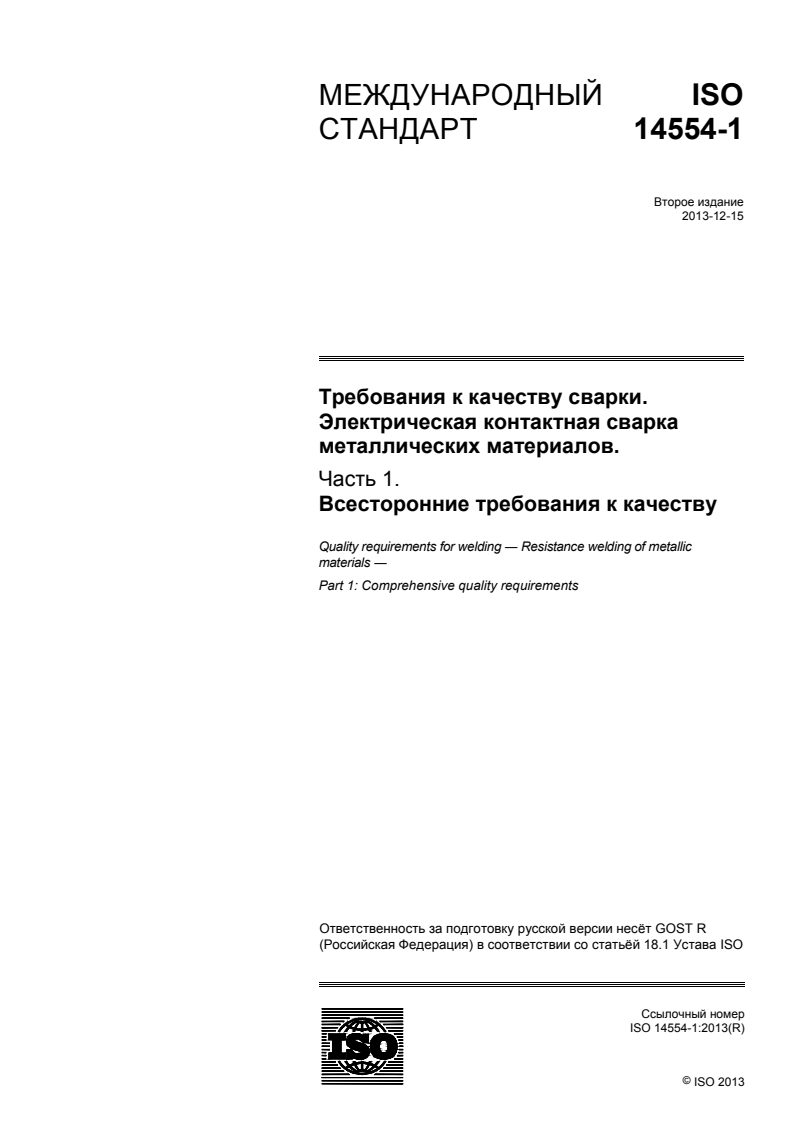
МЕЖДУНАРОДНЫЙ ISO
СТАНДАРТ 14554-1
Второе издание
2013-12-15
Требования к качеству сварки.
Электрическая контактная сварка
металлических материалов.
Часть 1.
Всесторонние требования к качеству
Quality requirements for welding ― Resistance welding of metallic
materials ―
Part 1: Comprehensive quality requirements
Ответственность за подготовку русской версии несёт GOST R
(Российская Федерация) в соответствии со статьёй 18.1 Устава ISO
Ссылочный номер
©
ISO 2013
ДОКУМЕНТ ЗАЩИЩЕН АВТОРСКИМ ПРАВОМ
Все права сохраняются. Если не указано иное, никакую часть настоящей публикации нельзя копировать или использовать в
какой-либо форме или каким-либо электронным или механическим способом, включая фотокопии и микрофильмы, без
предварительного письменного согласия ISO, которое должно быть получено после запроса о разрешении, направленного по
адресу, приведенному ниже, или в комитет-член ISO в стране запрашивающей стороны.
ISO copyright office
Case postale 56 • CH-1211 Geneva 20
Tel. + 41 22 749 01 11
Fax + 41 22 749 09 47
E-mail copyright @ iso.org
Web www.iso.org
Опубликовано в Швейцарии
ii © ISO 2013 – Все права сохраняются
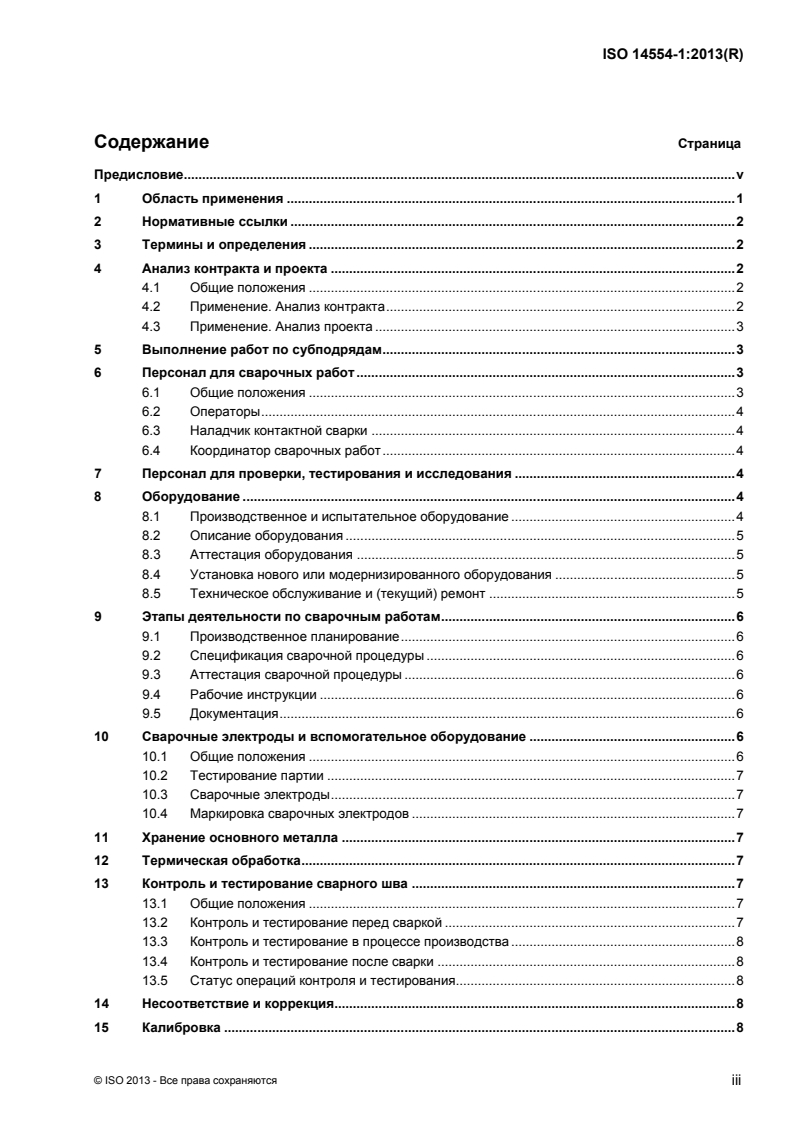
Содержание Страница
Предисловие. v
1 Область применения . 1
2 Нормативные ссылки . 2
3 Термины и определения . 2
4 Анализ контракта и проекта . 2
4.1 Общие положения . 2
4.2 Применение. Анализ контракта . 2
4.3 Применение. Анализ проекта . 3
5 Выполнение работ по субподрядам . 3
6 Персонал для сварочных работ . 3
6.1 Общие положения . 3
6.2 Операторы . 4
6.3 Наладчик контактной сварки . 4
6.4 Координатор сварочных работ . 4
7 Персонал для проверки, тестирования и исследования . 4
8 Оборудование . 4
8.1 Производственное и испытательное оборудование . 4
8.2 Описание оборудования . 5
8.3 Аттестация оборудования . 5
8.4 Установка нового или модернизированного оборудования . 5
8.5 Техническое обслуживание и (текущий) ремонт . 5
9 Этапы деятельности по сварочным работам . 6
9.1 Производственное планирование . 6
9.2 Спецификация сварочной процедуры . 6
9.3 Аттестация сварочной процедуры . 6
9.4 Рабочие инструкции . 6
9.5 Документация . 6
10 Сварочные электроды и вспомогательное оборудование . 6
10.1 Общие положения . 6
10.2 Тестирование партии . 7
10.3 Сварочные электроды . 7
10.4 Маркировка сварочных электродов . 7
11 Хранение основного металла . 7
12 Термическая обработка . 7
13 Контроль и тестирование сварного шва . 7
13.1 Общие положения . 7
13.2 Контроль и тестирование перед сваркой . 7
13.3 Контроль и тестирование в процессе производства . 8
13.4 Контроль и тестирование после сварки . 8
13.5 Статус операций контроля и тестирования. 8
14 Несоответствие и коррекция . 8
15 Калибровка . 8
iii
16 Идентификация и прослеживаемость .9
17 Протоколы, относящиеся к качеству .9
Приложение A (информативное) Сводное сравнение требований к качеству сварки в
данной части ISO 14554 и ISO 14554-2 . 10
Библиография . 11
iv
Предисловие
Международная организация по стандартизации (ISO) является всемирной федерацией национальных
организаций по стандартизации (комитетов-членов ISO). Разработка международных стандартов обычно
осуществляется техническими комитетами ISO. Каждый комитет-член, заинтересованный в деятельности,
для которой был создан технический комитет, имеет право быть представленным в этом комитете.
Международные правительственные и неправительственные организации, имеющие связи с ISO, также
принимают участие в работах. ISO работает в тесном сотрудничестве с Международной
электротехнической комиссией (IEC) по всем вопросам стандартизации в области электротехники.
Методики, использованные для разработки данного документа и те, которые предназначены для их
дальнейшего сохранения, описаны в Директивах ISO/IEC, Часть 1. Особенно следует указывать различные
критерии утверждения, необходимые для разных типов документов ISO. Данный документ составлен в
соответствии с редакторскими правилами Директив ISO/IEC, Часть 2. www.iso.org/directives
Следует иметь в виду, что некоторые элементы этого документа могут быть объектом патентных прав.
Организация ISO не должна нести ответственность за идентификацию какого-либо одного или всех
патентных прав. Детали любого патентного права, идентифицированного при разработке документа
должны находиться во Введении и/или в перечне полученных патентных заявок ISO. www.iso.org/patents
Любое фирменное наименование, используемое в этом документе является информацией для удобства
пользователей и не является одобрением.
О толковании значения специфических терминов ISO и выражений, относящихся к оценке соответствия, а
также информации о строгом соблюдении ISO принципов ВТО в отношении Технических барьеров в
торговле (TBT) см. следующую ссылку http://www.iso.org/iso/home/standards_development/resources-for-
technical-work/foreword.htm
Комитетом, ответственным за данный документ является ISO/TC 44, Сварка и родственные процессы,
Подкомитетом SC 6, Сварка контактная и родственные механические соединения.
Настоящее второе издание отменяет и заменяет первое издание (ISO 14554-1:2000), которое было
незначительно пересмотрено.
ISO 14554 состоит из следующих частей под общим заголовком: Требования к качеству сварки.
Электрическая контактная сварка металлических материалов:
— Часть 1. Всесторонние требования к качеству
— Часть 2. Элементарные требования к качеству
Запросы об официальной интерпретации любого вопроса в данной части ISO 14554 следует
направлять в Секретариат ISO/TC 44/SC 6 через ваш национальный комитет стандартов. Полный
перечень всех комитетов можно найти на www.iso.org.
v
МЕЖДУНАРОДНЫЙ СТАНДАРТ ISO 14554-1:2013(R)
Требования к качеству сварки. Электрическая контактная
сварка металлических материалов.
Часть 1.
Всесторонние требования к качеству
1 Область применения
Данная часть ISO 14554 устанавливает требования для демонстрации возможности изготовителя или
субподрядчика при создании сварных конструкций, выполняющих установленные требования к
качеству, в одном или нескольких документах, перечисленных ниже:
— в контракте между заинтересованными сторонами;
— в применяемом стандарте;
— в законодательном требовании.
Требования в данной части of ISO 14554 могут приниматься полностью или могут быть выборочно
отменены изготовителем, если они не применимы к рассматриваемой конструкции. Они обеспечивают
гибкую схему контроля сварки благодаря специфическим требованиям в следующих случаях:
— Случай 1 — контракты по контактной сварке, в которых изготовитель и субподрядчик должны
[4]
работать в системе качества, соответствующей ISO 9001;
— Случай 2 — контракты по контактной сварке, в которых изготовитель и субподрядчик должны
[4]
работать в системе качества, отличной от ISO 9001;
— Случай 3 — контактная сварка в качестве руководства для изготовителя или субподрядчика,
создающего систему качества;
— Случай 4 — ссылки в применяемых стандартах, использующих контактную сварку как часть своих
требований, или в контрактах между соответствующими сторонами, хотя это более относится к
части ISO 14554-2 , используемой в таких случаях.
Настоящая часть ISO 14554:
— не зависит от типа изготавливаемой сварной конструкции;
— определяет требования к качеству сварки, выполняемой как на заводах изготовителях, так и на
месте эксплуатации;
— дает руководство для описания возможности изготовителя при создании сварных конструкций в
соответствии с установленными требованиями;
— может использоваться в качестве базы для оценки изготовителя в отношении его возможностей при сварке.
Общие руководящие указания по выбору и применению, установлены в ISO 3834-1, тогда как
всесторонние и элементарные требования установлены для контактной сварки. В Приложении A
приведено сравнение характерных требований к качеству для контактной сварки в настоящей части
ISO 14554 и в части ISO 14554-2.
2 Нормативные ссылки
Следующие ссылочные нормативные документы являются обязательными для применения
настоящего документа. Для жестких ссылок применяется только цитируемое издание документа. Для
плавающих ссылок необходимо использовать самое последнее издание нормативного ссылочного
документа (включая любые изменения).
ISO 3834-1, Требования к качеству выполнения сварки плавлением металлических материалов.
Часть 1. Критерии выбора соответствующего уровня требований
3 Термины и определения
Для данного документа применяются термины и определения, приведенные в ISO 3834-1.
4 Анализ контракта и проекта
4.1 Общие положения
Изготовитель должен проанализировать требования контракта и проектные данные, представленные
заказчиком или собственные данные для конструкции, спроектированной изготовителем. Этим
гарантируется то, что до начала работ имеется вся информация необходимая для выполнения работ по
изготовлению. Изготовитель должен подтвердить свою способность выполнить контрактные требования по
сварке и обеспечить адекватное планирование всей деятельности, относящейся к качеству.
Анализ контракта проводится изготовителем для проверки того, что изготовитель может его
выполнить, что имеются достаточные ресурсы для получения графиков поставки, и что документация
является ясной и недвусмысленной. Изготовителю следует определить любые изменения между
контрактом и предшествующей представленной документацией, и уведомить заказчика о программе,
об изменениях в цене и технических решениях, которые могут возникнуть.
Пункты в разделе 4.2 обычно рассматриваются во время или до анализа контракта. Пункты в 4.3 обычно
составляют часть анализа проекта и должны учитываться во время анализа контракта, если проект не
выполняется изготовителем. Заказчик должен предоставить полную относящуюся к контракту информацию.
Если контракт отсутствует, т.е. продукция производится в резерв, изготовителю следует учитывать
требования 4.2 во время анализа проекта (см. 4.3).
4.2 Применение. Анализ контракта
В рассматриваемые требования контракта включаются:
a) положения, применяемого стандарт вместе с любыми дополнительными требованиями;
b) проверка и тестирование;
c) технические требования сварочных процедур, процедуры разрушающего и неразрушающего
исследования и процедуры термической обработки;
d) применяемый подход к аттестации процедуры сварки;
e) аттестация персонала;
f) термообработка (подробности см. в Разделе 12);
g) выбор, идентификация и/или единство измерений, например, материалов, сварочного
оборудования, сварщиков и сварных швов (см. Раздел 16);
h) устройства контроля качества, включая любое введение независимой контролирующей организации;
i) другие требования к сварке, например, к состоянию поверхности листов, к покрытиям, к сборке частей;
j) условия окружающей среды, т.н. условия сетевого напряжения, очень высокие/низкие
[1]
температуры окружающей среды, высокая влажность (см. ISO 669 );
k) требования к субподрядчику;
l) обработка несоответствий.
4.3 Применение. Анализ проекта
В рассматриваемые требования проекта включаются:
a) сварочный процесс или измененный сварочный процесс;
b) сварочное оборудование и сварочные электроды;
c) применение специальных методов, например сварки электродом с подкладкой, сварки в среде
защитного газа или защитных жидкостей, сварки с промежуточным электродом;
d) расположение, доступность и последовательность всех швов;
e) окончательная обработка поверхности и геометрия сварного соединения, т.н. чрезмерное внедрение
электрода в случае роликовой или точечной сварки с раздавливанием кромок шва избыточной толщины;
f) подробное описание основного металла(ов) и свойств сварного соединения;
g) сварные швы, которые выполняются на заводе или на месте;
h) первоначальные и окончательные размеры сваренного компонента, любая специальная
подготовка поверхности или кромки;
i) требования к приемке и качеству;
j) прочие специальные требования, например к шероховатости поверхности, термообработке, к меж
шовным связующим веществам, герметикам, грунтовке.
5 Выполнение работ по субподрядам
Когда изготовитель намерен использовать обслуживание до заключения контракта (т.н. сварку,
контроль, термическую обработку), то все соответствующие технические условия и требования
должны быть предоставлены изготовителем субподрядчику. Субподрядчик должен обеспечить
регистрацию и документирование своих работ, которые могут быть установлены изготовителем.
Каждый субподрядчик должен работать по инструкциям изготовителя и отвечать перед изготовителем
за полное соответствие всем требованиям данной части ISO 14554. Изготовитель должен
гарантировать возможность субподрядчика выполнить контрактные требования к качеству.
Информация, представляемая изготовителем субподрядчику, должна включать все относящиеся к
делу данные из анализа контракта (см. 4.2) и анализа проекта (см. 4.3). Возможна необходимость
установления дополнительных требований, если проект констр
...
МЕЖДУНАРОДНЫЙ ISO
СТАНДАРТ 14554-1
Второе издание
2013-12-15
Требования к качеству сварки.
Электрическая контактная сварка
металлических материалов.
Часть 1.
Всесторонние требования к качеству
Quality requirements for welding ― Resistance welding of metallic
materials ―
Part 1: Comprehensive quality requirements
Ответственность за подготовку русской версии несёт GOST R
(Российская Федерация) в соответствии со статьёй 18.1 Устава ISO
Ссылочный номер
©
ISO 2013
ДОКУМЕНТ ЗАЩИЩЕН АВТОРСКИМ ПРАВОМ
Все права сохраняются. Если не указано иное, никакую часть настоящей публикации нельзя копировать или использовать в
какой-либо форме или каким-либо электронным или механическим способом, включая фотокопии и микрофильмы, без
предварительного письменного согласия ISO, которое должно быть получено после запроса о разрешении, направленного по
адресу, приведенному ниже, или в комитет-член ISO в стране запрашивающей стороны.
ISO copyright office
Case postale 56 • CH-1211 Geneva 20
Tel. + 41 22 749 01 11
Fax + 41 22 749 09 47
E-mail copyright @ iso.org
Web www.iso.org
Опубликовано в Швейцарии
ii © ISO 2013 – Все права сохраняются
Содержание Страница
Предисловие. v
1 Область применения . 1
2 Нормативные ссылки . 2
3 Термины и определения . 2
4 Анализ контракта и проекта . 2
4.1 Общие положения . 2
4.2 Применение. Анализ контракта . 2
4.3 Применение. Анализ проекта . 3
5 Выполнение работ по субподрядам . 3
6 Персонал для сварочных работ . 3
6.1 Общие положения . 3
6.2 Операторы . 4
6.3 Наладчик контактной сварки . 4
6.4 Координатор сварочных работ . 4
7 Персонал для проверки, тестирования и исследования . 4
8 Оборудование . 4
8.1 Производственное и испытательное оборудование . 4
8.2 Описание оборудования . 5
8.3 Аттестация оборудования . 5
8.4 Установка нового или модернизированного оборудования . 5
8.5 Техническое обслуживание и (текущий) ремонт . 5
9 Этапы деятельности по сварочным работам . 6
9.1 Производственное планирование . 6
9.2 Спецификация сварочной процедуры . 6
9.3 Аттестация сварочной процедуры . 6
9.4 Рабочие инструкции . 6
9.5 Документация . 6
10 Сварочные электроды и вспомогательное оборудование . 6
10.1 Общие положения . 6
10.2 Тестирование партии . 7
10.3 Сварочные электроды . 7
10.4 Маркировка сварочных электродов . 7
11 Хранение основного металла . 7
12 Термическая обработка . 7
13 Контроль и тестирование сварного шва . 7
13.1 Общие положения . 7
13.2 Контроль и тестирование перед сваркой . 7
13.3 Контроль и тестирование в процессе производства . 8
13.4 Контроль и тестирование после сварки . 8
13.5 Статус операций контроля и тестирования. 8
14 Несоответствие и коррекция . 8
15 Калибровка . 8
iii
16 Идентификация и прослеживаемость .9
17 Протоколы, относящиеся к качеству .9
Приложение A (информативное) Сводное сравнение требований к качеству сварки в
данной части ISO 14554 и ISO 14554-2 . 10
Библиография . 11
iv
Предисловие
Международная организация по стандартизации (ISO) является всемирной федерацией национальных
организаций по стандартизации (комитетов-членов ISO). Разработка международных стандартов обычно
осуществляется техническими комитетами ISO. Каждый комитет-член, заинтересованный в деятельности,
для которой был создан технический комитет, имеет право быть представленным в этом комитете.
Международные правительственные и неправительственные организации, имеющие связи с ISO, также
принимают участие в работах. ISO работает в тесном сотрудничестве с Международной
электротехнической комиссией (IEC) по всем вопросам стандартизации в области электротехники.
Методики, использованные для разработки данного документа и те, которые предназначены для их
дальнейшего сохранения, описаны в Директивах ISO/IEC, Часть 1. Особенно следует указывать различные
критерии утверждения, необходимые для разных типов документов ISO. Данный документ составлен в
соответствии с редакторскими правилами Директив ISO/IEC, Часть 2. www.iso.org/directives
Следует иметь в виду, что некоторые элементы этого документа могут быть объектом патентных прав.
Организация ISO не должна нести ответственность за идентификацию какого-либо одного или всех
патентных прав. Детали любого патентного права, идентифицированного при разработке документа
должны находиться во Введении и/или в перечне полученных патентных заявок ISO. www.iso.org/patents
Любое фирменное наименование, используемое в этом документе является информацией для удобства
пользователей и не является одобрением.
О толковании значения специфических терминов ISO и выражений, относящихся к оценке соответствия, а
также информации о строгом соблюдении ISO принципов ВТО в отношении Технических барьеров в
торговле (TBT) см. следующую ссылку http://www.iso.org/iso/home/standards_development/resources-for-
technical-work/foreword.htm
Комитетом, ответственным за данный документ является ISO/TC 44, Сварка и родственные процессы,
Подкомитетом SC 6, Сварка контактная и родственные механические соединения.
Настоящее второе издание отменяет и заменяет первое издание (ISO 14554-1:2000), которое было
незначительно пересмотрено.
ISO 14554 состоит из следующих частей под общим заголовком: Требования к качеству сварки.
Электрическая контактная сварка металлических материалов:
— Часть 1. Всесторонние требования к качеству
— Часть 2. Элементарные требования к качеству
Запросы об официальной интерпретации любого вопроса в данной части ISO 14554 следует
направлять в Секретариат ISO/TC 44/SC 6 через ваш национальный комитет стандартов. Полный
перечень всех комитетов можно найти на www.iso.org.
v
МЕЖДУНАРОДНЫЙ СТАНДАРТ ISO 14554-1:2013(R)
Требования к качеству сварки. Электрическая контактная
сварка металлических материалов.
Часть 1.
Всесторонние требования к качеству
1 Область применения
Данная часть ISO 14554 устанавливает требования для демонстрации возможности изготовителя или
субподрядчика при создании сварных конструкций, выполняющих установленные требования к
качеству, в одном или нескольких документах, перечисленных ниже:
— в контракте между заинтересованными сторонами;
— в применяемом стандарте;
— в законодательном требовании.
Требования в данной части of ISO 14554 могут приниматься полностью или могут быть выборочно
отменены изготовителем, если они не применимы к рассматриваемой конструкции. Они обеспечивают
гибкую схему контроля сварки благодаря специфическим требованиям в следующих случаях:
— Случай 1 — контракты по контактной сварке, в которых изготовитель и субподрядчик должны
[4]
работать в системе качества, соответствующей ISO 9001;
— Случай 2 — контракты по контактной сварке, в которых изготовитель и субподрядчик должны
[4]
работать в системе качества, отличной от ISO 9001;
— Случай 3 — контактная сварка в качестве руководства для изготовителя или субподрядчика,
создающего систему качества;
— Случай 4 — ссылки в применяемых стандартах, использующих контактную сварку как часть своих
требований, или в контрактах между соответствующими сторонами, хотя это более относится к
части ISO 14554-2 , используемой в таких случаях.
Настоящая часть ISO 14554:
— не зависит от типа изготавливаемой сварной конструкции;
— определяет требования к качеству сварки, выполняемой как на заводах изготовителях, так и на
месте эксплуатации;
— дает руководство для описания возможности изготовителя при создании сварных конструкций в
соответствии с установленными требованиями;
— может использоваться в качестве базы для оценки изготовителя в отношении его возможностей при сварке.
Общие руководящие указания по выбору и применению, установлены в ISO 3834-1, тогда как
всесторонние и элементарные требования установлены для контактной сварки. В Приложении A
приведено сравнение характерных требований к качеству для контактной сварки в настоящей части
ISO 14554 и в части ISO 14554-2.
2 Нормативные ссылки
Следующие ссылочные нормативные документы являются обязательными для применения
настоящего документа. Для жестких ссылок применяется только цитируемое издание документа. Для
плавающих ссылок необходимо использовать самое последнее издание нормативного ссылочного
документа (включая любые изменения).
ISO 3834-1, Требования к качеству выполнения сварки плавлением металлических материалов.
Часть 1. Критерии выбора соответствующего уровня требований
3 Термины и определения
Для данного документа применяются термины и определения, приведенные в ISO 3834-1.
4 Анализ контракта и проекта
4.1 Общие положения
Изготовитель должен проанализировать требования контракта и проектные данные, представленные
заказчиком или собственные данные для конструкции, спроектированной изготовителем. Этим
гарантируется то, что до начала работ имеется вся информация необходимая для выполнения работ по
изготовлению. Изготовитель должен подтвердить свою способность выполнить контрактные требования по
сварке и обеспечить адекватное планирование всей деятельности, относящейся к качеству.
Анализ контракта проводится изготовителем для проверки того, что изготовитель может его
выполнить, что имеются достаточные ресурсы для получения графиков поставки, и что документация
является ясной и недвусмысленной. Изготовителю следует определить любые изменения между
контрактом и предшествующей представленной документацией, и уведомить заказчика о программе,
об изменениях в цене и технических решениях, которые могут возникнуть.
Пункты в разделе 4.2 обычно рассматриваются во время или до анализа контракта. Пункты в 4.3 обычно
составляют часть анализа проекта и должны учитываться во время анализа контракта, если проект не
выполняется изготовителем. Заказчик должен предоставить полную относящуюся к контракту информацию.
Если контракт отсутствует, т.е. продукция производится в резерв, изготовителю следует учитывать
требования 4.2 во время анализа проекта (см. 4.3).
4.2 Применение. Анализ контракта
В рассматриваемые требования контракта включаются:
a) положения, применяемого стандарт вместе с любыми дополнительными требованиями;
b) проверка и тестирование;
c) технические требования сварочных процедур, процедуры разрушающего и неразрушающего
исследования и процедуры термической обработки;
d) применяемый подход к аттестации процедуры сварки;
e) аттестация персонала;
f) термообработка (подробности см. в Разделе 12);
g) выбор, идентификация и/или единство измерений, например, материалов, сварочного
оборудования, сварщиков и сварных швов (см. Раздел 16);
h) устройства контроля качества, включая любое введение независимой контролирующей организации;
i) другие требования к сварке, например, к состоянию поверхности листов, к покрытиям, к сборке частей;
j) условия окружающей среды, т.н. условия сетевого напряжения, очень высокие/низкие
[1]
температуры окружающей среды, высокая влажность (см. ISO 669 );
k) требования к субподрядчику;
l) обработка несоответствий.
4.3 Применение. Анализ проекта
В рассматриваемые требования проекта включаются:
a) сварочный процесс или измененный сварочный процесс;
b) сварочное оборудование и сварочные электроды;
c) применение специальных методов, например сварки электродом с подкладкой, сварки в среде
защитного газа или защитных жидкостей, сварки с промежуточным электродом;
d) расположение, доступность и последовательность всех швов;
e) окончательная обработка поверхности и геометрия сварного соединения, т.н. чрезмерное внедрение
электрода в случае роликовой или точечной сварки с раздавливанием кромок шва избыточной толщины;
f) подробное описание основного металла(ов) и свойств сварного соединения;
g) сварные швы, которые выполняются на заводе или на месте;
h) первоначальные и окончательные размеры сваренного компонента, любая специальная
подготовка поверхности или кромки;
i) требования к приемке и качеству;
j) прочие специальные требования, например к шероховатости поверхности, термообработке, к меж
шовным связующим веществам, герметикам, грунтовке.
5 Выполнение работ по субподрядам
Когда изготовитель намерен использовать обслуживание до заключения контракта (т.н. сварку,
контроль, термическую обработку), то все соответствующие технические условия и требования
должны быть предоставлены изготовителем субподрядчику. Субподрядчик должен обеспечить
регистрацию и документирование своих работ, которые могут быть установлены изготовителем.
Каждый субподрядчик должен работать по инструкциям изготовителя и отвечать перед изготовителем
за полное соответствие всем требованиям данной части ISO 14554. Изготовитель должен
гарантировать возможность субподрядчика выполнить контрактные требования к качеству.
Информация, представляемая изготовителем субподрядчику, должна включать все относящиеся к
делу данные из анализа контракта (см. 4.2) и анализа проекта (см. 4.3). Возможна необходимость
установления дополнительных требований, если проект констр
...