


ISO 1146:1988
(Main)Pyrometric reference cones for laboratory use — Specification
Pyrometric reference cones for laboratory use — Specification
Specifies the characteristics of a standard series of pyrometric reference cones, which are used for determining the pyrometric cone equivalent (refractoriness) of refractory materials, over the temperature range 1500 to 1800 C. The cones specified in this International Standard are suitable for use in the procedure described in ISO 528, excluding determinations at 1500 and 1800 C.
Cônes pyroscopiques de référence pour emploi en laboratoire — Spécifications
General Information
- Status
- Published
- Publication Date
- 27-Jan-1988
- Technical Committee
- ISO/TC 33 - Refractories
- Drafting Committee
- ISO/TC 33 - Refractories
- Current Stage
- 9060 - Close of review
- Completion Date
- 04-Jun-2030
Overview
ISO 1146:1988 - Pyrometric Reference Cones for Laboratory Use - Specification outlines the requirements for a standard series of pyrometric reference cones. These cones are essential laboratory tools used to determine the pyrometric cone equivalent, or refractoriness, of refractory materials. The standard covers reference cones for use over a temperature range of 1500°C to 1800°C, making it vital for quality control and testing processes in industries reliant on accurate temperature measurements and refractory material assessment.
Key Topics
- Pyrometric Reference Cones: The standard defines these as blunt-tipped, skew triangular pyramids with specified shapes and dimensions. Their unique composition ensures they bend reliably at known temperatures under controlled laboratory conditions.
- Temperature Measurement Range: ISO 1146:1988 specifies reference cones effective between 1500°C and 1800°C, facilitating standardized testing procedures within this critical temperature range.
- Verification and Consistency: Detailed requirements regarding batch verification, heating rates, and temperature of collapse ensure consistency and reliability of results across laboratories.
- Marking and Designation: Each cone is marked according to its reference temperature designation, as shown in the standard, supporting traceability and uniform application.
Applications
Pyrometric reference cones standardized by ISO 1146:1988 are widely used in:
- Testing and Quality Control of Refractory Materials: Laboratories and manufacturers utilize these cones to evaluate the softening and melting points of refractories, crucial for industries such as ceramics, glassmaking, and metallurgy.
- Research and Development: Scientists and engineers in materials research depend on the precision and repeatability provided by standardized cones for developing and comparing new refractory materials.
- Industrial Furnaces and Kilns: Regular assessment of refractoriness ensures that chosen materials will withstand operational temperatures, preventing equipment failure and ensuring process integrity.
- Compliance and Certification: Organizations implementing ISO 1146:1988 benefit from demonstrating compliance with international specifications, improving credibility and facilitating global trade.
Related Standards
Implementing ISO 1146:1988 often requires reference to additional standards to ensure a comprehensive approach to testing and material specification:
- ISO 528: Specifies procedures for determining the pyrometric cone equivalent (refractoriness) of refractory products, complementing the use of ISO 1146 pyrometric cones, especially for measurements between 1500°C and 1800°C.
- ISO 520: Addresses the determination of pyrometric cone equivalent for refractory products, offering further guidance on associated test methods.
- Seger, Orton, and H.P.C. Standards: The ISO standard provides a basis for comparison with other prevalent cone types (see Annex for detailed comparison), supporting harmonization across laboratories using different systems.
Practical Value
Adopting ISO 1146:1988 brings significant practical benefits:
- Reliability: Enhances the integrity of laboratory and industrial testing by providing clearly defined, uniform reference materials.
- Efficiency: Simplifies material selection, process design, and troubleshooting for high-temperature applications.
- Traceability: Standardized markings and documentation improve batch traceability and facilitate quality assurance processes.
- Global Acceptance: Supports international trade and cooperation by aligning testing and reporting practices for refractories and related materials.
By integrating the guidelines of ISO 1146:1988, laboratories and industries ensure consistent, accurate high-temperature measurements, supporting product quality and operational safety in demanding environments.
Buy Documents
ISO 1146:1988 - Pyrometric reference cones for laboratory use — Specification Released:1/28/1988
ISO 1146:1988 - Cônes pyroscopiques de référence pour emploi en laboratoire — Spécifications Released:1/28/1988
ISO 1146:1988 - Cônes pyroscopiques de référence pour emploi en laboratoire — Spécifications Released:1/28/1988
Get Certified
Connect with accredited certification bodies for this standard

BSMI (Bureau of Standards, Metrology and Inspection)
Taiwan's standards and inspection authority.
Sponsored listings
Frequently Asked Questions
ISO 1146:1988 is a standard published by the International Organization for Standardization (ISO). Its full title is "Pyrometric reference cones for laboratory use — Specification". This standard covers: Specifies the characteristics of a standard series of pyrometric reference cones, which are used for determining the pyrometric cone equivalent (refractoriness) of refractory materials, over the temperature range 1500 to 1800 C. The cones specified in this International Standard are suitable for use in the procedure described in ISO 528, excluding determinations at 1500 and 1800 C.
Specifies the characteristics of a standard series of pyrometric reference cones, which are used for determining the pyrometric cone equivalent (refractoriness) of refractory materials, over the temperature range 1500 to 1800 C. The cones specified in this International Standard are suitable for use in the procedure described in ISO 528, excluding determinations at 1500 and 1800 C.
ISO 1146:1988 is classified under the following ICS (International Classification for Standards) categories: 17.200.20 - Temperature-measuring instruments. The ICS classification helps identify the subject area and facilitates finding related standards.
ISO 1146:1988 is available in PDF format for immediate download after purchase. The document can be added to your cart and obtained through the secure checkout process. Digital delivery ensures instant access to the complete standard document.
Standards Content (Sample)
ISO
INTERNATIONAL STANDARD 1146
First edition
1988-02-01
INTERNATIONAL ORGANIZATION FOR STANDARDIZATION
ORGANISATION INTERNATIONALE DE NORMALISATION
MEXBYHAPOAHAR OPrAHM3AL(Mfl n0 CTAH~APTM3A~MM
Pyrometric reference cones for laboratory use -
Specification
C6nes pyroscopiques de rkference pour emploi en laboratoire - Sphcifications
Reference number
ISO 1146: 1988 (E)
Foreword
ISO (the International Organization for Standardization) is a worldwide federation of
national Standards bodies (ISO member bedies). The work of preparing International
Standards is normally carried out through ISO technical committees. Esch member
body interested in a subject for which a technical committee has been established has
the right to be represented on that committee. International organizations, govern-
mental and non-governmental, in liaison with ISO, also take part in the work.
Draft International Standards adopted by the technical committees are circulated to
the member bodies for approval before their acceptance as International Standards by
the ISO Council. They are approved in accordance with ISO procedures requiring at
least 75 % approval by the member bodies voting.
International Standard ISO 1146 was prepared by Technical Committee ISO/TC 33,
Re frac tories.
lt cancels and replaces ISO Recommendation R 1146: 1969, of it constitutes a
technical revision.
Users should note that all International Standards undergo revision from time to time
and that any reference made herein to any other International Standard implies its
latest edition, unless otherwise stated.
l
0 International Organkation for Standardkation, 1988
Printed in Switzerland
ISO 1146: 1988 (E)
INTERNATIONAL STANDARD
Pyrometric reference cones for laboratory use -
Specification
3.1 pyrometric reference cone: A blunt-tipped skew
1 Scope and field of application
triangular pyramid with sharp edges, of specified shape and
dimensions and of such composition that, when mounted and
1 .l This International Standard specifies the characteristics
heated under specified conditions, it bends in a known manner
of a Standard series of pyrometric reference cones, which are
with reference to the temperature (see 3.2).
used for determining the pyrometric cone equivalent (refrac-
toriness) of refractory materials, over the temperature range
32 reference temperature; temperature of collapse :
1 500 to 1 800 OC.
The temperature at which the tip of a pyrometric reference
cone reaches the level on which the base of the cone is
1.2 The pyrometric reference cones specified in this Interna- mounted when the cone is heated at a specified rate under
specified conditions.
tional Standard are suitable for use in the procedure described
in ISO 528, excluding determinations at 1 500 and 1 800 OC.
4 Dimensions and shape of cones
2 Reference
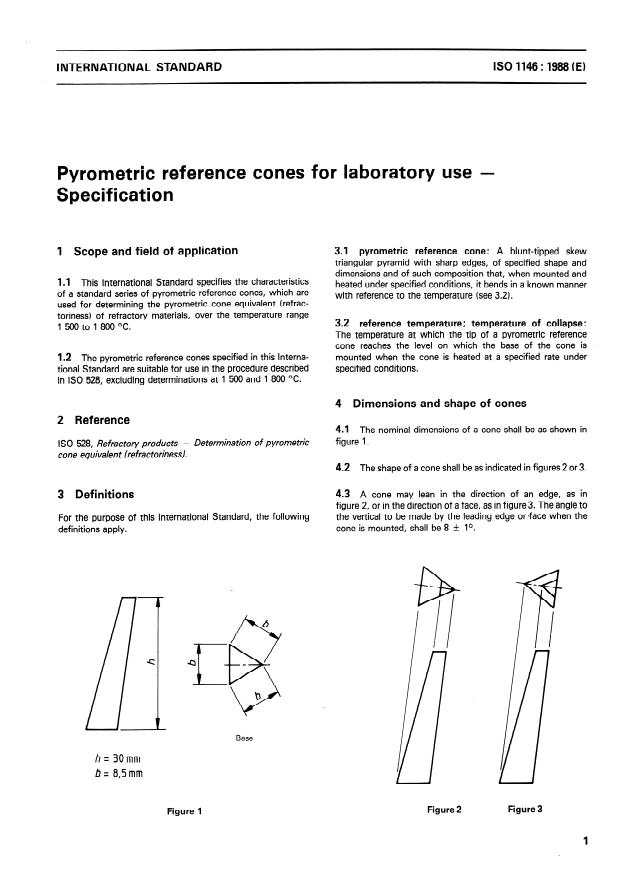
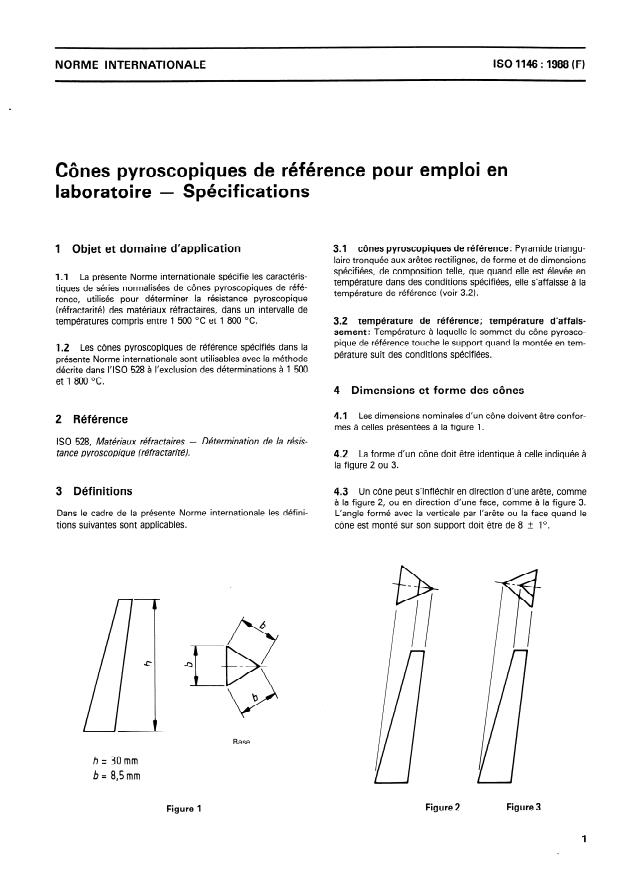
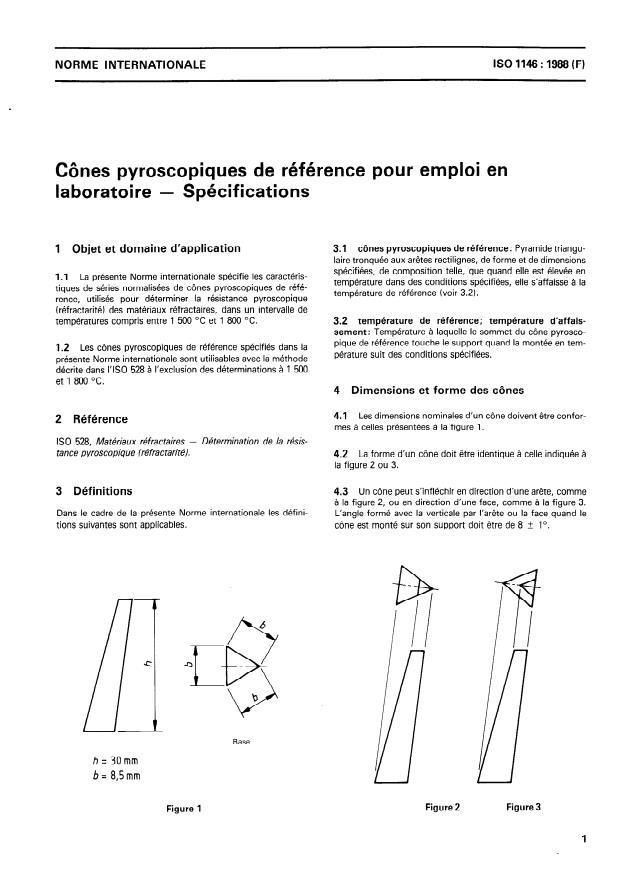
4.1 The nominal dimensions of a cone shall be as shown in
figure 1.
ISO 520, Refractory products - Determination of pyrometric
cone equivalen t (refractoriness).
4.2 The shape of a cone shall be as indicated in figures 2 or 3.
3 Definitions 4.3 A cone may lean in the direction of an edge, as in
figure 2, or in the direction of a face, as in figure3. The angle to
the vertical to be made by the leading edge or l face when the
For the purpose of this International Standard, the following
cone is mounted, shall be 8 & Io.
definitions apply.
-
Base
Figure 3
Figure 2
Figure 1
...
ISO
NORME INTERNATIONALE
Première édition
1988-02-o 1
INTERNATIONAL ORGANIZATION FOR STANDARDIZATION
ORGANISATION INTERNATIONALE DE NORMALISATION
MEX,QYHAPOAHAfl OPTAHM3A~MR Il0 CTAH~APTM3A~Wl
Cônes pyroscopiques de référence pour emploi en
laboratoire - Spécifications
Pyrometric reference cones for laboratory use - Specifica tion
Numéro de référence
ISO 1146: 1988 (F)
Avant-propos
L’ISO (Organisation internationale de normalisation) est une fédération mondiale
d’organismes nationaux de normalisation (comités membres de I’ISO). L’élaboration
des Normes internationales est normalement confiée aux comités techniques de I’ISO.
Chaque comité membre intéressé par une étude a le droit de faire partie du comité
technique créé à cet effet. Les organisations internationales, gouvernementales et non
gouvernementales, en liaison avec I’ISO participent également aux travaux.
Les projets de Normes internationales adoptés par les comités techniques sont soumis
aux comités membres pour approbation, avant leur acceptation comme Normes inter-
nationales par le Conseil de I’ISO. Les Normes internationales sont approuvées confor-
mément aux procédures de I’ISO qui requièrent l’approbation de 75 % au moins des
comités membres votants.
La Norme internationale ISO 1146 a été élaborée par le comité technique ISO/TC 33,
Matériaux réfractaires.
Elle annule et remplace la Recommandation ISO/R 1146 : 1969, dont elle constitue une
révision technique.
L’attention des utilisateurs est attirée sur le fait que toutes les Normes internationales
sont de temps en temps soumises à révision et que toute référence faite à une autre
Norme internationale dans le présent document implique qu’il s’agit, sauf indication
contraire, de la dernière édition.
0 Organisation internationale de normalisation, 1988 l
Imprimé en Suisse
NORME INTERNATIONALE ISO 1146 : 1988 (FI
Cônes pyroscopiques de référence pour emploi en
- Spécifications
laboratoire
cônes pyroscopiques de référence : Pyramide triangu-
1 Objet et domaine d’application 31
laire tronquée aux arêtes rectilignes, de forme et de dimensions
spécifiées, de composition telle, que quand elle est élevée en
1 .l La présente Norme internationale spécifie les caractéris-
température dans des conditions spécifiées, elle s’affaisse à la
tiques de séries normalisées de cônes pyroscopiques de réfé-
température de référence (voir 3.2).
rence, utilisés pour déterminer la résistance pyroscopique
(réfractarité) des matériaux réfractaires, dans un intervalle de
températures compris entre 1 500 OC et 1 800 OC. 3.2 température de référence; température d’affais-
sement: Température à laquelle le sommet du cône pyrosco-
pique de référence touche le support quand la montée en tem-
1.2 Les cônes pyroscopiques de référence spécifiés dans la
pérature suit des conditions spécifiées.
présente Norme internationale sont utilisables avec la méthode
décrite dans I’ISO 528 à l’exclusion des déterminations à 1 500
et 1 800 OC.
4 Dimensions et forme des cônes
4.1 Les dimensions nominales d’un cône doivent être confor-
2 Référence
mes à celles présentées à la figure 1.
IS 0 528, Matériaux réfractaires - Détermination de la résis-
tance pyroscopique fréfractaritél.
4.2 La forme d’un cône doit être identique à celle indiquée à
la figure 2 ou 3.
3 Définitions 4.3 Un cône peut s’infléchir en direction d’une arête, comme
à la figure 2, ou en direction d’une face, comme à la figure 3.
Dans le cadre de la présente Norme internationale les défini- L’angle formé avec la verticale par l’arête ou la face quand le
tions suivantes sont applicables.
cône est monté sur son support doit être de 8 k l”.
Base
Figure 1 Figure 2 Fi
...
ISO
NORME INTERNATIONALE
Première édition
1988-02-o 1
INTERNATIONAL ORGANIZATION FOR STANDARDIZATION
ORGANISATION INTERNATIONALE DE NORMALISATION
MEX,QYHAPOAHAfl OPTAHM3A~MR Il0 CTAH~APTM3A~Wl
Cônes pyroscopiques de référence pour emploi en
laboratoire - Spécifications
Pyrometric reference cones for laboratory use - Specifica tion
Numéro de référence
ISO 1146: 1988 (F)
Avant-propos
L’ISO (Organisation internationale de normalisation) est une fédération mondiale
d’organismes nationaux de normalisation (comités membres de I’ISO). L’élaboration
des Normes internationales est normalement confiée aux comités techniques de I’ISO.
Chaque comité membre intéressé par une étude a le droit de faire partie du comité
technique créé à cet effet. Les organisations internationales, gouvernementales et non
gouvernementales, en liaison avec I’ISO participent également aux travaux.
Les projets de Normes internationales adoptés par les comités techniques sont soumis
aux comités membres pour approbation, avant leur acceptation comme Normes inter-
nationales par le Conseil de I’ISO. Les Normes internationales sont approuvées confor-
mément aux procédures de I’ISO qui requièrent l’approbation de 75 % au moins des
comités membres votants.
La Norme internationale ISO 1146 a été élaborée par le comité technique ISO/TC 33,
Matériaux réfractaires.
Elle annule et remplace la Recommandation ISO/R 1146 : 1969, dont elle constitue une
révision technique.
L’attention des utilisateurs est attirée sur le fait que toutes les Normes internationales
sont de temps en temps soumises à révision et que toute référence faite à une autre
Norme internationale dans le présent document implique qu’il s’agit, sauf indication
contraire, de la dernière édition.
0 Organisation internationale de normalisation, 1988 l
Imprimé en Suisse
NORME INTERNATIONALE ISO 1146 : 1988 (FI
Cônes pyroscopiques de référence pour emploi en
- Spécifications
laboratoire
cônes pyroscopiques de référence : Pyramide triangu-
1 Objet et domaine d’application 31
laire tronquée aux arêtes rectilignes, de forme et de dimensions
spécifiées, de composition telle, que quand elle est élevée en
1 .l La présente Norme internationale spécifie les caractéris-
température dans des conditions spécifiées, elle s’affaisse à la
tiques de séries normalisées de cônes pyroscopiques de réfé-
température de référence (voir 3.2).
rence, utilisés pour déterminer la résistance pyroscopique
(réfractarité) des matériaux réfractaires, dans un intervalle de
températures compris entre 1 500 OC et 1 800 OC. 3.2 température de référence; température d’affais-
sement: Température à laquelle le sommet du cône pyrosco-
pique de référence touche le support quand la montée en tem-
1.2 Les cônes pyroscopiques de référence spécifiés dans la
pérature suit des conditions spécifiées.
présente Norme internationale sont utilisables avec la méthode
décrite dans I’ISO 528 à l’exclusion des déterminations à 1 500
et 1 800 OC.
4 Dimensions et forme des cônes
4.1 Les dimensions nominales d’un cône doivent être confor-
2 Référence
mes à celles présentées à la figure 1.
IS 0 528, Matériaux réfractaires - Détermination de la résis-
tance pyroscopique fréfractaritél.
4.2 La forme d’un cône doit être identique à celle indiquée à
la figure 2 ou 3.
3 Définitions 4.3 Un cône peut s’infléchir en direction d’une arête, comme
à la figure 2, ou en direction d’une face, comme à la figure 3.
Dans le cadre de la présente Norme internationale les défini- L’angle formé avec la verticale par l’arête ou la face quand le
tions suivantes sont applicables.
cône est monté sur son support doit être de 8 k l”.
Base
Figure 1 Figure 2 Fi
...
Questions, Comments and Discussion
Ask us and Technical Secretary will try to provide an answer. You can facilitate discussion about the standard in here.
Loading comments...