

ISO/FDIS 41012
(Main)Facility management — Guidance on strategic sourcing and the development of agreements
- Abstract
ISO 41012:2017 provides guidance on sourcing and development of agreements in facility management (FM). It highlights: · essential elements in FM sourcing processes; · FM roles and responsibilities in sourcing processes; · development processes and structures of typical agreement models. ISO 41012:2017 is applicable to: · strategic processes related to service and support functions for the core business; · development of FM strategies; · development of facility service provision agreements covering both public and private service demand and internal and external production/delivery options; · development of FM information systems; · FM education and research; · organization development and business re-engineering processes in major types of working environments (e.g. industrial, commercial, administration, military, healthcare, accommodation).
- Status
- Not Published
- Technical Committee
- ISO/TC 267 - Facility management
- Drafting Committee
- ISO/TC 267 - Facility management
- Current Stage
- 5000 - FDIS registered for formal approval
- Start Date
- 11-Aug-2026
- Completion Date
- 18-Aug-2026
Buy Documents
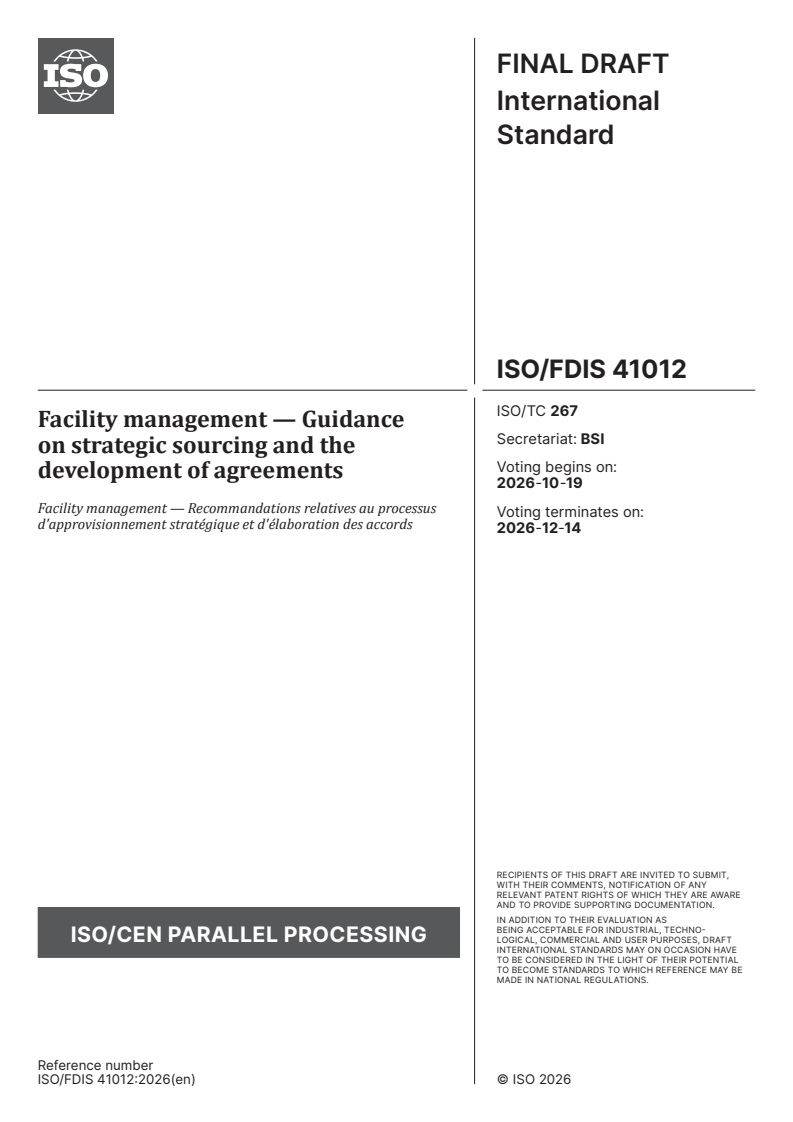
ISO/FDIS 41012 - Facility management — Guidance on strategic sourcing and the development of agreements
REDLINE ISO/FDIS 41012 - Facility management — Guidance on strategic sourcing and the development of agreements
ISO/FDIS 41012 is an ISO draft standard for facility management (FM) guidance on strategic sourcing and the development of agreements. It helps a demand organization decide how FM services should be delivered, how to turn needs into service requirements, and how to structure internal or external agreements and service level agreements (SLAs).
What does ISO/FDIS 41012 specify?
ISO/FDIS 41012 gives guidance on sourcing and agreement development in FM. It covers sourcing strategy, roles and responsibilities, and typical agreement models, and it is written as guidance rather than a fixed one-size-fits-all method.
The document applies to strategic processes for service and support functions that enable the core business, development of FM sourcing strategies, facility service provision agreements for public and private demand, internal and external delivery options, FM information systems, FM education and research, and organization development or business re-engineering in industrial, commercial, administration, military, healthcare and accommodation environments.
The document is organized into Clauses 1 to 12, starting with scope, references and terms, then moving through sourcing strategy, the FM sourcing process, service provision, agreement structure, common contract considerations, procurement, implementation, operational phases and performance measurement. Annexes A to F provide worked examples and structured guidance.
| Annex | What it covers |
|---|---|
| A | Examples of requirements for a service |
| B | Example of business case content |
| C | Structure of an agreement - General clauses |
| D | Service level agreements - benefits, preparation and structure |
| E | Price and rate mechanisms |
| F | External procurement for FM services |
What are the key requirements of ISO/FDIS 41012?
ISO/FDIS 41012 guides the reader through a complete FM sourcing cycle, from understanding the core business to measuring service performance. In practice, the document is about making sourcing decisions traceable, measurable and aligned with the organization’s needs.
Start with the core business context
Clause 4 says the FM organization should understand the core business before choosing a sourcing approach. That means collecting information on mission, strategy, service criticality, sites, portfolio, culture, risk, sustainability, legal obligations, current service model and stakeholder expectations.
This matters because FM sourcing is not only about cost. The document makes the organization test how FM choices affect continuity, security, service dependencies and the future shape of the business.
Turn needs into measurable requirements
Clause 5 says needs should be translated into requirements before service levels are set. The document expects requirements to be expressed clearly, with measurable performance indicators where possible, and to take account of interdependencies between FM activities.
This matters because vague service descriptions are hard to procure or manage. The document pushes the reader toward requirements that can be checked, compared and managed over time.
Set service levels and KPIs
Clause 5.4 says service levels should be practical, achievable and linked to the resources needed to deliver them. It also points to qualitative and quantitative performance measures, including response times, completion rates, preventive maintenance compliance, cleanliness, sustainability performance, space use, energy conservation and total cost of ownership.
In practice, this means the agreement should not only say what service is wanted, but also how success will be measured. Annex D supports this by showing how an SLA can be built around output or input specifications.
Choose the service delivery model
Clause 5.5 and Clause 6 describe the main delivery options: in-house services, separately externally contracted services, or bundled external services. The standard also says the organization should check capability, market availability, business continuity, security needs and strategic considerations before deciding.
This matters because the right model is not always the cheapest or most outsourced one. The document supports a make-or-buy decision based on business fit, risk and capacity.
Build the business case and pricing approach
Clause 5.6 and Clause 5.7 require analysis of financial considerations and pricing strategy. Annex B gives business case content, and Annex E describes fixed price, target price, pass-through costs and unit rate mechanisms.
In practice, this helps the organization match the pricing model to the way the service is actually used and measured. It also makes cost, risk sharing and financial transparency part of the sourcing decision.
Structure the agreement and manage change
Clause 7 and Clause 8 guide the agreement structure. The agreement should cover strategic, tactical and operational responsibilities, term, subcontracting, management responsibility, communication, flexibility, performance criteria, information responsibilities, reporting, auditing, continuous improvement, regulations and corporate standards.
This matters because FM agreements often fail when responsibilities are unclear or change is unmanaged. Annex C and Annex D provide example clause structures that can be adapted to the situation.
Control procurement, implementation and operations
Clause 9 covers procurement, including bid documentation, evaluation, probity, confidentiality, conflicts of interest and transparent assessment. Clause 10 covers mobilization and validation. Clause 11 covers transition, optimization, termination and demobilization.
In practice, the document treats handover and exit as planned phases, not afterthoughts. That is important for data transfer, continuity, performance start-up and closing out obligations cleanly.
Measure performance during service delivery
Clause 12 says performance should be monitored using appropriate measurement methods, including statistical or mathematical sampling where suitable. It also expects measurement against SLAs and KPIs, and validation through benchmarking where appropriate.
This matters because the agreement is meant to be managed, not just filed away. The standard links performance data to corrective action, improvement and, where needed, changes to the agreement.
What terms does ISO/FDIS 41012 define?
ISO/FDIS 41012 uses terms from ISO 41011 and adds a small number of key definitions for sourcing and risk.
- Strategic sourcing - the process a demand organization uses to decide the nature of FM service delivery.
- Risk - the effect of uncertainty, including positive or negative deviation from what is expected.
- Demand organization (DO) - the organization that needs the FM service and sets the requirements for delivery.
- Facility management organization (FMO) - the FM function or organization that plans, coordinates or delivers the service.
- Service level agreement (SLA) - the agreement that sets the required scope, quality and performance expectations for a service.
- Key performance indicator (KPI) - the measurable performance level used to track whether the agreed service is being achieved.
- Facility management (FM) - the field covered by the document, focused on organizing service and support functions for the core business.
Who uses ISO/FDIS 41012?
ISO/FDIS 41012 is intended for FM professionals, procurement teams, finance teams and senior management who need to source, contract and manage FM services. It is also relevant to service providers, whether internal or external, because it defines how service expectations, responsibilities and performance measures should be set.
The document is useful in both public and private sectors and in organizations with industrial, commercial, administration, military, healthcare or accommodation environments. Typical tasks include strategy development, service specification, SLA drafting, bid evaluation, contract mobilization, performance monitoring and agreement closure.
What changed in ISO/FDIS 41012 from the previous edition?
ISO/FDIS 41012 states that the second edition cancels and replaces ISO/DIS 41012:2017 and that it has been technically revised.
The changes listed in the document are:
- the sections were restructured to improve navigation, including the sourcing process figure
- major changes were made across Clauses 4 to 7
- a new Clause 9 was added for the procurement phase
- new Annex E was added on price and rate mechanisms
- new Annex F was added on external procurement for FM services
- alignment was strengthened with ISO 41001, ISO/TR 41030, ISO 31000, the ISO 55000 series, ISO 55001 and ISO 55002
Which standards are used with ISO/FDIS 41012?
ISO/FDIS 41012 has one normative reference and several related standards cited in notes and the bibliography.
| Standard | Contribution to ISO/FDIS 41012 |
|---|---|
| ISO 41011 | Vocabulary for FM terms and definitions |
| ISO 41001 | FM management systems context |
| ISO 41002 | Guidance on development of the FM organization |
| ISO 41014 | Guidance on FM strategy development |
| ISO/TR 41016 | Overview of available technologies in FM |
| ISO/TR 41030 | State of the industry for performance management in FM organizations |
| ISO 31000 | Risk management principles and guidance |
| ISO 55000 series, ISO 55001, ISO 55002 | Asset management vocabulary, requirements and guidance |
| ISO 37500 | Outsourcing principles that may apply to FM sourcing |
| EN 15221-3 | Guidance on quality in FM |
| EN 15221-7 | Guidelines for performance benchmarking in FM |
What does the ISO/FDIS 41012 document contain?
ISO/FDIS 41012 contains a staged model for strategic sourcing in FM, shown through figures and clause-by-clause guidance. It includes examples and checklists rather than fixed numerical requirements.
Annex A gives example translations from needs into service requirements and specifications. Annex B gives business case elements. Annex C and Annex D provide clause structures for general agreement terms and SLAs. Annex E explains pricing and rate mechanisms, and Annex F lays out the procurement sequence from preparation through award and execution.
The body of the document also contains process steps for identifying needs, defining service levels, choosing service delivery options, drafting agreements, mobilizing service, validating information, managing the operational phase, and measuring service delivery performance.
Relations
- Effective Date
- 12-Feb-2026
- Effective Date
- 22-Apr-2023
- Effective Date
- 15-Apr-2023
Buy Documents
ISO/FDIS 41012 - Facility management — Guidance on strategic sourcing and the development of agreements
REDLINE ISO/FDIS 41012 - Facility management — Guidance on strategic sourcing and the development of agreements
Get Certified
Connect with accredited certification bodies for this standard

Great Wall Tianjin Quality Assurance Center
Established 1993, first batch to receive national accreditation with IAF recognition.
Hong Kong Quality Assurance Agency (HKQAA)
Hong Kong's leading certification body.

Innovative Quality Certifications Pvt. Ltd. (IQCPL)
Known for integrity, providing ethical & impartial Assessment & Certification. CMMI Institute Partner.
Sponsored listings
Frequently Asked Questions
ISO/FDIS 41012 is a draft published by the International Organization for Standardization (ISO). Its full title is "Facility management — Guidance on strategic sourcing and the development of agreements". This standard covers: ISO 41012:2017 provides guidance on sourcing and development of agreements in facility management (FM). It highlights: · essential elements in FM sourcing processes; · FM roles and responsibilities in sourcing processes; · development processes and structures of typical agreement models. ISO 41012:2017 is applicable to: · strategic processes related to service and support functions for the core business; · development of FM strategies; · development of facility service provision agreements covering both public and private service demand and internal and external production/delivery options; · development of FM information systems; · FM education and research; · organization development and business re-engineering processes in major types of working environments (e.g. industrial, commercial, administration, military, healthcare, accommodation).
ISO 41012:2017 provides guidance on sourcing and development of agreements in facility management (FM). It highlights: · essential elements in FM sourcing processes; · FM roles and responsibilities in sourcing processes; · development processes and structures of typical agreement models. ISO 41012:2017 is applicable to: · strategic processes related to service and support functions for the core business; · development of FM strategies; · development of facility service provision agreements covering both public and private service demand and internal and external production/delivery options; · development of FM information systems; · FM education and research; · organization development and business re-engineering processes in major types of working environments (e.g. industrial, commercial, administration, military, healthcare, accommodation).
ISO/FDIS 41012 is classified under the following ICS (International Classification for Standards) categories: 03.080.10 - Maintenance services. Facilities management. The ICS classification helps identify the subject area and facilitates finding related standards.
ISO/FDIS 41012 has the following relationships with other standards: It is inter standard links to prEN ISO 41012, ISO/IEC 24711:2021, ISO 41012:2017. Understanding these relationships helps ensure you are using the most current and applicable version of the standard.
ISO/FDIS 41012 is available in PDF format for immediate download after purchase. The document can be added to your cart and obtained through the secure checkout process. Digital delivery ensures instant access to the complete standard document.
Standards Content (Sample)
FINAL DRAFT
International
Standard
ISO/TC 267
Facility management — Guidance
Secretariat: BSI
on strategic sourcing and the
Voting begins on:
development of agreements
2026-10-19
Facility management — Recommandations relatives au processus
Voting terminates on:
d'approvisionnement stratégique et d'élaboration des accords
2026-12-14
RECIPIENTS OF THIS DRAFT ARE INVITED TO SUBMIT,
WITH THEIR COMMENTS, NOTIFICATION OF ANY
RELEVANT PATENT RIGHTS OF WHICH THEY ARE AWARE
AND TO PROVIDE SUPPOR TING DOCUMENTATION.
IN ADDITION TO THEIR EVALUATION AS
BEING ACCEPTABLE FOR INDUSTRIAL, TECHNO
ISO/CEN PARALLEL PROCESSING LOGICAL, COMMERCIAL AND USER PURPOSES, DRAFT
INTERNATIONAL STANDARDS MAY ON OCCASION HAVE
TO BE CONSIDERED IN THE LIGHT OF THEIR POTENTIAL
TO BECOME STAN DARDS TO WHICH REFERENCE MAY BE
MADE IN NATIONAL REGULATIONS.
Reference number
FINAL DRAFT
International
Standard
ISO/TC 267
Facility management — Guidance
Secretariat: BSI
on strategic sourcing and the
Voting begins on:
development of agreements
Facility management — Recommandations relatives au processus
Voting terminates on:
d'approvisionnement stratégique et d'élaboration des accords
© ISO 2026
All rights reserved.
RECIPIENTS OF THIS DRAFT ARE INVITED TO SUBMIT,
WITH THEIR COMMENTS, NOTIFICATION OF ANY
This ISO publication is protected by copyright and is owned by ISO and/or its licensors.
RELEVANT PATENT RIGHTS OF WHICH THEY ARE AWARE
The content of this ISO publication is provided under licence, not sold. Use is subject to the applicable licence terms issued by ISO,
AND TO PROVIDE SUPPOR TING DOCUMENTATION.
an ISO member body, or an authorized third-party distributor.
IN ADDITION TO THEIR EVALUATION AS
BEING ACCEPTABLE FOR INDUSTRIAL, TECHNO
Except as required for implementation or expressly permitted by a separate licence, no part of this ISO publication may be
ISO/CEN PARALLEL PROCESSING
LOGICAL, COMMERCIAL AND USER PURPOSES, DRAFT
reproduced, distributed, modified, used, or made available in any form or by any means – electronic or mechanical, including
INTERNATIONAL STANDARDS MAY ON OCCASION HAVE
photocopying, scanning, recording, or posting on internal or external digital platforms. TO BE CONSIDERED IN THE LIGHT OF THEIR POTENTIAL
TO BECOME STAN DARDS TO WHICH REFERENCE MAY BE
Any use beyond the scope of the granted rights is prohibited and may result in legal action.
MADE IN NATIONAL REGULATIONS.
ISO copyright office
CP 401 • CH-1214 Vernier, Geneva
Phone: +41 22 749 01 11
Email: copyright@iso.org
Website: www.iso.org
Published in Switzerland
Reference number
ii
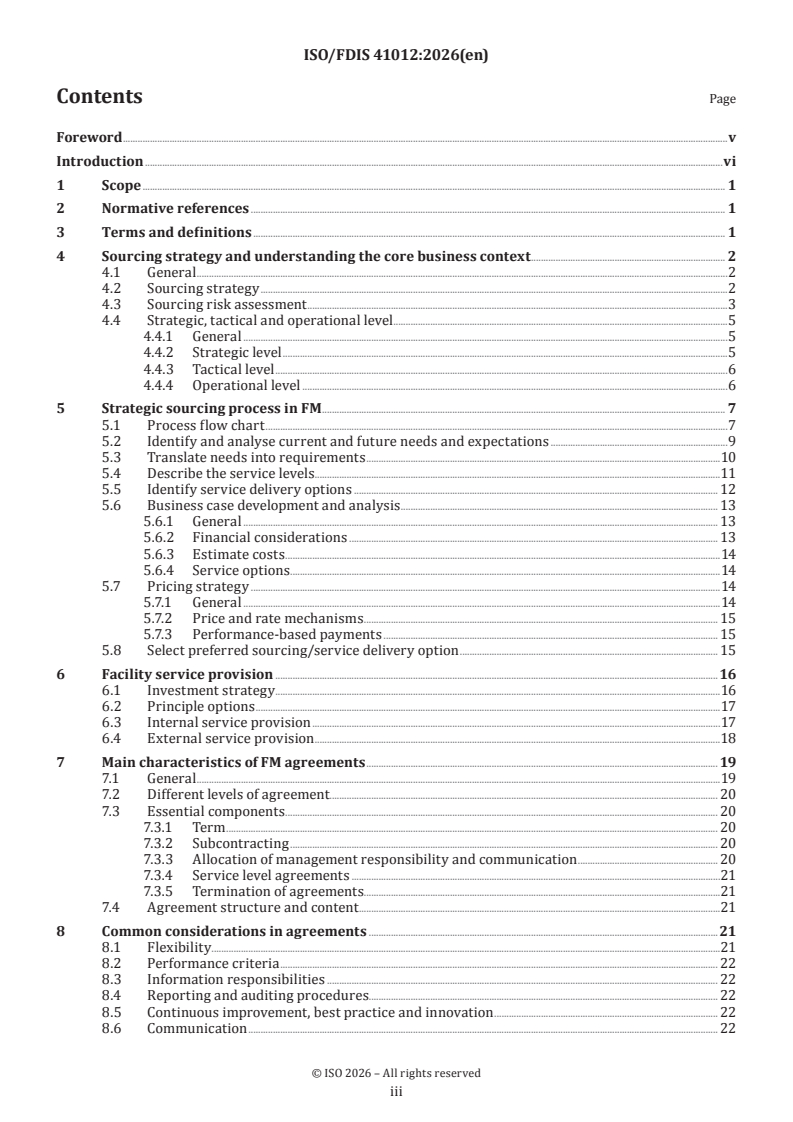
Contents Page
Foreword .v
Introduction .vi
1 Scope . 1
2 Normative references . 1
3 Terms and definitions . 1
4 Sourcing strategy and understanding the core business context . 2
4.1 General .2
4.2 Sourcing strategy .2
4.3 Sourcing risk assessment .3
4.4 Strategic, tactical and operational level .5
4.4.1 General .5
4.4.2 Strategic level .5
4.4.3 Tactical level .6
4.4.4 Operational level .6
5 Strategic sourcing process in FM . 7
5.1 Process flow chart .7
5.2 Identify and analyse current and future needs and expectations .9
5.3 Translate needs into requirements .10
5.4 Describe the service levels .11
5.5 Identify service delivery options . 12
5.6 Business case development and analysis . 13
5.6.1 General . 13
5.6.2 Financial considerations . 13
5.6.3 Estimate costs .14
5.6.4 Service options .14
5.7 Pricing strategy .14
5.7.1 General .14
5.7.2 Price and rate mechanisms . 15
5.7.3 Performance-based payments . 15
5.8 Select preferred sourcing/service delivery option . 15
6 Facility service provision .16
6.1 Investment strategy .16
6.2 Principle options .17
6.3 Internal service provision .17
6.4 External service provision .18
7 Main characteristics of FM agreements . 19
7.1 General .19
7.2 Different levels of agreement. 20
7.3 Essential components . 20
7.3.1 Term . 20
7.3.2 Subcontracting . 20
7.3.3 Allocation of management responsibility and communication . 20
7.3.4 Service level agreements .21
7.3.5 Termination of agreements.21
7.4 Agreement structure and content .21
8 Common considerations in agreements .21
8.1 Flexibility.21
8.2 Performance criteria . 22
8.3 Information responsibilities . 22
8.4 Reporting and auditing procedures. 22
8.5 Continuous improvement, best practice and innovation . 22
8.6 Communication . 22
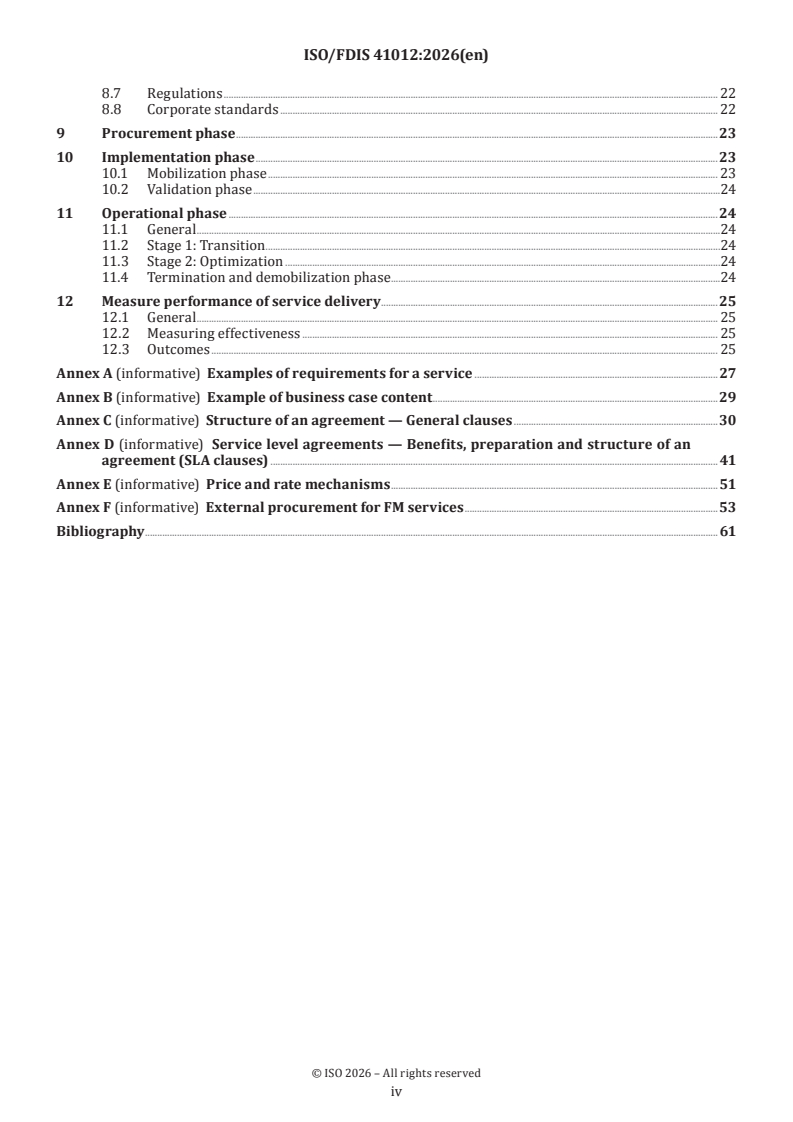
iii
8.7 Regulations . 22
8.8 Corporate standards . 22
9 Procurement phase .23
10 Implementation phase .23
10.1 Mobilization phase . 23
10.2 Validation phase .24
11 Operational phase .24
11.1 General .24
11.2 Stage 1: Transition . .24
11.3 Stage 2: Optimization .24
11.4 Termination and demobilization phase .24
12 Measure performance of service delivery .25
12.1 General . 25
12.2 Measuring effectiveness . 25
12.3 Outcomes . 25
Annex A (informative) Examples of requirements for a service .27
Annex B (informative) Example of business case content .29
Annex C (informative) Structure of an agreement — General clauses .30
Annex D (informative) Service level agreements — Benefits, preparation and structure of an
agreement (SLA clauses) . 41
Annex E (informative) Price and rate mechanisms . 51
Annex F (informative) External procurement for FM services .53
Bibliography . 61
iv
Foreword
ISO (the International Organization for Standardization) is a worldwide federation of national standards
bodies (ISO member bodies). The work of preparing International Standards is normally carried out through
ISO technical committees. Each member body interested in a subject for which a technical committee
has been established has the right to be represented on that committee. International organizations,
governmental and non-governmental, in liaison with ISO, also take part in the work. ISO collaborates closely
with the International Electrotechnical Commission (IEC) on all matters of electrotechnical standardization.
The procedures used to develop this document and those intended for its further maintenance are described
in the ISO/IEC Directives, Part 1. In particular, the different approval criteria needed for the different types
of ISO document should be noted. This document was drafted in accordance with the editorial rules of the
ISO/IEC Directives, Part 2 (see www.iso.org/directives).
ISO draws attention to the possibility that the implementation of this document may involve the use of (a)
patent(s). ISO takes no position concerning the evidence, validity or applicability of any claimed patent
rights in respect thereof. As of the date of publication of this document, ISO had not received notice of (a)
patent(s) which may be required to implement this document. However, implementers are cautioned that
this may not represent the latest information, which may be obtained from the patent database available at
www.iso.org/patents. ISO shall not be held responsible for identifying any or all such patent rights.
Any trade name used in this document is information given for the convenience of users and does not
constitute an endorsement.
For an explanation of the voluntary nature of standards, the meaning of ISO specific terms and expressions
related to conformity assessment, as well as information about ISO’s adherence to the World Trade
Organization (WTO) principles in the Technical Barriers to Trade (TBT), see www.iso.org/iso/foreword.html.
This document was prepared by Technical Committee ISO/TC 267, Facility management, in collaboration with
the European Committee for Standardization (CEN) Technical Committee CEN/TC 348, Facility Management,
in accordance with the Agreement on technical cooperation between ISO and CEN (Vienna Agreement).
This second edition cancels and replaces the first edition (ISO 41012:2017), which has been technically
revised.
The main changes are as follows:
— the document has been restructured to improve navigation of the standard, including sourcing process
given in Figure 3;
— changes have been made in Clause 4 (strategy), Clause 5 (sourcing process), Clause 6 (service provision
and delivery options) and Clause 7 (the agreement);
— a new Clause 9 has been added on the procurement phase;
— a new Annex E has been added on price and rate mechanisms and a new Annex F on eternal procurement
for facility management;
— alignment has been strengthened with related International Standards such as ISO 41001, ISO/TR 41030,
ISO 31000, ISO 55000, ISO 55001 and ISO 55002.
Any feedback or questions on this document should be directed to the user’s national standards body. A
complete listing of these bodies can be found at www.iso.org/members.html.
v
Introduction
The International Standards on facility management (FM) developed by ISO/TC 267 describe the
characteristics of facility management and are intended for use in both the private and public sectors.
NOTE The terms “facility management” and “facilities management” can be used interchangeably.
International cooperation in the preparation of these International Standards has identified common
practices that can be applied across a wide variety of market sectors, organizational types, process activities
and geographies, and their implementation will help to:
— improve quality, productivity and financial performance;
— enhance sustainability and reduce negative environmental impact;
— develop functional and motivating work environments;
— maintain regulatory compliance and provide safe workplaces;
— optimize life cycle performance and costs;
— improve resilience and relevance;
— project an organization’s identity and image more successfully.
FM and related goods and services support the achievement of core organizational activities and objectives.
The purpose of this document is to enable organizations to identify and select the most appropriate
resources for the design, sourcing and delivery of FM.
This document provides guidance on the overall strategic sourcing process and on how to prepare and
implement adequate internal or external FM agreements. Figure 1 provides an overview of the logical
sequence of this document.
vi
Figure 1 — Logical sequence of this document
This document also provides guidance on:
— types of agreements;
— development, structure and contents of agreements;
— clarification of definitions, where appropriate.
This document promotes a methodology from a strategic level to an operational level, with examples and
check lists. The application of this sourcing approach is intended to contribute significantly to adding value
vii
and optimizing costs of operations for FM professionals and procurement, finance and senior management
teams.
Annexes A and B give examples of requirements for typical services and a business case. Annexes C and D
provide general and specific clauses and structured checklists for typical agreements. These annexes
facilitate the selection of important clauses and preferences in the development of agreements, which
allow for differences in origin, purpose and jurisdictions/national rules and regulations, and are based on a
generic platform.
This document covers general demand organization requirements. The FM organization should apply this
document within its own context. Not all information in this document can be applicable to every FM process
or agreement.
In this document, references to “agreement”, “service” or “service provider” are specific to FM and facility
services agreement, facility service or facility service provider (internal or external). Any reference to a
single service can also include multiple services.
viii
FINAL DRAFT International Standard ISO/FDIS 41012:2026(en)
Facility management — Guidance on strategic sourcing and
the development of agreements
1 Scope
This document gives guidance on sourcing and the development of agreements in facility management (FM).
It highlights:
— different sourcing strategies and considerations to determine the best outcome for the demand
organization;
— essential elements in FM sourcing processes;
— FM roles and responsibilities in sourcing processes;
— development processes and structures of typical agreement models.
This document is applicable to:
— strategic processes related to service and support functions for the core business;
— development of FM sourcing strategies;
— development of facility service provision agreements covering both public and private service demand
and internal and external production/delivery options;
— development of FM information systems;
— FM education and research;
— organizational development and business re-engineering processes in major types of working
environments (e.g. industrial, commercial, administration, military, healthcare, accommodation).
2 Normative references
The following documents are referred to in the text in such a way that some or all of their content constitutes
requirements of this document. For dated references, only the edition cited applies. For undated references,
the latest edition of the referenced document (including any amendments) applies.
ISO 41011, Facility management — Vocabulary
3 Terms and definitions
For the purposes of this document, the terms and definitions given in ISO 41011 and the following apply.
ISO and IEC maintain terminology databases for use in standardization at the following addresses:
— ISO Online browsing platform: available at https:// www .iso .org/ obp
— IEC Electropedia: available at https:// www .electropedia .org/
3.1
strategic sourcing
process undertaken by a demand organization to come to a strategic decision about the nature of facility
management (FM) service delivery
3.2
risk
effect of uncertainty
Note 1 to entry: An effect is a deviation from the expected – positive or negative.
[SOURCE: ISO 41011:2024, 3.7.18, modified — “on objectives” in the definition and Notes 2, 3 and 4 to entry
deleted.]
4 Sourcing strategy and understanding the core business context
4.1 General
This step of the strategic sourcing process is shown in Figure 2. It is the first step of the strategic sourcing
process given in Figure 3.
Figure 2 — Sourcing strategy and core business context
4.2 Sourcing strategy
To achieve its core business objectives a demand organization should ensure the structures, the delivery of
FM and support services are aligned with the business strategy. The demand organization should employ an
effective sourcing process to achieve that objective.
Criteria that can have an impact on sourcing strategy include, but are not limited to:
— the competitive environment;
— value drivers (including cost/benefit analysis);
— the need for resource flexibility;
— business risks;
— reliability of supply chain / risk of over-reliance on single suppliers;
— operational characteristics;
— operational interdependencies;
— availability of in-house FM expertise;
— the availability and capability of various supply options;
— corporate policies;
— statutory obligations and legal requirements
— organizational culture and management style;
— reporting requirements and management information systems;
— demand organization objectives on a strategic and operational level;
— innovation;
— corporate and real estate strategy;
— FM strategy;
As most organizations live in an environment of dynamic change, these sourcing processes should be
reviewed regularly and should be, at all times, closely linked to the organization’s overall business strategy.
The adequate FM competence should be available within the demand organization to support the sourcing
process through internal and/or external sources. These competences should include, but are not limited to:
— understanding the core business;
— analytic skills;
— management skills;
— communication skills;
— appropriate knowledge of FM;
— procurement skills;
— understanding statutory obligations and legal requirements;
— environmental, social and cultural awareness.
To achieve an optimum outcome through each state of the process, the demand organization should engage
the appropriately competent expertise to ensure exposure to the broadest potential opportunities are made
available also in the procurement phase of the process.
4.3 Sourcing risk assessment
Risk analysis is a process that is used to understand the nature, sources and causes of risk. A careful
evaluation will ensure foreseeable risks are identified, quantified and, where possible, eliminated. It is
also used to study impacts and consequences. The level of detail and complexity applied to the review will
depend upon the potential impact.
Incorporating risk assessment and management into strategic sourcing and the development of agreements
enables the demand organization and delivery organization(s) to incorporate and address potential threats
and opportunities in a structured manner. In addition to identifying risks, the probability, impact and
consequence should be assessed so that they can be incorporated into strategic planning, decision-making
and the overall strategic sourcing and agreement process.
The demand organization should consider potential risks during development of the sourcing strategy
and modify as appropriate on the basis of improved knowledge during the procurement phase of the
process, eventual supplier selection and negotiation and through ongoing governance. The level of detail
and complexity applied to the risk assessment will depend upon risk complexity, probability, impact and
potential consequence.
A key objective is to ensure that risk is allocated and apportioned to the organization best able to manage or
mitigate each risk to a level acceptable to the demand organization.
Areas to consider during the risk assessment should be comprehensive enough to meet the needs of the
demand organization and the service or activity being sourced. The assessment may include, but is not
limited to, the following threats and opportunities:
— political:
— prevailing current and expected political climate to services being sourced;
— other political and regulatory events that can impact ability to deliver;
— economic:
— economic climate;
— inflation and potential impact to an agreement;
— market:
— supplier power and concentration;
— purchasing power;
— market practices;
— general competencies of suppliers for services being procured within the market;
— technology:
— availability and maturity of technology to support delivery of service over the life of an agreement;
— ownership of technology by a supplier or demand organization;
— legal:
— jurisdictional/national legal requirements;
— maturity of contracting arrangements;
— local familiarity with sourcing contract types, strategies and relationships.
More specific threats and opportunities for the demand organization to consider can include:
— demand organization expertise;
— compliance;
— business continuity;
— intellectual property;
— reputation;
— health and safety:
— ethics;
— brand of demand organization and potential suppliers;
— operations;
— mutual dependency (share of demand organization spend and share of supplier revenue);
— transition from a change in delivery from internal to third party or between third parties;
— events associated with the service or activity being sourced:
— portfolio data and/or assets;
— quality of information on service to be sourced;
— local service provider competencies;
— safety or compliance implications for specific service;
— impact of service on other demand organization operations.
NOTE For specific risk management information, see ISO 31000 and ISO 41014:2020, 4.4.
The demand organization should consider the potential threats and opportunities prior to implementing an
agreement. All foreseeable events should be considered to ensure the following (among other considerations):
— the impacts of needs are fully defined;
— needs and constraints are translated into requirement and specifications/service level, for example:
— data on the property portfolio and/or built environment;
— information on initial and long-term cost implications;
— competences in the demand organization;
— competences by the service provider;
— resources;
— health, safety and environment;
— security;
— funding;
— information technology (IT) system, hardware and communication technology/integration;
— due diligence;
— coordinated design, construction and commissioning;
— coordinated disaster recovery planning (natural and business-related);
— business continuity planning and management;
— corporate governance.
Throughout a strategic sourcing process, choices and decisions are made that can trigger threats or
opportunities. A risk-based approach to FM means that the assessment should be repeated throughout the
process of strategic sourcing as well as FM services at specific milestones, at a level appropriate for the
relevant milestone.
4.4 Strategic, tactical and operational level
4.4.1 General
In order to succeed and deliver required results, FM should be in close synchronization with the mission,
vision, objectives and domains of the core business. It is the role of FM to provide strategic guidance to
a core business in relation to FM aspects, interpreting needs and demands, translating them into explicit
service and deliverables requirements. FM acts on the main three levels:
— strategic;
— tactical;
— operational.
4.4.2 Strategic level
At the strategic level, the aim is to achieve the strategic objectives of the organization in the long term by
means of:
— establishing the FM strategy and sourcing strategy in accordance with the organization’s strategy;
— policymaking, elaborating guidelines for space, built environments, processes and services;
— initiating risk analysis and mitigation and providing the direction to adapt to changes in the organization;
— establishing performance management policy and outcomes;
— assessing the impact of facility on the primary activities, external environment and community;
— maintaining relations with authorities and other stakeholders;
— approving business plans and budgets;
— providing advisory services to the demand organization;
— making procurement decisions, including establishing the re-procurement criteria.
4.4.3 Tactical level
At the tactical level, the aim is to implement the strategic objectives in the organization in the medium term,
for example, through:
— administration;
— reporting (setting up and performing);
— recording (status and events);
— implementing and monitoring guidelines for strategies;
— developing business plans and budgets;
— translating strategic FM objectives into operational level requirements;
— establishing the service level agreements (SLAs);
— establishing the key performance indicators (KPIs);
— managing projects, processes and agreements;
— managing the FM teams;
— managing the services team;
— optimizing the use of resources;
— adapting to and reporting on changes and statuses;
— communicating with internal or external service providers on a tactical level.
4.4.4 Operational level
At the operational level, the aim is to create the required environment to the end users on a day-to-day basis,
for example, through:
— delivering services in accordance with the SLA;
— monitoring and checking the service delivery processes;
— monitoring the service providers;
— receiving requests for service (e.g. via a help desk or service line);
— collecting data for performance evaluations, feedback and demands from end users;
— reporting to tactical level;
— communicating with internal or external service providers on an operational level.
5 Strategic sourcing process in FM
5.1 Process flow chart
The strategic sourcing process consists of a number of steps described in Clauses 5 to 10, as illustrated in
Figure 3.
The decision-making is often a result of each stage or step and those decisions inform subsequent stages or
steps.
Figure 3 — Strategic sourcing process overview
5.2 Identify and analyse current and future needs and expectations
This step of the strategic sourcing process is shown in Figure 4.
Figure 4 — Identify and analyse current and future needs
The first step in the identification of needs is to understand the current conditions and establish a baseline.
The demand organization should have a good understanding of the current organizational structure and
capabilities, current service delivery models, existing service contracts and current performance measures.
The following additional elements of existing core business information are important in most sourcing
processes. As managing service supply can cover a very broad range of needs and demands of totally
different natures, FM related sourcing should acquire as a minimum the following information from the
demand organization:
— primary activities and core business, mission, vision, strategy and corporate values;
— key objectives of business/activities;
— identification of service criticality and dependencies between services;
— geographical locations and areas of operation, building portfolio and space;
— strategic directions of the organization short/long term and its influence on, for example, building
portfolio, technical infrastructure, work force and competence;
— organizational culture, structure, governance and principles of decision-making (local, regional, global);
— current and possible future (intended) corporate image and trademark;
— range and nature of core products/services and distribution (local, regional, global);
— strategic considerations related to sustainable environmental issues and social responsibilities;
— security, resilience and other risk concerns with decisive influence on strategic choices;
— customers, demand organizations and other stakeholders with decisive influence on strategic choices;
— management of information for planning and controlling services;
— setting up the demand organization’s FM service catalogue;
— existing basis and arrangements for service provision and scope of services;
— the interface between the primary activities and support services;
— the “as is” situation: users’ expectations and satisfaction of present range and quality of services
provision;
— applicable statutory obligations and legal requirements.
The organizational needs should be clearly articulated and the ultimate objectives documented before
commencement of any FM sourcing activity.
It is also important to understand the critical opportunities and risks and to identify the consequences
current and future strategic decisions will have on the service and facility support demand of the core
business of the demand organization.
The FM organization should have information on:
— top management’s impressions of the present FM organization’s performance, service levels and qualities;
— the strategic planning time frame of the demand organization/business unit;
— changes in core strategies which, within their planning horizon, are expected to cause notable impact
on:
— stakeholders’ expectations;
— geographic representation;
— building portfolio/tenancies;
— sites and locations;
— workspace/workplace;
— products and distribution;
— technical infrastructures and other infrastructure-built environments;
— human resources (HR) and corporate culture and identity;
— security and operational risk issues;
— sustainability and environmental issues;
— social responsibilities;
— the most likely serious challenges and what impact they can have on the needs and demand of service
and support;
— business objectives, main drivers and constraints;
— core and non-core business;
— sustainability aspects;
— scope of services;
— innovation requirements;
— special service requirements and hazardous operations, where applicable;
— transitional arrangements;
— current service delivery model.
5.3 Translate needs into requirements
This step of the strategic sourcing process is shown in Figure 5.
Figure 5 — Translate needs into requirements
After an understanding of the needs of the core business is established, the scope of the facility service
or services to be provided needs to be defined. The translation of a need to a requirement is to identify
satisfaction criteria and corresponding service and/or goods. See Annex A for examples of how to translate
needs into requirements.
The scope of facility services may include a single service (out-tasking) or a range of facility services.
All services supporting the primary activities should regularly be checked for relevance, adequate
performance and cost efficiency.
New service requirements can involve needs for knowledge and skills that have not been required before,
and such resources should be included early in the process. The following should be considered and actioned:
— checking required and available data for assessment/estimation of service options to satisfy new
requirements;
— estimating volumes, specifying preliminary service levels, quality and performance requirements for
new service provision and getting verification/acceptance from top management;
— adjusting volumes, service levels, quality and performance requirements on current service and support
in accordance with information from the primary activities;
— expressing performance requirements in measurable terms with corresponding/suggested performance
indicators, in order to compare agreed/decided performance requirements with measured results;
— considering interdependencies between FM activities which are important for creating or retaining
synergies between them.
5.4 Describe the service levels
This step of the strategic sourcing process is shown in Figure 6.
Figure 6 — Describe the service levels
After the demand requirements have been developed, the next step is to establish the level of service or
quality of performance to meet the requirements. The translation of requirements into specifications will
define the appropriate scope of work and required resources. Until the level of service is determined, staffing
levels or service provider provisions cannot be completely quantified.
The expected level of service needs to consider both qualitative and quantitative measures. Two key
elements are fundamental in creating effective service levels:
a) the expectations should be practical and achievable;
b) the expectations should acknowledge that there is a relationship between the SLA and the resources
needed to meet the level of service.
The service levels should relate to each requirement meeting a need of the demand organization’s core
business. Performance measures should be identified and cle
...
ISO/TC 267
Secretariat: BSI
Date: 2026-04-1510-02
Facility management — Guidance on strategic sourcing and the
development of agreements
Facility management — Recommandations relatives au processus d'approvisionnement stratégique et
d'élaboration des accords
FDIS stage
TThhiiss d drraftaft i iss s suubbmmiitttteded t too a pa pararallel vallel vootte e iinn I ISSOO,, C CEENN.
All rights reserved.
This ISO publication is protected by copyright and is owned by ISO and/or its licensors.
The content of this ISO publication is provided under licence, not sold. Use is subject to the applicable licence terms issued
by ISO, an ISO member body, or an authorized third-party distributor.
Except as required for implementation or expressly permitted by a separate licence, no part of this ISO publication may
be reproduced, distributed, modified, used, or made available in any form or by any means – electronic or mechanical,
including photocopying, scanning, recording, or posting on internal or external digital platforms.
Any use beyond the scope of the granted rights is prohibited and may result in legal action.
ISO copyright office
CP 401 • CH-1214 Vernier, Geneva
Phone: + 41 22 749 01 11
Email: copyright@iso.org
Website: www.iso.org
Published in Switzerland
ii
Contents
Foreword . v
Introduction . vi
1 Scope . 1
2 Normative references . 1
3 Terms and definitions . 1
4 Sourcing strategy and understanding the core business context . 2
4.1 General. 2
4.2 Sourcing strategy . 2
4.3 Sourcing risk assessment . 3
4.4 Strategic, tactical and operational level . 6
5 Strategic sourcing process in FM . 7
5.1 Process flow chart. 7
5.2 Identify and analyse current and future needs and expectations . 9
5.3 Translate needs into requirements . 11
5.4 Describe the service levels . 11
5.5 Identify service delivery options . 13
5.6 Business case development and analysis . 14
5.7 Pricing strategy. 15
5.8 Select preferred sourcing/service delivery option . 16
6 Facility service provision . 18
6.1 Investment strategy . 18
6.2 Principle options . 18
6.3 Internal service provision . 19
6.4 External service provision . 19
7 Main characteristics of FM agreements . 21
7.1 General. 21
7.2 Different levels of agreement . 21
7.3 Essential components . 22
7.4 Agreement structure and content . 23
8 Common considerations in agreements . 23
8.1 Flexibility . 23
8.2 Performance criteria . 23
8.3 Information responsibilities . 24
8.4 Reporting and auditing procedures . 24
8.5 Continuous improvement, best practice and innovation . 24
8.6 Communication . 24
8.7 Regulations . 24
8.8 Corporate standards . 24
9 Procurement phase . 24
10 Implementation phase . 25
10.1 Mobilization phase . 25
10.2 Validation phase . 26
11 Operational phase . 26
11.1 General. 26
11.2 Stage 1: Transition . 26
11.3 Stage 2: Optimization . 26
iii
11.4 Termination and demobilization phase . 26
12 Measure performance of service delivery . 27
12.1 General. 27
12.2 Measuring effectiveness . 27
12.3 Outcomes . 27
Annex A (informative) Examples of requirements for a service . 29
Annex B (informative) Example of business case content . 31
Annex C (informative) Structure of an agreement — General clauses . 33
Annex D (informative) Service level agreements — Benefits, preparation and structure of an
agreement (SLA clauses) . 45
Annex E (informative) Price and rate mechanisms . 56
Annex F (informative) External procurement for FM services. 58
Bibliography . 66
iv
Foreword
ISO (the International Organization for Standardization) is a worldwide federation of national standards
bodies (ISO member bodies). The work of preparing International Standards is normally carried out through
ISO technical committees. Each member body interested in a subject for which a technical committee has been
established has the right to be represented on that committee. International organizations, governmental and
non-governmental, in liaison with ISO, also take part in the work. ISO collaborates closely with the
International Electrotechnical Commission (IEC) on all matters of electrotechnical standardization.
The procedures used to develop this document and those intended for its further maintenance are described
in the ISO/IEC Directives, Part 1. In particular, the different approval criteria needed for the different types of
ISO document should be noted. This document was drafted in accordance with the editorial rules of the
ISO/IEC Directives, Part 2 (see www.iso.org/directives).
ISO draws attention to the possibility that the implementation of this document may involve the use of (a)
patent(s). ISO takes no position concerning the evidence, validity or applicability of any claimed patent rights
in respect thereof. As of the date of publication of this document, ISO had not received notice of (a) patent(s)
which may be required to implement this document. However, implementers are cautioned that this may not
represent the latest information, which may be obtained from the patent database available at
www.iso.org/patents. ISO shall not be held responsible for identifying any or all such patent rights.
Any trade name used in this document is information given for the convenience of users and does not
constitute an endorsement.
For an explanation of the voluntary nature of standards, the meaning of ISO specific terms and expressions
related to conformity assessment, as well as information about ISO’s adherence to the World Trade
Organization (WTO) principles in the Technical Barriers to Trade (TBT), see www.iso.org/iso/foreword.html.
This document was prepared by Technical Committee ISO/TC 267, Facility management., in collaboration with
the European Committee for Standardization (CEN) Technical Committee CEN/TC 348, Facility Management,
in accordance with the Agreement on technical cooperation between ISO and CEN (Vienna Agreement).
This second edition cancels and replaces the first edition (ISO/DIS 41012:2017), which has been technically
revised.
The main changes are as follows:
— Restructure the sections and improvement ofdocument has been restructured to improve navigation of
the standard, including Sourcingsourcing process given in Figure 3Figure 2 ;
— Major changes have been made in Clause 4across four sections related to: (strategy), Clause 5 (4),
(sourcing process), Clause 6(5), (service provision and delivery options (6) and Clause 7 (the agreement
(7));
— — Addition of a new Clause 9section 9 in relation to has been added on the Procurementprocurement
phase;
— — Addition ofa new Annex Eannexes in relation to Price has been added on price and rate mechanisms
(Annex E) and a new Annex FEternal on eternal procurement for FM (Annex F)facility management;
— — Strengthened alignment has been strengthened with related ISO standardsInternational Standards
such as ISO 41001, ISO/TR 41030, ISO 31000, ISO 55000 series, ISO 55001 and ISO 55002.
Any feedback or questions on this document should be directed to the user’s national standards body. A
complete listing of these bodies can be found at www.iso.org/members.html.
v
Introduction
The International Standards on facility management (FM) developed by ISO/TC 267 describe the
characteristics of facility management and are intended for use in both the private and public sectors.
NOTE The terms “facility management” and “facilities management” can be used interchangeably.
International cooperation in the preparation of these International Standards has identified common practices
that can be applied across a wide variety of market sectors, organizational types, process activities and
geographies, and their implementation will help to:
— improve quality, productivity and financial performance;
— enhance sustainability and reduce negative environmental impact;
— develop functional and motivating work environments;
— maintain regulatory compliance and provide safe workplaces;
— optimize life cycle performance and costs;
— improve resilience and relevance;
— project an organization’s identity and image more successfully.
FM and related goods and services support the achievement of core organizational activities and objectives.
The purpose of this document is to enable organizations to identify and select the most appropriate resources
for the design, sourcing and delivery of FM.
This document provides guidance on the overall strategic sourcing process and on how to prepare and
implement adequate internal or external FM agreements. Figure 1 provides an overview of the logical
sequence of this document.
vi
Figure 1 — Logical sequence of this document
This document also provides guidance on:
— types of agreements;
— development, structure and contents of agreements;
— clarification of definitions, where appropriate.
This document promotes a methodology from a strategic level to an operational level, with examples and
check lists. The application of this sourcing approach is intended to contribute significantly to adding value
vii
and optimizing costs of operations for FM professionals and procurement, finance and senior management
teams.
Annexes A and B give examples of requirements for typical services and a business case. Annexes C and D
provide general and specific clauses and structured checklists for typical agreements. These annexes facilitate
the selection of important clauses and preferences in the development of agreements, which allow for
differences in origin, purpose and jurisdictions/national rules and regulations, and are based on a generic
platform.
This document covers general demand organization requirements. The FM organization should apply this
document within its own context. Not all information in this document can be applicable to every FM process
or agreement.
In this document, references to “agreement”, “service” or “service provider” are specific to FM and facility
services agreement, facility service or facility service provider (internal or external). Any reference to a single
service can also include multiple services.
viii
Facility management — Guidance on strategic sourcing and the
development of agreements
1 Scope
This document gives guidance on sourcing and the development of agreements in facility management (FM).
It highlights:
— different sourcing strategies and considerations to determine the best outcome for the demand
organization;
— essential elements in FM sourcing processes;
— FM roles and responsibilities in sourcing processes;
— development processes and structures of typical agreement models.
This document is applicable to:
— strategic processes related to service and support functions for the core business;
— development of FM sourcing strategies;
— development of facility service provision agreements covering both public and private service demand
and internal and external production/delivery options;
— development of FM information systems;
— FM education and research;
— organizational development and business re-engineering processes in major types of working
environments (e.g. industrial, commercial, administration, military, healthcare, accommodation).
2 Normative references
The following documents are referred to in the text in such a way that some or all of their content constitutes
requirements of this document. For dated references, only the edition cited applies. For undated references,
the latest edition of the referenced document (including any amendments) applies.
ISO 41011, Facility management — Vocabulary
3 Terms and definitions
For the purposes of this document, the terms and definitions given in ISO 41011 and the following apply.
ISO and IEC maintain terminology databases for use in standardization at the following addresses:
— ISO Online browsing platform: available at https://www.iso.org/obp
— IEC Electropedia: available at https://www.electropedia.org/
3.1
strategic sourcing
process undertaken by a demand organization (DO) to come to a strategic decision about the nature of facility
management (FM) service delivery
3.2
Risk
3.2
risk
effect of uncertainty
NOTE Note 1: to entry: An effect is a deviation from the expected – positive or negative.
— ISO 31000:2018 – Risk management: available at [SOURCE: ISO 41011:2024, 3.7.18, modified — “on objectives” in
the definition and Notes 2, 3 and 4 to entry deleted.]
4 Sourcing strategy and understanding the core business context
4.1 General
This step of the strategic sourcing process is shown in Figure 2Figure 2.a below and. It is the first step of the
strategic sourcing process as showedgiven in Figure 3Figure 2. .
Figure 2.a — — Sourcing strategy and core business context
4.14.2 Sourcing strategy
To achieve its core business objectives a demand organization should ensure the structures, the delivery of
FM and support services are aligned with the business strategy. The demand organization should employ an
effective sourcing process to achieve that objective.
Criteria that can have an impact on sourcing strategy include, but are not limited to:
— the competitive environment;
— value drivers (including cost/benefit analysis);
— the need for resource flexibility;
— business risks;
— reliability of supply chain / risk of over-reliance on single suppliers;
— operational characteristics;
— operational interdependencies;
— availability of in-house FM expertise;
— the availability and capability of various supply options;
— corporate policies;
— statutory obligations and legal requirements
— organizational culture and management style;
— reporting requirements and management information systems;
— demand organization (DO) objectives on a strategic and operational level;
— innovation;
— corporate and real estate strategy;
— FM strategy;
As most organizations live in an environment of dynamic change, these sourcing processes should be reviewed
regularly and should be, at all times, closely linked to the organization’s overall business strategy.
The adequate FM competence should be available within the demand organization to support the sourcing
process through internal and/or external sources. These competences should include, but are not limited to:
— understanding the core business;
— analytic skills;
— management skills;
— communication skills;
— appropriate knowledge of FM;
— procurement skills;
— understanding statutory obligations and legal requirements;
— environmental, social and cultural awareness.
To achieve an optimum outcome through each state of the process, the demand organization should engage
the appropriately competent expertise to ensure exposure to the broadest potential opportunities are made
available also in the procurement phase of the process.
4.24.3 Sourcing risk assessment
Risk analysis is a process that is used to understand the nature, sources and causes of risk. A careful evaluation
will ensure foreseeable risks are identified, quantified and, where possible, eliminated. It is also used to study
impacts and consequences. The level of detail and complexity applied to the review will depend upon the
potential impact.
Incorporating risk assessment and management into strategic sourcing and the development of agreements
enables the demand organization and delivery organization(s) to incorporate and address potential threats
and opportunities in a structured manner. In addition to identifying risks, the probability, impact and
consequence should be assessed so that they can be incorporated into strategic planning, decision-making and
the overall strategic sourcing and agreement process.
The demand organization should consider potential risks during development of the sourcing strategy and
modify as appropriate on the basis of improved knowledge during the procurement phase of the process,
eventual supplier selection and negotiation and through ongoing governance. The level of detail and
complexity applied to the risk assessment will depend upon risk complexity, probability, impact and potential
consequence.
A key objective is to ensure that risk is allocated and apportioned to the organization best able to manage or
mitigate each risk to a level acceptable to the demand organization.
Areas to consider during the risk assessment should be comprehensive enough to meet the needs of the
demand organization and the service or activity being sourced. The assessment may include, but is not limited
to, the following threats and opportunities:
— political:
— prevailing current and expected political climate to services being sourced;
— other political and regulatory events that can impact ability to deliver;
— economic:
— economic climate;
— inflation and potential impact to an agreement;
— market:
— supplier power and concentration;
— purchasing power;
— market practices;
— general competencies of suppliers for services being procured within the market;
— technology:
— availability and maturity of technology to support delivery of service over the life of an agreement;
— ownership of technology by a supplier or demand organization;
— legal:
— jurisdictional/national legal requirements;
— maturity of contracting arrangements;
— local familiarity with sourcing contract types, strategies and relationships.
More specific threats and opportunities for the demand organization to consider can include:
— demand organization expertise;
— compliance;
— business continuity;
— intellectual property;
— reputation;
— health and safety:
— ethics;
— brand of demand organization and potential suppliers;
— operations;
— mutual dependency (share of demand organization spend and share of supplier revenue);
— transition from a change in delivery from internal to third party or between third parties;
— events associated with the service or activity being sourced:
— portfolio data and/or assets;
— quality of information on service to be sourced;
— local service provider competencies;
— safety or compliance implications for specific service;
— impact of service on other demand organization operations.
NOTE For specific risk management information, see ISO 31000 and ISO 41014:2020, 4.4.
The demand organization should consider the potential threats and opportunities prior to implementing an
agreement. All foreseeable events should be considered to ensure the following (among other considerations):
— the impacts of needs are fully defined;
— needs and constraints are translated into requirement and specifications/service level, for example:
— data on the property portfolio and/or built environment;
— information on initial and long-term cost implications;
— competences in the demand organization;
— competences by the service provider;
— resources;
— health, safety and environment;
— security;
— funding;
— information technology (IT) system, hardware and communication technology/integration;
— due diligence;
— coordinated design, construction and commissioning;
— coordinated disaster recovery planning (natural and business-related);
— business continuity planning and management;
— corporate governance.
Throughout a strategic sourcing process, choices and decisions are made that can trigger threats or
opportunities. A risk-based approach to FM means that the assessment should be repeated throughout the
process of strategic sourcing as well as FM services at specific milestones, at a level appropriate for the
relevant milestone.
4.34.4 Strategic, tactical and operational level
4.3.14.4.1 General
In order to succeed and deliver required results, FM should be in close synchronization with the mission,
vision, objectives and domains of the core business. It is the role of FM to provide strategic guidance to a core
business in relation to FM aspects, interpreting needs and demands, translating them into explicit service and
deliverables requirements. FM acts on the main three levels:
— strategic;
— tactical;
— operational.
4.3.24.4.2 Strategic level
At the strategic level, the aim is to achieve the strategic objectives of the organization in the long term by
means of:
— establishing the FM strategy and sourcing strategy in accordance with the organization’s strategy;
— policy-makingpolicymaking, elaborating guidelines for space, built environments, processes and services;
— initiating risk analysis and mitigation and providing the direction to adapt to changes in the organization;
— establishing performance management policy and outcomes;
— assessing the impact of facility on the primary activities, external environment and community;
— maintaining relations with authorities and other stakeholders;
— approving business plans and budgets;
— providing advisory services to the demand organization;
— making procurement decisions, including establishing the re-procurement criteria.
4.3.34.4.3 Tactical level
At the tactical level, the aim is to implement the strategic objectives in the organization in the medium term,
e.g.for example, through:
— administration;
— reporting (setting up and performing);
— recording (status and events);
— implementing and monitoring guidelines for strategies;
— developing business plans and budgets;
— translating strategic FM objectives into operational level requirements;
— establishing the service level agreements (SLAs);
— establishing the key performance indicators (KPIs);
— managing projects, processes and agreements;
— managing the FM teams;
— managing the services team;
— optimizing the use of resources;
— adapting to and reporting on changes and statuses;
— communicating with internal or external service providers on a tactical level.
4.3.44.4.4 Operational level
At the operational level, the aim is to create the required environment to the end users on a day-to-day basis,
e.g.for example, through:
— delivering services in accordance with the SLA;
— monitoring and checking the service delivery processes;
— monitoring the service providers;
— receiving requests for service (e.g. via a help desk or service line);
— collecting data for performance evaluations, feedback and demands from end users;
— reporting to tactical level;
— communicating with internal or external service providers on an operational level.
5 Strategic sourcing process in FM
5.1 Process flow chart
The strategic sourcing process consists of a number of steps described in Clauses 5 to 10, as illustrated in
Figure 3Figure 2.
The decision-making is often a result of each stage or step and those decisions inform subsequent stages or
steps.
Figure 2 3 — Strategic sourcing process overview
5.2 Identify and analyse current and future needs and expectations
This step of the strategic sourcing process is shown in Figure 4Figure 2.b.
STEP 2 of 10 Identify & analyse current & future needs
Figure 2.b —
Figure 4 — Identify and analyse current and future needs
The first step in the identification of needs is to understand the current conditions and establish a baseline.
The demand organization should have a good understanding of the current organizational structure and
capabilities, current service delivery models, existing service contracts and current performance measures.
The following additional elements of existing core business information are important in most sourcing
processes. As managing service supply can cover a very broad range of needs and demands of totally different
natures, FM related sourcing should acquire as a minimum the following information from the demand
organization:
— primary activities and core business, mission, vision, strategy and corporate values;
— key objectives of business/activities;
— identification of service criticality and dependencies between services;
— geographical locations and areas of operation, building portfolio and space;
— strategic directions of the organization short/long term and its influence on, for example, building
portfolio, technical infrastructure, work force and competence;
— organizational culture, structure, governance and principles of decision-making (local, regional, global);
— current and possible future (intended) corporate image and trademark;
— range and nature of core products/services and distribution (local, regional, global);
— strategic considerations related to sustainable environmental issues and social responsibilities;
— security, resilience and other risk concerns with decisive influence on strategic choices;
— customers, demand organizations and other stakeholders with decisive influence on strategic choices;
— management of information for planning and controlling services;
— setting up the demand organization’s FM service catalogue;
— existing basis and arrangements for service provision and scope of services;
— the interface between the primary activities and support services;
— the “as is” situation: users’ expectations and satisfaction of present range and quality of services provision;
— applicable statutory obligations and legal requirements.
The organizational needs should be clearly articulated and the ultimate objectives documented before
commencement of any FM sourcing activity.
It is also important to understand the critical opportunities and risks and to identify the consequences current
and future strategic decisions will have on the service and facility support demand of the core business of the
demand organization.
The FM organization should have information on:
— top management’s impressions of the present FM organization’s performance, service levels and qualities;
— the strategic planning time frame of the demand organization/business unit;
— changes in core strategies which, within their planning horizon, are expected to cause notable impact on:
— stakeholders’ expectations;
— geographic representation;
— building portfolio/tenancies;
— sites and locations;
— workspace/workplace;
— products and distribution;
— technical infrastructures and other infrastructure-built environments;
— human resources (HR) and corporate culture and identity;
— security and operational risk issues;
— sustainability and environmental issues;
— social responsibilities;
— the most likely serious challenges and what impact they can have on the needs and demand of service and
support;
— business objectives, main drivers and constraints;
— core and non-core business;
— sustainability aspects;
— scope of services;
— innovation requirements;
— special service requirements and hazardous operations, where applicable;
— transitional arrangements;
— current service delivery model.
5.3 Translate needs into requirements
This step of the strategic sourcing process is shown in Figure 5Figure 2c.
STEP 3 of 10 Translate needs into requirements
Figure 2.c —5 — Translate needs into requirements
After an understanding of the needs of the core business is established, the scope of the facility service or
services to be provided needs to be defined. The translation of a need to a requirement is to identify
satisfaction criteria and corresponding service and/or goods. See Annex A for examples of how to translate
needs into requirements.
The scope of facility services may include a single service (out-tasking) or a range of facility services.
All services supporting the primary activities should regularly be checked for relevance, adequate
performance and cost efficiency.
New service requirements can involve needs for knowledge and skills that have not been required before, and
such resources should be included early in the process. The following should be considered and actioned:
— checking required and available data for assessment/estimation of service options to satisfy new
requirements;
— estimating volumes, specifying preliminary service levels, quality and performance requirements for new
service provision and getting verification/acceptance from top management;
— adjusting volumes, service levels, quality and performance requirements on current service and support
in accordance with information from the primary activities;
— expressing performance requirements in measurable terms with corresponding/suggested performance
indicators, in order to compare agreed/decided performance requirements with measured results;
— considering interdependencies between FM activities which are important for creating or retaining
synergies between them.
5.4 Describe the service levels
This step of the strategic sourcing process is shown in Figure 6Figure 2.d.
STEP 4 of 10 Describe the Service Levels
Figure 2.d — 6 — Describe the service levels
After the demand requirements have been developed, the next step is to establish the level of service or quality
of performance to meet the requirements. The translation of requirements into specifications will define the
appropriate scope of work and required resources. Until the level of service is determined, staffing levels or
service provider provisions cannot be completely quantified.
The expected level of service needs to consider both qualitative and quantitative measures. Two key elements
are fundamental in creating effective service levels:
a) the expectations should be practical and achievable;
b) the expectations should acknowledge that there is a relationship between the SLA and the resources
needed to meet the level of service.
The service levels should relate to each requirement meeting a need of the demand organization’s core
business. Performance measures should be identified and clearly stated for all requirements. These
performance measures can be qualitative or quantitative, but should be sufficient to determine that needs and
expectations are being met or, if not, adequate to address gaps and requirements to improve performance.
A format and structure for service level requirements is included in Annex D.
The appropriate mix of service level performance measures defines the management metrics or KPIs and can
include some or all of the following:
— budget compliance/variance;
— response times (e.g. emergency, urgent and routine work);
— work completion rates;
— amount of proactive versus corrective (i.e. reactive) work;
— preventive maintenance compliance;
— safety inspection and testing compliance;
— staff/contractor utilization/productivity rates;
— level of cleanliness (internal and external);
— compliance with relocation requirements;
— project performance compliance;
— sustainability performance;
— system or equipment reliability;
— interruptions to operation;
— utilization of space or vacancy rates;
— energy conservation performance;
— life cycle performance of built environments (i.e. meet expectations for useful life);
— benchmarks;
— total costs of ownership.
The determination of performance indicators or management metrics should be established independent of
the method of service delivery discussed in 5.5.
At this point in the process, conclude and develop preferred service option(s) based on these requirements.
NOTE For more guidance on quality in FM, see EN 15221-3.
5.5 Identify service delivery options
This step of the strategic sourcing process is shown in Figure 7Figure 2.e.
STEP 5 of 10 Identify service delivery options
Figure 2.e — 7 — Identify service delivery options
There are three typical approaches to delivering services utilizing in-house or externally contracted services:
a) In house services: In this model, most services are performed by FM organization staff. Some services may
be contracted out based on strategic and sourcing decisions or most services provided and distributed by
the in-house FM organization.
b) Separately externally contracted services: In this model, selected services are contracted out to separate
companies and individually managed by the FM organization. The rest of the services may still be
performed in-house.
c) Bundled externally contracted services: In this model, most if not all main services are bundled and
contracted out to a single external service provider who manages the separate services. The
FM organization is responsible for managing the main contract. Some services may still be separately
contracted out or either performed in-house. Even when all services are externally provided or out-tasked
there should be an appropriate FM competence available within the demand organization.
For each of these approaches, there may be a spectrum or hybrid approach rather than an all or nothing split.
Regardless of the methodology for service delivery, the demand organisationorganization should have in
house or procured expertise to ensure that their needs are met by the contract delivery.
There are a number of important issues that should be closely analysed before finally deciding whether a
service should be provided by in-house staff or procured from an external provider, including the following:
— Does the organization have the staff levels, capabilities, skills, knowledge, organizational and supervisory
structure, and supporting facility and tools to meet internal service provision requirements?
— Does the market offer the total range of services with the quality specifications which are required by the
primary activities, or only partly?
— Will the organization be operating in regions where there are no qualified market offers for the required
services?
— Is the value of demand for the required service(s) sufficiently large to maintain an economical viable
competence level and an in-house organized production capacity, compared with what the market offers
for similar services?
— Are there special considerations to secure business continuity or specific security measures which can
only be satisfied by keeping the appropriate service(s) produced by in-house resources?
— Are there principal strategic decisions or considerations of a political, cultural or social nature which
override conclusions on one or more of the questions above?
5.6 Business case development and analysis
5.6.1 General
This step of the strategic sourcing process is shown in Figure 8Figure 2.f.
STEP 6 of 10 Business case development
Figure 2.f —8 — Business case development and analysis
The next step in the strategic sourcing process includes the development of a business case which summarizes
the scope, benefits, value, financial implications and risks of a proposed solution to a business need.
5.6.2 Financial considerations
There are a number of important financial considerations to be closely analysed before finally deciding
whether a service should be internally provided or alternatively purchased from an external provider,
including the following:
— Is internal production cost (covering both direct and indirect cost/overhead) adequately analysed,
understood and documented?
— Does business case and or financial analysis deliver a positive advantage or added value?
— Can the historic costs for an extended or amended service be accurately extrapolated to provide a clear
projection of future costs?
— Are there strategic decisions/policies that impact the acceptable level of cost?
— Are there other related investments that will affect the cost assessments?
5.6.3 Estimate costs
The development of cost estimates for services requires a careful accounting of the scope, areas and
inventory/registry of built environments. Determining the cost of providing services can be accomplished by
using a number of methods depending on the requirements for new or existing services:
— his
...