

ISO 41002:2026
(Main)Facility management — Development of the facility management organization
- Abstract
This document gives guidance on the development of a facility management (FM) organization working on the strategic, tactical and operational management levels to: satisfy the needs and objectives of the demand organization and users of its facility; meet the needs of stakeholders and applicable FM requirements consistently; provide a safe, healthy, secure and efficient environment that enhances the workplace experience for users; protect the asset value and resource value of the facility; provide appropriately specified, responsive and cost-effective facility services; implement measures to minimize the impact of climate change on the facility; contribute to goals and targets consistent with sustainable development; improve the usefulness and benefits provided by the FM system.
- Status
- Published
- Publication Date
- 18-Jun-2026
- Technical Committee
- ISO/TC 267 - Facility management
- Drafting Committee
- ISO/TC 267/WG 4 - Strategy and policy
- Current Stage
- 6060 - International Standard published - 60 Publication
- Start Date
- 19-Jun-2026
- Due Date
- 13-Mar-2027
- Completion Date
- 13-Mar-2027
Buy Documents
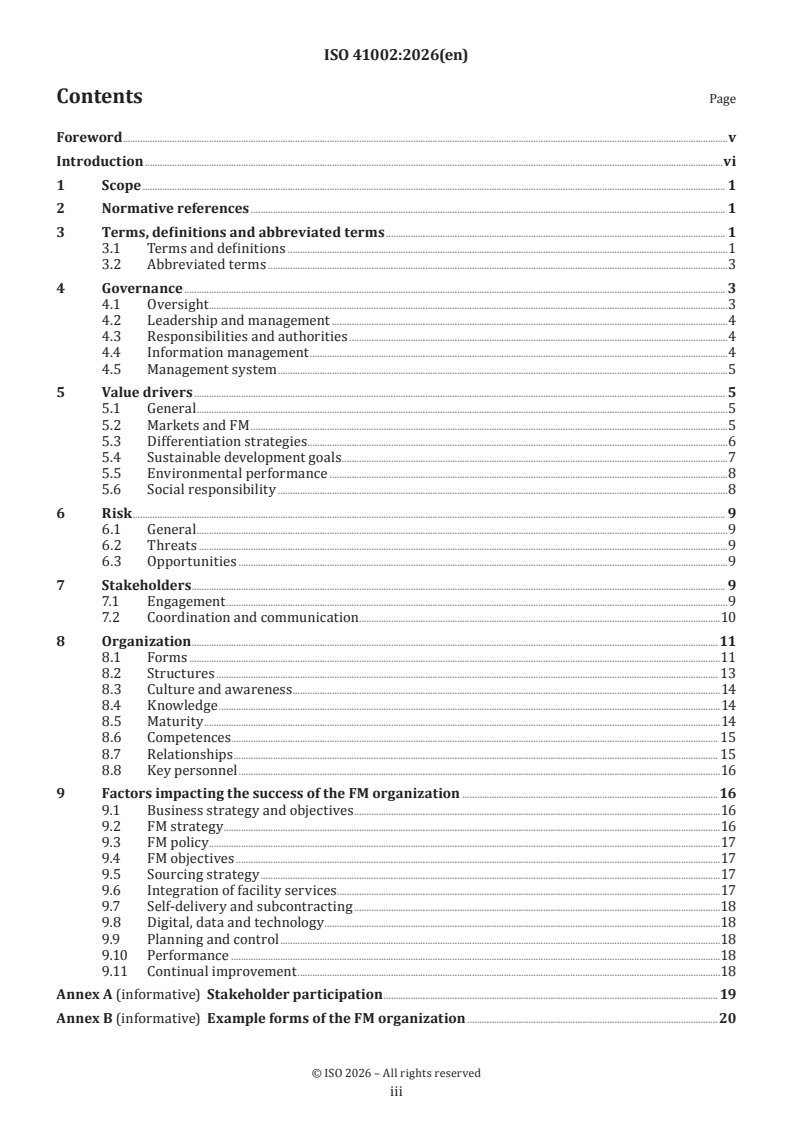

ISO 41002:2026 - Facility management — Development of the facility management organization

ISO 41002:2026 - Facility management — Élaboration d'un organisme de facility management
ISO 41002:2026 is an International Standard from ISO that gives guidance for developing a facility management (FM) organization. It explains how an FM organization working at strategic, tactical and operational levels can support the demand organization, users, stakeholders, service delivery, sustainability, risk management and performance.
What does ISO 41002:2026 specify?
ISO 41002:2026 specifies guidance for building and improving an FM organization so it can support the demand organization and users of the facility. The document is organized into clauses on governance, value drivers, risk, stakeholders, organization and the factors that affect success, followed by two informative annexes.
| Annex | What it covers |
|---|---|
| Annex A | Stakeholder participation and how to coordinate stakeholder inputs and responses |
| Annex B | Example forms of the FM organization, with case-style illustrations |
The scope focuses on FM organizations that work on strategic, tactical and operational management levels. It frames FM as a function that should help provide a safe, healthy, secure and efficient environment, protect asset and resource value, deliver responsive and cost-effective facility services, support climate and sustainability goals, and improve the usefulness of the FM system.
What are the key requirements of ISO 41002:2026?
ISO 41002:2026 is mainly a guidance document, but it sets out a practical way to develop the FM organization through governance, structure, stakeholder engagement, risk management and performance control.
Governance, leadership and control
Clause 4 says the FM organization should have clear governance, leadership and management arrangements, with visible decision-making from strategic to operational level. In practice, this means defining roles, responsibilities, authorities and communication paths so decisions can move through the organization without confusion.
Clause 4.3 highlights responsibility assignment, including the use of a RACI matrix. That matters because it helps the demand organization and FM organization see who is responsible, accountable, consulted and informed for each task.
Clause 4.4 emphasizes reliable, secure and accessible information and data. For the reader, this means the FM organization should control access, protect sensitive data and make sure information is accurate and timely enough for decisions.
Value drivers, sustainability and social responsibility
Clause 5 asks the FM organization to understand the value drivers that matter to stakeholders. The document treats value as both financial and non-financial, so the FM organization should link its work to business objectives, user experience and the performance of the facility.
The same clause covers Sustainable Development Goals (SDGs), environmental performance and social responsibility. In practice, this means the FM organization should know how its services affect energy, water, waste, health, well-being and reporting, and should be open about environmental and social claims to avoid greenwashing.
Risk and opportunity
Clause 6 distinguishes between issues, which are existing problems, and risks, which are uncertain events that could affect objectives. The FM organization should keep a risk register and identify both threats and opportunities.
This matters because FM is not only about avoiding failure. The document also expects the organization to look for opportunities such as better technology, new partnerships or improved skills that can strengthen service delivery.
Stakeholder engagement
Clause 7 makes stakeholder engagement a critical success factor. The FM organization should identify stakeholders, assess influence and interest, and decide how they should be involved.
Annex A gives a practical sequence for this work, from identifying stakeholders to establishing communications, collecting feedback, resolving conflict and maintaining transparency. For users, the key point is that stakeholder engagement is not informal - it should be planned and documented.
Organizational form, structure and competence
Clause 8 describes three basic forms of FM organization: internal, external and shared. It also discusses functional-line, divisional, matrix and adaptive structures, as well as centralized, decentralized and hybrid arrangements.
This matters because the document does not assume one model fits all. The FM organization should match its structure to the demand organization, the market, the facility and the level of competence available. Clause 8 also covers culture, knowledge, maturity, competence, relationships and key personnel, which means the organization should build capability deliberately and keep responsibilities understandable.
Strategy, sourcing, digital support and performance
Clause 9 links FM strategy, FM policy and FM objectives to the business strategy and objectives of the demand organization. It also covers sourcing strategy, integration of facility services, self-delivery and subcontracting, digital, data and technology, planning and control, performance and continual improvement.
In practice, this means the FM organization should define how services will be sourced and coordinated, agree measures such as KPIs and user experience measures before work starts, and keep improving from performance feedback. The document also expects continual improvement to be driven by performance management, not treated as a one-time programme.
What terms does ISO 41002:2026 define?
- Facility management (FM) - the organizational function that integrates people, place and process within the built environment to improve quality of life and core business productivity.
- Facility management organization (FM organization) - the entity responsible for FM on the strategic, tactical and operational levels.
- Governance - the principles, policies and framework by which an organization is directed, controlled and held to account.
- Management line-of-sight - visibility of decision-making from the strategic level through the tactical level to the operational level.
- Self-deliver - service delivery based solely on the provider’s own resources.
- Special purpose vehicle - a legal entity that separates a financial arrangement or project from its parent organization.
- Value driver - anything added, or perceived to be added, to a product or service to improve its worth to stakeholders.
- Greenwashing - false or misleading information about environmental or sustainability attributes.
Who uses ISO 41002:2026?
ISO 41002:2026 is intended for people who develop, lead, assess or buy FM arrangements. That includes FM managers, heads of facilities, top management, procurement teams, service providers, quality managers and buyers who need to shape the FM organization rather than only its day-to-day services.
It is useful across internal and external FM settings, including public and private organizations. The document is especially relevant when the reader needs to decide how FM should be structured, how responsibilities should be shared, how stakeholders should be engaged, and how performance should be measured and improved.
Which standards are used with ISO 41002:2026?
ISO 41002:2026 cites ISO 41011 as its normative reference for vocabulary. It also refers to related guidance that supports specific parts of the FM organization:
- ISO 41001 - management system requirements for FM, referenced when the document discusses management systems and support requirements.
- ISO 41012 - strategic sourcing and agreement development, referenced for sourcing options.
- ISO 41014 - development of an FM strategy, used for aligning FM strategy with demand needs.
- ISO 41018 - development of an FM policy, used when forming policy and linking it to operations.
- ISO/TR 41016 - available technologies, used for digital infrastructure and technology support.
- ISO/TR 41019 - FM’s role in sustainability, resilience and adaptability, used in sustainability and end-of-life considerations.
- ISO/TR 41030 - existing performance management in FM organizations, used for performance management context.
- ISO 14001 - environmental management systems, cited for environmental performance context.
- ISO 26000 - social responsibility, cited for social responsibility context.
- ISO 31000 - risk management guidelines, cited for risk treatment and risk process context.
- ISO 37000 - governance of organizations, cited for governance guidance.
- ISO 23592 - service excellence, cited for user experience and performance principles.
- ISO/UNDP PAS 53002 - guidelines for contributing to the SDGs, cited in the sustainability discussion.
What does the ISO 41002:2026 document contain?
The document contains clause-level guidance, definitions, abbreviated terms, and two informative annexes. Clause 4 addresses governance and information management; clause 5 covers value drivers, sustainability, environmental performance and social responsibility; clause 6 covers risk; clause 7 covers stakeholders; clause 8 covers organization form, structure, culture, knowledge, maturity, competence and relationships; and clause 9 covers strategy, sourcing, digital support, planning, performance and continual improvement.
It also includes Table A.1 on stakeholder participation, plus illustrative figures for internal, external and shared FM organizations. Annex B gives example forms of the FM organization through case-style descriptions for different settings, which helps readers translate the guidance into real organizational design and service delivery choices.
Relations
- Effective Date
- 12-Feb-2026
- Effective Date
- 01-Feb-2025
- Effective Date
- 08-Jul-2024
Buy Documents
ISO 41002:2026 - Facility management — Development of the facility management organization
ISO 41002:2026 - Facility management — Élaboration d'un organisme de facility management
Get Certified
Connect with accredited certification bodies for this standard

Great Wall Tianjin Quality Assurance Center
Established 1993, first batch to receive national accreditation with IAF recognition.

Hong Kong Quality Assurance Agency (HKQAA)
Hong Kong's leading certification body.

Innovative Quality Certifications Pvt. Ltd. (IQCPL)
Known for integrity, providing ethical & impartial Assessment & Certification. CMMI Institute Partner.
Sponsored listings
Frequently Asked Questions
ISO 41002:2026 is a standard published by the International Organization for Standardization (ISO). Its full title is "Facility management — Development of the facility management organization". This standard covers: This document gives guidance on the development of a facility management (FM) organization working on the strategic, tactical and operational management levels to: satisfy the needs and objectives of the demand organization and users of its facility; meet the needs of stakeholders and applicable FM requirements consistently; provide a safe, healthy, secure and efficient environment that enhances the workplace experience for users; protect the asset value and resource value of the facility; provide appropriately specified, responsive and cost-effective facility services; implement measures to minimize the impact of climate change on the facility; contribute to goals and targets consistent with sustainable development; improve the usefulness and benefits provided by the FM system.
This document gives guidance on the development of a facility management (FM) organization working on the strategic, tactical and operational management levels to: satisfy the needs and objectives of the demand organization and users of its facility; meet the needs of stakeholders and applicable FM requirements consistently; provide a safe, healthy, secure and efficient environment that enhances the workplace experience for users; protect the asset value and resource value of the facility; provide appropriately specified, responsive and cost-effective facility services; implement measures to minimize the impact of climate change on the facility; contribute to goals and targets consistent with sustainable development; improve the usefulness and benefits provided by the FM system.
ISO 41002:2026 is classified under the following ICS (International Classification for Standards) categories: 03.080.10 - Maintenance services. Facilities management. The ICS classification helps identify the subject area and facilitates finding related standards.
ISO 41002:2026 has the following relationships with other standards: It is inter standard links to EN ISO 41002:2026, ISO 17862:2022, ISO 13479:2022. Understanding these relationships helps ensure you are using the most current and applicable version of the standard.
ISO 41002:2026 is available in PDF format for immediate download after purchase. The document can be added to your cart and obtained through the secure checkout process. Digital delivery ensures instant access to the complete standard document.
Standards Content (Sample)
Contents
- Introduction
- 0.1 General
- 0.2 Process approach
- 1 Scope
- 2 Normative references
- 3 Terms, definitions and abbreviated terms
- 3.1 Terms and definitions
- 3.1.1 business unit
- 3.1.2 facility management
- 3.1.3 facility management organization
- 3.1.4 greenwashing
- 3.1.5 governance
- 3.1.6 management line-of-sight
- 3.1.7 self-deliver
- 3.1.8 siloed working
- 3.1.9 special purpose vehicle
- 3.1.10 value driver
- 3.2 Abbreviated terms
- 4 Governance
- 4.1 Oversight
- 4.2 Leadership and management
- 4.3 Responsibilities and authorities
- 4.4 Information management
- 4.5 Management system
- 5 Value drivers
- 5.1 General
- 5.2 Markets and FM
- 5.3 Differentiation strategies
- 5.4 Sustainable development goals
- 5.5 Environmental performance
- 5.6 Social responsibility
- 6 Risk
- 6.1 General
- 6.2 Threats
- 6.3 Opportunities
- 7 Stakeholders
- 7.1 Engagement
- 7.2 Coordination and communication
- 8 Organization
- 8.1 Forms
- 8.2 Structures
- 8.3 Culture and awareness
- 8.4 Knowledge
- 8.5 Maturity
- 8.6 Competences
- 8.7 Relationships
- 8.8 Key personnel
- 9 Factors impacting the success of the FM organization
- 9.1 Business strategy and objectives
- 9.2 FM strategy
- 9.3 FM policy
- 9.4 FM objectives
- 9.5 Sourcing strategy
- 9.6 Integration of facility services
- 9.7 Self-delivery and subcontracting
- 9.8 Digital, data and technology
- 9.9 Planning and control
- 9.10 Performance
- 9.11 Continual improvement
- Annex A
- Annex B
- Bibliography
Introduction
0.1 General
Facility management (FM) integrates multiple disciplines in order to have an influence on the efficiency and productivity of economies of societies, communities and organizations, as well as the manner in which individuals interact with the built environment. FM affects the safety, well-being and quality of life of much of the world’s societies and population through the services it manages and delivers (see ISO 41001). ISO 41001 makes reference to the demand organization and to the organization responsible for FM, including the delivery of facility services. A distinction is necessary because of the variable nature in which FM is organized and where facility services can be delivered through personnel within the demand organization, through external service providers or a combination of the two. If FM is efficient and effective, the users of a facility can expect the same quality of service regardless of whether the FM organization is internal or external to the demand organization.
This document is based upon the simple premise that a demand organization requires an arrangement internally, externally or through a combination of the two, to take responsibility for FM, including the delivery of facility services.
The benefits of having a formal FM organization include:
- a ready source of skills, knowledge and experience in FM on the strategic, tactical and operational management levels; - an efficient, responsive and cost-effective function in support of the demand organization’s business objectives, strategy and plans; - a function for managing compliance with statutory and demand organization requirements affecting the operation of the facility, including the health, safety, security and well-being of users; - a function for implementing measures to minimize the impact of climate change on the facility and for contributing to goals and targets consistent with sustainable development. NOTE The word “business” in conjunction with terms such as objectives, strategies and plans is intended in a general sense to apply to all organizations irrespective of their sector (e.g. private, not-for-profit and public). The guidance in this document applies to both an internal and external FM organization.
0.2 Process approach
This document underscores a leadership- and management-based approach to FM, including the delivery of facility services of whatever kind. It is explicit in the definition of an FM organization that it is able to function on all three management levels: strategic, tactical and operational. The ability of the FM organization to provide an efficient, responsive and effective function in support of the demand organization’s business objectives, strategy and plans necessitates processes that ensure continuity of purpose through all three management levels.
The document emphasizes the mutual interdependence between the demand organization and its FM organization. The former’s success depends on the latter and the reverse. For this relationship to succeed and thrive well into the future, top management in the demand organization is tasked with the purposeful application of the guidance in this document. Where the FM organization is external, this task is for the service provider’s top management.
The context for an external service provider acting as the FM organization is different to that of an internal (or in-house) service provider. An external service provider acting as the FM organization, and operating on all three management levels, is likely to be serving the needs of multiple demand organizations simultaneously; whereas the internal service provider has one demand organization to satisfy. In many countries, the market for FM comprises few large service providers but many more smaller service providers. Not all of the latter are expected to operate fully on all three management levels, although they can aspire to do so.
ISO 41002:2026(en) This document provides guidance with recommendations on how internal and external FM organizations can develop and enhance their capabilities on all three management levels. It identifies the decisions, functions, processes, information, data and stakeholders that enable the demand organization to form the essential foundation for the FM organization, whether it is internal or external. The subject matter includes governance, value drivers, risk, stakeholder engagement, organizational structure and factors impacting the success of the FM organization.
International Standard ISO 41002:2026(en) Facility management — Development of the facility management organization
1 Scope
This document gives guidance on the development of a facility management (FM) organization working on the strategic, tactical and operational management levels to:
a) satisfy the needs and objectives of the demand organization and users of its facility; b) meet the needs of stakeholders and applicable FM requirements consistently; c) provide a safe, healthy, secure and efficient environment that enhances the workplace experience for users; d) protect the asset value and resource value of the facility; e) provide appropriately specified, responsive and cost-effective facility services; f) implement measures to minimize the impact of climate change on the facility; g) contribute to goals and targets consistent with sustainable development; h) improve the usefulness and benefits provided by the FM system.
2 Normative references
The following documents are referred to in the text in such a way that some or all of their content constitutes requirements of this document. For dated references, only the edition cited applies. For undated references, the latest edition of the referenced document (including any amendments) applies. ISO 41011, Facility management — Vocabulary
3 Terms, definitions and abbreviated terms
3.1 Terms and definitions
For the purposes of this document, the terms and definitions given in ISO 41011 and the following apply. ISO and IEC maintain terminology databases for use in standardization at the following addresses:
- ISO Online browsing platform: available at https:// www .iso .org/ obp
- IEC Electropedia: available at https:// www .electropedia .org/
3.1.1 business unit
discrete and accountable function or sub-function within an organization [SOURCE: ISO/TS 21089:2018, 3.28, modified — Note 1 to entry deleted.]
ISO 41002:2026(en)
3.1.2 facility management
FM organizational function which integrates people, place and process within the built environment with the purpose of improving the quality of life of people and the productivity of the core business [SOURCE: ISO 41011:2024, 3.1.1, modified — Note 1 to entry deleted.]
3.1.3 facility management organization
FM organization entity responsible for facility management on the strategic, tactical and operational levels [SOURCE: ISO 41011:2024, 3.1.4, modified — “entity” replaced “organization” and “on the strategic, tactical and operational levels” added.]
3.1.4 greenwashing
false or misleading information, either intentionally or inadvertently, regarding the environmental or sustainability attributes of a product, asset and activity, which can have consequences on the assessment of financial and non-financial materiality [SOURCE: ISO 14100:2022, 3.1.15]
3.1.5 governance
principles, policies and framework by which an organization is directed, controlled and held to account [SOURCE: ISO 21505:2017, 3.1, modified — “and held to account” added.]
3.1.6 management line-of-sight
visibility of decision-making from the strategic to the tactical and operational levels in an organization
3.1.7 self-deliver
service delivery based solely upon the provider’s own resources [SOURCE: ISO 41014:2020, 3.4.3]
3.1.8 siloed working
organizational condition where groups, divisions or departments within the same organization are disinclined to share knowledge, information and data
3.1.9 special purpose vehicle
legal entity that separates a financial arrangement or project from its parent organization
3.1.10 value driver
anything that is added, or perceived to be added, to a product or service to improve its worth to stakeholders [SOURCE: ISO 41014:2020, 3.6.2]
ISO 41002:2026(en)
3.2 Abbreviated terms
ESG environmental, social and governance GHG greenhouse gas HVAC heating, ventilation and air conditioning RACI responsible, accountable, consulted and informed SDG sustainable development goal
4 Governance
4.1 Oversight
Governance creates and maintains an organization with a clear purpose that delivers long-term value consistent with the expectations of its stakeholders. This means that decision-making within an organization is based on its ethos, culture, norms, practices, behaviours, structures and processes. These elements form the bedrock of governance, empowering an organization to thrive with purpose and resilience. The purpose of governance lies in cultivating environments where trust is nurtured, aspirations are realized and collective well-being is prioritized. Resilience is about an organization’s adaptive capacity in a complex and changing environment.
NOTE Guidance on the governance of organizations is provided in ISO 37000. Governance provides a structured framework to which the organization should adhere for its effective management and achievement of its long-term goals. Top management should apply governance to all areas of administration to establish clarity and control over processes to maintain successful, sustainable business operations. This is assisted by having a management line-of-sight from the highest (i.e. strategic) level through to the lowest (i.e. operational) level in the organization. From the perspective of the supply chain, implementation of governance helps an organization manage risks arising within the supply chain, ensuring compliance, promoting ethical business relationships, preserving transparency in operations, achieving cost control, maintaining a high-level of quality, promoting sustainability, steering continual improvement and facilitating change. The FM organization should take actionable steps to foster an integrated approach to governance, bringing together top–down and bottom–up perspectives by:
- establishing robust communication channels to facilitate dialogue and feedback between leadership and stakeholders;
- prioritizing capability-building initiatives to ensure alignment with overarching business objectives and local needs;
- incentivizing collaboration and cross-functional teamwork, breaking down siloed working and fostering collective ownership;
- implementing regular monitoring and evaluation mechanisms to track progress and adapt strategies accordingly;
- cultivating a culture of inclusivity and empowerment, where diverse voices are valued and integrated into decision-making;
- highlighting the necessity of awareness on the breadth of statutory compliance and how it can be managed.
Additional proactive measures, such as periodic audits, continuing personal development and professional development, are fundamental to maintain compliance and should be mandated by the FM organization.
ISO 41002:2026(en) Fostering a culture of accountability and responsibility, empowers teams and individuals and enables them to navigate challenges, including regulations, with confidence. The FM organization should develop a coherent policy on its governance and make it available to all reasonable inquirers (see also ISO 41018).
4.2 Leadership and management
There is a close relationship between leadership, management and stakeholder engagement. While each is essential to achieve an organization’s objectives, distinctions should be drawn. Leadership embodies vision, inspiration and the ability to navigate complexity while creating alignment among diverse stakeholders. Management focuses on strategic planning, resource allocation and operational oversight, dealing directly with the needs of stakeholders. Distinguishing between leadership and management is necessary so that governance structures are transparent and correctly maintained (see 4.3). While management deals with tasks, processes and systems, and leadership is about influencing, inspiring and empowering individuals to achieve common goals, there remains the practical matter of efficient distribution of tasks. Effective delegation is key in both leadership and management for enabling efficient distribution of tasks. The FM organization should take into account individuals’ needs in relation to skills’ development and autonomy when determining the allocation of tasks. Clarity in leadership, management and delegation is vital for effective governance. Fostering a culture of transparency and open dialogue enhances organizational coherence and effectiveness. The FM organization should establish clear communication channels, delineate roles and responsibilities, and set realistic expectations. Feedback mechanisms and performance evaluations are then necessary to monitor progress and identify areas for improvement.
4.3 Responsibilities and authorities
The FM organization should be clearly structured and defined to fit the purpose of its existence in meeting the demand organization’s business objectives, strategy and operational plans. Depending on its size and diversification, the FM organization’s structure should consist of business units that are interdependent but without overlapping functions that can reduce their ability to perform. To achieve this state, the roles, responsibilities and purpose of the business units within the FM organization should be defined. These definitions can be expected to provide clarity for authorizing and implementing appropriate processes for each business unit.
To ensure smooth operations, the roles and responsibilities of various levels of leadership and individuals in the FM organization should be clearly defined. This will provide leadership with an understanding of how to manage the expectations of the various parties. Additionally, clear and well-defined roles and responsibilities are likely to help in the treatment of risks related to day-to-day operations and productivity. The FM organization’s business units, where they are defined, should be provided with the appropriate level of authority by top management. Levels of authority enable leadership at various levels within the FM organization to approve work within predefined limits that they have authorized thus making the process of decision-making in the delivery of services as efficient as possible. The FM organization should establish and maintain appropriate assignment of responsibilities. The usual form is a matrix or chart denoted RACI to demonstrate who is responsible for what and how the other roles relate to them. Clarity in the nature of a role and the assignment of tasks to it ensures open and transparent management decision-making.
4.4 Information management
The FM organization should take steps to ensure that information and data are reliable, secure and accessible to authorized personnel. Information security and data protection are of critical importance. Failure to maintain adequate controls can lead to a data breach with implications for the owners of the affected data and reputational damage for both the demand organization and the FM organization. Safeguarding sensitive data is a fundamental requirement as well as a matter of compliance with the legislation and data protection standards.
ISO 41002:2026(en) The FM organization should acknowledge the indispensable role of accurate, reliable and timely information in driving informed decision-making processes. Necessary information provides the foundation upon which strategic choices are made, while sufficiency ensures that decision-makers have access to all pertinent data required for effective analysis.
In this view, it is crucial to differentiate between completeness, accuracy and timeliness in respect of information in the context of management decision-making. While completeness ensures that all relevant data are included, accuracy guarantees its reliability and timeliness ensures its relevance to the decisionmaking timeline. To ensure that information and data remain reliable, secure and accessible to authorized personnel, the FM organization should implement a multifaceted approach. This includes deploying encryption and access control mechanisms, conducting regular audits to identify vulnerabilities and providing ongoing training to personnel on data security practices. Fundamental to this process is determining levels of authorized access for all personnel.
Furthermore, establishing clear policies and procedures for data handling and enforcing strict compliance measures are paramount. By fostering a culture of data awareness and accountability throughout the FM organization, information security can be upheld as a top priority, safeguarding against potential threats and ensuring the integrity of decision-making processes.
4.5 Management system
The FM organization should be aware of any implementation of a management system and its requirements. NOTE ISO 41001 sets out the requirements for a management system.
5 Value drivers
5.1 General
Value drivers are the benefits (financial and non-financial) that an organization’s stakeholders expect to realize from the performance of its core business activities or which are delivered by it to achieve its core business objectives. The principle applies equally to the demand organization and the FM organization irrespective of whether the latter is internal or external. In all cases, account should be taken of identified and perceived benefits, the stakeholders affected by them, and how these can be enhanced or diminished by FM, including facility services.
5.2 Markets and FM
The demand organization should recognize the differences between the work environment for an internal FM organization and an external service provider offering FM on all three management levels. The internal FM organization is dedicated to the demand organization, unless there is a sharing of resources with a body affiliated to the demand organization, and so there is likely to be a fairly stable work environment. In contrast, an external FM organization is operating in an unpredictable environment in which industry maturity, competitive dynamics, availability of skilled providers, regulatory environment and cultural attitudes towards utilizing externally provided services in the specific market, country or demand organization shape its business outlook and behaviour. These factors can also be of consequence to the internal FM organization where it is sourcing facility services externally. In countries with a mature FM industry, there is usually availability of highly skilled and specialist service providers and labour. Competition and choice can drive service performance and cost-effectiveness and, in general, there are robust processes, technology and focus on compliance, sustainability, environmental performance and social responsibility. Where the FM industry is less developed, the demand organization can find it difficult to recruit personnel and attract service providers to meet their requirements in full and standards for delivery performance, quality and reliability. Lack of market maturity can drive the development of internal FM organizations, with in-house service delivery, to secure control over operations.
...
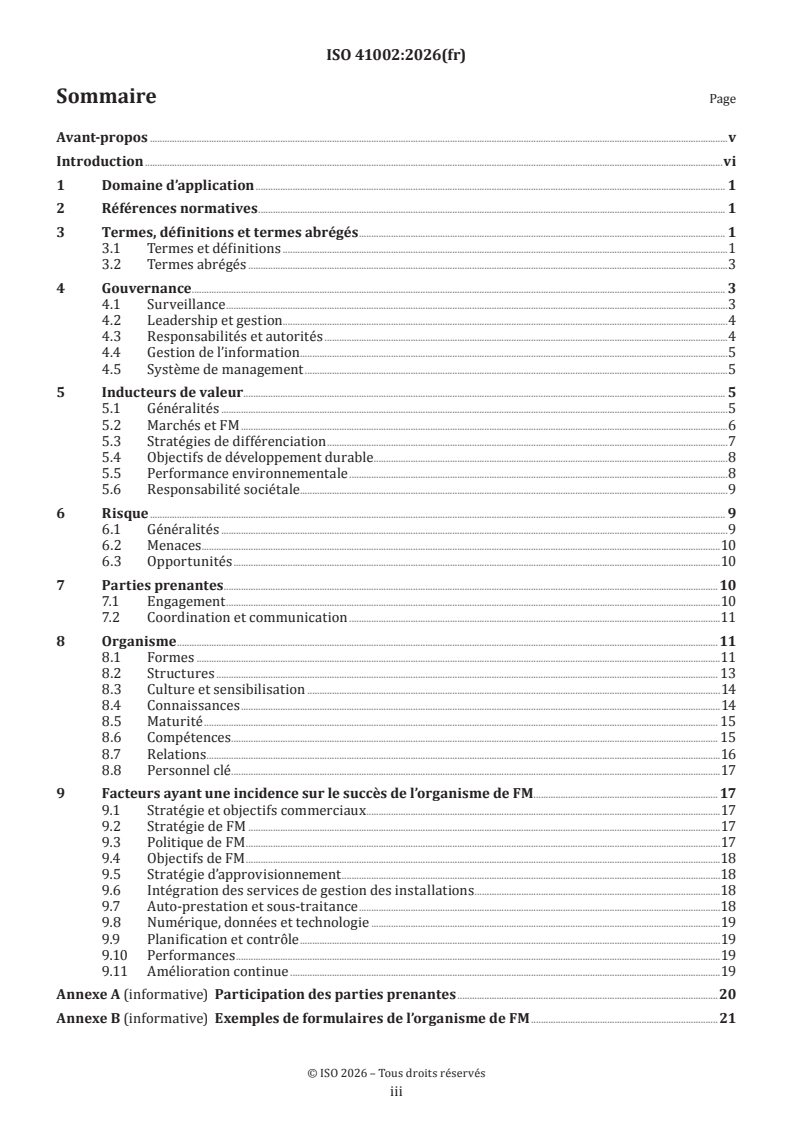
Contents
- Introduction
- 0.1 Généralités
- 0.2 Approche processus
- 1 Domaine d’application
- 2 Références normatives
- 3 Termes, définitions et termes abrégés
- 3.1 Termes et définitions
- 3.1.1 unité opérationnelle
- 3.1.2 facility management
- 3.1.3 organisme de facility management
- 3.1.4 écoblanchiment
- 3.1.5 gouvernance
- 3.1.6 ligne de visée de gestion
- 3.1.7 auto-prestation
- 3.1.8 travail cloisonné
- 3.1.9 entité ad hoc
- 3.1.10 inducteur de valeur
- 3.2 Termes abrégés
- 4 Gouvernance
- 4.1 Surveillance
- 4.2 Leadership et gestion
- 4.3 Responsabilités et autorités
- 4.4 Gestion de l’information
- 4.5 Système de management
- 5 Inducteurs de valeur
- 5.1 Généralités
- 5.2 Marchés et FM
- 5.3 Stratégies de différenciation
- 5.4 Objectifs de développement durable
- 5.5 Performance environnementale
- 5.6 Responsabilité sociétale
- 6 Risque
- 6.1 Généralités
- 6.2 Menaces
- 6.3 Opportunités
- 7 Parties prenantes
- 7.1 Engagement
- 7.2 Coordination et communication
- 8 Organisme
- 8.1 Formes
- 8.2 Structures
- 8.3 Culture et sensibilisation
- 8.4 Connaissances
- 8.5 Maturité
- 8.6 Compétences
- 8.7 Relations
- 8.8 Personnel clé
- 9 Facteurs ayant une incidence sur le succès de l’organisme de FM
- 9.1 Stratégie et objectifs commerciaux
- 9.2 Stratégie de FM
- 9.3 Politique de FM
- 9.4 Objectifs de FM
- 9.5 Stratégie d’approvisionnement
- 9.6 Intégration des services de gestion des installations
- 9.7 Auto-prestation et sous-traitance
- 9.8 Numérique, données et technologie
- 9.9 Planification et contrôle
- 9.10 Performances
- 9.11 Amélioration continue
- Annexe A
- Annexe B
- Bibliographie
Introduction
0.1 Généralités
Le facility management (FM) intègre de multiples disciplines afin d’avoir une influence sur l’efficience et la productivité de l’économie des sociétés, des collectivités et des organismes ainsi que sur la manière dont les individus interagissent avec l’environnement construit. Le FM a une incidence sur la santé, le bien-être et la qualité de vie d’une grande partie des sociétés et de la population mondiale par le biais des services qu’il gère et fournit (voir ISO 41001).
L’ISO 41001 fait référence à l’organisme demandeur et à l’organisme responsable du FM, y compris la fourniture des services de gestion des installations. Une distinction est nécessaire en raison de la nature variable de l’organisation du FM et du fait que les services de gestion des installations peuvent être fournis par le personnel au sein de l’organisme demandeur, par des fournisseurs de services externes ou une combinaison des deux. Si le FM est efficient et efficace, les utilisateurs d’une installation peuvent s’attendre à la même qualité de service, que l’organisme de FM soit interne ou externe à l’organisme demandeur. Le présent document est basé sur le postulat simple qu’un organisme demandeur a besoin d’un arrangement en interne, en externe ou par le biais d’une combinaison des deux, pour assumer la responsabilité du FM, y compris la fourniture des services de gestion des installations. Le fait de disposer d’un organisme de FM officiel confère les avantages suivants:
- une source immédiate de compétences, de connaissances et d’expérience en FM aux niveaux de gestion stratégique, tactique et opérationnel;
- une fonction efficace, réactive et rentable à l’appui des objectifs, de la stratégie et des plans commerciaux de l’organisme demandeur;
- une fonction de gestion de la conformité aux exigences légales et aux exigences de l’organisme demandeur affectant le fonctionnement de l’installation, y compris la santé, la sûreté, la sécurité et le bien-être des utilisateurs;
- une fonction de mise en œuvre de mesures visant à réduire le plus possible l’impact du changement climatique sur l’installation et à contribuer à la réalisation des objectifs et cibles compatibles avec le développement durable.
REMARQUE Le mot “entreprise” associé à des termes tels que objectifs, stratégies et plans est destiné à s’appliquer de manière générale à toutes les organisations, quel que soit leur secteur (par exemple, privé, à but non lucratif et public).
Les recommandations du présent document s’appliquent à un organisme de FM interne et externe.
0.2 Approche processus
Le présent document met l’accent sur une approche de FM axée sur le leadership et le management, y compris la prestation de services d’entretien des installations de toute nature. Il est explicite dans la définition d’un organisme de FM qu’il est en mesure de fonctionner aux trois niveaux de gestion: stratégique, tactique et opérationnel. La capacité de l’organisme de FM à fournir une fonction efficiente, réactive et efficace à l’appui des objectifs, de la stratégie et des plans commerciaux de l’organisme demandeur nécessite des processus qui assurent la continuité de la finalité à travers les trois niveaux de gestion. Le document souligne l’interdépendance mutuelle entre l’organisme demandeur et son organisme de FM. Le succès du premier dépend du second et de l’inverse. Pour que cette relation réussisse et prospère à long terme, la haute direction de l’organisme demandeur est chargée d’appliquer judicieusement les directives contenues dans le présent document. Lorsque l’organisme de FM est externe, cette tâche incombe à la direction du prestataire de services.
Le contexte d’un fournisseur de services externe agissant en tant qu’organisme de FM est différent de celui d’un fournisseur de services interne (ou intra-entreprise). Un fournisseur de services externe agissant en tant qu’organisme de FM et opérant aux trois niveaux de gestion est susceptible de répondre simultanément aux
ISO 41002:2026(fr) besoins de plusieurs organismes demandeurs, alors que le fournisseur de services interne a un organisme demandeur à satisfaire. Dans de nombreux pays, le marché du FM comprend peu de grands fournisseurs de services, mais beaucoup plus de petits fournisseurs de services. Ces derniers ne sont pas tous censés fonctionner pleinement aux trois niveaux de gestion, bien qu’ils puissent y aspirer. Le présent document fournit des lignes directrices sur la manière dont les organismes de FM internes et externes peuvent développer et améliorer leurs capacités aux trois niveaux de gestion. Il identifie les décisions, les fonctions, les processus, les informations, les données et les parties prenantes qui permettent à l’organisme demandeur de constituer la base essentielle pour l’organisme de FM, qu’il soit interne ou externe. Le sujet inclut la gouvernance, les facteurs de valeur, le risque, l’engagement des parties prenantes, la structure organisationnelle et les facteurs ayant un impact sur la réussite de l’organisme de FM.
Norme internationale ISO 41002:2026(fr) Facility management — Élaboration d'un organisme de facility management
1 Domaine d’application
Le présent document fournit des recommandations relatives au développement d’un organisme de facility management (FM) travaillant aux niveaux de gestion stratégique, tactique et opérationnel pour:
a) satisfaire les besoins et les objectifs de l’organisme demandeur et des utilisateurs de ses installations; b) répondre aux besoins des parties prenantes et aux exigences applicables relatives au FM de manière cohérente; c) fournir un environnement sûr, sain, sécurisé et efficace qui améliore l’expérience sur le lieu de travail pour les utilisateurs; d) protéger la valeur des actifs et la valeur des ressources de l’installation; e) fournir des services de gestion des installations convenablement spécifiés, réactifs et rentables; f) mettre en œuvre des mesures pour réduire le plus possible l’impact du changement climatique sur l’installation; g) contribuer aux objectifs et cibles cohérents avec le développement durable; h) améliorer l’utilité et les avantages fournis par le système de FM.
2 Références normatives
Les documents suivants sont cités dans le texte de sorte qu’ils constituent, pour tout ou partie de leur contenu, des exigences du présent document. Pour les références datées, seule l’édition citée s’applique. Pour les références non datées, la dernière édition du document de référence s’applique (y compris les éventuels amendements).
ISO 41011, Facility management — Vocabulaire
3 Termes, définitions et termes abrégés
3.1 Termes et définitions
Pour les besoins du présent document, les termes et les définitions de l’ISO 41011 ainsi que les suivants s’appliquent.
L’ISO et l’IEC tiennent à jour des bases de données terminologiques destinées à être utilisées en normalisation, consultables aux adresses suivantes:
- ISO Online browsing platform: disponible à l’adresse https:// www .iso .org/ obp
- IEC Electropedia: disponible à l’adresse https:// www .electropedia .org/
ISO 41002:2026(fr)
3.1.1 unité opérationnelle
fonction ou sous-fonction discrète et responsable au sein d’un organisme [SOURCE: ISO/TS 21089:2018, 3.28, modifié — La Note 1 à l’article a été supprimée.]
3.1.2 facility management
FM fonction de l’organisme qui intègre des personnels, des lieux et des processus au sein de l’environnement construit, ayant pour but d’améliorer la qualité de vie du personnel et la productivité du cœur de métier [SOURCE: ISO 41011:2024, 3.1.1, modifié — La Note 1 à l’article a été supprimée.]
3.1.3 organisme de facility management
Organisme de FM entité responsable du facility management aux niveaux stratégique, tactique et opérationnel [SOURCE: ISO 41011:2024, 3.1.4, modifié — remplacement de “organisme” par “entité” et ajout de “aux niveaux stratégique, tactique et opérationnel”.]
3.1.4 écoblanchiment
informations fausses ou trompeuses, intentionnellement ou par inadvertance, concernant les caractéristiques environnementales ou de durabilité d’un produit, d’un actif et d’une activité, qui peuvent avoir des conséquences sur l’évaluation de l’importance relative financière et non financière [SOURCE: ISO 14100:2022, 3.1.15]
3.1.5 gouvernance
principes, politiques et cadre permettant à un organisme d’être dirigé, contrôlé et tenu de rendre des comptes [SOURCE: ISO 21505:2017, 3.1, modifié — ajout de “et tenu de rendre des comptes”.]
3.1.6 ligne de visée de gestion
visibilité de la prise de décision du niveau stratégique au niveau tactique et opérationnel au sein d’un organisme
3.1.7 auto-prestation
fourniture de services reposant uniquement sur les ressources propres du fournisseur [SOURCE: ISO 41014:2020, 3.4.3]
3.1.8 travail cloisonné
situation organisationnelle dans laquelle des groupes, des divisions ou des départements au sein d’une même organisation sont réticents à partager des connaissances, des informations et des données
3.1.9 entité ad hoc
entité juridique qui sépare un montage financier ou un projet de son organisation mère
ISO 41002:2026(fr)
3.1.10 inducteur de valeur
tout ce qui est ajouté, ou perçu comme étant ajouté, à un produit ou service pour en améliorer la valeur aux yeux des parties prenantes [SOURCE: ISO 41014:2020, 3.6.2]
3.2 Termes abrégés
ESG environnement, social et gouvernance GES Gaz à effet de serre CVC Chauffage, ventilation et climatisation RACI Réalisateur, Approbateur, Consulté et Informé ODD Objectifs de développement durable
4 Gouvernance
4.1 Surveillance
Une gouvernance permet d’instaurer et de faire perdurer un organisme avec une finalité claire qui crée une valeur à long terme en cohérence avec les attentes de ses parties prenantes. Cela signifie que la prise de décision au sein de l’organisme est basée sur son éthique, sa culture, ses règles, ses pratiques, les comportements, ses structures organisationnelles et ses processus. Ces éléments constituent le socle de la gouvernance, permettant à un organisme de prospérer avec détermination et résilience. Le but de la gouvernance est de cultiver des environnements où la confiance est entretenue, les aspirations sont réalisées et le bien-être collectif est prioritaire. La résilience concernant la capacité d’adaptation d’un organisme dans un environnement complexe et changeant.
NOTE Des recommandations relatives à la gouvernance des organismes sont fournies dans l’ISO 37000. La gouvernance fournit un cadre structuré auquel il convient que l’organisme adhère pour sa gestion efficace et la réalisation de ses objectifs à long terme. Il convient que la direction applique la gouvernance à tous les domaines de l’administration afin d’établir la clarté et le contrôle des processus pour maintenir des opérations commerciales fructueuses et durables. Cela est facilité par l’existence d’une ligne de visée de gestion du niveau le plus élevé (c’est-à-dire stratégique) au niveau le plus bas (c’est-à-dire opérationnel) de l’organisme.
Du point de vue de la chaîne d’approvisionnement, la mise en œuvre de la gouvernance aide un organisme à gérer les risques survenant au sein de la chaîne d’approvisionnement, en assurant la conformité, en promouvant des relations commerciales éthiques, en préservant la transparence des opérations, en assurant la maîtrise des coûts, en maintenant un haut niveau de qualité, en promouvant la durabilité, en pilotant l’amélioration continue et en facilitant le changement.
Il convient que l’organisme de FM prenne des mesures exploitables pour favoriser une approche intégrée de la gouvernance, en réunissant des perspectives descendantes et ascendantes en:
- établissant des canaux de communication solides pour faciliter le dialogue et le retour d’information entre le leadership et les parties prenantes;
- mettant la priorité sur les initiatives de renforcement des capacités afin d’assurer l’alignement avec les objectifs opérationnels généraux et les besoins locaux;
- encourageant la collaboration et le travail d’équipe interfonctionnel, briser le travail cloisonné et favoriser l’appropriation collective;
ISO 41002:2026(fr) - mettant en œuvre des mécanismes de suivi et d’évaluation réguliers pour suivre les progrès et adapter les stratégies en conséquence; - cultivant une culture d’inclusivité et d’autonomisation, où les voix diverses sont valorisées et intégrées dans la prise de décision; - soulignant la nécessité de prendre conscience de l’étendue de la conformité réglementaire et de la manière dont elle pourrait être gérée.
Des mesures proactives supplémentaires, telles que des audits périodiques, le développement personnel continu et le développement professionnel, sont fondamentales pour maintenir la conformité et il convient qu’elles soient mandatées par l’organisme de FM. Favoriser une culture de responsabilisation, rendre les équipes et les individus autonomes et leur permettre de relever les défis, y compris les réglementations, en toute confiance.
Il convient que l’organisme de FM élabore une politique cohérente sur sa gouvernance et la mette à la disposition de tous les demandeurs raisonnables (voir également l’ISO 41018).
4.2 Leadership et gestion
Il existe une relation étroite entre le leadership, la gestion et l’engagement des parties prenantes. Bien que chacun d’eux soit essentiel pour atteindre les objectifs d’une organisation, il convient que des distinctions soient établies. Le leadership incarne la vision, l’inspiration et la capacité à gérer la complexité tout en créant un alignement entre les diverses parties prenantes. La gestion se concentre sur la planification stratégique, l’affectation des ressources et la supervision opérationnelle, en traitant directement les besoins des parties prenantes. La distinction entre leadership et gestion est nécessaire pour que les structures de gouvernance soient transparentes et correctement maintenues (voir 4.3).
Alors que la gestion s’occupe des tâches, des processus et des systèmes et que le leadership consiste à influencer, inspirer et responsabiliser les individus pour atteindre des objectifs communs, il reste la question pratique d’une répartition efficace des tâches. Une délégation efficace est essentielle à la fois au leadership et à la gestion pour permettre une répartition efficace des tâches. Il convient que l’organisme de FM tienne compte des besoins des individus en matière de développement des compétences et d’autonomie lors de la détermination de l’attribution des tâches.
La clarté du leadership, de la gestion et de la délégation est vitale pour une gouvernance efficace. La promotion d’une culture de transparence et de dialogue ouvert améliore la cohérence et l’efficacité de l’organisation. Il convient que l’organisme de FM établisse des canaux de communication clairs, délimite les rôles et responsabilités et définisse des attentes réalistes. Des mécanismes de rétroaction et d’évaluation des performances sont alors nécessaires pour suivre les progrès et identifier les domaines à améliorer.
4.3 Responsabilités et autorités
Il convient que l’organisme de FM soit clairement structuré et défini de manière à correspondre à l’objectif de son existence dans la satisfaction des objectifs commerciaux, de la stratégie et des plans opérationnels de l’organisme demandeur. En fonction de sa taille et de sa diversification, il convient que la structure de l’organisme de FM se compose d’unités opérationnelles interdépendantes, mais sans chevauchement de fonctions susceptibles de réduire leur capacité à exercer. Pour atteindre cet état, il convient de définir les rôles, responsabilités et objectifs des unités opérationnelles au sein de l’organisme de FM. On peut s’attendre à ce que ces définitions fournissent des informations claires sur l’autorisation et la mise en œuvre des processus appropriés pour chaque unité opérationnelle.
Pour assurer le bon fonctionnement, il convient de définir clairement les rôles et responsabilités des différents niveaux de leadership et des personnes au sein de l’organisme de FM. Cela permettra au leadership de comprendre comment gérer les attentes des différentes parties. En outre, des rôles et des responsabilités clairs et bien définis sont susceptibles d’aider au traitement des risques liés aux opérations quotidiennes et à la productivité.
Il convient que la direction fournisse aux unités opérationnelles de l’organisme de FM, lorsqu’elles sont définies, le niveau d’autorité approprié. Les niveaux d’autorité permettent à la direction à différents niveaux
ISO 41002:2026(fr) au sein de l’organisme de FM d’approuver le travail dans les limites prédéfinies qu’elle a autorisées, rendant ainsi le processus de prise de décision dans la fourniture des services aussi efficace que possible. Il convient que l’organisme de FM établisse et tienne à jour une attribution appropriée des responsabilités. La forme habituelle est une matrice ou un graphique désigné RACI pour démontrer qui est responsable de quoi et comment les autres rôles s’y rapportent. La clarté de la nature d’un rôle et de l’attribution des tâches à celui-ci garantit une prise de décision ouverte et transparente.
4.4 Gestion de l’information
Il convient que l’organisme de FM prenne des mesures pour s’assurer que les informations et données sont fiables, sécurisées et accessibles au personnel autorisé. La sécurité de l’information et la protection des données sont d’une importance critique. L’incapacité à maintenir des contrôles adéquats pourrait entraîner une fuite de données avec des implications pour les propriétaires des données affectées et une atteinte à la réputation à la fois pour l’organisme demandeur et l’organisme de FM. La protection des données sensibles est une exigence fondamentale ainsi qu’une question de respect de la législation et des normes de protection des données.
Il convient que l’organisme de FM reconnaisse le rôle indispensable d’informations exactes, fiables et opportunes dans la conduite de processus de prise de décision éclairés. Les informations nécessaires fournissent les bases sur lesquelles les choix stratégiques sont faits, tandis que le caractère suffisant garantit que les décideurs ont accès à toutes les données pertinentes exigées pour une analyse efficace. À cet égard, il est essentiel de faire la distinction entre l’exhaustivité, l’exactitude et l’actualité de l’information dans le contexte de la prise de décisions de gestion. Si l’exhaustivité garantit que toutes les données pertinentes sont incluses, l’exactitude garantit leur fiabilité et l’actualité garantit leur pertinence par rapport au calendrier de prise de décision.
Pour s’assurer que les informations et les données restent fiables, sécurisées et accessibles au personnel autorisé, il convient que l’organisme de FM mette en œuvre une approche multidimensionnelle. Cela comprend le déploiement de mécanismes de chiffrement et de contrôle d’accès, la réalisation d’audits réguliers pour identifier les vulnérabilités et la formation continue du personnel sur les pratiques de sécurité des données. La détermination des niveaux d’accès autorisés pour l’ensemble du personnel est fondamentale pour ce processus.
En outre, l’établissement de politiques et de procédures claires pour le traitement des données et l’application de mesures strictes de conformité sont primordiales. En encourageant une culture de sensibilisation aux données et de responsabilité dans l’ensemble de l’organisme de FM, la sécurité de l’information peut être maintenue comme une priorité absolue, en protégeant contre les menaces et en assurant l’intégrité des processus de prise de décision.
4.5 Système de management
Il convient que l’organisme de FM soit informé de toute mise en œuvre d’un système de management et de ses exigences.
...